Stanza · Audio guide
Iximche Audio Guide
A place to remember. A story to take with you.
Iximche is a Pre-Columbian Mesoamerican archaeological site located in the western highlands of Guatemala. It served as the capital of the Late Postclassic Kaqchikel Maya kingdom from 1470 until 1524.
Download Stanza, then search for “Iximche”.
About the tour
One guide. Your kind of visit.
Iximche is a Pre-Columbian Mesoamerican archaeological site located in the western highlands of Guatemala. It served as the capital of the Late Postclassic Kaqchikel Maya kingdom from 1470 until 1524.
Ready when you are.
- 01Get the free Stanza app.
iOS & Android
- 02Find your guide.
“Iximche”
- 03Download before you go.
Works offline
Audio guide / 13 narrated stops
Inside the guide
Get to know a few of the stories before you go. Open a stop to read more.
01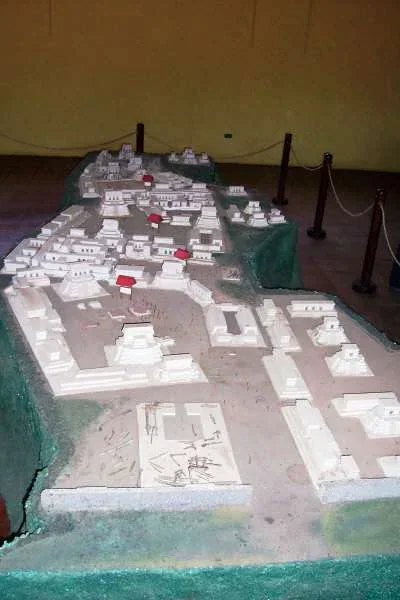 On-Site Museum and City Model
Scale Model of the Site Core
Welcome to Iximche, the old capital of the Kaqchikel Maya in the Guatemalan highlands. The model shows the whole site at once: more than a hundred and sixty mapped structures, with temples, palaces and two ballcourts. Its six plazas, lettered A to F, two large and four small, each held at least two temples. The city was founded around 1470, after the Kaqchikel broke with their K'iche' overlords. It grew with astonishing speed. Within fifty years of its foundation it had reached its maximum extent. Two lords planned the new capital, Wuqu-Batz' and Hun-Toh, and each had his own palace, court and temples in the city. The name itself is a small riddle. Ixim means maize and che means tree, so Iximche is the maize tree, the Kaqchikel reading of the ramon tree. Nineteenth-century investigators knew the ruins by another name as well, Patinamit, a Kaqchikel word meaning simply the city.
No machine-readable author provided. Authenticmaya~commonswiki assumed (based on copyright claims). · CC BY-SA 2.5
02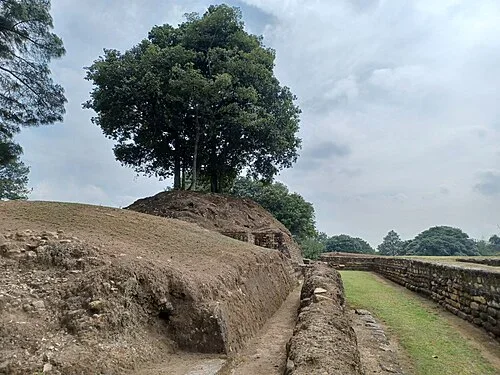 The Defensive Ditch
Crossing the Defensive Ditch
Every approach to Iximche ran into the same obstacle: the ridge itself. The city stands at 2,260 metres on a promontory called Ratzamut, flanked by deep ravines. Two rivers, the El Molino and the Los Chocoyos, cut through those ravines and join together beyond the ruins. Volcanic pumice and ash beneath the ridge have eroded into precipitous natural cliffs, so nature supplied most of the defences. The Kaqchikel supplied the rest. They cut a ditch across the ridge, about eight metres deep, separating the ceremonial core from the residential quarter where most people lived. A capital founded under threat needed a fortress, and its K'iche' and Tz'utujil neighbours were hostile. Ratzamut is itself a spur of Tecpán hill, a mountain of more than three thousand metres to the northwest.
Photo: Simon Burchell · CC BY-SA 4.0
03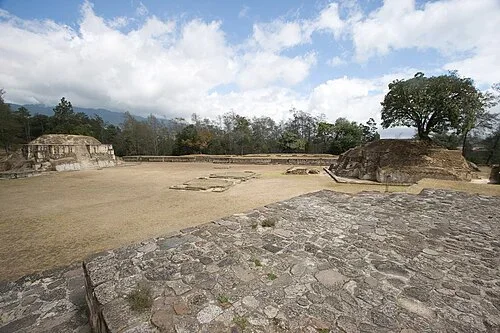 Plaza A and Temple 2
Plaza A, the Ceremonial Heart
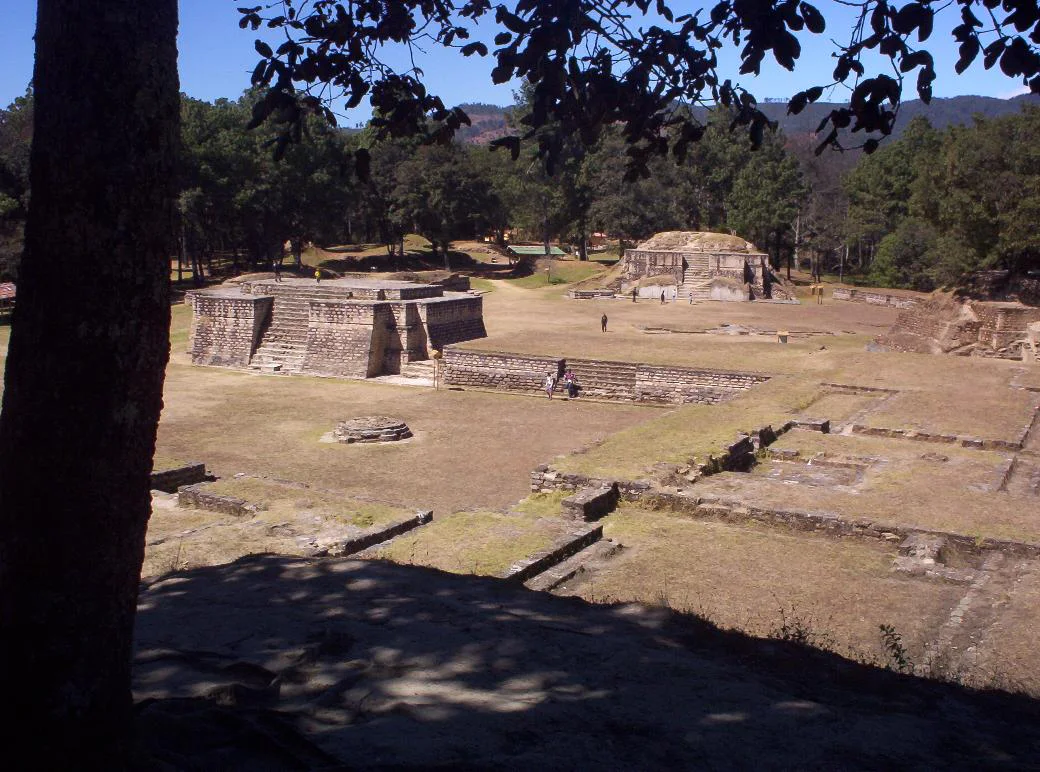
Plaza A was the ceremonial heart of the Sotz'il, the senior clan of the city. Its half of Iximche held a ballcourt, two temples and ten palace structures, five of them interconnected. Behind Temple 2 stands Structure 27, and inside it archaeologists found the noble tomb they numbered E-27-A. The man buried there had died in battle, struck on the head by a blunt weapon. Three sacrificed adults were piled face down above him, in a space of just one square metre. Under them he sat, dressed for a royal household. He wore a gold headband set with a mosaic of jade and turquoise. His necklace carried ten jaguar-head pendants. Forty small gold beads hung with them. On each arm he wore a bracelet cut from the bone of a human skull, engraved with birds and stars beneath a celestial band. A finely worked piece of jade lay near his jaw, probably placed in his mouth, and a copper nose ornament shaped like the moon completed the set. The tomb belongs to the city's earlier years. Archaeologists tentatively identify its occupant as a son of the founder Wuqu-Batz', one of two princes who died in the Kaqchikel wars of expansion.
Listen in the appGreg Willis · CC BY-SA 2.0
04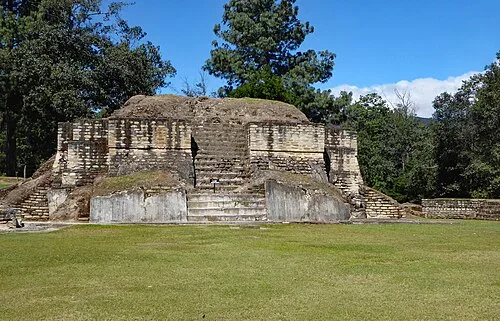 Plaza A and Temple 2
Temple 2 and the Sacrificial Altar
Temple 2 is the best preserved of the excavated temples, a stepped pyramid on the west side of Plaza A. Its stairway climbs the east face, and the building faces the sunrise on the summer solstice. Like many buildings here it was rebuilt three times, under the reigns of Wuqu-Batz', Oxlahuh-Tz'i' and Hun-Iq'. Archaeologists tunnelling into the interior found the oldest phase, its facing stones long since stripped away for reuse elsewhere. The middle phase survives best: four stepped tiers carrying sloping walls topped by vertical panels, in the talud-tablero style. The temple floor stands nine metres above the plaza. The walls and roof of the shrine would have added about five more when the Spanish arrived. At the head of the stair sat a small altar of stone and stucco, its top slightly concave. It is of a type used in heart sacrifice. The shrine had benches built against three of its walls and a hearth in the middle of the floor. A small rear chamber, also benched, may have been where the gods of the Sotz'il were kept. In front of the temple a turtle was buried in the plaza, perhaps one of the mythical beings believed to hold the building up.
Listen in the appHans Birger Nilsen · CC BY-SA 2.0
05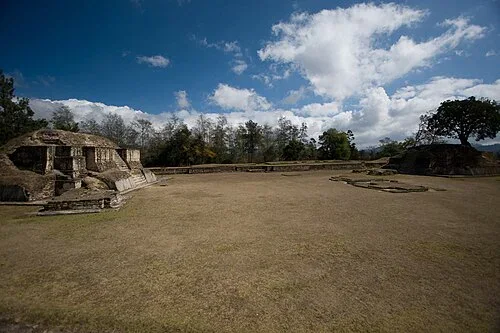 Plaza A and Temple 2
The Itzompan, the Skull Place
At the southwest corner of Temple 2 lies a low platform with a stark decoration. Its painted murals showed a skull above crossed longbones, set on two bands of ornament. The Kaqchikel called such a platform an itzompan, a skull place, their version of the Aztec tzompantli racks where the heads of sacrificed victims were displayed. Southeast of the temple, excavators found a cache of two skulls bearing marks of decapitation, buried together with obsidian blades. Whether those two skulls belonged on the platform itself is something the finds cannot settle.
Listen in the appGreg Willis from Denver, CO, usa · CC BY-SA 2.0
06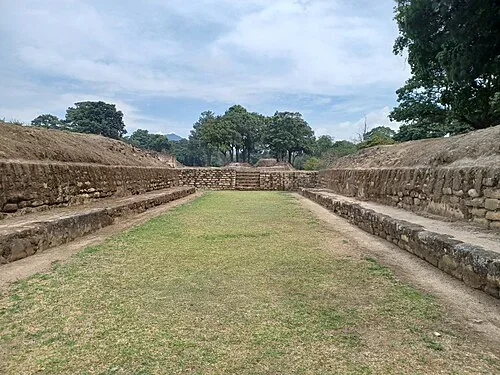 The Sunken Ballcourt of Plaza A
The Sunken Ballcourt (Structure 8)
The Kaqchikel called a ballcourt hom, and saw it as a gateway to Xibalba, the underworld. Structure 8, on the southwest side of Plaza A, is the finest survivor at the site: an I-shaped court, sunken below the ground around it. It runs about forty metres from end to end. Inside, the playing strip measures thirty metres long by seven wide. The end zones are enclosed and reached by their own stairways. Two levels of plaster flooring show that the court was built in the second of the city's three main construction phases, around the year 1500. Near Structure 24, excavators turned up two crude tenoned heads, probably jaguars. They were likely ballcourt markers for one of the city's two courts, made as a core over which stucco modelling was applied.
Listen in the appPhoto: Simon Burchell · CC BY-SA 4.0
07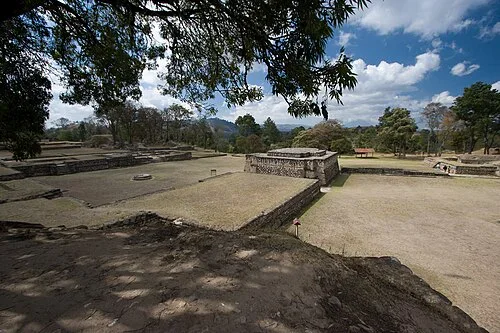 Plaza B and the Great Palace I
Plaza B and Temple 1
Temple 1, facing onto Plaza B, is the only temple at Iximche to have been completely restored, so it gives the best sense of what the surrounding mounds once were. Plaza B also held a stranger piece of ritual furniture. Structure 14 is a circular altar three and a half metres across, very like the platforms the Aztecs used for so-called gladiatorial sacrifice, in which a captive was bound and armed before the fight. It may have served the same purpose here. A noble buried at the altar with three companions supports that reading. Whether the altar actually hosted such contests is a question the evidence leaves open.
Listen in the appGreg Willis · CC BY-SA 2.0
08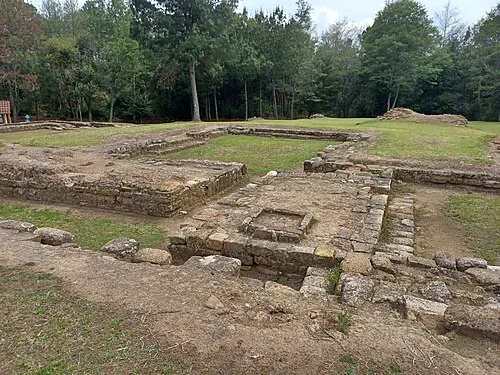 Plaza B and the Great Palace I
Great Palace I of the Ahpo Sotz'il
These low stone footings are what shows of Great Palace I, the seat of the Ahpo Sotz'il on the northeast side of Plaza B. Its oldest rooms date to the founding of the city under Wuqu-Batz' and Hun-Toh. That first palace covered about five hundred square metres: four long single-room ranges around a courtyard, with an altar at its centre. The rooms had benches set into the walls and hearths in the middle of the floors. The adobe walls were once covered with painted murals. Household goods came out of the excavations: obsidian knives, comals for cooking, metates for grinding maize, everyday ceramics, and fragments of incense burners near the altars. The palace kept expanding around that early core, and by the joint reign of Hun-Iq' and Lajuj Noj it covered more than three thousand square metres. In the southwest courtyard stood low platforms that may have served for ritual dance. On the southeast side was a room with benches along three walls and hearths at each end, likely where the Ahpo Sotz'il held court, received visitors and collected tribute.
Listen in the appPhoto: Simon Burchell · CC BY-SA 4.0
09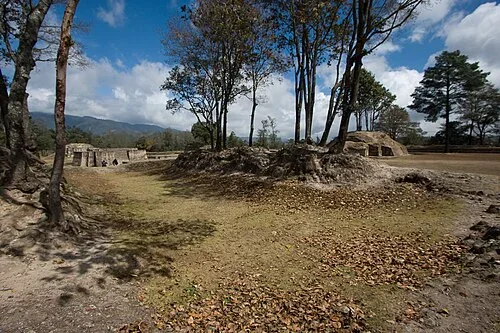 Plaza C and the Palace of the Fire
Plaza C and the Junior Ruler
Kaqchikel kingship was divided between two royal houses. The Ahpo Sotz'il ruled as the senior, the firstborn; the Ahpo Xahil as the junior, the lastborn. Both titles had been bestowed by the K'iche' kings in gratitude for military service to their kingdom of Q'umarkaj, and two lesser lords stood beside the pair. Plaza C was the Xahil half of the city, cut off from Plazas A and B by a wall three metres high. It had two temples facing each other across the square, and its own ballcourt on the southwest side. The Xahil palace proper stood on the southeast side, aligned east to west, with its entry courtyard on the western end.
Listen in the appPhoto: Simon Burchell · CC BY-SA 4.0
10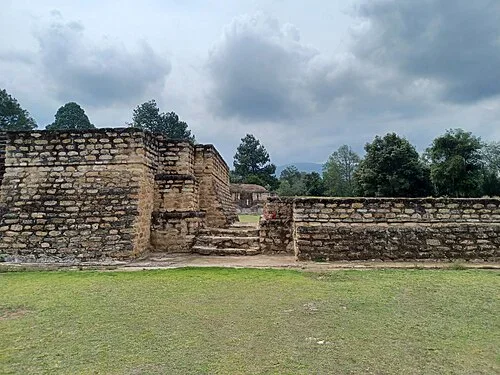 Plaza C and the Palace of the Fire
The Xahil Palace and the Spanish Capital
In April 1524 the conquistador Pedro de Alvarado reached the highlands, nearly three years after the fall of the Aztec capital. The Kaqchikel lords Belehe Qat and Cahi Imox welcomed him into Iximche, and Kaqchikel warriors marched with the Spanish against the K'iche' and the neighbouring Tz'utujil kingdom. In late July of that year, Alvarado declared Iximche the first capital of Guatemala, under the name Santiago de los Caballeros de Guatemala. The name Guatemala came from the Nahuatl Quauhtemallan, meaning forested land, the word the Spanish allies from Mexico used for this city. It spread from here to the kingdom, and in time to the country itself. The friendship did not last. Alvarado's demands for gold tribute grew so heavy that a Kaqchikel priest foretold the gods would destroy the Spanish, and in late August 1524 the people abandoned their capital for the forests and hills. In February 1526, sixteen Spanish deserters burned the Xahil palace, sacked the temples and carried off a priest. The fire collapsed the building's adobe walls, and that collapse sealed its domestic contents in place for archaeologists to find. This may be the very complex where Alvarado lodged with his soldiers, though that cannot be proven. That same year the conquistador Bernal Díaz del Castillo spent a night in the old city and reported the houses still in excellent condition, the last description of Iximche while it was still lived in.
Listen in the appPhoto: Simon Burchell · CC BY-SA 4.0
- 11
Structure 4 and the Cache of Severed Heads
An unrestored mound beside a pit field of forty-eight severed heads, possibly the court of captured K'iche' kings.
- 12
The Modern Ceremonial Altars
Six concrete altars in the pines, where Maya daykeepers still arrive as pilgrims from across the highlands.
- 13
The Fire Still Burning
A live fire on a stone altar, and what it says about the ridge that remains sacred ground today.
Iximche
Frequently asked questions
How much does the guide cost?
Free app download. Listed guide price: $0.99. Guide price shown in the app. Audio guide only. Venue admission is separate.
Can I listen without internet?
Yes. Download the guide’s audio, images, and maps in the app before your visit. Your downloaded content is then available offline.
Can I listen in my language?
This audio guide is available in 15 languages, including English.
Do I need to follow a schedule?
No. This is a self-guided experience. Choose your stops, pause whenever you like, and return to a story at your own pace.
At your own pace
Explore Iximche.
Download Stanza, then search for “Iximche”.
Free app download · Guide price shown in the app
Keep exploring
Audio guides — Guatemala
Río Santiago · 42 km
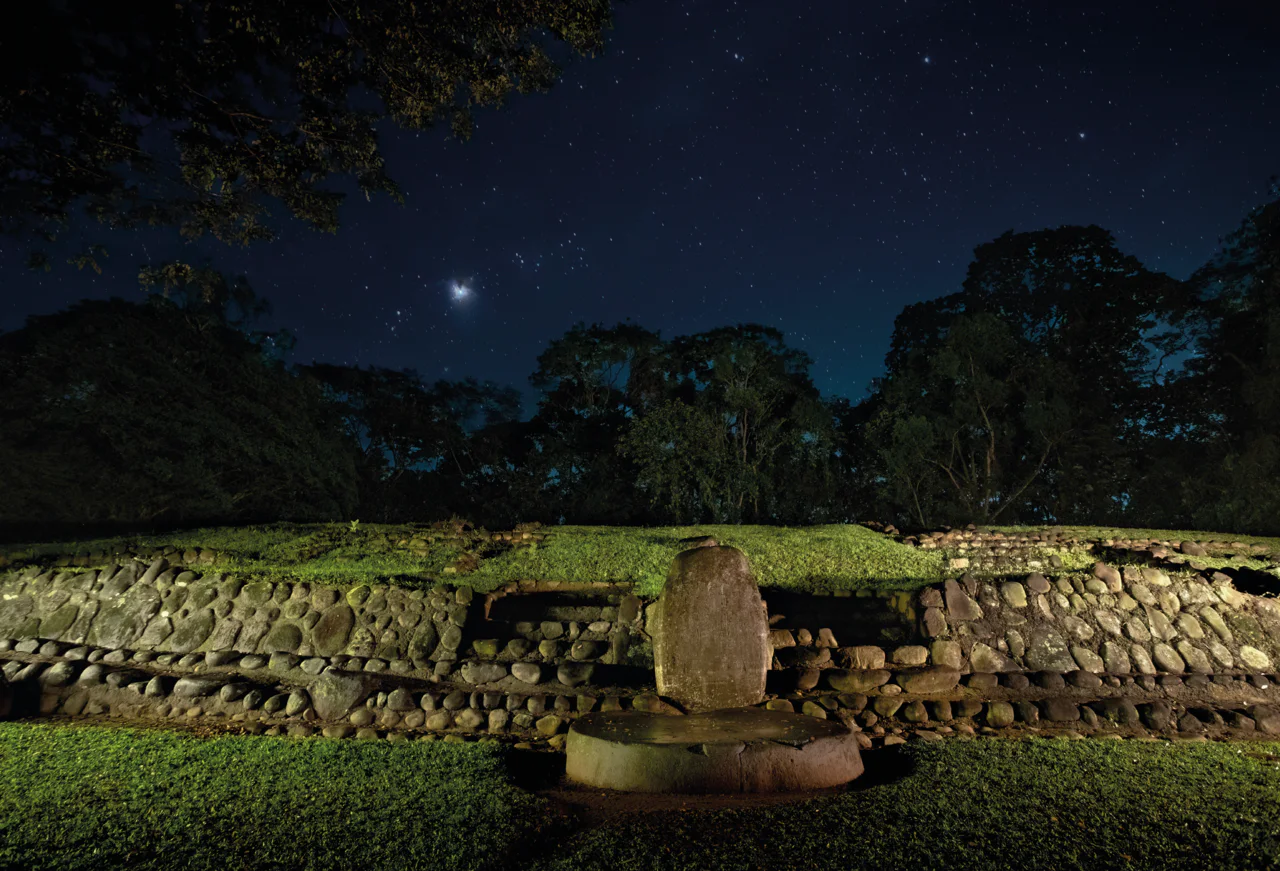
El Baúl
Content & sources
Photo: Simon Burchell · CC BY-SA 3.0
El Asintal · 80 km
Takalik Abaj
Content & sources
Gobierno de Guatemala · Public domain
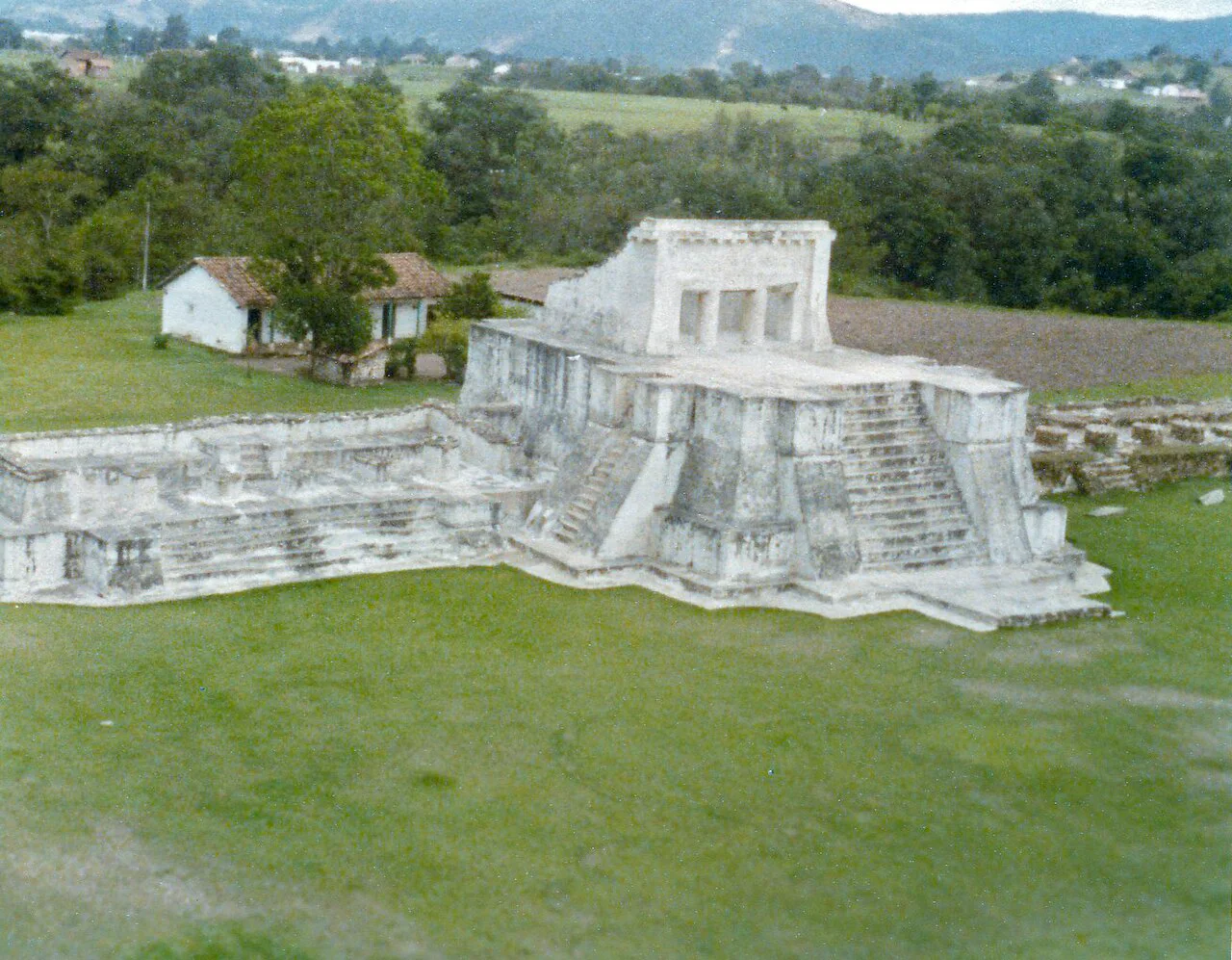
Huehuetenango · 85 km
Zaculeu
Content & sources
Infrogmation of New Orleans · CC BY-SA 3.0
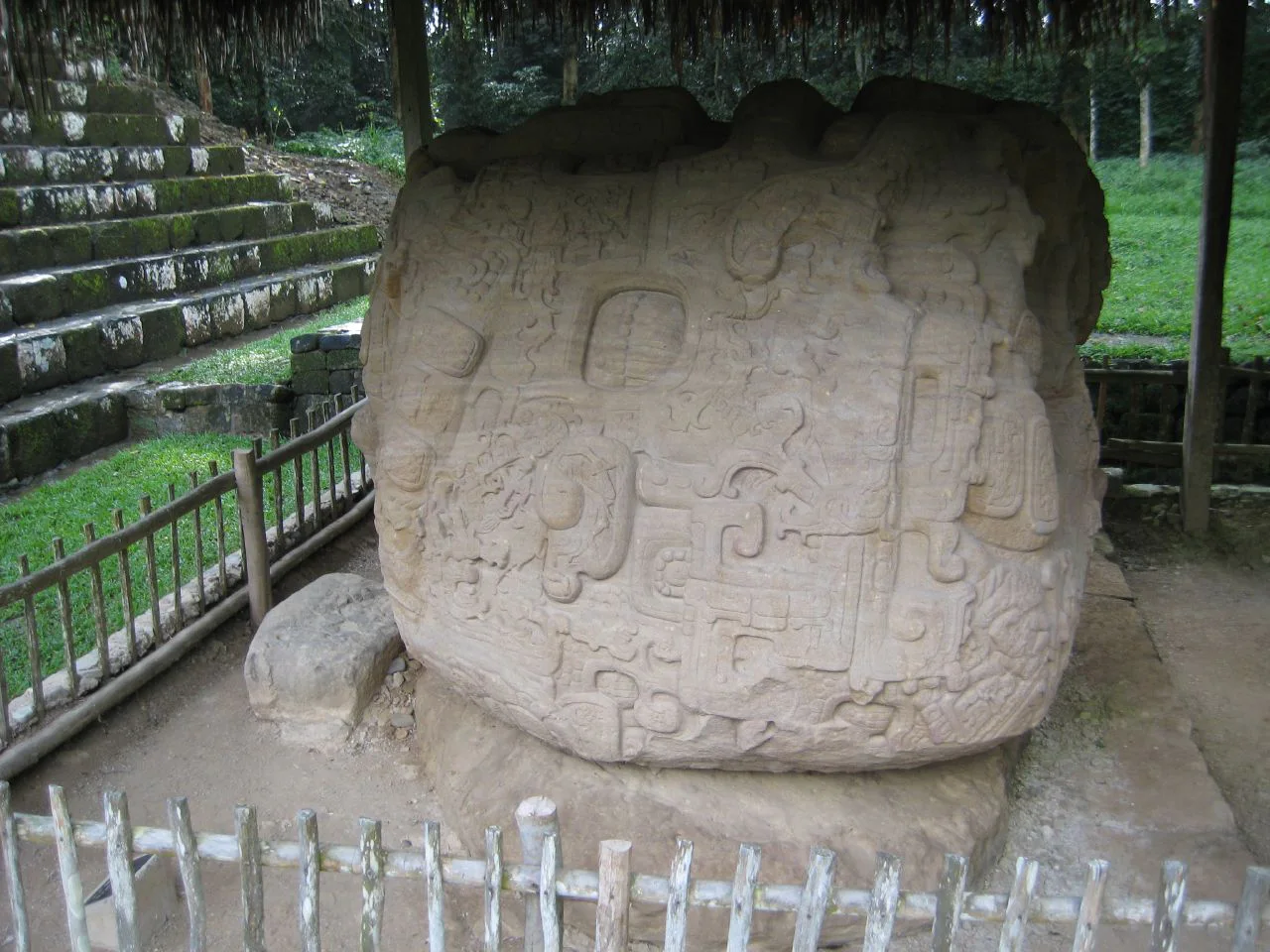
Quiriguá
Quiriguá
Content & sources
S2RD2 · CC BY 2.0