Stanza · Audio guide
El Baúl Audio Guide
A place to remember. A story to take with you.
El Baúl is a Pre-Columbian archaeological site located in the Escuintla Department of Guatemala. It was occupied during the prehistoric Formative stage of the Americas and is part of the Cotzumalhuapa…
Download Stanza, then search for “El Baúl”.
About the tour
One guide. Your kind of visit.
El Baúl is a Pre-Columbian archaeological site located in the Escuintla Department of Guatemala. It was occupied during the prehistoric Formative stage of the Americas and is part of the Cotzumalhuapa Archaeological Zone.
Ready when you are.
- 01Get the free Stanza app.
iOS & Android
- 02Find your guide.
“El Baúl”
- 03Download before you go.
Works offline
Audio guide / 7 narrated stops
Inside the guide
Get to know a few of the stories before you go. Open a stop to read more.
01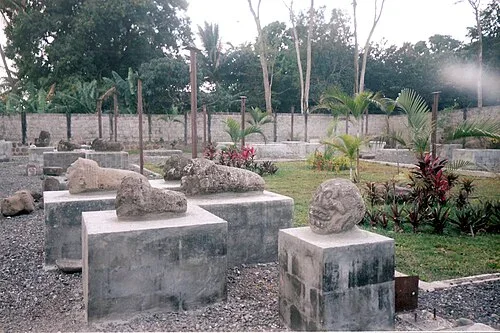 North Acropolis Display Terrace and Plantation Context
North Acropolis Sculpture Terrace
Welcome to El Baúl, one of the principal acropolises of the Cotzumalhuapa Archaeological Zone in southern Guatemala. Cotzumalhuapa was a great urban center on the Pacific coastal plain, and it was not a Maya city. Its world included three main sites: El Baúl, Bilbao, and El Castillo. The acropolis stands four kilometers north of the town of Santa Lucía Cotzumalguapa, on ground five hundred fifty meters above the sea, with the Pacific about fifty kilometers away. The open-air terrace here preserves monumental sculptures from the North Acropolis, the ceremonial and administrative heart that survived. The city was tied together by paved causeways. The largest ran two and a half kilometers, between eleven and fourteen meters wide, joining El Baúl with the acropolis of Bilbao. Many of the stones gathered here were found scattered across the site and along those causeways, so this terrace is a place of preservation rather than each carving's original home.
Photo: Simon Burchell · CC BY-SA 3.0
02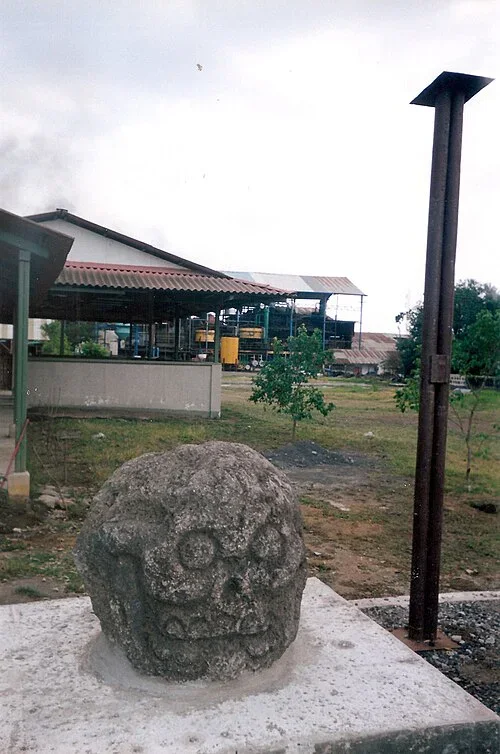 North Acropolis Display Terrace and Plantation Context
Carved Stone Head in the Plantation Landscape
A carved stone head stands in open ground here, with plantation sheds and factory roofs rising behind it. That contrast tells the story of the land itself. El Baúl sits just south of Fuego, an active volcano that has erupted again and again through the centuries. When archaeologists dug a deep test pit here, they went down nearly four meters. Below layers of volcanic ash from Fuego's eruptions, they found broken obsidian, the waste left by craftsmen at work. Below the ash, the obsidian waste went on layer after layer, a sign that the spot served as a refuse dump for a long time. The city's workshops processed this volcanic glass on a large scale, and the deposits left behind are now a key source for studying the ancient industry. Life here always carried on under the mountain.
Photo: Simon Burchell · CC BY-SA 3.0
03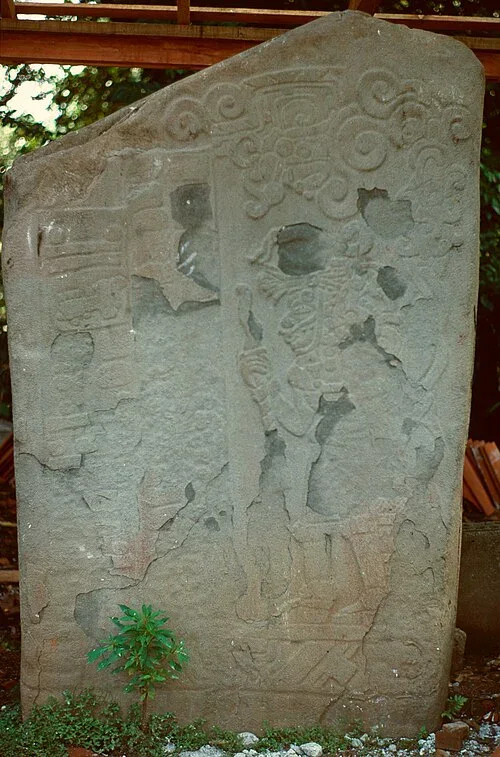 Stela 1 and the Early Long Count Calendar
Stela 1 and the Early Long Count
Stela 1 is the most scientifically important monument at El Baúl. Its carved surface carries a Long Count date: seven dot nineteen dot fifteen dot seven dot twelve, which corresponds to March 6, in the year 37 of our era. That makes it one of the earliest Long Count dates yet discovered anywhere in Mesoamerica. The Long Count was the great continuous calendar of the ancient Maya world, counting days from a fixed starting point far in the past. Finding it here, on the Pacific coast, shows that sophisticated calendar mathematics took root in this region centuries before the Classic Maya civilization reached its height in the lowlands of Petén. The carving itself has suffered badly. A frontal figure stands at the center, scroll motifs curl above, and a column of glyphs runs down the left side. Much of the surface has eroded or flaked away, so the date is known through decipherment rather than by reading it with the eye.
Listen in the appPhoto: HJPD · CC BY 3.0
04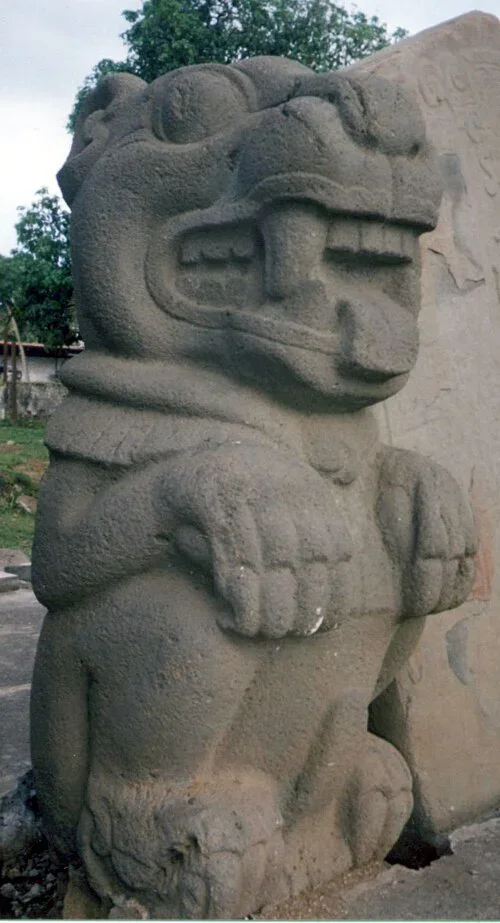 Cotzumalhuapa Sculpture: Jaguars and Skeletal Deities
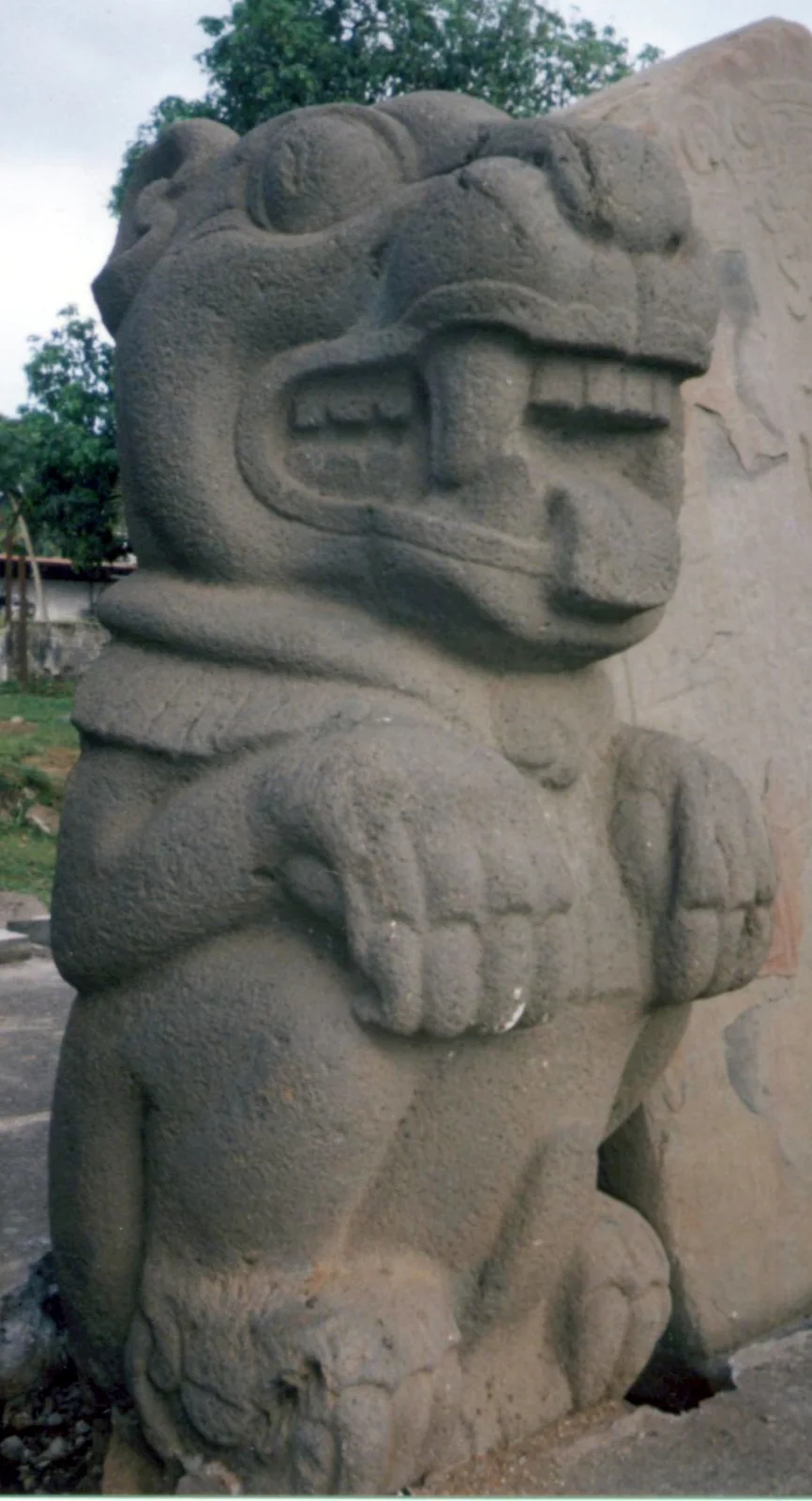
Seated Jaguar Sculpture
This seated feline shows what makes Cotzumalhuapa carving instantly recognizable. The animal leans forward with its mouth wide open, fangs bared and tongue curling out, and its claws grip its own chest in deep, rounded relief. The style favors exactly this: dynamic, naturalistic animals and human figures, carved with energy and depth rather than the stiff, flat forms common elsewhere. Cotzumalhuapa art is distinctive and non-Maya, with its own visual language of vigorous bodies and intertwined motifs. What this jaguar meant to the people who carved it, or where it originally stood, no one can say with certainty. Its craftsmanship, though, needs no explanation: the rounded modeling of the paws and the snarling face make it one of the most vivid animals to survive from the ancient Pacific coast.
Listen in the appPhoto: Simon Burchell · CC BY-SA 3.0
05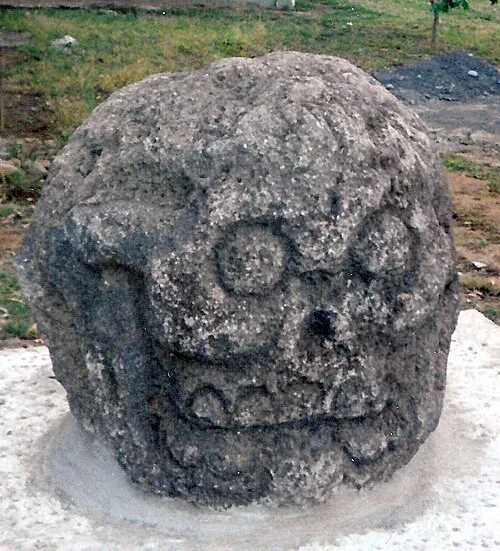 Cotzumalhuapa Sculpture: Jaguars and Skeletal Deities
Carved Skull Sculpture
Death has its own place in the art of Cotzumalhuapa. This round carved head shows a skull, with deep hollow eye sockets and a full row of bared teeth. Its surface is pitted and weathered from long exposure, giving the face a rough, eroded texture. Alongside the dynamic living figures and intertwined motifs, skeletal imagery recurs across the monuments of this tradition, making death symbolism one of its hallmarks. The carvers gave the skull the same care they gave their felines: the sockets are rounded and deep, the teeth clearly defined, the whole form modeled in the round. Which deity, if any, this skull represents, and where it first stood, remain open questions. What is certain is that the artists of this city felt no need to hide death from view. They carved it in stone, weathered and staring, and set it among their monuments.
Listen in the appPhoto: Simon Burchell · CC BY-SA 3.0
06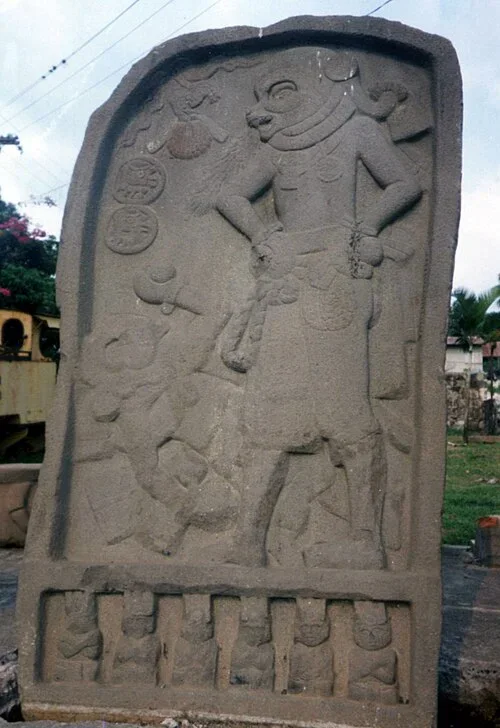 The Sacred Ballgame and Ceremonial Stelae
The Ballgame Stela
The great ritual sport of ancient Mesoamerica was the ballgame, and El Baúl carved it into stone. This stela shows a tall standing figure dressed for play, wearing protective gear and a mask, hands on hips. Below, a smaller figure crouches, and at the upper left a pair of circular disks mark the kind of ring or marker associated with the game. Along the base runs a register of small kneeling figures. Speech scrolls curl from the figures' mouths, part of a glyphic system all Cotzumalhuapa's own, distinct from Maya writing and not readable today. The ballgame was far more than sport across Mesoamerica, a ceremony bound up with power and ritual. Here the game had a court of its own: the ballcourt lies five hundred meters north of the acropolis, with residential groups in between, and the whole area was joined by two causeways. Whether this stela originally stood at that court is not established.
Listen in the appPhoto: Simon Burchell · CC BY-SA 3.0
07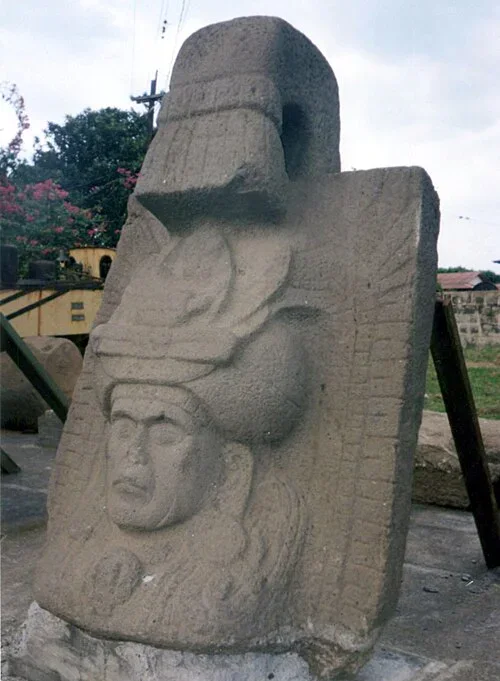 The Sacred Ballgame and Ceremonial Stelae
Carved Monument with Human Figure
A human face gazes out from this carved monument, wearing an elaborate headdress that may be made of feathers, set above a paneled slab. It stands for everything this city achieved, from a causeway with a bridge across the Santiago River gorge to beliefs carved deep into stone. The city flourished from roughly six hundred of our era, and by around nine hundred it had been abandoned. What remains is fragile. In 1997 the South Acropolis was destroyed by urban development, and much of the site's main groups now lie under sugarcane fields. The North Acropolis and its monuments are what survive, gathered and recorded for protection. Every carved face and feline that outlasted the city is now part of what remains, and worth keeping.
Listen in the appPhoto: Simon Burchell · CC BY-SA 3.0
El Baúl
Frequently asked questions
How much does the guide cost?
Free app download. Listed guide price: $0.99. Guide price shown in the app. Audio guide only. Venue admission is separate.
Can I listen without internet?
Yes. Download the guide’s audio, images, and maps in the app before your visit. Your downloaded content is then available offline.
Can I listen in my language?
This audio guide is available in 15 languages, including English.
Do I need to follow a schedule?
No. This is a self-guided experience. Choose your stops, pause whenever you like, and return to a story at your own pace.
At your own pace
Explore El Baúl.
Download Stanza, then search for “El Baúl”.
Free app download · Guide price shown in the app
Keep exploring
Audio guides — Guatemala
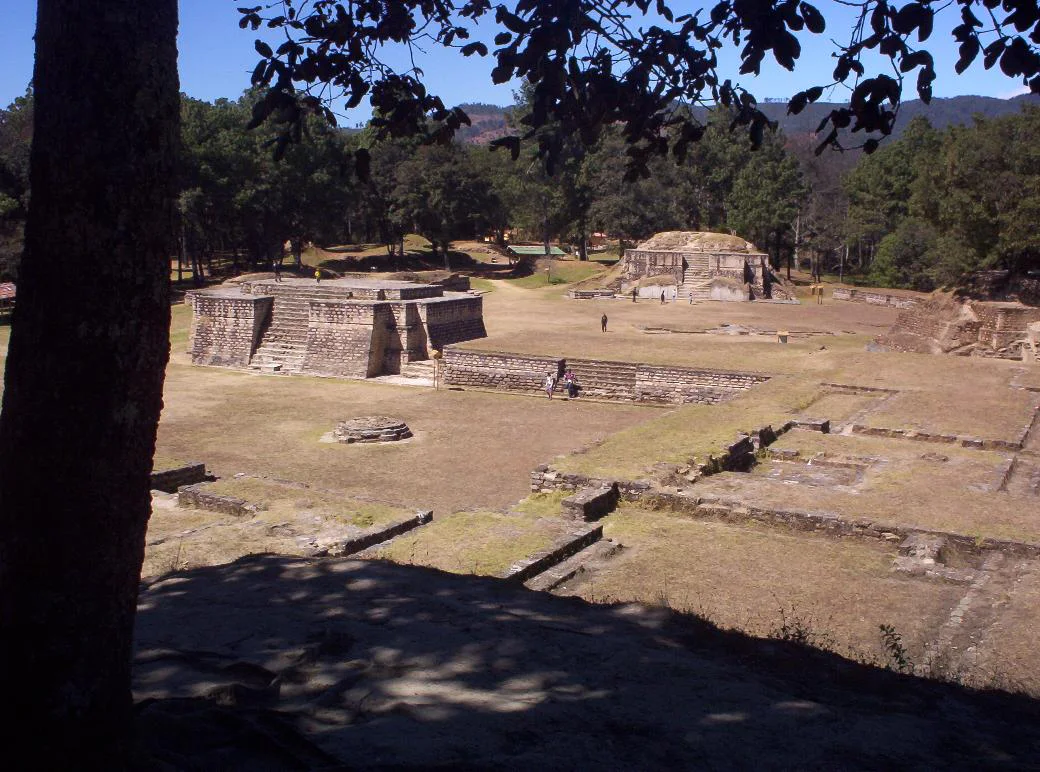
Tecpán Guatemala · 42 km
Iximche
Content & sources
Colocho · Public domain
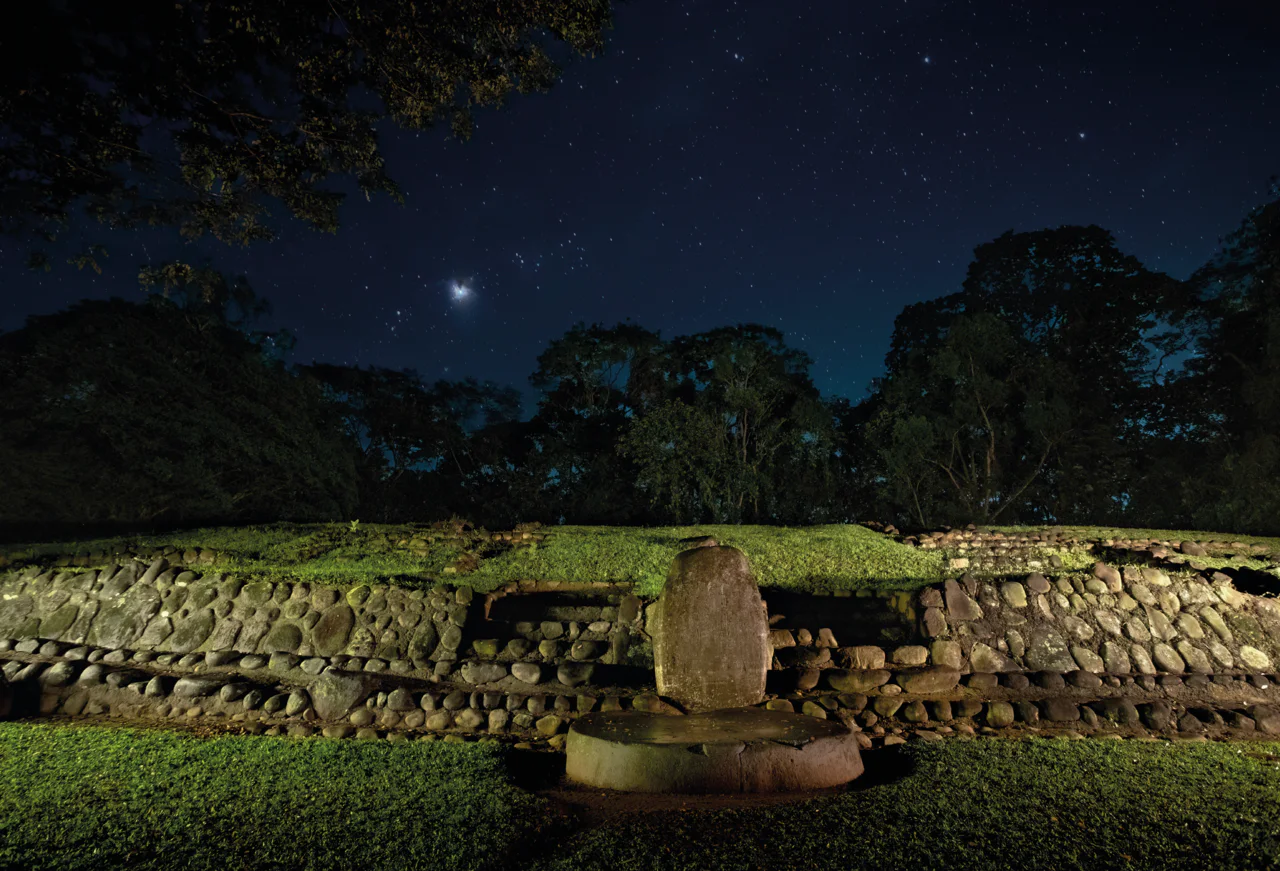
El Asintal · 83 km
Takalik Abaj
Content & sources
Gobierno de Guatemala · Public domain
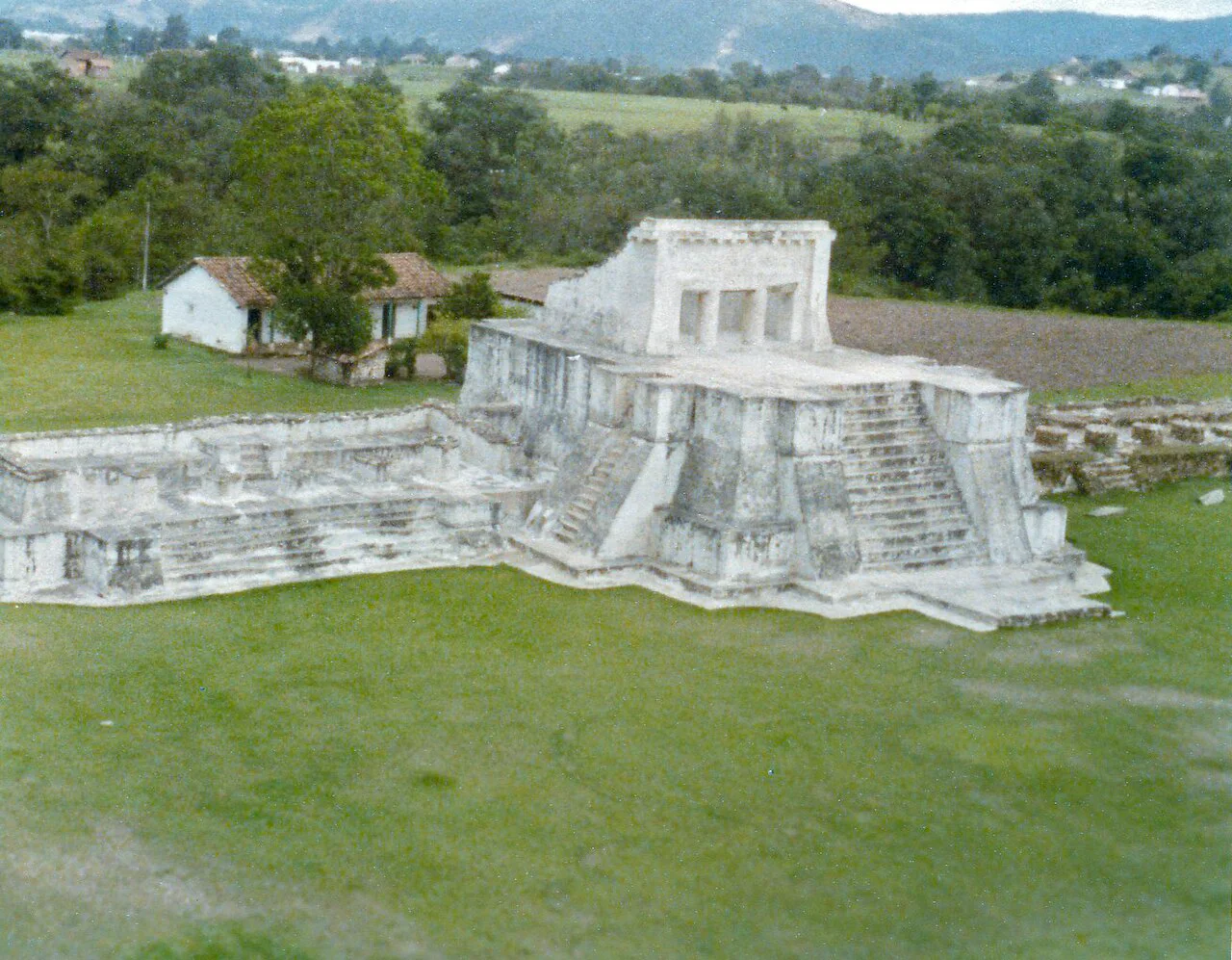
Huehuetenango · 120 km
Zaculeu
Content & sources
Infrogmation of New Orleans · CC BY-SA 3.0
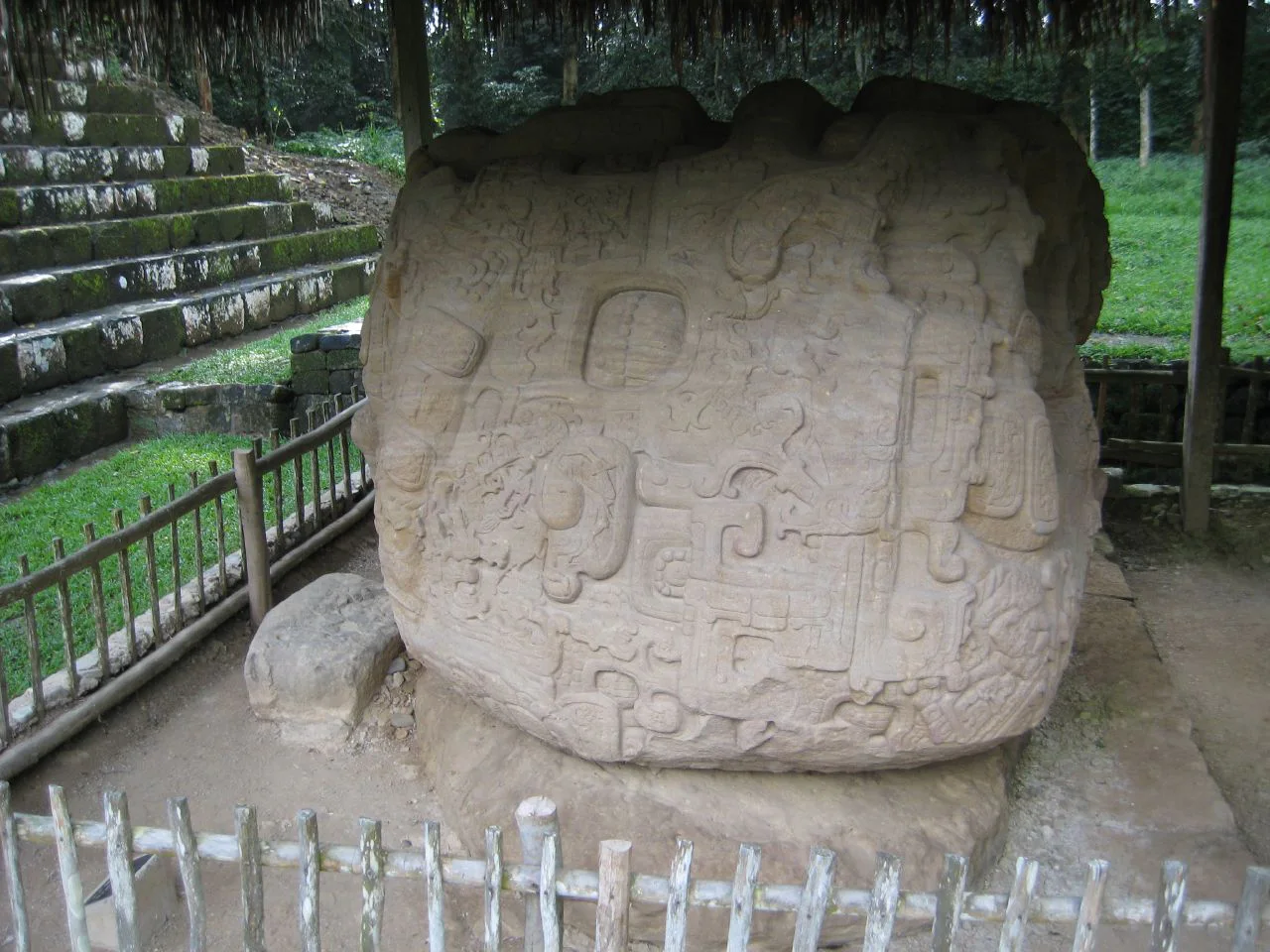
Quiriguá
Quiriguá
Content & sources
S2RD2 · CC BY 2.0