Stanza · Audio guide
Nagarjunakonda Audio Guide
A place to remember. A story to take with you.
Nagarjunakonda is a historical town and Buddhist archaeological site located on an island in Andhra Pradesh, India. The site is significant because its archaeological relics were excavated and relocated to…
Download Stanza, then search for “Nagarjunakonda”.
About the tour
One guide. Your kind of visit.
Nagarjunakonda is a historical town and Buddhist archaeological site located on an island in Andhra Pradesh, India. The site is significant because its archaeological relics were excavated and relocated to higher ground after being submerged by the construction of the Nagarjuna Sagar Dam.
Ready when you are.
- 01Get the free Stanza app.
iOS & Android
- 02Find your guide.
“Nagarjunakonda”
- 03Download before you go.
Works offline
Audio guide / 13 narrated stops
Inside the guide
Get to know a few of the stories before you go. Open a stop to read more.
01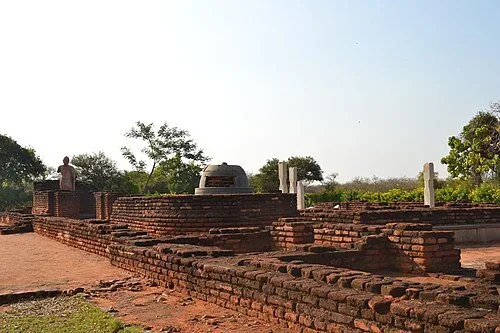 Island Landing & Salvaged Citadel Fortress
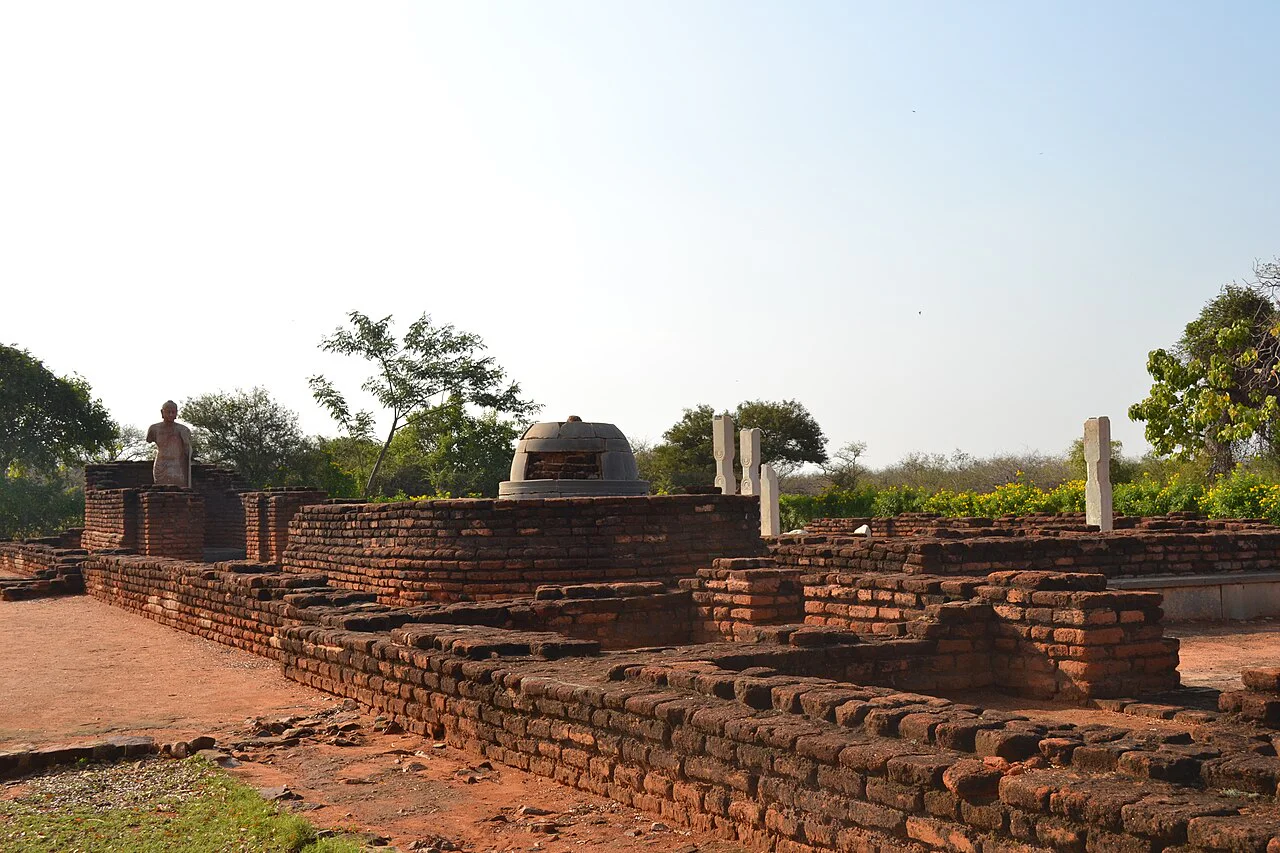
Arrival on Nagarjuna's Hill: The Ruins of Vijayapuri
Welcome to Nagarjunakonda, an island set in the middle of a man-made lake in Andhra Pradesh. The name means Nagarjuna's Hill, after the southern master of Mahayana Buddhism who lived in the second century. Tradition holds that he lived and taught on this hill, though digging here has never proved it. The inscriptions from the site tell a plainer story. In the third and fourth centuries this city was called Vijayapuri, the city of victory. It was the capital of the Ikshvaku kings, who rose to power after the Satavahana dynasty faded in the early third century. Their records always tie the capital to the Sriparvata hill, naming it Siriparvate Vijayapure. The brick ruins spread across this ground are what remains of that capital's Buddhist monuments, carried up from the valley that now lies drowned.
Sabyk2001 · CC BY-SA 3.0
02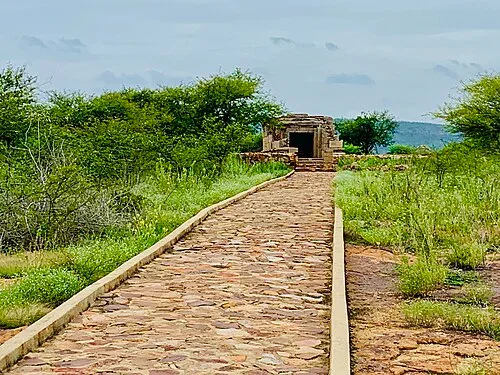 Island Landing & Salvaged Citadel Fortress
The Great Salvage: Moving a Civilization Uphill
The valley that held this city now lies at the bottom of a reservoir. In the 1950s a dam rose across the Krishna River, and the filling lake was going to cover everything here. So the monuments were dug up and moved before the water came. The great salvage excavation ran from 1954 to 1960, led by R. Subrahmanyam. It turned up material from the Early Stone Age all the way to the sixteenth century. The work had begun decades earlier, when the French archaeologist Gabriel Jouveau-Dubreuil made the first discoveries in 1926, followed by systematic digging under A. H. Longhurst. On the hilltop, around fourteen large replicas of the excavated ruins were re-erected, and a museum was built in 1966. The stone path climbing through the trees toward rebuilt walls is the result. A whole ancient landscape, taken apart and set down again on high ground.
Photo: Ms Sarah Welch · CC0
03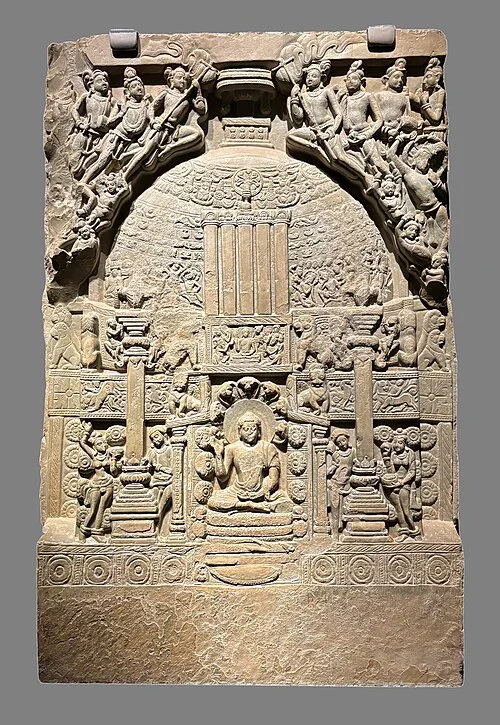 The Archaeological Museum & Limestone Masterpieces
Inside the Vihara-Shaped Museum
The museum on this island was built in the shape of a Buddhist vihara, the kind of building where monks once lived. It became the treasure house of everything the excavations recovered. Among the relics are a small tooth and an ear-ring believed to belong to Gautama Buddha himself. The older finds run deep, with tools from Paleolithic and Neolithic times, along with coins and jewellery. This carved limestone panel shows the quality of what was saved. A great dome rises at its centre, ringed with rows of figures, and the Buddha sits beneath it in meditation. Every inch of the stone is crowded with people, animals and ornament, all cut with a sure hand. Panels like this one were lifted from the ruined stupas of the valley and brought here for safekeeping.
Listen in the appPhoto: Anandajoti · CC BY-SA 4.0
04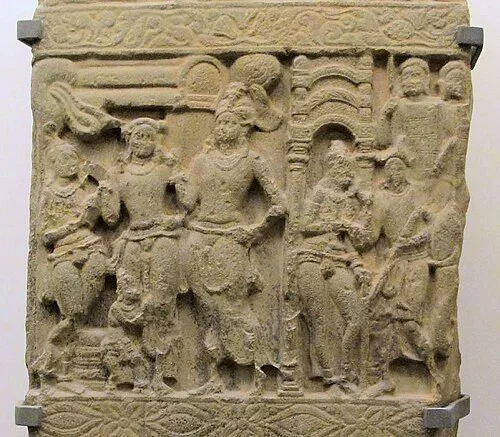 The Archaeological Museum & Limestone Masterpieces
The Scythian Guards of the Ikshvaku Kings
Soldiers in unmistakably foreign dress march across this carved panel, wearing tall caps and heavy coats. Sculptors at Vijayapuri recorded the people around the royal court. These figures are identified as Scythians, warriors from the Indo-Scythian world far to the northwest. An inscription found here says a garrison of Scythian guards was employed by the Ikshvaku kings, and may have been stationed in the city. Indian rulers keeping foreign bodyguards says something about how mobile people were in the third century. Marriage worked the same way. King Virapurushadatta, who ruled from about 250 to 275, had several wives, one of them Rudradhara-bhattarika, daughter of the ruler of Ujjain, quite possibly the Indo-Scythian Western Kshatrapa king Rudrasena II. Foreign soldiers at the gate, foreign princesses in the palace, all recorded in stone.
Listen in the appsailko · CC BY-SA 3.0
05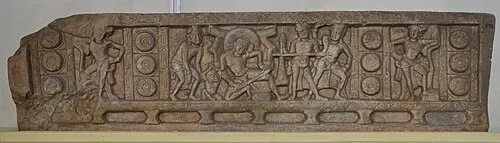 The Archaeological Museum & Limestone Masterpieces
The Sibi Jataka: Stories in White Limestone
This long limestone panel carries a Jataka, one of the tales of the Buddha's earlier lives, here the story of King Sibi. It was carved in the Ikshvaku period, around the third or fourth century, in the style known as Amaravati, or Later Andhra. The sculptures of Nagarjunakonda form the second most important group of that style anywhere. Their carving sits very close to the late work of the Amaravati Stupa, not far to the east, which was made slightly earlier. One modern judgement calls these reliefs lively and interesting, though flatter and simpler than the mature Amaravati phase. The valley held foreign things as well as foreign soldiers. Roman gold coins were found here, one of the emperor Tiberius and another of Faustina the Elder, along with a coin of Antoninus Pius. A carved relief of Dionysus, wine barrel at his side, came from the palace site, all pointing to trade with the Roman world.
Listen in the appBiswarup Ganguly · CC BY 3.0
06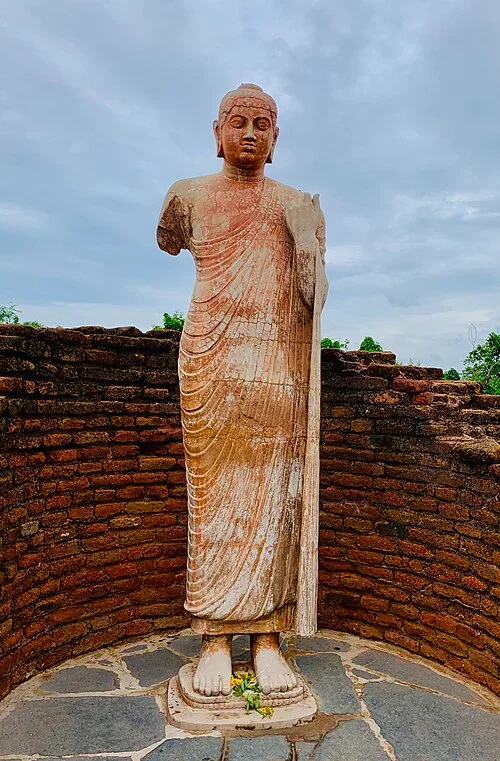 The Monolithic Buddha Sanctuary
The Monolithic Standing Buddha
A tall figure in flowing robes rises above low brick walls, carved from a single block of stone. This monolithic standing Buddha is the main attraction on the island. The robe falls in long, smooth folds across the body, gathered over one shoulder, and the carved face holds a calm, level gaze. The statue is partly ruined, and its setting tells its own story. It stands within a circular floor of flat stones, ringed by the low brick walls of a shrine rebuilt around it. Flowers rest at its bare feet, so the figure is still honoured as an image of the Buddha, not only preserved as an artefact. Against the sky it gives a fair sense of how the valley's shrines once felt, a carved colossus at the centre of a brick sanctuary.
Listen in the appPhoto: Ms Sarah Welch · CC0
07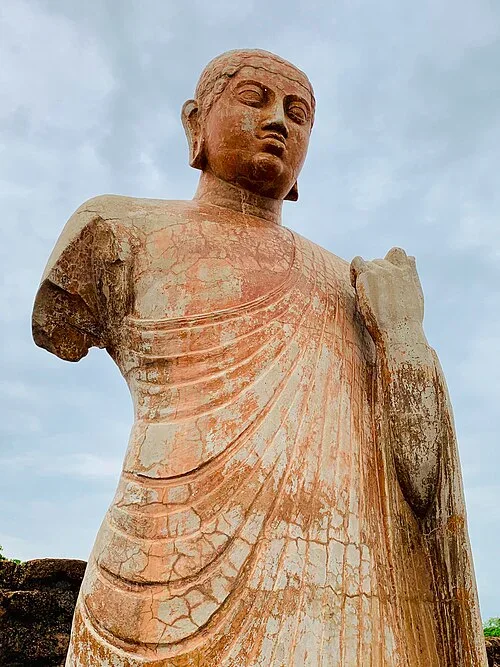 The Monolithic Buddha Sanctuary
A Survivor's Surface: Reading the Damage
Up close, the statue shows its age honestly. Both forearms are gone, broken away below the shoulder and elbow, so the hands that once made a gesture of teaching or blessing are lost. The stone surface is cracked into a fine web, and stained in patches of pale grey and warm red. Rain and sun have softened the edges of the robe's folds without erasing them. The face has kept its composure best of all, the eyes half open, the mouth set and calm. No record explains when the arms were lost or how. What remains is still enough to hold the eye, a damaged monolith that has outlasted everything built around it.
Listen in the appPhoto: Ms Sarah Welch · CC0
08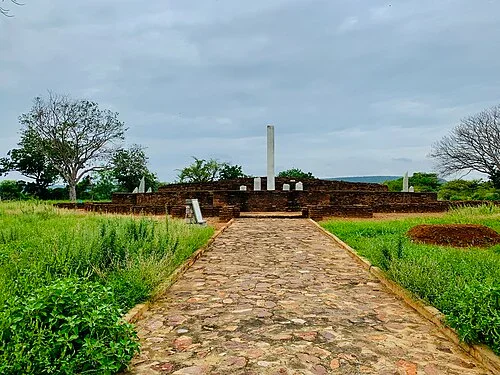 The Great Stupa (Mahachaitya) & Royal Ayaka Pillars
The Mahachaitya: The Great Stupa
The spiritual heart of Vijayapuri was a great stupa called the Mahachaitya. It belonged to a class of stupas called uncased stupas, meaning its brickwork was left bare, plastered over and decorated with a large garland ornament instead of stone facing. The structure was shaped like a wheel, with rectangular platforms projecting from it. The numbers give a sense of its scale. It measured about thirty-two metres across and rose eighteen metres high, with a path four metres wide for worshippers to walk around it. That walking, called circumambulation, was itself an act of devotion. Tradition holds that the Mahachaitya contained sacred relics of the Buddha, which is why it drew pilgrims and royal patronage. What stands here now is the rebuilt platform of that monument, its brick drum and one raised pillar marking where the great dome rose.
Listen in the appPhoto: Ms Sarah Welch · CC0
09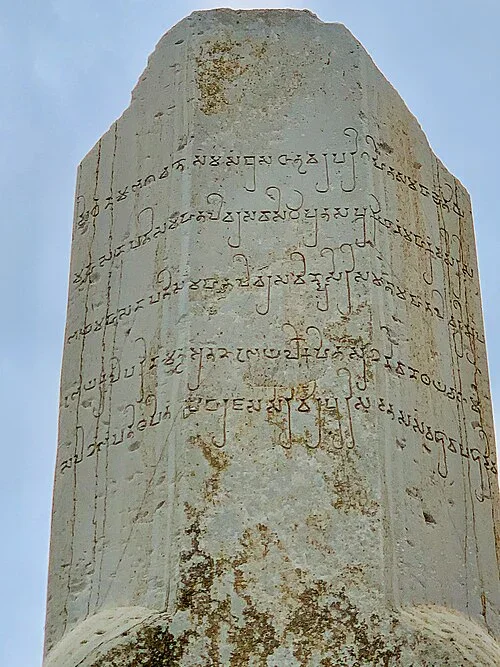 The Great Stupa (Mahachaitya) & Royal Ayaka Pillars
The Ayaka Pillar Inscription
The tall weathered pillar carries rows of carved letters, an ancient script called Brahmi, cut deep and still legible after seventeen centuries. Pillars like this stood at the great stupa as ayaka pillars, erected when it was renovated in the third century. The renovation was paid for by Chamtisiri, an Ikshvaku princess. Her record is remarkable in its persistence. She is noted as having funded the main stupa for ten consecutive years, an unbroken chain of gifts. She was not alone in this. The Ikshvaku queens sponsored the building of temples and monasteries across the valley, so royal women's money underwrote much of what stood here. Each inscribed pillar named its donor, turning architecture into a public record of who gave, and how much.
Listen in the appPhoto: Ms Sarah Welch · CC0
10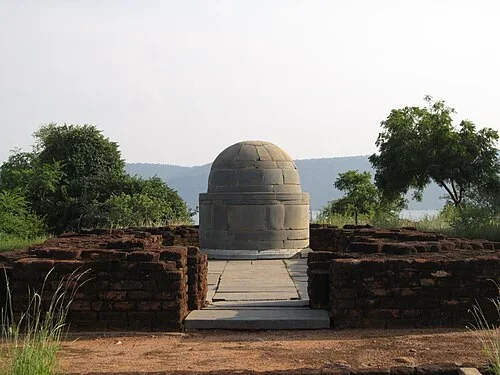 The Monastic University Complex
The Bodhisri Chaitya: A Donor's Name in Stone
Not every monument in the valley was raised by kings. This small, complete chaitya, a domed shrine, carries the name of Bodhishri. She was an upasika, a lay devotee rather than a nun or a queen, and she is recorded as having constructed Buddhist monuments here. Another lay devotee named Chandrashri did the same. Their gifts were part of a wider pattern. Many non-royal names were inscribed on the relics and monuments of the valley, so support for the monasteries spread well beyond the noble classes. The little dome sits within low brick walls, its stone facing intact, with the wide water of the reservoir behind it. It gives the clearest idea of what a single donor's monument looked like, modest beside the great stupa, and built with the same care.
Listen in the appAyan Mukherjee · CC BY 3.0
- 11
The Monastic University of Vijayapuri
More than thirty monasteries drew monks from China, Sri Lanka and Gandhara, making this the largest Buddhist centre in South India.
- 12
Across the Water: The Reconstructed Monuments of Anupu
Across the water at Anupu, more rescued monuments rise in terraces on the mainland shore of the lake.
- 13
What the Waters Could Not Take
From decline to medieval fortress to the rebuilt stupa in its park: the long afterlife of Nagarjunakonda.
Nagarjunakonda
Frequently asked questions
How much does the guide cost?
Free app download. Listed guide price: $0.99. Guide price shown in the app. Audio guide only. Venue admission is separate.
Can I listen without internet?
Yes. Download the guide’s audio, images, and maps in the app before your visit. Your downloaded content is then available offline.
Can I listen in my language?
This audio guide is available in 15 languages, including English.
Do I need to follow a schedule?
No. This is a self-guided experience. Choose your stops, pause whenever you like, and return to a story at your own pace.
At your own pace
Explore Nagarjunakonda.
Download Stanza, then search for “Nagarjunakonda”.
Free app download · Guide price shown in the app
Keep exploring
Audio guides — India
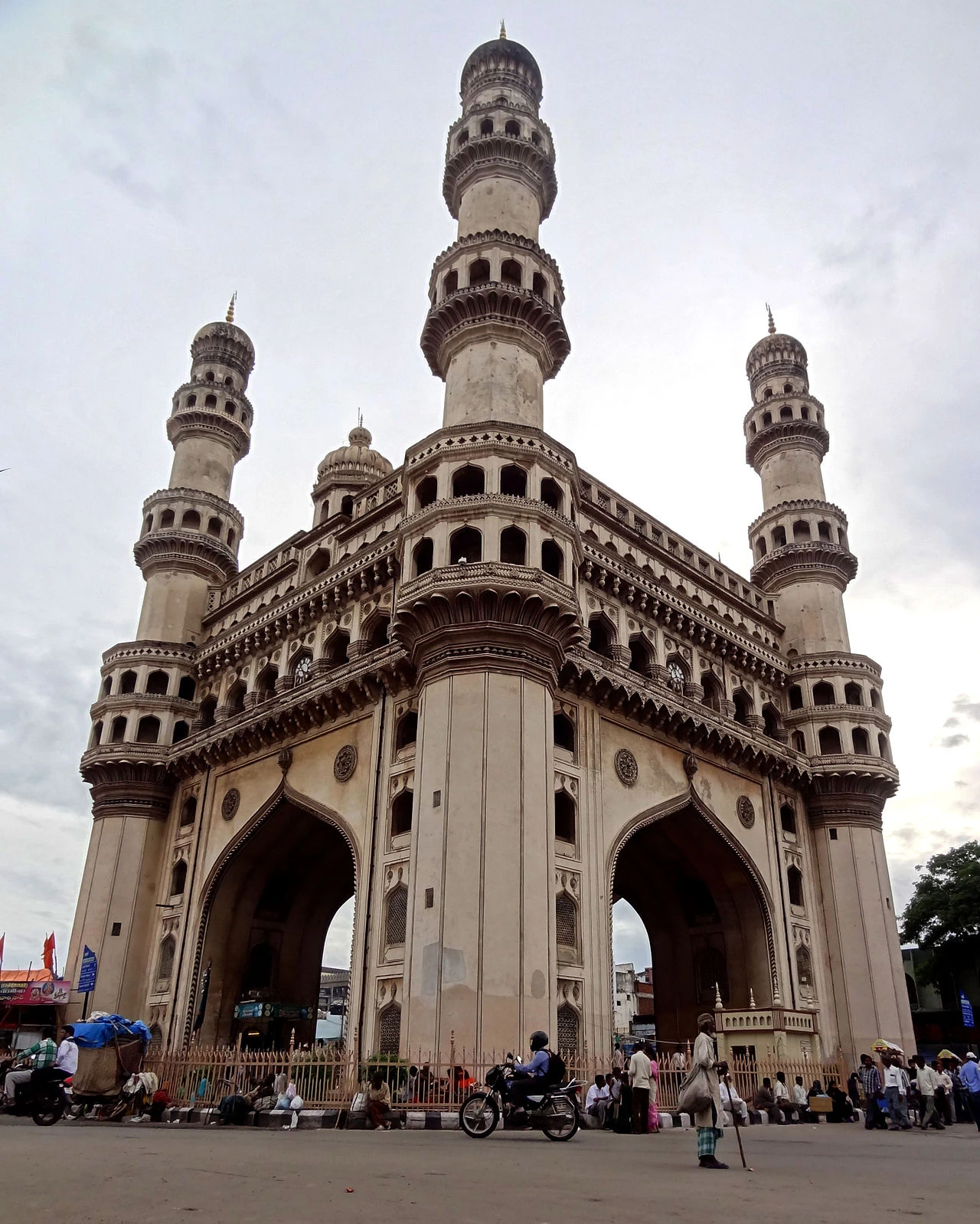
Hyderabad · 124 km
Charminar
Content & sources
Gopikrishna Narla · CC BY-SA 3.0
Hyderabad · 131 km
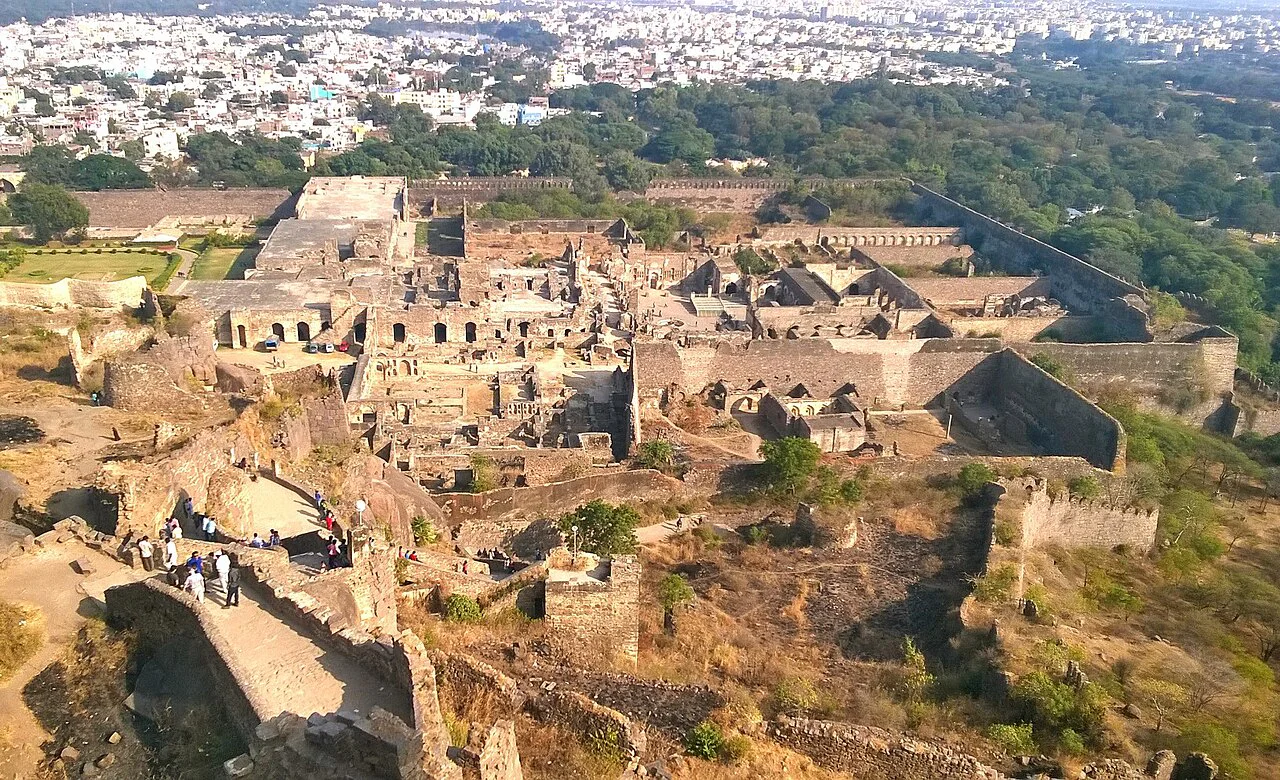
Golconda
Content & sources
Photo: Khadeeja Henna · CC BY-SA 4.0
Hyderabad · 132 km
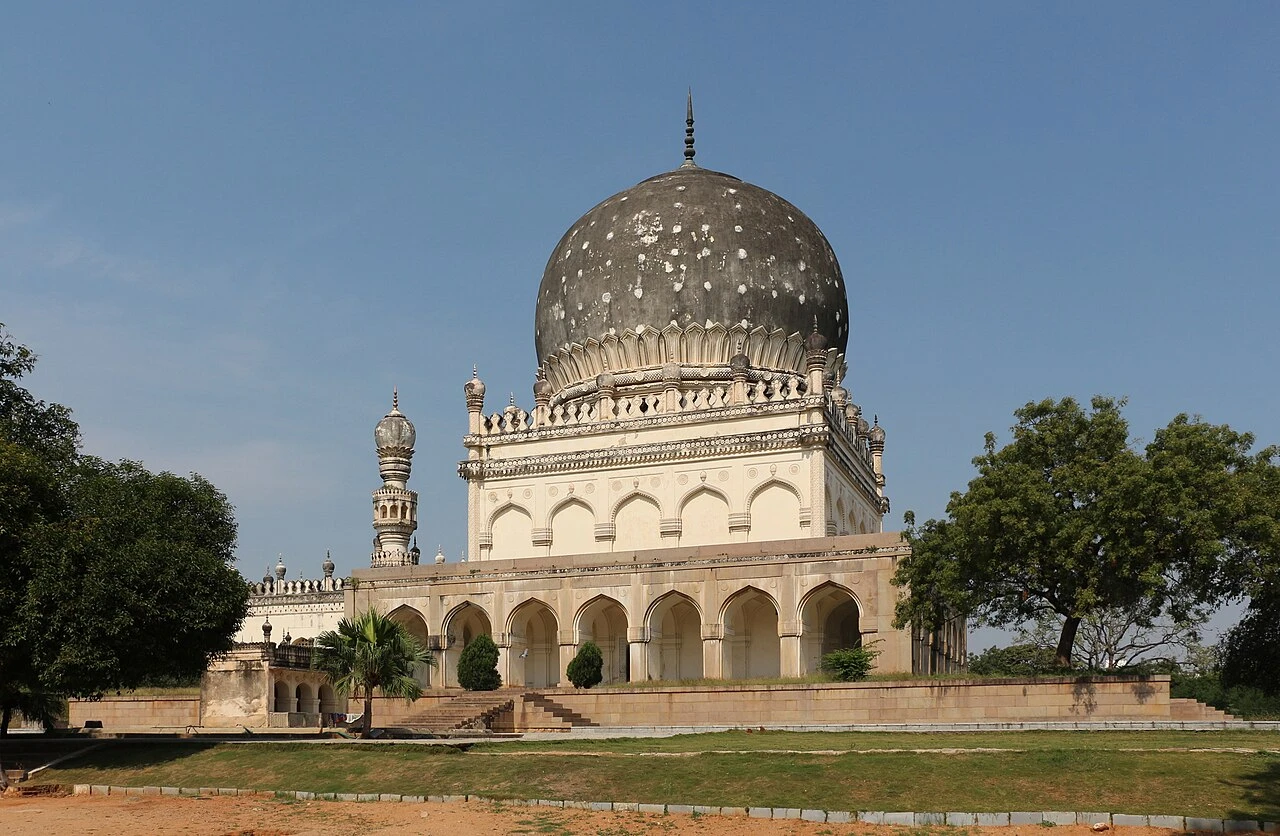
Qutb Shahi Tombs
Content & sources
Bernard Gagnon · CC BY-SA 3.0
Hampi
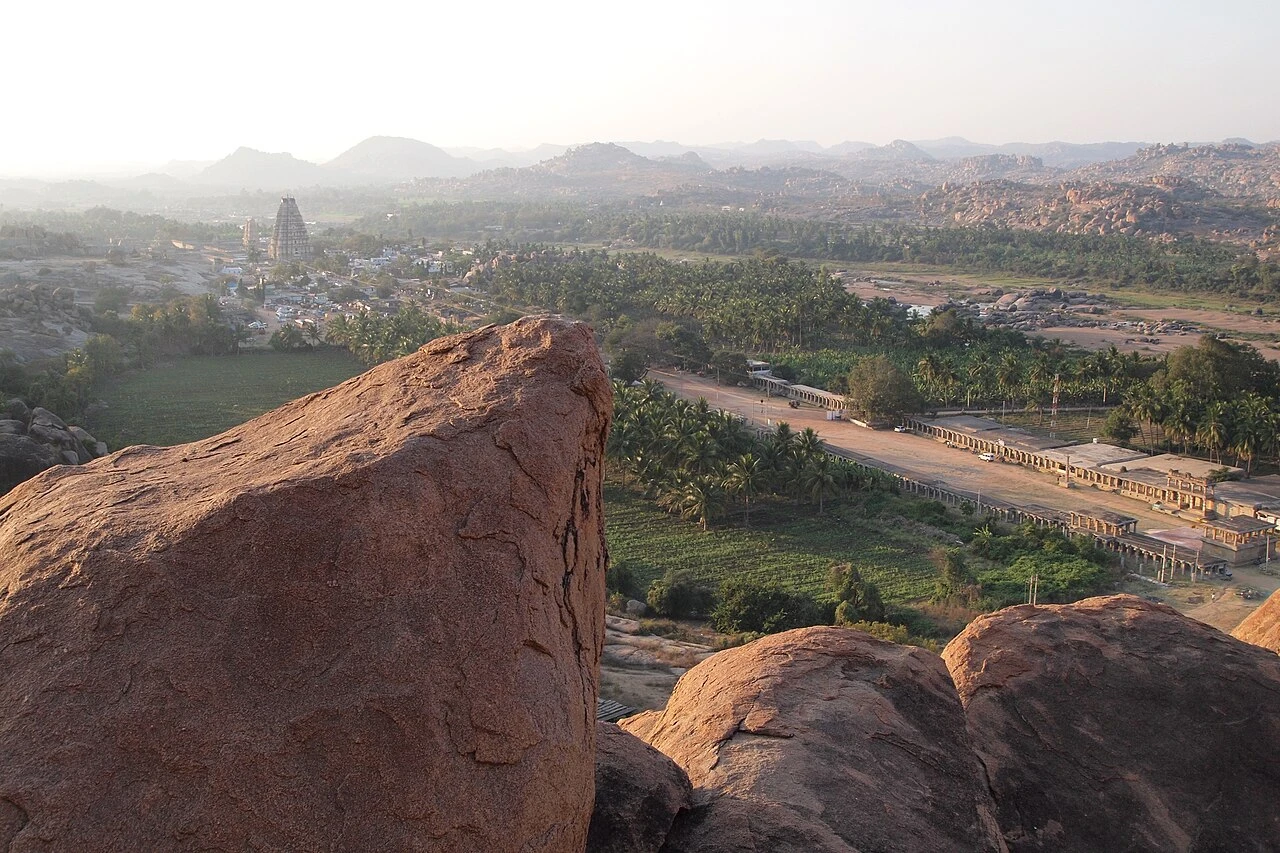
Hampi
Content & sources
Vyacheslav Argenberg · CC BY 4.0