Stanza · Audio guide
Qutb Shahi TombsAudio guide
A place to remember. A story to take with you.
The Qutb Shahi Tombs comprise a necropolis housing the tombs and mosques built by the various rulers of the Qutb Shahi dynasty. The site is a prominent example of Indo-Islamic architecture located near the…
Download Stanza, then search for “Qutb Shahi Tombs”.
About the tour
One guide. Your kind of visit.
The Qutb Shahi Tombs comprise a necropolis housing the tombs and mosques built by the various rulers of the Qutb Shahi dynasty. The site is a prominent example of Indo-Islamic architecture located near the Golconda Fort.
Ready when you are.
- 01Get the free Stanza app.
iOS & Android
- 02Find your guide.
“Qutb Shahi Tombs”
- 03Download before you go.
Works offline
Audio guide / 15 narrated stops
Inside the guide
Get to know a few of the stories before you go. Open a stop to read more.
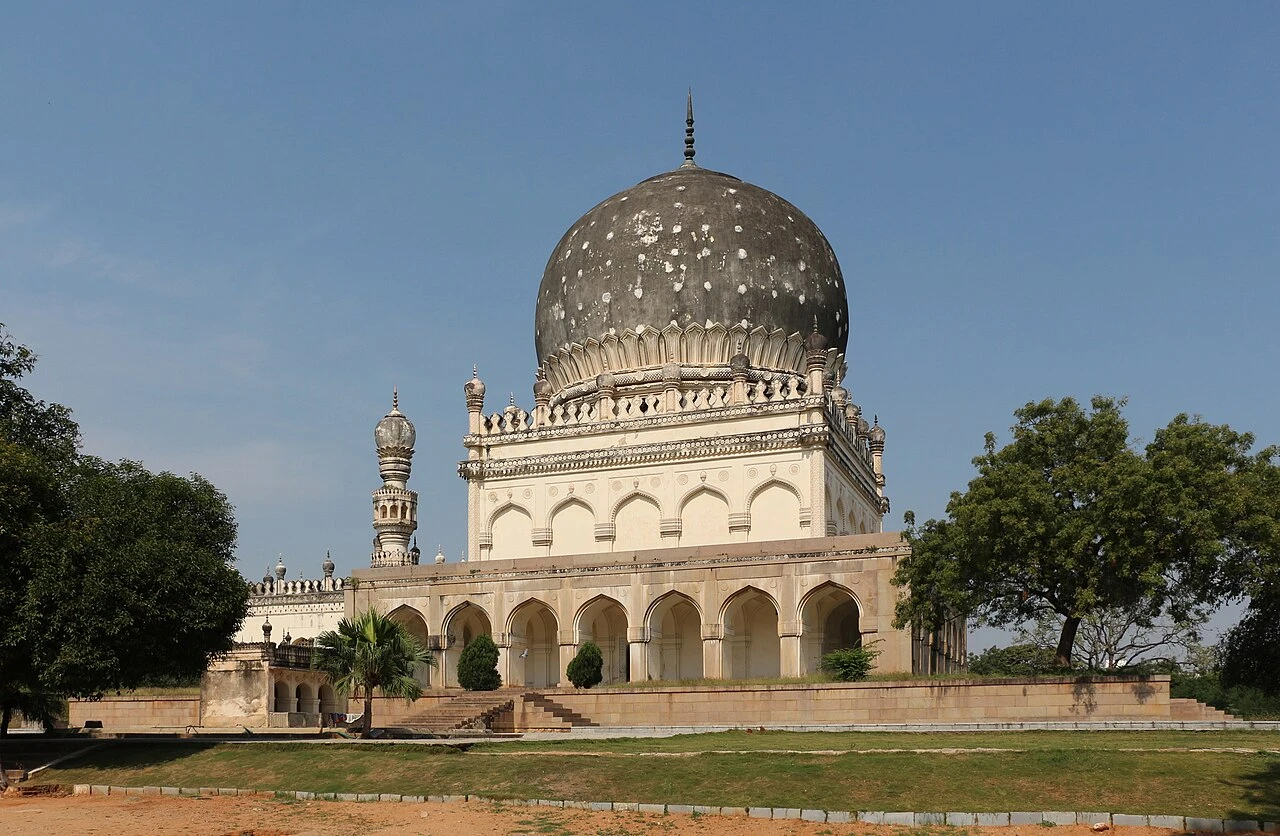
01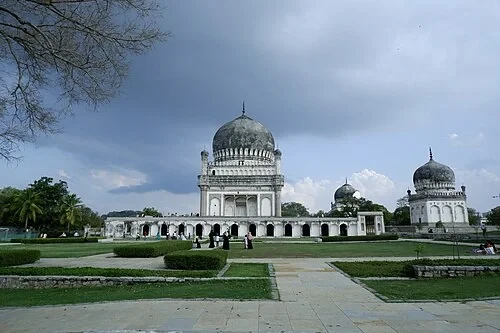 Ibrahim Bagh and the Royal GardensThe Royal Garden Necropolis
Welcome to the Ibrahim Bagh, a historic garden landscape once known to the Qutb Shahi court as "Lagar-e-Faiz Athar," meaning a place of bountiful entertainment. Today, this park functions as a royal necropolis of grand scale, containing the mausoleums of seven of the eight dynasty rulers who governed this region. As you look across the landscaped lawns, you can see towering domes rising against the skyline. These structures represent a unique architectural fusion, combining Persian elegance, robust Pashtun masonry, and delicate Hindu decorative motifs. This blend of styles became the hallmark of Deccan architecture, defining the region's artistic identity for generations. The layout of the gardens served both a social and a spiritual purpose, combining royal leisure with the solemnity of ancestral remembrance. The sprawling parkland connects these massive structures, allowing visitors to walk from one monumental reign to another. Notice how the pathways align with the various domes, creating framed views of the stone structures as you navigate the grounds.
Photo: Manu prasad52 · CC0
02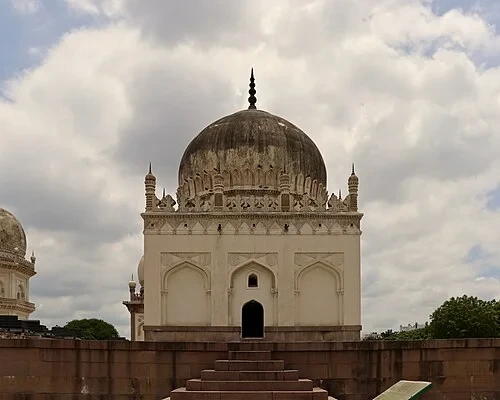 Mausoleum of Sultan Quli Qutb-ul-MulkTomb of Sultan Quli
Initiated around 1543, this tomb belongs to Sultan Quli Qutb-ul-Mulk, the founder of the Qutb Shahi dynasty. The design of this monument established a strict architectural blueprint that successive rulers would follow and expand upon for over a century. A square base forms the foundation, which transitions upward into an octagonal mortuary chamber, finally crowned by a rounded dome. The entire structure rises from an elevated stone terrace that measures precisely 30 meters on each side, providing a sturdy, raised platform that separates the sacred tomb from the surrounding gardens. By raising the monument on a plinth, the builders ensured it would dominate the immediate landscape. The simple yet balanced proportions of this building reflect the early phase of Deccan architecture, before later sultans introduced more elaborate ornamentation. Walking around the base, you can observe the clean lines of the stone masonry and the transition from the square foundation to the circular dome above. This fundamental layout remains visible in nearly every mausoleum across the entire necropolis.
iMahesh · CC BY-SA 4.0
03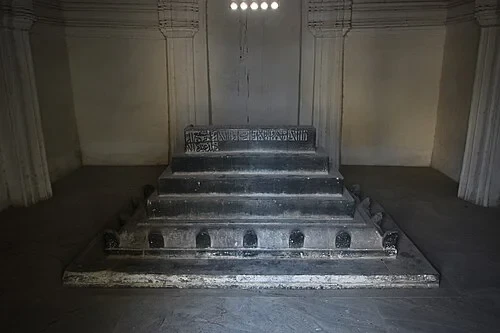 Mausoleum of Sultan Quli Qutb-ul-MulkSarcophagus of Sultan Quli
Stepping into the quiet interior sanctuary of Sultan Quli's tomb reveals a tiered, dark basalt sarcophagus resting in the center of the chamber. The polished dark stone contrasts sharply with the plain, high walls of the room, creating an intimate and solemn atmosphere. Fine calligraphic inscriptions are carved into the sides of the stone, executed by master artists of the sixteenth century. These early inscriptions record religious verses alongside details of the sultan's life and reign. While this beautifully carved sarcophagus is the primary focus of the inner chamber, it does not actually contain the royal remains. The true burial vault lies in a hidden crypt located directly beneath the floor, ensuring that the body remains in direct contact with the earth, in keeping with traditional funerary practices. Light filters into the room through arched openings, illuminating the dark stone surface and revealing the tool marks of the ancient stonemasons. The cool air inside the thick masonry walls provides a quiet space for reflecting on the origin of the dynasty.
Listen in the appPhoto: Sailko · CC BY 3.0
04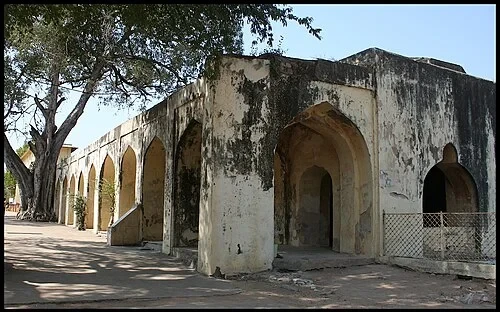 The Mortuary BathThe Mortuary Bath
Near the tombs stands the Hammam, a mortuary bathhouse dedicated to the ritual washing of royal bodies before their final interment. This building played an essential part in the funerary rites of the Qutb Shahi court, ensuring that deceased kings and family members were prepared in strict accordance with religious customs. The exterior architecture of the bathhouse features prominent Turkish and Persian design elements, reflecting the diverse cultural influences that shaped daily life and customs in the Golconda kingdom. These international architectural styles were imported by merchants, builders, and scholars who frequented the active royal court. The structure's dome-topped chambers and arched entryways mirror the bathhouses found in contemporary Safavid Persia and the Ottoman Empire. By integrating these foreign designs with local stone construction, the builders created a functional yet dignified space for the final earthly preparations of the elite. The exterior's modest, sturdy appearance conceals the highly organized interior water systems that supported these sacred cleansing rituals.
Listen in the appKandukuru Nagarjun from Bangalore, India · CC BY 2.0
05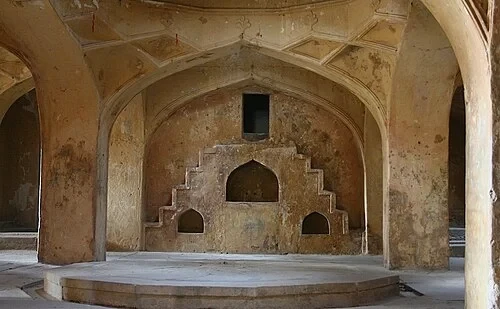 The Mortuary BathThe Mortuary Chamber
Inside the quiet rooms of the Hammam, you can observe the specialized stone structures designed for preparing the deceased royal family members. Circular stone platforms rise from the floor, serving as the tables where the ritual washings occurred. Stepped recesses built into the thick walls likely held lamps, oils, and the vessels used during the cleansing process. Along the stone floors, narrow channels cut directly into the masonry once delivered hot and cold water from external boilers. The architecture of this chamber was carefully designed to maintain a quiet, private, and deeply respectful environment for those tasked with performing these intimate duties. The thick stone walls insulated the interior from the sounds of the outer gardens, maintaining a cool temperature year-round. Although the water has long since dried and the chambers are now empty, the layout of the plumbing and platforms remains completely intact. These structural details offer a rare glimpse into the highly organized court rituals and sanitary practices of the medieval Deccan rulers.
Listen in the appKandukuru Nagarjun from Bangalore, India · CC BY 2.0
06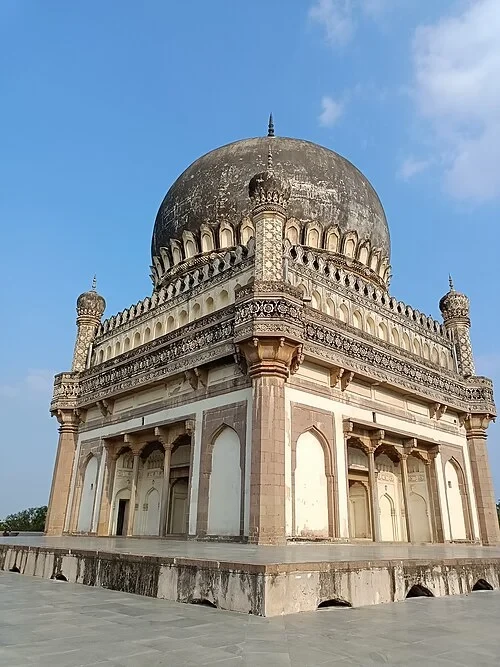 Mausoleum of Muhammad Quli Qutb ShahMausoleum of Muhammad Quli
Commemorating Muhammad Quli Qutb Shah, the fifth sultan and the founder of the nearby city of Hyderabad, this grand mausoleum represents the peak of the dynasty's architectural ambition. As the largest monument in the complex, it commands attention from across the gardens. The entire building rests on an immense square terrace measuring 65 meters on each side, rising 4 meters above the ground level. Two distinct levels of galleries wrap around the exterior, featuring elegant rows of pointed arches that soften the massive stone facade. Above these galleries rises a towering, bulbous dome, which showcases how the dynasty's structural capabilities expanded over generations. This monument is significantly larger and more decorated than the tomb of the dynasty's founder, reflecting the immense wealth and power accumulated by the state by the early seventeenth century. The open galleries on the terrace level once provided visitors and mourners with shaded walkways looking out over the gardens. Walking along the wide stone platform reveals the sheer scale of the masonry required to support the massive dome above.
Listen in the appPhoto: Tarunsamanta · CC BY-SA 4.0
07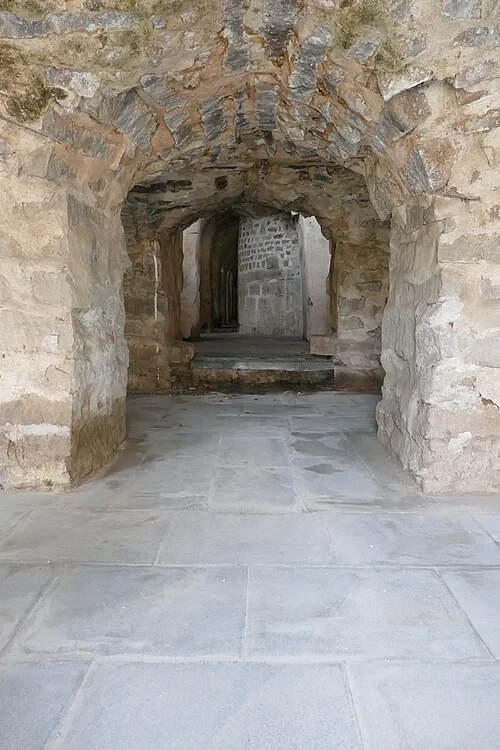 Mausoleum of Muhammad Quli Qutb ShahThe Vaulted Passageway
Beneath the massive upper terrace of Muhammad Quli’s tomb lies a quiet network of vaulted corridors and heavy stone arches. This lower level showcases the advanced engineering required to support the immense weight of the double-storied mausoleum and its giant dome. The thick masonry arches are strategically positioned to distribute the load of the heavy stone platform and structure above, channeling the pressure down into deep, stable foundations. Walking through these cool, shaded passageways, you can observe the rough-hewn stone surfaces and the precision of the interlocking arch stones. This functional basement area was not built for public display, yet the quality of its structural masonry matches the visible exterior of the monument. By creating this vaulted substructure, the builders successfully elevated the tomb chamber above the garden level while preventing the colossal building from settling into the soil. The play of light and shadow through the repeating arches reveals the structural rhythm that holds up one of the largest historic domes in the region.
Listen in the appPhoto: Kritzolina · CC BY-SA 4.0
08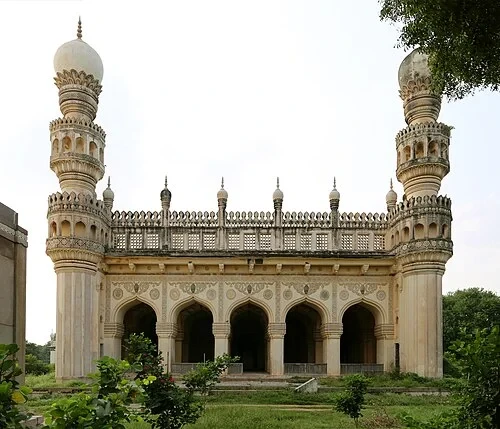 The Great Mosque of Hayat Bakshi BegumGreat Mosque of Hayat Bakshi
Commissioned in 1666, this expansive mosque was built by Hayat Bakshi Begum, a highly influential queen mother who ruled the Qutb Shahi kingdom as regent during a period of transition. The facade of the prayer hall features five grand pointed arches, a layout typical of the region's royal mosques. On either side of the facade, two lofty minarets rise high into the sky, detailed with decorative balconies and crowned by bulbous dome caps. Along the roofline, fifteen small cupolas line the parapet, standing as a primary example of late Qutb Shahi religious architecture. The mosque was built to serve the religious needs of the royal family and visitors to the tomb gardens, establishing a sacred space adjacent to the ancestral mausoleums. The combination of grand public scale and elegant detailing highlights the political power and architectural legacy of Hayat Bakshi Begum, who was one of the few women to commission major state monuments in the Golconda sultanate. The courtyard in front of the arches provided ample space for congregation during Friday prayers.
Listen in the appPhoto: Sailko · CC BY 3.0
09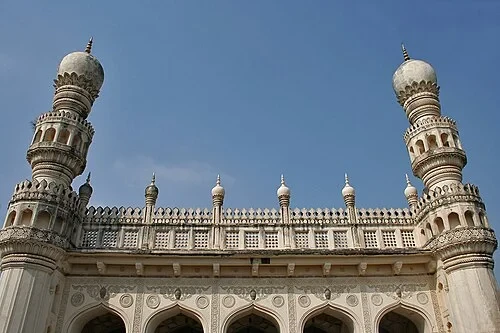 The Great Mosque of Hayat Bakshi BegumThe Mosque Roofline
Gazing up at the upper parapet and minarets of the Hayat Bakshi Mosque reveals the intricate stucco work created by seventeenth-century craftsmen. Geometric plaster screens run along the roofline, designed to allow light and air to pass through while forming complex repeating patterns. Small, ornamental mini-minarets are topped with decorative bulbous caps, echoing the form of the larger domes found across the necropolis. The stucco decorations blend Islamic geometric design with traditional Hindu floral and architectural motifs, showing how local Hindu artisans adapted their skills to the aesthetic preferences of the Muslim court. This ornamental plasterwork was built using a durable lime mortar mix, which has survived centuries of monsoon rains. The details are particularly visible where the plaster joins the stone minarets, showing the precise hand of the carvers who worked directly on the high scaffolding. These subtle decorative bands break up the heavy appearance of the stone walls, adding a sense of lightness and intricate detail to the sacred structure.
Listen in the appPhoto: J.M.Garg · CC BY-SA 4.0
10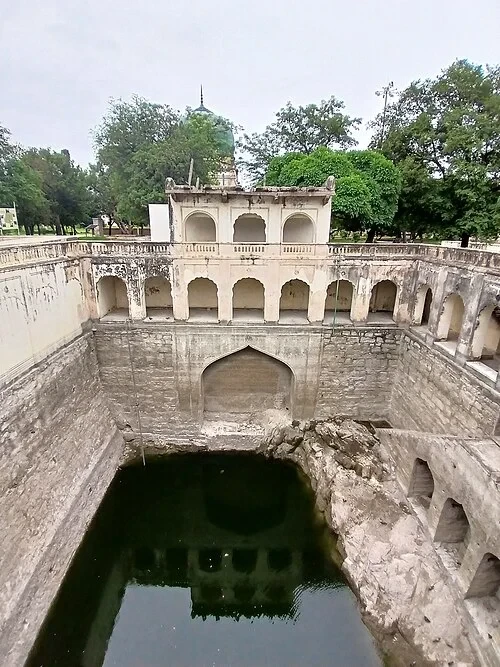 The Badi Baoli Step-wellThe Badi Baoli Step-Well
Key to the survival of the lush landscapes surrounding the tombs is the Badi Baoli, a massive step-well engineered to collect and store rainwater. This deep, rock-cut pool is surrounded by multi-tiered stone masonry structures, designed to provide easy access to the water at varying levels throughout the dry and wet seasons. In the past, this step-well served as the vital water source for irrigating the extensive royal orchards, flowerbeds, and decorative gardens of the Ibrahim Bagh. Water was drawn up using animal-powered pulley systems and directed into a network of stone channels that ran across the complex. The sheer scale of the masonry walls indicates that the step-well was constructed not just for utility, but as a significant piece of civic architecture. The thick stone arches built into the sides of the well walls helped prevent the surrounding soil from collapsing into the pool, showing a sophisticated understanding of hydraulic engineering and soil mechanics in the medieval Deccan.
Listen in the appPhoto: Shishirdasika · CC BY-SA 4.0
Qutb Shahi Tombs
Frequently asked questions
How much does the guide cost?
Free app download. Listed guide price: $3.99. Guide price shown in the app. Audio guide only. Venue admission is separate.
Can I listen without internet?
Yes. Download the guide’s audio, images, and maps in the app before your visit. Your downloaded content is then available offline.
Can I listen in my language?
Stanza supports 15 languages. Check the app for the languages available for this guide.
Do I need to follow a schedule?
No. This is a self-guided experience. Choose your stops, pause whenever you like, and return to a story at your own pace.
At your own pace
Explore Qutb Shahi Tombs.
Download Stanza, then search for “Qutb Shahi Tombs”.
Free app download · Guide price shown in the app
Keep exploring
Nearby audio guides
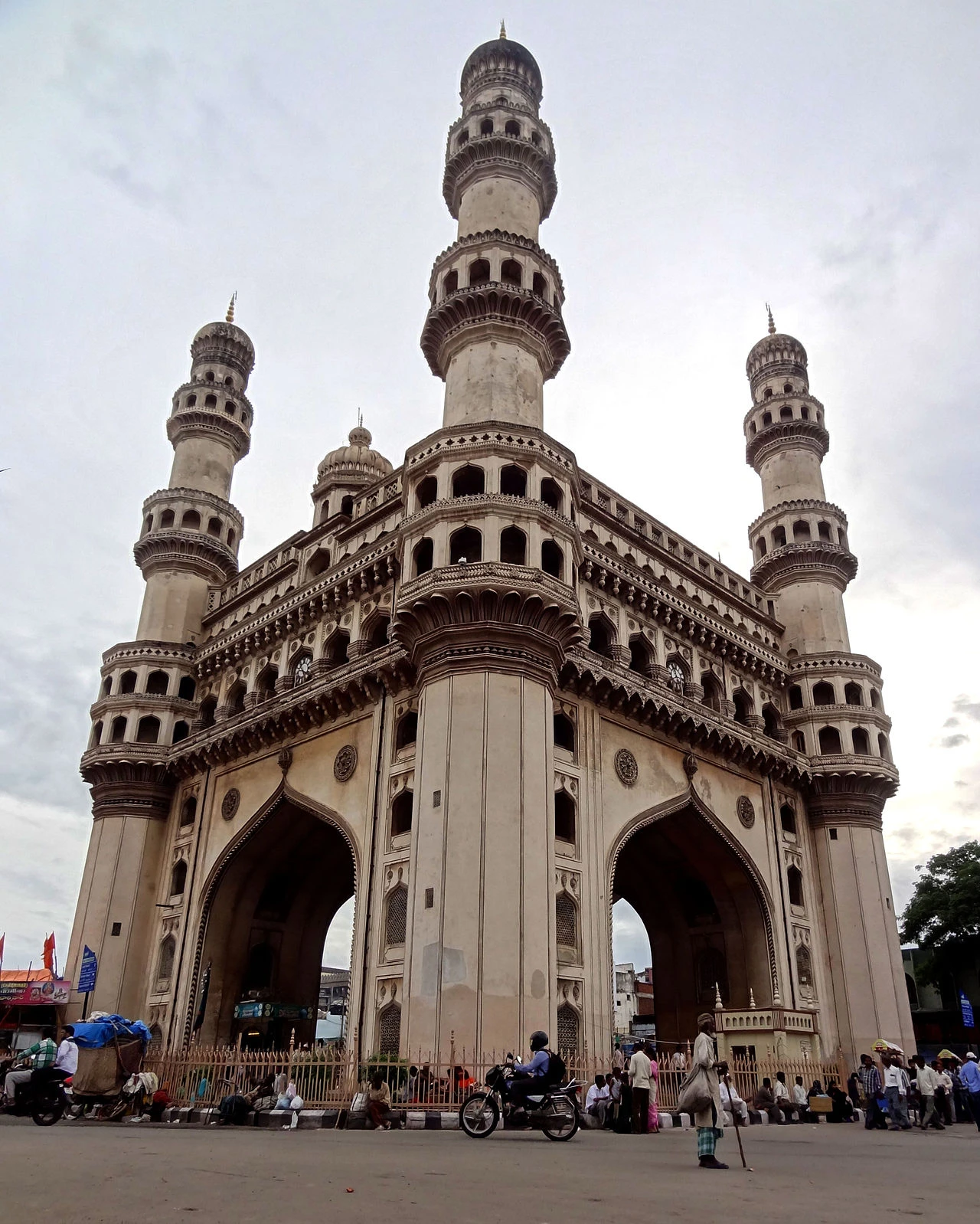
Hyderabad
Charminar
Content & sources
Gopikrishna Narla · CC BY-SA 3.0
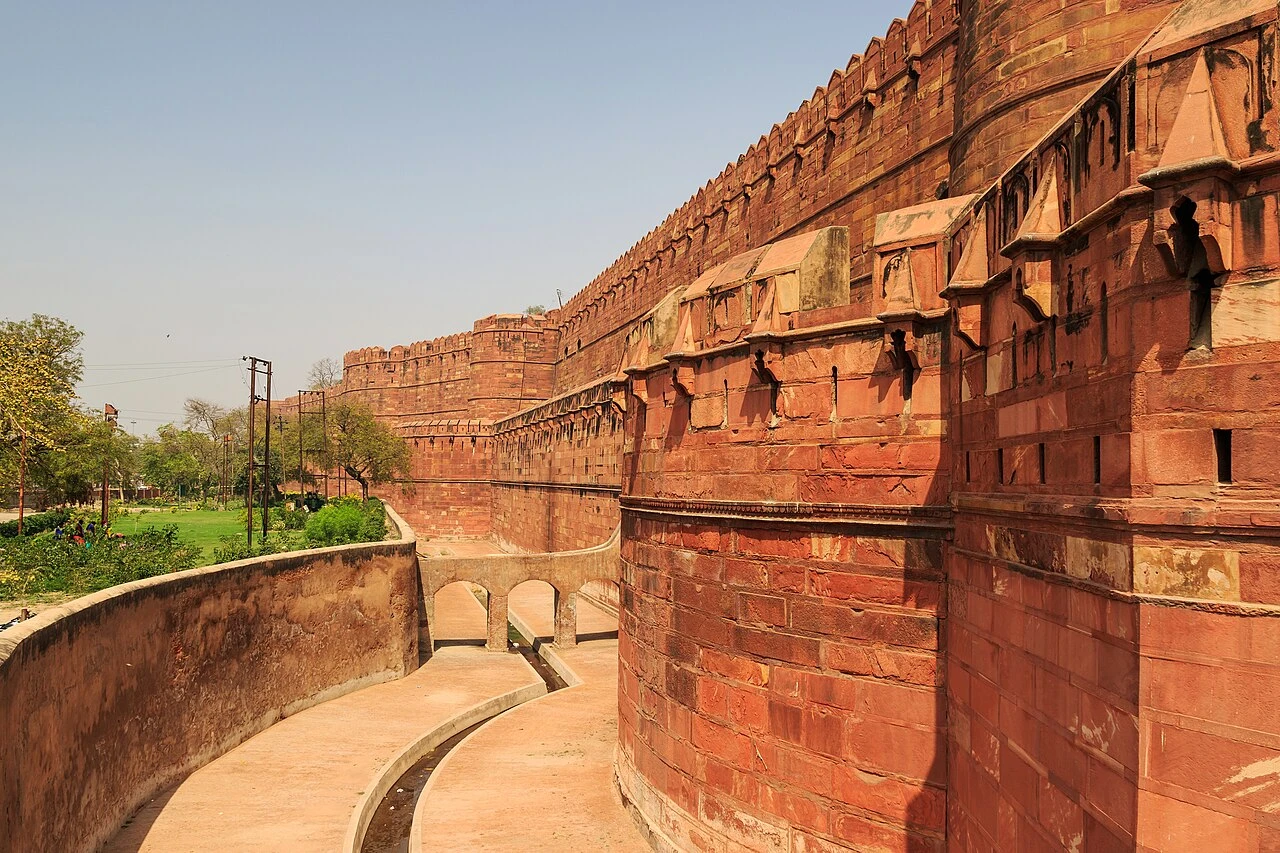
Agra
Agra Fort
Content & sources
Photo: A.Savin · FAL
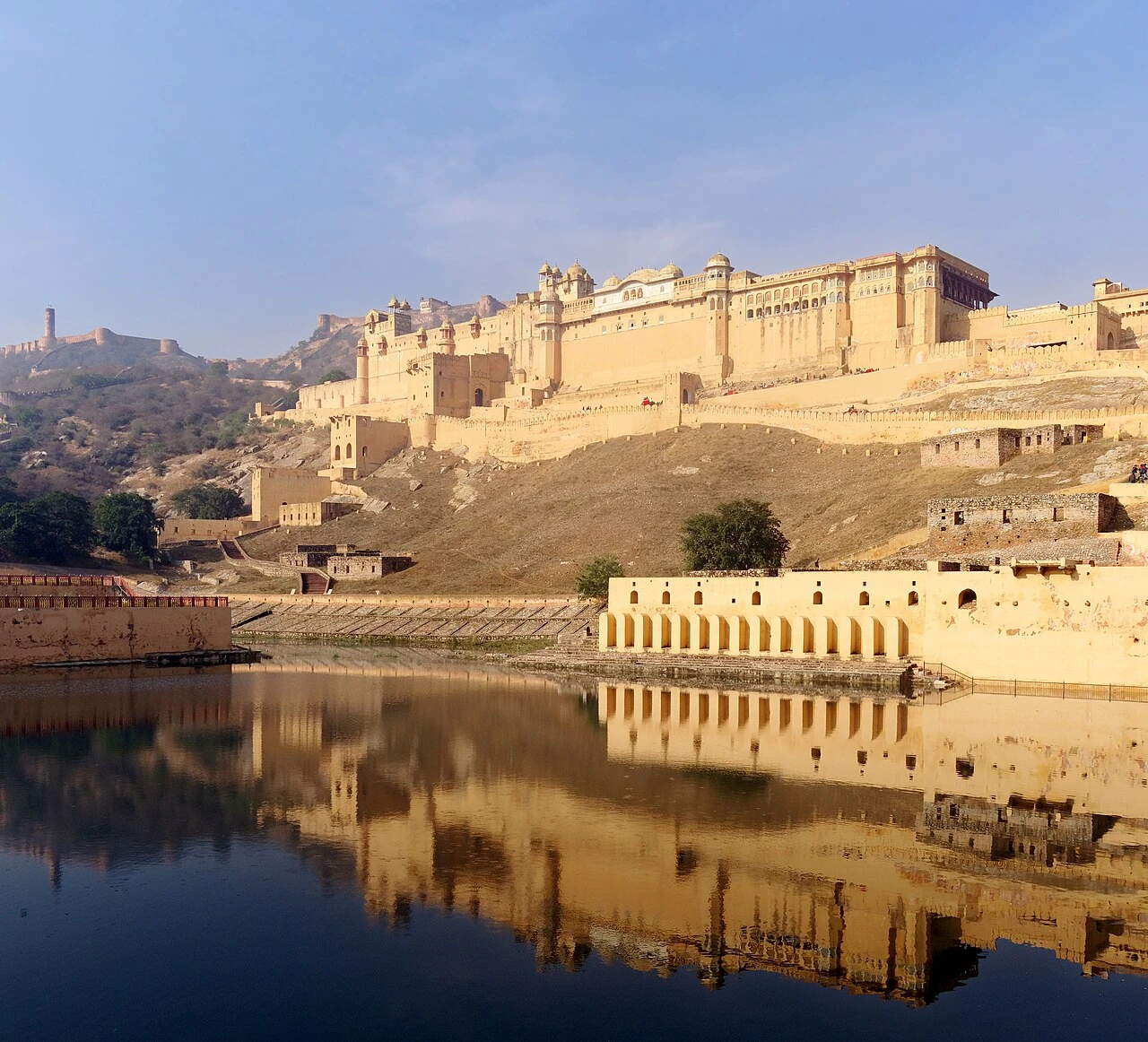
Jaipur Municipal Corporation
Amber Fort
Content & sources
Jakub Hałun · CC BY-SA 4.0
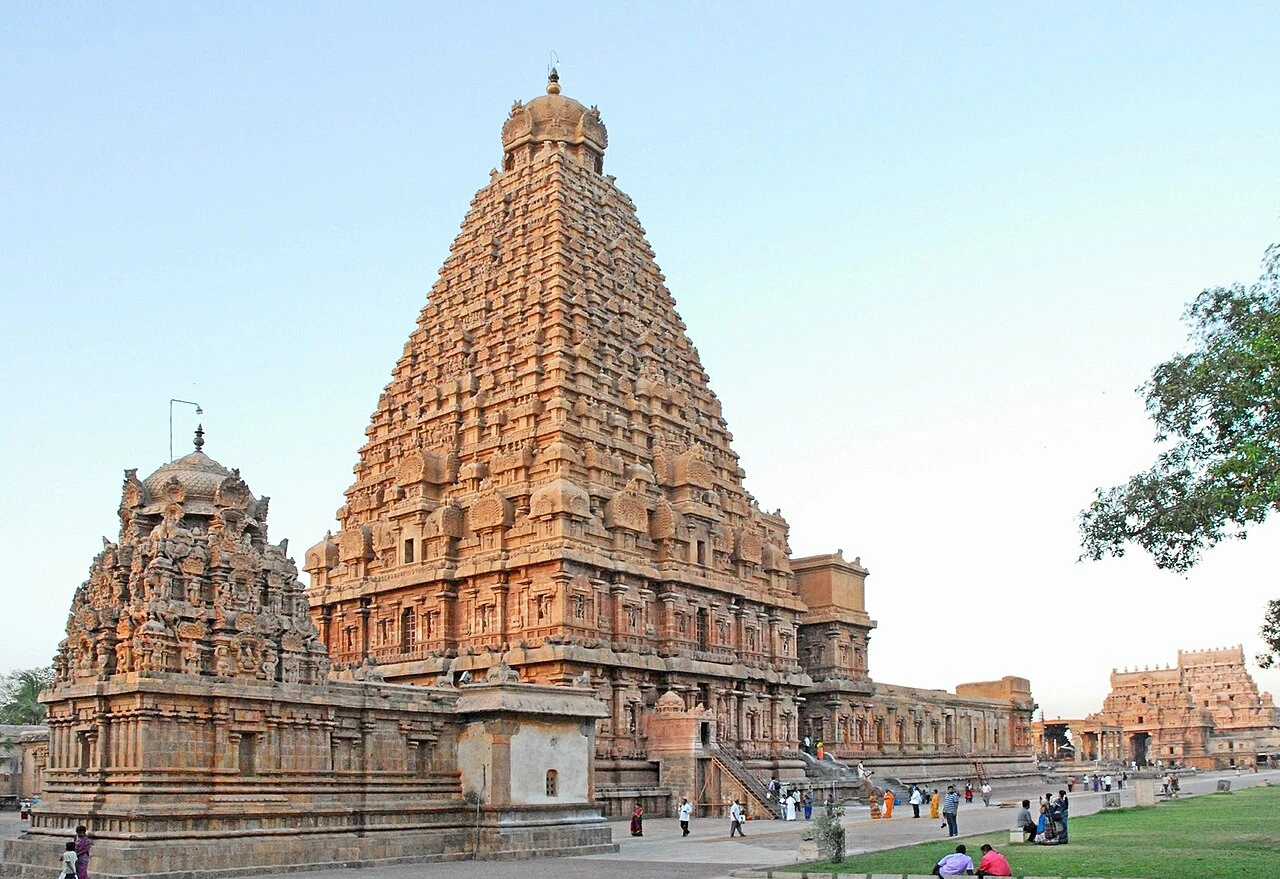
Thanjavur
Brihadisvara Temple
Content & sources
Jean-Pierre Dalbéra from Paris, France · CC BY 2.0