Stanza · Audio guide
Ellora Caves Audio Guide
A place to remember. A story to take with you.
The Ellora Caves are a UNESCO World Heritage Site in Aurangabad, India, featuring one of the largest rock-cut cave complexes in the world. The site contains artwork dating from AD 600–1000 and serves as a…
Download Stanza, then search for “Ellora Caves”.
About the tour
One guide. Your kind of visit.
The Ellora Caves are a UNESCO World Heritage Site in Aurangabad, India, featuring one of the largest rock-cut cave complexes in the world. The site contains artwork dating from AD 600–1000 and serves as a leading example of Indian rock-cut architecture.
Ready when you are.
- 01Get the free Stanza app.
iOS & Android
- 02Find your guide.
“Ellora Caves”
- 03Download before you go.
Works offline
Audio guide / 17 narrated stops
Inside the guide
Get to know a few of the stories before you go. Open a stop to read more.
01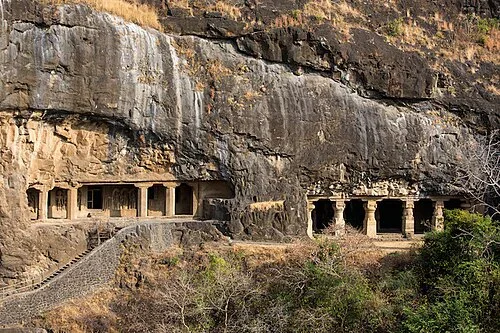 The Charanandri Cliff and Early Monasteries (Caves 1–5)
The Charanandri Cliff: An Orientation
Welcome to Ellora, in the Charanandri hills of Maharashtra. More than a hundred caves were cut into this basalt cliff, and thirty-four are open to visitors. They stretch for roughly two kilometres along the rock face. Work began around 600 CE and carried on for centuries. Twelve Buddhist caves sit at one end, seventeen Hindu caves in the middle, and five Jain caves beyond them. Buddhist, Hindu and Jain communities carved their sanctuaries side by side, often at the same time. The caves served as temples and monasteries, and as a rest stop for pilgrims travelling an ancient trade route through the Deccan. Royalty paid for the carving, and so did traders and wealthy families of the region. The cliff is a leading example of Indian rock-cut architecture, from simple monastic cells to temples cut as single pieces of stone.
Photo: Torchtelangana · CC BY-SA 4.0
02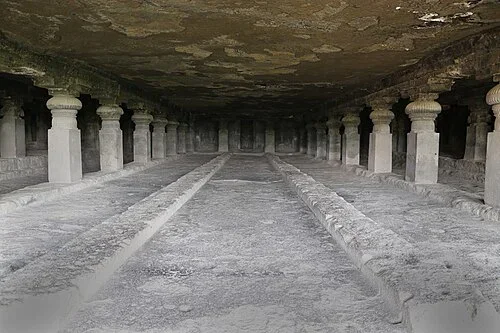 The Charanandri Cliff and Early Monasteries (Caves 1–5)
Cave 5: A Monastic Assembly Hall
Eleven of the twelve Buddhist caves here are viharas, monasteries carved straight into the mountain face. A vihara held prayer halls, living and sleeping quarters, kitchens and other rooms, all cut from the rock. Shrines carried images of Gautama Buddha, bodhisattvas and saints. Cave 5 stands out among them. Its long pillared hall has a pair of parallel stone benches running down the centre, with a Buddha shrine at the far end. The benches mark it out as a refectory, a place for the monastic community to gather and eat. Only one other Buddhist cave in all of India, Cave 11 of the Kanheri Caves, was arranged this way. A hall like this one could receive pilgrims as well as the monks.
Photo: Sailko · CC BY 3.0
03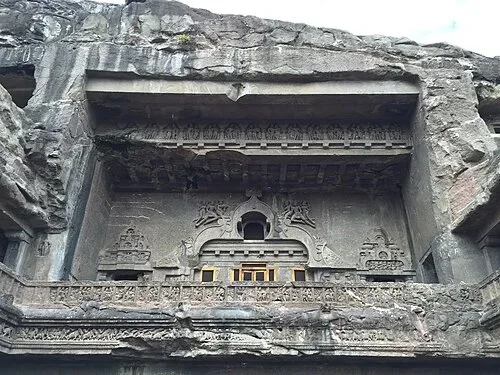 Vishvakarma Chaitya: The Carpenter's Cave (Cave 10)
Vishvakarma Cave 10: The Chaitya Facade
Cave 10 is the one Buddhist cave at Ellora built purely for worship. It is the only dedicated chaitya-griha, a prayer hall, among the twelve, cut around 650 CE and modelled on similar lines to Caves 19 and 26 at Ajanta. The facade rises in several storeys, and its great arched window, the gavaksha or chandrashala, opens above the portico like an enormous horseshoe. The cave actually combines two buildings in one: a monastery with eight subsidiary cells, four in the back wall and four on the right, and the chapel-like hall itself. A passage even connects it sideways to Cave 9 next door.
Listen in the appPrithwiraj Dhang · CC BY-SA 3.0
04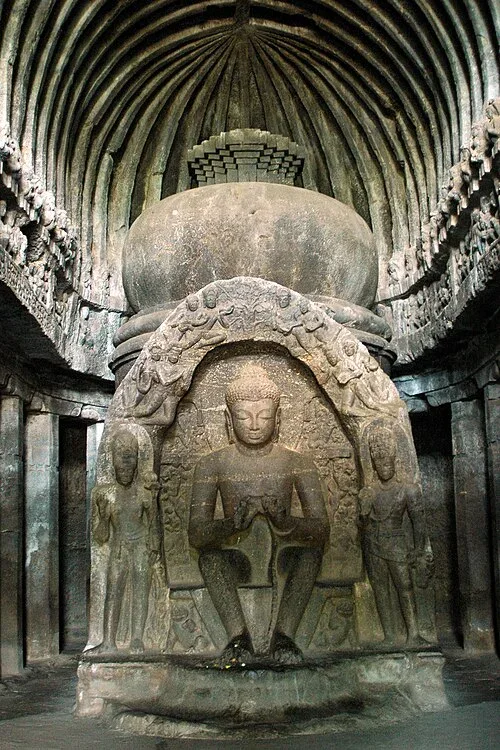 Vishvakarma Chaitya: The Carpenter's Cave (Cave 10)
The Carpenter's Prayer Hall
Inside, the hall runs apsidal, rounded at its far end. Twenty-eight octagonal columns divide it into a central nave and side aisles. The vaulted roof carries ribs carved straight out of the rock, imitating the wooden beams of a carpenter's roof, which is how the cave got its name. At the rounded end stands a stupa, and on its face sits a colossal Buddha, about fifteen feet high, in the posture of teaching. A large Bodhi tree is carved at his back. Above the pillars run friezes of Naga queens. The reliefs around the hall show dancers, musicians and entertainers, signs of a prayer hall that was a crowded, living place of worship.
Listen in the appPrithwiraj Dhang · CC BY-SA 3.0
05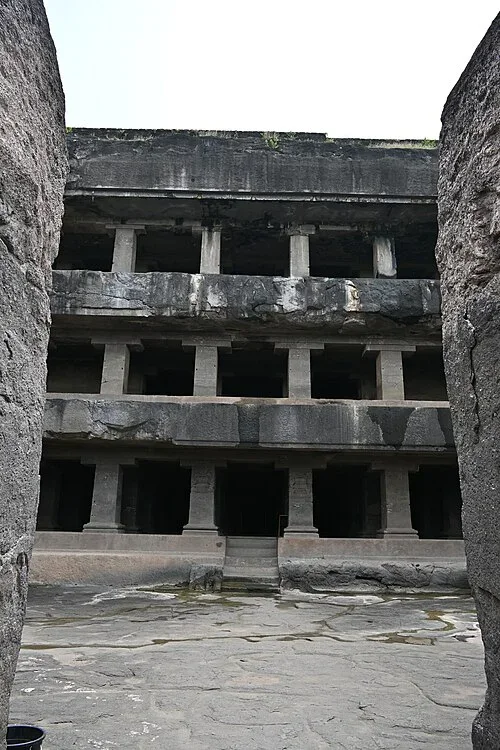 Tin Thal: The Three-Storeyed Monasteries (Cave 12)
Tin Thal: The Three-Storey Monastery
Caves 11 and 12, at the southern end of the cliff, take the monastery idea to its limit. Do Thal means two storeys, Tin Thal three, and Cave 12 really does rise three full floors out of the hillside. Each storey was excavated floor by floor, the workers cutting down into the rock level by level. They were built either between 630 and 700, or 600 and 730 CE, and they were the last of the Buddhist excavations at Ellora. What the earlier monastery caves did in a single hall, these did as whole institutions, with prayer halls, shrines and living space stacked one above the other.
Listen in the appPhoto: Vinayaraj · CC BY-SA 4.0
06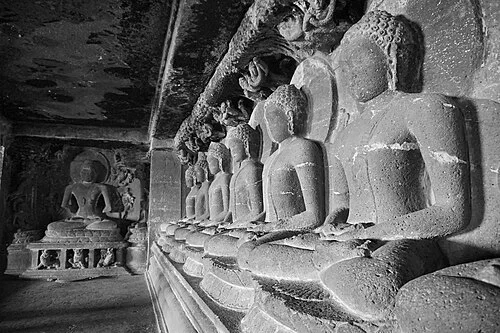 Tin Thal: The Three-Storeyed Monasteries (Cave 12)
Row of Buddhas, Cave 12
These rows of seated Buddhas line the shrine walls of Cave 12, the three-storey monastery. The carvings here belong to Mahayana Buddhism, but they carry something newer: Vajrayana, the Tantric turn. The walls hold mandalas, numerous goddesses and Bodhisattva imagery, all cut in stone. These caves are compelling evidence that Vajrayana and Tantric ideas of Buddhism were already well established in South Asia by the 8th century CE. A quiet wall of meditating Buddhas, in other words, fixes a turning point in Buddhist thought into the rock.
Listen in the appPhoto Dharma from Sadao, Thailand · CC BY 2.0
07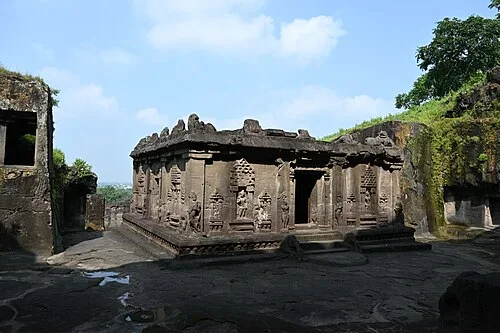 Dashavatara Cave: Pavilion and Avatar Reliefs (Cave 15)
Dashavatara Cave 15: The Courtyard Pavilion
Cave 15 began one way and ended another. Its cells and layout are so like Buddhist Caves 11 and 12 that scholars think it may first have been planned as a Buddhist cave. Then the plan changed. At its entrance stands the Nrtya Mandapa, a dance pavilion, and a free-standing monolithic mandapa rises in the open court, with the two-storeyed excavated temple behind. Those features belong to a Hindu monument, and the cave was completed as one, after Cave 14, Ravan ki Khai, during the Rashtrakuta period. One explanation is that the same architects and workers simply moved between Buddhist and Hindu projects. The other is that a planned Buddhist cave was adapted into a Hindu temple. Either way, the boundary between the two workshops was thin: Hindu images have even been found inside Buddhist Cave 11.
Listen in the appPhoto: Vinayaraj · CC BY-SA 4.0
08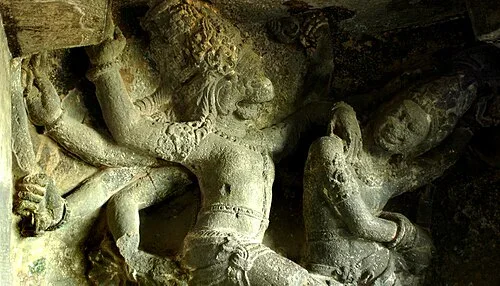 Dashavatara Cave: Pavilion and Avatar Reliefs (Cave 15)
Avatar Reliefs of Cave 15
The name Dashavatara means the ten avatars of Vishnu, and the upper floor of Cave 15 shows them in deep relief. Between the wall columns run large sculptural panels covering a wide range of themes, the avatar series at their heart. The finest, in the eyes of the art historian Coomaraswamy, shows the death of Hiranyakashipu. Vishnu in his man-lion form, Narasimha, emerges from a pillar and lays a fatal hand on the demon's shoulder. Other panels show the Gangadhara, the marriage of Shiva and Parvati, a dancing Shiva, and Govardhanadhari. Carmel Berkson notes that the panels are arranged in pairs, reinforcing each other with what she calls cooperative but also antagonistic energy.
Listen in the appPrithwiraj Dhang · CC BY-SA 3.0
09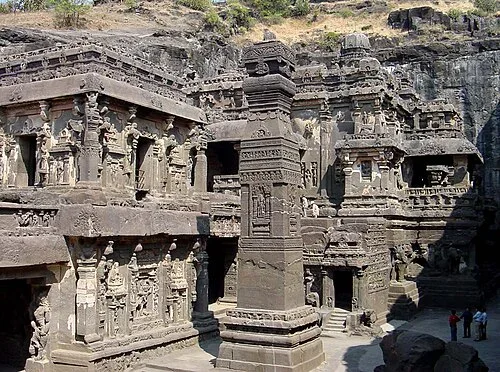 Kailash Temple: The Monolithic Marvel (Cave 16)
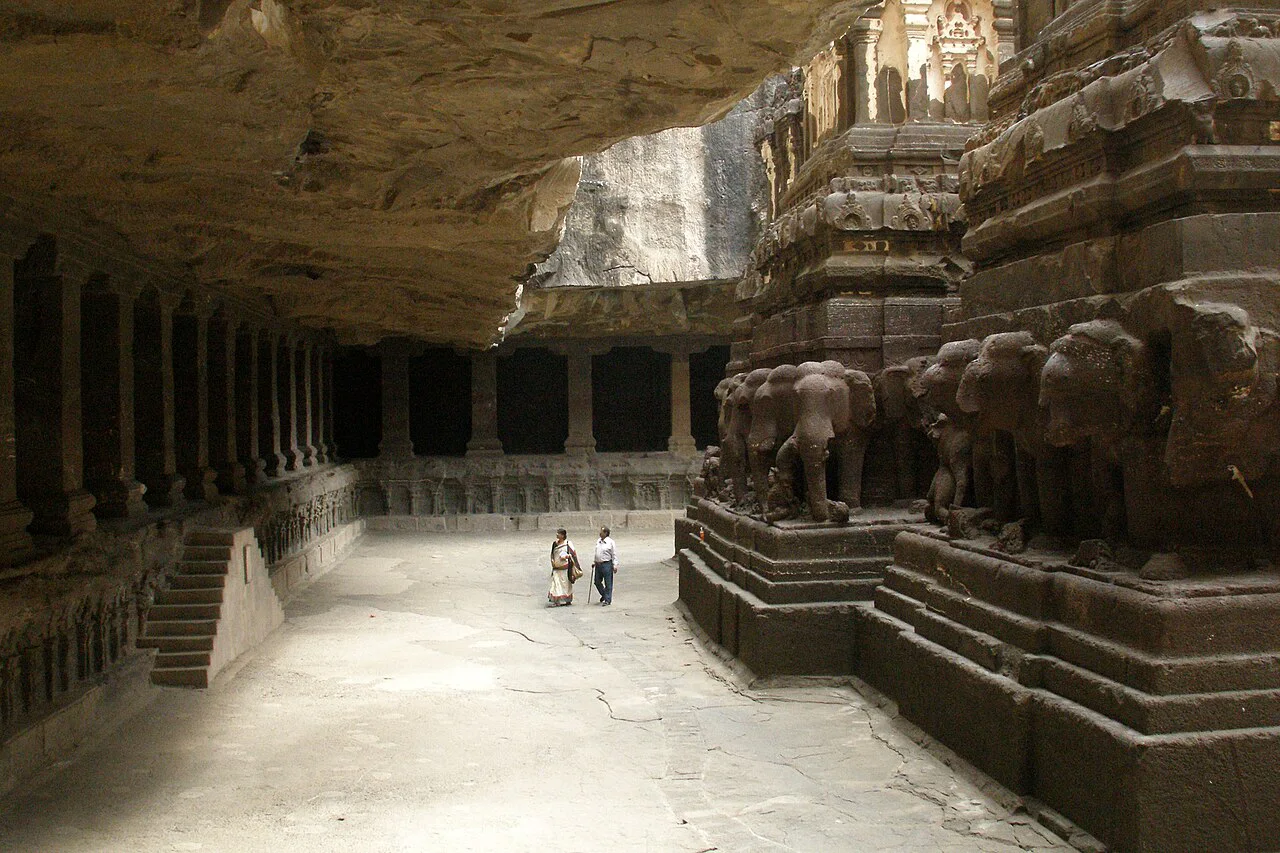
Kailash Temple: The Courtyard
Cave 16 holds the Kailash temple, dedicated to Shiva and inspired by his mountain home, Mount Kailash. The Rashtrakuta king Krishna I, who reigned from 756 to 773 CE, is credited with its construction. It follows the full anatomy of a Hindu temple, and every part is carved from one rock: a gateway with a low gopuram, an assembly hall, a multi-storey main temple, and a spire shaped like the sacred mountain itself. The layout follows the square principle, with a path for circumambulation around the sanctum, the garbha-griha, where the linga-yoni resides. Nandi, Shiva's sacred bull, stands on a porch in front. Around the main temple, shrines honor the whole pantheon: Ganga, Yamuna and Saraswati, the ten avatars of Vishnu, Vedic gods like Indra and Agni, and Ganesha, Harihara, Annapurna and Durga. The basement level alone carries Shaiva, Vaishnava and Shakti works, including twelve episodes from the childhood of Krishna.
Listen in the appPhoto: G41rn8 · CC BY-SA 4.0
10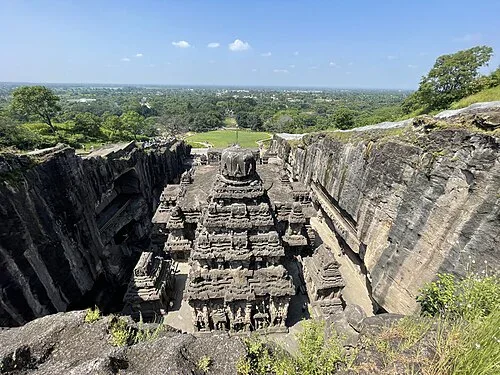 Kailash Temple: The Monolithic Marvel (Cave 16)
Carved from the Top Down
Every temple on this cliff was cut out of rock, but the Kailash went further: it was carved from the top down. There was no building up, no scaffolding, no blocks hauled into place. Sculptors started at the crest of the rock face and cut downwards, freeing the temple from the cliff as they descended. To do it, they removed about three million cubic feet of stone. That is roughly two hundred thousand tons. What remained is a freestanding, multi-level complex covering twice the area of the Parthenon in Athens, the largest single monolithic excavation in the world. The rock itself has a story. Ellora sits in the Deccan Traps, layers of basalt laid down by volcanoes in the Cretaceous period. That volcanic activity formed a west-facing cliff with a clean vertical face, giving architects access to many layers of rock. Where they wanted the finest detail, they could pick basalt with finer grains. A copper plate inscription from 812 CE, found in Baroda in Gujarat, records the wonder the finished temple caused. It describes a great edifice built on a hill at Elapura, the ancient name of Ellora, and says the master architect was suddenly struck with astonishment, saying, 'Oh, how was it that I built it!'
Listen in the appPhoto: Evilvoldy · CC BY-SA 4.0
- 11
Ravananugraha Relief, Kailash Temple
The crowded epic panels of the Kailash walls, and the demon who shakes the very mountain this temple imitates.
- 12
Rameshwar Cave 21: The Nandi Court
One of the earliest Hindu caves at Ellora, raised by the Kalachuri kings, with Shiva's bull facing the sanctum.
- 13
Yamuna at the Entrance of Cave 21
Two river goddesses guard the entrance of Cave 21, and a hidden triangle of geometry holds the temple's meaning.
- 14
The Vale Ganga Waterfall
The monsoon waterfall the first temple-builders folded into the heart of their sacred site.
- 15
Dhumar Lena, Cave 29
One of Ellora's earliest and largest halls, and the scholar who judged its giant figures clumsy.
- 16
Indra Sabha, Cave 32
The great Jain temple with the wrong name, and the communities still carving and worshipping here in the thirteenth century.
- 17
Ambika on Her Lion: Closing at the Jain Shrine
Ambika on her lion, the fine-grained stone that made her possible, and the end of Ellora's centuries of shared carving.
Ellora Caves
Frequently asked questions
How much does the guide cost?
Free app download. Listed guide price: $2.99. Guide price shown in the app. Audio guide only. Venue admission is separate.
Can I listen without internet?
Yes. Download the guide’s audio, images, and maps in the app before your visit. Your downloaded content is then available offline.
Can I listen in my language?
This audio guide is available in 15 languages, including English.
Do I need to follow a schedule?
No. This is a self-guided experience. Choose your stops, pause whenever you like, and return to a story at your own pace.
At your own pace
Explore Ellora Caves.
Download Stanza, then search for “Ellora Caves”.
Free app download · Guide price shown in the app
Keep exploring
Audio guides — India
Chhatrapati Sambhajinagar · 20 km
Bibi Ka Maqbara
Content & sources
Photo: Sailko · CC BY 3.0
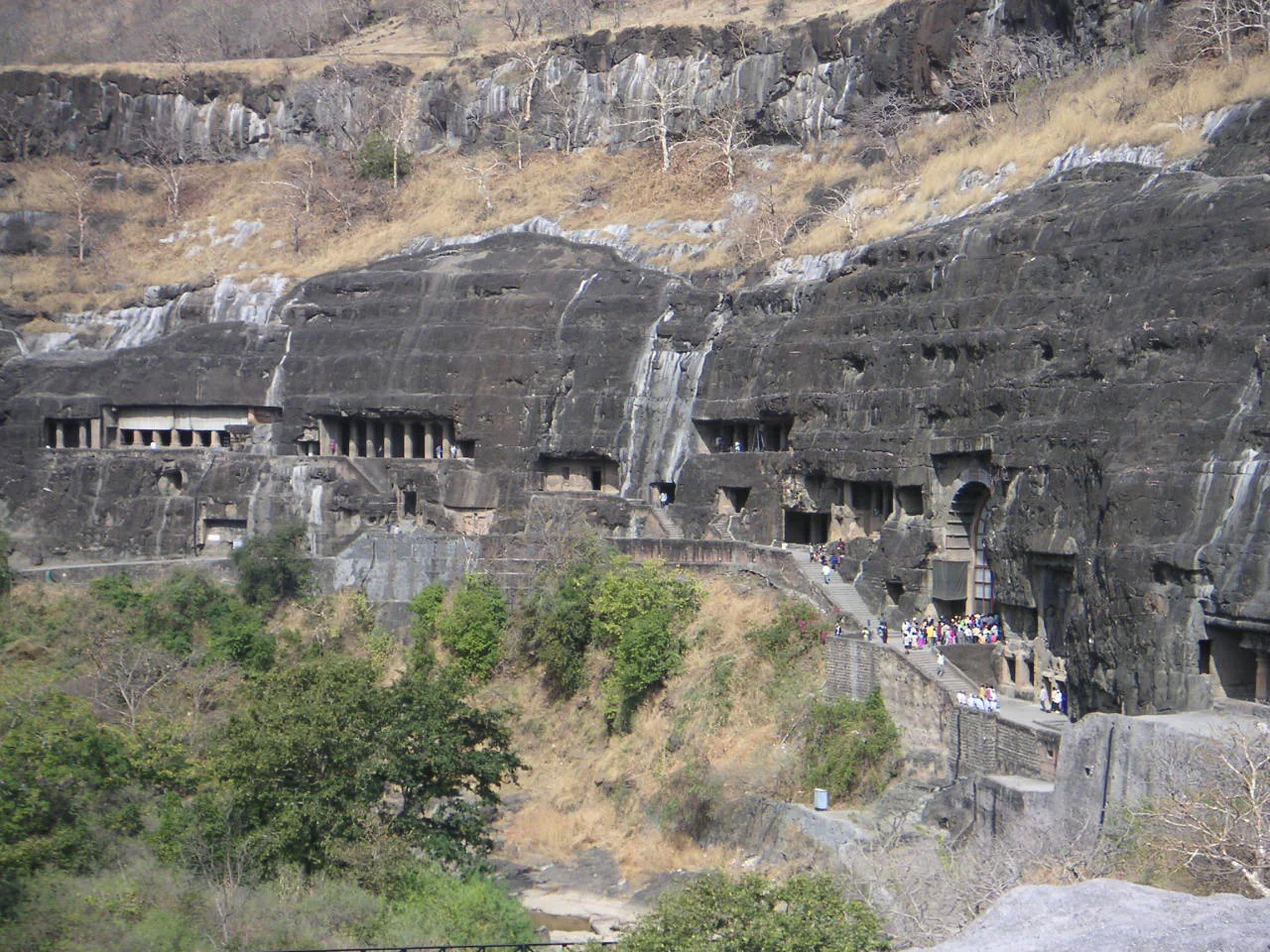
Aurangabad district · 80 km
Ajanta Caves
Content & sources
No machine-readable author provided. Soman assumed (based on copyright claims). · CC BY 2.5
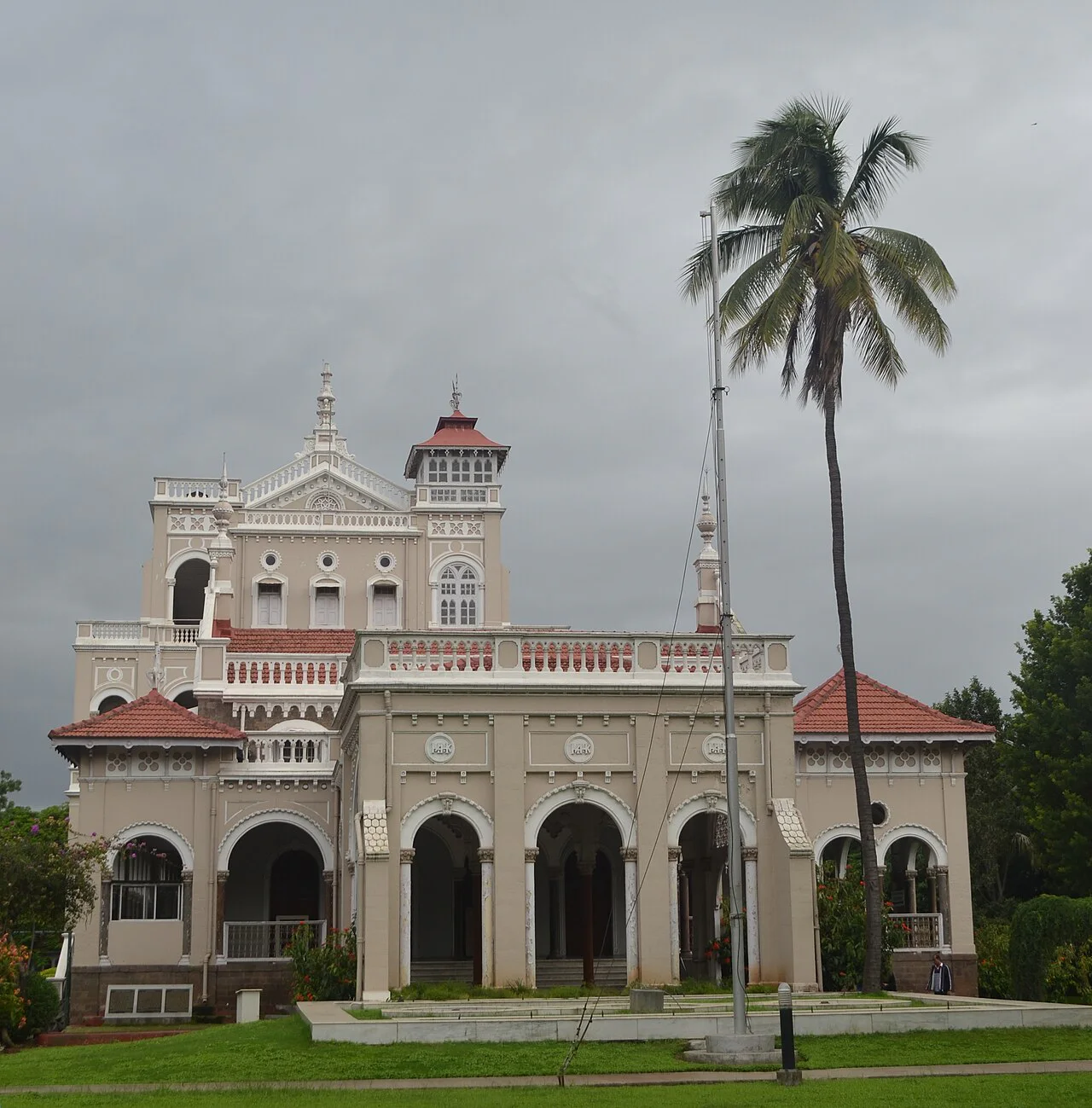
Pune
Aga Khan Palace
Content & sources
Aakash.gautam · CC BY-SA 3.0
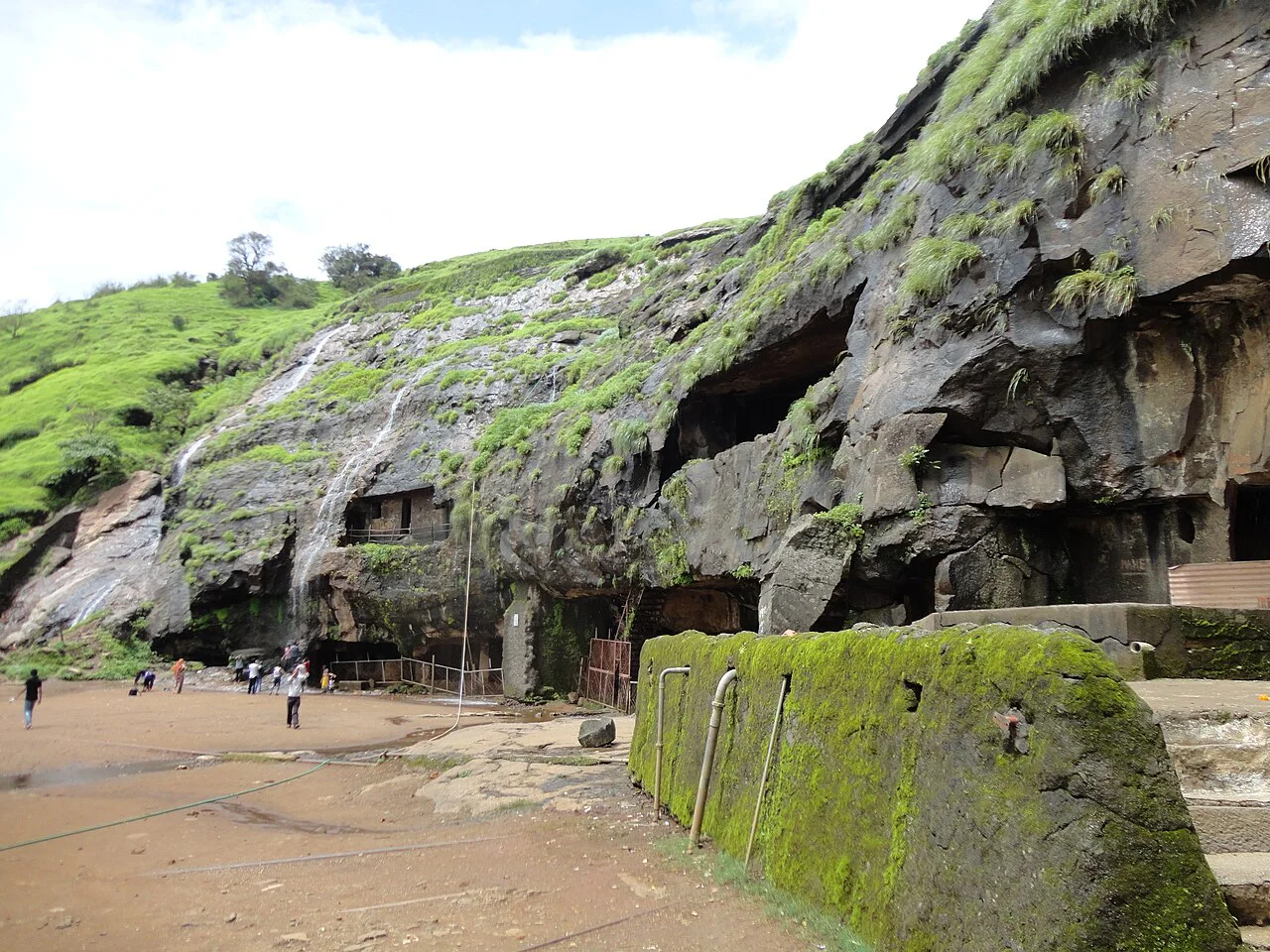
Karla
Karla Caves
Content & sources
Photo: Kalpeshzala59 · CC BY-SA 3.0