Stanza · Audio guide
Lohagad Audio Guide
A place to remember. A story to take with you.
Lohagad is a hill fort located in the Pune district of Maharashtra, India. It was captured by Chhatrapati Shivaji Maharaj in 1648 and remained under the Maratha empire until 1818.
Download Stanza, then search for “Lohagad”.
About the tour
One guide. Your kind of visit.
Lohagad is a hill fort located in the Pune district of Maharashtra, India. It was captured by Chhatrapati Shivaji Maharaj in 1648 and remained under the Maratha empire until 1818.
Ready when you are.
- 01Get the free Stanza app.
iOS & Android
- 02Find your guide.
“Lohagad”
- 03Download before you go.
Works offline
Audio guide / 12 narrated stops
Inside the guide
Get to know a few of the stories before you go. Open a stop to read more.
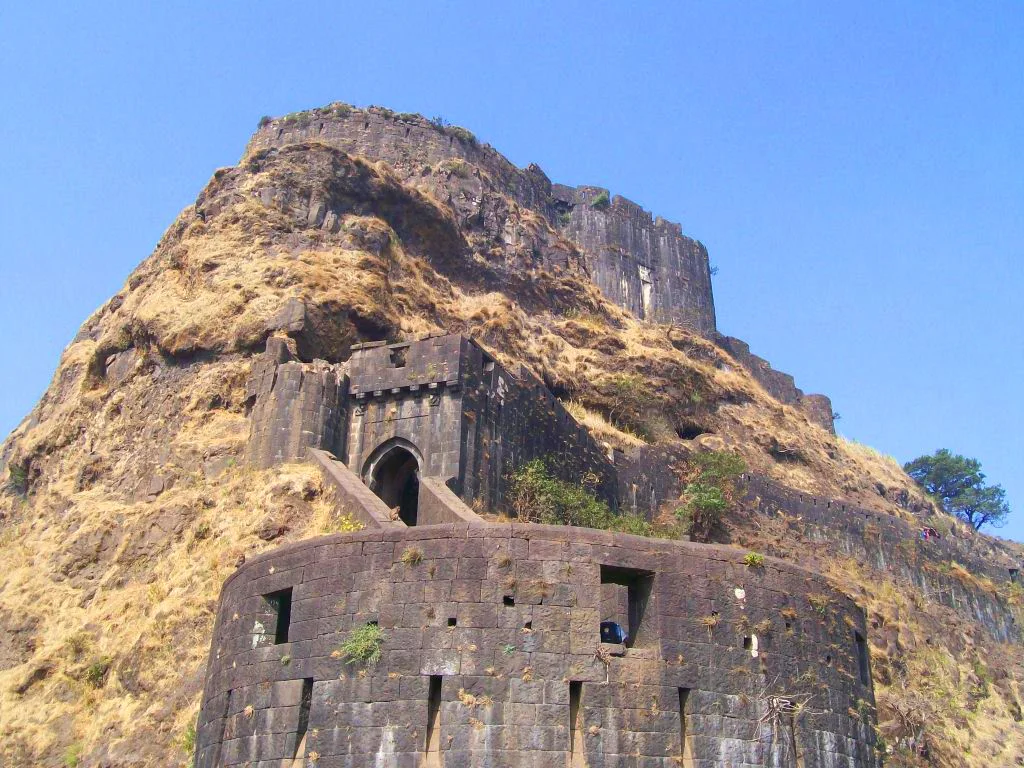
01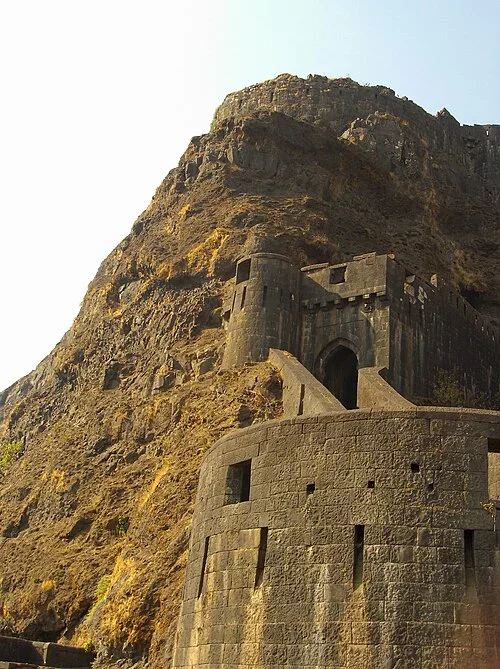 The Lower Ascent and Rock-Cut Caves
Approaching Lohagad Fort
Welcome to Lohagad, a hill fort standing high in the Western Ghats of Maharashtra. The name means Iron Fort, and the stone ahead has earned it. The hill rises to about a thousand meters above sea level, roughly fifty kilometers northwest of Pune. Its top overlooks the Pavana reservoir to the south and the passes that divide the Indrayani river from the Pavana lake. That position is the whole reason the fort exists. Armies, merchants and dynasties all wanted to hold this ridge, because whoever held it controlled the mountain routes below. The approach shows how seriously its builders took that. A winding ramp climbs toward the gates, and a round bastion of fitted stone blocks stands guard beside it, its walls pierced with narrow openings. Attackers climbing that ramp would have found no straight run at the door. This tour follows the hill from bottom to top. It starts with caves carved into the cliff more than two thousand years ago, moves through the fort's great gateways, crosses the summit with its tanks, tomb and temples, and ends on the long fortified ridge that gives the fort its most curious shape.
Photo: Deoboo · CC BY-SA 3.0
02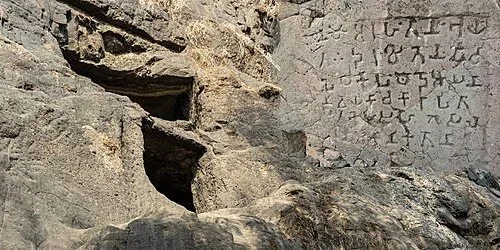 The Lower Ascent and Rock-Cut Caves
The Jain Brahmi Inscription
Long before any fort stood here, Jain monks were living on this cliff. The proof is carved into the rock face itself, in letters that most visitors would walk straight past. In September 2019, a team of trekkers from Pune noticed an inscription on the eastern side cliff, close to the village of Lohagadwadi. It is cut in Brahmi script, one of the oldest writing systems of India, and the language is Prakrit, with a touch of Sanskrit influence. The inscription runs to six lines, about half a meter wide. Scholars date it to the first or second century before Christ. It opens with the words Namo Arihantanam, a prayer Jains still use today, which marks the cave as a Jain retreat. The lines record a patron named Ida Rakhita, meaning Indra Rakshita, who paid for water cisterns and rock-cut benches for people settling in the area. Dr. Shreekant Pradhan, a scholar of ancient Indian paintings at Deccan College, studied the inscription. It reads much like one found earlier at the Pale caves in Maval, which archaeologists H. D. Sankalia and Shobhana Gokhale examined in 1969, though the Lohagad text is more descriptive. So this hill was already a place of worship and shelter when the fort's first walls were still more than a thousand years in the future.
Kevin Standage · CC BY-SA 4.0
03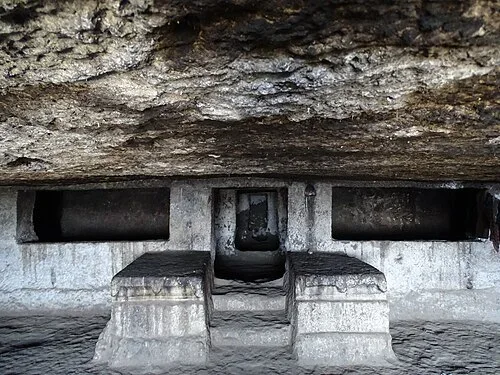 The Lower Ascent and Rock-Cut Caves
Laxmi Gufa Rock-Cut Cave
The caves on the south side of the hill, facing Lohagadwadi, were not built. They were carved, cut down into the living basalt of the cliff. Inside, the rock itself forms the architecture. Pillars were left standing where the excavators wanted support, and the ceiling is simply the underside of the original stone. Along the walls, openings lead into small cells, and benches were cut from the rock where people could sit or sleep. A recessed shrine-like space sits at the center, reached by low steps, with stone platforms flanking it. Water was part of the design too, since cisterns were cut into these caves to catch and hold rain. That fits exactly with what the inscription records. This was a place made to be lived in, quietly, high on a cliff face. Monks would have spent seasons here, and the carving was done over time rather than in one campaign. When you run a hand along these walls, you are touching the same surfaces those workers shaped, long before anyone thought of fortifying this hill.
Listen in the appPhoto: Chincholkar · CC BY-SA 4.0
04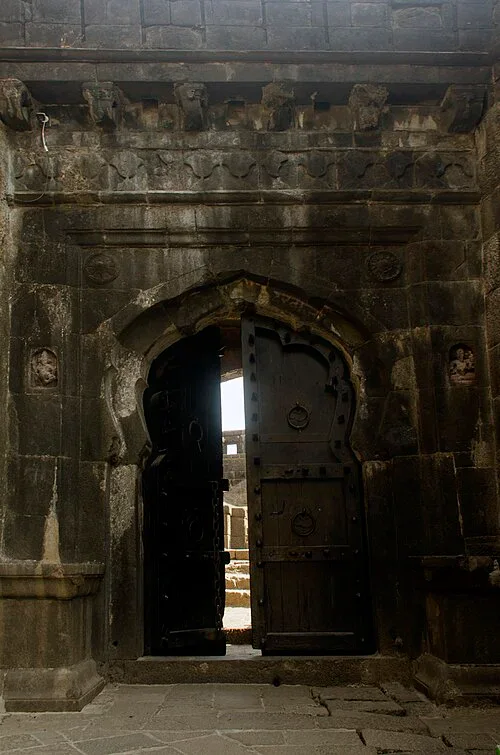 The Defended Gateways and Ramparts
Ganesh Darwaza
The gateways of Lohagad are its first line of defense, and they still stand in good condition. The fort has four large gates, and no attacker ever faced a straight road to any of them. Each one is set so that the path turns sharply as it approaches, forcing anyone coming up to slow down, bend around a wall, and expose a flank while doing it. The doors themselves are heavy timber, thick with iron studs. Those studs were not decoration. They were the answer to a particular weapon of Deccan warfare, the armored war elephant. Elephants were trained to charge gates and ram them open, so hill forts of this region studded their doors with iron to absorb the blows and hung the gates behind tight, twisting approaches that gave the animals no run at all. Ganesh Darwaza shows the system at its finest. The carved stone arch frames a pair of tall wooden doors, their surfaces studded and ringed, standing slightly open. Above the arch, a carved frieze runs along the lintel, and small figures sit in niches on either side. A defender on the wall above could drop stones or pour anything at will onto anyone stalled in the narrow passage below. Four gates in sequence meant four chances to stop an attack.
Listen in the appPhoto: Rangan Datta Wiki · CC BY-SA 4.0
05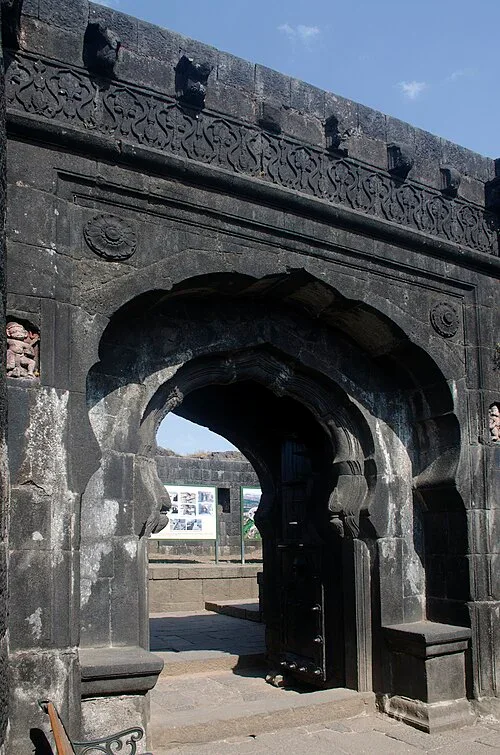 The Defended Gateways and Ramparts
Maha Darwaza
This grand gateway belongs to the fort's most famous chapter. In 1648, Chhatrapati Shivaji Maharaj captured Lohagad and brought it into the Maratha state. Seventeen years later, the tide turned against him. Under the Treaty of Purandar, signed in 1665, he was forced to hand the fort over to the Mughals, and it stayed in their hands for about five years. He did not accept the loss for long. In 1670 Shivaji recaptured Lohagad, and then he gave it a new job. The fort became his treasury. Its cliffs, its height and its chain of gates made it about as close to impregnable as a hill could be, so it was the natural vault for his wealth. Among the treasure kept here were the winnings from Surat, the rich Mughal port that Maratha forces had raided. Gold and coin from that campaign sat behind these gates, guarded by the same defenses that had defied elephants. The carved arch here, with its scalloped opening and decorative lintel, gives a sense of the scale those treasury convoys passed through. The fort's value was never only military. It was a strongroom in the sky.
Listen in the appPhoto: Rangan Datta Wiki · CC BY-SA 4.0
06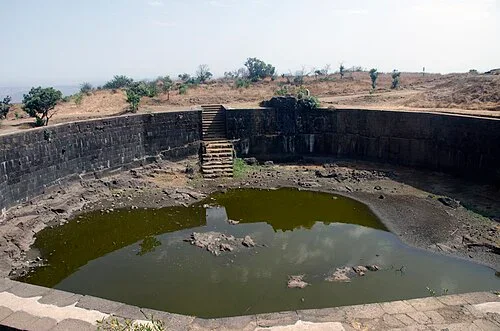 The Summit Plateau and Water Systems
The 16-Sided Tank
Water decided more sieges than swords ever did, and in the Peshwa era this fort got a master of the problem. Nana Phadnavis, the influential minister of the later Maratha court, used Lohagad as a residence in times of political unrest, and he built structures here to make it self-sustaining. His most notable works were a big tank and a step-well. The great masonry tank on the plateau shows the idea at work. Its stone walls form a many-sided basin, with steps leading down into the water, and even now it holds a pool of green water in the dry season. The principle is simple and clever. Rain falls on the summit, runs off the rock, and is caught and stored in cut stone instead of draining away down the cliffs. A fort that can harvest its own rainwater cannot be starved out by a siege that waits for thirst to do the work. For a minister who came here when politics turned dangerous, that was more than engineering. It was insurance. He could retreat to this hill knowing that his garrison had grain in store, walls below, and water rising in the tank with every monsoon.
Listen in the appPhoto: Rangan Datta Wiki · CC BY-SA 4.0
07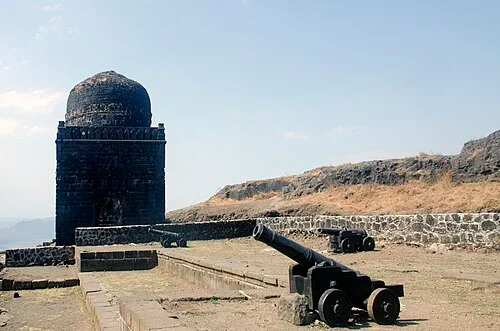 The Summit Plateau and Water Systems
The Tomb and Cannon on the Summit
The open ground of the summit was the garrison's working space, and two kinds of structure share it here. On one side stands a domed stone tomb, a square base rising to a rounded dome, its weathered masonry softened by centuries of wind. Who it commemorates, and when it was built, are questions no record here answers. It remains one of the fort's quiet mysteries, a memorial whose name has not survived. Nearby, on the bare plateau, sit several old cannon. One rests on its carriage with wooden-spoked wheels, its barrel aimed across the open ground toward the hill's edge. Others lie further back along the stone wall. From this height, artillery commanded the approaches on every side, and any force trying to take the gates below would have come under fire from guns exactly like these. Whether every barrel now on the plateau served here in the fort's fighting days, or was placed later, is honestly uncertain. Together, the tomb and the guns give the summit its character. This was a place where soldiers lived, worked, and were remembered.
Listen in the appPhoto: Rangan Datta Wiki · CC BY-SA 4.0
08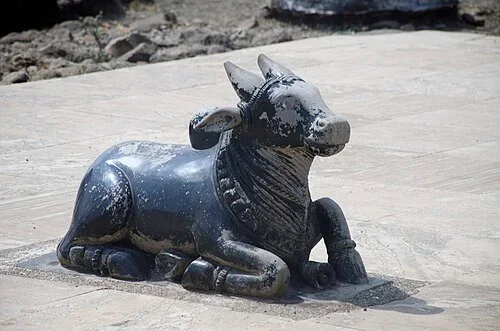 The Summit Plateau and Water Systems
Nandi Bull at the Mahadev Temple
Among the guns and walls of this military summit sits a quieter resident. A Nandi bull, carved in black stone, lies resting on a paved platform. The sculpture is weathered, its surface flaked and pale in patches, but the form is clear. The bull lies with its legs folded, head raised and horns sharp, wearing a carved collar. Nandi is the mount of the god Shiva, and a Nandi like this faces the sanctum of a Shiva temple, which is why the shrine here is known as the Mahadev temple. Its presence tells you something about how this fort actually worked. Forts across this region commonly carried temples, because garrisons were not just fighting units. Soldiers lived on these summits for years, with families, festivals and prayers, and a temple was part of a working fortress. The date of the temple and of this Nandi is not recorded, so its story stays modest. But the image itself is the evidence. Long after the last cannon fell silent, this carved bull still faces the shrine it was made for.
Listen in the appPhoto: Rangan Datta Wiki · CC BY-SA 4.0
09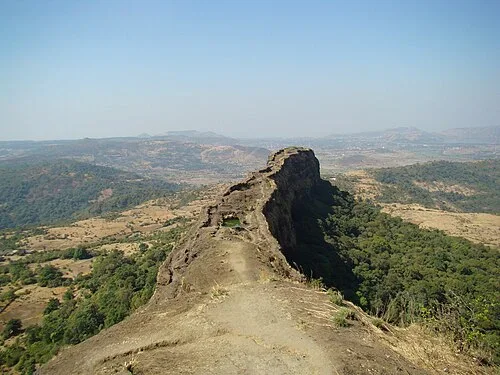 The Vinchukada Fortified Spur
Vinchukata, the Scorpion's Tail
Every hill fort needs a good name for its strangest feature, and Lohagad's is a delight. The long fortified ridge running out to the northwest is called Vinchukada, the Scorpion's tail, because that is exactly what it looks like. The main hill is the body, and this narrow, rocky spur curves out and away, ending in a raised sting of its own. The shape was too useful to leave undefended. Because the spur extends toward the valley, an enemy who got past the main fort could have used it as a route to creep around the flank. So walls were raised along its whole length, turning the tail into a fortified corridor of its own. From the ridge, the defenders' view is extraordinary. The hills and valleys of the Western Ghats spread out on every side, and any movement along the approaches below would be seen long before it arrived. The walk along it is narrow, with the ground falling away steeply on both sides. Here the fort's geography does the explaining. The rock, the curve and the walls together show why this position was worth fighting for.
Listen in the appVarun Patil · CC BY-SA 3.0
10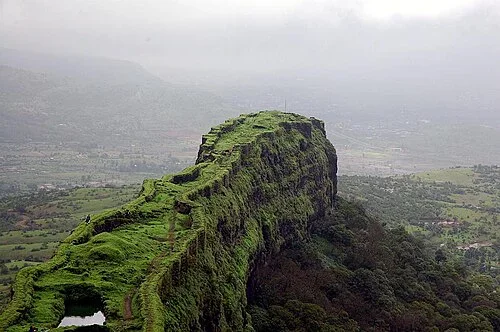 The Vinchukada Fortified Spur
Sulka: the Spur in the Monsoon
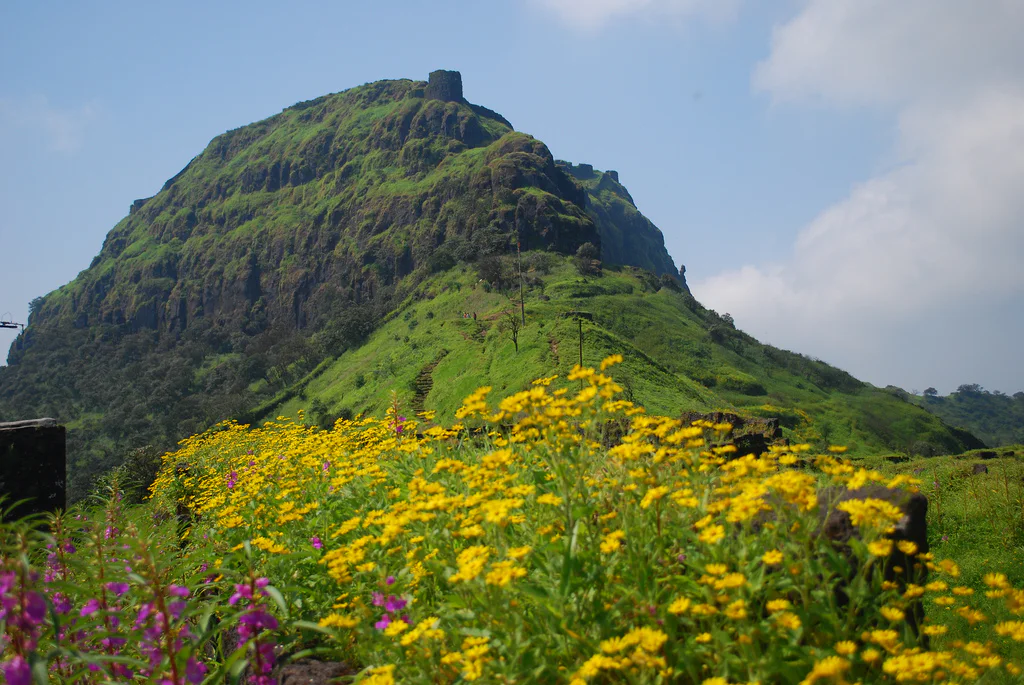
The same spur that looks dry and golden for most of the year wears a completely different face in the monsoon. When the rains arrive, the summit of Lohagad disappears into mist and cloud. Moss grows across the stone walls and the rocks, and the whole ridge turns a deep, vivid green, with old rainwater pooling in the hollows of the path. That green ridge under cloud is the monsoon fort, and it changes more than the view. The trails and steps that lead up the hill become quite slippery at this time of year, and care is needed on the routes. The same rain that filled Nana Phadnavis's tanks also made the approaches treacherous. There is a fitting symmetry in that. The fort's defenses were designed around the difficulty of its terrain, and the monsoon simply made that terrain harder for everyone, attacker and visitor alike. In the dry season you can see the valleys for miles. In the rains, the fort keeps its own counsel, wrapped in cloud, green and dripping.
Listen in the appvivek Joshi · CC BY 2.0
- 11
Visapur, the Twin Fort
Visapur, the larger twin across the range, and the end of Lohagad's military story in March 1818.
- 12
The Bastions of Lohagad
Intact gates, standing bastions, and a place on the UNESCO World Heritage list with the Maratha Military Landscapes.
Lohagad
Frequently asked questions
How much does the guide cost?
Free app download. Listed guide price: $0.99. Guide price shown in the app. Audio guide only. Venue admission is separate.
Can I listen without internet?
Yes. Download the guide’s audio, images, and maps in the app before your visit. Your downloaded content is then available offline.
Can I listen in my language?
This audio guide is available in 15 languages, including English.
Do I need to follow a schedule?
No. This is a self-guided experience. Choose your stops, pause whenever you like, and return to a story at your own pace.
At your own pace
Explore Lohagad.
Download Stanza, then search for “Lohagad”.
Free app download · Guide price shown in the app
Keep exploring
Nearby audio guides
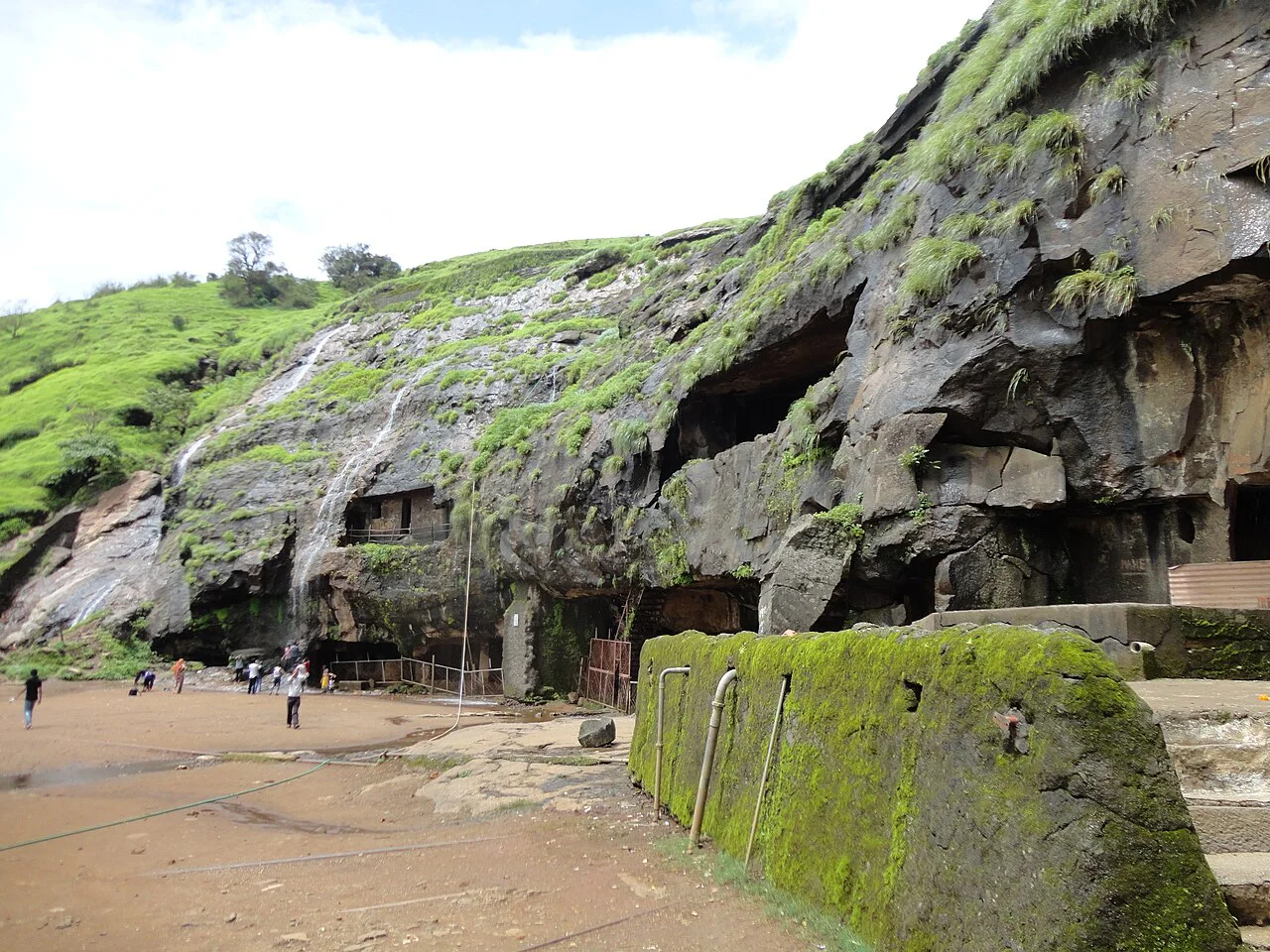
Karla · 8 km
Karla Caves
Content & sources
Photo: Kalpeshzala59 · CC BY-SA 3.0

Pune · 48 km
Aga Khan Palace
Content & sources
Aakash.gautam · CC BY-SA 3.0
Velhe · 56 km
Rajgad
Content & sources
Photo: Goldengoof · Public domain

Mumbai · 72 km
Gateway of India
Content & sources
Photo: A.Savin · FAL