Stanza · Audio guide
Ali Qapu Audio Guide
A place to remember. A story to take with you.
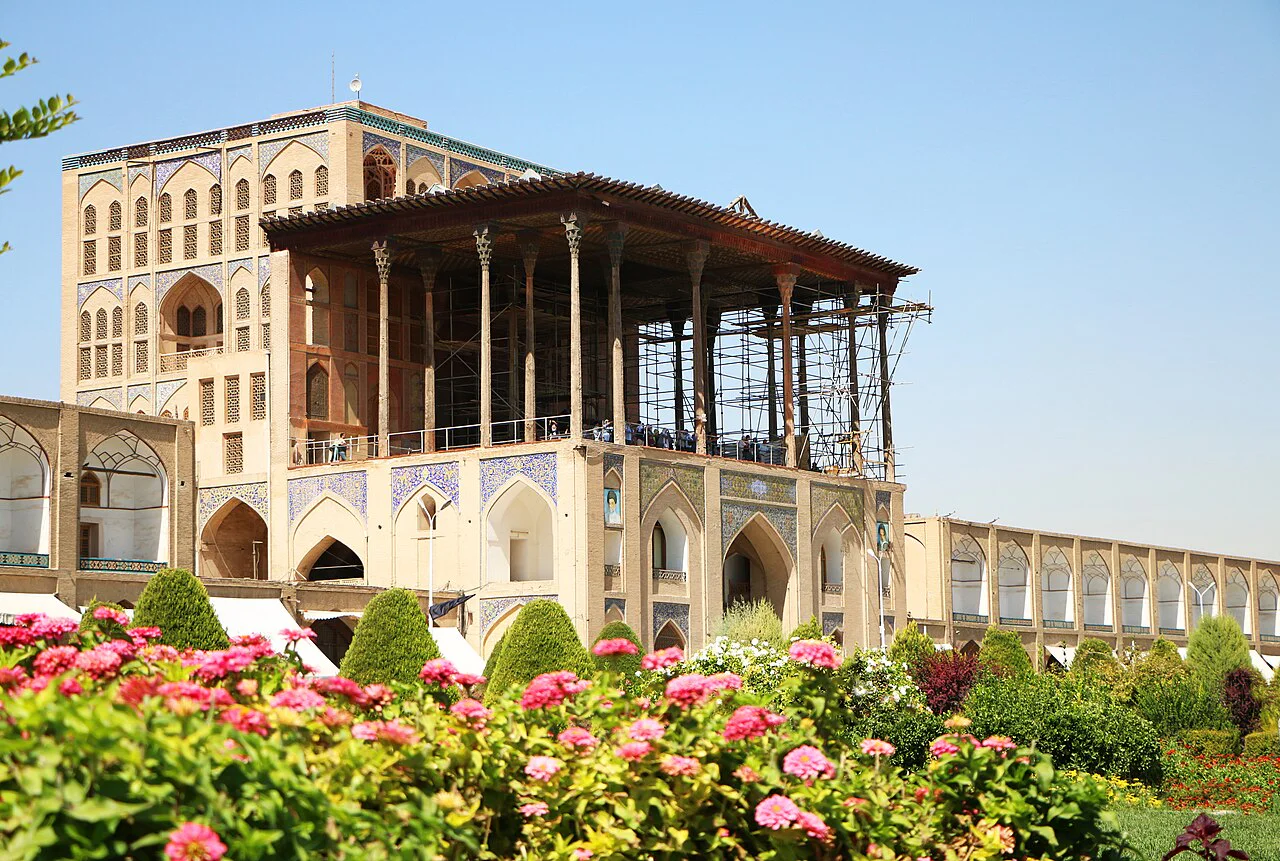
Ali Qapu is an imperial palace located on the western side of Naqsh-e Jahan Square in Isfahan. UNESCO inscribed the palace and the square as a World Heritage Site due to their cultural and historical…
Download Stanza, then search for “Ali Qapu”.
About the tour
One guide. Your kind of visit.
Ali Qapu is an imperial palace located on the western side of Naqsh-e Jahan Square in Isfahan. UNESCO inscribed the palace and the square as a World Heritage Site due to their cultural and historical importance.
Ready when you are.
- 01Get the free Stanza app.
iOS & Android
- 02Find your guide.
“Ali Qapu”
- 03Download before you go.
Works offline
Audio guide / 11 narrated stops
Inside the guide
Get to know a few of the stories before you go. Open a stop to read more.
01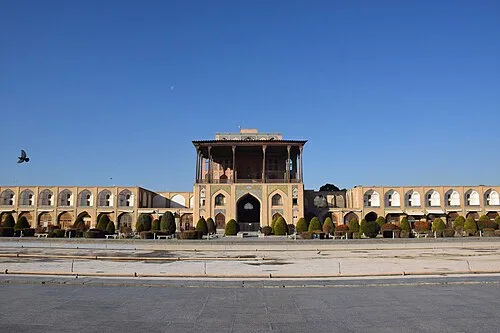 Grand Entrance Portal and Facade
Ali Qapu from Naqsh-e Jahan Square
Ali Qapu was designed as a vast gateway to a complex of royal palaces. Shah Abbas the Great ordered it built in the early seventeenth century. The complex stretched from this square toward Chahar Bagh Boulevard. The palace stands on the western side of Naqsh-e Jahan Square, opposite the Sheikh Lotfollah Mosque. A tall arched portal sits in the centre, with a columned pavilion above it. Long arcades run out on either side. The name has two parts. The first, Ali, comes from Arabic and has been translated as high, great, superior or imperial. The second, qapu, is an old Turkic word for gate. Together, the name is often rendered as Grand Gate. Isfahanis tell a story about the name. They say it points to Ali, the first Shia imam, and to a door said to have come from his shrine at Najaf. It is told as a tradition rather than as settled history. The palace and the square together have been a UNESCO World Heritage Site since 1979. Many regard the palace as the finest example of Safavid architecture.
Photo: Mahdi751 · CC BY-SA 4.0
02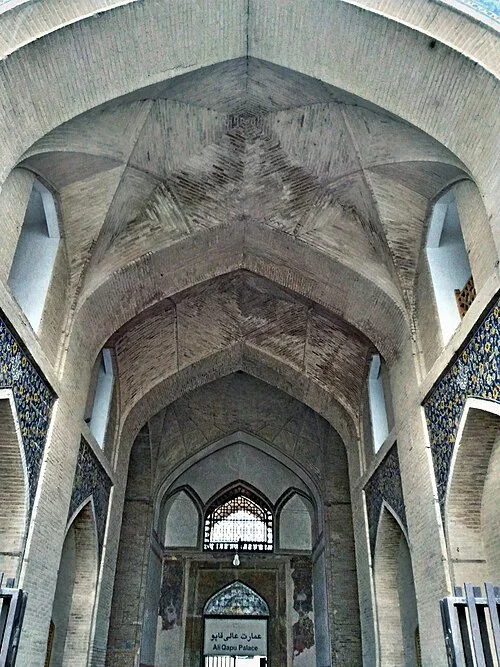 Grand Entrance Portal and Facade
Vaulted Entrance Passage with Palace Sign
Shah Abbas the Great handled the affairs of his kingdom in this palace, and he issued laws here. The chancellery, the government office that ran official business, was set up on the first floor. Under the brick vault, blue tiles line the walls of the entrance. The palace also hosted a court celebration of Nowruz, the Iranian New Year. The shah celebrated it here for the first time in 1597. By the Islamic calendar, that year was 1006.
Photo: Mansour.zargaran · CC BY-SA 4.0
03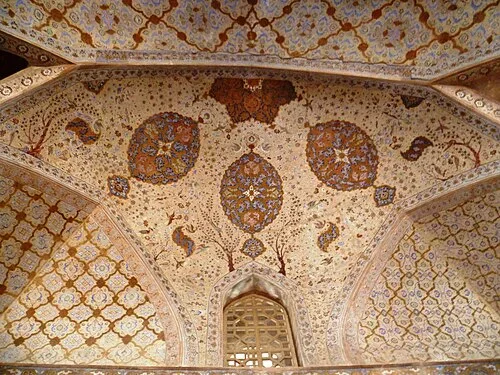 Ground Floor Vestibule and Imperial Chancellery
Painted Vault with Floral Medallions
Painters in this palace did not stop at the walls. Several halls have painted ceilings, and this vault is covered with large round medallions of flowers. Small trees grow between the medallions, and birds and small animals appear among the branches. Geometric patterns fill the side panels. Below the vault, a pointed niche holds a lattice window.
Listen in the appRadosław Botev · CC BY 3.0 pl
04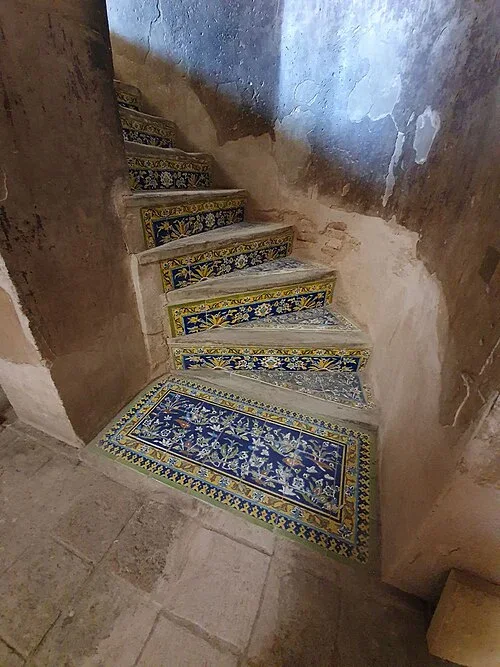 The Defensive Spiral Staircases
Tiled Spiral Staircase
Each of the palace's six floors is reached by a spiral staircase, and the climb is difficult. The steps here are faced with floral tiles in blue, yellow and white. The tiles cover the treads and the risers, while the walls beside them carry floral plaster decoration. Another stairway was built on the palace's southern side, called the Kingly Stairway. It was built at the same time as the wooden ceiling of the balcony. Its style is said to be unique to the region.
Listen in the appPhoto: Parvin Aqaee · CC BY-SA 4.0
05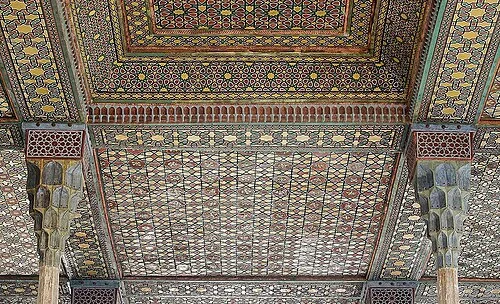 The Elevated Royal Terrace (Talar)
Painted Timber Ceiling with Carved Column Brackets
Shah Abbas the Second was keen on the palace's decoration, and his chief contribution went into the great hall on the third floor. Its eighteen columns were covered with mirrors, and its ceiling was decorated with large paintings. Geometric patterns fill the ceiling here, and carved brackets sit where the columns meet it. The palace has been repaired many times. Shah Soltan Hoseyn, the last Safavid ruler, had it substantially restored. Later, during the brief rule of the invading Afghans, it fell into a dreadful state again. In the first restoration campaign, Italian experts worked on twelve of the columns. Iranian restorers drew up plans for the other six columns. In later decades, work continued on the paintings, the doors, the floors, the stairs, and the portico and its ceiling.
Listen in the appHamidreza Nikoomaram · CC BY 4.0
06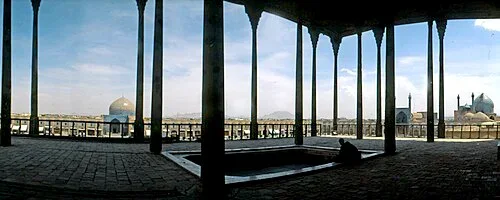 The Elevated Royal Terrace (Talar)
Columned Royal Terrace Panorama
From the upper galleries of the palace, the Safavid shahs watched polo, army manoeuvres and horse racing in Naqsh-e Jahan Square. Polo was called chowgan. The palace was also where the monarchs entertained noble visitors and foreign ambassadors. The terrace rests on a row of slender columns, and it looks out over the square and the domes beyond. Set into the paved floor is a sunken pool, called the copper pool. A water tower on the palace's northern flank was built to keep the copper pool supplied.
Listen in the appPhoto: LBM1948 · CC BY-SA 4.0
07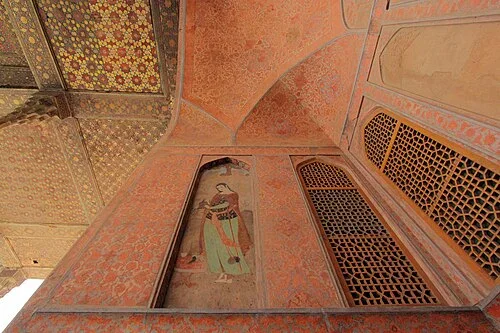 Imperial Banquet Chambers and Murals
Painted Standing Woman in a Wall Panel
Some of the palace's decoration shows people as well as flowers. In a recessed panel, a woman stands in a long robe. A pierced lattice window sits beside her. Nearly all of the palace's highly ornamented doors and windows were looted in times of social disorder. Only one window on the third floor is said to have survived.
Listen in the appPhoto: Mostafameraji · CC BY-SA 4.0
08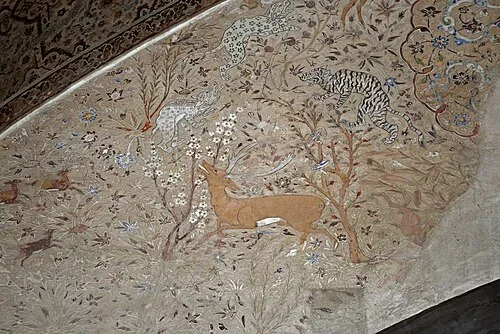 Imperial Banquet Chambers and Murals
Wall Painting of Deer and Large Cats
The naturalistic wall paintings of Ali Qapu are attributed to Reza Abbasi, the court painter of Shah Abbas the Great, and to his pupils. Their work is full of flowers, animals and birds. Here a large deer stands among blossoming trees, with smaller deer nearby. Two big cats move through the same landscape, one spotted and one striped. The animals are drawn to look like real creatures, set among the plants. The landscape runs right across the curve of the wall.
Listen in the appPhoto: Wojciech Kocot · CC BY-SA 4.0
09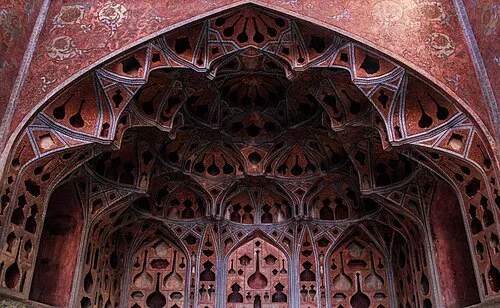 The Sixth-Floor Music Hall (Tong-Bori)
Music Hall Vault with Cusped Arches
People called the top floor of Ali Qapu the Music Hall. Various ensembles played music and sang songs here. Royal receptions and banquets were held on this floor as well, and it has the largest rooms in the palace. The rooms were also used for private parties and for the king's musicians. The walls carry large paintings of rulers, singers and dancers at a feast.
Listen in the appPhoto: Mahta8495 · CC BY-SA 4.0
10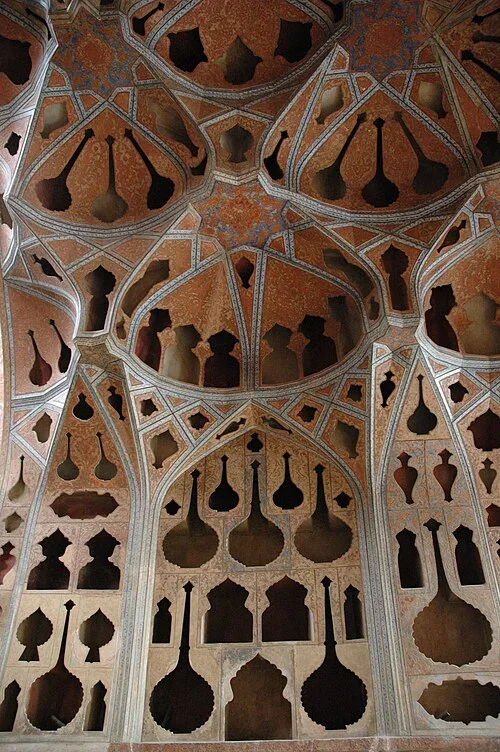 The Sixth-Floor Music Hall (Tong-Bori)
Vessel-Shaped Niches in the Music Hall
The walls of the Music Hall are cut with recesses shaped like pots and vessels. This kind of cut-out plasterwork is known as tong-bori, and a Persian account calls the technique koshte-bori. Deep circular niches are cut into the walls too, with decorative and acoustic value. One writer concludes that the cut-outs were made for ornament, not for storage. The plasterwork is so delicate that it falls apart at the lightest touch. The hollows were said to hold on to echoes, so singing and instruments could be heard clearly in every part of the room.
Listen in the appamerican_rugbier · CC BY-SA 2.0
- 11
Rear Facade Seen Along the Arcaded Walk
The rear face of the palace, and why it seems to have a different number of storeys from each side.
Ali Qapu
Frequently asked questions
How much does the guide cost?
Free app download. Listed guide price: $0.99. Guide price shown in the app. Audio guide only. Venue admission is separate.
Can I listen without internet?
Yes. Download the guide’s audio, images, and maps in the app before your visit. Your downloaded content is then available offline.
Can I listen in my language?
This audio guide is available in 15 languages, including English.
Do I need to follow a schedule?
No. This is a self-guided experience. Choose your stops, pause whenever you like, and return to a story at your own pace.
At your own pace
Explore Ali Qapu.
Download Stanza, then search for “Ali Qapu”.
Free app download · Guide price shown in the app
Keep exploring
Audio guides — Iran
Shush
Chogha Zanbil
Content & sources
Photo: Shauni · CC BY-SA 3.0
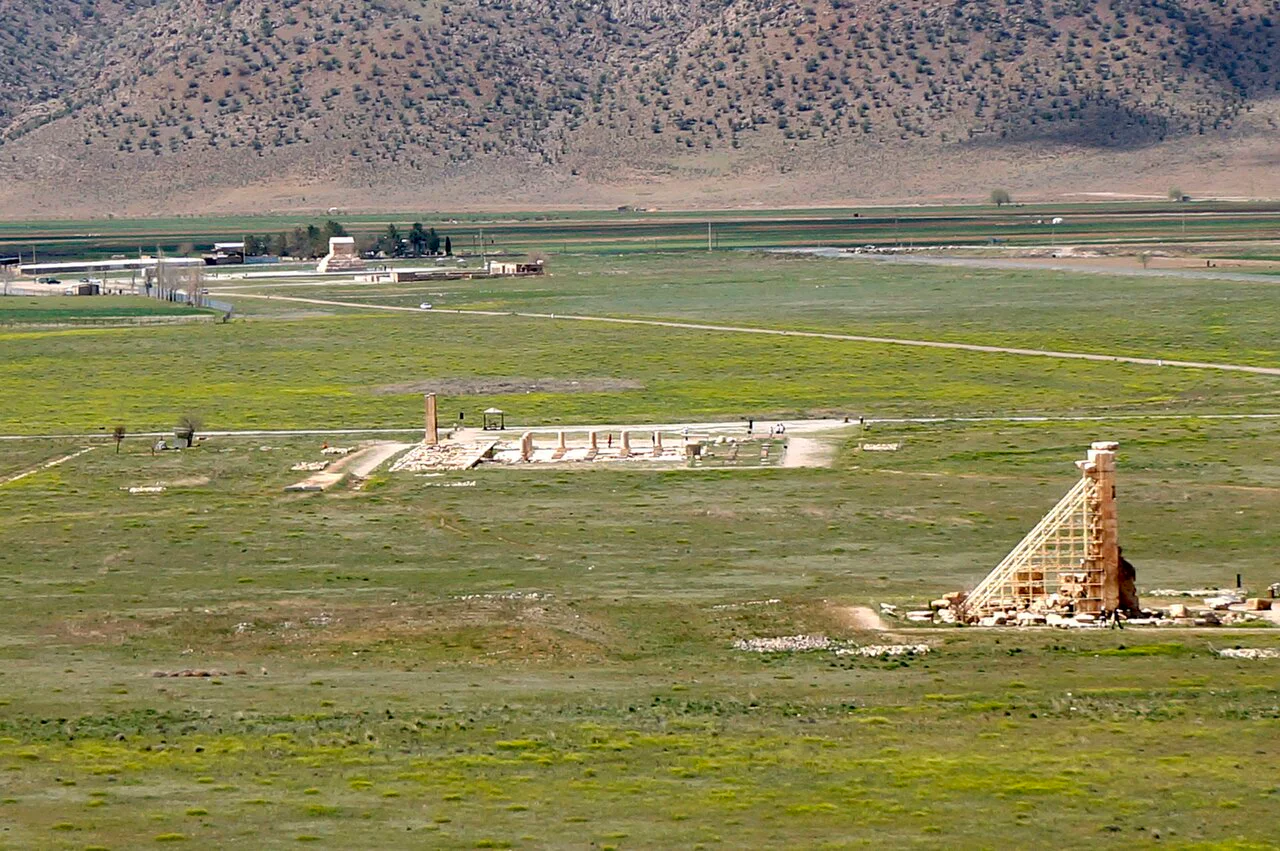
Sa'adat Shahr
Pasargadae
Content & sources
Soheil Callage · CC BY-SA 4.0
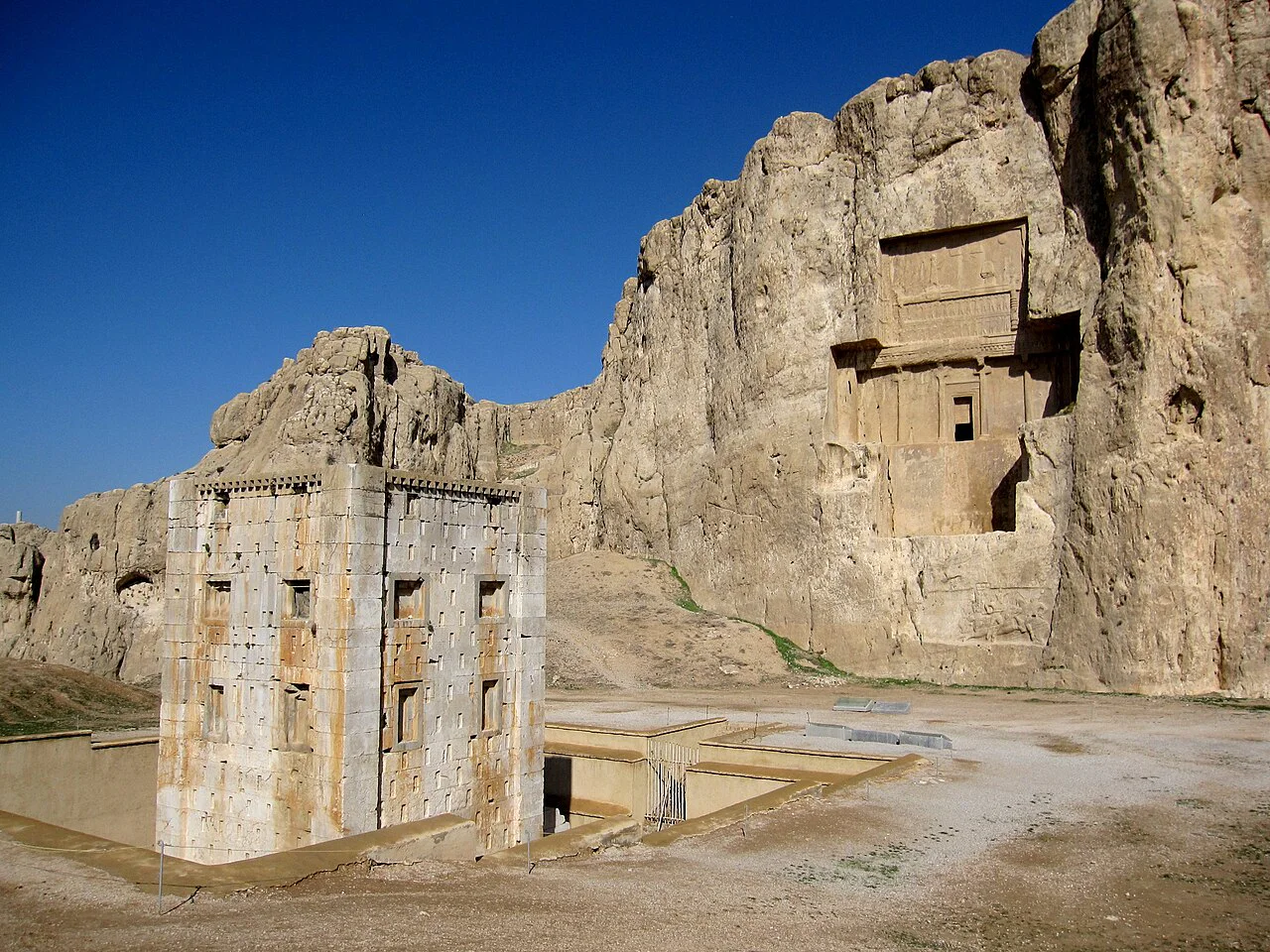
Marvdasht
Naqsh-e Rostam
Content & sources
Stefan Krasowski from New York, NY, USA · CC BY 2.0
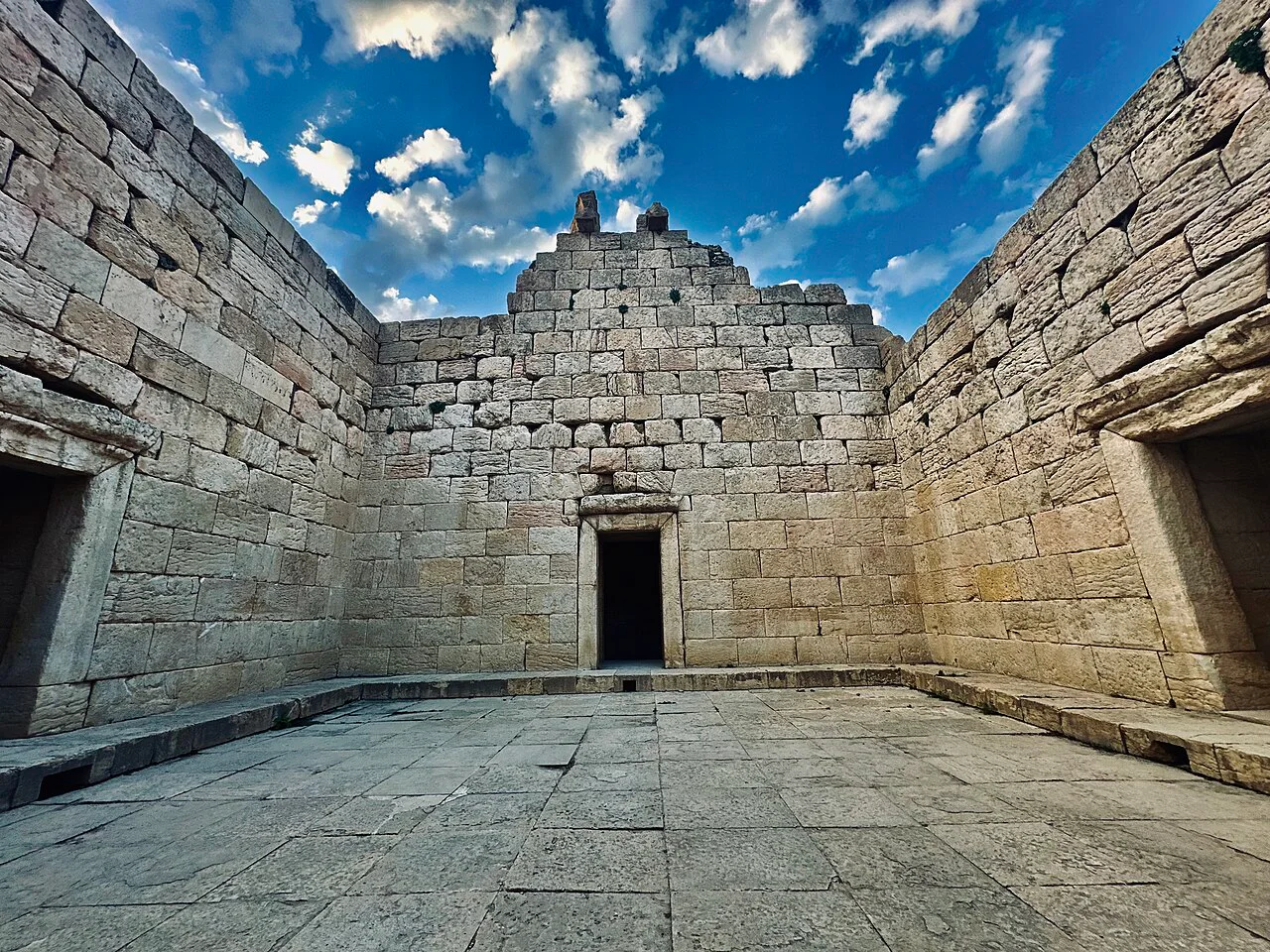
Kazerun
Bishapur
Content & sources
Photo: Behnam9395 · CC0