Stanza · Audio guide
Chogha Zanbil Audio Guide
A place to remember. A story to take with you.
Chogha Zanbil is an ancient Elamite complex in the Khuzestan province of Iran. It is considered to be the best preserved example of a stepped pyramidal monument by UNESCO.
Download Stanza, then search for “Chogha Zanbil”.
About the tour
One guide. Your kind of visit.
Chogha Zanbil is an ancient Elamite complex in the Khuzestan province of Iran. It is considered to be the best preserved example of a stepped pyramidal monument by UNESCO.
Ready when you are.
- 01Get the free Stanza app.
iOS & Android
- 02Find your guide.
“Chogha Zanbil”
- 03Download before you go.
Works offline
Audio guide / 11 narrated stops
Inside the guide
Get to know a few of the stories before you go. Open a stop to read more.
01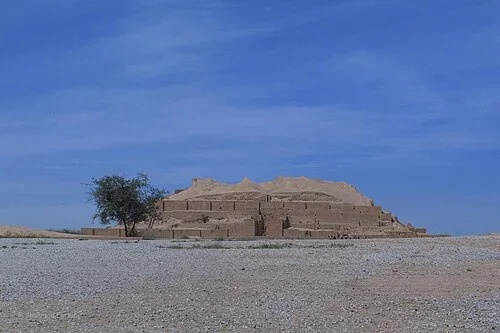 Outer Perimeter and Arrival at Dur-Untash
Arrival at Dur-Untash: The Basket Mound
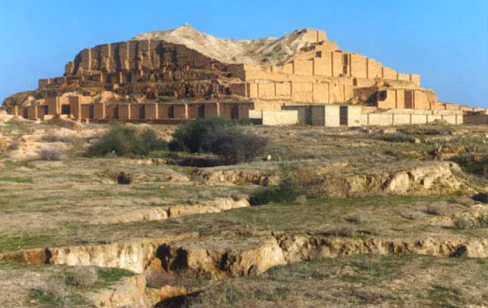
Chogha Zanbil means 'basket mound', and from a distance the name makes sense. The sacred city of Dur Untash reads as a hill rising from the plain, its tower long buried under earth. Dur Untash means 'town of Untash', after King Untash-Napirisha, who began building here about 1250 BC, mainly to honour the great god Inshushinak. Unusually for an ancient city, few people seem to have lived here besides priests and servants. The tour follows the place from its outer walls to the top of the tower, and to the water that kept it alive. For centuries nobody knew what the mound held. In the nineteen-thirties a geologist surveying for oil found an inscribed brick here and, being an amateur archaeologist, carried it to excavators then working at Susa. The inscription described the building of a sacred city by one 'Untash-Gal'. Digging followed. Roland de Mecquenem worked the site from 1935, and Roman Ghirshman excavated it through the nineteen-fifties, hauling away enormous quantities of debris with local crews. Under the hill lay an entire holy city, almost intact.
Shahrzad Fattahi · CC BY-SA 4.0
02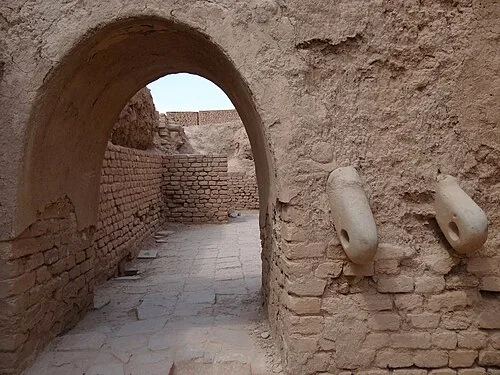 Outer Perimeter and Arrival at Dur-Untash
Gateway Through the Sacred Walls
The city was designed as rings within rings. Three concentric mud-brick walls divide the whole complex, which covers about ninety-six hectares. Each wall marked a zone of its own, and gates controlled who passed between them. Inscriptions record seven gates in the outer wall; only two have been found. The middle wall had four gates of its own. Beyond them, the innermost area, a little over two hectares, is taken up almost entirely by the great ziggurat. Between the outer and middle walls stood a temple shared by two gods, Napirisha and Inshushinak. The brick arch of this gateway, with its rounded vault, gives a fair sense of how those thresholds once looked. Every gate was a boundary between the ordinary world and the sacred one.
Adam Jones from Kelowna, BC, Canada · CC BY-SA 2.0
03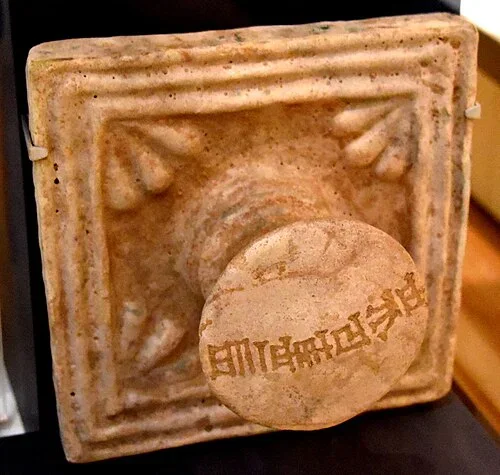 The Royal Quarter and Subterranean Tombs
The Royal Quarter and the Untouched Tomb
A small glazed plaque once fixed to a door says whose quarter this was. Its inscription reads 'Palace of Untash-Napirisha, King of Elam', and its glaze was originally blue. It dates to the thirteenth century BC. In the outer area of the city lie royal palaces, and a funerary palace with five subterranean tombs beneath its courtyard. The tombs tell very different stories. One was apparently never used. Another was robbed out in antiquity. One held the partially burned remains of five people, cremated somewhere else. The fourth was found completely undisturbed. It contained an adult woman, between about forty and sixty years old, buried with grave goods. Who she was, and how she belonged to the royal family, remains unknown. The plaque itself now sits in a museum, evidence of the palace rather than the tomb.
Listen in the appOsama Shukir Muhammed Amin FRCP(Glasg) · CC BY-SA 4.0
04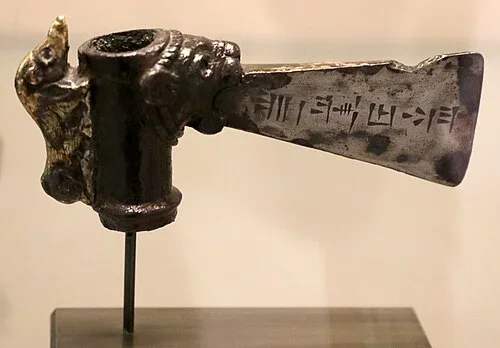 Temples of the Outer Precinct
Axe of the King from the Temple of Kiririsha
An axe head of silver and electrum carries the name of Untash-Napirisha. It is said to come from the temple of the goddess Kiririsha here at Chogha Zanbil. Brick inscriptions found at the site refer to twenty-two temples; only about half have been located. The middle area alone held sanctuaries for gods including Nabu, Adad, Inanna and Humban, alongside shrines of Isniqarab and Kiririsha to the northeast. Many of these were regional gods, worshipped by particular peoples of Elam. Scholars read the crowd of temples as deliberate policy. In their view, Untash-Napirisha meant to create a new religious centre, possibly to replace Susa, gathering the gods of both highland and lowland Elam at one site. The axe fits that ambition: a royal object bearing the king's name, dedicated in a goddess's temple.
Listen in the appFrancesco Bini · CC BY-SA 4.0
05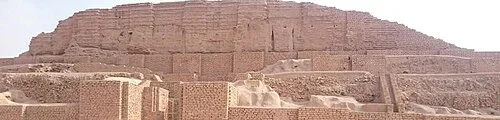 The Great Ziggurat of Dur-Untash
The ziggurat was the heart of it all, and it remains extraordinary. Its square base measured 105.2 metres on each side. Originally it rose in five levels to about 53 metres, crowned by a temple. Today it stands at just under 25 metres, less than half its original height, and yet its state of preservation is unsurpassed. Mud brick was the basic material of the whole ensemble, given a facing of baked bricks. Unlike the ziggurats of Mesopotamia, whose tiers stack on one another, each of the five levels here was founded at ground level, rising in parallel. Some facing bricks were glazed, and others carried rosette-shaped studs, decoration counted among the oldest tiles in the world. UNESCO considers it the best-preserved stepped pyramid monument of the ancient Near East. In 1979 Chogha Zanbil became the first Iranian site on the World Heritage List.
Listen in the appPhoto: Bazras55 · CC BY-SA 4.0
06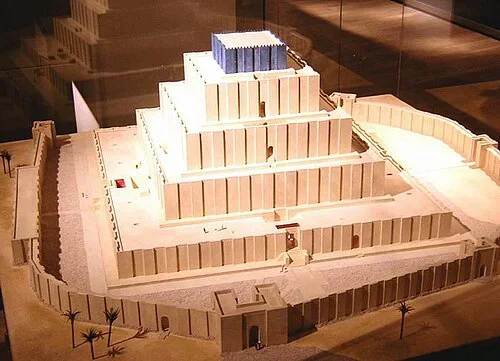 The Great Ziggurat of Dur-Untash
Rebuilding the Five Stories: Model of the Ziggurat
A museum model shows what the ruin once was: five stepped stories climbing to a high sanctuary at the top, the level known as the kukunnum. The crowning shrine belonged to the god Inshushinak. Excavation showed that the tower went up in two phases. First the builders raised it to the second level, with two temples inside. Then they built onwards to the fifth. In effect, the lower monument was nested inside the taller one. In one of those early temples, white and black glass tiles came to light. The blue of the model's top reflects the glazed bricks that the king's own inscription claims for the sanctuary, though the exact appearance of the shrine is a modern reconstruction, not something anyone can confirm.
Listen in the appJona Lendering · CC0
07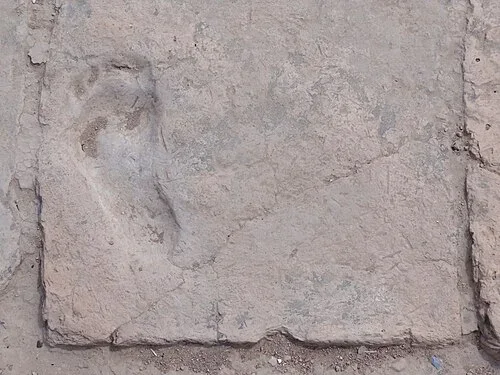 The Great Ziggurat of Dur-Untash
The Builder's Footprint
Pressed into one of the mud bricks is a human footprint. Someone stepping on the wet clay left the only signature they had. Every part of this monument was made and laid by hand, brick after brick in mud brick and baked brick. When Roman Ghirshman excavated the site, his crews of a hundred to a hundred and twenty-five workers at a time moved the debris the same way, with no machines at all. The footprint is undated and unexplained. It simply belongs to one of the people who built the place.
Listen in the appAdam Jones from Kelowna, BC, Canada · CC BY-SA 2.0
08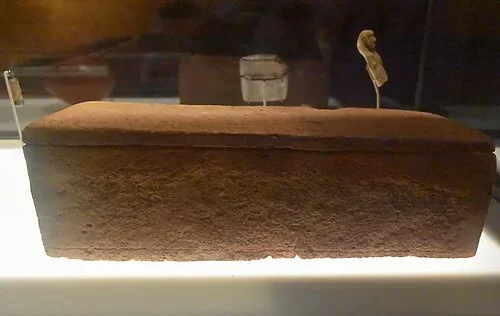 The Great Ziggurat of Dur-Untash
Bricks That Speak: The Cuneiform Inscriptions
The walls of the ziggurat speak. Excavators found 5,257 inscribed bricks, most written in Elamite. Sixty-seven of them are in Akkadian instead. Every eleventh row of bricks in the tower carried an inscription. A stamped brick could name the builder and the purpose of the building, and one of them carries the king's own words. 'I, Untash-Napirisha, son of Humbanumena, king of Anshan and of Susa,' it reads, 'a temple of baked bricks and a sanctuary of glazed bricks I built; I gave it to Inshushinak.' It ends with a plea: 'May what I made and toiled for, as a gift on my behalf, be acceptable to Inshushinak.' The monument is at once a building and a prayer.
Listen in the appPhoto: Dorieo · CC BY-SA 4.0
09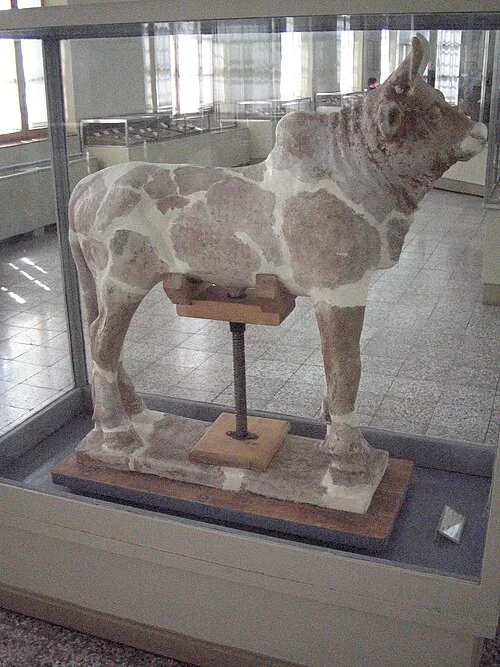 Sacred Gateways and the Guardian Bull
Guardians at the Gates: The Bulls of the Ziggurat
The gates of the ziggurat had guardians. Large gates opened into all four sides of the tower, and at each one stood statues about half life size. One of them, of blue-glazed terracotta, carried an inscription dedicating it to the god Inshushinak. Bulls belong to this world of protective figures. This pottery bull from Chogha Zanbil, with an Elamite inscription of its own, is now in the National Museum of Iran. It is not one of the gate statues themselves. No one knows whether it relates to the guardians. What it does show is the tradition of powerful animal figures watching over the sacred entrances here.
Listen in the appPhoto: Tangopaso · Public domain
10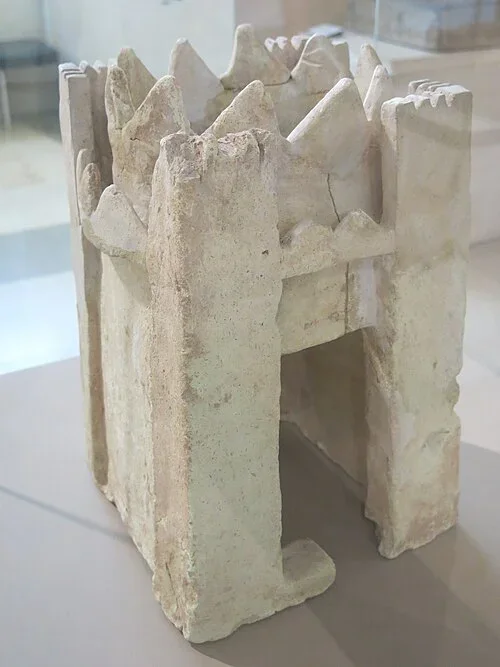 Sacred Gateways and the Guardian Bull
Climbing to the Sanctuary: Stairways of the Tower
A small model of a tower, found at Chogha Zanbil and now in the Louvre, offers a contemporary image of how these sacred towers were imagined. Its exact purpose is debated: a votive offering, a representation of the ziggurat itself, something else again. The full-size tower was made for climbing, at least in part. Gates opened on all four sides, and three of them had stairs rising to the second level. The fourth, on the southwest, climbed all the way to the fifth and highest level. That was presumably the most important approach, the route kept for the highest rites. From the ground to the god's shrine, the tower rose in stages, and so did the people who entered it.
Listen in the appPhoto: Tangopaso · Public domain
- 11
Water in the Desert - and the End of Dur-Untash
The world's oldest known water purification plant, the Assyrian destruction of 645 BC, and why the mound survived.
Chogha Zanbil
Frequently asked questions
How much does the guide cost?
Free app download. Listed guide price: $1.99. Guide price shown in the app. Audio guide only. Venue admission is separate.
Can I listen without internet?
Yes. Download the guide’s audio, images, and maps in the app before your visit. Your downloaded content is then available offline.
Can I listen in my language?
This audio guide is available in 15 languages, including English.
Do I need to follow a schedule?
No. This is a self-guided experience. Choose your stops, pause whenever you like, and return to a story at your own pace.
At your own pace
Explore Chogha Zanbil.
Download Stanza, then search for “Chogha Zanbil”.
Free app download · Guide price shown in the app
Keep exploring
Audio guides — Iran
Isfahan
Ali Qapu
Content & sources
Photo: Zahradibaji · CC BY-SA 4.0
Kazerun
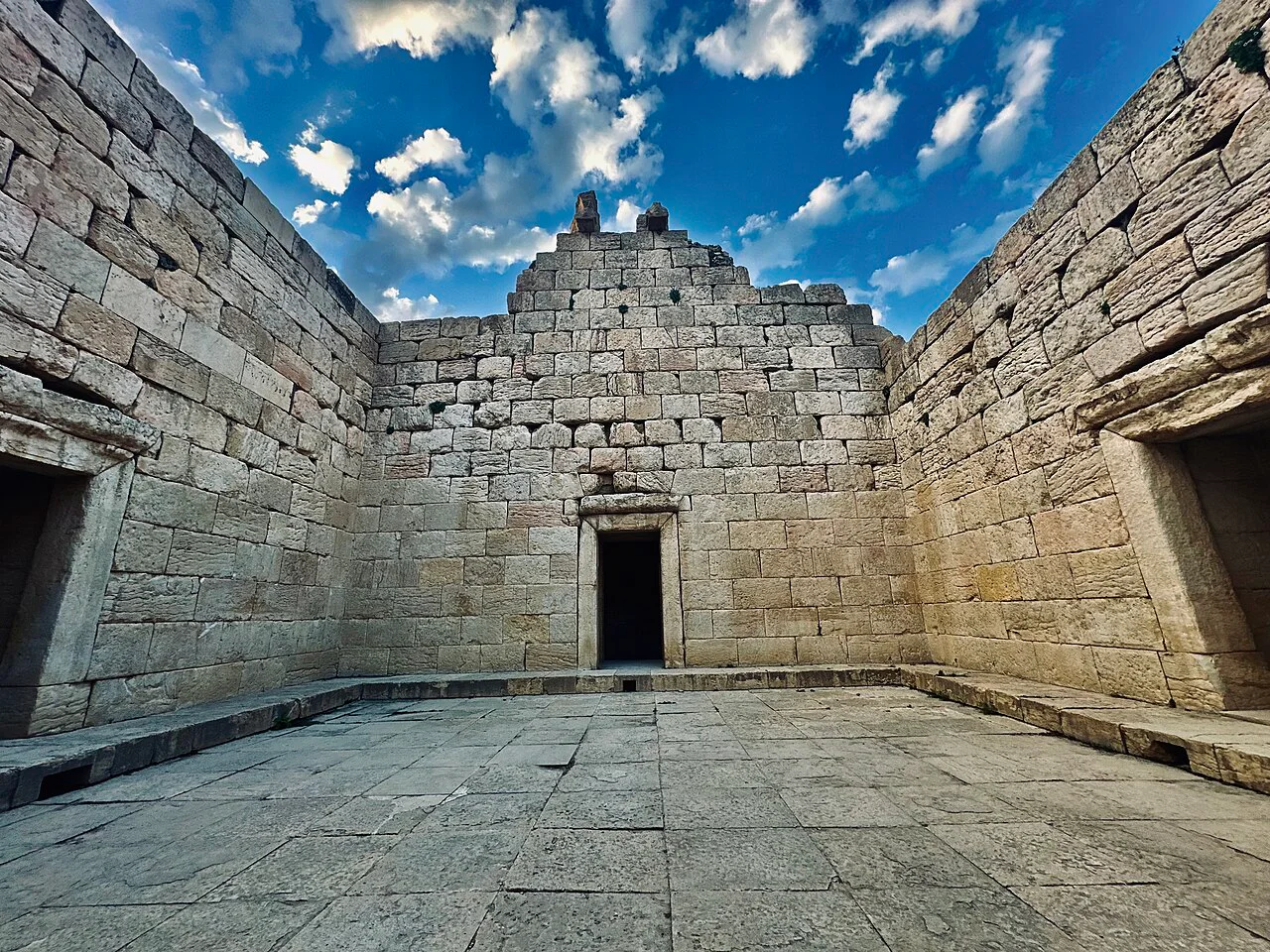
Bishapur
Content & sources
Photo: Behnam9395 · CC0
Marvdasht
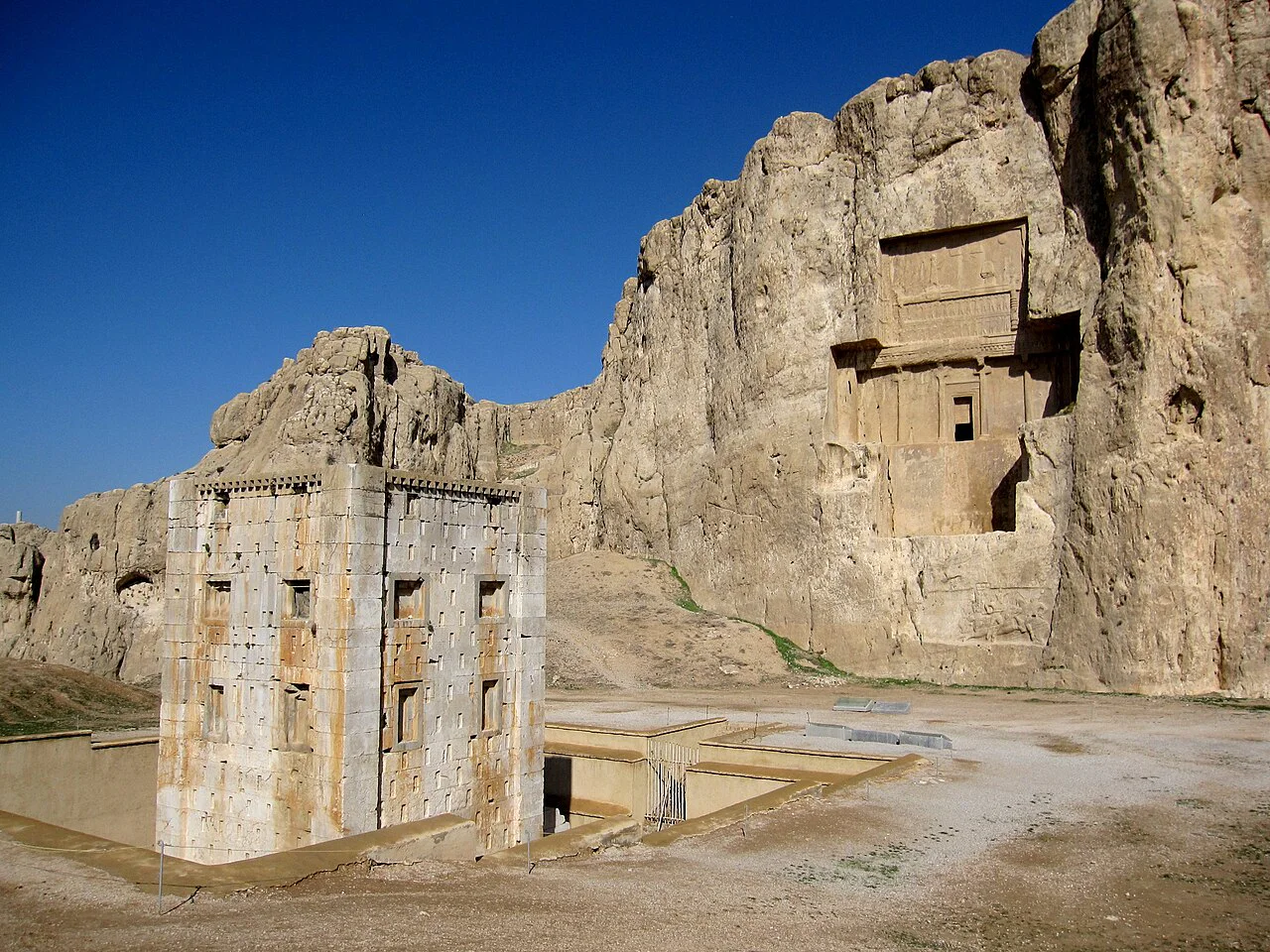
Naqsh-e Rostam
Content & sources
Stefan Krasowski from New York, NY, USA · CC BY 2.0
Sa'adat Shahr
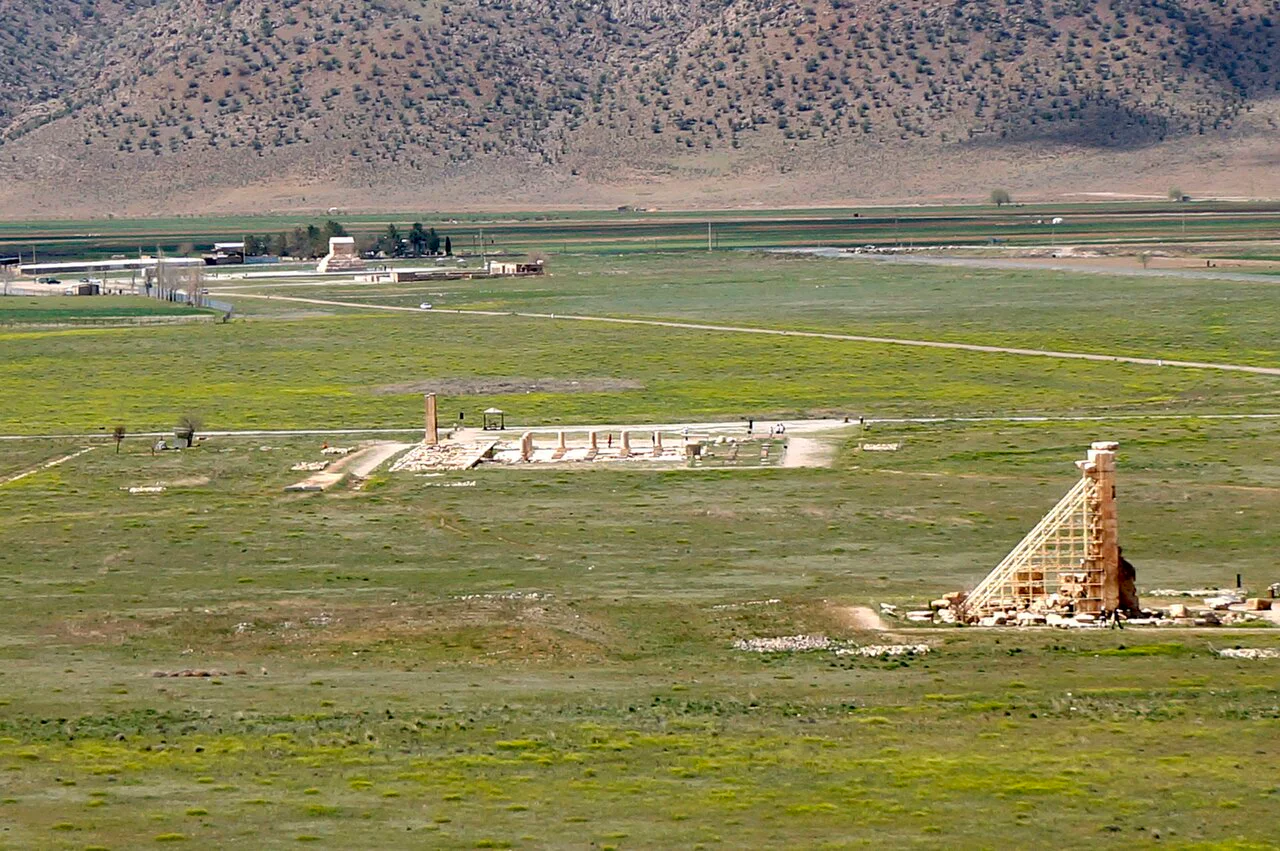
Pasargadae
Content & sources
Soheil Callage · CC BY-SA 4.0
Kuwait City
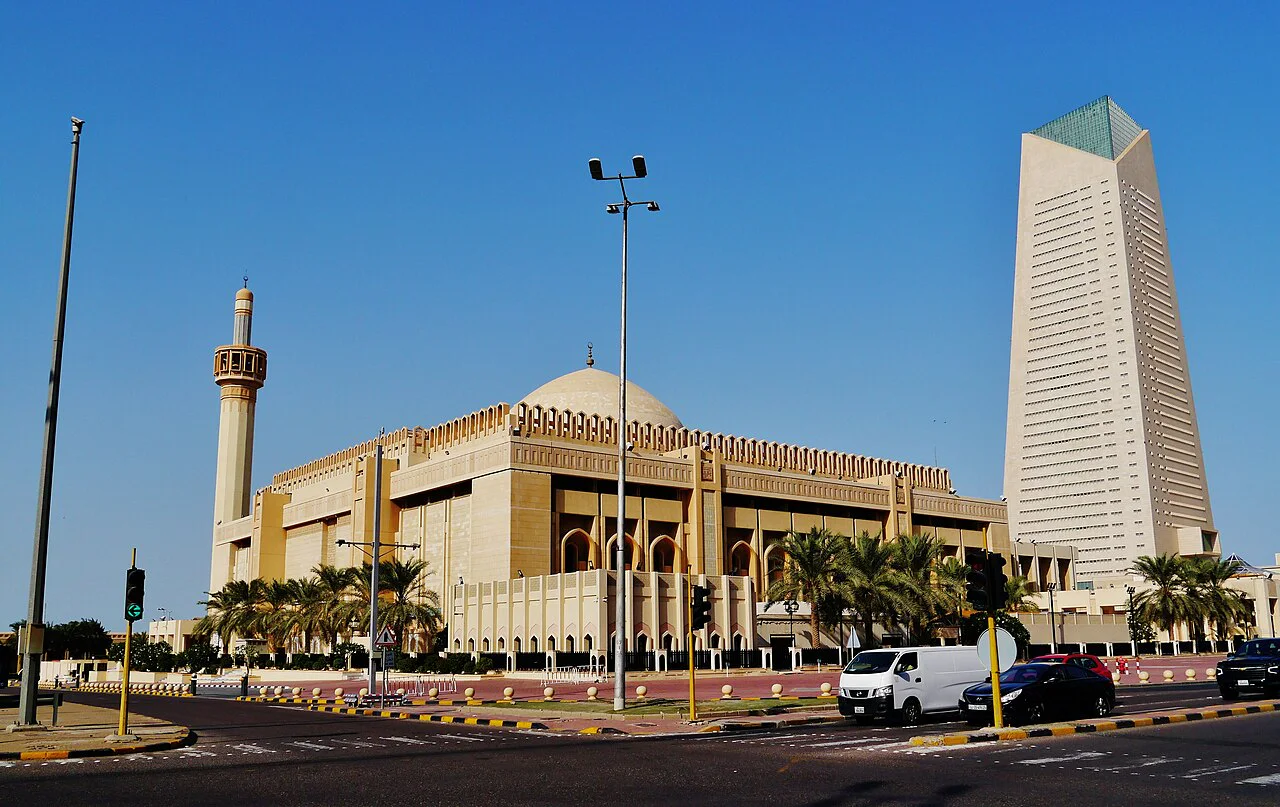
Grand Mosque of Kuwait
Content & sources
Photo: Zairon · CC BY 4.0