Stanza · Audio guide
Dublin Castle Audio Guide
A place to remember. A story to take with you.
Dublin Castle is a major Irish government complex, conference centre, and tourist attraction. It is located off Dame Street in central Dublin.
Download Stanza, then search for “Dublin Castle”.
About the tour
One guide. Your kind of visit.
Dublin Castle is a major Irish government complex, conference centre, and tourist attraction. It is located off Dame Street in central Dublin.
Ready when you are.
- 01Get the free Stanza app.
iOS & Android
- 02Find your guide.
“Dublin Castle”
- 03Download before you go.
Works offline
Audio guide / 13 narrated stops
Inside the guide
Get to know a few of the stories before you go. Open a stop to read more.
01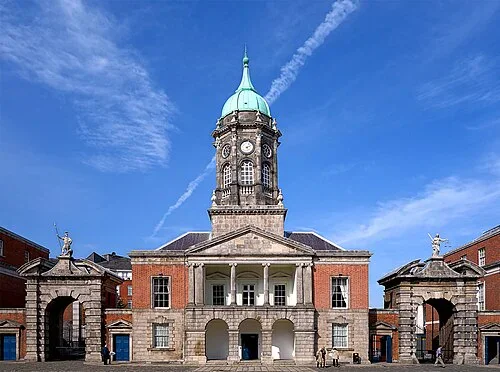 Upper Castle Yard and Bedford Tower
Bedford Tower and the Upper Castle Yard
Welcome to Dublin Castle, where eight centuries of Irish history are packed behind one set of walls. The story begins in 1204, when King John of England ordered a castle built here in Dublin. His man on the ground was Meiler Fitzhenry, who raised a fortress with strong walls and good ditches. Its job was to defend the city, administer justice, and protect the King's treasure. For over seven hundred years the castle did all three, serving as the seat of English, and later British, government in Ireland. That role lasted until the early 1920s. The tower over the yard is Bedford Tower, begun in 1750 and finished in 1761. Thomas Eyre designed it, and the Guard House nearby mirrors it. It shows what the place had become: the medieval fortress was gradually rebuilt as a stately Georgian palace of government. The gateways on either side of Bedford Tower are named Fortitude and Justice.
Photo: Velvet · CC BY-SA 3.0
02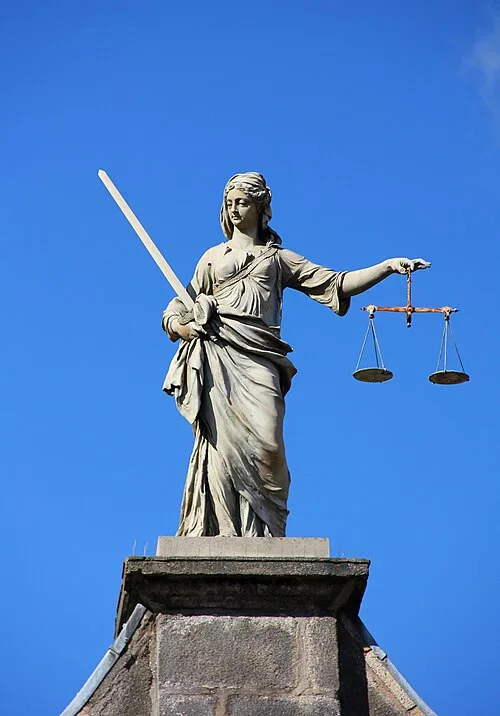 Upper Castle Yard and Bedford Tower
The Gates of Fortitude and Justice
Justice stands above the gateway with her sword raised and her scales held out. For the officials who laid out this yard, she made a claim: that power here answered to law. Inside the castle square once stood a Great Hall of stone and timber. At various times it served as parliament house, court of law and banqueting hall. It survived until 1673, when fire damaged it and it was demolished soon after. The castle also housed a court with a harder reputation. The Court of Castle Chamber was the Irish counterpart to England's Star Chamber, and a room was specially built for it around 1570. Then there is the mystery. In 1907 the Irish Crown Jewels were stolen from the castle's Office of Arms. Suspicion fell on the Officer of Arms, Sir Arthur Vicars, though rumours may have compromised the investigation. The jewels have never been recovered.
Jan-Herm Janßen · CC BY-SA 3.0
03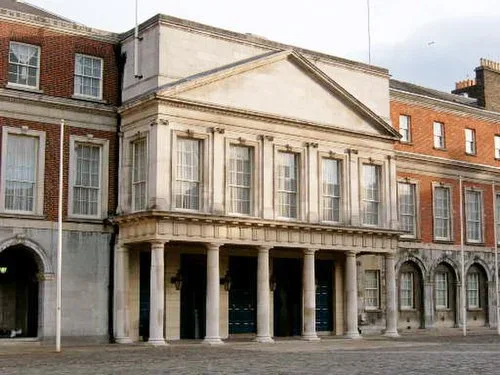 State Apartments Entrance and Battleaxe Landing
State Apartments Entrance
A severe fire in 1684 set off the rebuilding that turned this medieval fortress into a Georgian palace. Many of the buildings now date from the eighteenth century. The classical portico with its stone columns leads into the State Apartments, along the southern range of the Upper Yard. Lord Chesterfield had them built in the 1740s for the Lord Lieutenant, the monarch's representative in Ireland. Each winter came the Castle Season, a cycle of viceregal balls, dinners and social events. Behind the polish, the castle saw harder moments too. At the very start of the Easter Rising in 1916, twenty-five men of the Irish Citizen Army seized the castle's entrance gate and its guard room before reinforcements reached the small garrison. And on the night of Bloody Sunday in 1920, three prisoners, two of them senior IRA officers, were tortured and killed inside the complex.
Listen in the appUser Jtdirl on en.wikipedia · Public domain
04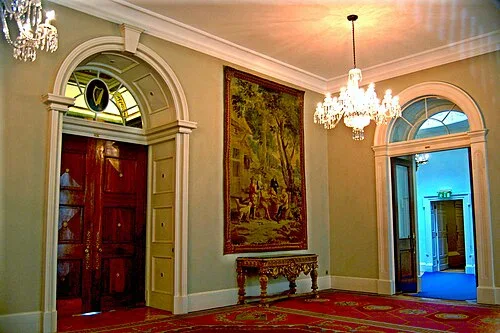 State Apartments Entrance and Battleaxe Landing
The Ceremonial Landing
The way into the State Apartments was designed to impress. Beyond the staircase lies the State Corridor, built around 1758 to designs of Thomas Eyre, the Surveyor General. He modelled it on Sir Edward Lovett Pearce's corridor in the old Parliament House on College Green. A marching procession of vaults and arches runs along it, originally lit from skylights above. The landing at the top of the stairs sets the tone for everything beyond. A large tapestry hangs on the wall, and crystal chandeliers throw light onto tall polished doors. Guests climbing up from the courtyard passed through spaces like this on their way into the Viceroy's suite.
Listen in the appJoseph Mischyshyn · CC BY-SA 2.0
05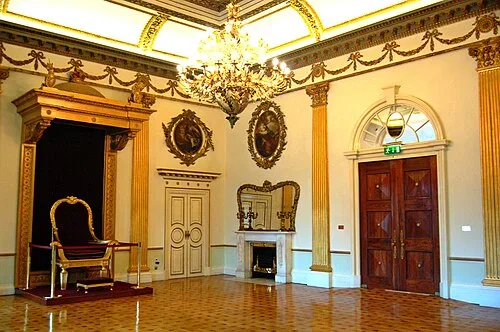 The State Apartments
The Throne Room
This chamber began life as the Battleaxe Hall in the 1740s. Around 1790 it was converted into a presence chamber, where the Viceroy received people in formal state. Its regal decoration dates from that conversion, and from further alterations in the 1830s. The throne beneath the gilded canopy has a specific birthday. It was built for the visit of King George IV to Ireland in 1821. A throne made for a king's own visit still stands here on its raised platform, under the chandelier.
Listen in the appJoseph Mischyshyn · CC BY-SA 2.0
06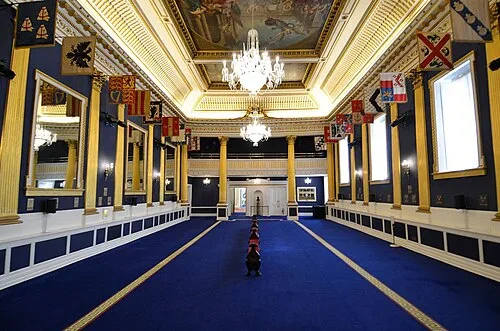 The State Apartments
Saint Patrick's Hall
The grandest room in the State Apartments is Saint Patrick's Hall, once the ballroom of the Lord Lieutenant's administration. Overhead hangs the most significant painted ceiling in Ireland, executed by Vincenzo Valdre around 1790. Its three panels show the coronation of King George III, Saint Patrick introducing Christianity to Ireland, and King Henry II receiving the submission of the Irish chieftains. Along the walls fly the banners of the Order of Saint Patrick, Ireland's order of chivalry. When the Church of Ireland was disestablished in 1871, the order moved its ceremonial home here from Saint Patrick's Cathedral. The banners and hatchment plates of the knights of 1922 remain in place. And the ceremonial life goes on. In 1938 Douglas Hyde was inaugurated as the first President of Ireland, and every president since has been inaugurated at the castle.
Listen in the appAdrian Grycuk · CC BY-SA 3.0 pl
07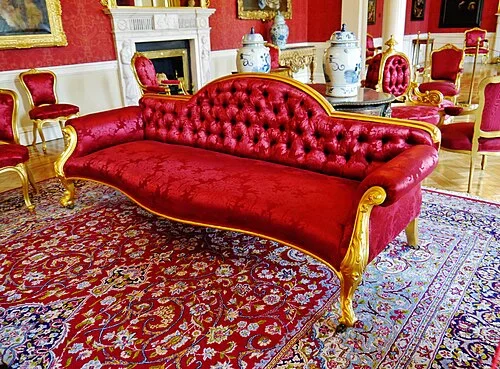 The State Apartments
The State Drawing Room
Remodelled in the 1830s, this was the principal reception room of the Lord Lieutenant and his household. Today it is reserved for receiving foreign dignitaries. The rich interior holds a hidden story: much of it is younger than it looks. Fire largely destroyed the room in 1941. Between 1964 and 1968 the Office of Public Works rebuilt it with minor modifications, using salvaged and replicated furnishings and fittings. The red velvet sofa and gilded chairs are a blend of the original and the carefully recreated.
Listen in the appPhoto: Zairon · CC BY 4.0
08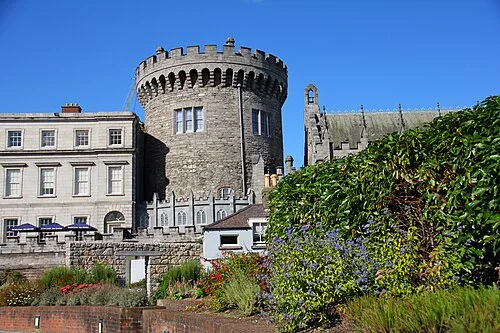 The Record Tower and Chapel Royal
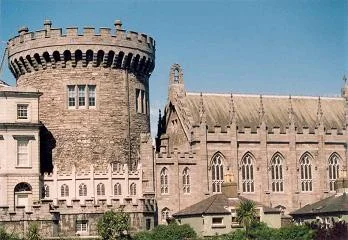
The Record Tower
The round tower at the southeast corner is the last of its kind. The Record Tower dates from the 1220s and is the sole surviving tower of the medieval castle. No trace of the other medieval buildings remains above ground today. Its battlements are an early nineteenth-century addition, and Francis Johnston restored the tower between 1810 and 1813. It also carries one of the castle's great escape stories. In January 1592, Red Hugh O'Donnell and the brothers Art and Henry O'Neill broke out of imprisonment in the castle. They fled south through a freezing winter night towards Glenmalure, a rebel stronghold in the mountains. Art O'Neill died of exposure on the way. Since 2009 the journey has been commemorated every January by the Art O'Neill Challenge, an endurance race and walk.
Listen in the appPhoto: J.-H. Janßen · CC BY-SA 3.0
09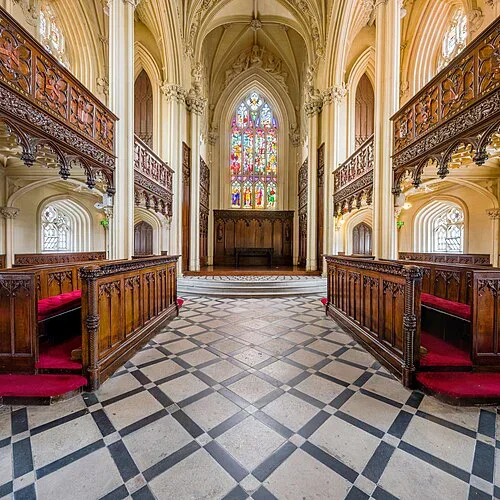 The Record Tower and Chapel Royal
The Chapel Royal
Beside the old tower stands the Chapel Royal, built in Gothic Revival style for the castle's religious life. Inside, richly carved wooden galleries line both sides of the nave, and stained glass floods the altar with colour. On the exterior, a carved head of Saint Patrick looks out over the grounds. The chapel's life has changed with the castle around it. Its crypt now serves as an arts centre, and occasional concerts are held in the castle grounds.
Listen in the appDavid Iliff · CC BY-SA 3.0
10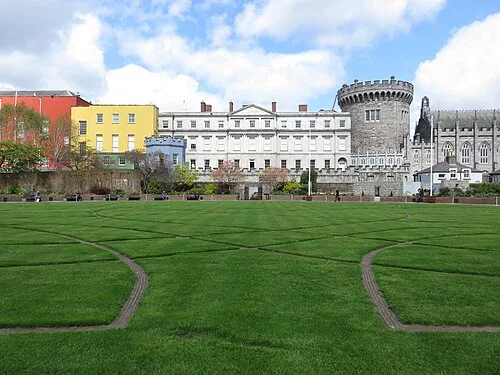 Dubh Linn Garden
The Dubhlinn Gardens
The name Dublin was born here. The castle was built beside a dark pool, Dubh Linn in Irish, on the lower course of the River Poddle just before it joined the Liffey. That dark pool gave the city its name. When the fortress rose, the Liffey was much wider than it is today, so the castle was effectively defended by both rivers. The Poddle now runs under the complex. The gardens were completed in 1680 and lie over the former pool site. Behind the lawn, the castle walls rise as they have for centuries.
Listen in the appPhoto: Antony-22 · CC BY-SA 4.0
- 11
The Garden Memorial
A spiral of blue mosaic in the garden, and the memorial to Gardaí who died in service.
- 12
The Chester Beatty Library
A world-class museum of manuscripts and rare books, sheltered inside the old castle complex.
- 13
The Lower Castle Yard and the Handover
Michael Collins, seven minutes late, and the January day the castle changed hands.
Dublin Castle
Frequently asked questions
How much does the guide cost?
Free app download. Listed guide price: $1.99. Guide price shown in the app. Audio guide only. Venue admission is separate.
Can I listen without internet?
Yes. Download the guide’s audio, images, and maps in the app before your visit. Your downloaded content is then available offline.
Can I listen in my language?
This audio guide is available in 15 languages, including English.
Do I need to follow a schedule?
No. This is a self-guided experience. Choose your stops, pause whenever you like, and return to a story at your own pace.
At your own pace
Explore Dublin Castle.
Download Stanza, then search for “Dublin Castle”.
Free app download · Guide price shown in the app
Keep exploring
Nearby audio guides
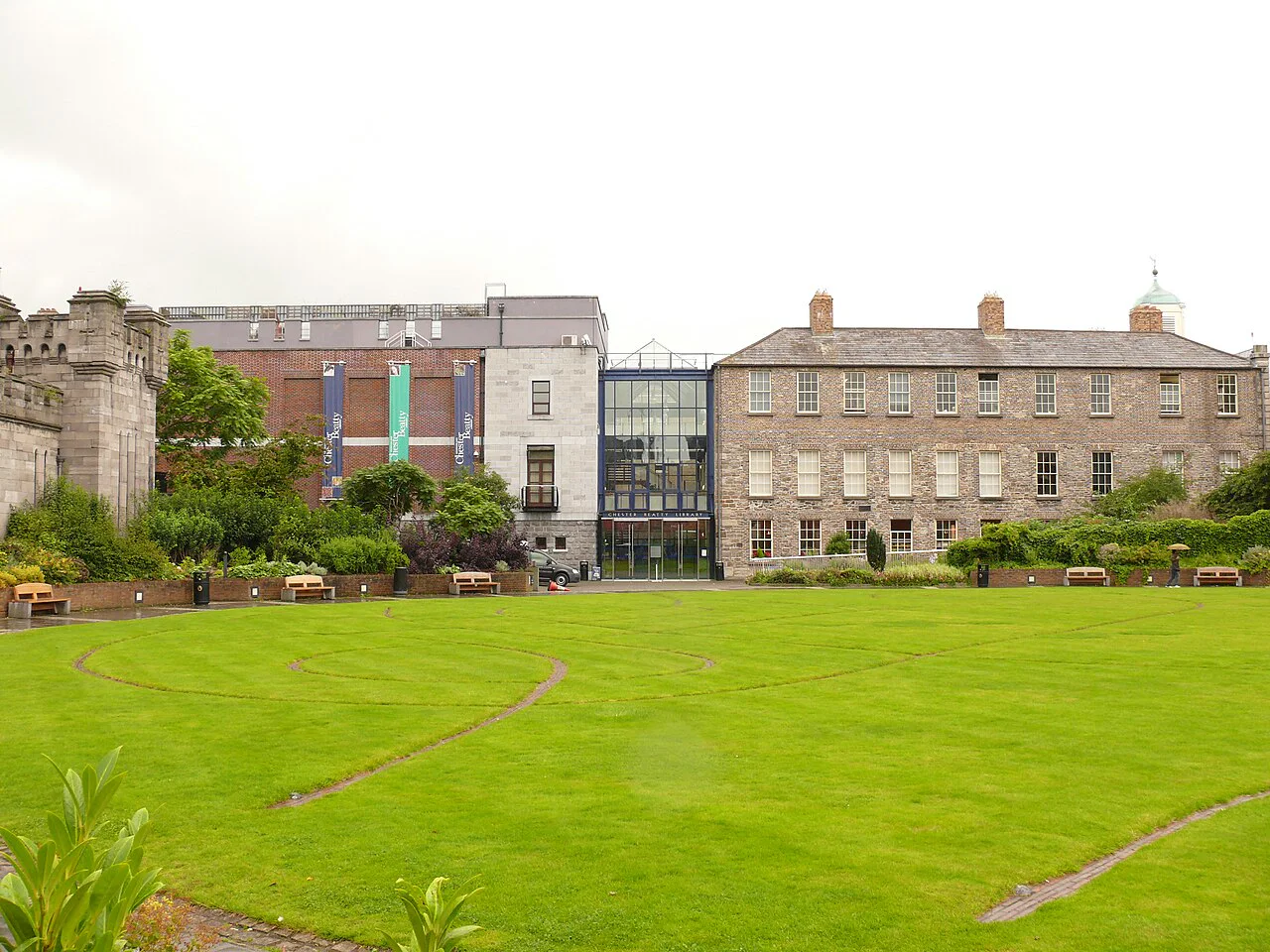
Dublin · 1 km
Chester Beatty Library
Content & sources
Photo: Aligatorek · CC BY-SA 3.0
Dublin · 1 km
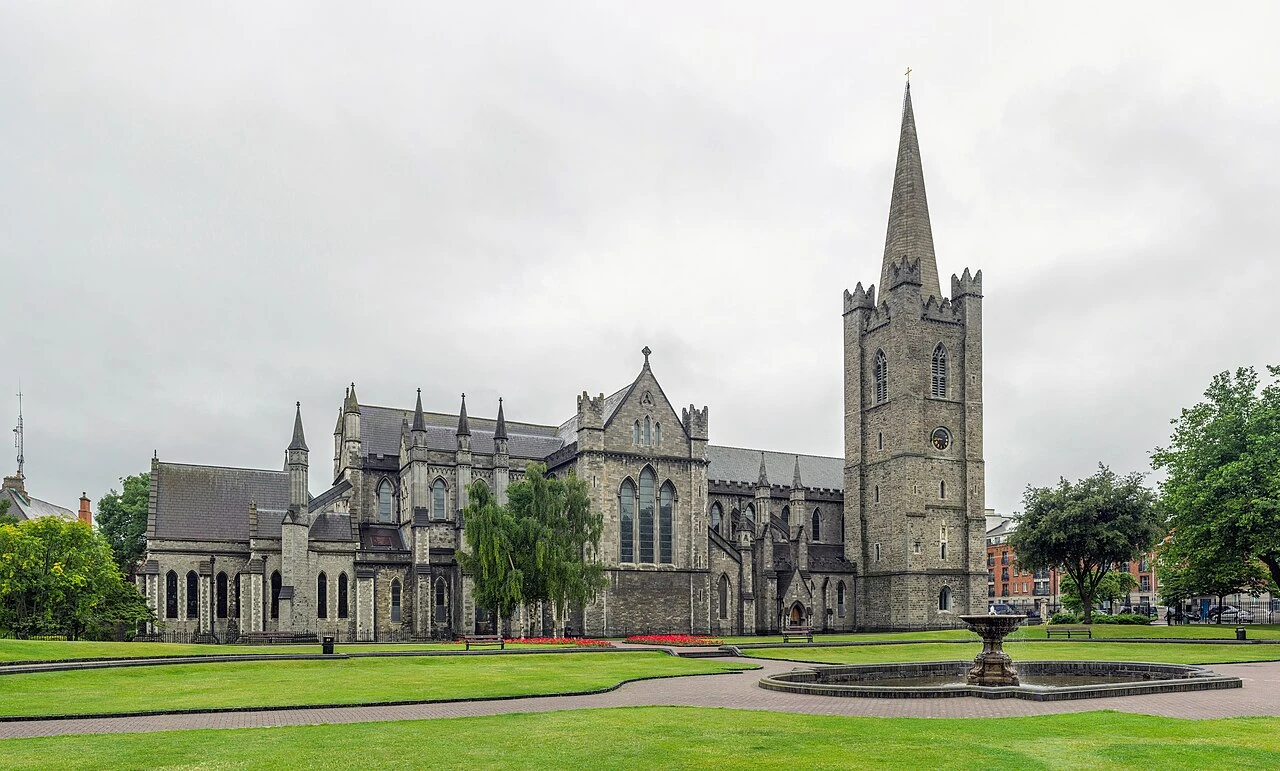
St. Patrick's Cathedral
Content & sources
Photo: Diliff · CC BY-SA 3.0
Dublin City · 1 km
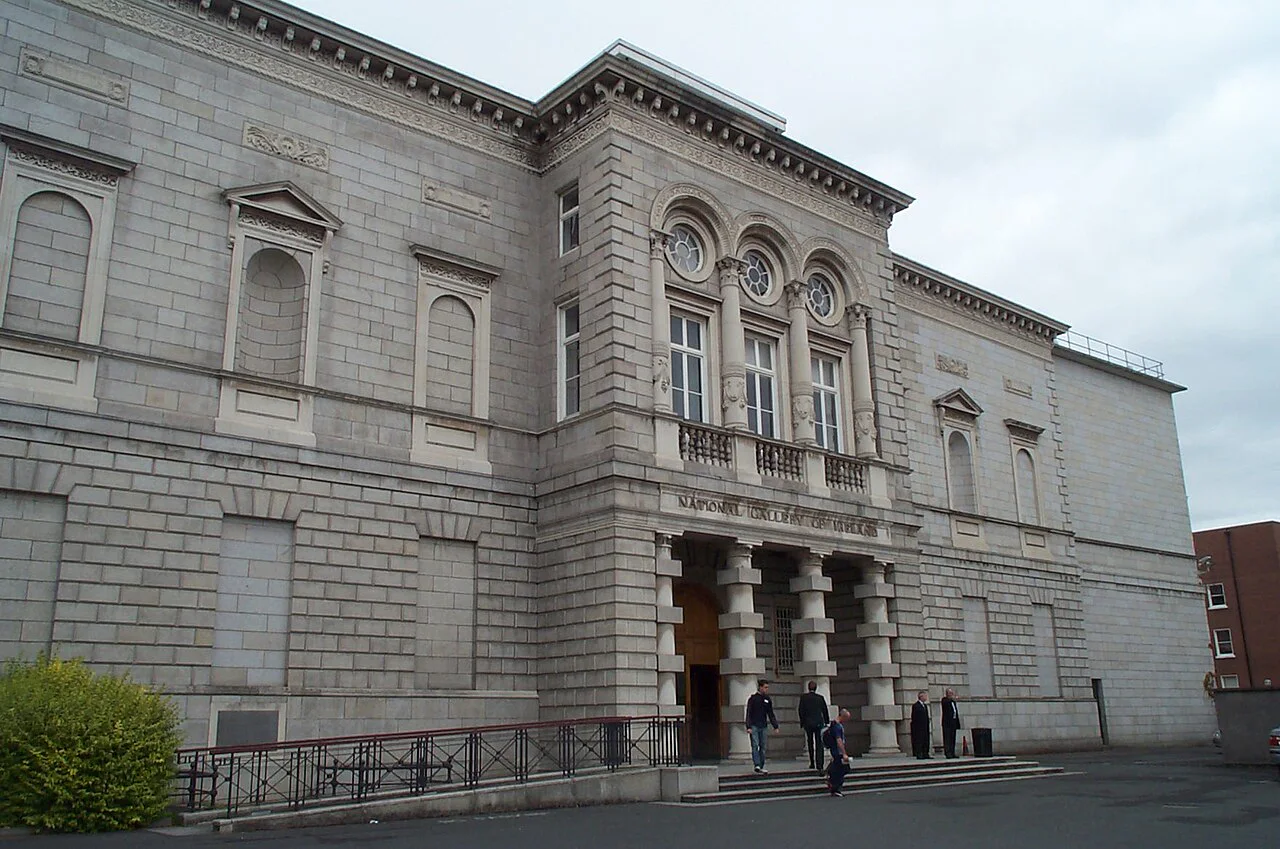
National Gallery of Ireland
Content & sources
Copyright © 2006 Kaihsu Tai · CC BY-SA 3.0
The Municipal District of Ashbourne · 35 km
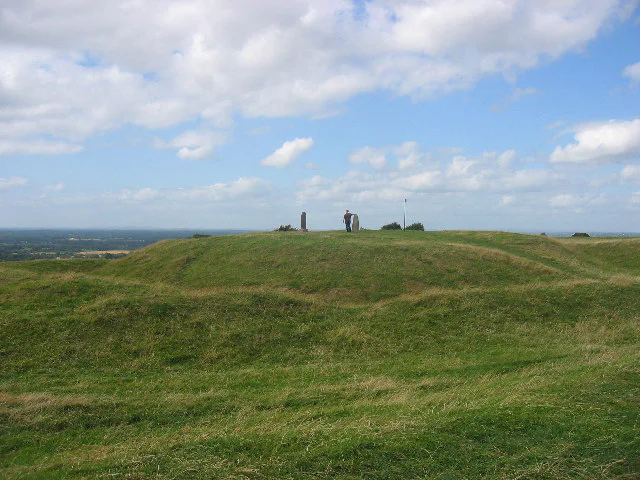
Hill of Tara
Content & sources
Patrick Brown · CC BY-SA 2.0