Stanza · Audio guide
Tel Arad Audio Guide
A place to remember. A story to take with you.
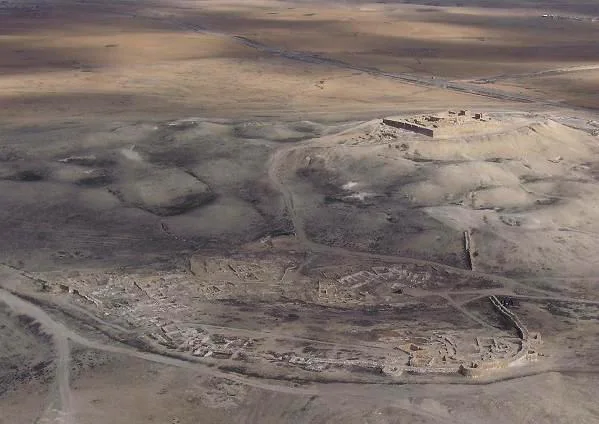
Tel Arad is an archaeological site consisting of a lower section and a tell located west of the Dead Sea. The site covers approximately 10.1 hectares and is situated in an area known as the Arad Plain.
Download Stanza, then search for “Tel Arad”.
About the tour
One guide. Your kind of visit.
Tel Arad is an archaeological site consisting of a lower section and a tell located west of the Dead Sea. The site covers approximately 10.1 hectares and is situated in an area known as the Arad Plain.
Ready when you are.
- 01Get the free Stanza app.
iOS & Android
- 02Find your guide.
“Tel Arad”
- 03Download before you go.
Works offline
Audio guide / 11 narrated stops
Inside the guide
Get to know a few of the stories before you go. Open a stop to read more.
01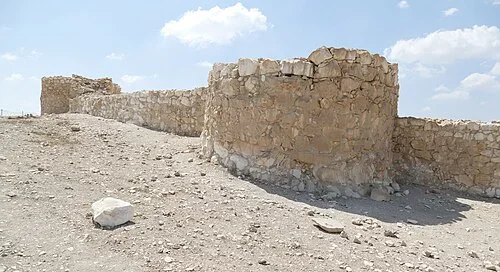 The Fortified Lower City and the Canaanite Mystery
Lower City Wall and Semi-Circular Tower
Welcome to Tel Arad, in the Arad Plain about ten kilometres west of the modern city of Arad. This site has an unusual shape, and it helps to hold both halves in mind. Down here on the flat ground lies a city from the Early Bronze Age, built in the early third millennium BCE. Up on the hill above it stands a much later fortress, the mound that came long after. Together the two parts cover about twenty-five acres. The round tower in the stonework belongs to the lower city's defensive wall. It ran for roughly twelve hundred metres around the whole settlement, braced at intervals by semi-circular towers like this one. A wall that long, on that scale, was not improvised. It is the first sign that Arad was planned before a single house went up.
Photo: Bukvoed · CC BY 4.0
02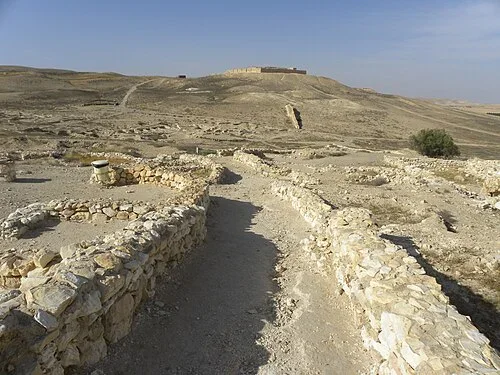 The Fortified Lower City and the Canaanite Mystery
Streets of the Planned Early Bronze Age City
This street runs straight between stone walls, and that is the point. In its great period, Stratum III, Arad was a true urban town. It had a city wall, a palace, a sacred precinct, public buildings and a reservoir, all laid out together. That town was destroyed around 2800 BCE and quickly rebuilt. The wide empty ground around the street hides another puzzle, though. The Bible describes a Canaanite Arad, a city fought during the Exodus. Yet excavation found no remains from the Middle or Late Bronze Age at all, a gap of some fifteen hundred years. One theory moves that city to Tel Malhata, thirteen kilometres southwest, where substantial Middle Bronze fortifications came to light. Another reads the biblical phrase the Negev of Arad as simply the name of the region, with no city in it. As for the Early Bronze city itself, it faded in the mid third millennium, possibly because trade routes carrying copper toward Egypt shifted away.
Ian Scott · CC BY-SA 2.0
03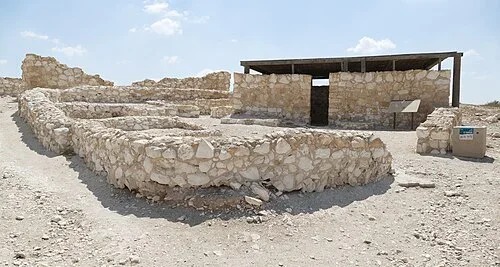 The Arad House and Residential Quarters
The Arad House — Regional Architecture
Under this shelter stands the signature building of ancient Arad, the house type archaeologists call the Arad house. It is a broadroom house: a rectangle entered from its long side, not from the narrow end. The foundations are stone, and the walls above them rose in mudbrick. Houses of this plan stood packed together across the Early Bronze Age city, wall to wall, quarter after quarter. The design was so standard that potters made little ceramic models of it, and one of those models, from around 3000 to 2650 BCE, is now in the Israel Museum in Jerusalem. Builders across the whole region copied the pattern, which is why it carries Arad's name.
Listen in the appPhoto: Bukvoed · CC BY 4.0
04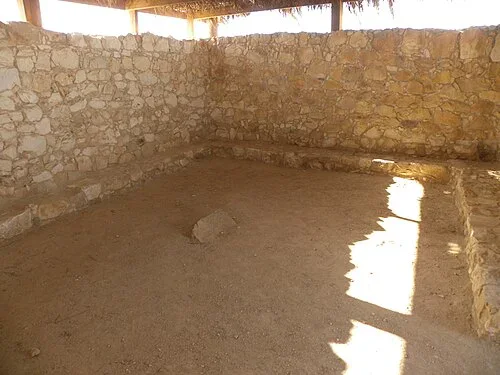 The Arad House and Residential Quarters
Inside an Early Bronze Age House
The room is smaller than its reputation. One main long space, with stone fittings built along the walls, held most of a household's life. Cooking happened here, and storage, and sleep, all within a few paces. A smaller side room took the overflow, the goods a family wanted kept cool and dark. The low stone benches and fittings along the walls gave the room its working shape, leaving the clay floor open in the middle. A roof shaded the whole space, and today a protective shelter does that job for the excavated rooms the same way. This was the everyday scale of the planned city: grand walls and a palace outside, and inside, one room and its stones.
Listen in the appIan Scott · CC BY-SA 2.0
05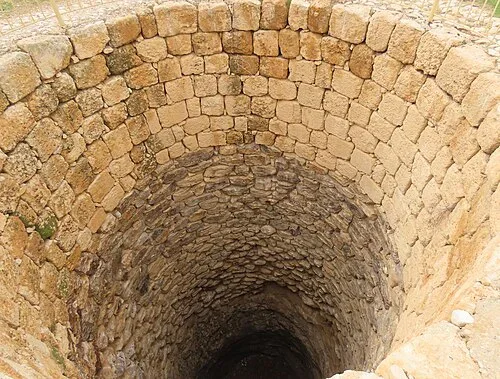 The Lower City Central Water Reservoir
The Lower City Well
Everything at Arad began with water, in a region too dry to take it for granted. The Early Bronze Age city first survived on a system that harvested rainwater and its runoff, channelling every drop toward storage in the low ground. Later a well supplemented that supply, like the stone-lined shaft here. Archaeologists still argue about its age: some think the Early Bronze settlers dug it, others date it only to the Iron Age, more than a thousand years afterwards. The city's last phase, Stratum I, was a sparse settlement scattered through the ruins of the older town. By around 2650 BCE it was abandoned, and the lower city stood empty.
Listen in the appPhoto: יעקב · CC BY-SA 4.0
06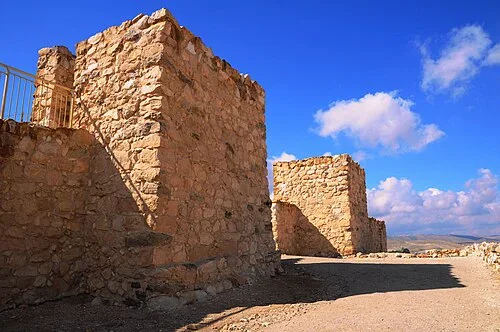 The Judahite Fortress Gate and the Eliashib Archive
The Judahite Fortress Gate and Walls
The story moves up the hill, to the fortress. From this height the ground explains itself: the mound commands the Arad Plain and the east-west valley that caravans used, guarding the southern edge of the Kingdom of Judah. People resettled the hill in the tenth and ninth centuries BCE, after the long gap that followed the Early Bronze city. From the second half of the ninth century came a proper casemate fortress, known as Stratum XI. What follows is a hard military rhythm. The fortress was destroyed and, it seems, immediately rebuilt, six phases in all across roughly 260 years, until the early sixth century BCE. That is when Judah itself fell to the Babylonians, and the last fortress fell with it. A garrison in a place like this needed supplies, water and writing, and each of those has its own stop.
Listen in the appSarah Murray from South Bend, IN, USA · CC BY-SA 2.0
07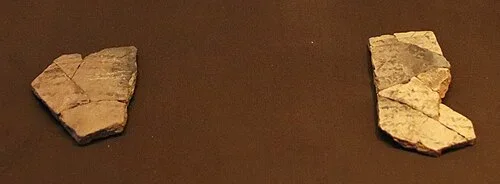 The Judahite Fortress Gate and the Eliashib Archive
The Arad Ostraca — Letters to Eliashib
These small inscribed sherds are the fortress's paperwork. Between 1962 and 1964 excavators recovered some two hundred ostraca, notes written on broken pieces of pottery. A hundred and seven of them are in ancient Hebrew, in the Paleo-Hebrew alphabet, dated to about 600 BCE. Most are everyday military correspondence between the commanders of the fort, and most of it is addressed to one man: Eliashib, thought to be the fort's quartermaster. His letters are orders and accounts, supplies and duties, nothing like epic literature. One sherd carries a phrase that made scholars sit up: a mention of a house of YHWH. Some read that as the Temple in Jerusalem, though others disagree, and the question is still open. The later sherds from the site are mostly Aramaic, with a few written in Greek and Arabic. Many of the letters are now kept in the Israel Museum in Jerusalem.
Listen in the appGary Todd from Xinzheng, China · CC0
08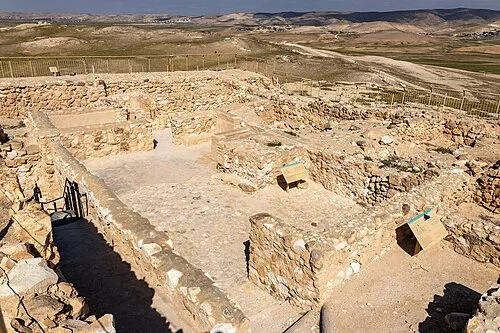 The Judahite Temple and the Holy of Holies
The Judahite Temple — Overview
Within the fortress compound, archaeologist Yohanan Aharoni uncovered something no one expected: a temple. It came to light in the very first excavation season, in 1962. It is one of very few temples of Yahweh ever excavated. That makes it direct physical evidence of how Judahite worship worked beyond the capital, in a provincial fortress on the desert edge, in the First Temple period. The biblical text describes no such sanctuary here, which is part of what makes it remarkable. Aharoni spent the rest of his life working on this temple, and died in 1976 before publishing the results. The final report was still incomplete decades later. The courtyard here also holds a secret underneath, a reservoir cut into the rock, saved for its own stop.
Listen in the appOren Rozen · CC BY-SA 4.0
09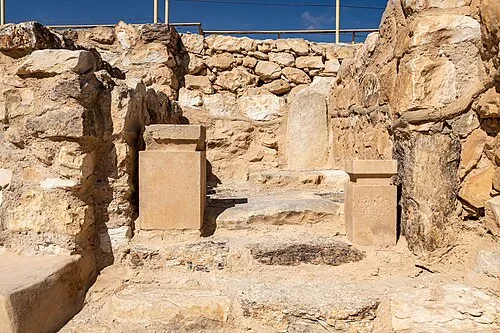 The Judahite Temple and the Holy of Holies
The Holy of Holies — Standing Stones and Incense Altars
At the far end of the temple is the Holy of Holies, the innermost recess. Two stones, possibly massebot or standing stones, were found here, with two small incense altars before them. What stands here today are replicas; the originals are in the Israel Museum in Jerusalem. One stone is plausibly dedicated to Yahweh; the other, most likely, to Asherah. It is rare physical evidence of what worship here actually looked like. The altars held something more surprising. Dark material preserved on their upper surfaces was sent for organic residue analysis. The smaller altar showed cannabis derivatives, including THC and CBD. The larger carried many compounds associated with frankincense. Burning frankincense in ritual is well known across the ancient world. The cannabis was something else entirely: the first known evidence of a hallucinogenic substance used in the Kingdom of Judah.
Listen in the appOren Rozen · CC BY-SA 4.0
10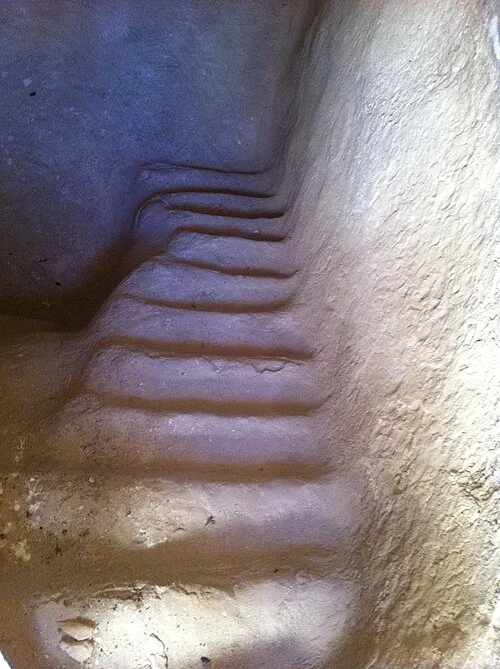 The Subterranean Fortress Reservoir and Desert Lookout
The Rock-Cut Fortress Reservoir
The fortress survived the desert because of rooms like this one, hidden underground. These stairs, cut straight into the rock and coated in plaster, lead down to the fortress reservoir. It was hewn and used in the ninth and eighth centuries BCE, carved beneath the area of the temple courtyard. The reservoir reaches about ten metres deep and holds roughly four hundred cubic meters of water. It is divided into two chambers, each lined with layers of plaster on its walls. The first chamber is the vast one, with a tiny room set inside it. The second, medium-sized chamber has the plastered staircase, built for maintenance and for drawing water. The fort's occupants relied on it in peacetime and during a siege alike, and the water served in temple ceremonies as well.
Listen in the appPhoto: Alpha12 · CC BY-SA 4.0
- 11
Citadel Lookout — Five Thousand Years on the Frontier
From Bar Kokhba to an Early Muslim citadel, and the scholar who put Arad back on the map.
Tel Arad
Frequently asked questions
How much does the guide cost?
Free app download. Listed guide price: $0.99. Guide price shown in the app. Audio guide only. Venue admission is separate.
Can I listen without internet?
Yes. Download the guide’s audio, images, and maps in the app before your visit. Your downloaded content is then available offline.
Can I listen in my language?
This audio guide is available in 15 languages, including English.
Do I need to follow a schedule?
No. This is a self-guided experience. Choose your stops, pause whenever you like, and return to a story at your own pace.
At your own pace
Explore Tel Arad.
Download Stanza, then search for “Tel Arad”.
Free app download · Guide price shown in the app
Keep exploring
Nearby audio guides
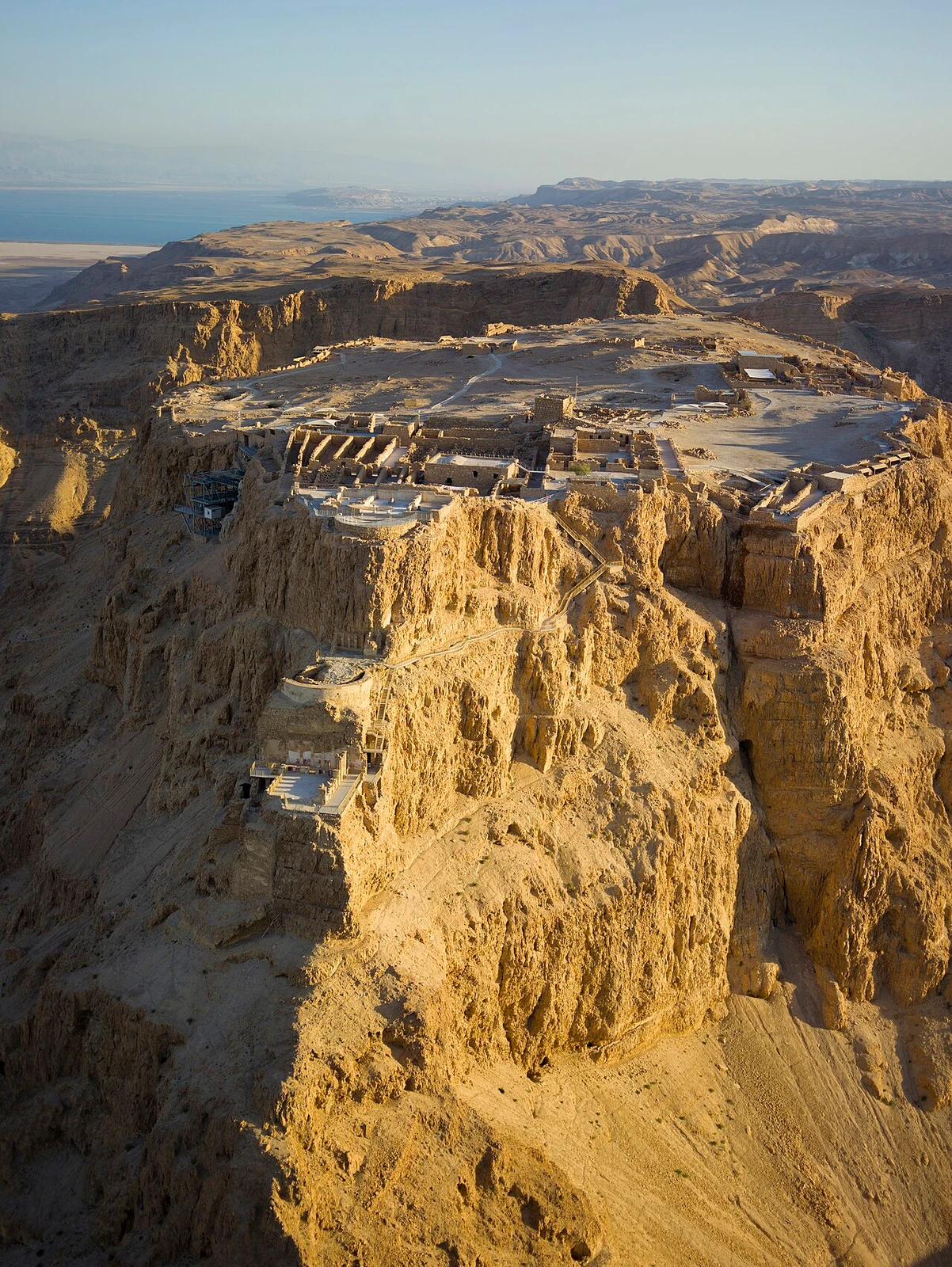
Masada · 22 km
Masada
Content & sources
Photo: Godot13 · CC BY-SA 4.0
Beersheba · 27 km
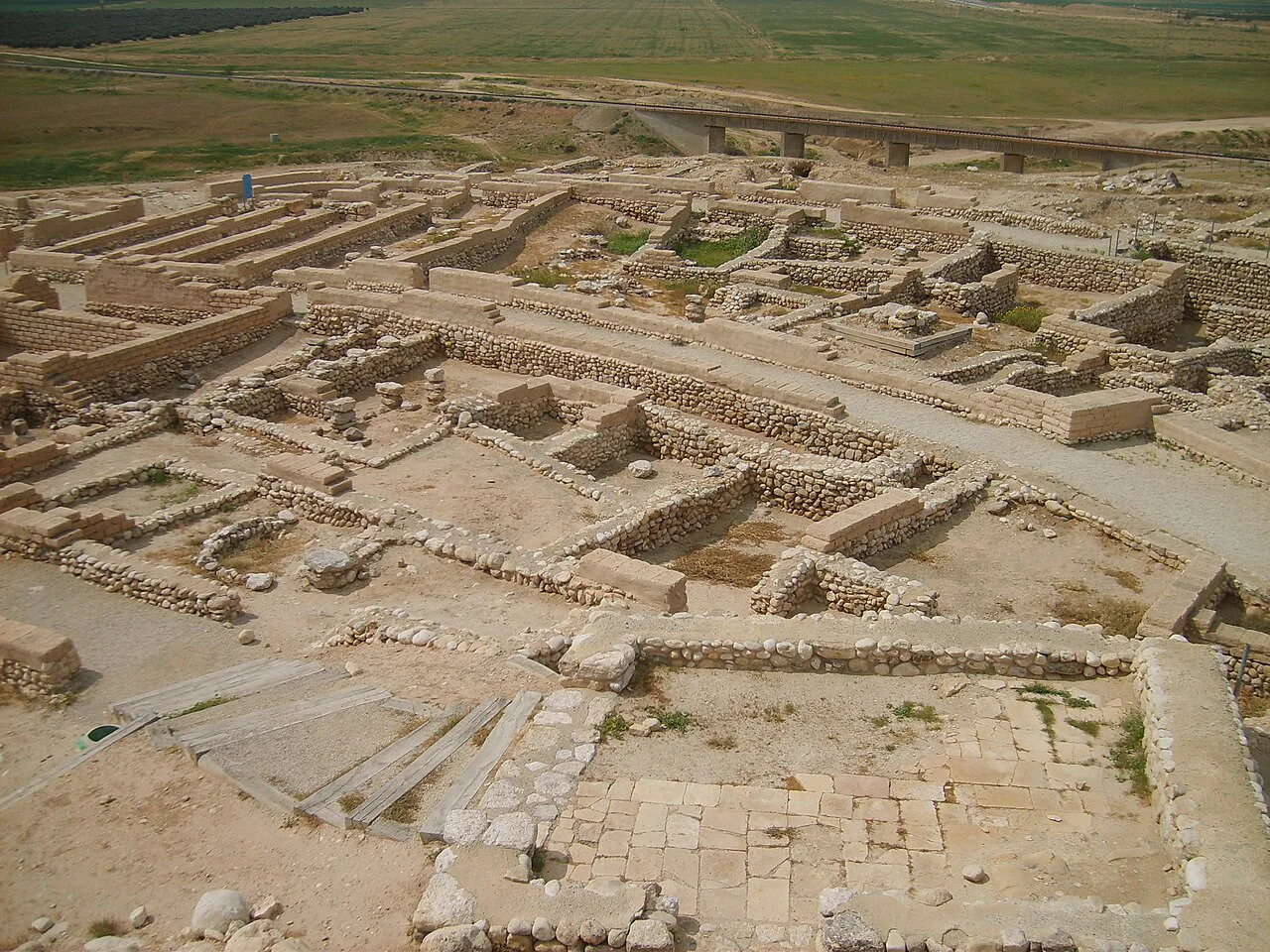
Tel Be'er Sheva
Content & sources
Photo: Gugganij · CC BY-SA 3.0
Yoav Regional Council · 41 km
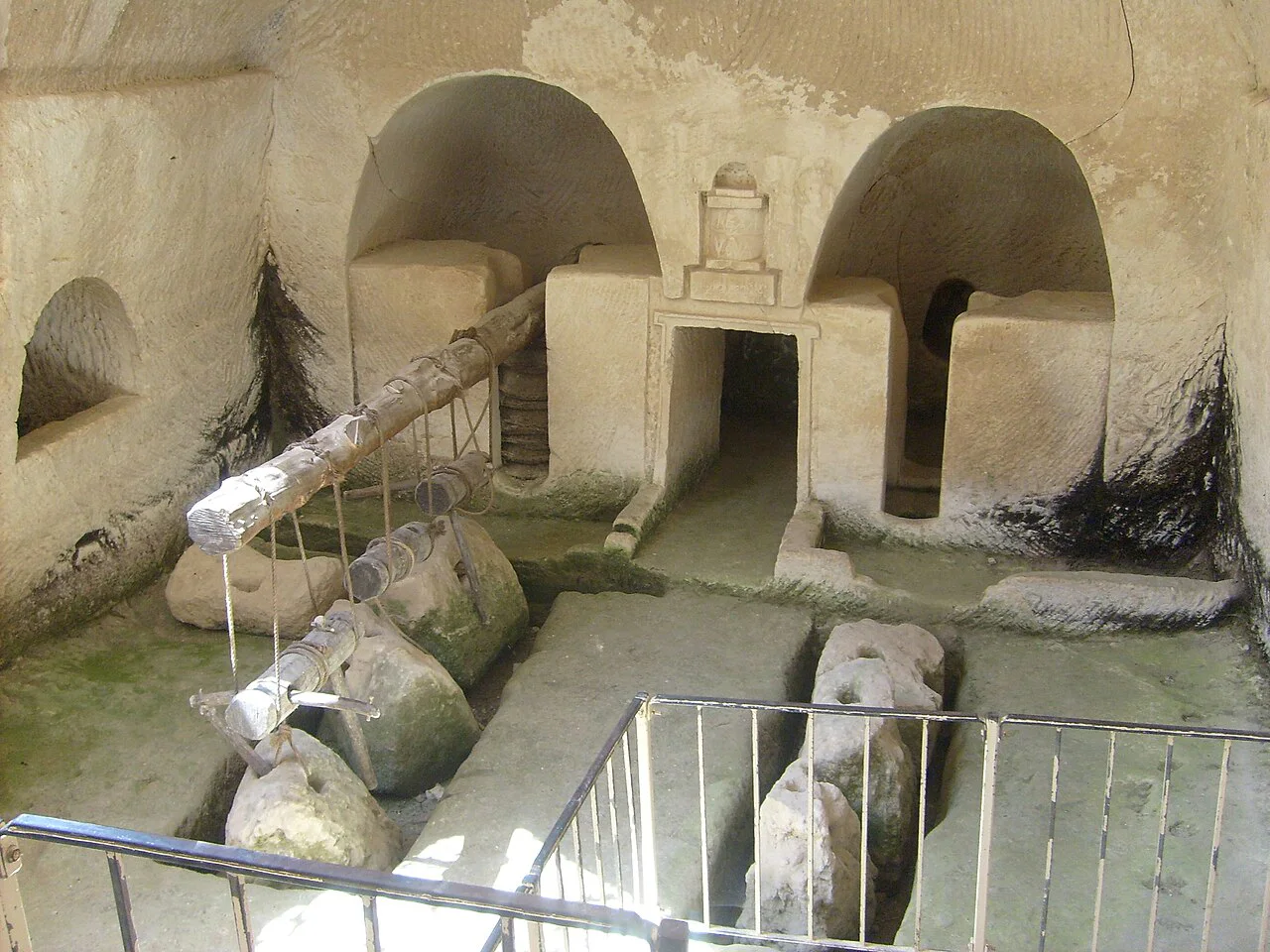
Maresha
Content & sources
Chai · CC BY-SA 3.0
Bethlehem · 44 km
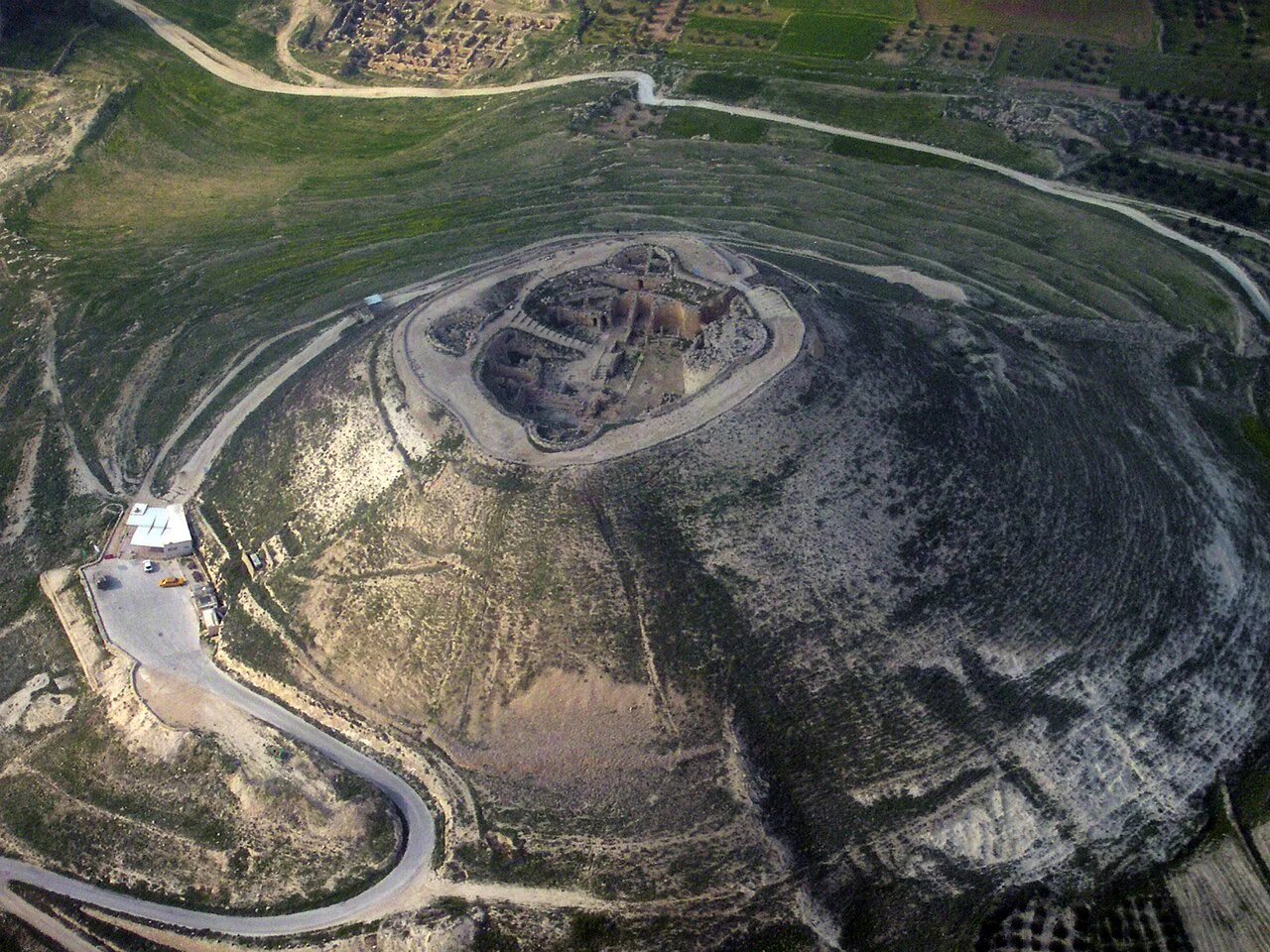
Herodium
Content & sources
Asaf T. · Public domain