Stanza · Audio guide
Herodium Audio Guide
A place to remember. A story to take with you.
Herodium is a fortified desert palace built by Herod the Great in the first century BCE. The complex stands atop a hill in the Judaean Desert.
Download Stanza, then search for “Herodium”.
About the tour
One guide. Your kind of visit.
Herodium is a fortified desert palace built by Herod the Great in the first century BCE. The complex stands atop a hill in the Judaean Desert.
Ready when you are.
- 01Get the free Stanza app.
iOS & Android
- 02Find your guide.
“Herodium”
- 03Download before you go.
Works offline
Audio guide / 15 narrated stops
Inside the guide
Get to know a few of the stories before you go. Open a stop to read more.
01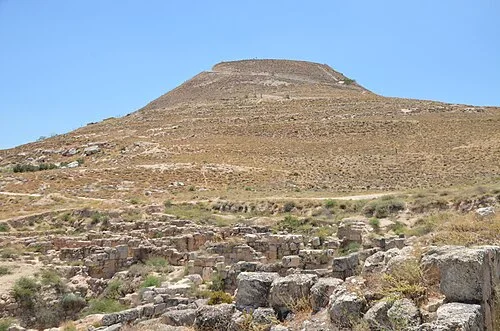 Arrival and the Conical Artificial Hill
Herodium: The Man-Made Mountain
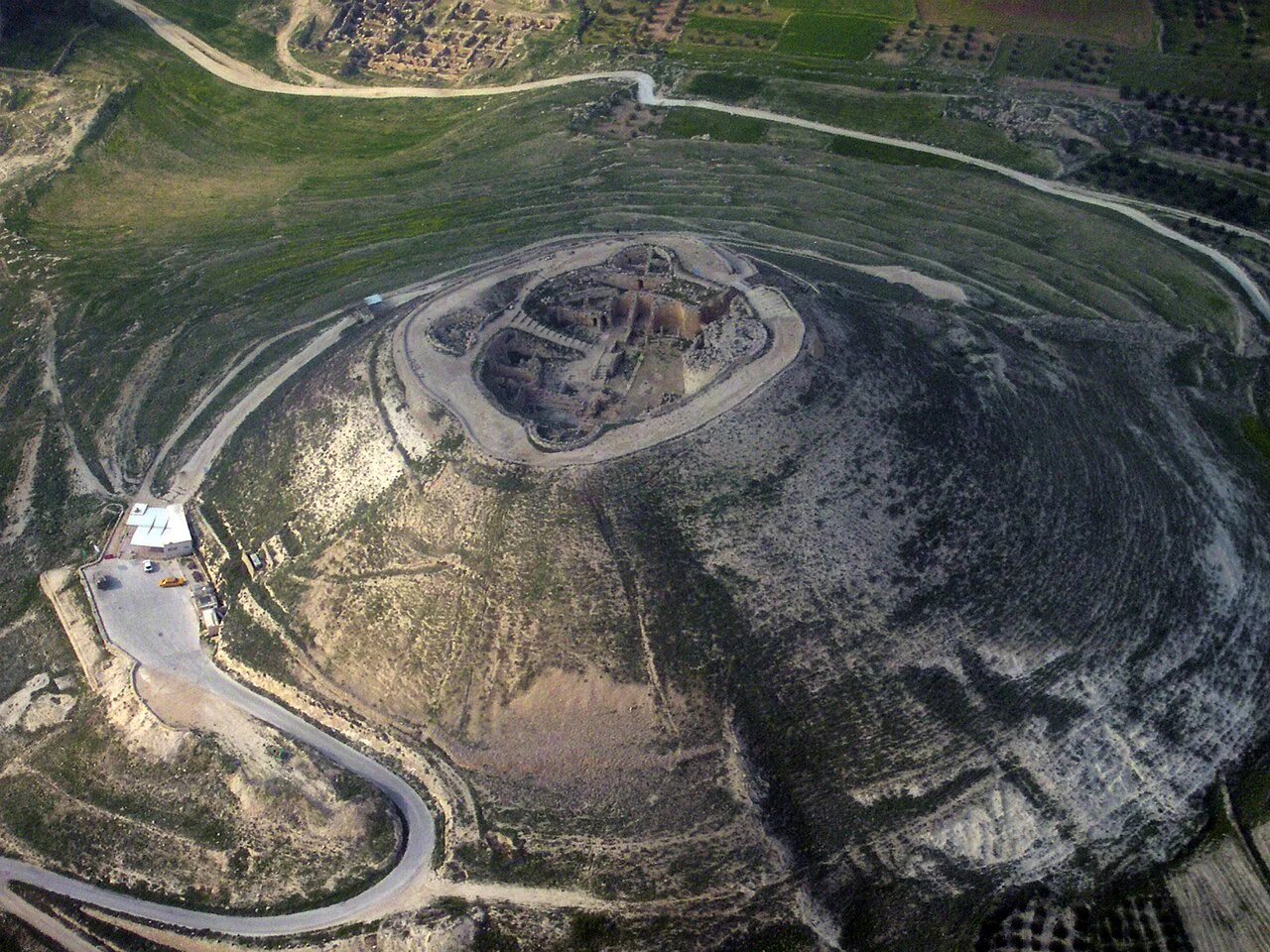
Welcome to Herodium, a fortified desert palace built by Herod the Great in the first century BCE. It lies about twelve kilometres south of Jerusalem, out in the Judaean Desert. The great cone of the hill dominates everything around it. Part of that cone is natural. Part of it was raised by human hands, heaped up and rounded until it ruled the skyline. The ancient historian Josephus wrote that the hill was raised to a greater height by the hand of man and rounded off in the shape of a breast. It could be seen from Jerusalem, and it still can. The site stands 758 meters above sea level. Herod packed a palace, a fortress and, in the end, a tomb into this single monument.
Carole Raddato from FRANKFURT, Germany · CC BY-SA 2.0
02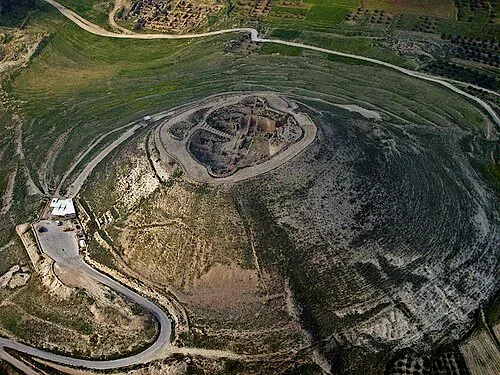 Arrival and the Conical Artificial Hill
The Founding: Herod's Victory
In 40 BCE Herod was running for his life. The Parthians had conquered Syria, and his rival Antigonus held Judaea, so Herod fled toward the fortress of Masada. On the way, near this spot, he clashed with fighters loyal to Antigonus. He won. According to Josephus, he then built a town on that spot in commemoration of his victory, and called it Herodion after himself. That makes it the only place in the world named for Herod the Great. The whole plan still reads clearly: a round fortress crowning the cone, with ruins spilling down the slopes. The main building work came later, roughly between 23 and 15 BCE, when Herod was king and could build on a royal scale.
Seetheholyland.net · CC BY-SA 2.0
03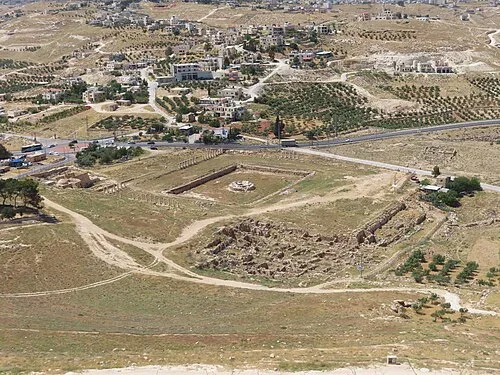 The Lower Palace and Great Pool
Lower Herodium: The Great Pool
At the foot of the mountain Herod built a second world. Lower Herodium held gardens, courtyards and a large pool, all fed by aqueducts. Josephus singled the pleasure grounds out for one reason. Water, he wrote, was lacking in that place, yet it was brought in from a distance and at great expense. That expense is the point of the whole complex. In the middle of the desert, Herod's guests could stroll shaded gardens and gather around a pool fit for a Roman villa. The lower palace was built to impress, and it worked. A visit here announced, without a word being spoken, that the host could move a river uphill if he pleased.
Listen in the appPhoto: Fallaner · CC BY-SA 4.0
04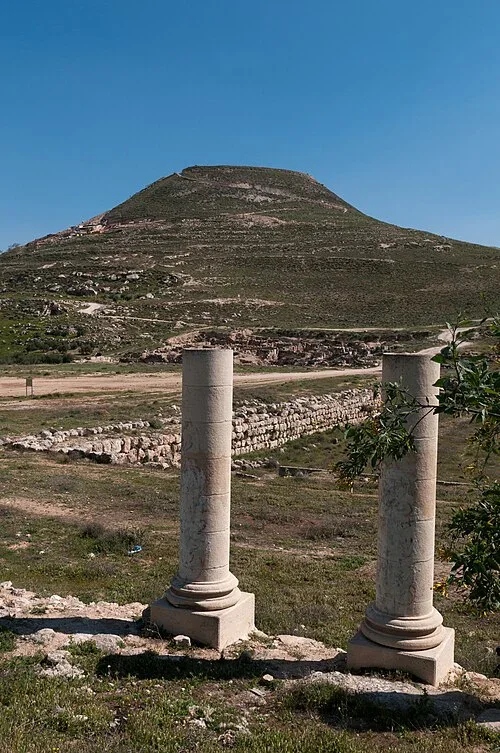 The Lower Palace and Great Pool
A Capital in the Desert
The standing columns of the lower city give the scale away. This was no mere retreat. Herodium served as the capital of a toparchy, a small administrative district of Judaea, which made it a working seat of government. Josephus described the surrounding plain as built up like a city second to none, with the hill serving as an acropolis for the other dwellings. That word, acropolis, means the fortified high point a city looks up to. The arrangement is visible even now, with colonnades and paving at the base and the cone rising behind them. Administration below, refuge and display above: the two halves of Herodium answered to each other.
Listen in the appPhoto: Ralf Roletschek · GFDL 1.2
05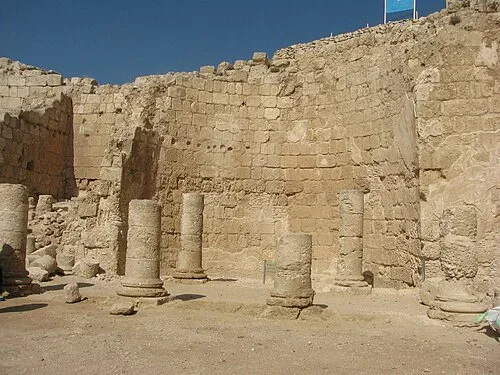 The Upper Palace-Fortress and Courtyard
The Peristyle Courtyard
Herod's private quarters filled the summit of the hill. Josephus summed up the design in one phrase: costly royal apartments made for security and for ornament at the same time. The peristyle courtyard, ringed by columns, opened onto the finest of them. Herod decorated his rooms with mosaic floors and elaborate frescoes, the style of a Roman villa transplanted onto a mountaintop. The luxury was deliberate. Anyone admitted this far into the fortress saw wealth on every surface, and also saw that it sat inside double walls on a man-made hill. Comfort and defense were designed as one. Herod did not choose between feeling safe and living beautifully; he paid for both.
Listen in the appיהודית גרעין-כל Yehudit Garinkol · CC BY 2.5
06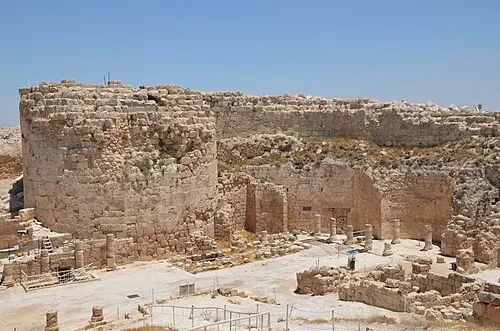 The Upper Palace-Fortress and Courtyard
The Circular Fortress and Its Towers
Herodium's fortress is a circle, and that alone makes it unusual. Double walls ran around the summit, and four massive towers rose from the ring. The largest stood on a stone base 18 meters in diameter, and this was most likely where Herod himself lived. The other three towers measured 16 meters across and held living space and storage. According to one account they rose as many as seven stories. Josephus records the approach as well: a steep ascent formed of two hundred steps of hewn stone. Anyone climbing to the gates did so in full view of the walls above. The whole design told visitors, before they reached the door, exactly whom they were dealing with.
Listen in the appCarole Raddato from FRANKFURT, Germany · CC BY-SA 2.0
07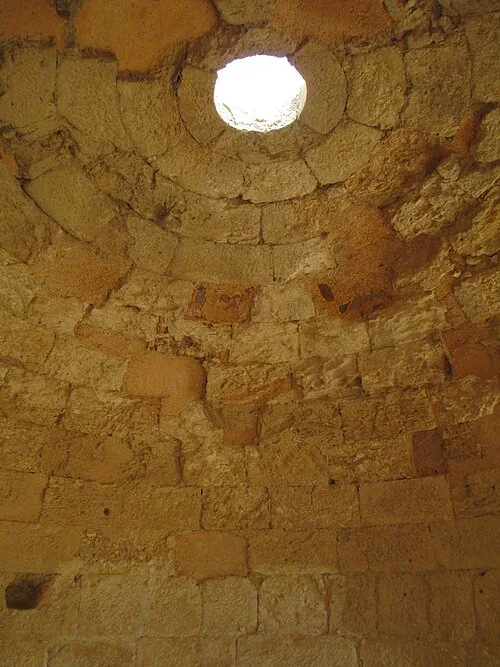 The Roman Bathhouse
The Bathhouse Dome
The stone dome of the bathhouse has outlasted everything around it. Two thousand years of earthquakes and wars have left it in good condition, and it is counted among the oldest intact domes of its kind in the region. Herod built the bathhouse as part of the palace's Roman luxury, and it worked in three rooms, taken in sequence. First came the caldarium, the hot room for sweating. Then the tepidarium, the warm room where bathers eased down. Last came the frigidarium, where guests cooled off in a large pool. Hot, warm, cold: the same round of bathing that filled the bathhouses of Rome, carried out here on a desert mountaintop.
Listen in the appAvi1111 dr. avishai teicher · CC BY-SA 4.0
08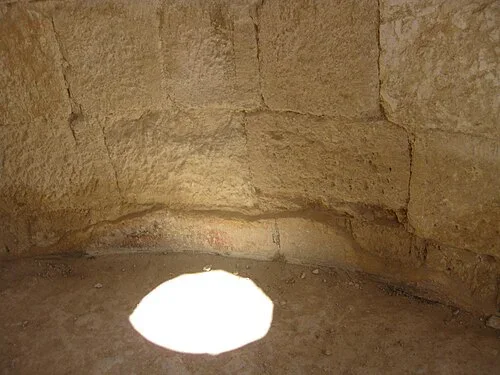 The Roman Bathhouse
How the Bath Worked
The comfort of the bathhouse rested on hidden machinery. In the caldarium, the floor was raised on supports, leaving a gap beneath where hot air could flow. Channels built into the walls carried that heat upward, warming the vaulted ceilings as well. Bathers above felt gentle warmth underfoot and on every surface, with no idea of the engineering below. The warm tepidarium room was finished for the eye too, with mosaic floors and frescoes just like the living quarters of the palace. Even the rooms without fire were dressed like a villa. The frigidarium waited at the end of the round, its large pool ready to close the pores the heat had opened.
Listen in the appPhoto: Deror avi · CC BY-SA 3.0
09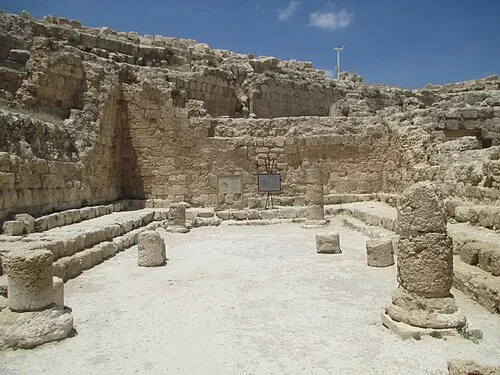 The Rebel Synagogue
Herod's grand dining hall, the triclinium, ended its life serving his enemies. During the First Jewish-Roman War, from 66 to 73 CE, Jewish rebels held Herodium and transformed that hall into a synagogue. They installed benches along the walls and built a mikveh, a ritual bath, outside the entrance, which faced eastward. The room is considered one of the earliest synagogues in the Levant. It was also strikingly plain. There was no niche for the Torah scrolls and no reading desk, features that later synagogues took for granted. It functioned simply as a communal hall, and that simplicity is what makes it valuable evidence. Not long after, the fortress fell to the Romans under the legate Sextus Lucilius Bassus.
Listen in the appDr. Avishai Teicher · CC BY 2.5
10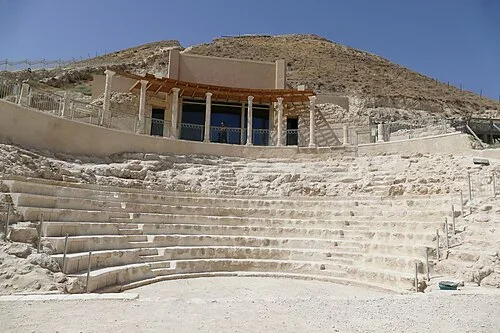 The Royal Theater and Frescoes
The Royal Theater
Near the base of the hill Herod built himself a small private theater. Stone benches held an audience of several hundred, perhaps six hundred and fifty at most. This was no civic playhouse for the crowds. At its heart stood an elaborately decorated loggia, a theater box reserved for the king. When Herod or another notable came to watch a play, that box offered luxury treatment while the rest of the audience sat below on the benches. The theater came to light in excavations led by Ehud Netzer, uncovered shortly before his death.
Listen in the appPhoto: Bukvoed · CC BY 4.0
- 11
Frescoes of Italy and the Nile
The royal box frescoes: painted landscapes of Italy and the Nile, likely by painters from Rome.
- 12
Herod's Tomb: The Search and Discovery
The tomb Herod built for himself, found in 2007 after Ehud Netzer's thirty-five-year search.
- 13
The Sarcophagus of Herod
The ornate sarcophagus claimed as Herod's, judged by its decoration alone.
- 14
Rebels in the Tunnels
Bar Kokhba's second headquarters: rebels sheltering in the tunnels and shoring up the water system.
- 15
Cisterns: The Mountain's Afterlife
The rock-cut cisterns that kept the mountain alive, and the silence after 135 CE.
Herodium
Frequently asked questions
How much does the guide cost?
Free app download. Listed guide price: $1.99. Guide price shown in the app. Audio guide only. Venue admission is separate.
Can I listen without internet?
Yes. Download the guide’s audio, images, and maps in the app before your visit. Your downloaded content is then available offline.
Can I listen in my language?
This audio guide is available in 15 languages, including English.
Do I need to follow a schedule?
No. This is a self-guided experience. Choose your stops, pause whenever you like, and return to a story at your own pace.
At your own pace
Explore Herodium.
Download Stanza, then search for “Herodium”.
Free app download · Guide price shown in the app
Keep exploring
Nearby audio guides
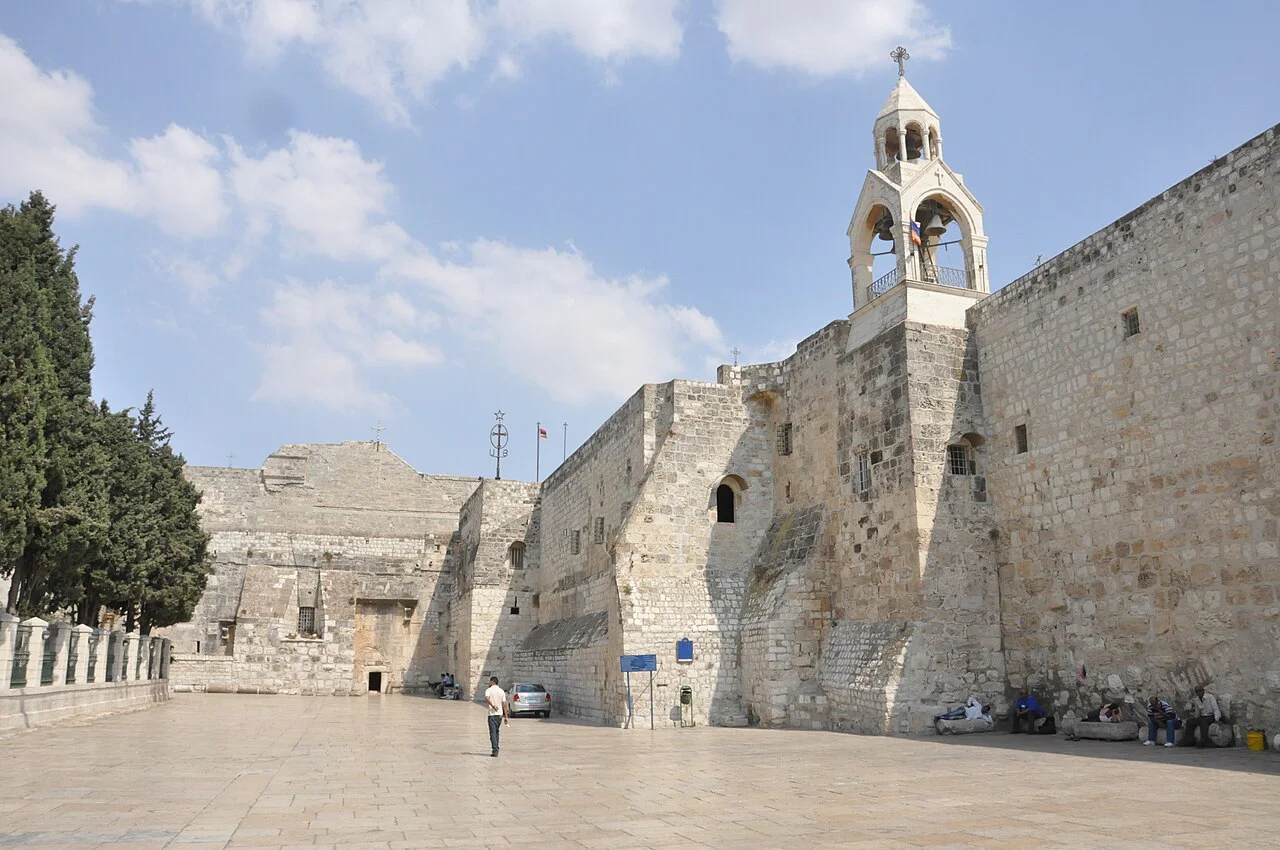
Bethlehem · 5 km
Church of the Nativity
Content & sources
Neil Ward · CC BY 2.0
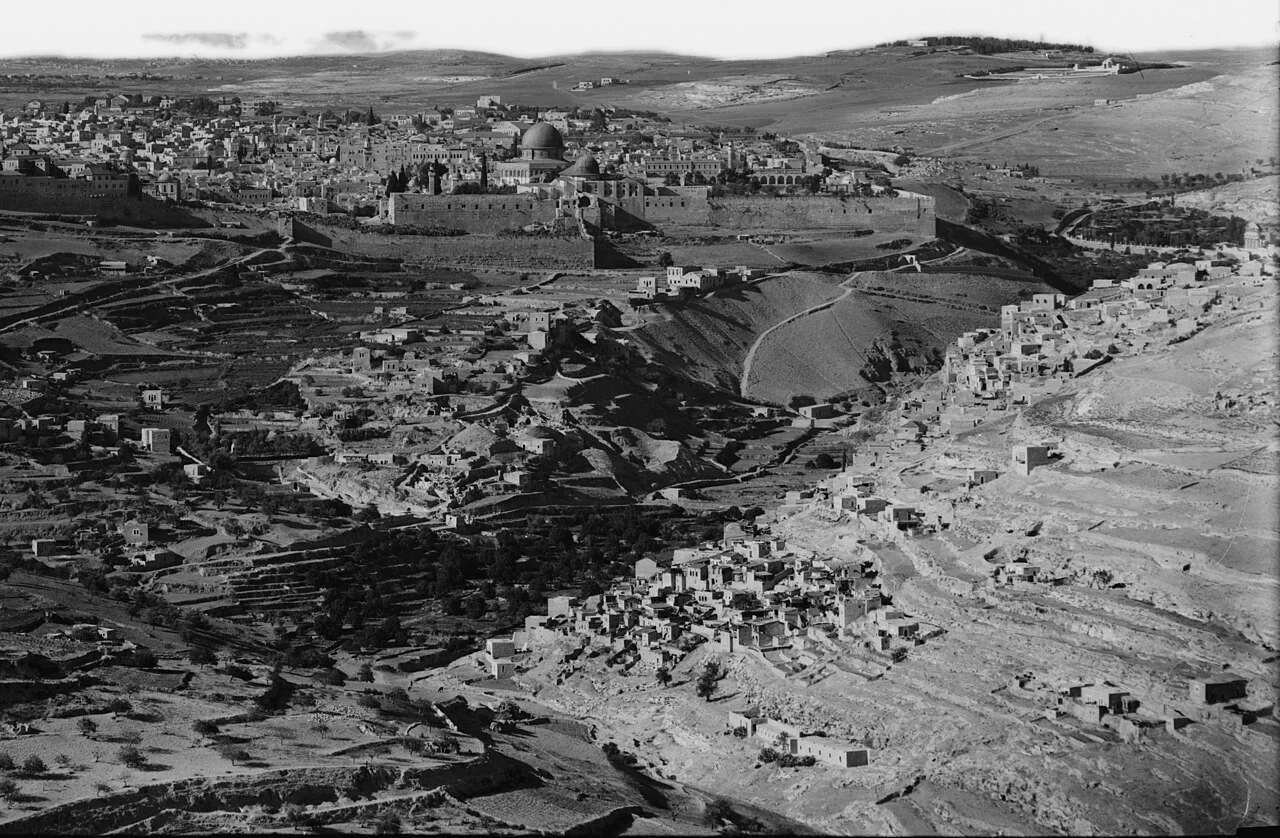
Jerusalem · 12 km
City of David
Content & sources
Matson Collection · Public domain
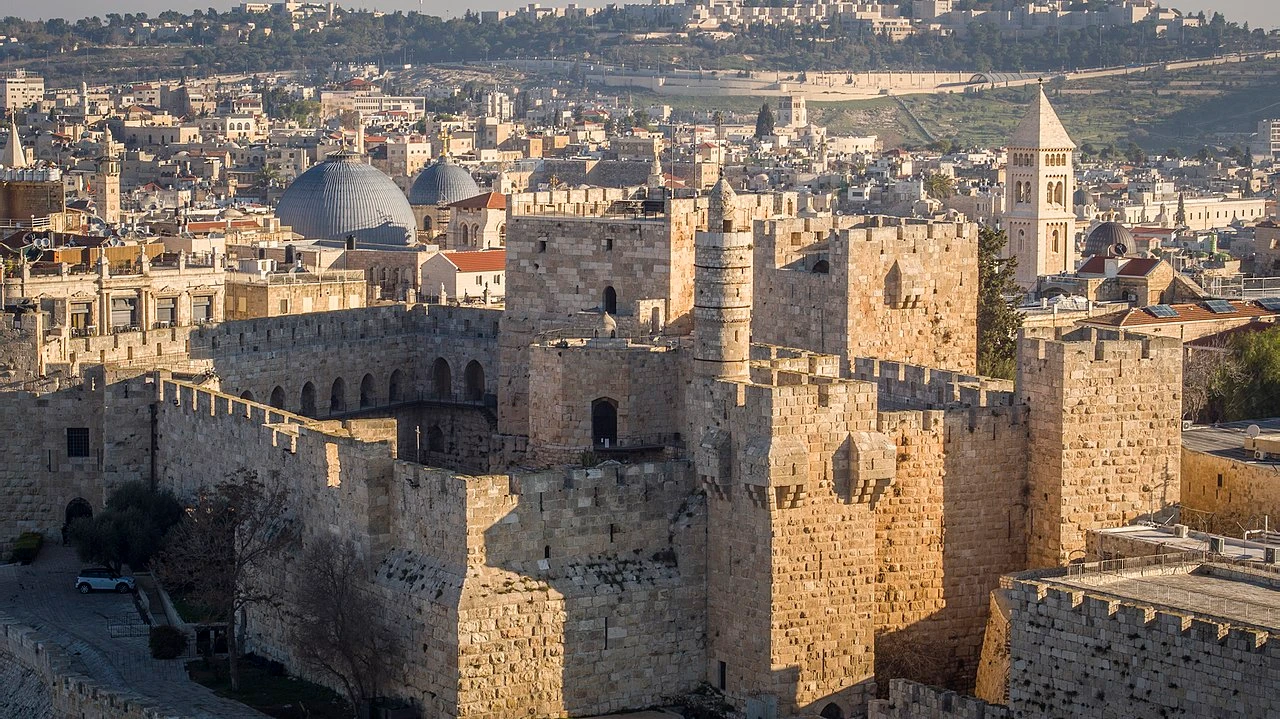
Jerusalem · 12 km
Tower of David
Content & sources
Photo: אורי אלוני · CC BY-SA 4.0
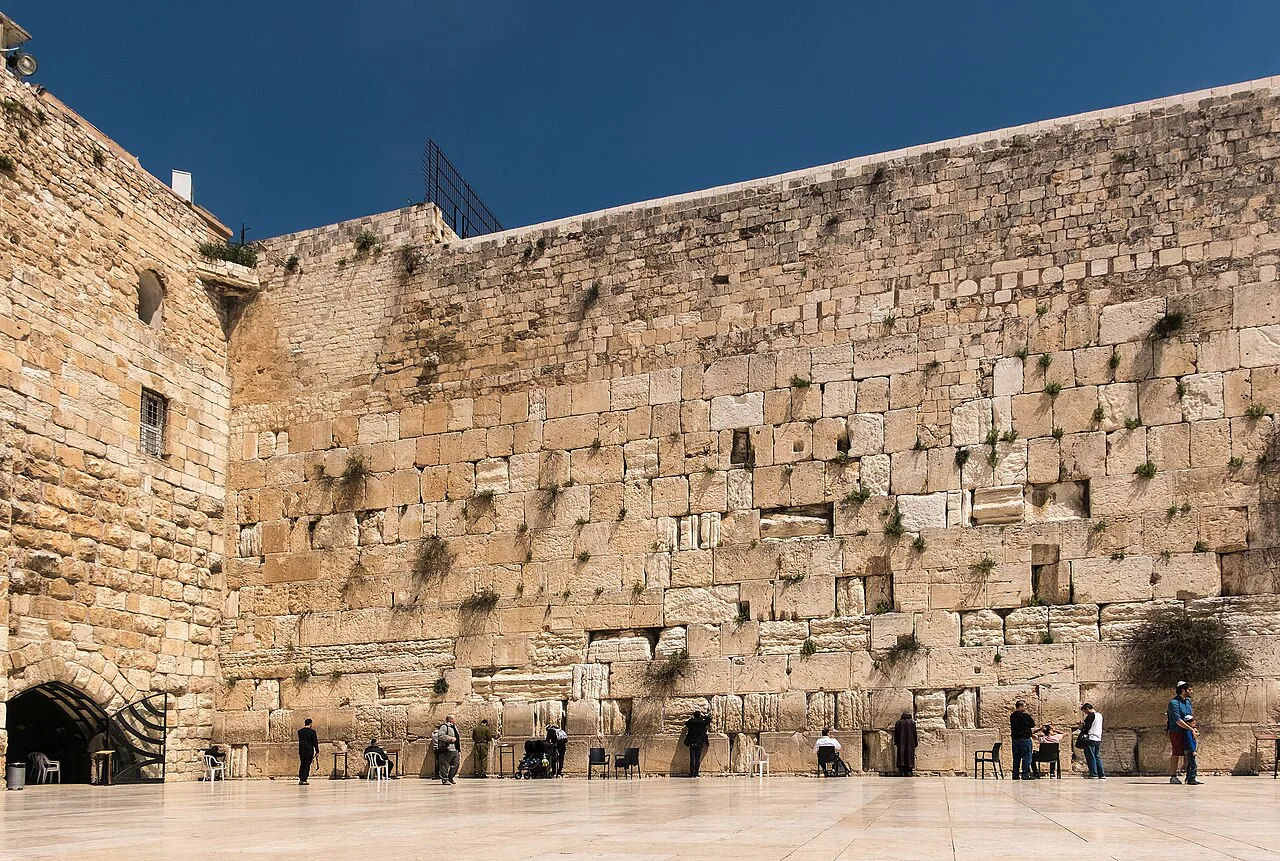
Jerusalem · 12 km
Western Wall
Content & sources
Photo: Ralf Roletschek · GFDL 1.2