 Stanza / Audio guide
Content & sources
Stanza · Audio guide
Sepphoris Audio Guide
A place to remember. A story to take with you.
Sepphoris is an ancient city in Israel that served as the epicenter of second-century Jewish life. It is one of the most excavated and studied archaeological sites in the country.
Download Stanza, then search for “Sepphoris”.
About the tour
One guide. Your kind of visit.
Sepphoris is an ancient city in Israel that served as the epicenter of second-century Jewish life. It is one of the most excavated and studied archaeological sites in the country.
Ready when you are.
- 01Get the free Stanza app.
iOS & Android
- 02Find your guide.
“Sepphoris”
- 03Download before you go.
Works offline
Audio guide / 17 narrated stops
Inside the guide
Get to know a few of the stories before you go. Open a stop to read more.
01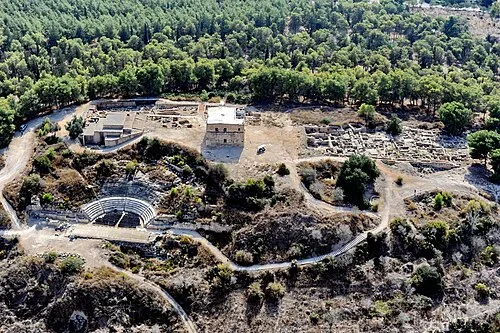 Arrival & City Panorama: The Bird of the Galilee
Sepphoris from Above: The Hill Over the Beit Netofa Valley
Welcome to Sepphoris — Tzipori in Hebrew, a name drawn from the Hebrew word for bird. The hill suits the name. It rises about 286 meters above the sea and looks out over the Beit Netofa Valley, with Nazareth only a few kilometers away. From this height the whole ancient city spreads out, excavated street by street. Two landmarks stand out. On the slope, the hollow of a Roman theatre; on the summit, a square fortress. People have lived on this hill since at least the fourth century before the Common Era, in the Hellenistic period. It grew into the administrative capital of the Galilee, and later into a busy commercial town on the trade routes through the region. Jews, pagans and Christians lived side by side here, each keeping its own identity while daily life blended together. More than sixty mosaics, made between the third and the sixth century, survive in the ruins. This tour follows the city from its founding drama to the waterworks beneath it.
Photo: AVRAMGR · CC BY-SA 4.0
02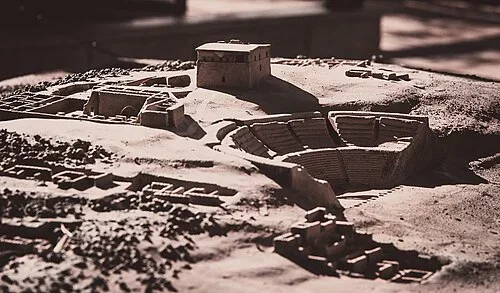 Arrival & City Panorama: The Bird of the Galilee
Scale Model of the Ancient City
This model shows Sepphoris laid out at its height, and the road there began with an attack. In the year 4 before the Common Era, after Herod the Great died, a rebel named Judas, son of Ezekias, seized the town, then the administrative center of the Galilee. He emptied its treasury and weapons and armed his followers against Herodian rule. The Jewish historian Josephus reports that the Roman governor Varus burned the whole city down and sold its people into slavery. Archaeology has found no traces of that fire, so it remains an ancient report rather than a proven event. Herod's son Antipas, made governor of the Galilee, rebuilt the city and proclaimed its new name: Autocratoris. Josephus calls his Sepphoris the 'Ornament of the Galilee'. Antipas expanded the old palace and arsenal and built a city wall. The new population was loyal to Rome. In the centuries that followed, some thirty thousand people lived here, largely at peace with one another.
Photo: Novilex · CC BY-SA 4.0
03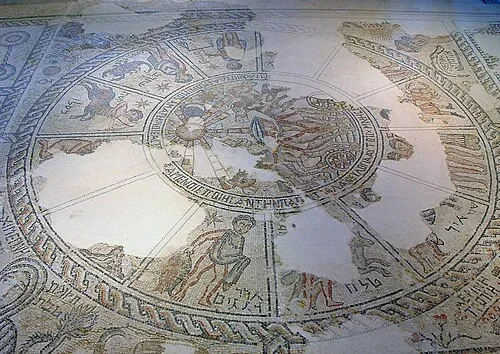 The Ancient Synagogue & Zodiac Mosaic
The Zodiac Mosaic of the Synagogue
Near the edge of town stood a synagogue, built in the fifth century, a modest hall about twenty meters long. Its mosaic floor is divided into seven panels. Near the entrance, angels visit Sarah. On the far side, two lions flank a wreath, their paws resting on the head of an ox. And at the center, a large panel: a zodiac wheel. The names of the months are written in Hebrew around the rim. In the middle sits Helios, the Greek sun god, in his chariot. That is the puzzle and the charm of this floor. A Jewish congregation, in a town that appears to have been predominantly Jewish, set a pagan sun god into its house of worship, ringed by the Roman signs of the zodiac. The community kept its Bible stories and its traditions, and felt entirely at home in the visual language of the empire around it.
Listen in the appG.dallorto · Public domain
04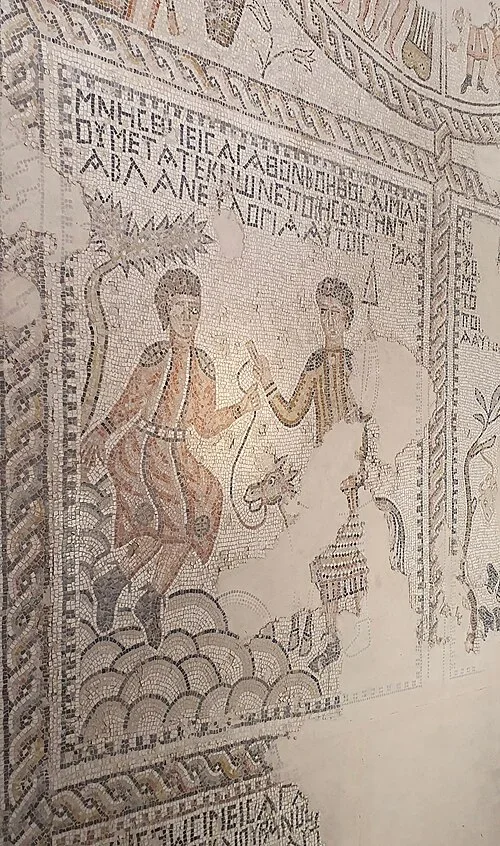 The Ancient Synagogue & Zodiac Mosaic
The Binding of Isaac Panel
Another panel on this same floor shows the binding of Isaac, with the two servants and the donkey waiting below while the ordeal unfolds. Inscriptions on this floor, in Aramaic and Greek, record the donors who paid for the work. The synagogue is fifth-century, but the town's place in Jewish life was older still. After the Bar Kokhba revolt against Rome, from 132 to 135, rabbinical families from devastated Judea moved north, and this city became one of their centers. Rabbi Yehuda Hanasi came here, bringing with him the Sanhedrin, the supreme Jewish court. In this town the Mishnah took shape, the foundational compilation of rabbinic teaching on the Torah. The academies of learning stayed until about the year 220, when they moved on to Tiberias. For that generation, this hilltop was the spiritual capital of Jewish life.
Listen in the appYair Haklai · CC BY-SA 4.0
05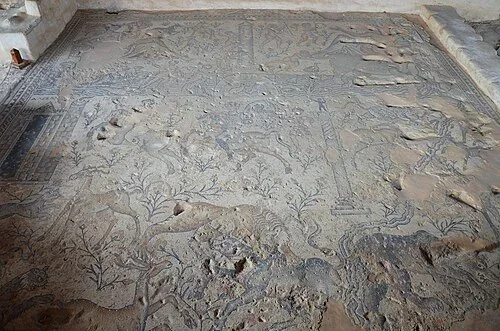 The Nile Festival House
The Nile Mosaic Floor
This sprawling fifth-century building was no private house — excavators describe it as a public mansion. Its great floor is large and intricate, and most of it is devoted to a single subject: the annual flooding of the Nile, and the celebrations that followed it. Egypt's great river, honored on a floor in the Galilee. The mosaic is composed of many scenes, each showing a different event of the flood. Offerings of fruits and grains spill from a Roman cornucopia. Drainage channels were found cut into the floor itself. That detail led some scholars to a suggestion: the room may have served festival rituals involving water, perhaps even covered with it. No one knows for certain. What is certain is that the city's elite knew Egypt's lore well enough to have it set in stone.
Listen in the appCarole Raddato · CC BY-SA 2.0
06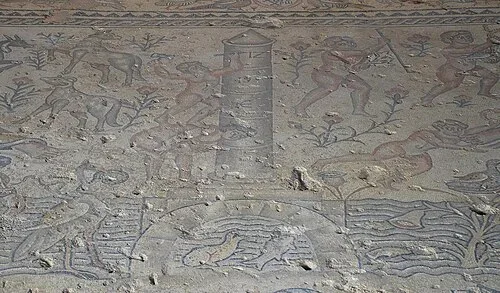 The Nile Festival House
The Nilometer Scene
One scene on the Nile floor rewards a closer eye: the tall, graduated pillar at its center. This is a nilometer, the device by which Egyptians measured the flood. Its markings recorded how high the water rose. In Egypt the reading mattered enormously — it told farmers what the harvest would hold, and told the tax collectors what to expect. The mosaicists gave the scene its full setting: figures move around the pillar, and fish and river creatures swim through the water below. A technical instrument from the banks of the Nile, drawn in detail by craftsmen in a Galilean town, says something about how far information travelled in this era. Whoever commissioned this floor wanted Egypt's knowledge on it, not just its myths.
Listen in the appCarole Raddato from FRANKFURT, Germany · CC BY-SA 2.0
07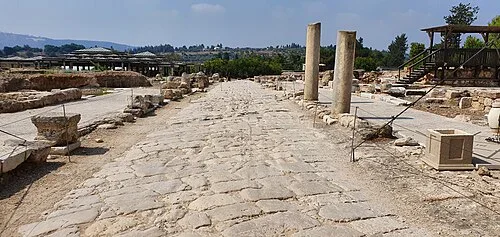 The Colonnaded Cardo and Decumanus
The Cardo
The broad paved street, lined with columns, was the cardo — the main artery of a busy commercial metropolis. Sepphoris sat close to the important trade routes through the Galilee, and this street carried that traffic. Jewish homes stood along the cobblestone way. In the stones of the street itself, images were carved: a menorah, and another marking that resembles an ancient game, something like tic-tac-toe. Throughout the city, excavators uncovered stepped pools. These are generally believed to be mikva'ot — Jewish ritual baths, entered by steps for purification. Their number tells its own story. A Jewish population went about its daily life inside a Roman city plan, keeping its own practices along a street built in the empire's style.
Listen in the appYair Haklai · CC BY-SA 4.0
08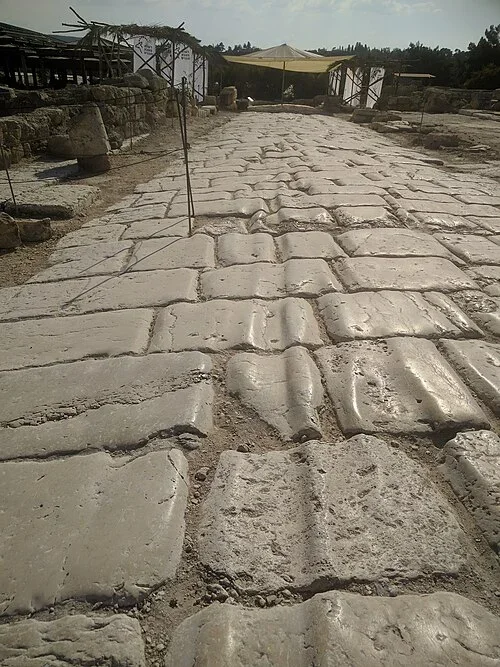 The Colonnaded Cardo and Decumanus
Carriage Ruts on the Paved Street
Deep ruts run through these paving stones, cut by cartwheels over years of heavy traffic. The street carries a political story too. In the year 66, when Judea rose in the Great Revolt against Rome, the people of Sepphoris stayed out of it. Josephus, sent north to recruit the Galilee into the rebellion, tried twice to take the city and failed — once against fierce resistance, and once because a Roman garrison arrived to help defend it. Rejected, he camped outside the walls and moved on to Jotapata. Sepphoris opened its gates to Vespasian's army. Around the year 68, the city minted its first coins, proudly bearing the name Eirenopolis — City of Peace. After the revolt, its coins showed laurel wreaths, palm trees and ears of barley. The ruts underfoot are the ordinary trace of that choice: trade went on.
Listen in the appPhoto: Pomponad · CC BY-SA 4.0
09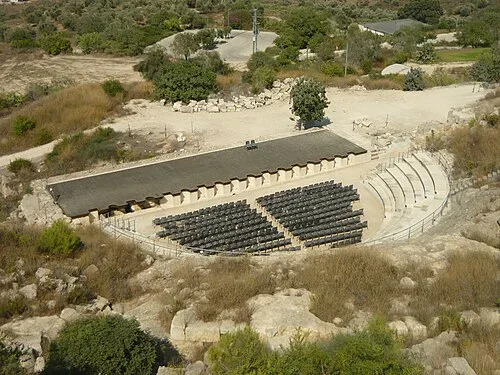 The Roman Theatre
 from Above
On the northern slope of the hill, a great hollow in the rock holds a Roman theatre, built to seat about four and a half thousand spectators. Built around the end of the first century or the start of the second, it gave the town a full Roman playhouse on a Jewish hilltop. That is what loyalty to Rome brought: the entertainment culture of the empire, imported whole. A population that kept ritual baths near its marketplace and carved a menorah into its street stones filled these seats as well. The theatre is one of the clearest signs of how Roman the Galilee's Jewish capital had become. In later centuries the city added bath-houses and mosaic floors of its own around it.
Listen in the appPhoto: Almog · Public domain
10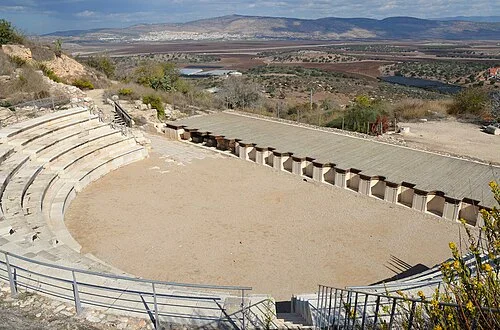 The Roman Theatre
The Theatre Cavea and Stage
Most of this theatre was never built at all — it was carved. The builders cut the seating tiers straight into the northern slope of the hill, and where the slope ran out, they raised separate stone pillars to hold the structure up. The whole semicircle measures about forty-five meters across. With the seats full, the crowd looked out past the stage toward a broad view over the valley below. When the theatre was founded is still discussed, and some accounts reach back to Herod Antipas's rebuilding of the city. The stonework carries scars. Ancient damage shows in the structure, possibly from the earthquake that struck the Galilee in 363. The city had been razed about a decade earlier, in a revolt against Rome, and rebuilt soon after the quake.
Listen in the appCarole Raddato · CC BY-SA 2.0
- 11
The Dionysus Mosaic
A Roman villa's dining floor where guests reclined around fifteen panels devoted to the god of wine.
- 12
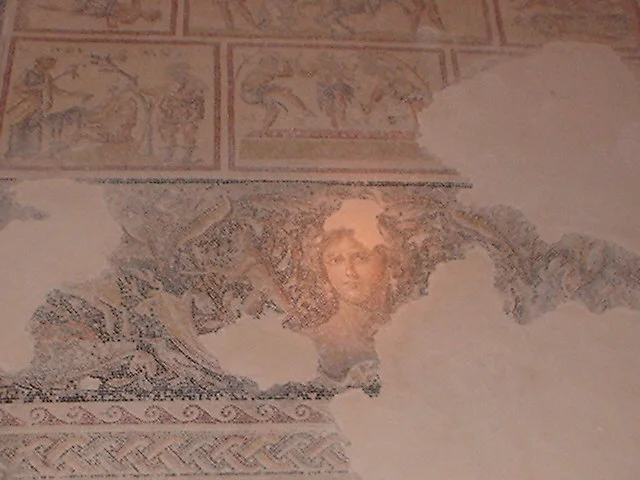
The Mona Lisa of the Galilee
The portrait of a young woman, possibly Venus, made lifelike by smaller mosaic cubes.
- 13
The Crusader-Ottoman Fortress
The square tower on the summit: Crusader fort, Ottoman rebuilding, village school, and the road to Hattin.
- 14
Reused Sarcophagi in the Fortress Walls
A carved stone coffin from the ancient city, set into the fortress wall as ordinary masonry.
- 15
St Anne's Church
The medieval church at the traditional birthplace of Mary, mother of Jesus.
- 16
The Six-Shaft Tunnel
Inside the hand-cut aqueduct tunnel, dug by teams working from six shafts and meeting in the middle.
- 17
The Ancient Water Reservoir
A vast chalk-cut reservoir holding thousands of cubic meters — and the closing thought of the tour.
Sepphoris
Frequently asked questions
How much does the guide cost?
Free app download. Listed guide price: $1.99. Guide price shown in the app. Audio guide only. Venue admission is separate.
Can I listen without internet?
Yes. Download the guide’s audio, images, and maps in the app before your visit. Your downloaded content is then available offline.
Can I listen in my language?
This audio guide is available in 15 languages, including English.
Do I need to follow a schedule?
No. This is a self-guided experience. Choose your stops, pause whenever you like, and return to a story at your own pace.
At your own pace
Explore Sepphoris.
Download Stanza, then search for “Sepphoris”.
Free app download · Guide price shown in the app
Keep exploring
Nearby audio guides
Kiryat Tiv'on · 15 km
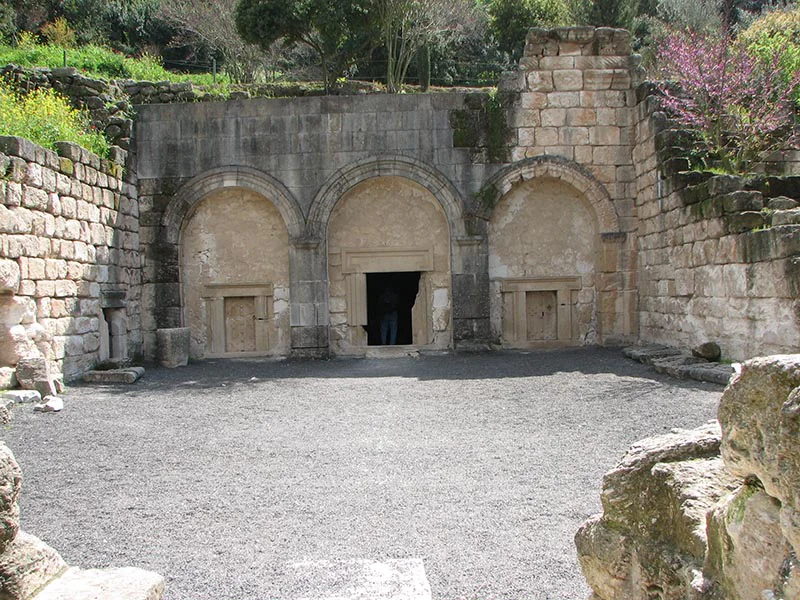
Beit She'arim necropolis
Content & sources
Photo: Rf~commonswiki · CC BY-SA 3.0
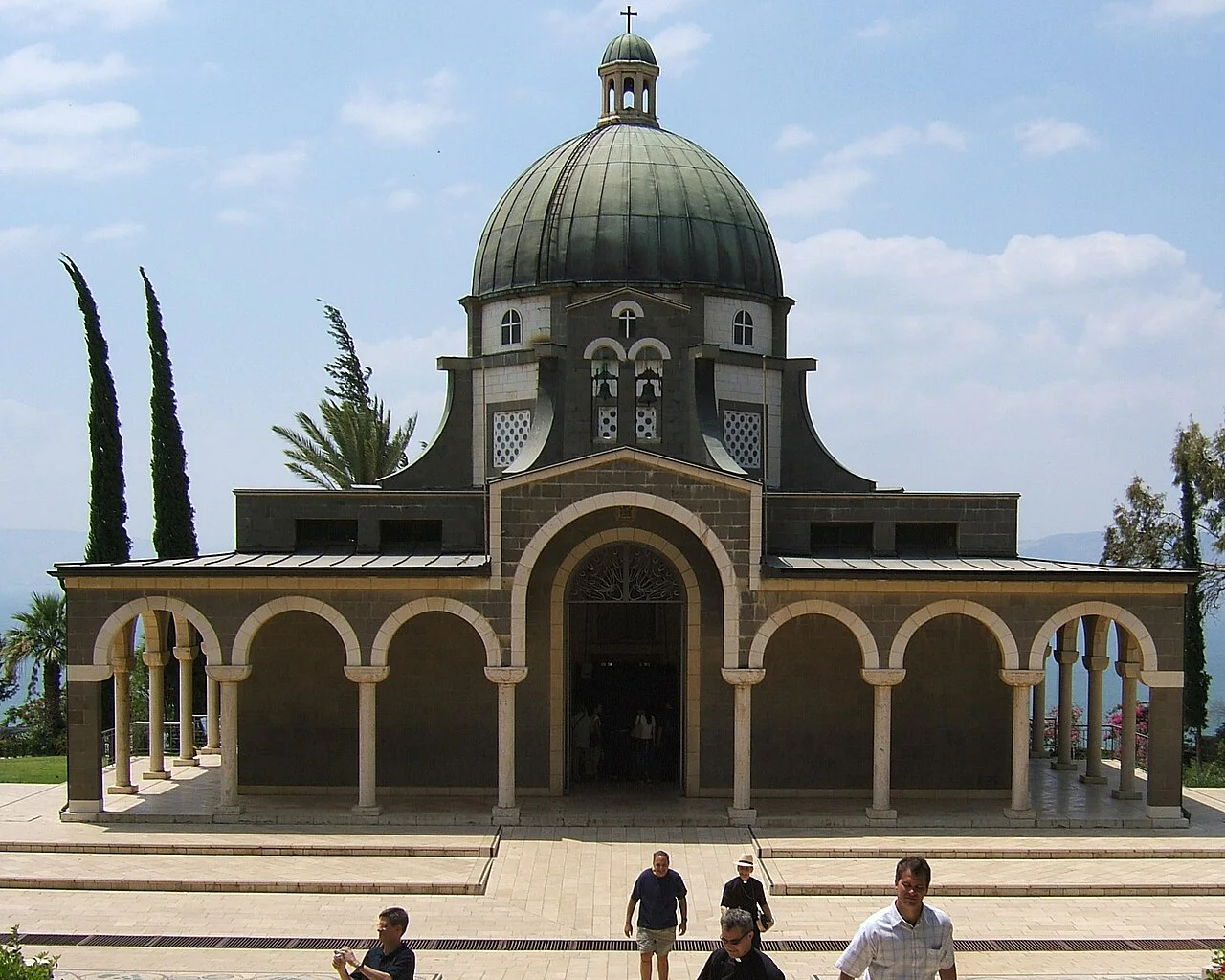
Tabgha · 29 km
Church of the Beatitudes
Content & sources
No machine-readable author provided. Bantosh~commonswiki assumed (based on copyright claims). · Public domain
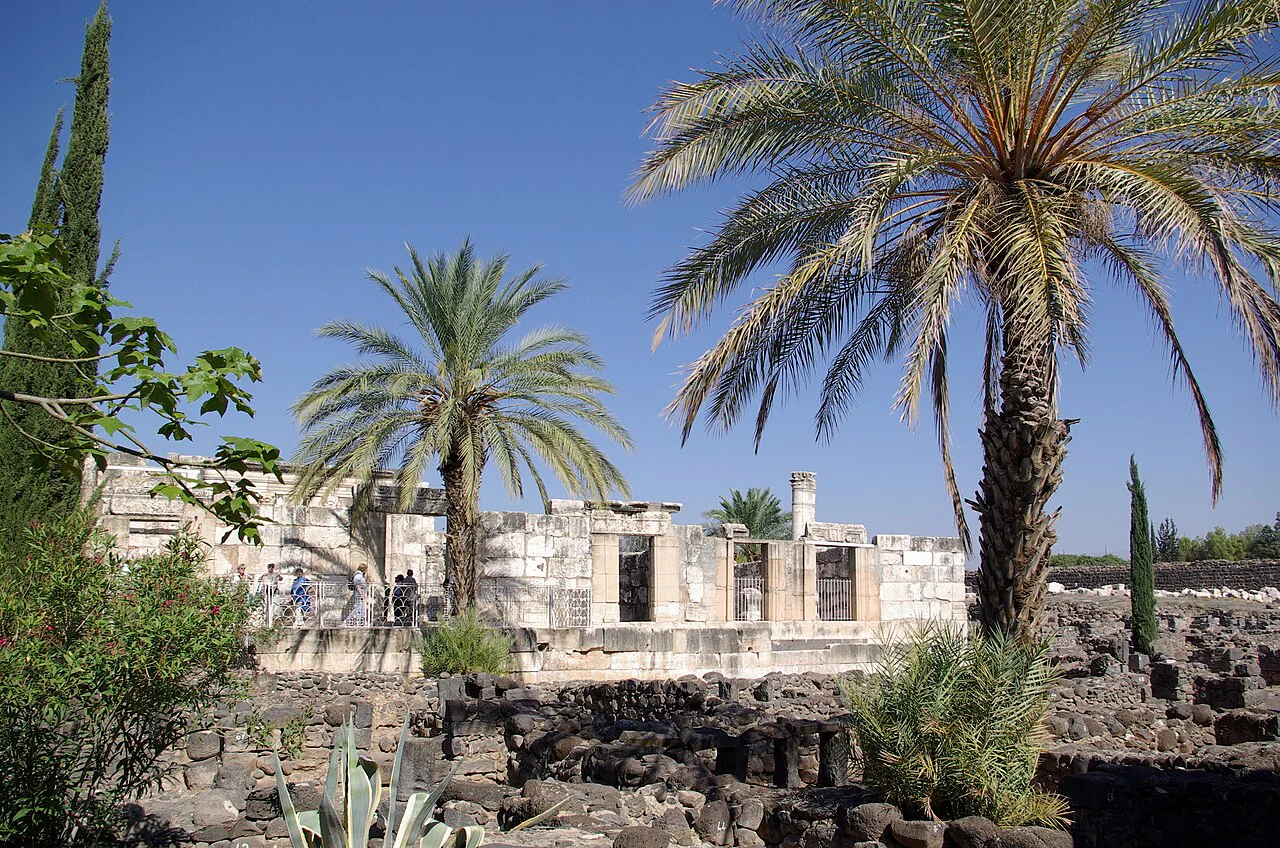
Emek HaYarden Regional Council · 31 km
Capernaum
Content & sources
Photo: Berthold Werner · Public domain
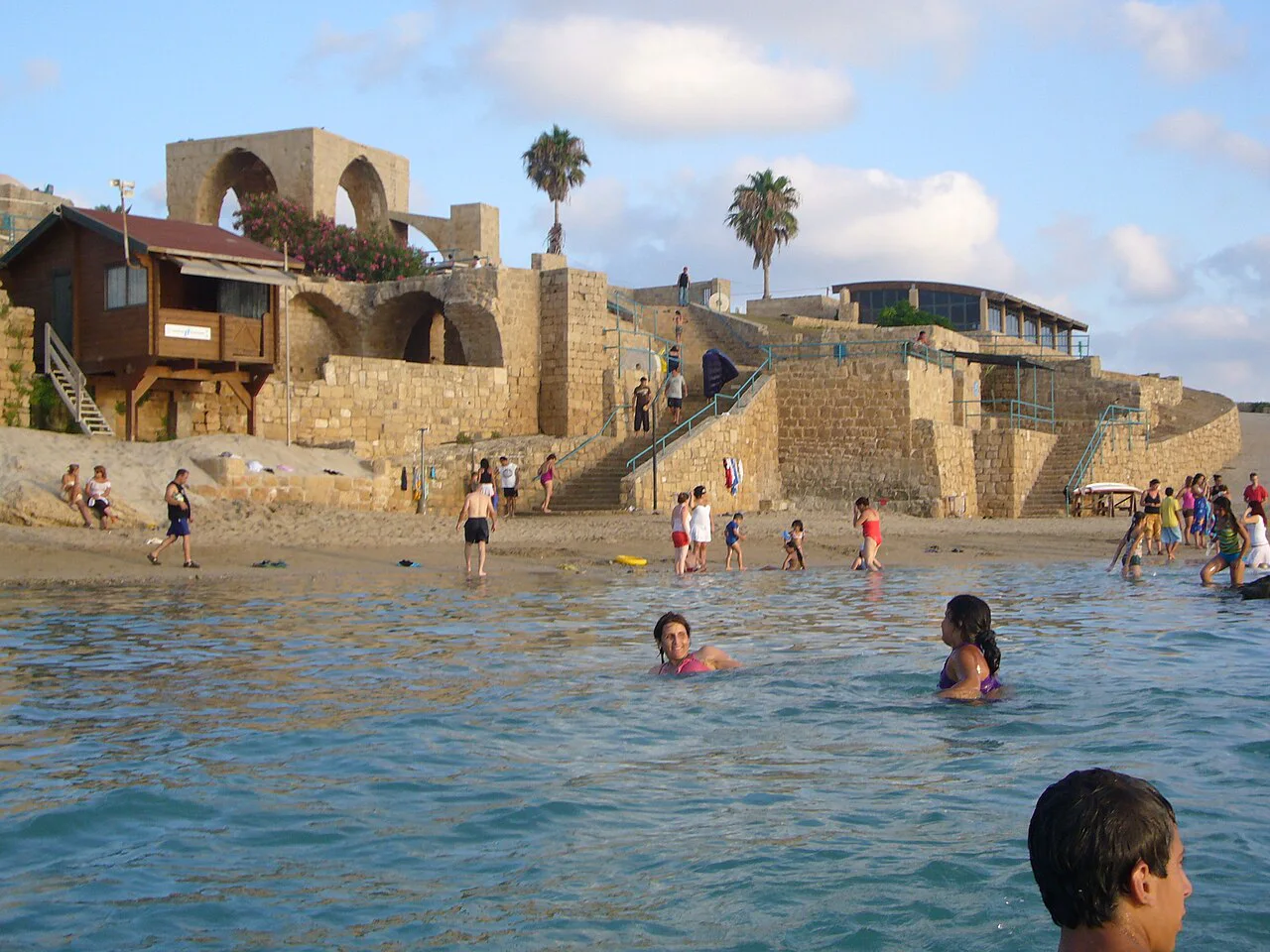
Mate Asher Regional Council · 37 km
Achziv
Content & sources
Al Ameer son (talk) 19:03, 11 August 2008 (UTC) · Public domain