 Stanza / Audio guide
Content & sources
Stanza · Audio guide
Capernaum Audio Guide
A place to remember. A story to take with you.
Capernaum was a fishing village established during the time of the Hasmoneans on the northern shore of the Sea of Galilee. It is significant for its archaeological remains, including two ancient synagogues…
Download Stanza, then search for “Capernaum”.
About the tour
One guide. Your kind of visit.
Capernaum was a fishing village established during the time of the Hasmoneans on the northern shore of the Sea of Galilee. It is significant for its archaeological remains, including two ancient synagogues and a house traditionally associated with Saint Peter.
Ready when you are.
- 01Get the free Stanza app.
iOS & Android
- 02Find your guide.
“Capernaum”
- 03Download before you go.
Works offline
Audio guide / 11 narrated stops
Inside the guide
Get to know a few of the stories before you go. Open a stop to read more.
01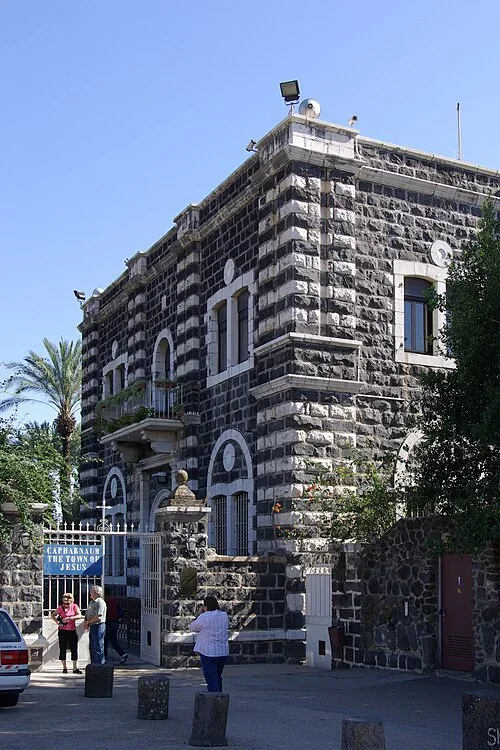 Franciscan Gate and Monastery
The Gatehouse of Capernaum
Welcome to Capernaum, a fishing village on the northern shore of the Sea of Galilee. The gatehouse in front of you announces the whole site in two stones: black basalt, quarried from the local volcanic rock, and white limestone brought from far away. Those two colors will follow you through everything here. The village was founded in the second century before Christ, in the time of the Hasmoneans, when fishing settlements spread around the lake. By the first century after Christ it held about fifteen hundred people. Under Roman rule it kept a customs post, garrisoned by a centurion, collecting duties on the goods that moved along the lakeshore. The Gospels made this small town the center of Jesus' ministry in Galilee. People lived here continuously until the village was abandoned in the eleventh century. In 1838 the American explorer Edward Robinson found the ruins of a synagogue here, and in 1866 Charles William Wilson identified the site as Capernaum. In 1894 the Franciscan friar Giuseppe Baldi bought much of the land, and the order has cared for the site ever since.
Photo: Berthold Werner · Public domain
02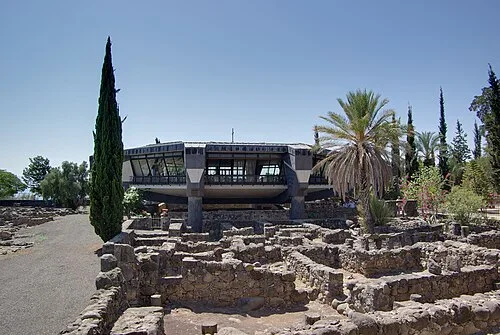 The Basalt Insulae (Ancient Residential Ruins)
The Basalt Village and the Hovering Church
Capernaum was laid out with surprising order for a fishing village. A wide main street ran north to south, and on either side of it stood blocks of small homes, cut by narrow cross streets and dead-end lanes. The Franciscan archaeologists who dug here gave those blocks a Latin name: insulae, islands, compounds of houses gathered around a shared courtyard. Every home was built from the black basalt you see across the ruins. The stones were left rough, undressed, and stacked with mud and rubble for reinforcement. Mortar appears only at the thresholds, where doors needed a solid footing. The walls were coarse, so most homes stayed single-story, their roofs made of light wooden beams and thatch mixed with mud. Stone stairs led up to those roofs, and the cobbled courtyards held grain mills and a clay furnace. It was humble building, raised from the same dark rock the volcano left here, and it gives the whole town its somber color.
Photo: Berthold Werner · Public domain
03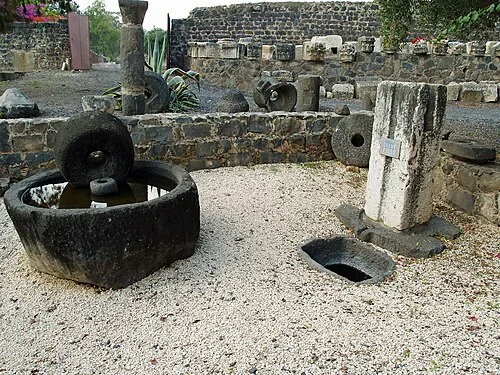 The Basalt Insulae (Ancient Residential Ruins)
The Roman Olive Press
This Roman-period olive press, rebuilt from its heavy stone parts, opens a window on how Capernaum lived. Fishing was a major source of income for the town. The remains of an ancient harbor were found west of the modern pier the Franciscans built, and the nets, hooks, and lead weights that turn up in the excavations belong to that trade. Farming happened just along the shore. Two and a half kilometers away lies Tabgha, and the digging there revealed many mills for grinding grain and pressing olives, which suggests the area was worked for agriculture. The press here, with its carved basins and rolling stones, fits right into that mixed economy: fish from the lake, oil and flour from the groves and fields nearby. A village of fifteen hundred people needed both, and the basalt tools scattered through these ruins are the plain evidence of the work.
Listen in the appPhoto: David Shankbone · CC BY-SA 3.0
04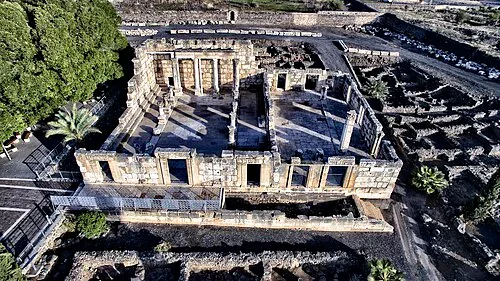 The White Synagogue and Basalt Foundations
The White Synagogue from Above
From above, the White Synagogue shows its full shape. The building has four parts: the prayer hall itself, a western patio, a southern balustrade, and a small room at the northwest corner. The prayer hall is the grand space, measuring about twenty-four by nineteen meters, and its southern face looks toward Jerusalem, the direction of prayer. Almost every block is white limestone, hauled from distant quarries, which is what makes the building glow against the black basalt town around it. Inside, the excavators found painted plaster and fine stucco work that once covered the walls. Two earlier scholars, Watzinger and Orfali, believed there had been an upper floor for women, reached by an external staircase, but later excavations never substantiated that idea. Restoration began in 1926 under Gaudenzio Orfali, who died that year in a car accident; a Latin inscription on one of the columns commemorates him. Virgilio Corbo took the work up again in 1976. The building itself dates to the fourth or fifth century.
Listen in the appזאב שטיין · CC BY 2.5
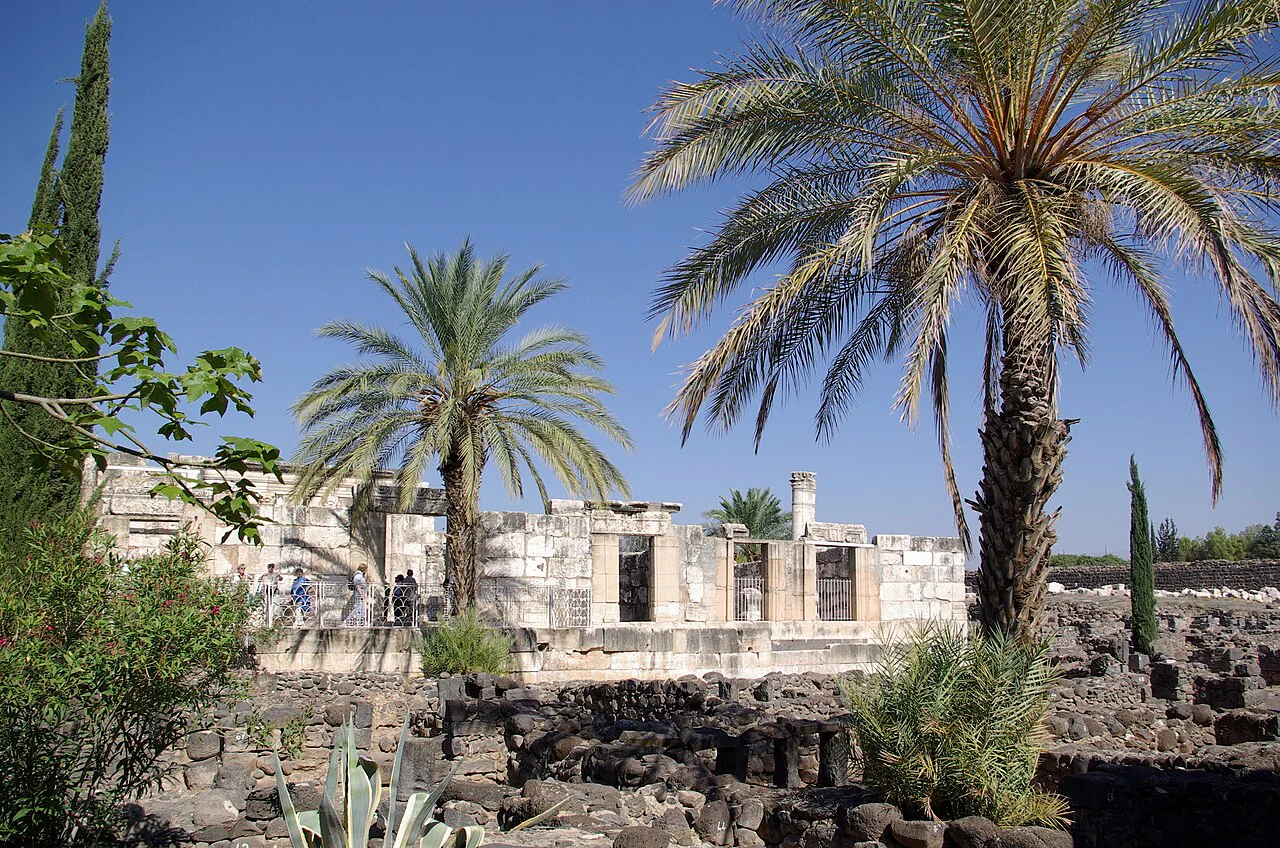
05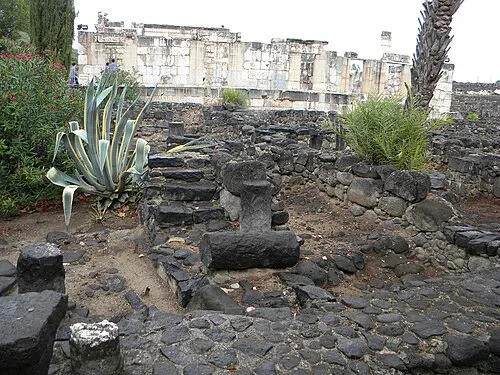 The White Synagogue and Basalt Foundations
The Synagogue above the Basalt Town
At ground level the layering becomes visible: white limestone blocks rising above the dark basalt walls of the village. Beneath the foundation of this synagogue lies another foundation, made of basalt. The archaeologist Loffreda suggested it belonged to a synagogue of the first century, perhaps the very one mentioned in the Gospels. Luke writes that the Capernaum synagogue of Jesus' time was built or funded by a Roman centurion stationed in the town, an officer who, the Gospel says, loved the Jewish community and paid for their house of prayer. Mark and Luke both record Jesus teaching here on a Sabbath. That link rests on Loffreda's suggestion, not on proof. When later excavation work tried to dig beneath the synagogue floor, Loffreda claimed to have found a paved surface from the older building. Others looked at the same paving and reached a different conclusion: an open, paved market area. Two readings of one floor, and the question is still open.
Listen in the appPhoto: Britchi Mirela · CC BY-SA 4.0
06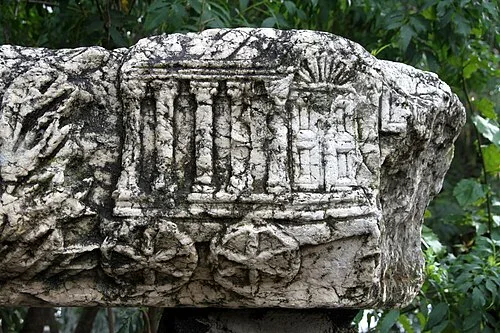 The White Synagogue and Basalt Foundations
The Carved Torah Shrine
This carved block comes from the synagogue's ornament. It shows an architectural shrine mounted on wheels, traditionally read as the Ark of the Covenant, the chest that once held the tablets of the Law. The carving gives it columns, a roof, and a rayed panel beside it, the way a mason imagined the sacred object. The same decorative language runs through the building: carvings of five-pointed and six-pointed stars, and of palm trees, cut into the white limestone. The synagogue also carries two inscriptions, one in Greek and one in Aramaic, and both commemorate the benefactors who helped pay for the building. That was how such projects worked: local donors funded the stones, and the community carved its thanks into the walls. The names of those who gave, and the symbols they chose, are still legible in the fragments gathered around these ruins.
Listen in the appPhoto: Gerd Eichmann · CC BY-SA 4.0
07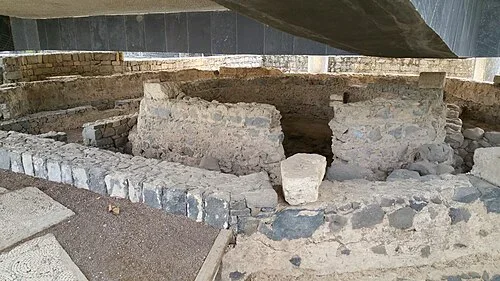 House of Saint Peter and the Suspended Memorial
The Ruins of the House of Peter
Among the black insulae between the synagogue and the lakeshore, one compound stands apart. The excavators concluded that a house here was venerated as the home of Peter the fisherman as early as the mid-first century, within living memory of the man himself. That identification rests on Christian tradition and on the excavators' reading of the remains; no inscription names the owner. But the house was clearly treated differently from its neighbors. From the latter half of the first century its rough walls were reworked with care and plastered, and almost no household pottery was found there. Instead, lamps and large storage jars abounded, as if the room had stopped being a home and become a gathering place. By the fourth century the whole compound, which the Franciscans called the sacra insula, the holy island, was enclosed by a thick trapezoidal wall, twenty-seven to thirty meters on a side, with two doors. The special room was expanded, given a central archway to carry its roof, and paved and plastered. What rose above it comes next, inside the church overhead.
Listen in the appKonrad Summers from Santa Clarita (Valencia) , California, USA · CC BY-SA 2.0
08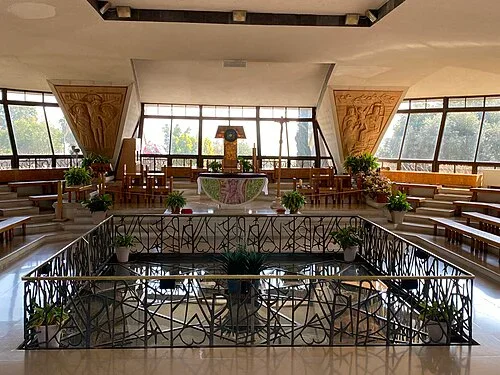 House of Saint Peter and the Suspended Memorial
Inside the Memorial of the House of Peter
The disk-shaped church above these ruins is the newest chapter of a very old story. Dedicated in 1990, it stands on eight concrete stilts, lifted clear of the archaeology so that the ancient remains stay visible at ground level and, at the center of the floor, through a panel of glass. Through that glass lies the fifth-century layer. In the middle of that century the holy compound was dismantled and replaced by a Byzantine octagonal church. Its builders set the central octagon, ringed by eight pillars, directly on top of the walls of the venerated house, to preserve the exact spot, even though the house itself had disappeared under mosaics. A portico led from the church into the buildings to the east, until that passage was blocked and an apse with a baptismal pool was built into the east wall. Two stairs flanked the baptistery, and the water from the rite drained away along that path. A modern church on stilts, a Byzantine octagon, and a fisherman's house, all stacked on one set of walls.
Listen in the appשלמה רודד · CC BY 2.5
09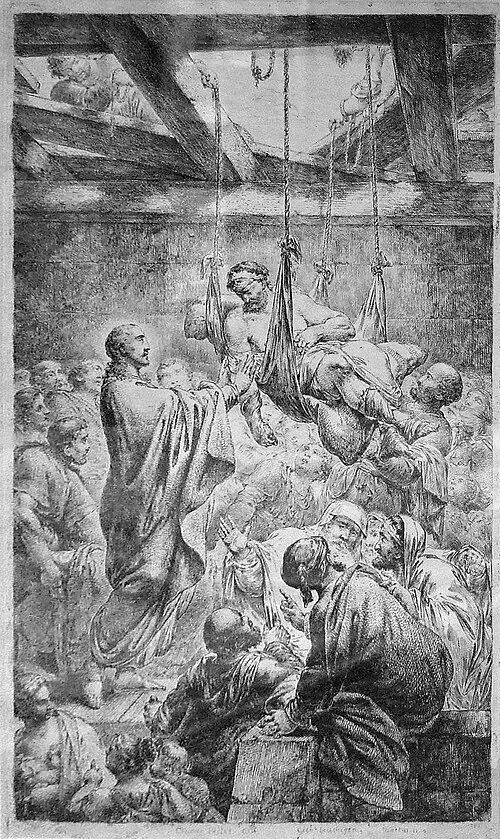 House of Saint Peter and the Suspended Memorial
Healing the Paralytic at Capernaum
Mark and Luke tell this story in Capernaum. Jesus was teaching in a house, and the crowd pressed so tightly around the door that a group of friends could not carry their paralyzed man through. The houses here explain what they did next. You have seen those light roofs and the stone stairs that led up to them. The friends climbed to the roof, uncovered it, broke it open, and lowered the man on his cot down into the room, in front of Jesus. The engraving before you is a later artist's imagining of that moment, not a view of any actual room, and the Gospels do not name the building. Tradition places gatherings like this at the house complex venerated as Peter's. Capernaum carries several such healings: Peter's mother-in-law cured of a fever, and the servant of the Roman centurion, restored at a word. The paralyzed man's story is the one the town's rooftops seem made for.
Listen in the appBernhard Rode · Public domain
10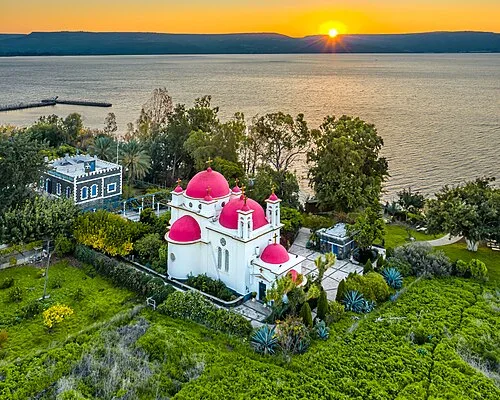 The Greek Orthodox Church of the Holy Apostles
The Church of the Twelve Apostles at Sunrise
The town's last chapters belong to this eastern shore. In 749 an earthquake destroyed the village, and it was rebuilt about a hundred and fifty meters northeast of its old position, near Peter's church. That second settlement did not last. As far as is known, it was never rebuilt, not even in the Crusader period. Later pilgrims read that ending as the fulfillment of Jesus' words against the lakeside towns, Capernaum among them, though the link between the curse and this particular ground is a tradition, not a record. The eastern half of the site, owned by the Greek Orthodox Patriarchate, was surveyed and partly excavated under Vassilios Tzaferis. His dig uncovered the village of the Byzantine and Early Arab periods, a pool apparently used for processing fish, and a hoard of gold coins. In 1931 the Church of the Twelve Apostles and its monastery were founded here, and the red-domed church still rises over the water at sunrise.
Listen in the appPhoto: Giladtop · CC BY-SA 4.0
- 11
Christ Pantocrator in the Dome
Christ Pantocrator in a golden dome, the newest painted layer over two thousand years of memory.
Capernaum
Frequently asked questions
How much does the guide cost?
Free app download. Listed guide price: $1.99. Guide price shown in the app. Audio guide only. Venue admission is separate.
Can I listen without internet?
Yes. Download the guide’s audio, images, and maps in the app before your visit. Your downloaded content is then available offline.
Can I listen in my language?
This audio guide is available in 15 languages, including English.
Do I need to follow a schedule?
No. This is a self-guided experience. Choose your stops, pause whenever you like, and return to a story at your own pace.
At your own pace
Explore Capernaum.
Download Stanza, then search for “Capernaum”.
Free app download · Guide price shown in the app
Keep exploring
Nearby audio guides
Tabgha · 2 km
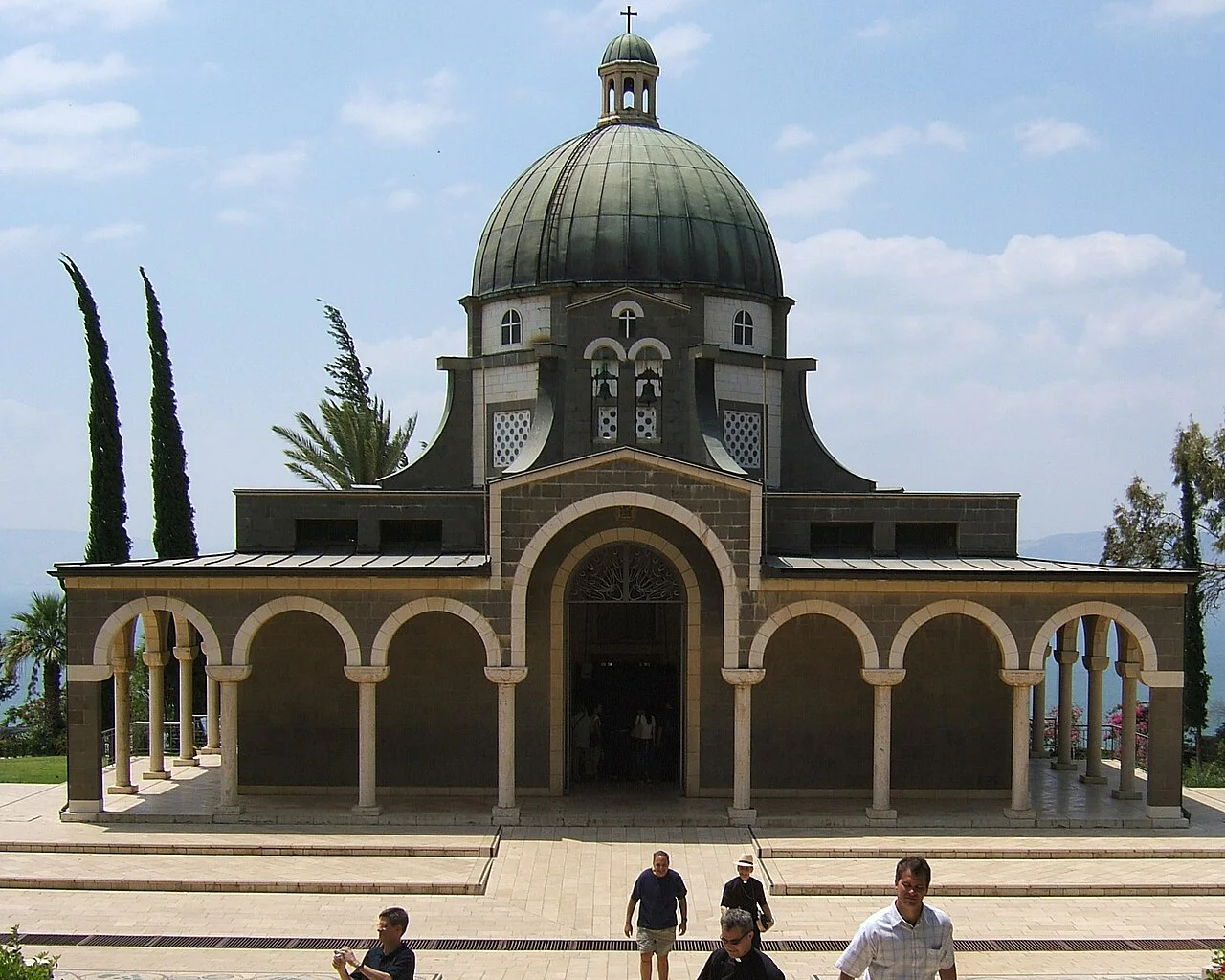
Church of the Beatitudes
Content & sources
No machine-readable author provided. Bantosh~commonswiki assumed (based on copyright claims). · Public domain
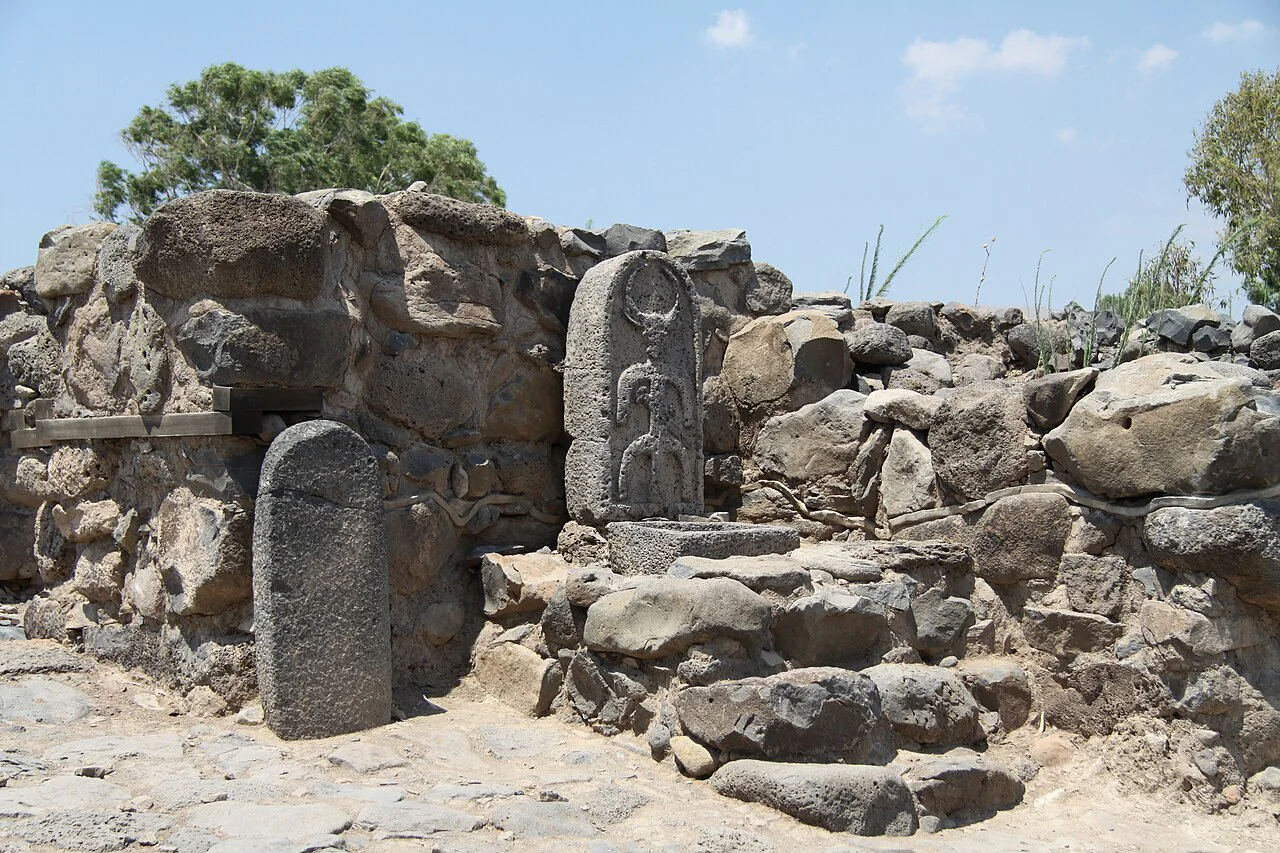
Golan Regional Council · 6 km
Bethsaida
Content & sources
Photo: Chmee2 · CC BY 3.0
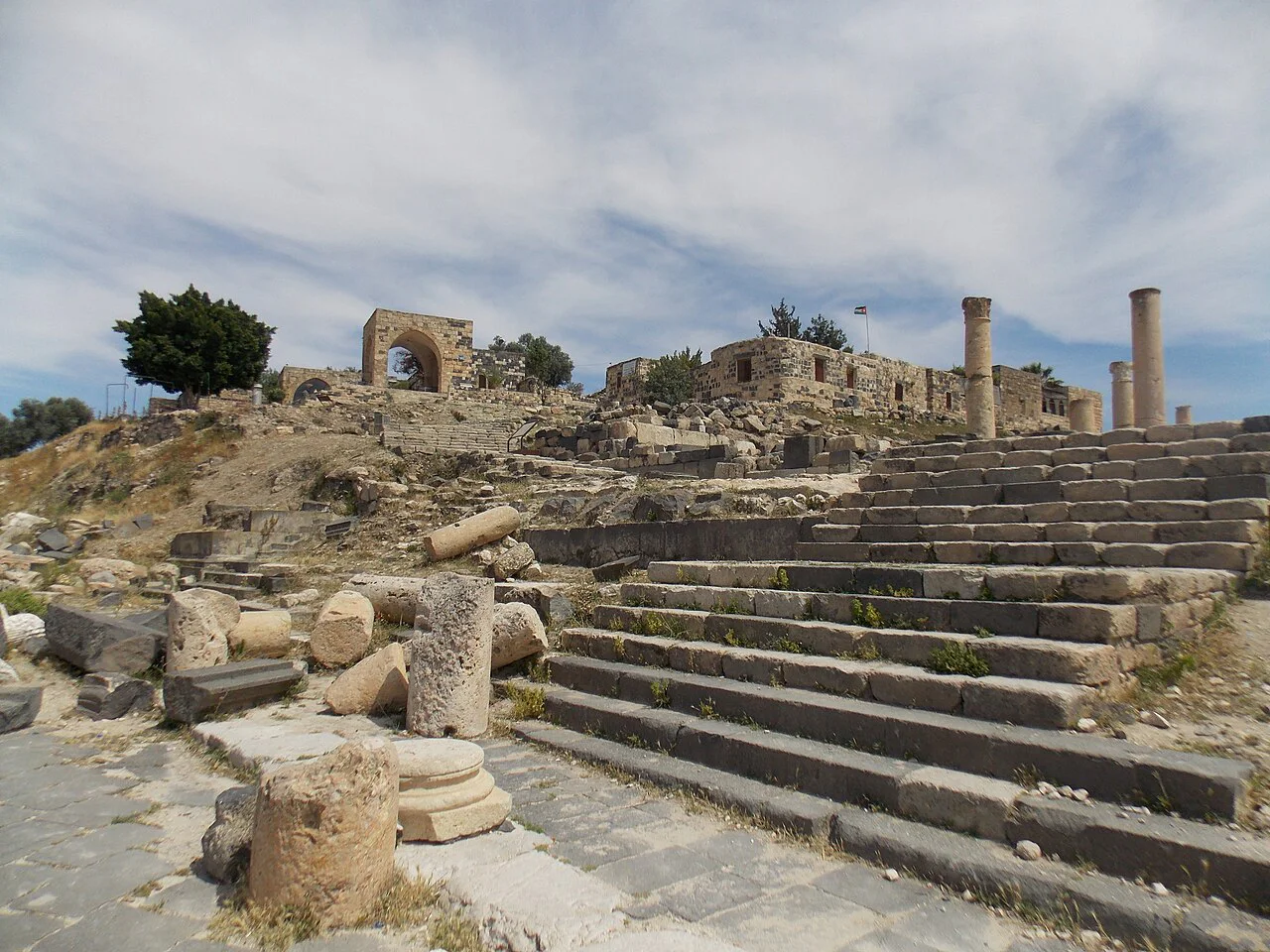
Umm Qais · 27 km
Gadara
Content & sources
Samir I. Sharbaty · CC BY-SA 3.0
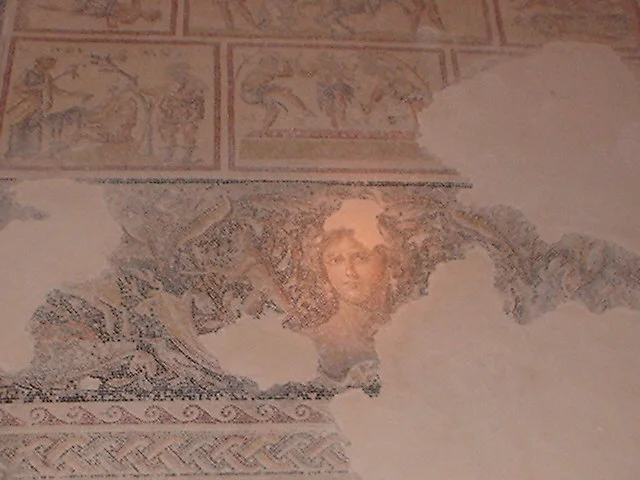
Jezreel Valley Regional Council · 31 km
Sepphoris
Content & sources
No machine-readable author provided. Bachrach44 assumed (based on copyright claims). · Public domain