Stanza · Audio guide
Gadara Audio Guide
A place to remember. A story to take with you.
Gadara was an ancient Hellenistic city located in modern-day Jordan. It was a long-time member of the Decapolis city league and served as a former bishopric.
Download Stanza, then search for “Gadara”.
About the tour
One guide. Your kind of visit.
Gadara was an ancient Hellenistic city located in modern-day Jordan. It was a long-time member of the Decapolis city league and served as a former bishopric.
Ready when you are.
- 01Get the free Stanza app.
iOS & Android
- 02Find your guide.
“Gadara”
- 03Download before you go.
Works offline
Audio guide / 21 narrated stops
Inside the guide
Get to know a few of the stories before you go. Open a stop to read more.
01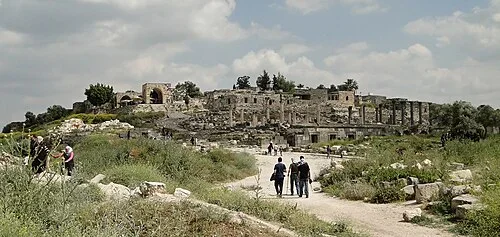 Gadara Acropolis and Tri-Border Panorama
Gadara: Ridge City of the Decapolis
Long before the modern borders drew near this corner of Jordan, a fortified town stood on this ridge. Gadara sits about three hundred and seventy-eight metres above sea level, reachable by approach only from the east. Steep falls guard the other three sides, and the Yarmouk River gorge runs below. From the high ground, the Golan Heights and the Sea of Galilee lie well in view. The Greek historian Polybius knew the place: in 218 BC he called it the strongest of all places in the region. Even so, it soon capitulated to Antiochus the Third, the Seleucid king of Syria. Under Rome, Gadara joined the Decapolis, a league of semi-autonomous cities, and grew into a centre of Greek culture. Later it was the seat of a Christian bishop. The ruins lie today in the small town of Umm Qais. In 2017, archaeologists uncovered a Hellenistic temple from the third century BC here; some believe it was dedicated to Poseidon. Fortress, city, bishop's seat, village — the ridge carried them all.
Bernard Gagnon · CC BY-SA 3.0
02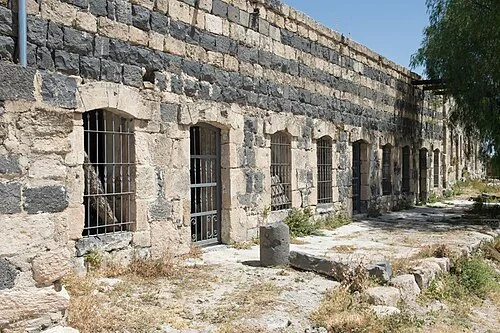 Beit Malkawi
: An Ottoman House on Roman Foundations
The walls band dark and pale: black basalt alternating with warm limestone, course after course. That striping is the signature of the village houses built on this ridge in the late Ottoman period, in the nineteenth century. Villagers raised their courtyard homes directly over the ruins of the Roman city, and their building material came free from the ground beneath. Reused basalt blocks, and even old columns, went into the new walls. A prominent house like this one, known as Beit Malkawi, arranged its rooms around an open court, in the manner of Ottoman-era families across rural Jordan. The ancient city became, in effect, a quarry. The Roman blocks supplied the stone; the village supplied the hands that set them.
Photo: Dosseman · CC BY-SA 4.0
03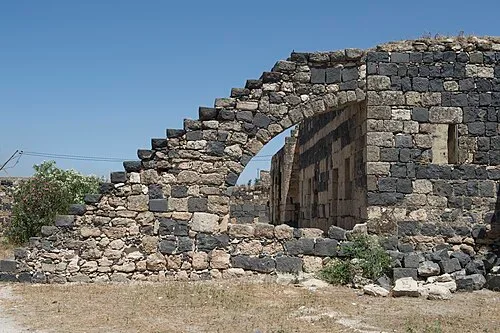 Beit Malkawi
Village Masonry: Arch and Stair
A stair of heavy stone climbs straight up this wall, and beside it an arched opening breaks the masonry. Village builders in the late Ottoman period shaped entrances and stairs from massive blocks, fitting basalt and limestone together course by course. The arch does the quiet structural work: it carries the weight of the wall above and spreads it down to the sides. Each block in the curve is cut as a wedge, so the arch locks itself together as it rises. The stair treads are single slabs, set one above the other to gain height in a narrow space. The same two stones, dark and pale, run through stair, arch and wall alike.
Listen in the appPhoto: Dosseman · CC BY-SA 4.0
04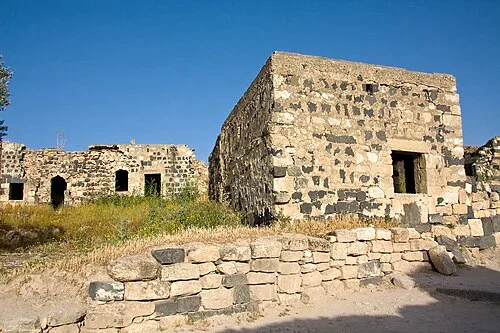 Beit Malkawi
Umm Qais: The Village That Stayed
After the ancient city fell silent, the ridge did not empty out. Umm Qais, the town that occupies the site today, grew up among the ruins rather than beside them. Its older houses are simple courtyard dwellings of stone, a room or two around an open court, under open skies. Village lanes wove between fallen walls and old foundations, and fields ran up to the ancient masonry. Life here continued on a much smaller scale than the Roman city's, but it never quite stopped. Some of those old houses still stand roofless, their doorways opening onto sky.
Listen in the appDavid Bjorgen · CC BY-SA 4.0
05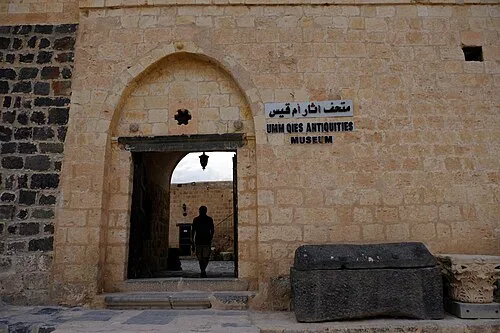 Archaeological Museum of Gadara
Umm Qais Antiquities Museum: Beit Rousan
A German traveller named Ulrich Seetzen reached this ridge in 1806 and recognised it as ancient Gadara. Until then, the city had survived mostly as a name in ancient texts. The building that now serves as the site's museum and visitor centre has a story of its own: it was the residence of the Ottoman governor, known as Beit Rousan. Restored, it gathers finds from across Gadara under one roof, from sculptures to mosaic floors. The city it commemorates had faded long before. After the Arab conquest, and an earthquake around 749, Gadara was largely destroyed and abandoned. Seetzen's recognition turned a village with old stones back into a place with a name again.
Listen in the appDavide Mauro · CC BY-SA 4.0
06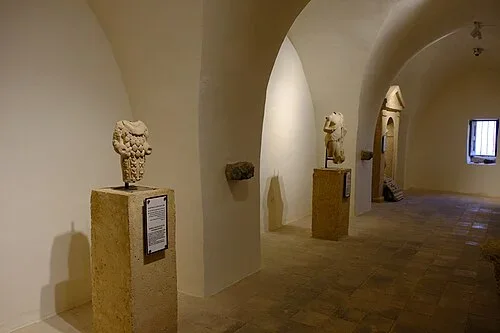 Archaeological Museum of Gadara
Gallery of Stone: The City of Philosophers
Gadara was once called the city of philosophers — a small hill town that kept exporting its finest minds to Greece and Italy. The first famous son was Menippus, in the third century BC. Born a slave, he became a Cynic philosopher who mocked human follies in a mixture of prose and verse. His own works are lost, but writers like Varro and Lucian imitated them. Centuries later came Philodemus, an Epicurean who studied in Athens and taught in Italy, at the Villa of the Pisos in Herculaneum. When Vesuvius buried the villa, his library of scrolls was charred — and by that charring preserved. They remain an important record of Roman Epicureanism. Then there was Meleager, a poet of the first century BC, admired for his own verses and for his anthology of other poets, which formed the basis of the collection known as the Greek Anthology.
Listen in the appDavide Mauro · CC BY-SA 4.0
07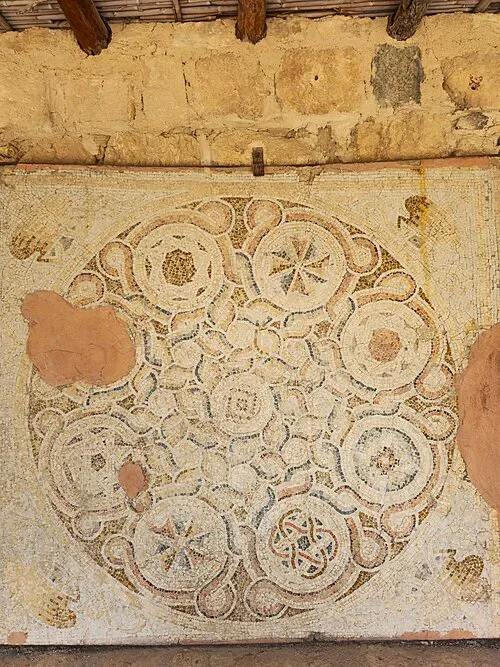 Archaeological Museum of Gadara
Mosaic Carpet of Stone
Thousands of hand-cut stone cubes make up this floor panel, each one set by hand. Mosaicists call the cubes tesserae, and they laid them face up in beds of mortar, building pattern the way a weaver builds cloth. At the centre, circles interlock around knots and rosettes, in creams, terracottas and dark greys, all framed within a great medallion. Floors like this paved the churches and fine buildings of Gadara in the Byzantine period. Where sections have fallen away, the plain bedding shows through, and each cube reveals how shallowly it sits. What reads from a distance as a carpet is, up close, thousands of small decisions made one stone at a time.
Listen in the appPhoto: Mohammad hajeer · CC BY-SA 4.0
08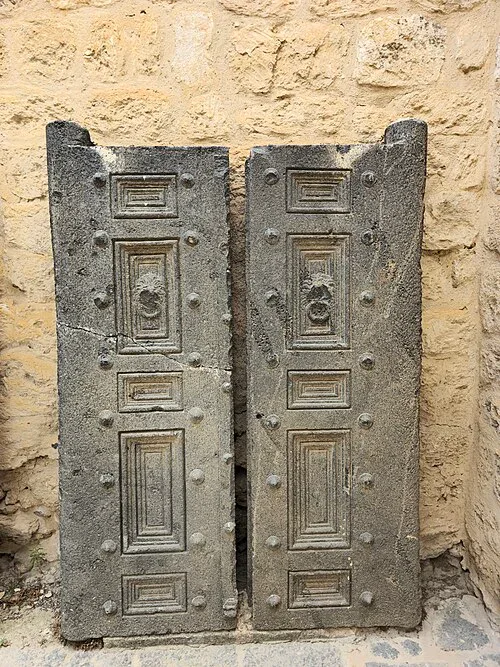 Archaeological Museum of Gadara
Doors of Basalt
Two slabs of black basalt lean against the wall here, carved as a pair of door leaves. Each carries recessed panels set in tall frames, with projecting bosses like heavy studs down the sides. At the centre of each leaf is a lion's mask, carved where a knocker would sit. Basalt is volcanic rock: hard, dark and dense, yet it takes fine detail, as the lion's mane shows. Gadara built with this stone wherever strength mattered, from theatres to street paving, and doors were no exception. Whether these leaves actually swung on hinges in some doorway, or served quite another purpose, no one can say for certain.
Listen in the appPhoto: Mohammad hajeer · CC BY-SA 4.0
09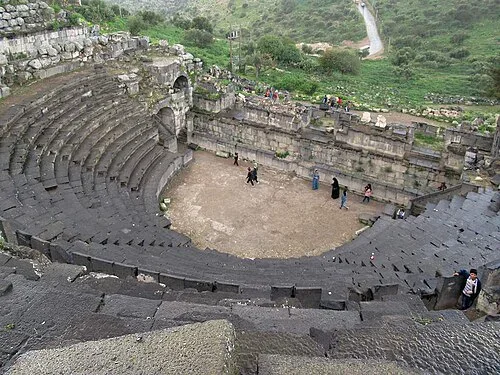 Gadara West Theatre
Gadara was large and prosperous enough to boast two theatres, and this is the western one. It was built of local black basalt in the Severan era, the late second or early third century AD. The seating rises in a wide semicircle from the flat orchestra at its heart, cut and stacked in dark stone that weathers almost black. In Roman theatres across the province, the whole town came: comedy and pantomime on the stage, rhetoric and recital in season.
Listen in the appDavid Stanley from Nanaimo, Canada · CC BY 2.0
10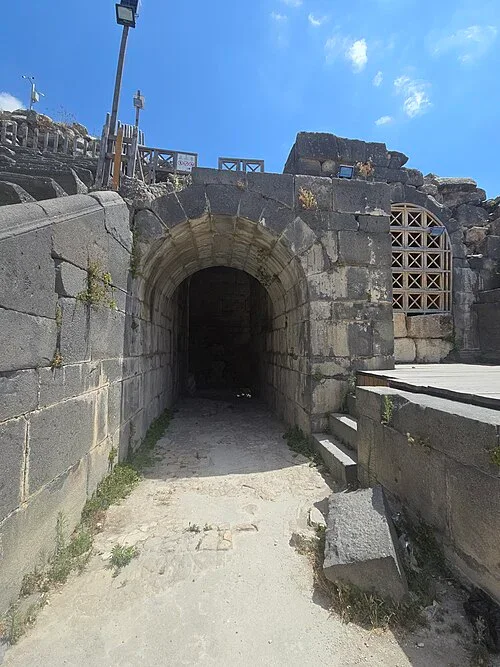 Gadara West Theatre
West Theatre: The Vaulted Entrance
A deep arch opens into a barrel vault here: a continuous curve of stone running overhead, built from wedge-shaped blocks the Romans called voussoirs. Each wedge presses against its neighbours, so the whole curve holds itself up once the final stone, the keystone, drops into place. Roman builders used vaults like this to carry heavy loads and to give spectators covered passages into the seats of a theatre. The blocks here are weathered basalt, darkened by centuries, but the cut of each wedge is still clean. Small plants have found footing in the joints between them. The passage leads inward toward the darkness of the seating tiers.
Listen in the appPhoto: Mohammad hajeer · CC BY-SA 4.0
- 11
West Theatre: Seat with a View
From the top rows, the theatre turns its back on the city and opens onto the hills and the climbing road.
- 12
Byzantine Octagonal Church
A church built as an octagon, ringed with black basalt columns and white carved capitals, on a terrace that once served pagan temples.
- 13
Columns of the Western Terrace
A row of tall black basalt columns with carved capitals, lining the sacred terrace of the old church precinct.
- 14
Paving of the Church Terrace
Underfoot on the church terrace: worn flagstones and a surviving patch of patterned stone flooring.
- 15
Nymphaeum: Water on a Dry Ridge
How a dry ridge stayed well watered: a spring, cisterns, and a qanat aqueduct with the longest ancient tunnel known.
- 16
Frieze from the Fountain
A carved limestone block with scrolling vines and acanthus leaves, pale ornament amid all the black basalt.
- 17
Decumanus Maximus: The Paved Spine
The Decumanus Maximus: a paved street with a double colonnade, running the full length of the city.
- 18
The End of the Roman City
Where the Roman city ended: the Arab conquest of 636, the earthquake around 749, and the abandonment that followed.
- 19
Footwear of the Street: Worn Flagstones
The street surface itself: basalt flags polished and dished by centuries of feet and wheels.
- 20
West Gate
The city's western gate, where the road ran down toward Tiberias and the lake — and where a Gospel story attaches to the region.
- 21
Toward the Lake: The Western Descent
The outward face of the gate: curved basalt work among olive trees, where the ridge falls away toward the valley and the lake.
Gadara
Frequently asked questions
How much does the guide cost?
Free app download. Listed guide price: $1.99. Guide price shown in the app. Audio guide only. Venue admission is separate.
Can I listen without internet?
Yes. Download the guide’s audio, images, and maps in the app before your visit. Your downloaded content is then available offline.
Can I listen in my language?
This audio guide is available in 15 languages, including English.
Do I need to follow a schedule?
No. This is a self-guided experience. Choose your stops, pause whenever you like, and return to a story at your own pace.
At your own pace
Explore Gadara.
Download Stanza, then search for “Gadara”.
Free app download · Guide price shown in the app
Keep exploring
Nearby audio guides
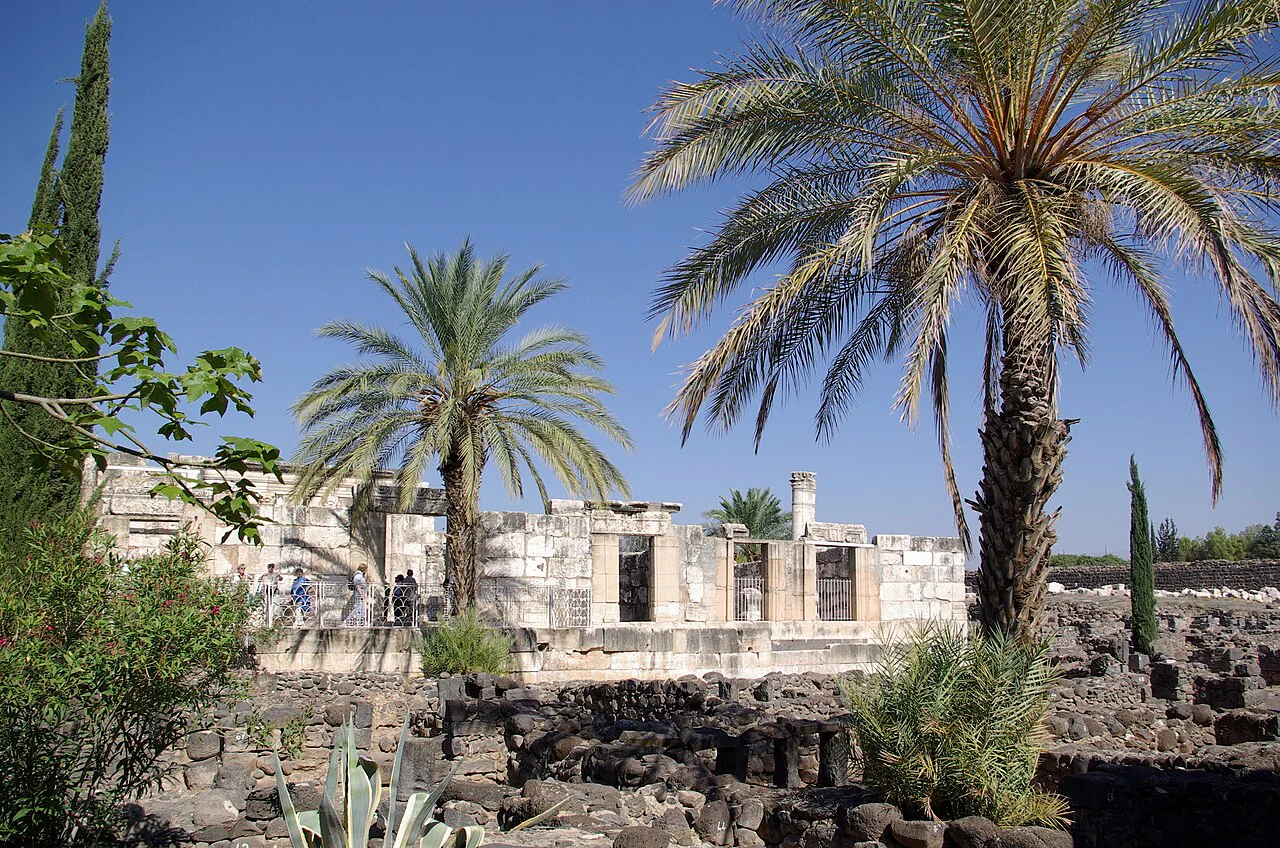
Emek HaYarden Regional Council · 27 km
Capernaum
Content & sources
Photo: Berthold Werner · Public domain
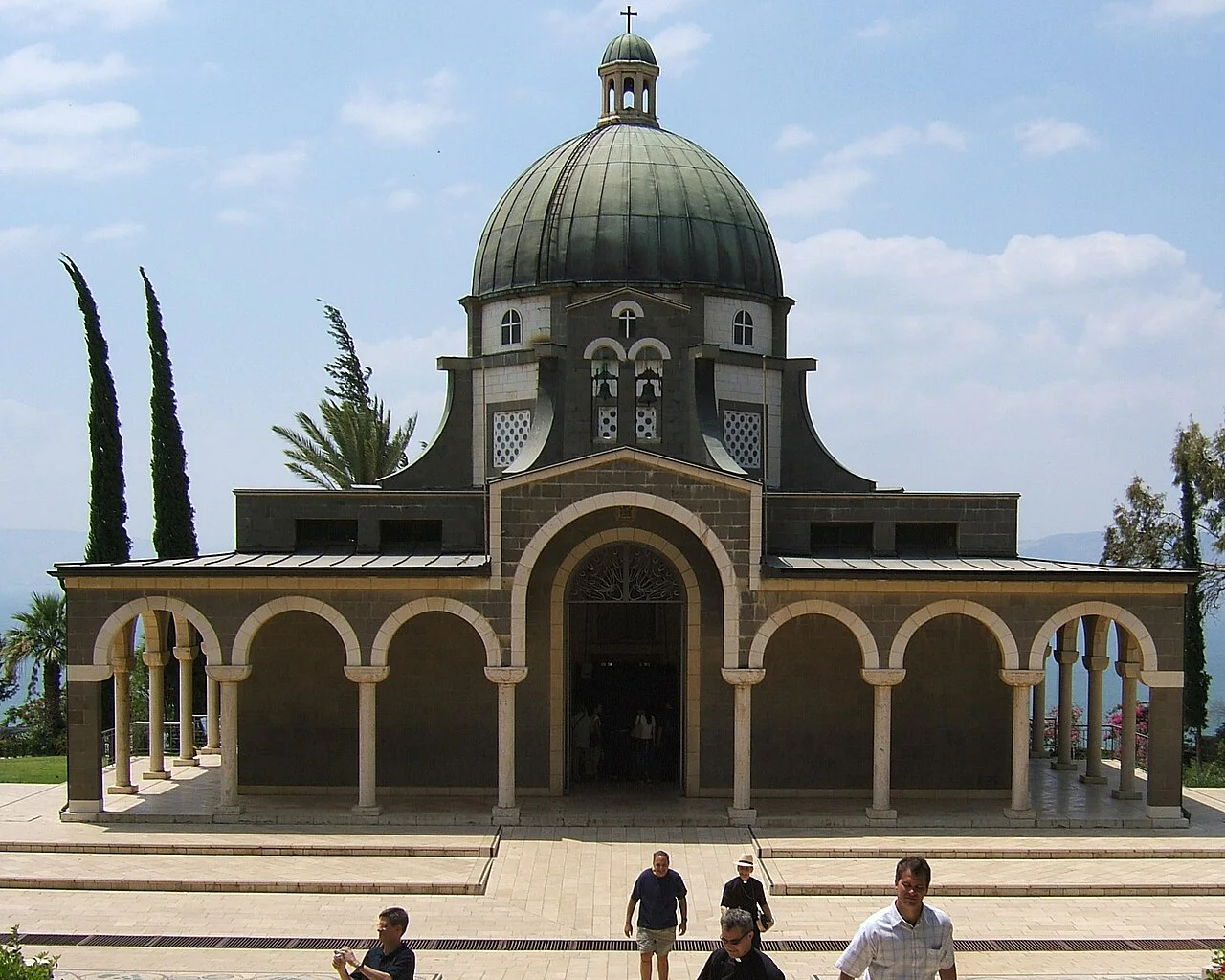
Tabgha · 28 km
Church of the Beatitudes
Content & sources
No machine-readable author provided. Bantosh~commonswiki assumed (based on copyright claims). · Public domain
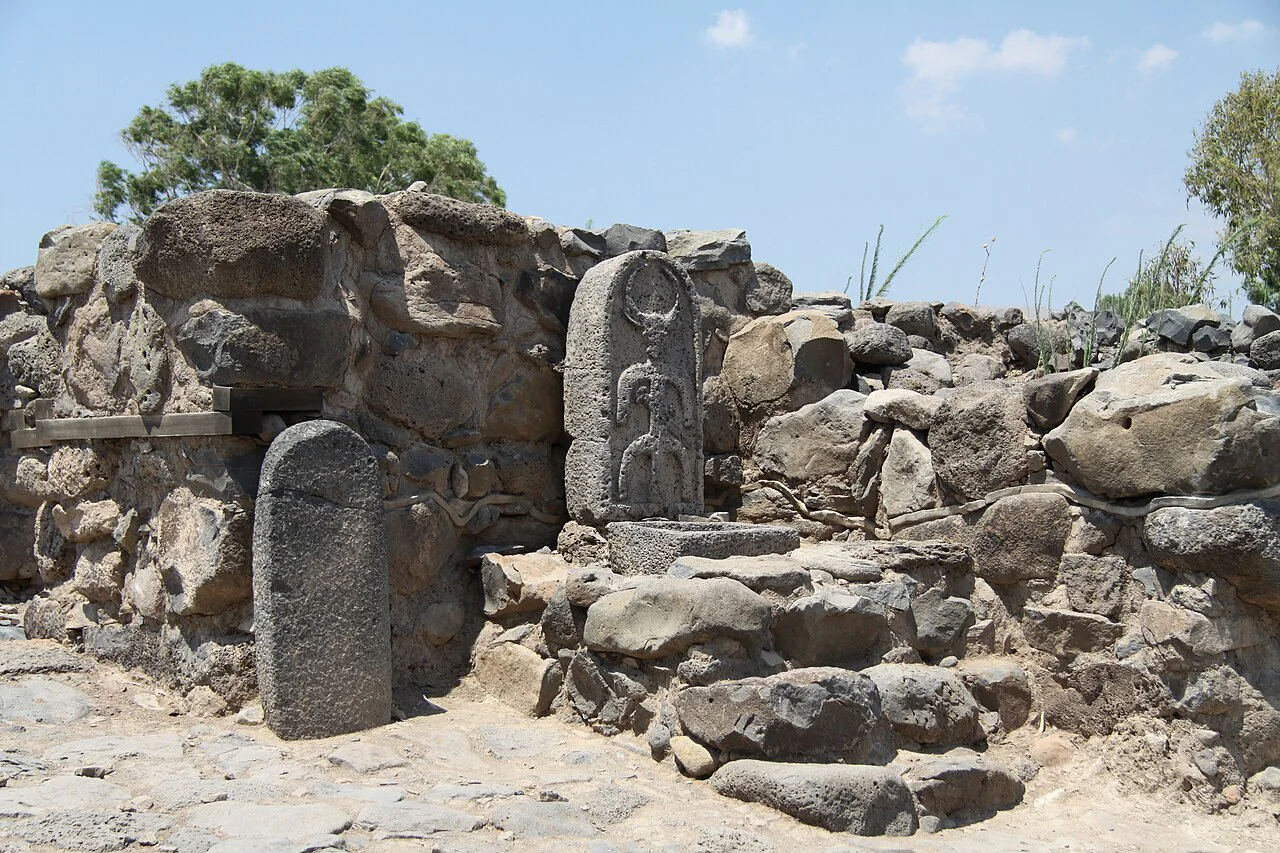
Golan Regional Council · 29 km
Bethsaida
Content & sources
Photo: Chmee2 · CC BY 3.0
Jezreel Valley Regional Council · 39 km
Sepphoris
Content & sources
No machine-readable author provided. Bachrach44 assumed (based on copyright claims). · Public domain