 Stanza / Audio guide
Content & sources
Stanza · Audio guide
Church of the Beatitudes Audio Guide
A place to remember. A story to take with you.
The Church of the Beatitudes is a Roman Catholic church located on the Mount of Beatitudes by the Sea of Galilee. It is situated near Tabgha and Capernaum in Israel.
Download Stanza, then search for “Church of the Beatitudes”.
About the tour
One guide. Your kind of visit.
The Church of the Beatitudes is a Roman Catholic church located on the Mount of Beatitudes by the Sea of Galilee. It is situated near Tabgha and Capernaum in Israel.
Ready when you are.
- 01Get the free Stanza app.
iOS & Android
- 02Find your guide.
“Church of the Beatitudes”
- 03Download before you go.
Works offline
Audio guide / 9 narrated stops
Inside the guide
Get to know a few of the stories before you go. Open a stop to read more.
01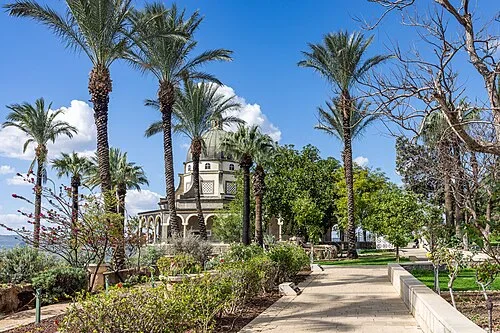 Garden Approach and Octagonal Exterior
The Garden Path to the Mount
Welcome to the Church of the Beatitudes, a Roman Catholic pilgrimage church on a small hill above the Sea of Galilee. It stands near Tabgha and Capernaum, on the mount traditionally linked with the Sermon on the Mount. The building ahead sits in gardens shaded by tall palms, with a path leading up to its dome. This place has Italian roots. The National Association for Assistance to Italian Missionaries maintains the church, and it was funded by the Italian state of its day. Day-to-day care belongs to the Franciscan Missionary Sisters of the Immaculate Heart of Mary, often called the Sisters of Egypt. They look after the church and offer hospitality to the pilgrims who arrive. Beyond the church stands a convent with a guesthouse and a small farm. The gardens hold quiet corners for services facing the lake, along with statues and plaques bearing the verses of the Beatitudes. Pilgrims have been coming up this hill for a very long time.
Ninara · CC BY 4.0
02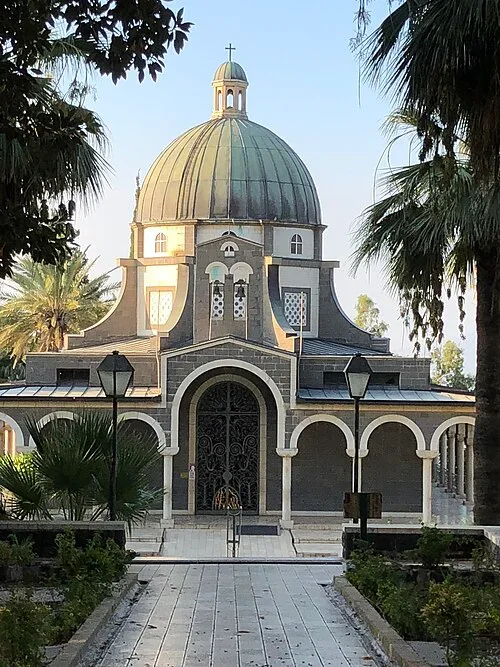 Garden Approach and Octagonal Exterior
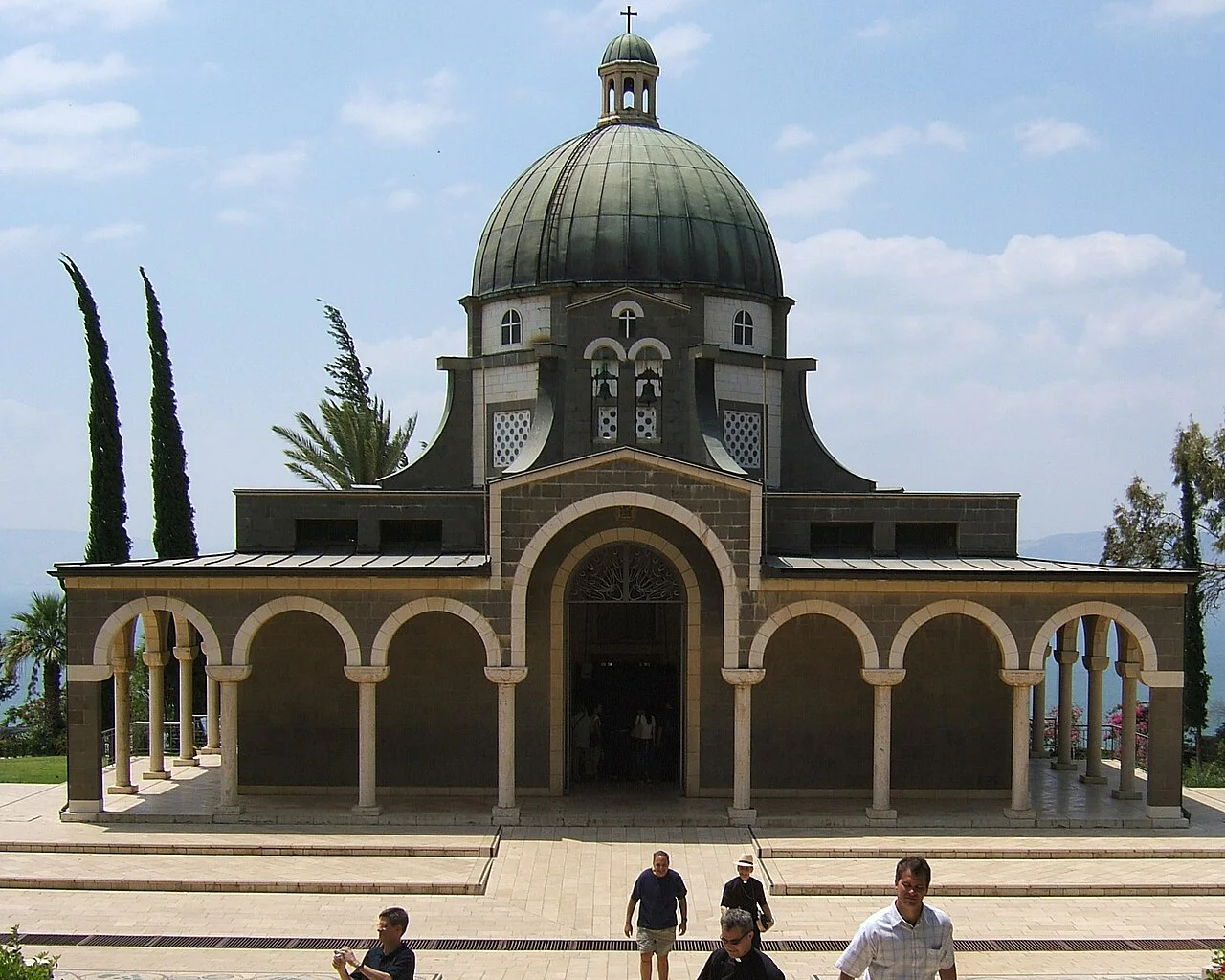
The Octagonal Church
The architect Antonio Barluzzi designed this church, and work on it ran from 1936 to 1938. It was inaugurated in 1938, in the Neo-Byzantine style he favoured. Barluzzi built several of the great Catholic churches of the Holy Land, and this is one of his best known. The floor plan is octagonal, and the eight sides stand for the eight Beatitudes, the eight blessings that open the Sermon on the Mount. Architecture that teaches: the shape of the building repeats the shape of the sermon. The facade shows the materials clearly. Dark blocks of local basalt alternate with pale white limestone, a striking contrast against the green hillside. Above the entrance rises the dome, sheathed in copper that has weathered softly over the decades.
Photo: Alejandrofsc · CC BY-SA 4.0
03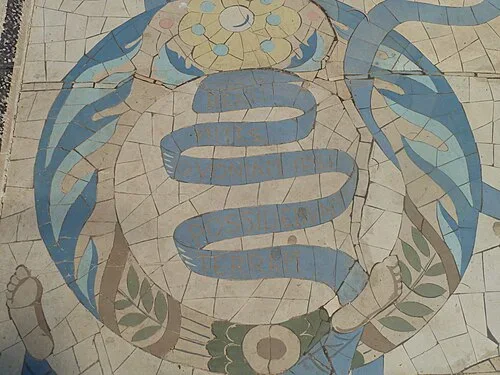 The Courtyard Mosaic and Entrance Portal
The 1983 Courtyard Mosaic
Underfoot in the forecourt lies a large pavement mosaic, laid here in 1983. It is a twentieth-century addition, quite separate from the ancient floors with older stories. Interlacing vine branches spread across the pavement, forming round medallions as they cross. Inside the medallions appear Christian saints, along with figures from the Bible and from history. The gates of Jerusalem appear in the design as well. And the eight verses of the Beatitudes are set in wreaths of flowers, each one carried by angels. A whole devotional programme worked out in stone and glass tesserae, before a visitor even reaches the door.
Listen in the appderor_avi · CC BY-SA 3.0
04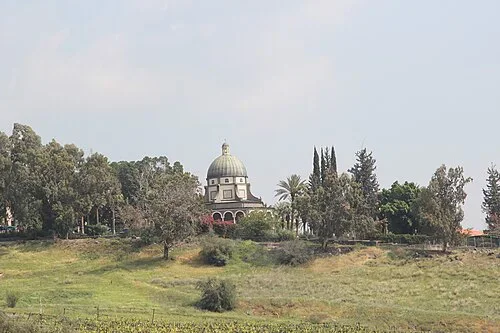 The Courtyard Mosaic and Entrance Portal
The Ancient Pilgrim Hill
Seen from a distance across the hillside, the church looks small, and the hill's history looks very long. Christian pilgrims have honoured this approximate site since at least the fourth century. A pilgrim named Egeria travelled here around the year 381 and wrote an itinerary of the Holy Land. After describing the Church of the Loaves and Fishes nearby, she wrote of a mountain close by. On it, she said, is the cave to which the Savior climbed and spoke the Beatitudes. Downhill from the modern church lie the ruins of a small Byzantine church from the late fourth century. Beneath it is a rock-cut cistern, and the remains of a small monastery sit to its southeast. Part of the original mosaic floor has been recovered, and it is now on display in Capernaum. Whether this is the exact spot, no one can say for certain. The scholar Jerome Murphy-O'Connor observed that this well-watered lakeside area, with its shade trees, was a convenient place for Byzantine pilgrims to localize the Sermon. Even so, the church stands in a very similar setting to where the sermon was delivered.
Listen in the appPhoto: Fallaner · CC BY-SA 4.0
05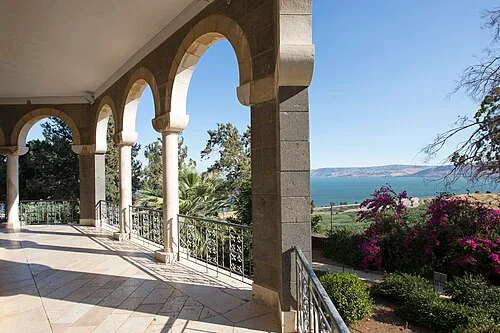 The Panoramic Portico
The church is wrapped in a colonnaded walk, an arcade of arches open to the air. Its purpose is simple and generous. Pilgrims can step out of the sun into the shade, and the arches frame the view beyond. Through them open the fields, the hills and the broad water of the Sea of Galilee. The design binds the building to the landscape around it. The Gospel stories unfolded in country like this, and the portico lets the visit breathe with it. It is as much a viewing place as a corridor.
Listen in the appisraeltourism from Israel · CC BY-SA 2.0
06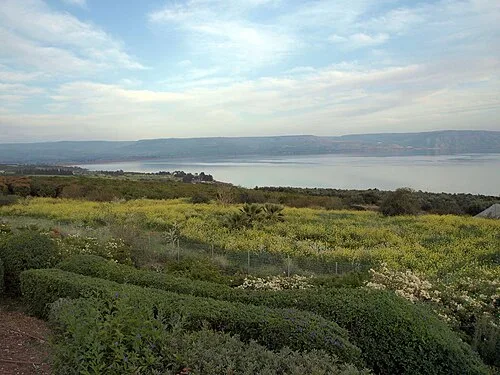 The Panoramic Portico
The View over Galilee
From this hillside, the water of Galilee spreads out below, ringed by the hills where the Gospel stories were set. This is the landscape commemorated here: the Sermon on the Mount, with the Beatitudes at its heart. The sermon gathers the blessings, blessed are the poor in spirit, the meek, the peacemakers, and much more teaching besides. An open-air address to gathered listeners suits country like this naturally. A natural amphitheatre of slope and water carries a voice a long way. And whatever the exact spot, the setting rings true. Murphy-O'Connor put it plainly: from here one can see virtually all the places in which Jesus lived and worked.
Listen in the appPhoto: Obendorf · CC0
07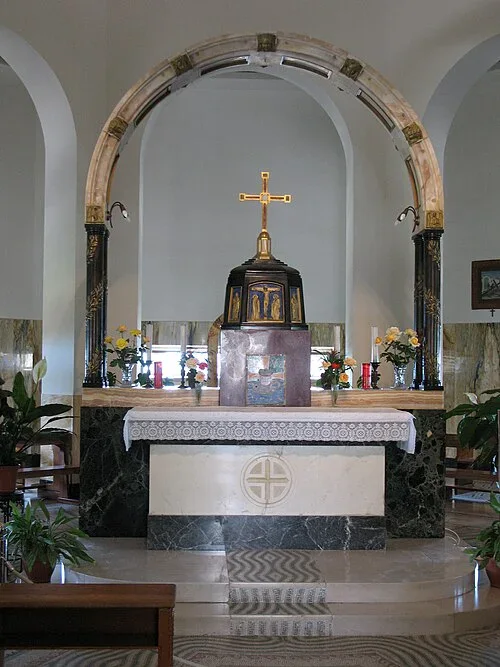 The Central Altar and Virtues Mosaic
The Central Altar
Inside, the altar is the liturgical heart of the church, a functioning Roman Catholic sanctuary where the Eucharist is celebrated. Flowers and candles stand dressed around it, as they do for worship. This is no monument kept for visitors alone; Mass is said here regularly. Two popes have celebrated Mass in this church during their pastoral visits to the Holy Land. Paul VI came in 1964, and John Paul II in 2000.
Listen in the appJames Emery from Douglasville, United States · CC BY 2.0
08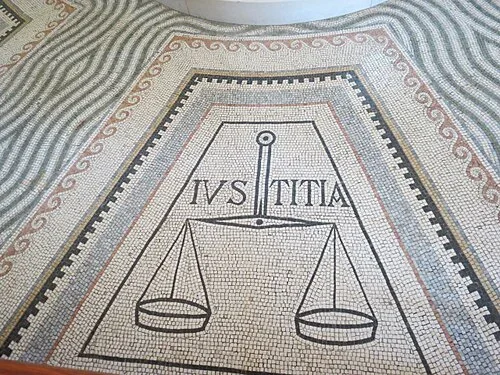 The Central Altar and Virtues Mosaic
The Mosaic of Justice
Set into the pavement around the altar is a ring of mosaic symbols, one for each of the seven virtues. The medallion with the scales carries the Latin word IVSTITIA, Justice, holding its two pans in balance. Its companions stand for Prudence, Fortitude and Temperance, and for the three theological virtues, Faith, Hope and Charity. The idea is that the floor itself teaches. The ethical teaching of the Sermon extends into the very ground the worshipper stands on. Seven virtues, seven medallions, circling the altar where the Eucharist is celebrated.
Listen in the appPhoto: Hoshvilim · CC BY-SA 4.0
09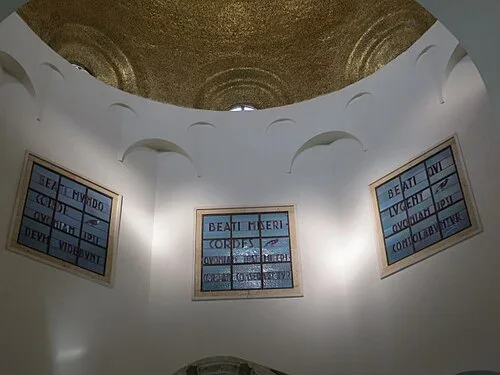 The Golden Dome and Stained-Glass Beatitudes
The Stained-Glass Beatitudes and Golden Dome
Overhead, the dome glows with gold mosaic, the crowning feature of Barluzzi's Neo-Byzantine interior. The lower walls carry marble veneer, and the white walls rise to meet the golden vault. In the drum of the dome, eight stained-glass windows filter coloured light into the sanctuary. Each window is inscribed with the Latin text of one of the eight Beatitudes. Beati pauperes corde, blessed are the poor in spirit, and its seven companions. The eight windows answer the eight sides of the octagon. The theme that shaped the whole building closes here, in light. From garden path to golden dome, everything in this church circles back to those eight blessings.
Listen in the appPhoto: Hoshvilim · CC BY-SA 4.0
Church of the Beatitudes
Frequently asked questions
How much does the guide cost?
Free app download. Listed guide price: Free guide. Guide price shown in the app. Audio guide only. Venue admission is separate.
Can I listen without internet?
Yes. Download the guide’s audio, images, and maps in the app before your visit. Your downloaded content is then available offline.
Can I listen in my language?
This audio guide is available in 15 languages, including English.
Do I need to follow a schedule?
No. This is a self-guided experience. Choose your stops, pause whenever you like, and return to a story at your own pace.
At your own pace
Explore Church of the Beatitudes.
Download Stanza, then search for “Church of the Beatitudes”.
Free app download · Guide price shown in the app
Keep exploring
Nearby audio guides
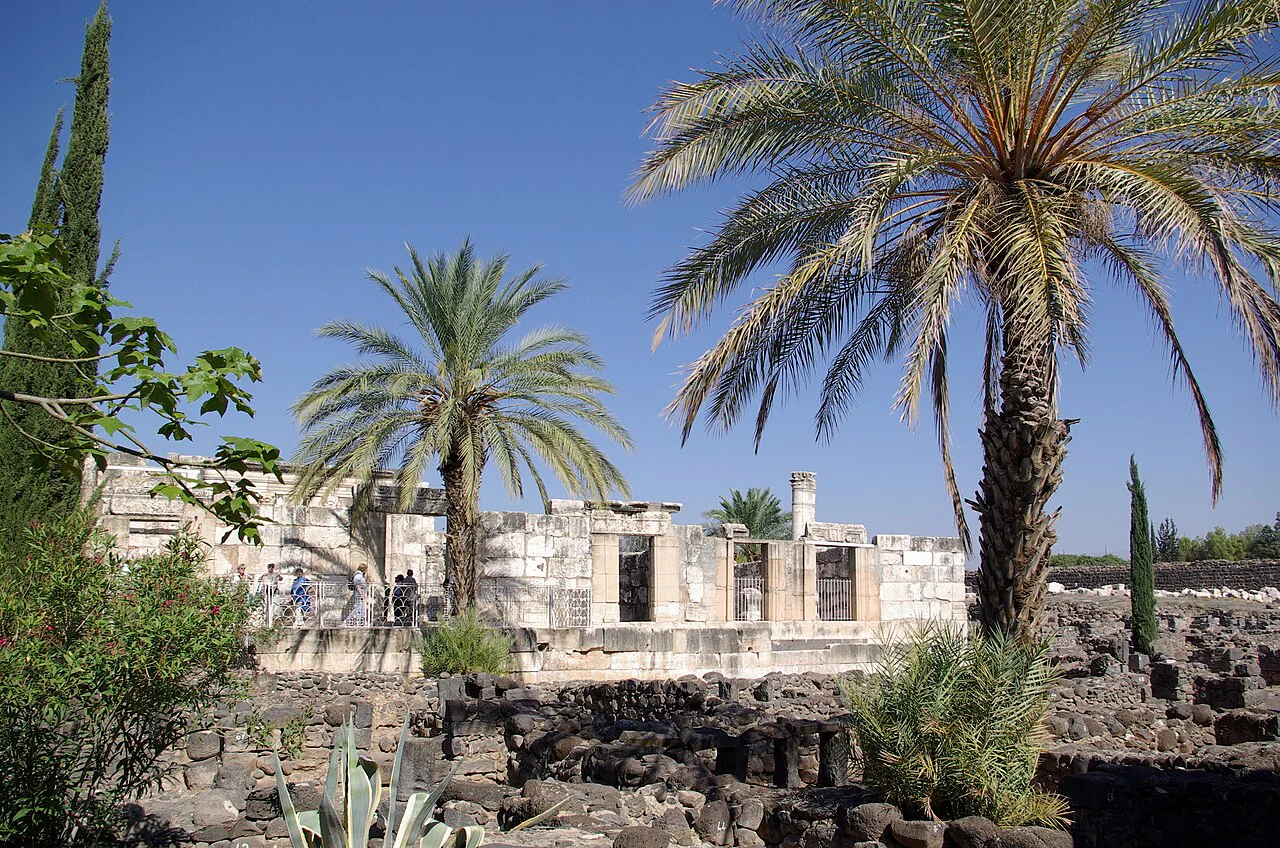
Emek HaYarden Regional Council · 2 km
Capernaum
Content & sources
Photo: Berthold Werner · Public domain
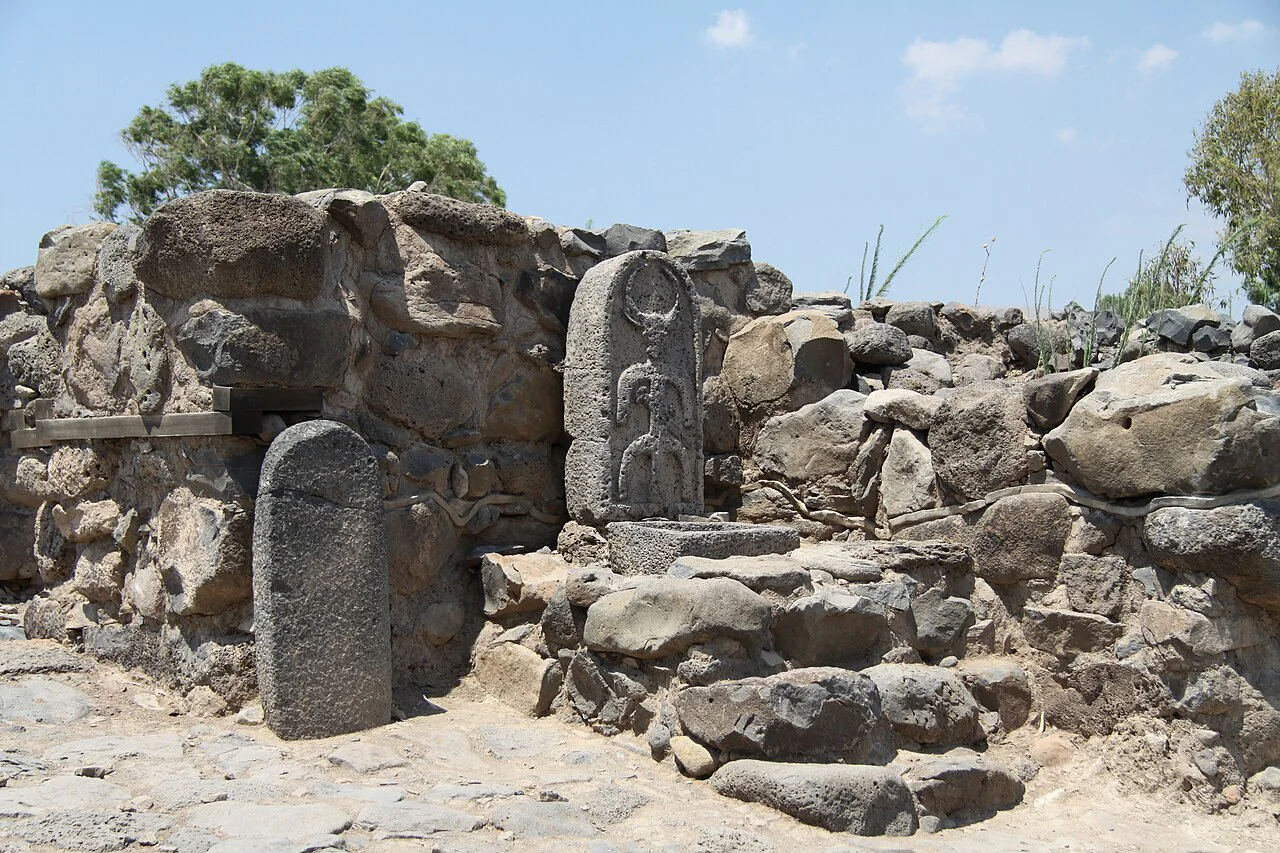
Golan Regional Council · 8 km
Bethsaida
Content & sources
Photo: Chmee2 · CC BY 3.0
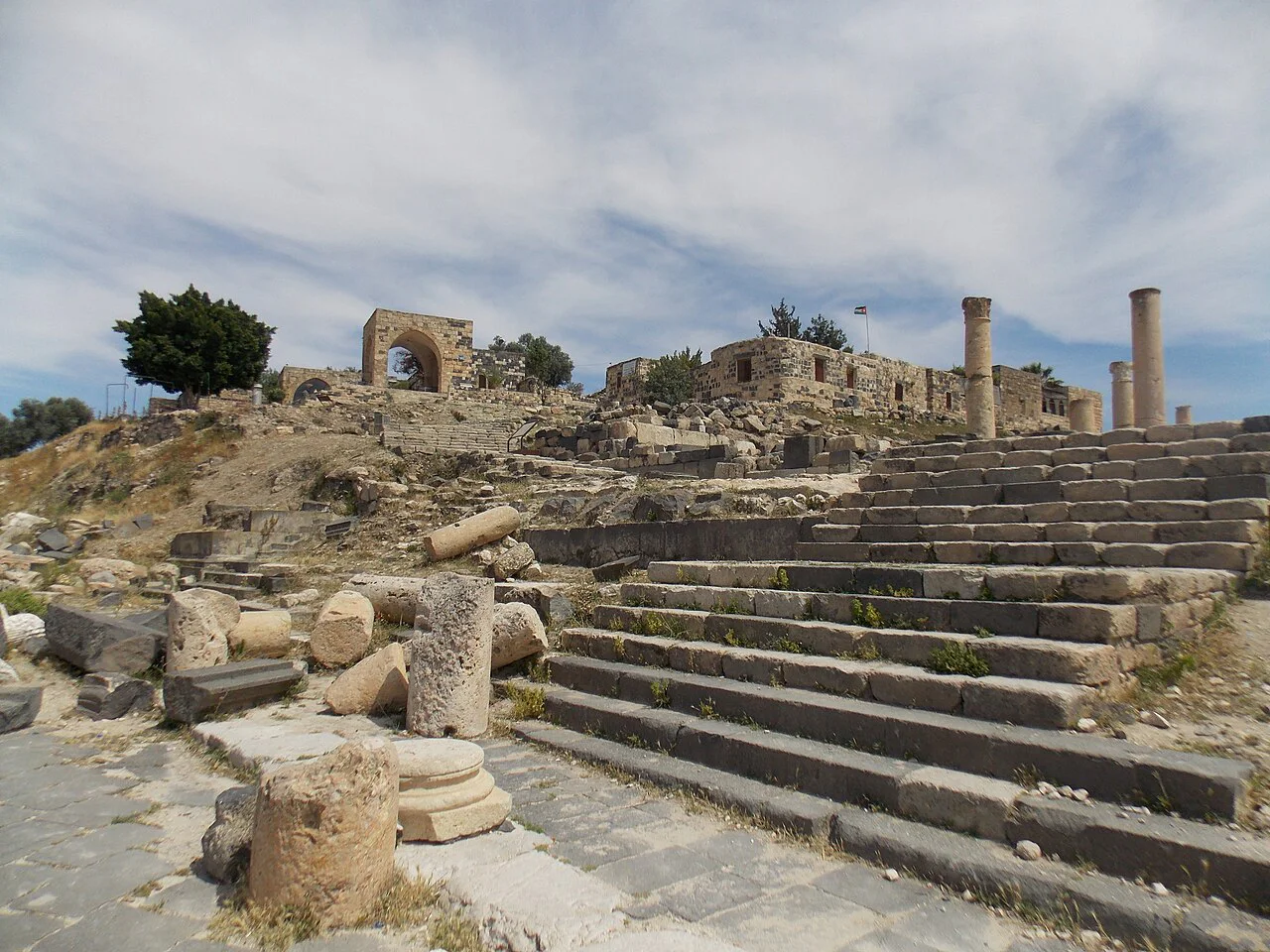
Umm Qais · 28 km
Gadara
Content & sources
Samir I. Sharbaty · CC BY-SA 3.0
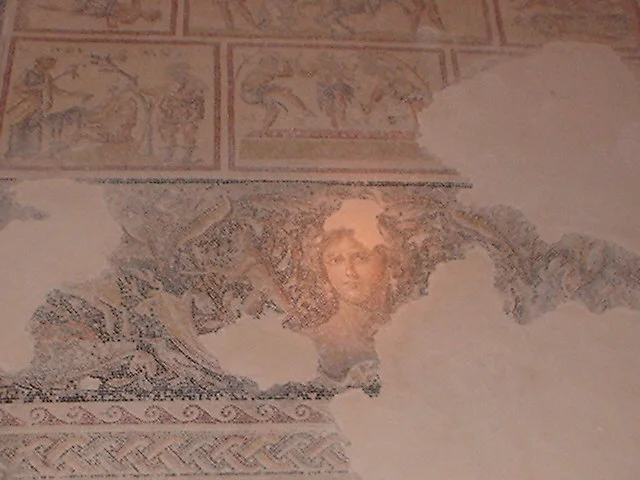
Jezreel Valley Regional Council · 29 km
Sepphoris
Content & sources
No machine-readable author provided. Bachrach44 assumed (based on copyright claims). · Public domain