Stanza · Audio guide
Beit She'arim necropolis Audio Guide
A place to remember. A story to take with you.
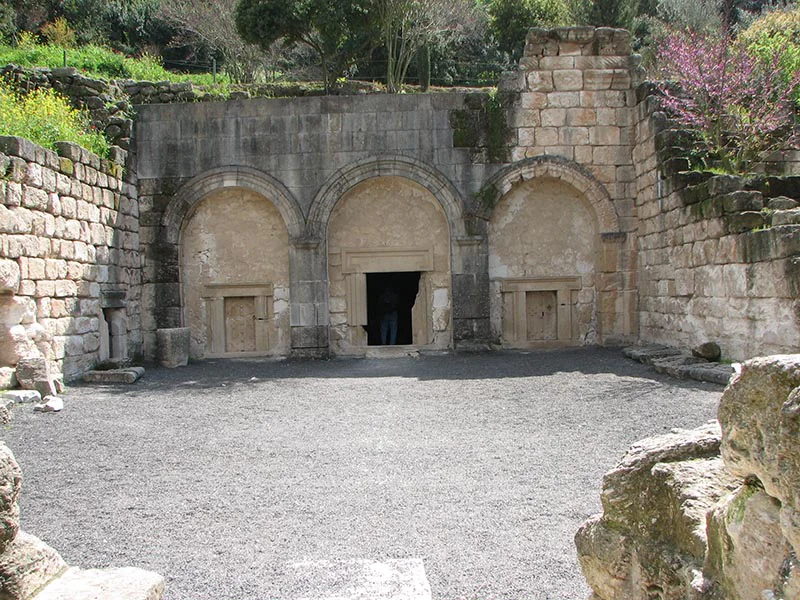
Beit She'arim Necropolis is an extensive rock-cut necropolis located near the ancient Jewish town of Beit She'arim in the southern foothills of the Lower Galilee. It served as a burial site from the first to…
Download Stanza, then search for “Beit She'arim necropolis”.
About the tour
One guide. Your kind of visit.
Beit She'arim Necropolis is an extensive rock-cut necropolis located near the ancient Jewish town of Beit She'arim in the southern foothills of the Lower Galilee. It served as a burial site from the first to fourth centuries CE and was designated a UNESCO World Heritage Site in 2015.
Ready when you are.
- 01Get the free Stanza app.
iOS & Android
- 02Find your guide.
“Beit She'arim necropolis”
- 03Download before you go.
Works offline
Audio guide / 16 narrated stops
Inside the guide
Get to know a few of the stories before you go. Open a stop to read more.
01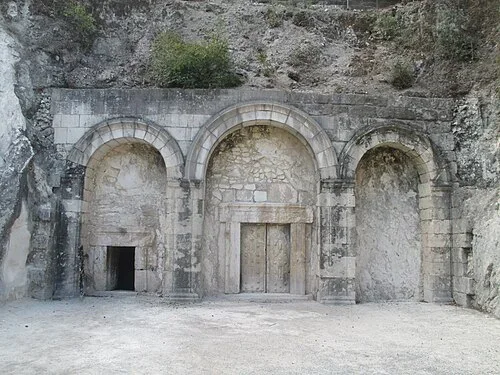 Catacomb 14 – Courtyard and Tomb of Rabbi Judah ha-Nasi
Facade of Catacomb 14 – Opening Orientation
Welcome to Beit She'arim, the House of Gates, a hillside of burial caves about twenty kilometers east of Haifa. The three great arches cut into the limestone cliff belong to Catacomb Fourteen, and they announce the place's ambition in full Roman style. For Jews of antiquity, the most desired grave of all was on the Mount of Olives in Jerusalem. In the year 135 that door closed, when Jews were barred from the city. By then the Sanhedrin, the Jewish high council, had been wandering for decades, from Jabneh to Usha to Shefar'am. When it settled here, the town and its hillside rose with it. This ground became one of the most prestigious Jewish burial places of late antiquity, and families wanted their dead laid near the sages interred here. Cave after cave was hollowed out of the rock to receive them.
דר' אבישי טייכר · CC BY 2.5
02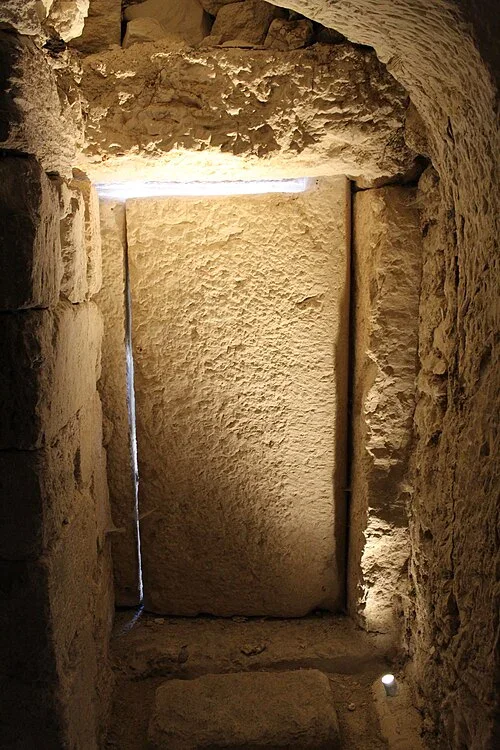 Catacomb 14 – Courtyard and Tomb of Rabbi Judah ha-Nasi
The Pivoting Stone Door
None of these caves was built. They were cut. The hill here is soft limestone, and local Jewish stonemasons' workshops carved it into halls, burial recesses and stairways, all out of the living rock. Even the doors came from the same hillside. Access to many of the catacombs passed through stone doors that once turned on their own axis, and in some cases still do. A single massive slab stands in its frame, shaped and balanced by hand so it could swing shut behind the mourners. A closed door sealed the chamber and protected the dead inside. It took workshops of skilled carvers years to open one of these systems into the hill. What looks like a natural cavern is really a piece of architecture, quarried downward and inward, room by room.
Photo: Davidbena · CC BY-SA 4.0
03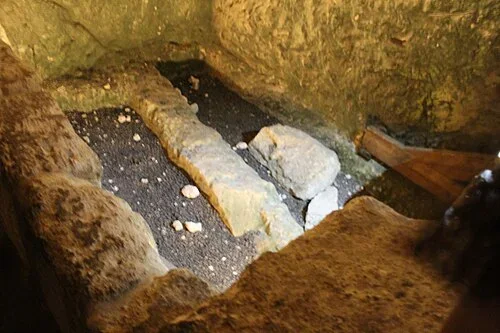 Catacomb 14 – Courtyard and Tomb of Rabbi Judah ha-Nasi
The Tomb of Rabbi Judah ha-Nasi
Rabbi Judah ha-Nasi was head of the Sanhedrin and the compiler of the Mishnah, the great handbook of Jewish law. In the last seventeen years of his life he lived in Sepphoris, for the sake of his health, but he planned his burial here in Beit She'arim. The Talmud describes the day it came. Eighteen synagogues gathered to mourn him and bore him to Beit She'arim, and the daylight, it says, lingered until every mourner had reached home. Catacomb Fourteen is thought to have belonged to his family. The two rock-cut graves side by side carry bilingual inscriptions in Hebrew and Greek, naming R. Gamliel and R. Shimon. They are believed to be his sons, Gamaliel the Third and Rabbi Shimon, and the pair matches his dying words. Simon my son shall be hakham, he said, Gamaliel my son patriarch, and Hanania bar Hama shall preside over the great court. His grave here is believed to be a major reason the necropolis became so sought after.
Listen in the appPhoto: Davidbena · CC BY-SA 4.0
04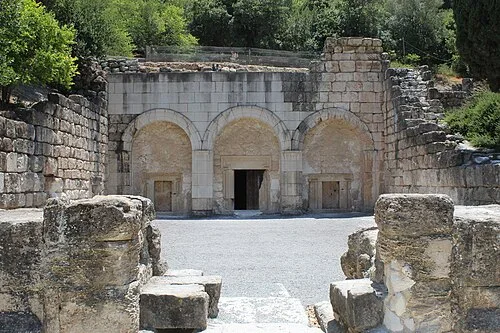 Catacomb 20 – Hall of the Sarcophagi
Catacomb 20 – The Cave of the Coffins
The Cave of the Coffins is the most splendid burial system found at Beit She'arim. It runs roughly seventy-five meters in each direction, through branching corridors and many halls of the dead. Inside, excavators counted a hundred and thirty-five sarcophagi, and thirty-five of them were richly sculpted. Each limestone coffin weighed between four and five tons. Nahman Avigad, the archaeologist who dug here, judged that such an enterprise took organization and resources, and served families of standing and means. Many inscriptions in this cave are in Hebrew. The men buried here bore Hebrew names, while the women bore Greek and Roman ones, written in Hebrew letters. Avigad took that to mean these were families of sages, still speaking a Hebrew that was already growing rare. The arched front was found wrecked and has been partly rebuilt in modern times, so some of what rises there is new masonry over old.
Listen in the appPhoto: Davidbena · CC BY-SA 4.0
05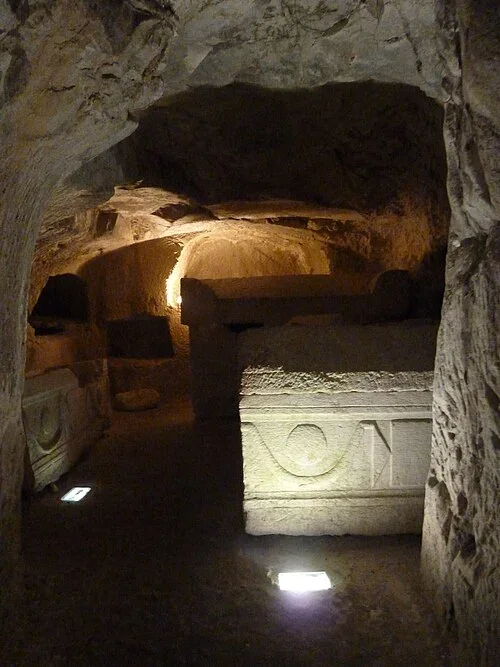 Catacomb 20 – Hall of the Sarcophagi
Inside the Hall of Sarcophagi
The great hall is dim and quiet now, its massive coffins picked out by small lamps on the floor. It was not quiet in every age. Nearly all the sarcophagi here were broken open by grave robbers hunting for treasure. Judging by the terracotta oil lamps they left behind, the pillaging happened in the eighth and ninth centuries. The robbers took whatever valuables they imagined, and they emptied the stone coffins even of the bones of the dead. Some remains were scattered that way, and others were later removed and reburied by Atra Kadisha, the body that handles exhumed bones at archaeological sites. The cave outlived even that. During the Mamluk period, between the thirteenth and fifteenth centuries, the Cave of the Coffins served Arab shepherds as a place of refuge.
Listen in the appDeror_avi · CC BY-SA 3.0
06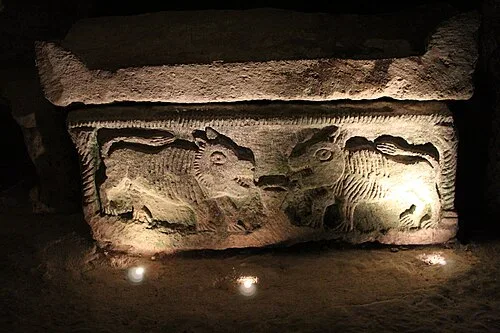 Catacomb 20 – Hall of the Sarcophagi
A Sarcophagus of Facing Lions
Two lions face each other across the side of this coffin, carved in deep relief. The scene comes from Greek mythology, yet it was made for Jewish dead, in the cemetery of a rabbinic town. That mix runs through the whole necropolis. Wealthy families here moved comfortably in Hellenistic culture, and they let it follow them into the tomb. Coffins carry animals, geometric ornament, and figures from classical myth and religion, set beside Jewish symbols on the very same stone. The words on the tombs follow the same pattern. Many of the epitaphs written for the deceased are drawn straight from the poems of Homer. The dead of Beit She'arim were buried as Jews, in the visual language of the wider Roman world.
Listen in the appPhoto: Davidbena · CC BY-SA 4.0
07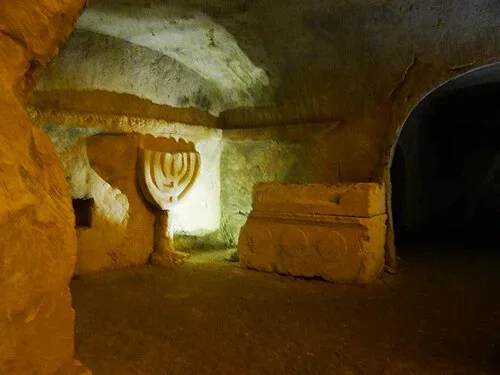 Catacomb 20 – Hall of the Sarcophagi
The Menorah of Catacomb 20
Carved into the cave wall, a seven-branched menorah stands in relief, close to two meters high. After the destruction of the Temple in Jerusalem, the image of its great candelabrum took on a new life. It became the defining emblem of Jewish identity, the sign people placed where they wanted to say who they were. At Beit She'arim it appears again and again, carved, incised and painted across the caves. It often appears beside a shofar and other ritual symbols, a small vocabulary of memory in stone. In a cemetery, the image carried a promise as well. The lamp that once stood in the Temple would, it was believed, burn again.
Listen in the appPhoto: Hanay · CC BY-SA 4.0
08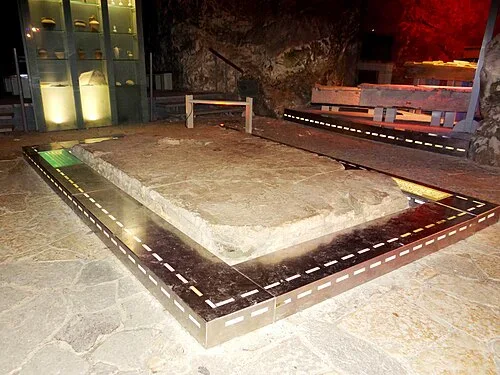 The Museum Cave – The Glass Monolith and Diaspora Inscriptions
The Nine-Ton Glass Slab
A bulldozer working at the site in 1956 unearthed an enormous rectangular slab, about three and a half meters long and almost half a meter thick. At first it was simply paved over. When it was finally studied, it turned out to be a single gigantic piece of glass, weighing nine tons. The story goes back to the ninth century, under Abbasid rule. A glassmaking furnace operated here then, producing huge batches of molten glass. The batches were cooled in place and later broken into small pieces for crafting glass vessels. This batch never got that far. Some flaw in the glass is thought to have left it here, one vast unbroken mass, and centuries after the last burial the cemetery hill had found a second, unexpected use.
Listen in the appPhoto: Hanay · CC BY-SA 4.0
09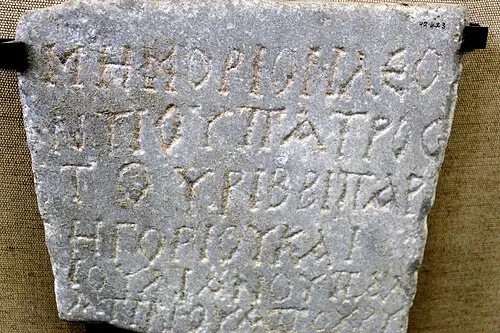 The Museum Cave – The Glass Monolith and Diaspora Inscriptions
Voices in Greek – Diaspora Epitaphs
A small marble slab carries a message in Greek letters: in memory of Leo, father of the comforting rabbi and of Julian, the palatine goldsmiths. Leo's sons worked in gold, and someone paid to have his name cut in stone here. Close to three hundred funerary inscriptions have come out of these caves, and most of them are in Greek. Others are in Hebrew, in Aramaic, and in Palmyrene. The place names in them reach far beyond Galilee. There are dead from Palmyra in Syria and from Tyre, from Antioch, and from Mesene in southern Mesopotamia. Others came up the Phoenician coast from Sidon, Beirut and Byblos. The farthest home of all was Himyar, in what is now Yemen. Benjamin Mazar uncovered their tombs in 1937, dating to the third century. They lie in a single catacomb, with forty small chambers branching off a main hall. One of their number, Menaḥem, is called prince of Himyar in his own script, and an elder of the community in Greek. Another name, a woman's, is still argued over by scholars, who read it in more than one way. For Jews of the time, burial in the land of the forefathers was an outstanding virtue, and families with the means carried their dead across the ancient world to lie near the sages buried here.
Listen in the appPhoto: Davidbena · CC BY-SA 4.0
10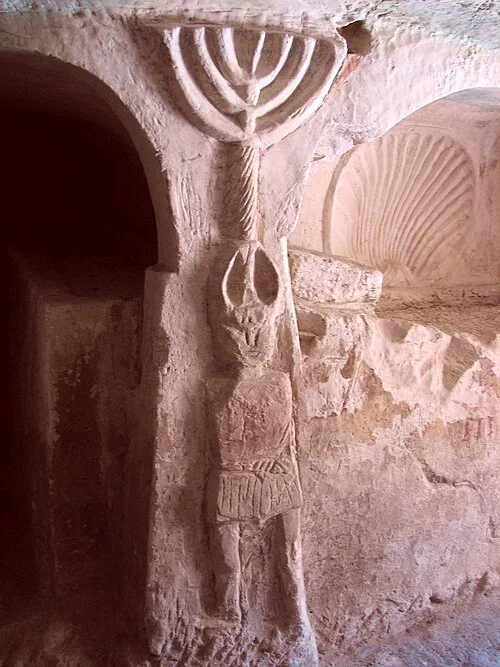 The Menorah Caves Complex
The Warrior and His Menorah
Most of the carving in these caves speaks in symbols and ornament. Here, a person stands carved in stone. The relief shows a full human figure, dressed in a short tunic, cut into the living rock of a western burial cave. Above him rises a large menorah on a twisted stem, and a shell motif spreads on the wall beside him. Craftsmen elsewhere in the necropolis worked for grand sarcophagi and formal facades. This figure has a rougher, more personal hand, closer to folk art than to a workshop masterpiece. It suggests a family that chose to show a man himself, or the role he held in life, rather than a scene of myth. Out of all the decoration in the necropolis, images of named, standing people like this are rare. Whoever he was, he has kept his place under the lampstand for some seventeen centuries.
Listen in the appPhoto: Hanay · CC BY-SA 3.0
- 11
The Torah Ark Relief
A burial cave where a Torah ark is carved into the wall, bringing the sanctuary into the tomb.
- 12
The Ancient Town on the Hill
The hilltop town behind the cemetery: Herod's foundation, the House of Two Gates, and Queen Berenice's estates.
- 13
The Great Synagogue and the End of the Town
The basilica synagogue where the Sanhedrin's town worshipped, and the revolt of 351 that probably ended it.
- 14
Alexander Zaïd and the Rediscovery
The bronze horseman Alexander Zaïd, the 1936 rediscovery of the caves, and the surveys that came before.
- 15
The Tomb of Sheikh Abreik
The domed Muslim shrine that gave the hill its modern name, and the land deal that made a park of it.
- 16
Closing View over the Jezreel Valley
The wide Jezreel panorama, and the 2015 World Heritage listing that named this place a landmark of Jewish renewal.
Beit She'arim necropolis
Frequently asked questions
How much does the guide cost?
Free app download. Listed guide price: $1.99. Guide price shown in the app. Audio guide only. Venue admission is separate.
Can I listen without internet?
Yes. Download the guide’s audio, images, and maps in the app before your visit. Your downloaded content is then available offline.
Can I listen in my language?
This audio guide is available in 15 languages, including English.
Do I need to follow a schedule?
No. This is a self-guided experience. Choose your stops, pause whenever you like, and return to a story at your own pace.
At your own pace
Explore Beit She'arim necropolis.
Download Stanza, then search for “Beit She'arim necropolis”.
Free app download · Guide price shown in the app
Keep exploring
Nearby audio guides
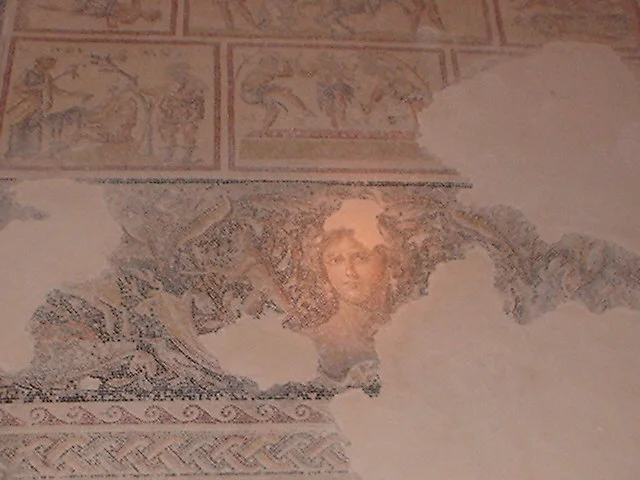
Jezreel Valley Regional Council · 15 km
Sepphoris
Content & sources
No machine-readable author provided. Bachrach44 assumed (based on copyright claims). · Public domain
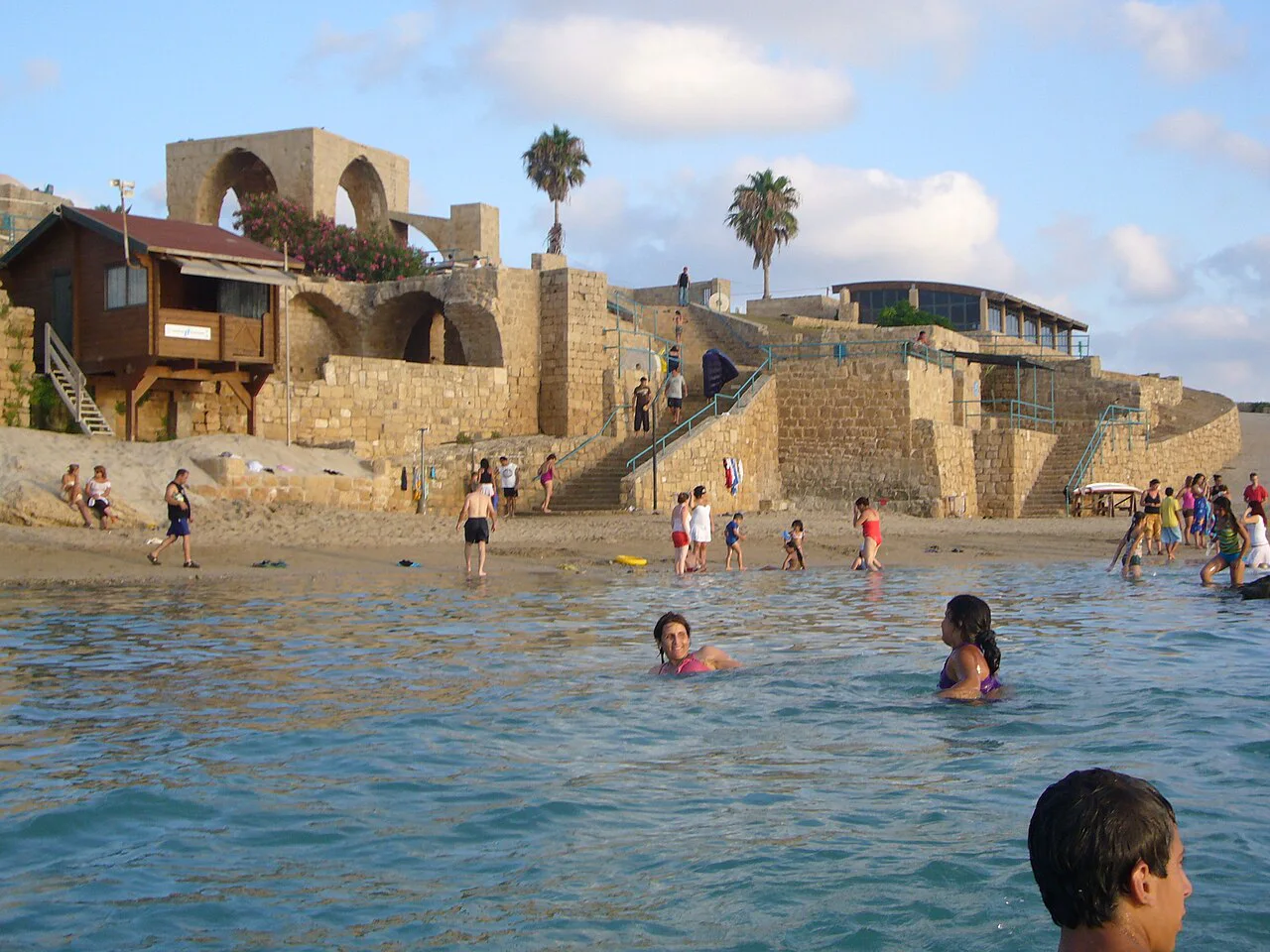
Mate Asher Regional Council · 38 km
Achziv
Content & sources
Al Ameer son (talk) 19:03, 11 August 2008 (UTC) · Public domain
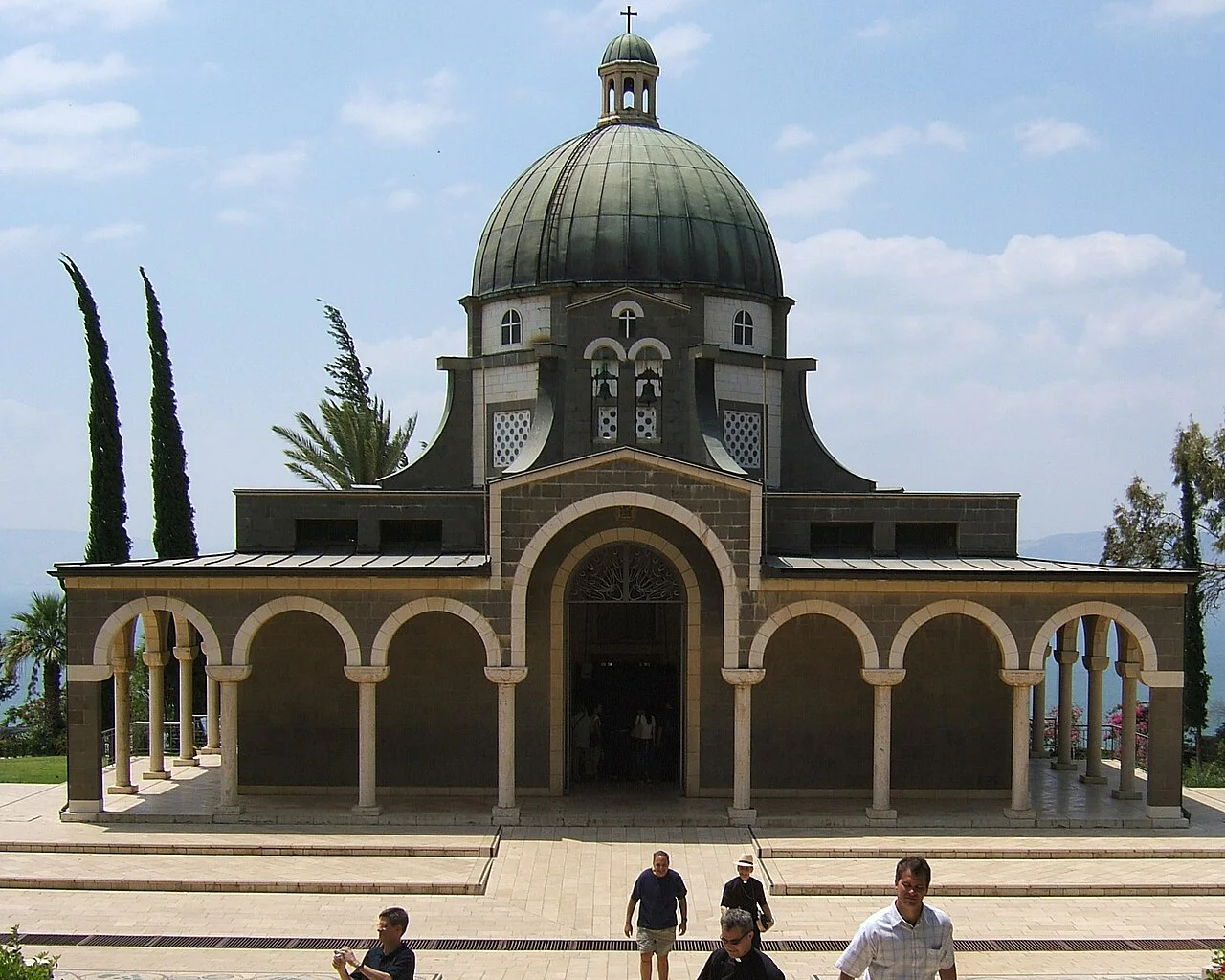
Tabgha · 45 km
Church of the Beatitudes
Content & sources
No machine-readable author provided. Bantosh~commonswiki assumed (based on copyright claims). · Public domain
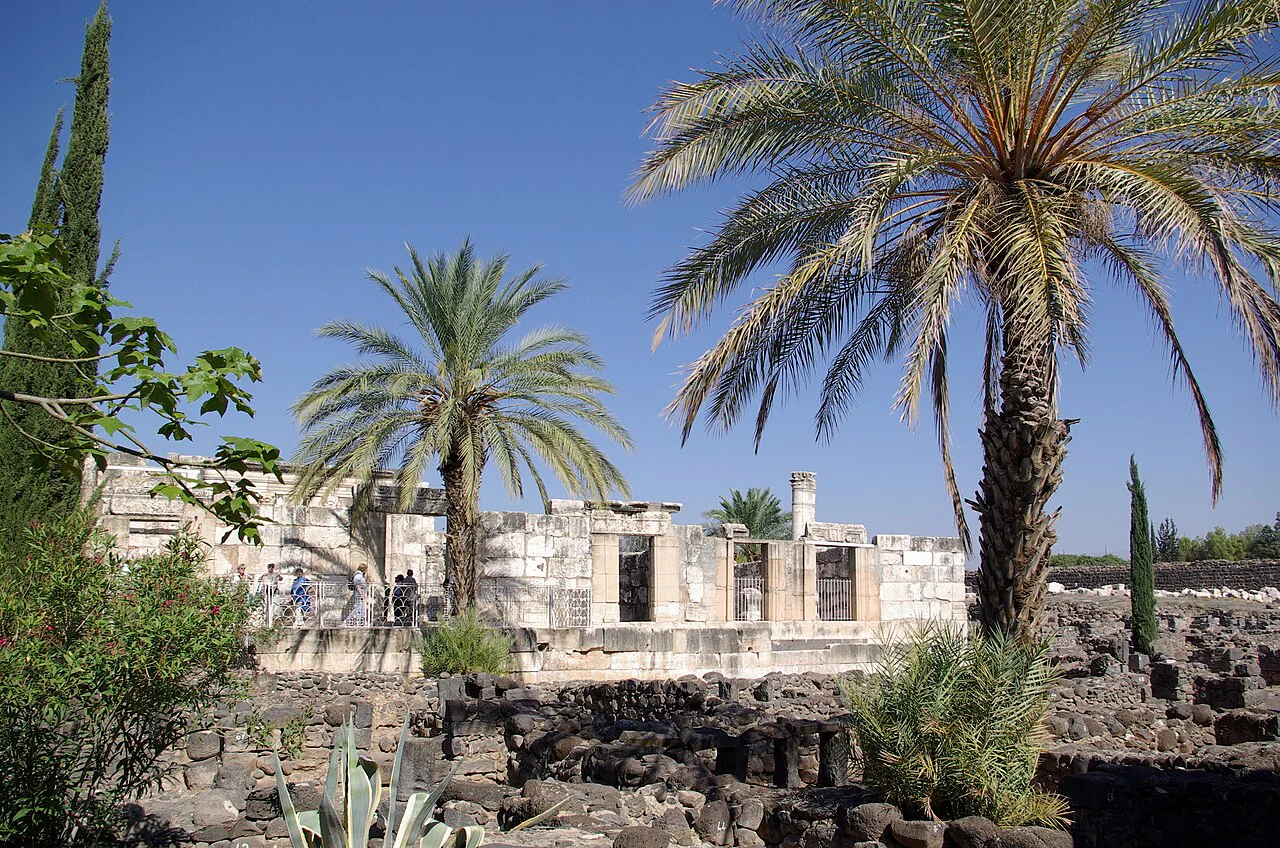
Emek HaYarden Regional Council · 46 km
Capernaum
Content & sources
Photo: Berthold Werner · Public domain