Stanza · Audio guide
Morgantina Audio Guide
A place to remember. A story to take with you.
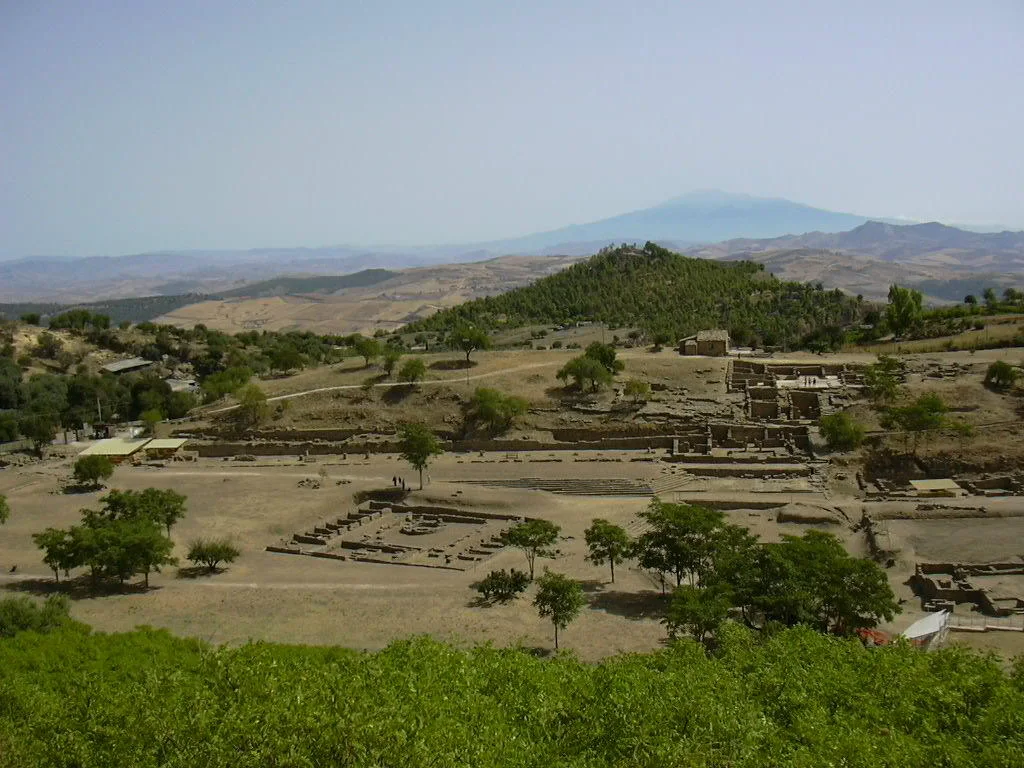
Morgantina is an archaeological site located in east central Sicily. It consists of two major settlements that were inhabited from approximately 1000 BCE to 50 CE.
Download Stanza, then search for “Morgantina”.
About the tour
One guide. Your kind of visit.
Morgantina is an archaeological site located in east central Sicily. It consists of two major settlements that were inhabited from approximately 1000 BCE to 50 CE.
Ready when you are.
- 01Get the free Stanza app.
iOS & Android
- 02Find your guide.
“Morgantina”
- 03Download before you go.
Works offline
Audio guide / 16 narrated stops
Inside the guide
Get to know a few of the stories before you go. Open a stop to read more.
01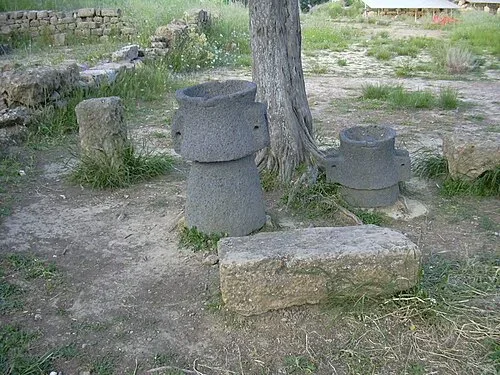 Site Entrance and Archaic Horizons
Ancient Millstones
Morgantina was an ancient town in east-central Sicily, about sixty kilometres from the Ionian coast. Later, much of the town stood on Serra Orlando, a ridge about two kilometres long. This tour follows the town from its hilltop beginnings to its Roman market. The round stones beside the tree are millstones, the grinding stones that turned grain into flour. Wheat and barley were a big part of the town's trade. Oil, wine, and terracotta made in kilns also passed through its markets. Morgantina has been the main site of American research into classical Sicily. Traces of its defensive walls remain on a steep eastern slope.
Photo: Morgantia07 · Public domain
02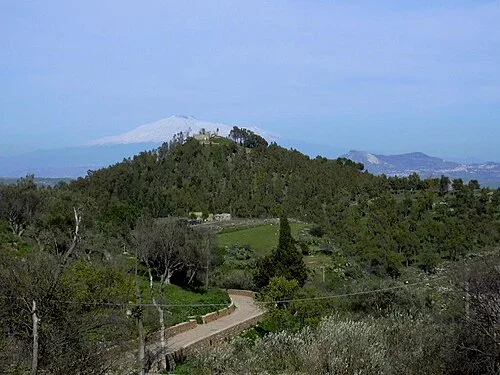 Site Entrance and Archaic Horizons
Cittadella Hill and Mount Etna
Cittadella, the hill with a building on its crest, was the earliest major settlement at Morgantina. Trees cover its slopes today, and Mount Etna rises behind it with snow on its summit. A settlement stood on its top from around the tenth or ninth century BC. Ancient writers did not agree about who founded the town. Strabo credited a people called the Morgetes, who came from Rhegium. Dionysius of Halicarnassus told of a king named Morges who led them. Another tradition puts the founding in the eleventh century BC. In 459 BC, Ducetius, leader of the native Sicel people of central Sicily, attacked the town and captured it. That is the earliest date from written history tied to Morgantina. Cittadella's main settlement lasted until about 450 BC. Then the town grew on Serra Orlando, the long ridge to the southwest.
Photo: Morgantia07 · Public domain
03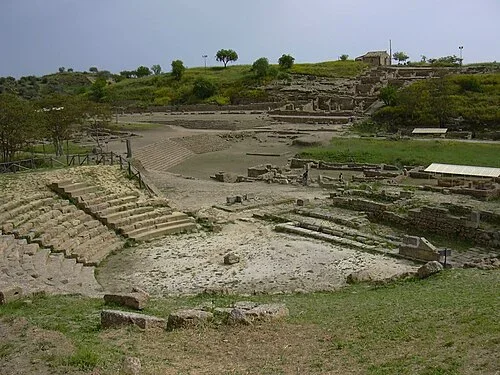 The Lower Agora and Theater of Dionysus
Ancient Greek Theatre of Morgantina
The theatre at Morgantina leans against the western hill, beside the lower agora, the town's open square. Its first phase, from about the middle of the fourth century BC, seems to have had a trapezoid plan, a four-sided shape with two parallel sides. Later, between the late fourth and early third centuries BC, builders rebuilt it with seats curved in a horseshoe. These rows of seats, called the cavea, are split into sectors. The stone tiers at the left edge still climb the slope. Two side passages, called parodoi, led into the orchestra, the open space where the chorus moved. The orchestra was closed off by the stage building, a fixed architectural front. Its scenery was movable, held up by wooden beams. Sockets for those beams are cut into a large triangular block.
Listen in the appPhoto: Morgantia07 · Public domain
04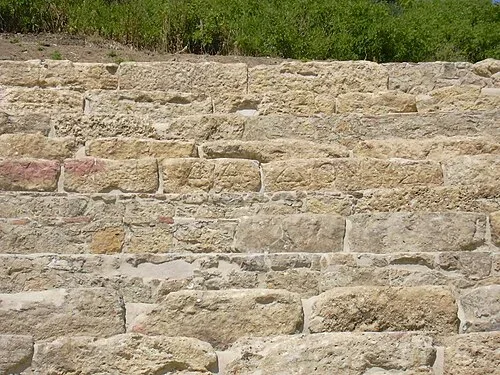 The Lower Agora and Theater of Dionysus
Theatre Retaining Wall and Dionysus Dedication
The theatre was dedicated to the god Dionysus. The seats sit on a gently sloping area of the rocky ridge, built up with fill of sand and earth. That fill is held back by thick walls. Buttresses, supports built against the walls, carry the weight. The wall that holds up the seating is made of carefully squared blocks, laid in regular rows. The god's name is cut into the riser of one step, the upright face of a stair, not across every step.
Listen in the appPhoto: Morgantia07 · Public domain
05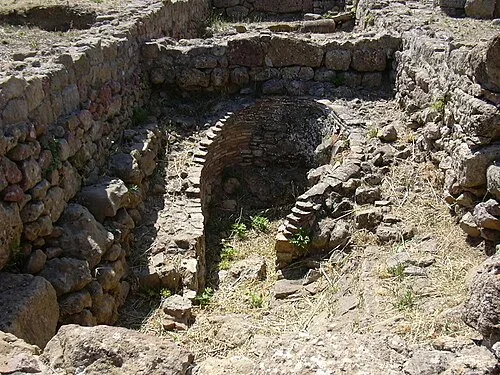 The Lower Agora and Theater of Dionysus
Sanctuary Area with Brick-Arched Recess
Demeter and Persephone were worshipped in a sacred area beside the theatre. Greek settlers of Chalcidian origin arrived at Morgantina around the middle of the sixth century BC. They seem to have lived fairly peacefully alongside the people already there. The newcomers turned the local mother goddess into the Greek goddesses Demeter and Persephone. Scholars call such deities chthonic, meaning linked with the earth and the underworld. A cylindrical altar marks the sacred area. Set into the stone walls is a brick arch, with a short flight of steps beside it. The brick arch's purpose has not been settled.
Listen in the appPhoto: Morgantia07 · Public domain
06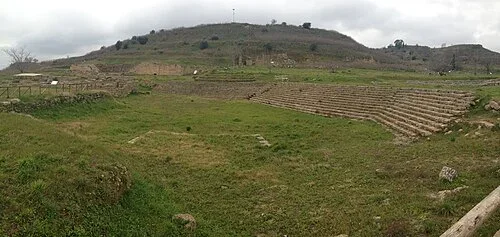 The Monumental Assembly Steps and Civic Council
Monumental Assembly Steps (Ekklesiasterion)
The town's assembly of citizens is said to have met on these stone steps to take its most important decisions. The Greek word for such a place is ekklesiasterion, a meeting place for the assembly. The steps bridge the drop from the upper square to the lower agora. Their shape repeats the original trapezoid plan of the theatre beside them. They were built in the same phase as the theatre's new seating. The flight was left unfinished at its eastern end.
Listen in the appDavide Mauro · CC BY-SA 4.0
07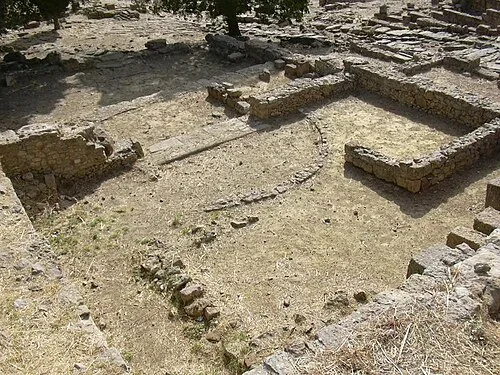 The Monumental Assembly Steps and Civic Council
Bouleuterion (Council House)
The bouleuterion, the council house of Morgantina, stood beside the agora. The name comes from the Greek word for council. It was founded in the third century BC, a time of great prosperity for the town. By then Morgantina had taken on a deeply Greek character. Low foundation walls still trace its rectangular plan. Inside it are the remains of a semicircular wall and a rectangular platform. The council members' seats were probably arranged around them.
Listen in the appPhoto: Morgantia07 · Public domain
08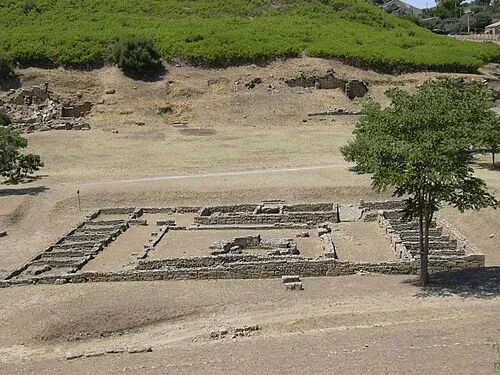 The Upper Agora, Roman Macellum, and Gymnasium
Roman Macellum
Morgantina stayed out of Roman hands until 211 BC. That year it became the last Sicilian town the Romans captured. Rome then handed it over as payment to a group of Spanish mercenaries. Afterwards its walls were taken down, and the settlement shrank. Over time the Greek city was turned into a Roman town, used by the legions passing through Sicily. In the middle of the agora a macellum was built, a Roman market building. Its foundations form a rectangle. Thirteen shops of equal size lined the north and south sides of a colonnaded courtyard, with a small round pavilion at its centre. A tree stands beside it. Bronze coins with the Latin word Hispanorum, meaning of the Spaniards, were struck while Moericus, the leader of those Spanish mercenaries, ruled the town. Kenan Erim used coins like these, along with the Roman historian Livy, to identify the ridge at Serra Orlando as Morgantina.
Listen in the appUser:Francesca Ciantia · Public domain
09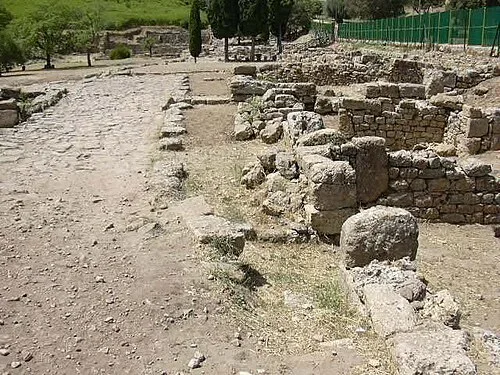 The Upper Agora, Roman Macellum, and Gymnasium
North Stoa and Gymnasium
The agora, the town's central open square, has a long covered portico along its north side. The portico is about ninety metres long, and it is also called the North Stoa. It is identified as a gymnasium, a place for the sports of young people. Rooms opened off the portico, among them changing rooms and basins for washing. The portico was built in the third century BC, under Hieron the Second. At that time Morgantina was part of the Syracusan kingdom that Hieron ruled. Today a paved way runs along one side of the ruins. On the other side, large blocks of stone lie among low walls.
Listen in the appPhoto: Morgantia07 · Public domain
10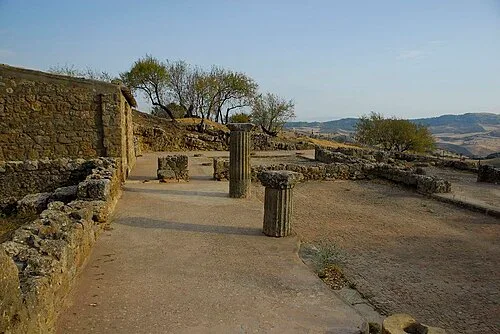 East Hill Mansions and Early Hellenistic Mosaics
House of Ganymede (Casa di Ganimede)
East of the agora lay a residential quarter, and several of its houses were richly decorated with mosaics. Some of the houses are named after something found inside them. The House of Ganymede is one of these, named after its Ganymede mosaic. A paved walk runs past the low walls, and beyond them the land rolls away toward distant hills. Column drums, the round blocks stacked one on another to make a column, stand upright near the walls.
Listen in the appRino Porrovecchio from Palermo, Italy · CC BY-SA 2.0
- 11
Ganymede Mosaic Fragment
The Trojan youth carried off by an eagle, and the fragment of mosaic named after him.
- 12
Greeting Inscription in the House of the Doric Capital
A Greek welcome set in white stones on a hilltop house that looks down over the agora.
- 13
Plateia A Paved Street
A paved street with raised edges and drainage channels, and a planner's name linked to grids like this one.
- 14
House of the Magistrate (Casa del Magistrato)
A house of twenty-four rooms whose name hints at a ruler, and whose later occupant was a potter.
- 15
Archaeological Museum of Aidone
How works looted from Morgantina reached famous collections, and how they came home to Aidone.
- 16
Dea di Morgantina (Goddess of Morgantina)
A draped statue with one arm reaching out, titled the Goddess of Morgantina.
Morgantina
Frequently asked questions
How much does the guide cost?
Free app download. Listed guide price: $0.99. Guide price shown in the app. Audio guide only. Venue admission is separate.
Can I listen without internet?
Yes. Download the guide’s audio, images, and maps in the app before your visit. Your downloaded content is then available offline.
Can I listen in my language?
This audio guide is available in 15 languages, including English.
Do I need to follow a schedule?
No. This is a self-guided experience. Choose your stops, pause whenever you like, and return to a story at your own pace.
At your own pace
Explore Morgantina.
Download Stanza, then search for “Morgantina”.
Free app download · Guide price shown in the app
Keep exploring
Nearby audio guides
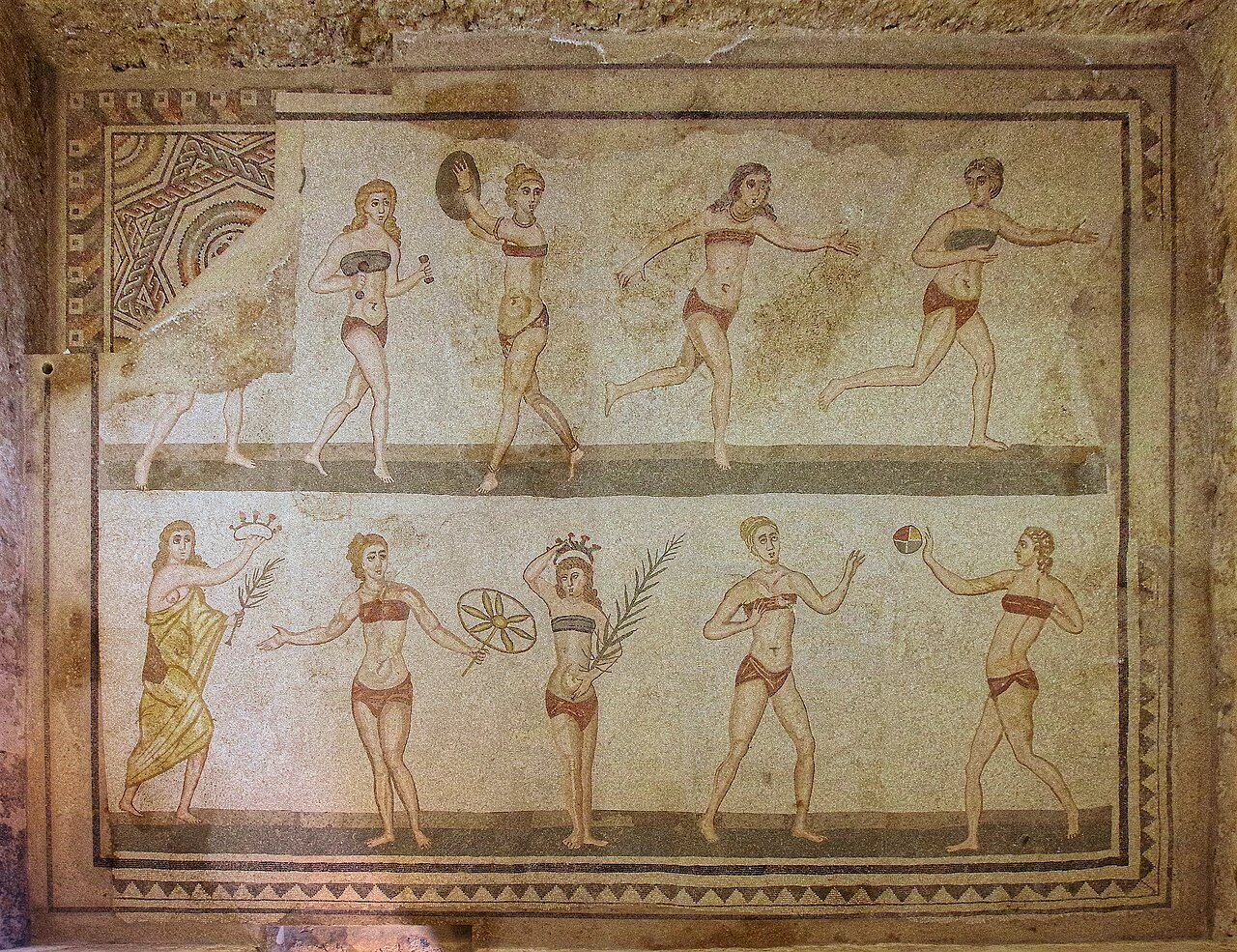
Piazza Armerina · 15 km
Villa Romana del Casale
Content & sources
Photo: Berthold Werner · CC BY-SA 4.0
Sortino · 56 km
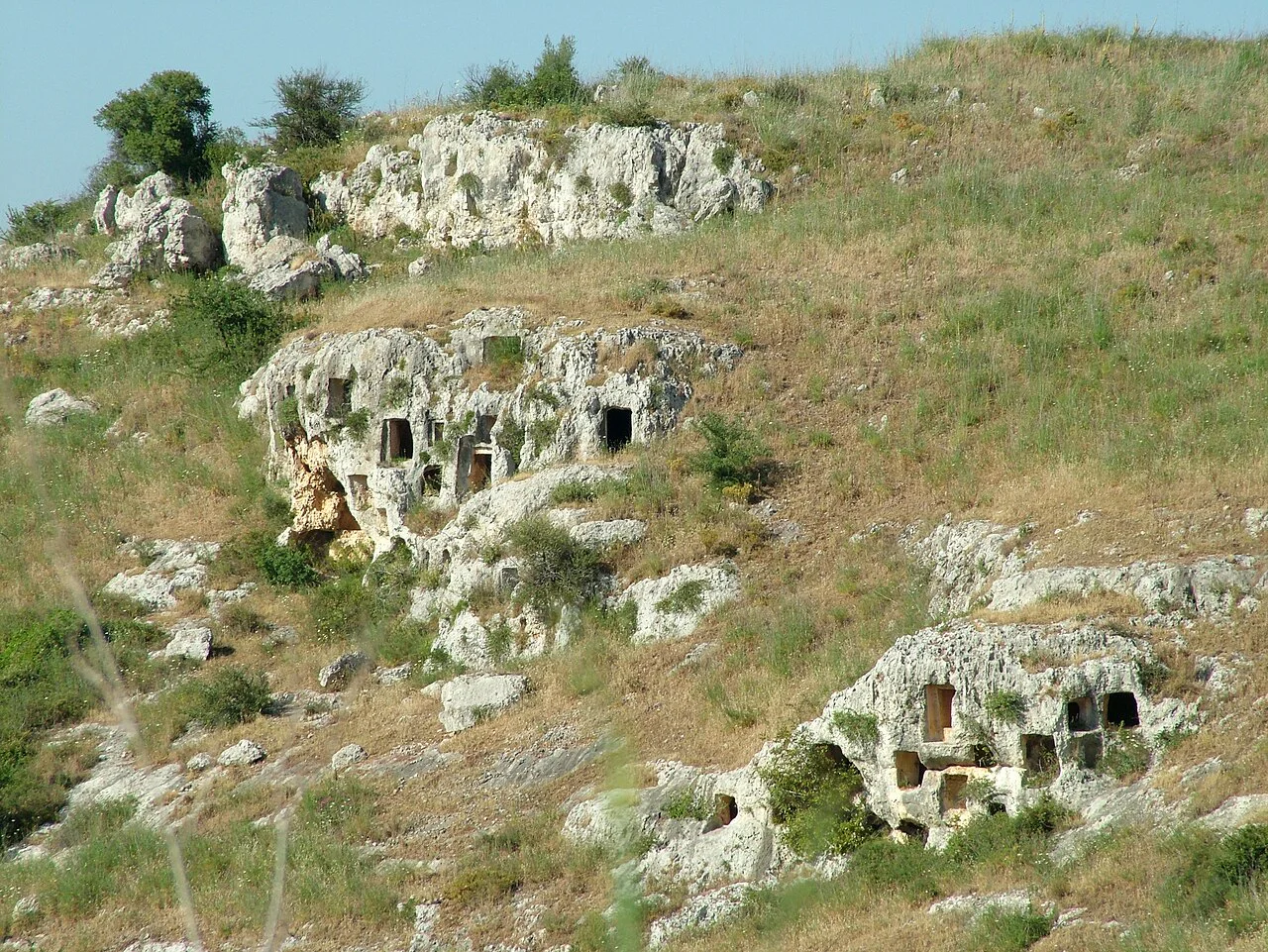
Pantalica
Content & sources
Photo: Clemensfranz · CC BY 2.5
Cefalù · 79 km
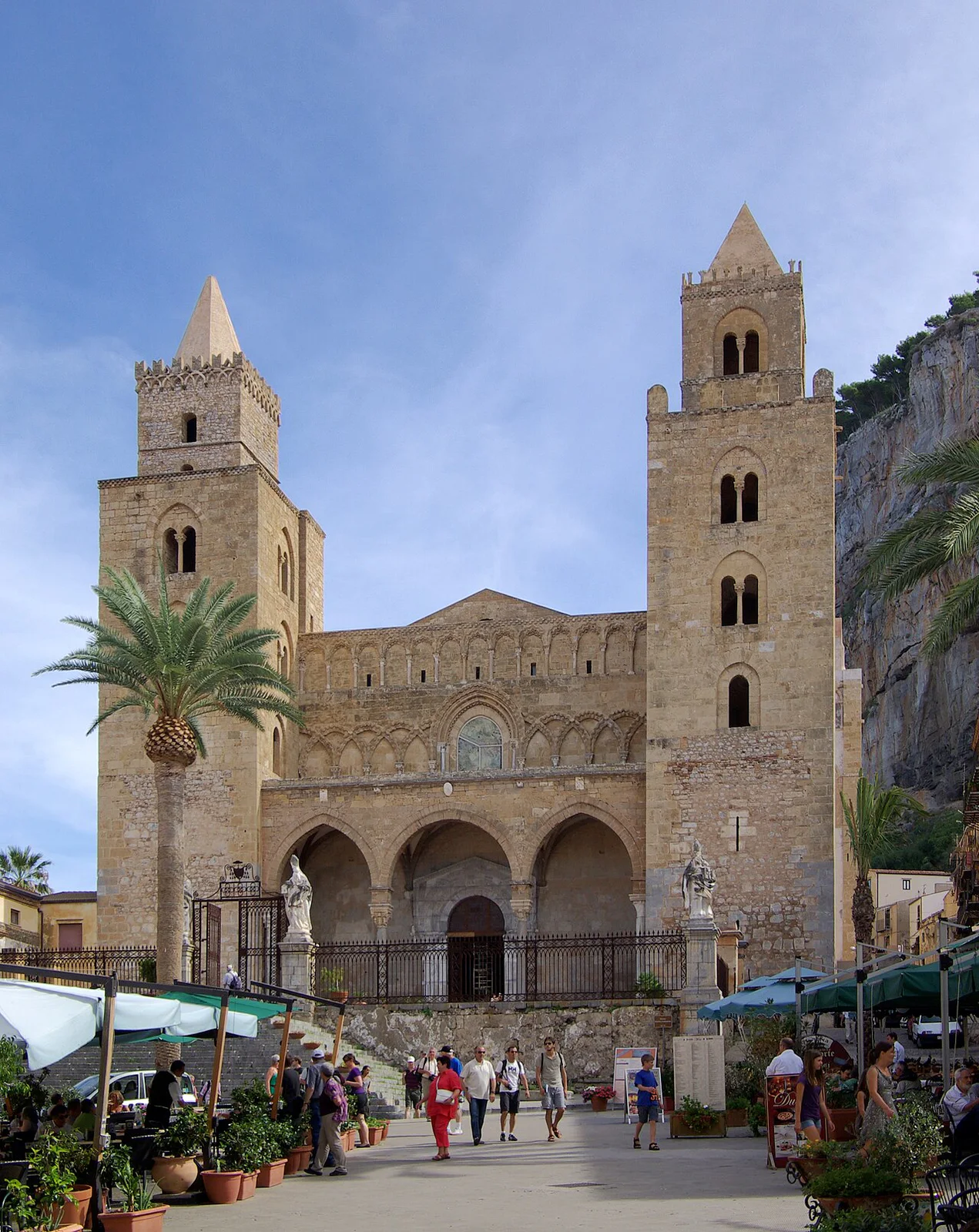
Duomo di Cefalù
Content & sources
Photo: Berthold Werner · CC BY-SA 3.0
Agrigento · 80 km
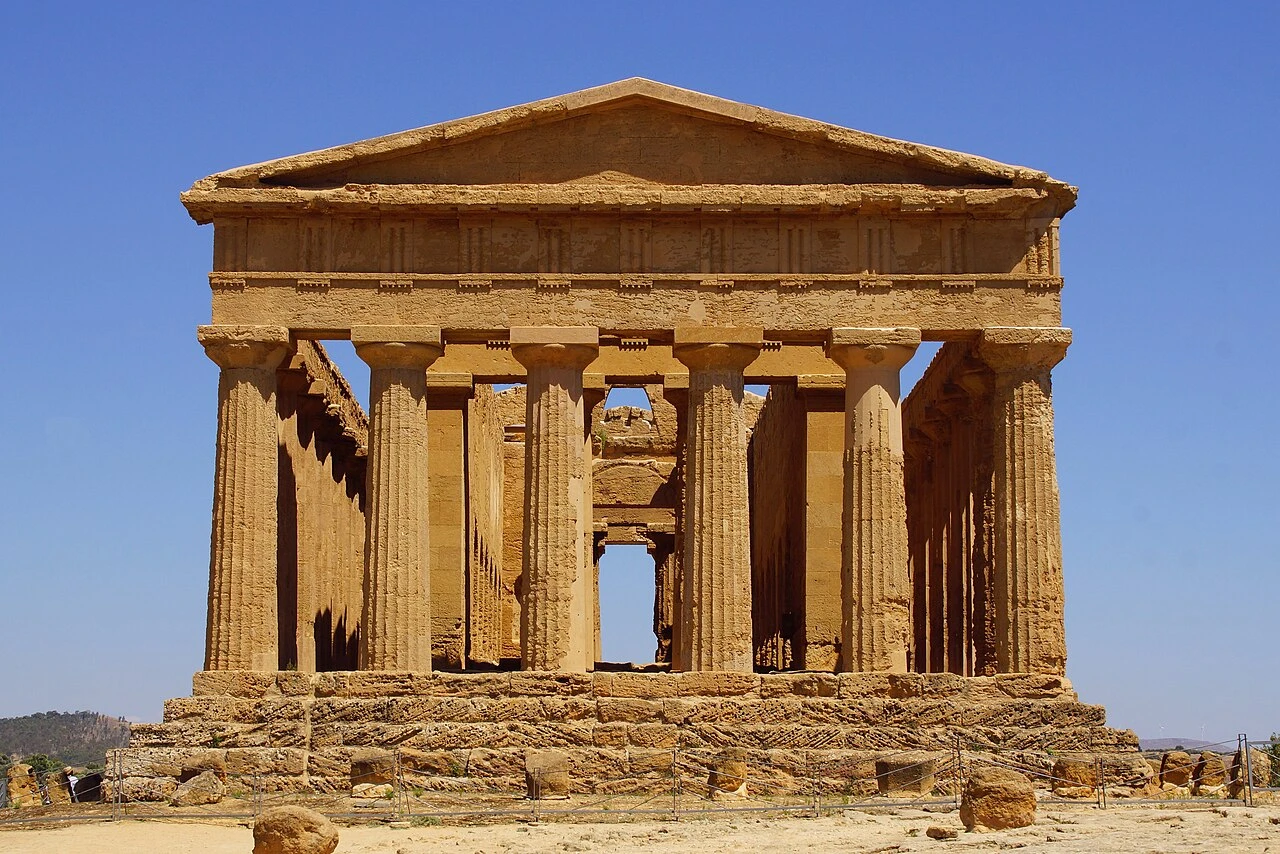
Valley of the Temples
Content & sources
Photo: Wolfgang Pehlemann · CC BY-SA 3.0 de