Stanza · Audio guide
Duomo di Cefalù Audio Guide
A place to remember. A story to take with you.
The Cathedral of Cefalù is a Roman Catholic basilica in Cefalù, Sicily. It is one of nine structures included in the UNESCO World Heritage Site known as Arab-Norman Palermo and the Cathedral Churches of…
Download Stanza, then search for “Duomo di Cefalù”.
About the tour
One guide. Your kind of visit.
The Cathedral of Cefalù is a Roman Catholic basilica in Cefalù, Sicily. It is one of nine structures included in the UNESCO World Heritage Site known as Arab-Norman Palermo and the Cathedral Churches of Cefalù and Monreale.
Ready when you are.
- 01Get the free Stanza app.
iOS & Android
- 02Find your guide.
“Duomo di Cefalù”
- 03Download before you go.
Works offline
Audio guide / 13 narrated stops
Inside the guide
Get to know a few of the stories before you go. Open a stop to read more.
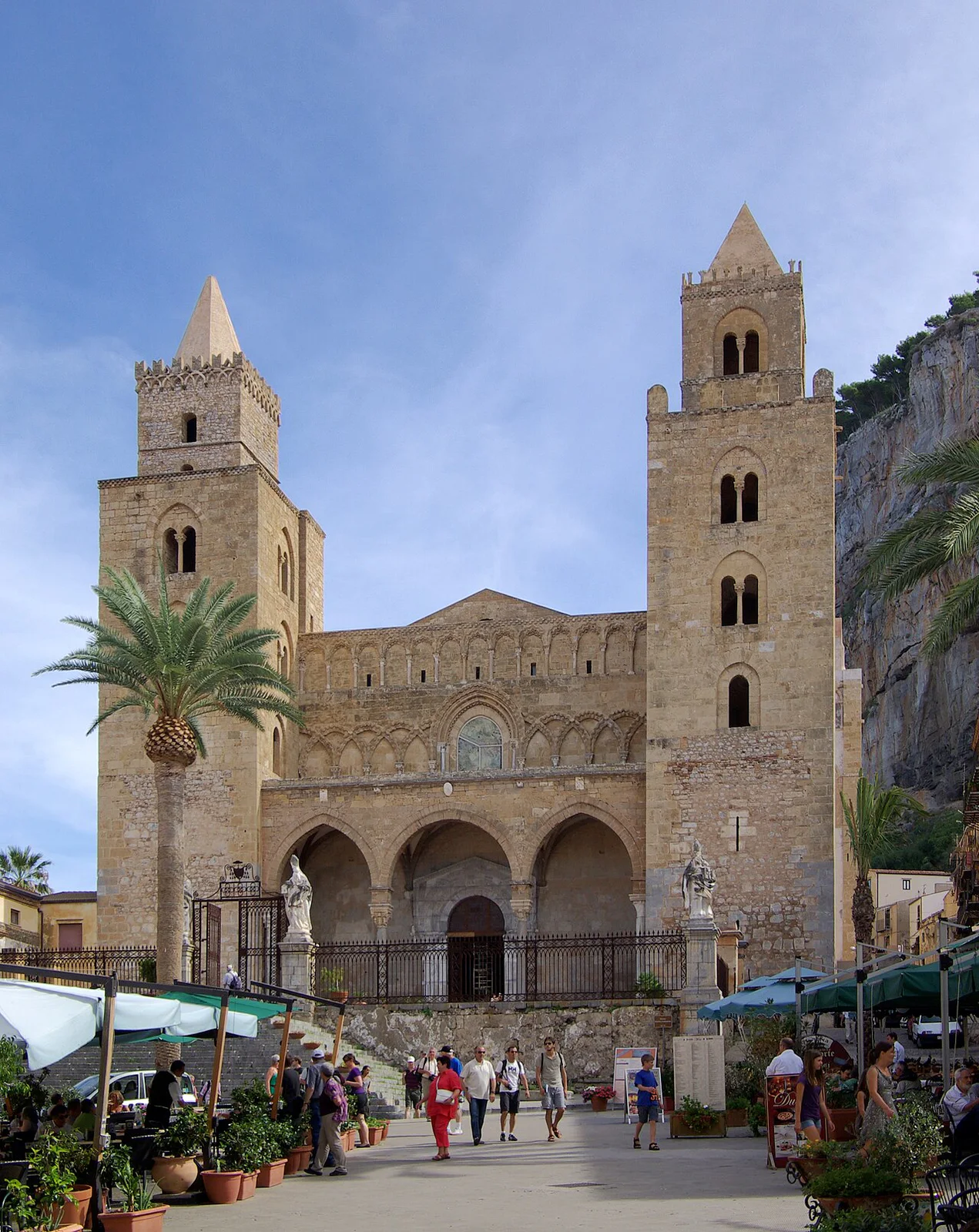
01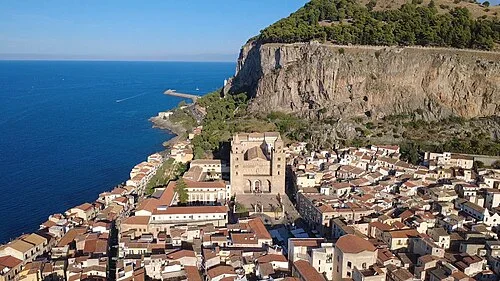 Terraced Parvis and Fortress Facade
The Cathedral Above the Town
Welcome to the Duomo di Cefalù, the great Norman cathedral of this small Sicilian town by the sea. The church rises over a jumble of tiled roofs, with the sea on one side and the sheer cliff of La Rocca behind it. Building began in 1131, under Roger the Second, King of Sicily. The story told here is that Roger landed on this beach after escaping a storm at sea, and vowed to the Holy Saviour to build a church in thanks. That is the legend; the politics behind it were real. The Normans had conquered Sicily in 1091, and Roger wanted a dynastic royal church on the Carolingian-Norman model, a deliberate statement of Norman power. The building makes that statement in stone. Its walls are thick and stern, more fortress than ornament, and from a distance it dominates the whole skyline of the medieval town.
Photo: Enricopis · CC BY-SA 4.0
02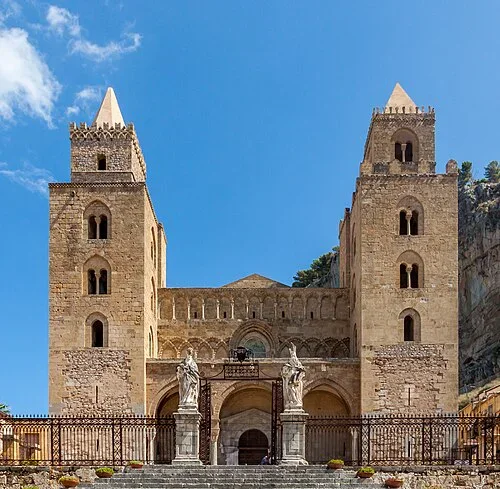 Terraced Parvis and Fortress Facade
The Twin Towers and Their Two Spires
The facade is framed by two massive towers, built with techniques that recall the churches of Normandy, and of Caen in particular. Elegant mullioned windows lighten their heavy faces. Each tower carries a small spire, and the two spires are nothing alike. Both were added in the fifteenth century, and each makes its own claim. One has a square plan ringed with flame-shaped merlons, a symbol of Papal authority and the mitre. The other is octagonal, with Ghibelline merlons standing for the crown and temporal power. Church against empire, spelled out in stone above the entrance. The wide terrace in front of the facade was once a cemetery. Tradition says its earth was brought back from Jerusalem, and was believed to mummify bodies quickly. It is a story people here have long told, though no one has ever proved it.
User:Matthias Süßen · CC BY-SA 4.0
03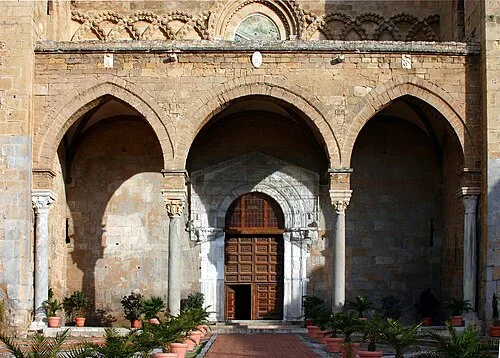 15th-Century Portico and Porta Regum
The Fifteenth-Century Portico
Across the front of the cathedral runs a portico of three arches, added in 1472 by Ambrogio da Como. The two outer arches are pointed, in the Gothic manner, and four columns carry the vaulting ribs above. It sits between the two great towers, a graceful late-medieval canopy against very different masonry. Above it, the Norman wall keeps its heavy, plain twelfth-century character. The contrast is easy to see. A church begun in 1131 was still taking shape more than three hundred years later, as each generation left its own mark on the front.
Listen in the appJosé Luiz · CC BY-SA 4.0
04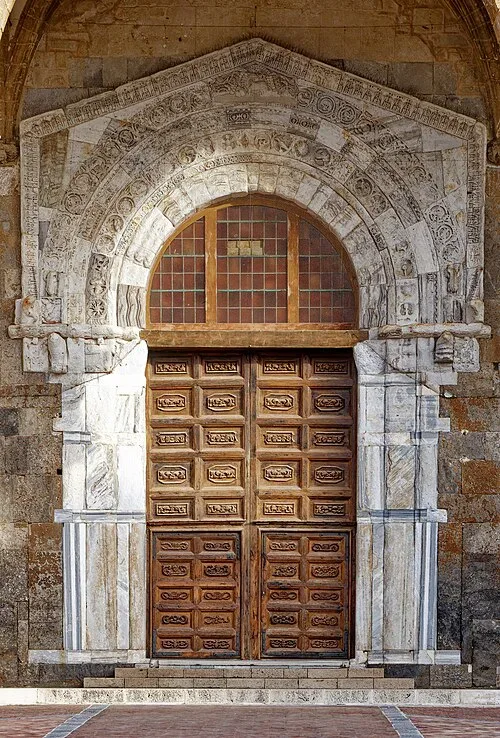 15th-Century Portico and Porta Regum
Porta Regum - The Kings' Door
Under the portico waits the main entrance, called the Porta Regum, the Kings' Door. Its portal is finely worked marble, carved in deep, layered mouldings that frame the doorway arch by arch. The wooden double doors are studded with metal, heavy and dark with age. Wall paintings once flanked the portal on either side. Through this door passed the clergy, the townspeople, and on great occasions the crown itself, into a basilica built by a king.
Listen in the appPhoto: Holger Uwe Schmitt · CC BY-SA 4.0
05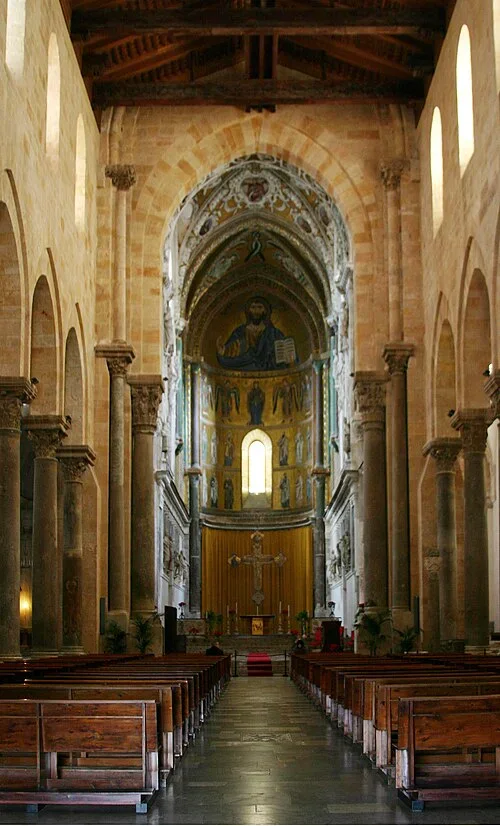 Central Nave and Ancient Roman Columns
The Nave and Its Roman Columns
Inside, the church opens out on the Latin cross plan, a nave with two side aisles. The arcades that divide them are built of antique columns, taken from older Roman buildings. Fourteen are of pink granite, and two are of cipolin marble. Their bases and capitals date from the second century, cut centuries before the Normans ever reached Sicily. Reusing them was more than economy. It tied the new royal church visibly to the weight of Rome. The ground itself was old long before that. Excavations here uncovered a Roman road and a polychrome mosaic from the sixth century, showing a dove drinking among birds and trees. It probably belonged to an earlier Byzantine basilica, and this spot remained a bishop's seat into the eighth century. At the far end of the nave, the golden half-dome of the apse glows above the altar.
Listen in the appJosé Luiz · CC BY-SA 4.0
06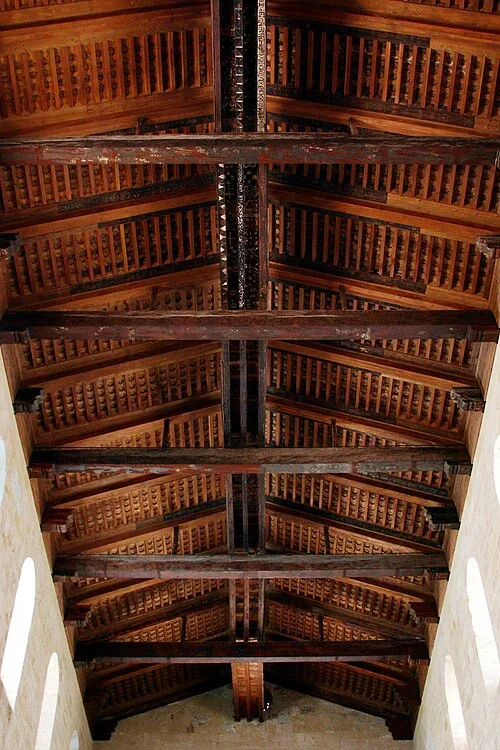 Central Nave and Ancient Roman Columns
The Painted Wooden Ceiling
The ceiling over the nave is timber, and it is painted with busts and fanciful animals. Other motifs run along the beams too, probably the work of Arabic craftsmen. That attribution carries real weight. The stone structure is Norman, the gold mosaics of the apse are Byzantine, and this carpentry belongs to the Islamic tradition of Sicily. Three cultures worked on one building, each leaving its own layer. Roger's Sicily was a mixed island, and the cathedral is that mixture made visible, from the floor to the rafters.
Listen in the appJosé Luiz · CC BY-SA 4.0
07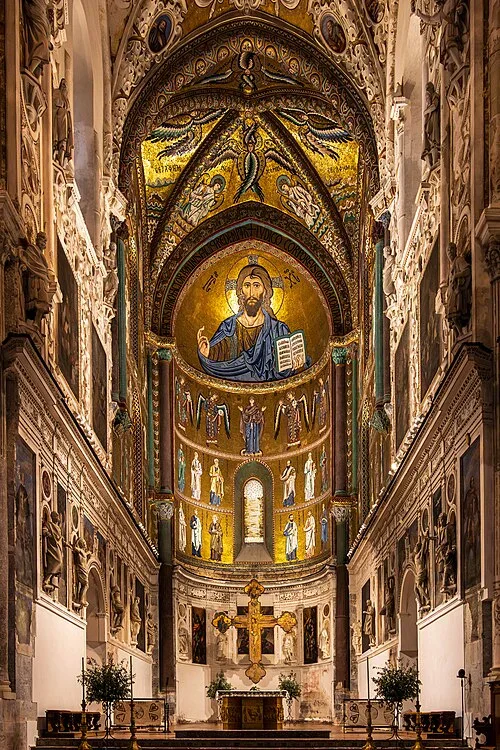 Presbytery and Royal Ambition
The Presbytery and the Empty Tombs
The presbytery occupies the crossing, raised a few steps above the rest of the church. The transept here rises higher than both the nave and the aisles, and that vertical lift was meant for something grand. In 1145 Roger the Second placed two sarcophagi of purple porphyry in this church, intended for his own tomb and that of his wife. Cefalù was to be a royal burial church. It never came to pass. In 1215 the Emperor Frederick the Second, Roger's grandson, moved both sarcophagi to the Cathedral of Palermo, for himself and his father Henry the Sixth. The town kept the ambition and lost the tombs. Work on the cathedral resumed soon after, and the facade was finished in 1240. The church was finally consecrated in 1267, by Rodolphe de Chevrières, Bishop of Albano. A painted wooden cross by Guglielmo da Pesaro, made around 1468, is preserved in the cathedral.
Listen in the appPhoto: Matthias Süßen · CC BY-SA 4.0
08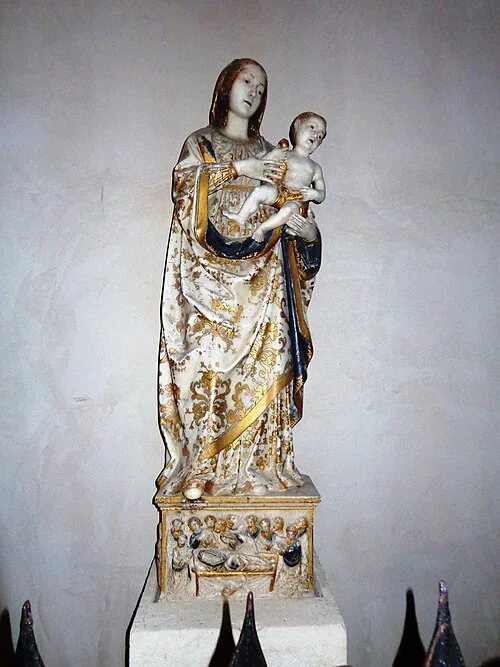 Presbytery and Royal Ambition
The Gagini Madonna
Among the older glories of the cathedral stands a marble Madonna and Child from the Renaissance. It came from the workshop of Antonello Gagini, commissioned in 1533 by a man named Filippo Serio. Her mantle is gilded and patterned, and the Christ child rests on her arm. The pedestal base carries a bas-relief of the Dormition of Mary. Into that scene the sculptor set the effigies of the donor and his wife. Centuries after the Norman builders were gone, people were still commissioning works of devotion here, and putting their own faces into the story.
Listen in the appPhoto: Effems · CC BY-SA 4.0
09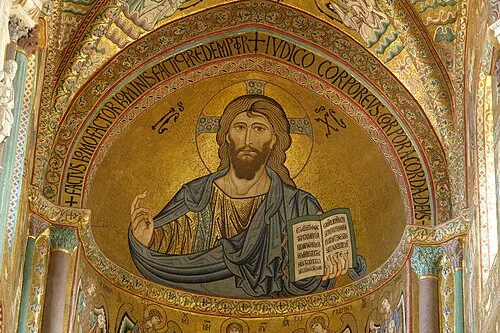 Christ Pantokrator and Apse Mosaics
Christ Pantokrator
High in the semi-dome of the apse, Christ appears as the Pantokrator, the ruler of all. His right hand is raised in blessing. In his left he holds the open Gospel of John, inscribed in both Greek and Latin. The words read, I am the light of the world; who follows me will not wander in the darkness, but will have the light of life. His robe is a deep blue, and the gold tiles behind him give it its glow. The face is calm and alert, the drapery falls with an elegance that has few rivals. This work is considered the finest Byzantine mosaic in Italy, and it stands comparison with the late masterpieces of Constantinople itself.
Listen in the appAndreas Wahra · CC BY-SA 3.0
10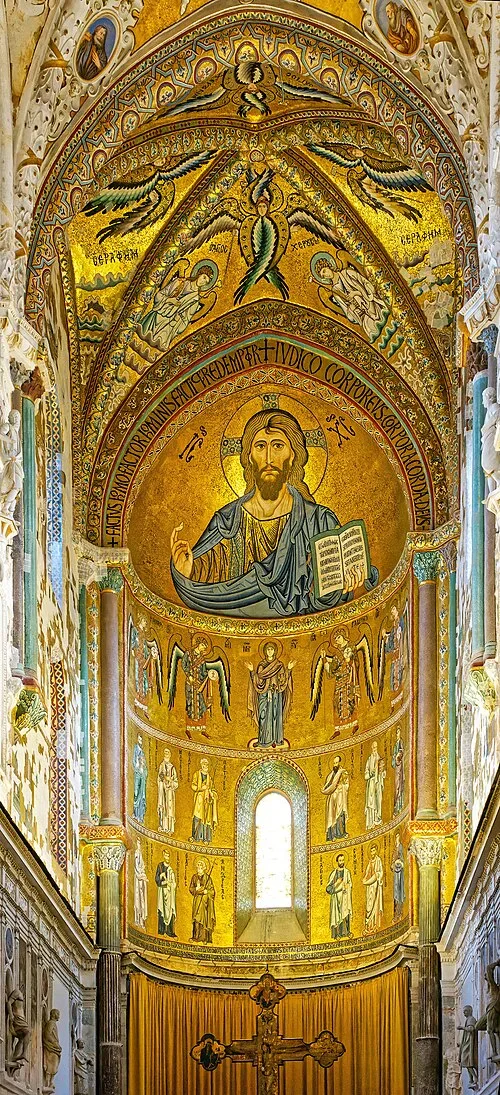 Christ Pantokrator and Apse Mosaics
The Golden Apse - How the Mosaic Was Made
The whole apse and its vault form one vast program of gold. Roger the Second brought masters in mosaic from Constantinople to make it, men trained in the Byzantine capital itself. They had to fit their Eastern decorative art to a building of northern European form, a space unlike anything they knew. The oldest mosaics, in the apse and the crossing, were underway by 1145, and an inscription records both the patron, King Roger the Second, and the date 1148. Reading upward, the tiers follow a planned order. The Virgin Mary stands in prayer, hands raised, flanked by the four archangels. Beside the window are Peter and Paul, then the evangelists, and below them the other apostles. Every figure carries its name in Latin and Greek. The vault above shows four cherubim and four seraphim. The plan probably called for the entire church to be covered in mosaic, but only the presbytery was ever completed. Even so, the gold covers more than six hundred square metres, the apse and about half of the side walls.
Listen in the appPhoto: Holger Uwe Schmitt · CC BY-SA 4.0
- 11
The Norman Cloister
The quiet garden walk that became the model for Sicily's Norman cloisters.
- 12
The Noah Capital
Noah's Ark carved in stone, a story told at eye level.
- 13
The Cathedral and Its City
The cathedral in its streets, and world recognition in 2015.
Duomo di Cefalù
Frequently asked questions
How much does the guide cost?
Free app download. Listed guide price: $0.99. Guide price shown in the app. Audio guide only. Venue admission is separate.
Can I listen without internet?
Yes. Download the guide’s audio, images, and maps in the app before your visit. Your downloaded content is then available offline.
Can I listen in my language?
This audio guide is available in 15 languages, including English.
Do I need to follow a schedule?
No. This is a self-guided experience. Choose your stops, pause whenever you like, and return to a story at your own pace.
At your own pace
Explore Duomo di Cefalù.
Download Stanza, then search for “Duomo di Cefalù”.
Free app download · Guide price shown in the app
Keep exploring
Nearby audio guides
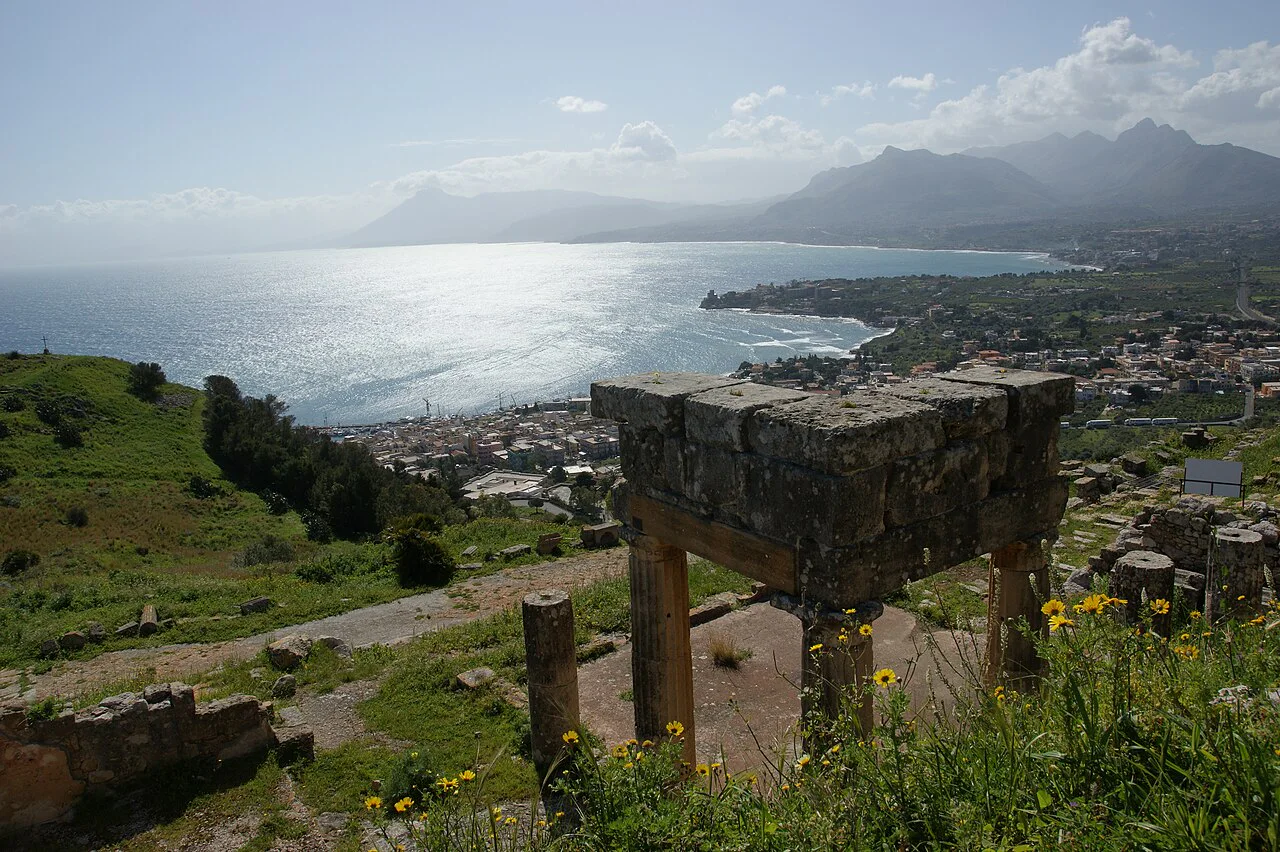
Santa Flavia · 43 km
Solunto
Content & sources
Allie_Caulfield from Germany · CC BY 2.0
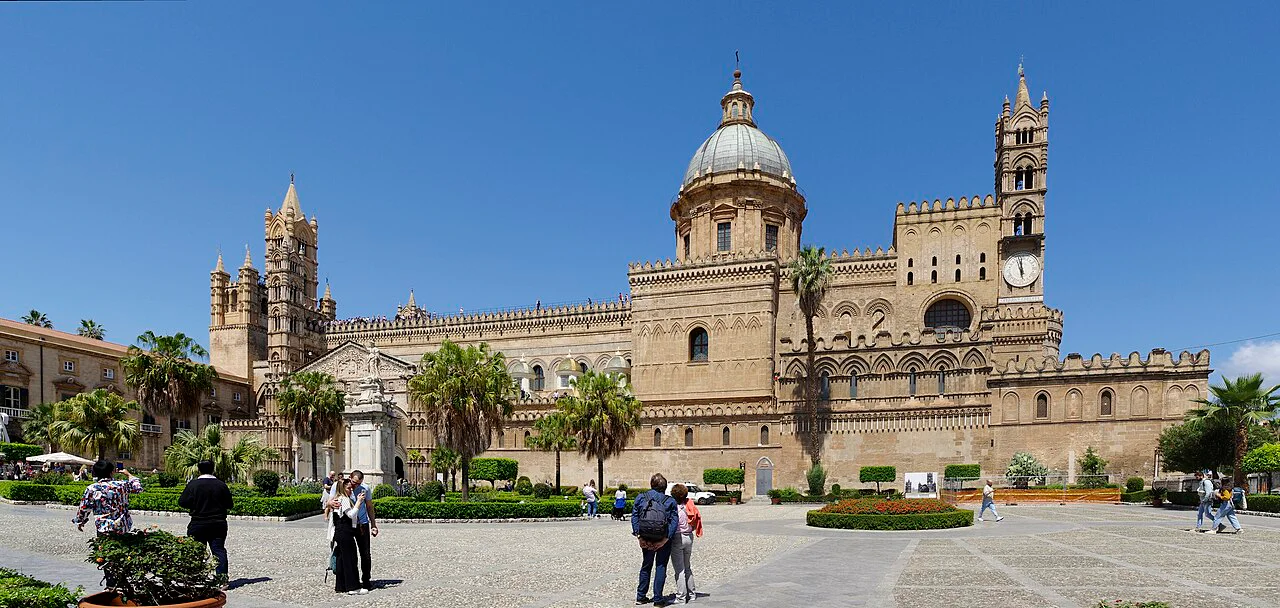
Palermo · 59 km
Cattedrale di Palermo
Content & sources
Photo: Berthold Werner · CC BY-SA 4.0
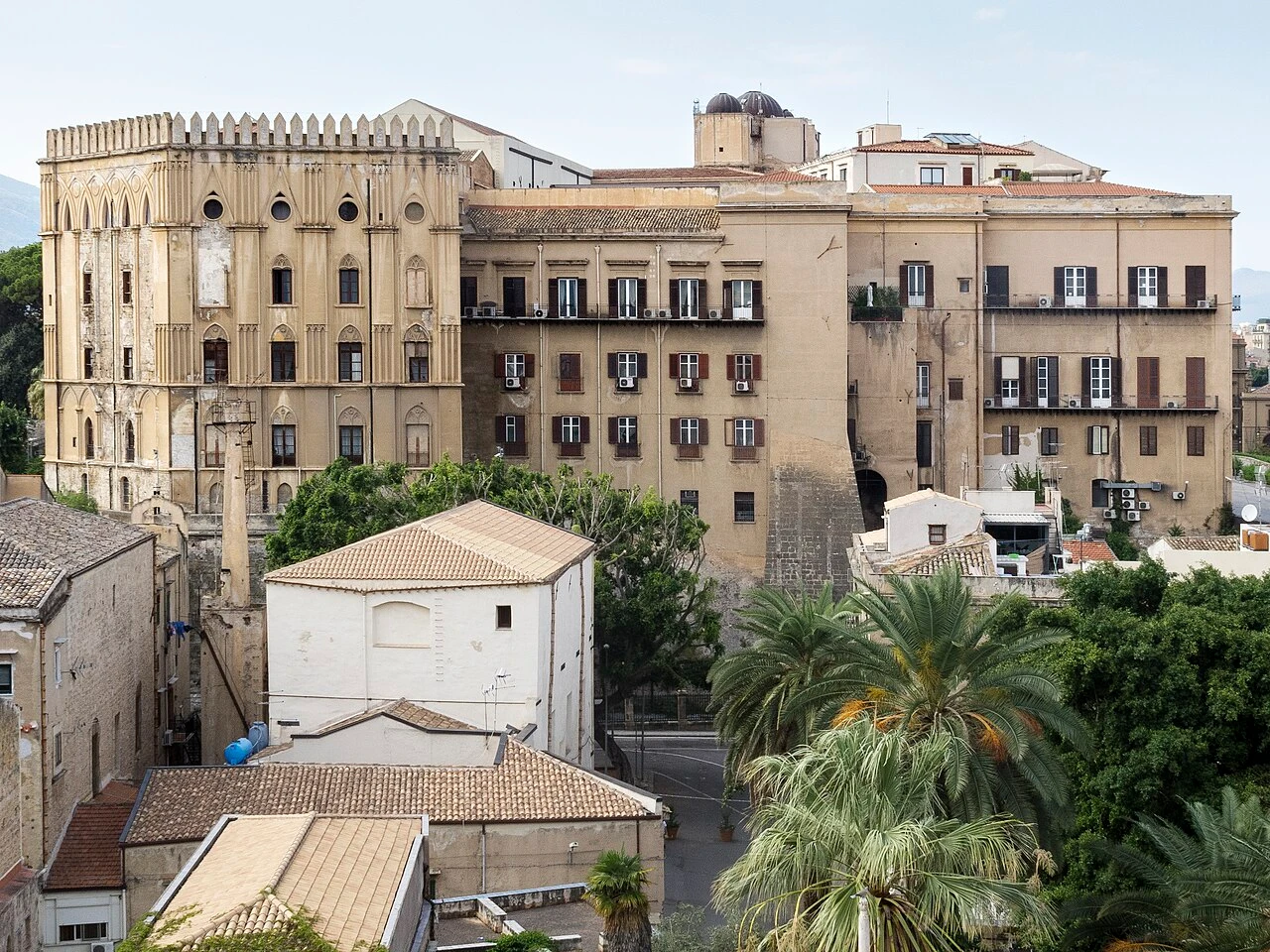
Palermo · 59 km
Palazzo dei Normanni
Content & sources
Photo: Jules Vaulont · CC BY-SA 4.0
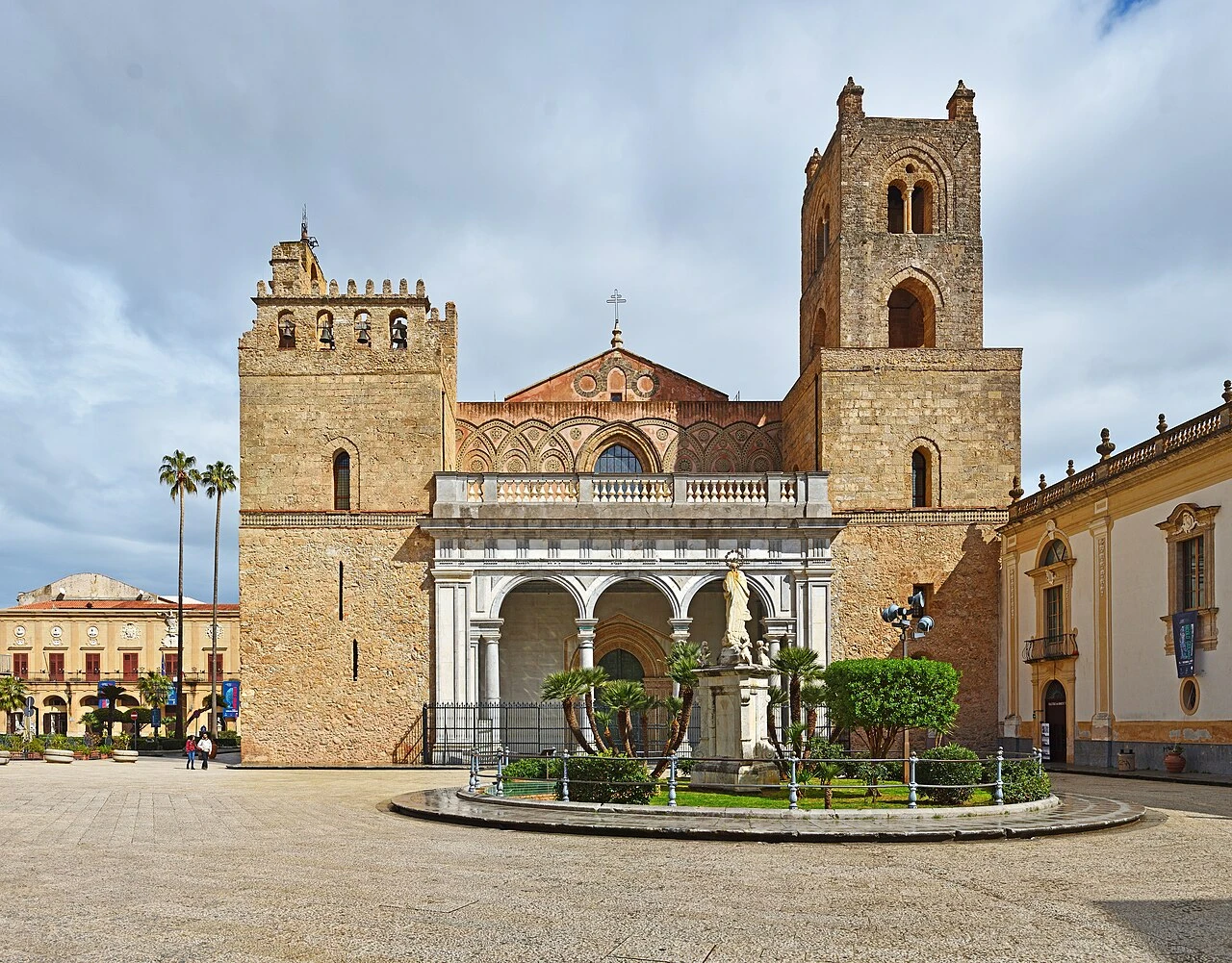
Monreale · 64 km
Cattedrale di Monreale
Content & sources
Photo: Ludvig14 · CC BY-SA 4.0