Stanza · Audio guide
Solunto Audio Guide
A place to remember. A story to take with you.
Soluntum is an ancient city located on the Tyrrhenian coast of Sicily. It is a major tourist attraction that provides a well-preserved example of an ancient city where Greek, Roman, and Punic traditions mixed.
Download Stanza, then search for “Solunto”.
About the tour
One guide. Your kind of visit.
Soluntum is an ancient city located on the Tyrrhenian coast of Sicily. It is a major tourist attraction that provides a well-preserved example of an ancient city where Greek, Roman, and Punic traditions mixed.
Ready when you are.
- 01Get the free Stanza app.
iOS & Android
- 02Find your guide.
“Solunto”
- 03Download before you go.
Works offline
Audio guide / 12 narrated stops
Inside the guide
Get to know a few of the stories before you go. Open a stop to read more.
01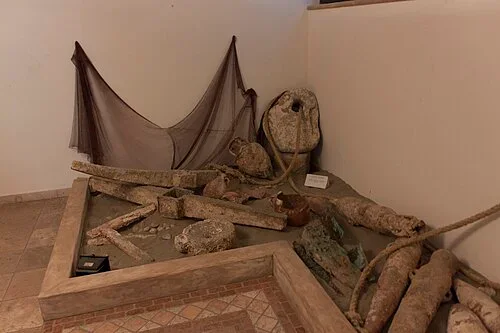 Antiquarium Museum
The Antiquarium: Solunto's Beginnings
Welcome to Solunto, an ancient city on the northern coast of Sicily. The room here gathers what the sea left behind: stone anchors, rope, netting, the gear of a port town. Thucydides wrote that Phoenicians founded the city in the eighth or seventh century BC. It grew into one of the three chief Phoenician settlements of Sicily, alongside Motya and modern Palermo. Its Punic name was simply Kapara, meaning Village. The city stayed loyal to Carthage even when most allies deserted. In 396 BC it was betrayed to Dionysius, the tyrant of Syracuse, and destroyed. A generation or two later it was rebuilt, this time on top of Monte Catalfano. What grew there became something unusual: a hilltown where Punic, Greek and Roman traditions lived side by side. That mingling is the thread this tour follows, from the streets below to the theatre above.
Davide Mauro · CC BY-SA 4.0
02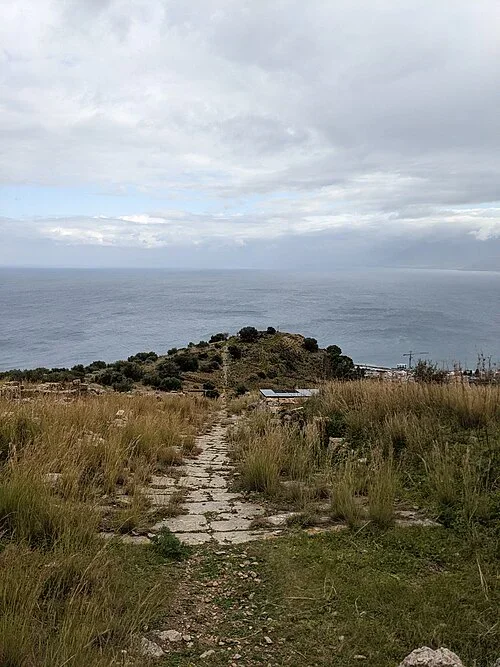 Via dell'Agora and the Hippodamian Grid
Via dell'Agora: A Grid on a Mountainside
The main street of the city runs through the town up to the agora. The whole town was laid out on a regular grid, in the Hippodamian system the Greeks used for new cities. That was no small feat here, because the highest point of the city sits some sixty metres above the lowest. Three level streets run along the slope, each about six metres wide. The east-west cross streets are a different matter: they are essentially staircases climbing the hillside. The blocks between them measure roughly forty by eighty metres, each split by an alley barely a metre across. One Greek inscription names a citizen who paid for the paving of this main street from his own funds. He was Antallus, son of Asclapus, from the family of the Ornichi. When the grid was first laid out is uncertain. One scholar suggested it came with the Greek soldiers who settled here in 307 BC.
Photo: Oxidising · CC BY-SA 4.0
03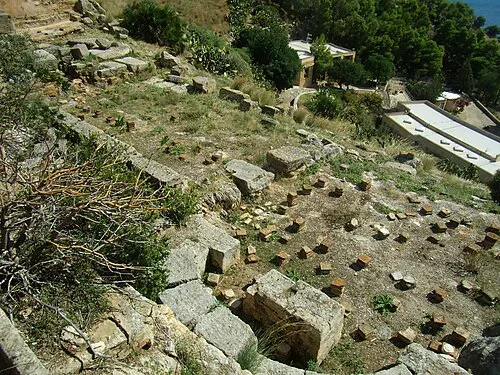 South Bathhouse Complex
The Roman Baths
Solunto surrendered to the Romans in 250 BC, after they captured nearby Panormus during the First Punic War. Under Roman rule the city flourished, and in the first century BC these baths were built. The building was small, four large rooms with some smaller side rooms around an open courtyard. The sequence followed the usual Roman routine. Bathers started in the frigidarium, once floored with a geometric mosaic, then moved to the tepidarium, and finished in the hot caldarium. The two heated rooms sat on a hypocaust, a system of raised floors through which hot air flowed. There was even a laconicum, a dry sweating room. The brick pillars on the slope carried that raised floor. The civic bones of the city were Hellenistic; this was Roman comfort added on top.
Listen in the appPhoto: Udimu · CC BY-SA 4.0
04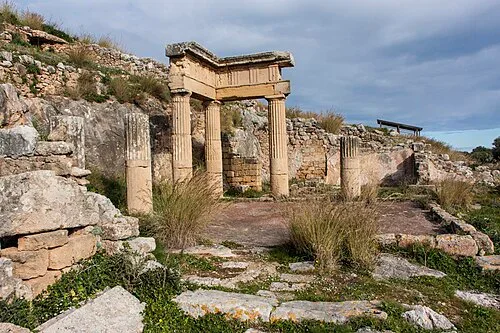 The Gymnasium House
The So-Called Gymnasium
The name is wrong, and the story of how it stuck is a lesson in archaeological accidents. During excavations in 1865, workers found a Greek inscription here honouring a gymnasiarch, an official in charge of athletic training. But the inscription did not originally stand in this house. It was never a gymnasium at all. The building was a large private residence, probably built in the third century BC and lived in until the third century AD. Its heart was a peristyle court over two storeys, and in the nineteenth century six of those columns were re-erected, with parts of the building reconstructed around them. The columns standing today are that nineteenth-century work. Along the street front ran four shops, each with two rooms, probably rented out. The owners lived well above, and the shopfronts earned them rent.
Listen in the appDavide Mauro · CC BY-SA 4.0
05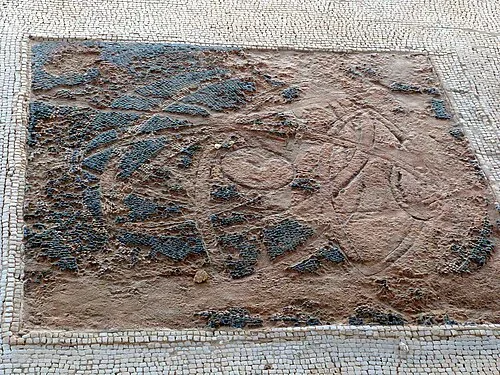 The House of Leda and Elite Residences
House of Leda: The Armillary Sphere Mosaic
This house takes its name from a wall painting of Leda with the swan. Vincenzo Tusa uncovered the house in the mid-twentieth century, and its paintings are among the best preserved here. When they were made is disputed. Early research placed them at the end of the first century AD, in the Roman fourth style. More recent work prefers the first century BC and the second style, several generations earlier. They replaced an even older set of paintings in the first style. The floor holds the mosaic in view: an armillary sphere, a model of the heavens, its lines marked out with strips of lead. The excavator suggested it was imported from Alexandria in Egypt, the great centre of Greek learning. If so, its owner wanted more than wealth on display. The house also had four shops on the street, and one room with stone troughs, used as a stable.
Listen in the appPhoto: Ziegler175 · CC BY-SA 3.0
06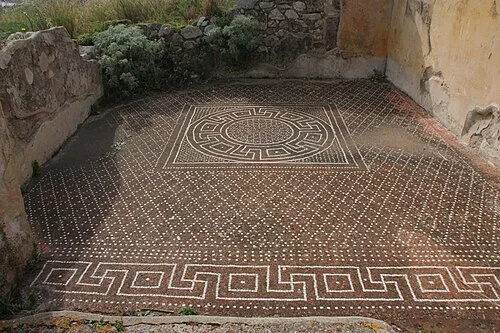 The House of Leda and Elite Residences
House of Harpocrates
A bronze statue of the Egyptian god Harpocrates came to light in this house, and the god gave it its name. Vincenzo Tusa excavated it around 1970, in a campaign driven partly by the ruins' growing appeal to visitors. The main room was decorated with a geometric mosaic, a circle framed by a maeander, the running Greek key pattern spread across the floor around it. Traces of wall paintings survive on the walls. Many of the paintings uncovered here in the mid-twentieth century have fared worse. Exposed to the elements, they have largely been destroyed. The second-style paintings found in the nineteenth century survived because they were removed from the walls and put into storerooms straight away. Those are the ones now displayed in the Antiquarium.
Listen in the appDavide Mauro · CC BY-SA 4.0
07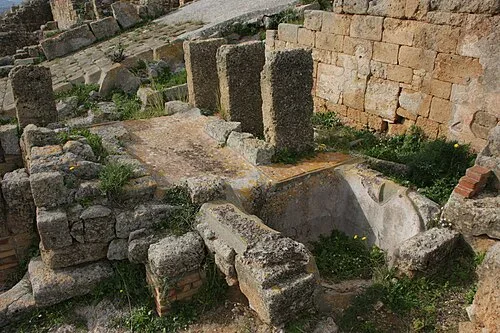 The Punic Sacred Area
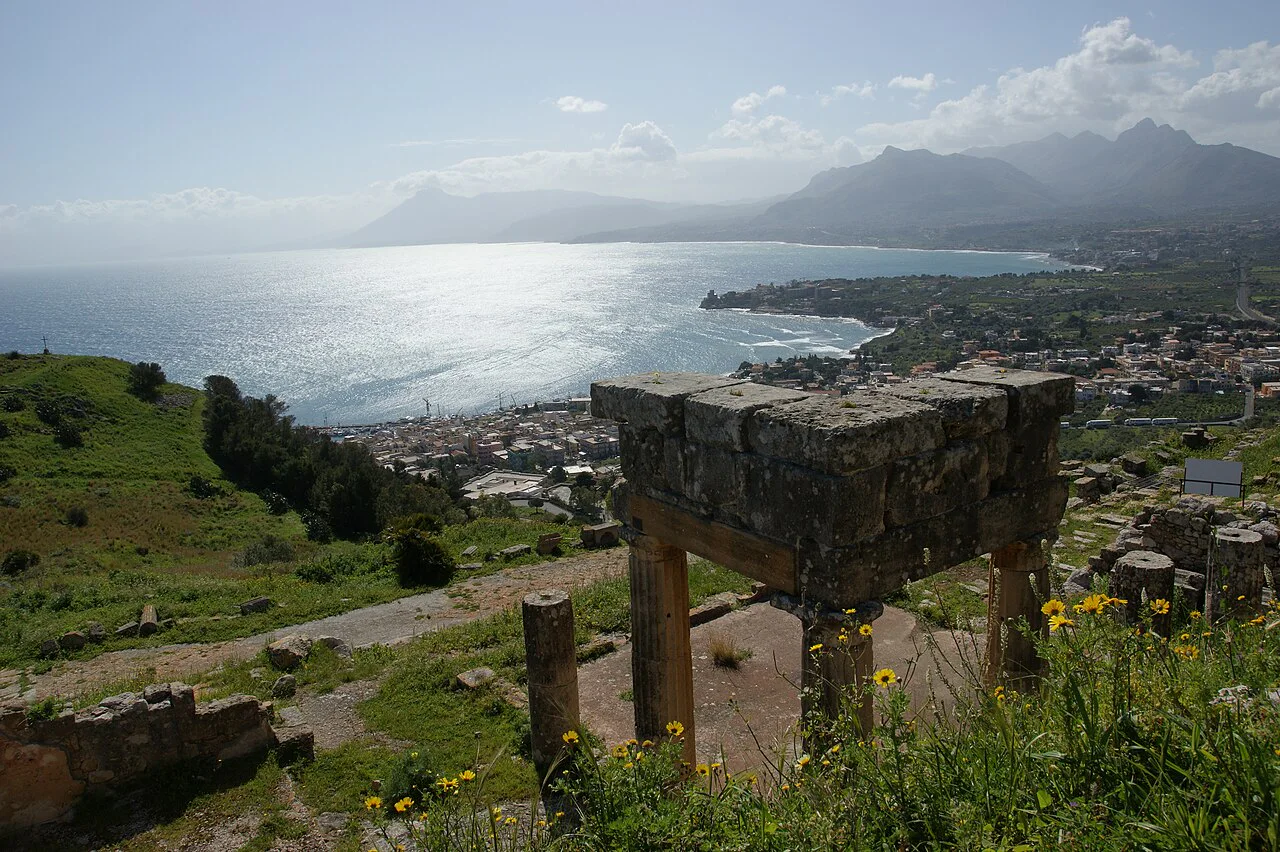
Solunto had no temple in the Greek or Roman style. Instead it had three Punic sanctuaries, and this is one of them, at the entrance to the agora. The three tall pillar-shaped altars are betyls, sacred standing stones of Semitic tradition. The Punic way of worship was aniconic: the god was not shown in human form but dwelt in the stone itself. The central room has stone benches along all four sides, and has been interpreted as a waiting room for visitors to the sanctuary. A basin stands nearby, though its exact ritual use is unknown, and the deity honoured here cannot be named with certainty. What is certain is the setting. This sacred precinct stands right beside the Greek civic architecture of the agora, the clearest physical sign of the city's mixed identity.
Listen in the appDavide Mauro · CC BY-SA 4.0
08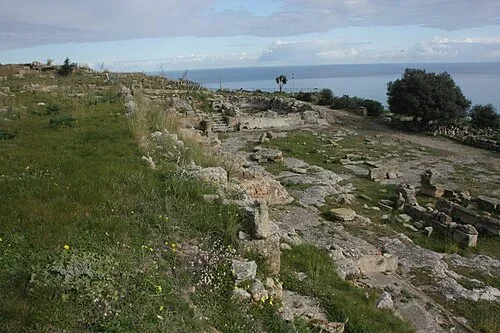 Civic Center: Agora and Stoa
The Agora and Stoa
The agora was the rectangular heart of the city, the place for festivals, gatherings and markets. At its southern entrance, excavators found a stone threshold and a large six-pointed star made of plaster, evidence of a gateway there. The west side was taken up by a stoa, a long colonnaded hall whose surviving remains date from the second century BC. It ran nearly sixty-nine metres long and over twenty wide, its whole front lined with Doric columns. Most of those columns are gone, but much of the structure remains. The tufa cornice still carries its lion's-head waterspouts, made to throw rainwater clear of the walkway. Behind the colonnade opened nine exedrae, recessed spaces for sitting and display. In the northernmost one stand the bases for two statues, a father and son: Apollonius and Ariston. The Greek inscription on one records that Ariston set up the statue of his father.
Listen in the appDavide Mauro · CC BY-SA 4.0
09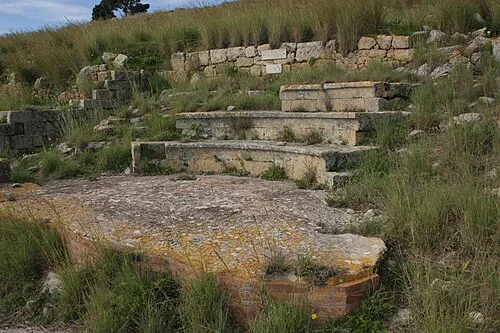 The Bouleuterion
Behind the stoa sits a small building with five rows of curved seating, with room for around a hundred people. For a long time scholars called it an odeion, a roofed music hall. Newer research calls it a bouleuterion, the chamber where the city's council met. The archaeologist Markus Wolf proposed that it served both functions, council business and performance in the same room. The debate is not settled. Just south of it lies a large walled enclosure, over thirty metres long, whose purpose is still unclear. It may have been a religious precinct.
Listen in the appDavide Mauro · CC BY-SA 4.0
10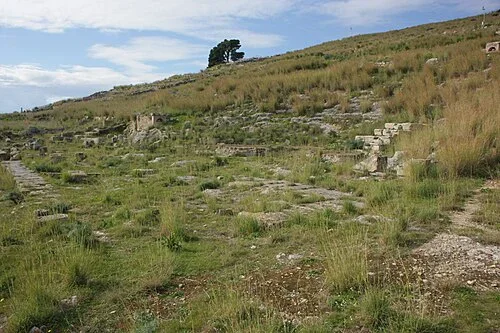 The Hellenistic Theatre
The theatre was probably built in the second century BC, in the same prosperous period as the new stoa. Its northern parts were built right over the top of an older house, and no theatre stood here before. The seating was carved into the slope of Monte Catalfano, some twenty rows in all, though little of it survives. Some stones from the middle section have been pieced back together in a modern reconstruction. The stage building has been reconstructed from scattered finds of its elements. It stood two storeys tall, with projecting wings at each end, Doric columns and doors below and an Ionic colonnade above. Two caryatids, figures carved as supporting pillars, may have decorated its podium. The upper floor probably carried balustrades with a diamond pattern, the same decoration used on the stoa and on several private houses. Two phases of construction are visible in the orchestra, and the theatre probably stayed in use until the city itself was abandoned.
Listen in the appDavide Mauro · CC BY-SA 4.0
- 11
The Great Cistern
A Punic cistern next to the Agora: how a city on a dry hilltop drank.
- 12
Solunto Overlook: The City and the Sea
The view over the ruins to the sea, and the half of Solunto that still lies unexcavated under the hill.
Solunto
Frequently asked questions
How much does the guide cost?
Free app download. Listed guide price: $0.99. Guide price shown in the app. Audio guide only. Venue admission is separate.
Can I listen without internet?
Yes. Download the guide’s audio, images, and maps in the app before your visit. Your downloaded content is then available offline.
Can I listen in my language?
This audio guide is available in 15 languages, including English.
Do I need to follow a schedule?
No. This is a self-guided experience. Choose your stops, pause whenever you like, and return to a story at your own pace.
At your own pace
Explore Solunto.
Download Stanza, then search for “Solunto”.
Free app download · Guide price shown in the app
Keep exploring
Nearby audio guides
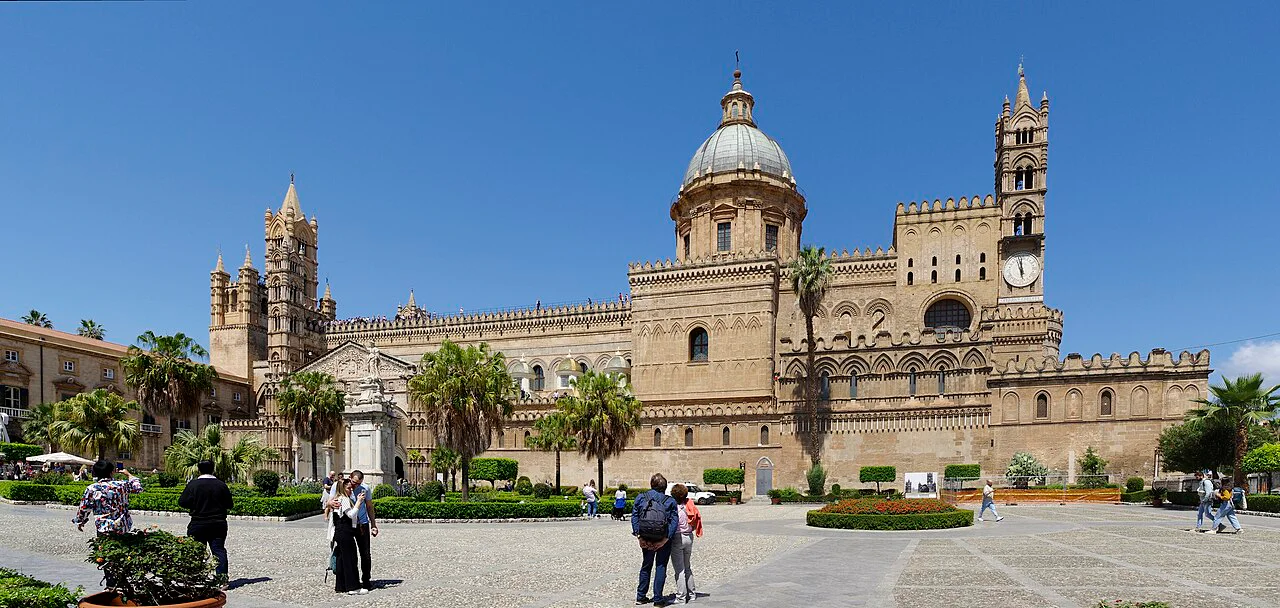
Palermo · 16 km
Cattedrale di Palermo
Content & sources
Photo: Berthold Werner · CC BY-SA 4.0
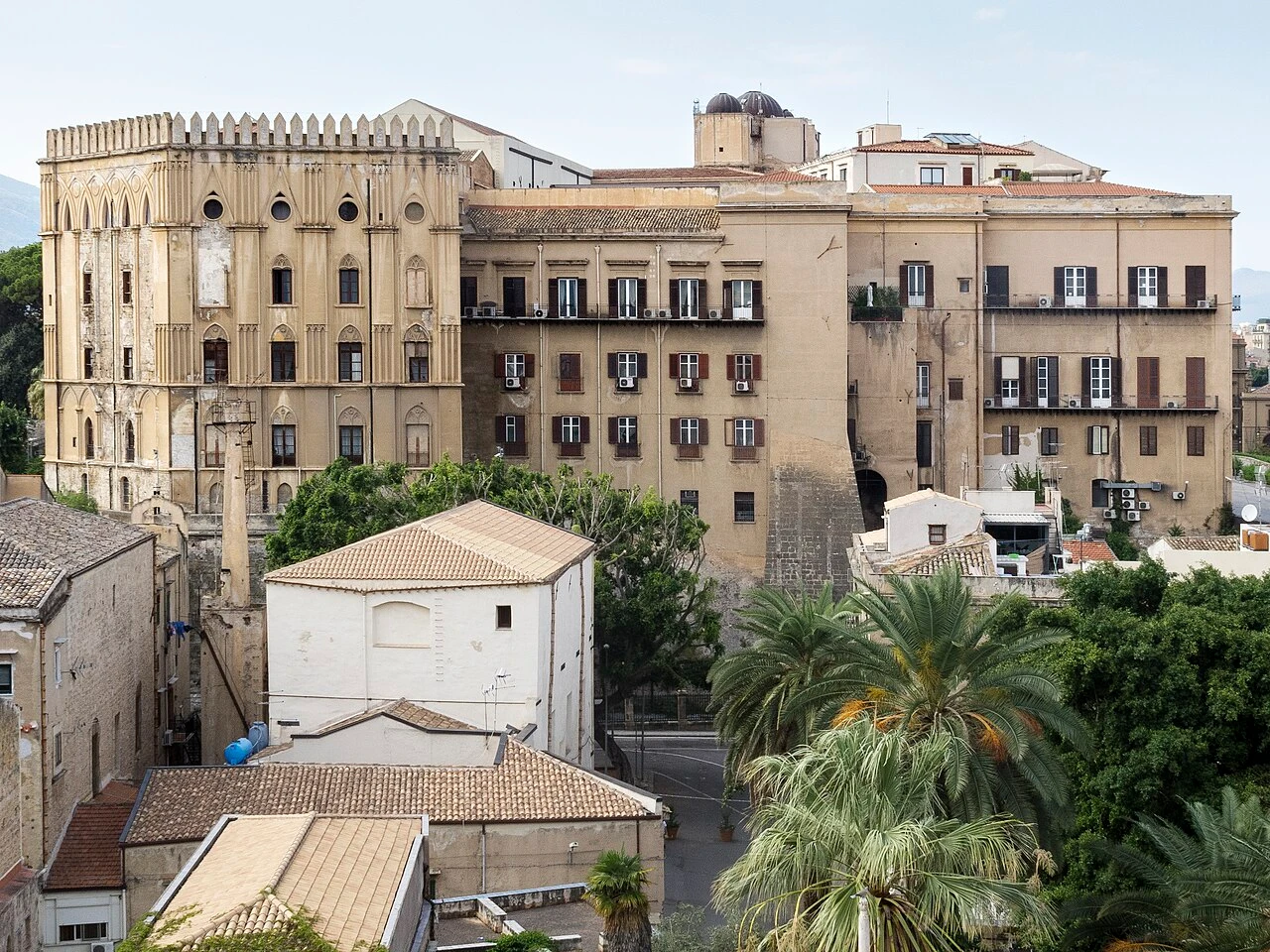
Palermo · 16 km
Palazzo dei Normanni
Content & sources
Photo: Jules Vaulont · CC BY-SA 4.0
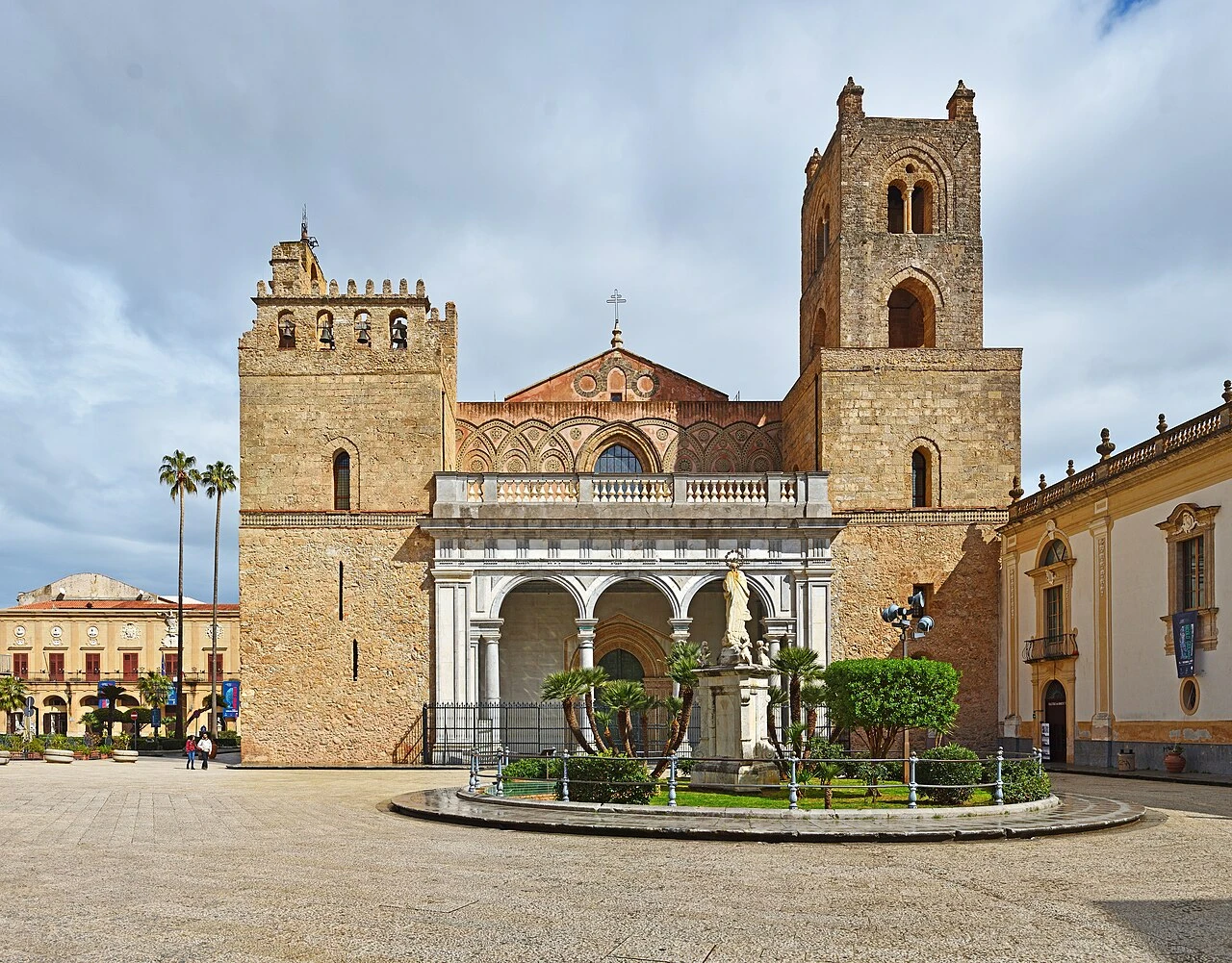
Monreale · 21 km
Cattedrale di Monreale
Content & sources
Photo: Ludvig14 · CC BY-SA 4.0
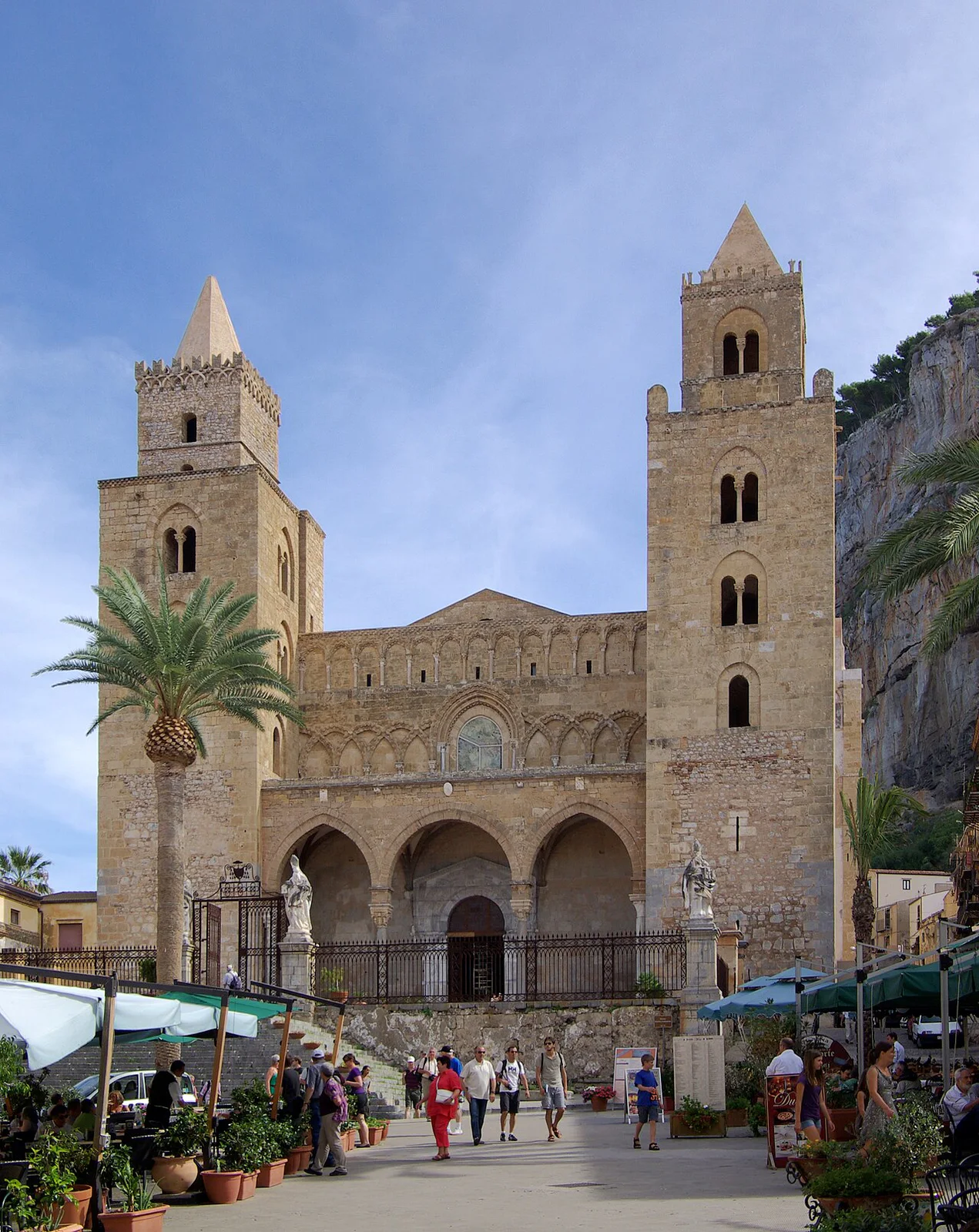
Cefalù · 43 km
Duomo di Cefalù
Content & sources
Photo: Berthold Werner · CC BY-SA 3.0