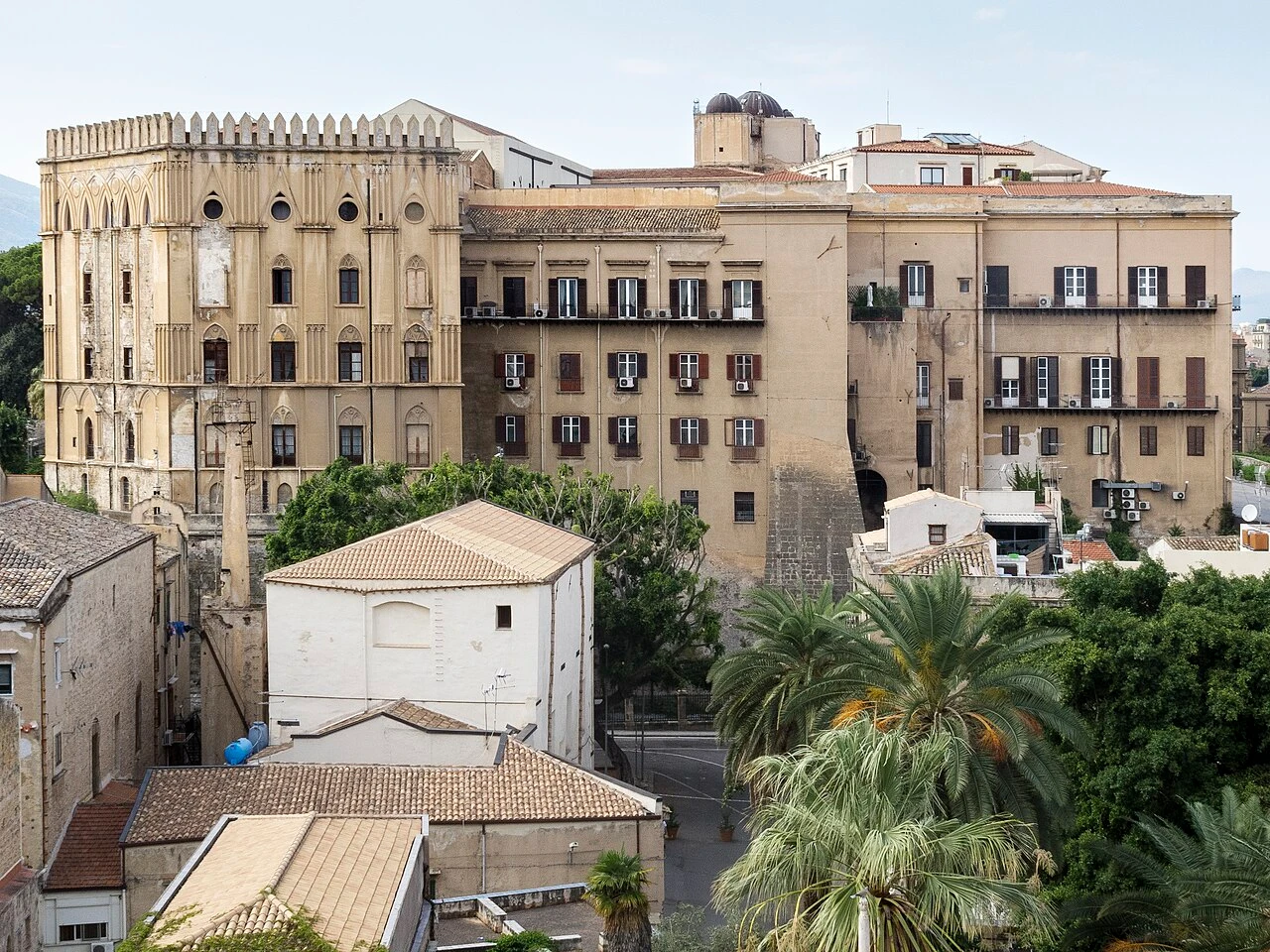
Stanza · Audio guide
Palazzo dei Normanni Audio Guide
A place to remember. A story to take with you.
Also known as the Royal Palace of Palermo, this historic building served as the seat of the Kings of Sicily during the Norman rule. It is world-renowned for housing the Cappella Palatina, a masterpiece of…
Download Stanza, then search for “Palazzo dei Normanni”.
About the tour
One guide. Your kind of visit.
Also known as the Royal Palace of Palermo, this historic building served as the seat of the Kings of Sicily during the Norman rule. It is world-renowned for housing the Cappella Palatina, a masterpiece of Byzantine and Islamic-influenced art.
Ready when you are.
- 01Get the free Stanza app.
iOS & Android
- 02Find your guide.
“Palazzo dei Normanni”
- 03Download before you go.
Works offline
Audio guide / 17 narrated stops
Inside the guide
Get to know a few of the stories before you go. Open a stop to read more.
01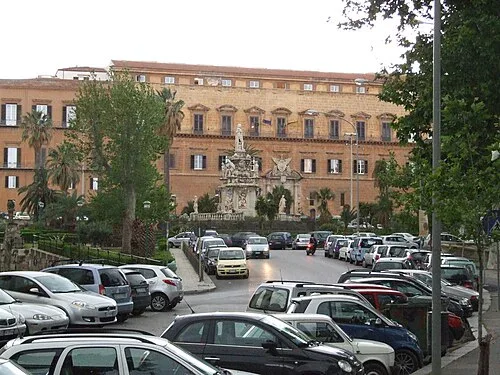 Piazza del Parlamento and the Royal Facade
The Norman Palace from Piazza del Parlamento
Welcome to the Royal Palace of Palermo, called the Palace of the Normans. This is said to be the oldest royal residence in Europe. The Normans built their castle here after taking the city in 1072, and Roger the Second, the first Norman king of Sicily, made it the seat of his crown. The rulers who came after them made these walls the main seat of power in Sicily, and since 1947 the Sicilian Regional Assembly has met inside. In 2015 the palace joined the UNESCO World Heritage list as part of Arab-Norman Palermo, together with the cathedrals of Cefalù and Monreale. The building stands on the highest point of the city, raised over fortifications far older than the Normans themselves. One building holds the whole story: ancient strongholds, Norman kings, Spanish viceroys, and a parliament still sitting today. The tour follows those layers, from the ground up.
gnuckx · CC BY 2.0
02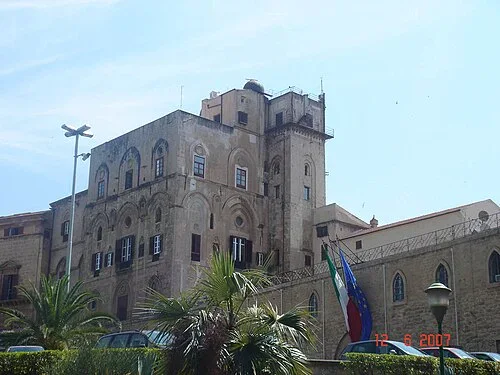 Piazza del Parlamento and the Royal Facade
The Torre Pisana
The palace's Norman core was built for war as much as for ceremony. Four towers marked its corners, with workshops and textile laboratories tucked inside the walls. Of the four, only two survive, and the tall tower rising above the eastern front is the Torre Pisana. Its thick stone carried the logic of a citadel, a stronghold that could hold out on its own. The Norman dynasty ended in blood and plunder here. In 1194 Henry the Sixth ordered the sack of the palace, and chroniclers record that a hundred mules were needed to carry off the gold and precious objects from the treasury. The tower's working life outlasted its kings. Under viceroy Francesco d'Aquino di Caramanico, an astronomical observatory was built on the Torre Pisana in 1790, and the fortress tower turned its gaze from enemies to the sky.
Photo: Sibeaster · Public domain
03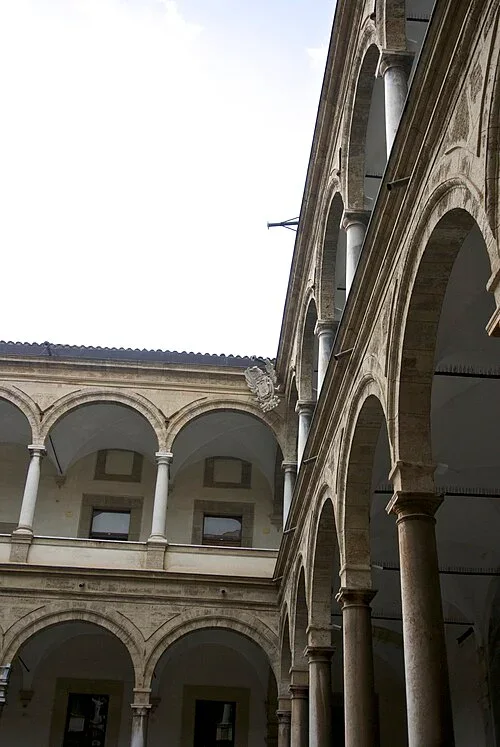 Cortile Maqueda and the Grand Staircase
Cortile Maqueda
The palace grew by wrapping new eras around the old Norman core, and this courtyard is where that happened most visibly. In 1600 Bernardino de Cárdenas y Portugal, Duke of Maqueda, built a courtyard entirely ringed with colonnades and Renaissance loggias, two tiers of arches stacked one above the other. It took his title, and it still carries it: the Cortile Maqueda. Inside it worked the Deputazione del Regno, the governing body first instituted by Alfonso the Fifth of Aragon. By then the Spanish viceroys had already given the palace a thorough renewal, adding courtyards and halls that served both ceremony and the military needs of a garrison. From here the visit turns inward, from the fortified exterior to the palace's stacked interior levels, each one built by a different age.
Listen in the appColsu · CC BY-SA 4.0
04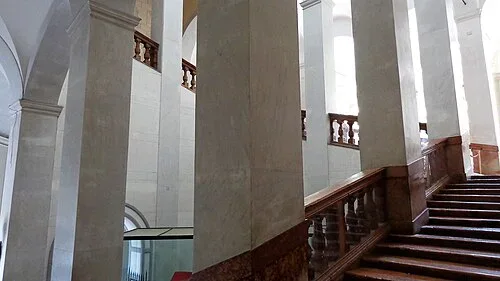 Cortile Maqueda and the Grand Staircase
The Grand Staircase
The red marble staircase carries the way upward, from the Renaissance courtyard to the palace's noble floors. Its balustrades run in the same deep stone, polished by centuries of ceremonial comings and goings. The climb passes the level of the Palatine Chapel before reaching the state rooms above, moving through the palace's layers one floor at a time.
Listen in the appPhoto: Effems · CC BY-SA 4.0
05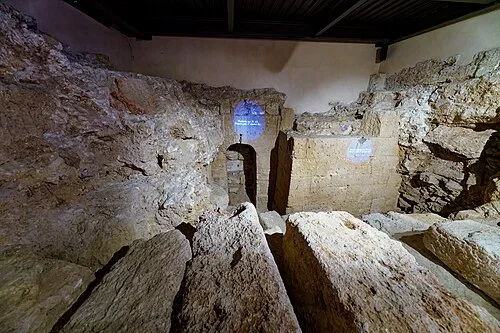 Subterranean Foundations: Punic City Walls
Punic City Walls
The oldest thing in this palace is not Norman at all. In 1984, work beneath the Duke of Montalto Halls uncovered fortifications of Phoenician and Punic origin, their layered masonry dating between the eighth and fifth centuries before Christ. The ancient city here was called Panormos, roughly 'all-port', a Greek name for a harbour town set between two rivers, the Kemonia and the Papireto. These walls formed the political and social heart of the early settlement, the paleopolis, and a small preserved postern gate once managed access into the stronghold. In 254 before Christ the Romans took the fortress for their own. The Norman kings, centuries later, raised their citadel directly on the oldest layer of the palace's site. They chose the highest ground, and the ground beneath it already belonged to Palermo's first defenders.
Listen in the appPhoto: Holger Uwe Schmitt · CC BY-SA 4.0
06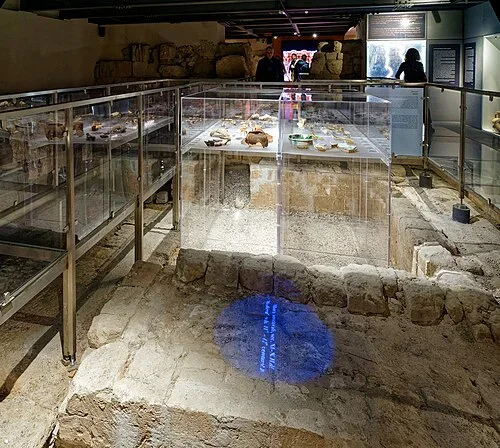 Subterranean Foundations: Punic City Walls
Archaeological Area beneath the Palace
This buried level has lived several lives. After 1553, when the viceroys decided to move their residence from the Castello a Mare into the Royal Palace, the semi-basement here was set aside as a depot for ammunition. Gunpowder stored in the shadow of the Punic walls, a floor below the royal apartments. In 1637 Don Luigi Moncada, Duke of Montalto, gave the rooms their finest role. He had the old depot painted with frescoes by the leading artists of the day, among them Pietro Novelli, and turned it into the summer hearing hall of the Sicilian Parliament. The communicating rooms took his title, the Sala Duca di Montalto. Even the humblest, deepest stratum of the palace kept being called back into service, each century finding a new use for the old stone.
Listen in the appPhoto: Holger Uwe Schmitt · CC BY-SA 4.0
07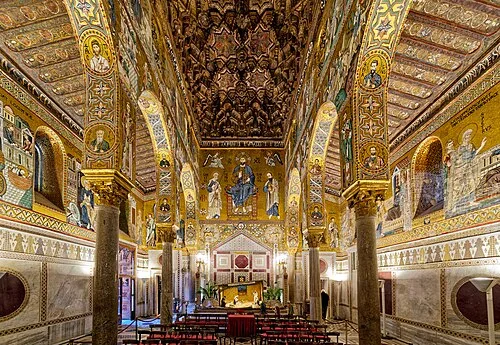 The Palatine Chapel: Golden Nave and Royal Sanctuary
Cappella Palatina: The Golden Nave
After his coronation in 1130, King Roger the Second built a private chapel for his royal family inside the palace. It was consecrated on the twenty-eighth of April 1140 and dedicated to Saints Peter and Paul. What he and his craftsmen created became the supreme example of the Norman-Arab-Byzantine style that ruled twelfth-century Sicily. Three traditions share the single nave. The upper walls and sanctuary glow with Byzantine mosaics. The wooden roof, elaborately carved and painted, follows Arab craftsmanship. And the lower walls are sheathed in marble incrustation, with floors to match. A Christian royal chapel, built with the hands and arts of the cultures Roger ruled. Conquerors usually erase; here the palace's kings seem to have gathered everything they found and set it side by side under one golden roof.
Listen in the appPhoto: Holger Uwe Schmitt · CC BY-SA 4.0
08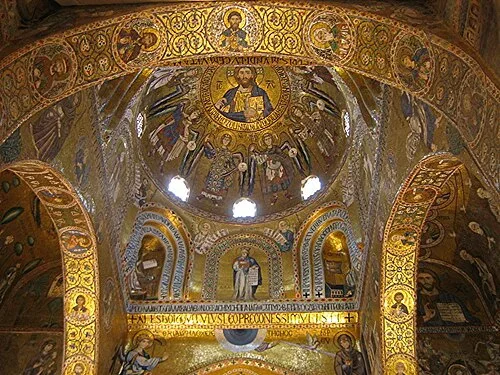 The Palatine Chapel: Golden Nave and Royal Sanctuary
Christ Pantocrator and the Mosaic Dome
At the crown of the dome, Christ Pantocrator looks down, the all-ruling Christ of the Byzantine tradition, his hand raised in blessing. Around him circle the hierarchies of angels and archangels, with prophets, saints and the Evangelists filling the golden surfaces below. These are the chapel's oldest mosaics, made at the original construction around 1143. Greek-Byzantine mosaicists came to work in Sicily for Norman patrons, bringing a visual language born half a sea away. The later mosaics along the nave carry Latin inscriptions and Old Testament scenes, while the side aisles tell the stories of Saints Peter and Paul. The gold tesserae catch every flame and flicker of light, so the whole sanctuary seems made of radiance. In that glow, the king of Sicily worshipped beneath the image of the King of Heaven.
Listen in the appUrban · CC BY-SA 3.0
09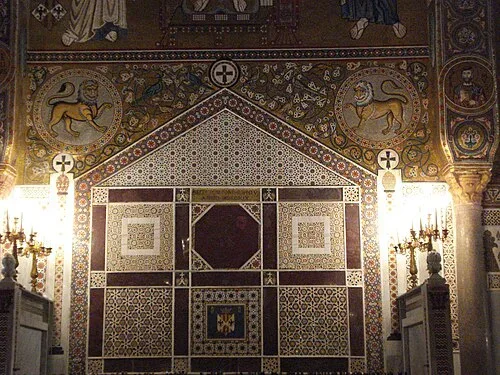 The Palatine Chapel: Golden Nave and Royal Sanctuary
The Royal Throne
At the entrance to the nave stands the royal throne, sheathed in mosaics like everything else in this chapel. From here the king heard the liturgy enthroned, flanked by the mosaic lions that guard this wall, power and worship staged in a single view. But royal control of this palace once broke. In 1160 and 1161 the barons rose against King William the First, in a conspiracy plotted by Matteo Bonello. The rebels forced their way into the palace itself. The halls of the royal residence were sacked and set alight, and an irreplaceable library of manuscripts and records burned with them. The revolt failed, and the crown held Sicily still. The throne remained in its place, and the kings sat on as before, with the memory of the flames close by.
Listen in the appPhoto: Sibeaster · Public domain
10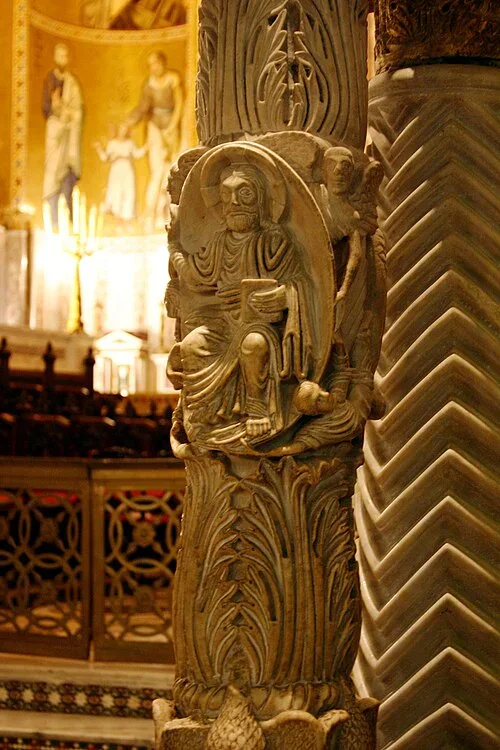 The Palatine Chapel: Golden Nave and Royal Sanctuary
The Paschal Candelabrum
Beside the sanctuary stands a candlestick of carved marble, four and a half metres tall. It was made in the twelfth century to hold the Paschal candle, the great flame of Easter. The shaft climbs in acanthus leaves, with figures and animals caught among the foliage. Among them sits a figure of Christ in glory, a book in his hand, an angel at his shoulder. Every fold of the drapery and every leaf was cut by hand into the stone. The shape of the work and its figure carving belong to the Romanesque tradition of mainland Europe. Yet even this single liturgical furnishing carries the same meeting of crafts as the rest of the chapel, blending Romanesque, Arab and Byzantine elements in one piece of marble.
Listen in the appJosé Luiz · CC BY-SA 4.0
- 11
The Muqarnas Ceiling
The painted wooden ceiling of 1143, built by Islamic craftsmen for a Christian king's chapel.
- 12
Musicians and Dancers of the Ceiling
Dancers and musicians painted on the chapel ceiling, courtly pleasure preserved in a place of worship.
- 13
Sala dei Venti
The 'jewelled' tower of Roger the Second, built for the king's leisure and quiet.
- 14
King Roger's Room
Golden mosaics of hunts, leopards and date palms, a rare worldly program in a Norman palace.
- 15
Sala dei Viceré
A hall of twenty-one portraits of the rulers who governed Sicily after the kings.
- 16
Sala d'Ercole: The Assembly Chamber
Hercules painted in 1799 above the hall where Sicily's regional deputies legislate today.
- 17
Porta Nuova
Charles the Fifth's triumphal gate at the palace's northern edge, the final layer on an ever-rebuilt stronghold.
Palazzo dei Normanni
Frequently asked questions
How much does the guide cost?
Free app download. Listed guide price: $1.99. Guide price shown in the app. Audio guide only. Venue admission is separate.
Can I listen without internet?
Yes. Download the guide’s audio, images, and maps in the app before your visit. Your downloaded content is then available offline.
Can I listen in my language?
This audio guide is available in 15 languages, including English.
Do I need to follow a schedule?
No. This is a self-guided experience. Choose your stops, pause whenever you like, and return to a story at your own pace.
At your own pace
Explore Palazzo dei Normanni.
Download Stanza, then search for “Palazzo dei Normanni”.
Free app download · Guide price shown in the app
Keep exploring
Nearby audio guides
Palermo · 1 km
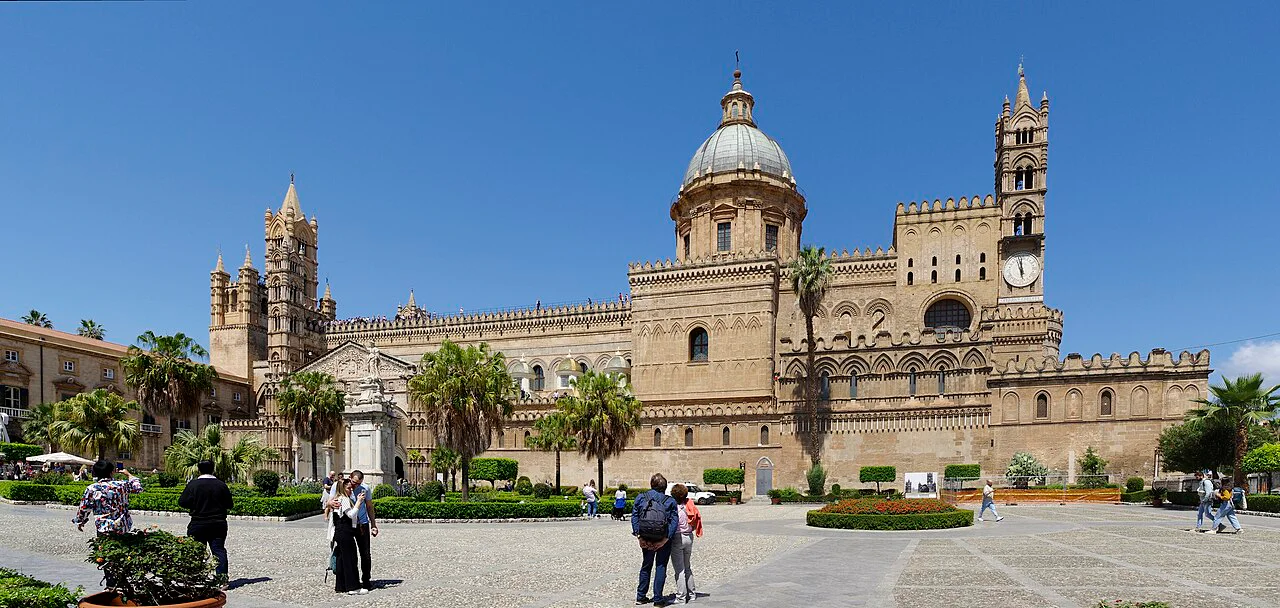
Cattedrale di Palermo
Content & sources
Photo: Berthold Werner · CC BY-SA 4.0
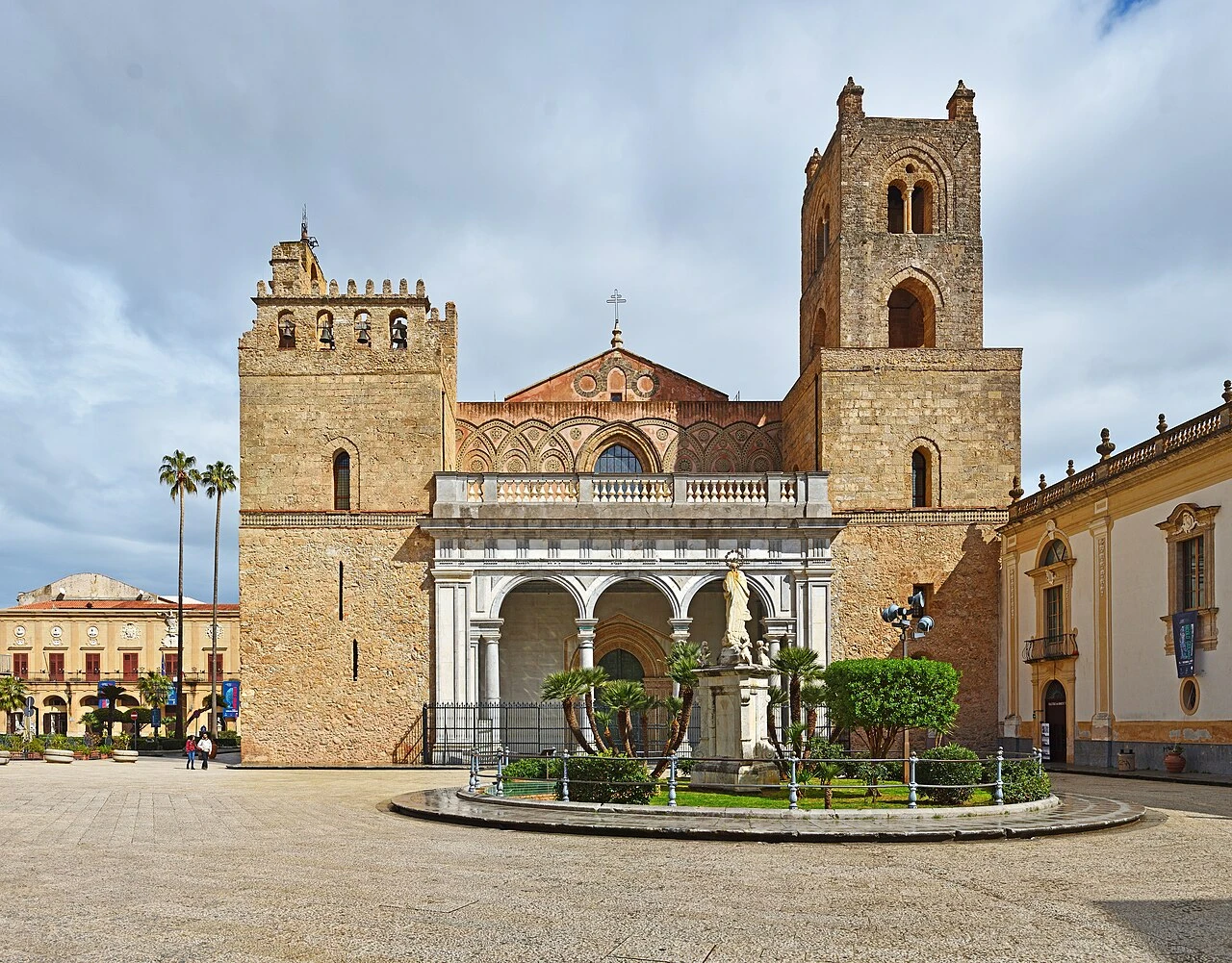
Monreale · 6 km
Cattedrale di Monreale
Content & sources
Photo: Ludvig14 · CC BY-SA 4.0
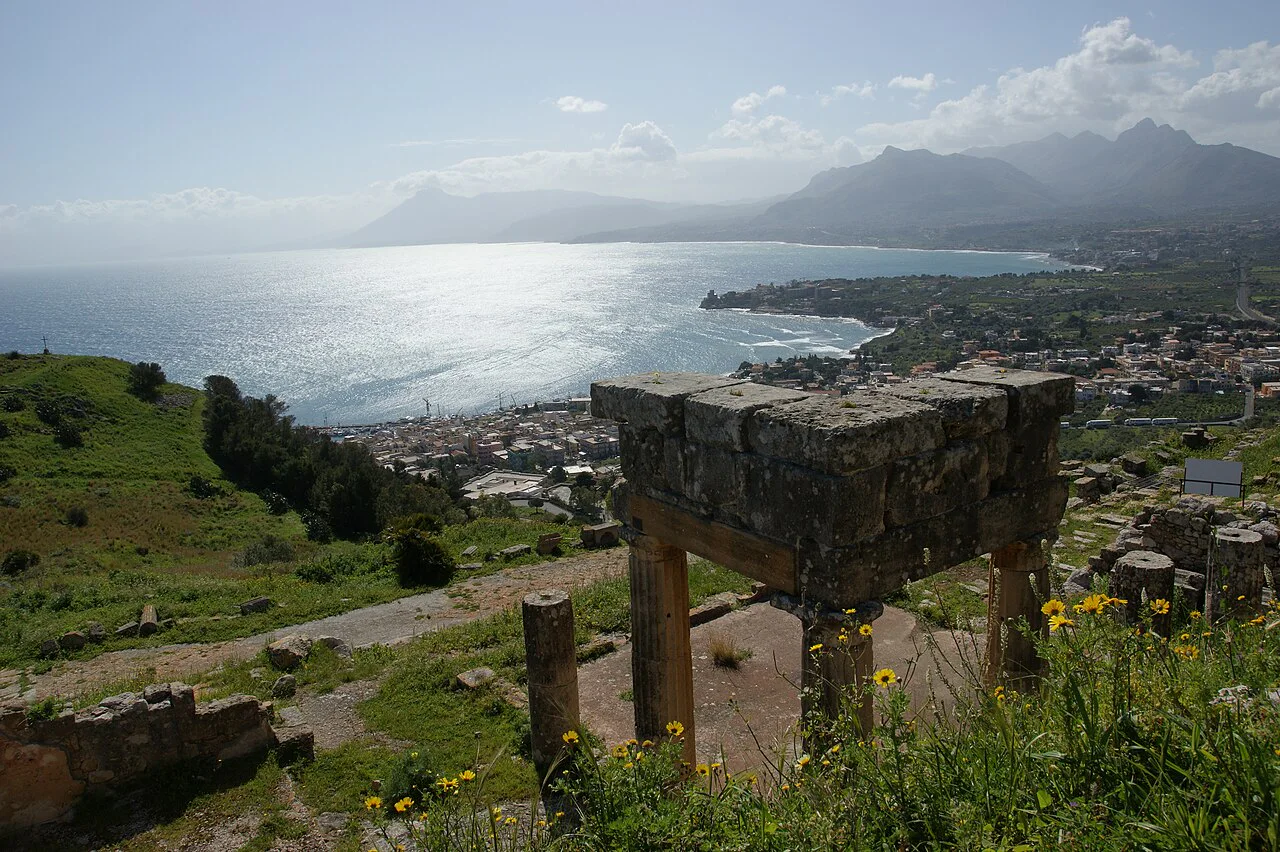
Santa Flavia · 16 km
Solunto
Content & sources
Allie_Caulfield from Germany · CC BY 2.0
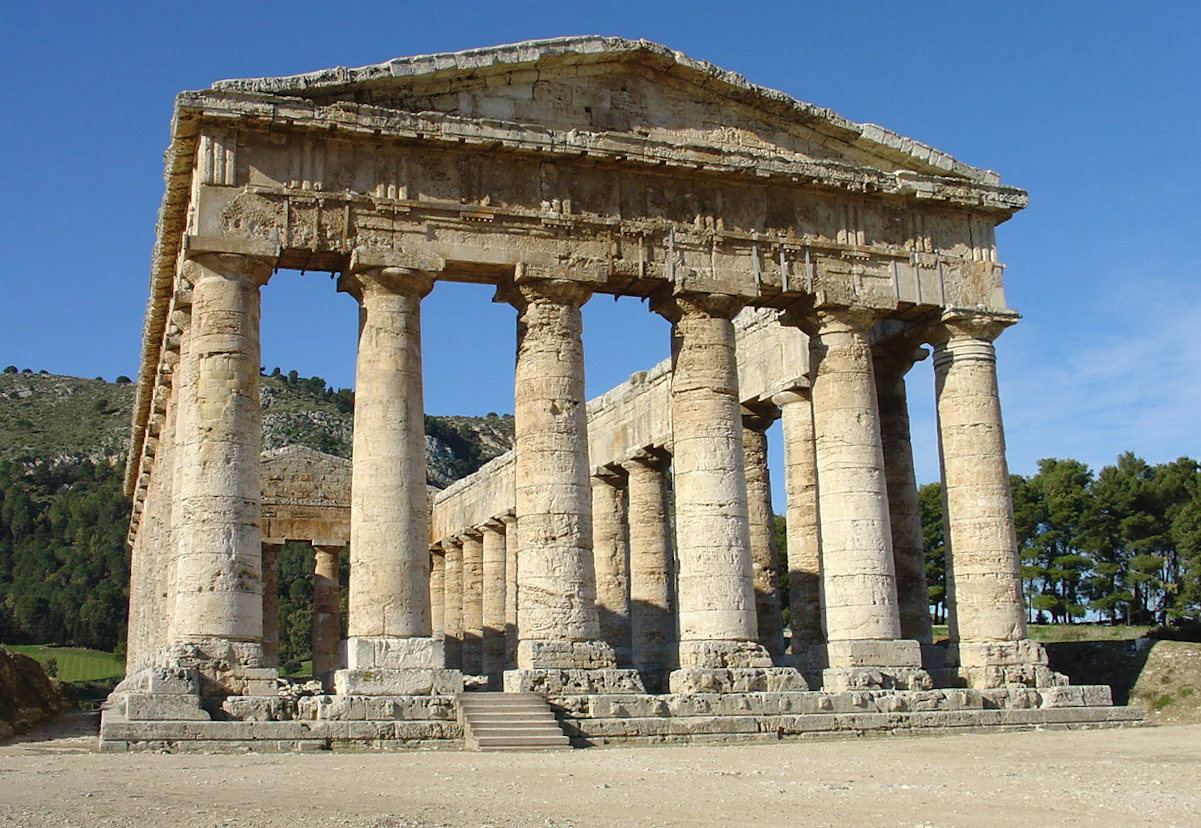
Calatafimi-Segesta · 49 km
Segesta
Content & sources
Photo: Ptyx · Public domain