Stanza · Audio guide
Segesta Audio Guide
A place to remember. A story to take with you.
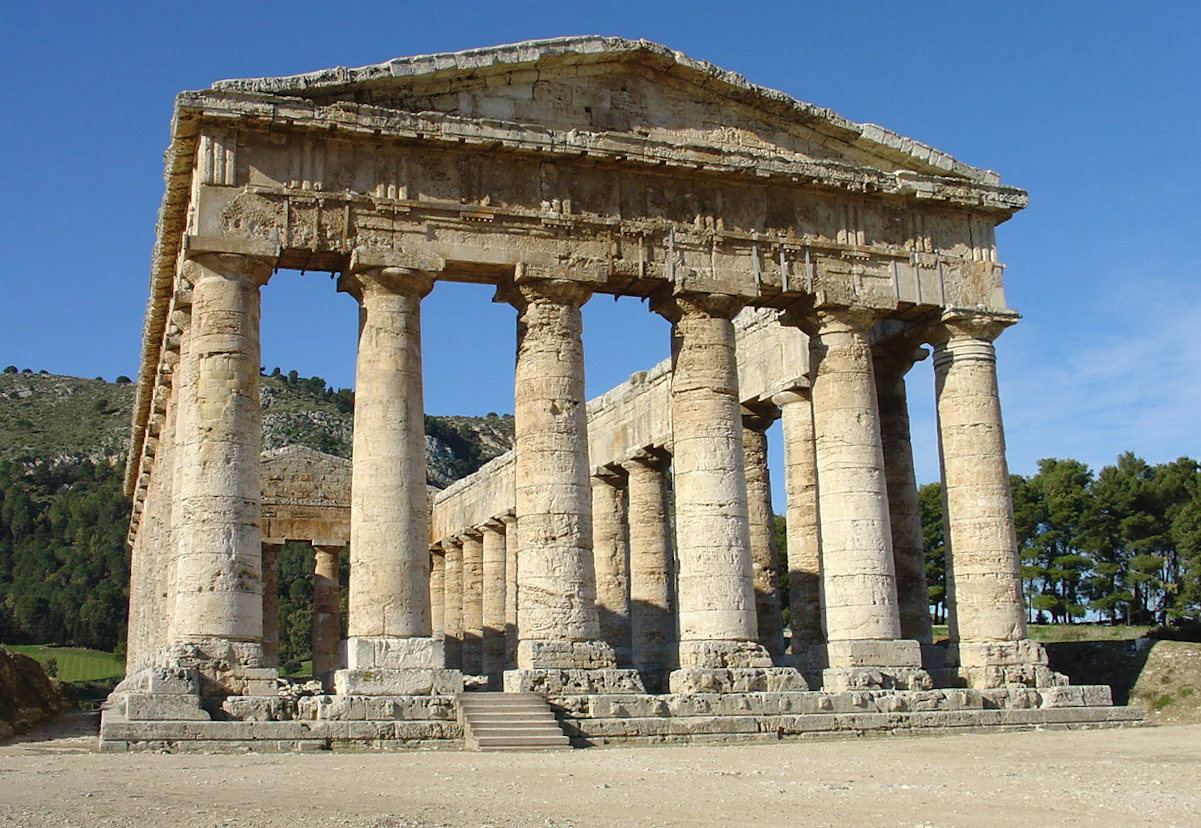
Segesta was one of the major cities of the Elymians, one of the three indigenous peoples of Sicily. The other major cities of the Elymians were Eryx and Entella.
Download Stanza, then search for “Segesta”.
About the tour
One guide. Your kind of visit.
Segesta was one of the major cities of the Elymians, one of the three indigenous peoples of Sicily. The other major cities of the Elymians were Eryx and Entella.
Ready when you are.
- 01Get the free Stanza app.
iOS & Android
- 02Find your guide.
“Segesta”
- 03Download before you go.
Works offline
Audio guide / 13 narrated stops
Inside the guide
Get to know a few of the stories before you go. Open a stop to read more.
01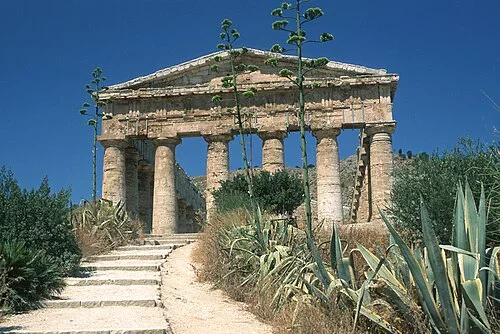 Arrival and the Elymian Heritage
The Doric Temple Seen from the Approach Path
Segesta was a hilltop city in the northwest of Sicily, near the modern town of Calatafimi-Segesta. Its people were the Elymians, and the city controlled several major roads between the coast to the north and the interior of the island. Agave plants line the stone path, and above them the temple's columns carry a triangular pediment. The temple stands on a hill of its own. The city itself lay higher, on Monte Bàrbaro, three hundred and five metres above sea level. Among the ruins, one temple stands out for being unusually well preserved.
Photo: Mauripri · CC BY-SA 4.0
02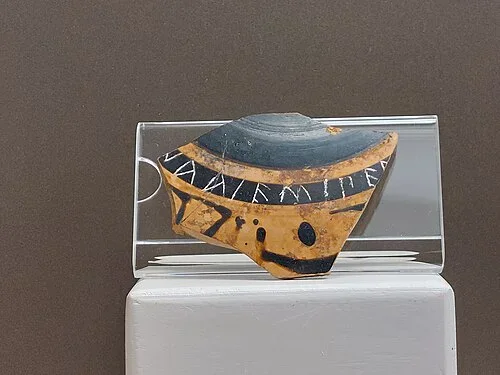 Arrival and the Elymian Heritage
Cup Fragment with Painted Inscription
The Elymians were one of the three native peoples of Sicily, and Segesta was one of their great cities. Eryx and Entella were the other two major Elymian cities. Segesta was not a Sicanian city, though the Sicanians lived in this part of the island. Greek writers called outsiders barbarians, and the historian Thucydides used that word for the Segestans. Yet Segesta appears to have had close ties with the Greek cities of Sicily from a very early date. Its coins carry Greek letters and bear the clear stamp of Greek art. This fragment of a painted Athenian cup, with letters running across its band, is kept in a museum, away from the site. Its inscription is in the Elymian language, written in Greek letters. The stories of where the city came from disagree. The Greek tradition, recorded by Thucydides in the fifth century BC, said Trojan fugitives founded it after their city was destroyed. Thucydides seems to have thought the Elymians were descended from those Trojans. Another account had the Elymians already living here when the Trojans arrived. Virgil told the story differently in the Aeneid. There, a local king named Acestes was said to be the son of a river god. He founded the city with the Trojans who chose to stay behind.
Photo: HaguardDuNord · CC BY-SA 4.0
03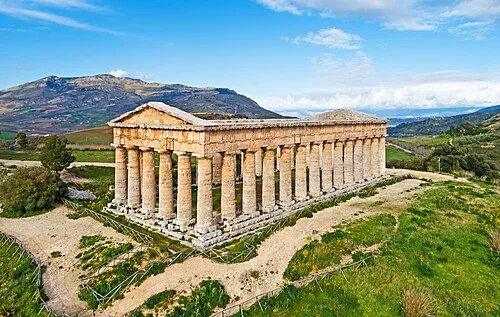 The Great Doric Temple
The Doric Temple in Its Hillside Setting
Beyond the walls of Segesta, along the roads that led into the town, stood two sacred places. This temple was one of them. The other was a sanctuary at Contrada Mango, which dates from the sixth and fifth centuries BC. Today the temple sits on its hill, with green fields and mountains beyond. In April 1787, the German writer Goethe reached Segesta on his journey through Italy. He paid close attention to the temple's structure. He also noted that a restoration had been carried out there in 1781.
Listen in the appPhoto: Ludvig14 · CC BY-SA 4.0
04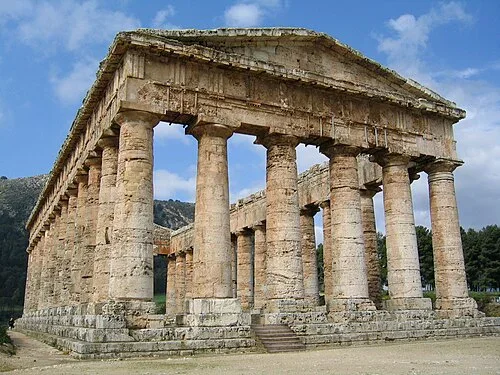 The Great Doric Temple
The Temple's Colonnade and Pediment
Thirty-six columns surround this temple. Six stand at each short end. Fourteen run along each long side. Each column rises about ten metres. The temple stands on a platform three steps high. The style is Doric, the plain, sturdy order of classical Greece, and the front is capped by a triangular gable called the pediment. The temple was built in the last decades of the fifth century BC. The prevailing view is that the Elymians built it. Some think an Athenian architect had a hand in it, though the city had no Greek population.
Listen in the appEvan Erickson · Public domain
05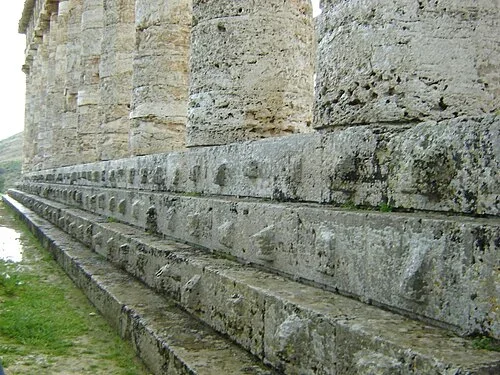 Inside the Unfinished Temple
Lifting Bosses on the Temple Base
Rough knobs of stone, called bosses, still stick out from the blocks of this temple's base. Builders used the bosses to lift each block into place. Normally they were removed afterwards. Here many of them remain, which is one sign the temple was left unfinished.
Listen in the appHkelly1 (talk) (Uploads) · Public domain
06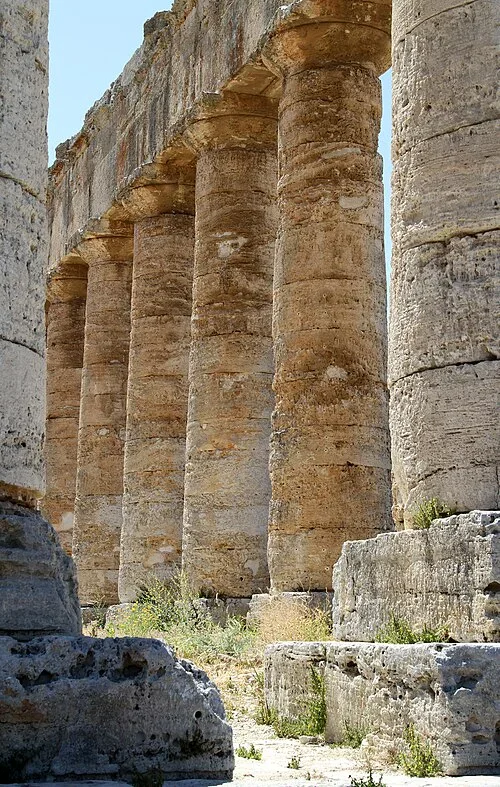 Inside the Unfinished Temple
Column Shafts of the Doric Temple
Doric columns normally carry vertical grooves called flutes, running up the shaft. The columns of this temple never received them. Each shaft is built from stacked drums of stone, and the joints between the drums show as thin horizontal lines. Fluting was a finishing stage, and these columns never reached it.
Listen in the appCarlo Pelagalli · CC BY-SA 3.0
07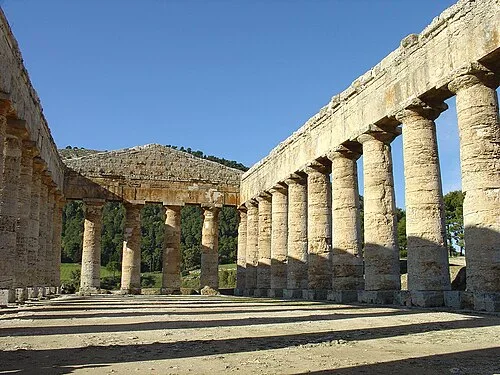 Inside the Unfinished Temple
Inside the Temple Colonnade
Inside the temple there is only a ring of columns. It has no cella, the enclosed inner room that Greek temples usually had. It has no roof, no altar, and no dedication to a god. Classical roofs were usually made of timber, and timber rots, so the missing roof probably helped the columns survive. The temple was never completed because of a war with Selinunte. The two cities were fighting as early as 580 BC. Selinunte called in Syracusan help. Segesta asked Agrigentum and then Carthage for aid, without success, and so it turned to Athens. In 416 BC, ancient writers say, the Segestans put on a misleading display of wealth for the Athenian envoys. The envoys came away convinced the city was far richer than it was, and Athens sent a fleet. The temple escaped destruction by the Carthaginians in the late fifth century BC.
Listen in the appPhoto: Alec · Public domain
08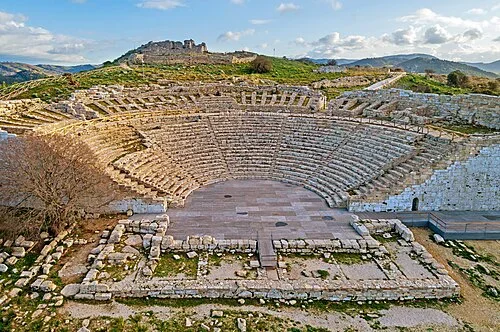 The Hellenistic Theatre of Monte Bàrbaro
The Theatre of Monte Bàrbaro
Many Greek theatres use the natural slope of a hill for their seats. This one is different. Its seating was built up with blocks of local limestone, and retaining walls hold it in place. The theatre dates from the end of the third century BC. It stands on the highest point of Monte Bàrbaro, behind the agora, on a spot that had been a place of worship many centuries earlier. Its seating curves about sixty-three metres across. Two entrances, set slightly off the central line, lead in, and the theatre can hold about four thousand people. The sea and hills beyond serve as its backdrop, with the valley running toward the Gulf of Castellammare.
Listen in the appPhoto: Ludvig14 · CC BY-SA 4.0
09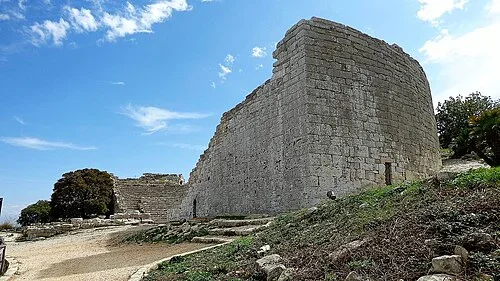 The Hellenistic Theatre of Monte Bàrbaro
Stone Wall on the Summit
Large blocks of cut stone make up this wall on the summit, and it is not clear which building it belonged to. Some of the stonework might come from a rebuilding after 307 BC. That was the year Agathocles, the ruler of Syracuse, attacked the city. He had come to western Sicily on his way back from Africa, and Segesta welcomed him as a friend and ally. Then he turned on the people, on the pretext that they were disloyal. He had the whole citizen body put to death, said to number ten thousand, and seized their wealth. Women and children were sold into slavery. He renamed the city Dicaeopolis and handed it to the fugitives and deserters who had gathered around him.
Listen in the appPhoto: Effems · CC BY-SA 4.0
10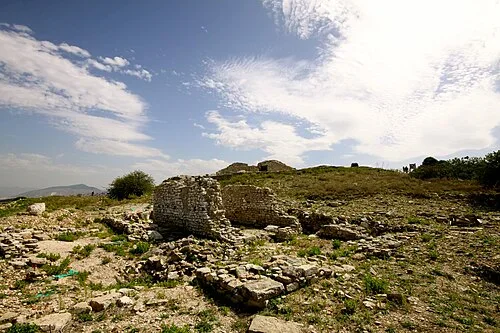 The Monte Bàrbaro Acropolis and Agora
Excavated Remains on the Summit Plateau
Among the remains on the summit lies the agora, the public square of the city. Digging resumed in February 2022 to uncover the parts of the square still buried. Early in the First Punic War, which began in 264 BC, the people of Segesta killed their Carthaginian garrison and declared for Rome. Carthage sent a force to besiege the city, and at one point it was in great distress. Gaius Duilius brought relief after his naval victory in 260 BC. Rome then exempted Segesta from all public burdens. Rome had also welcomed the city's Trojan origin story and claimed a kinship with its people. Even in the time of Cicero, Segesta was still called a free and immune city. Later, after Carthage was destroyed, Scipio Africanus gave back a statue of Diana that the Carthaginians had carried off.
Listen in the appUser:Matthias Süßen · CC BY 3.0
- 11
Medieval Ruins on the Summit
A Muslim community's mosque and burial ground in the Norman period, and how that settlement came to an end.
- 12
Walkway Through Stone Walls
A castle and medieval village on the summit, and the historian who found the site again in 1574.
- 13
Fortification Walls on the Slope
Steep slopes, a zigzag of walls, and what the choices made across the site reveal about the people who lived there.
Segesta
Frequently asked questions
How much does the guide cost?
Free app download. Listed guide price: $0.99. Guide price shown in the app. Audio guide only. Venue admission is separate.
Can I listen without internet?
Yes. Download the guide’s audio, images, and maps in the app before your visit. Your downloaded content is then available offline.
Can I listen in my language?
This audio guide is available in 15 languages, including English.
Do I need to follow a schedule?
No. This is a self-guided experience. Choose your stops, pause whenever you like, and return to a story at your own pace.
At your own pace
Explore Segesta.
Download Stanza, then search for “Segesta”.
Free app download · Guide price shown in the app
Keep exploring
Nearby audio guides
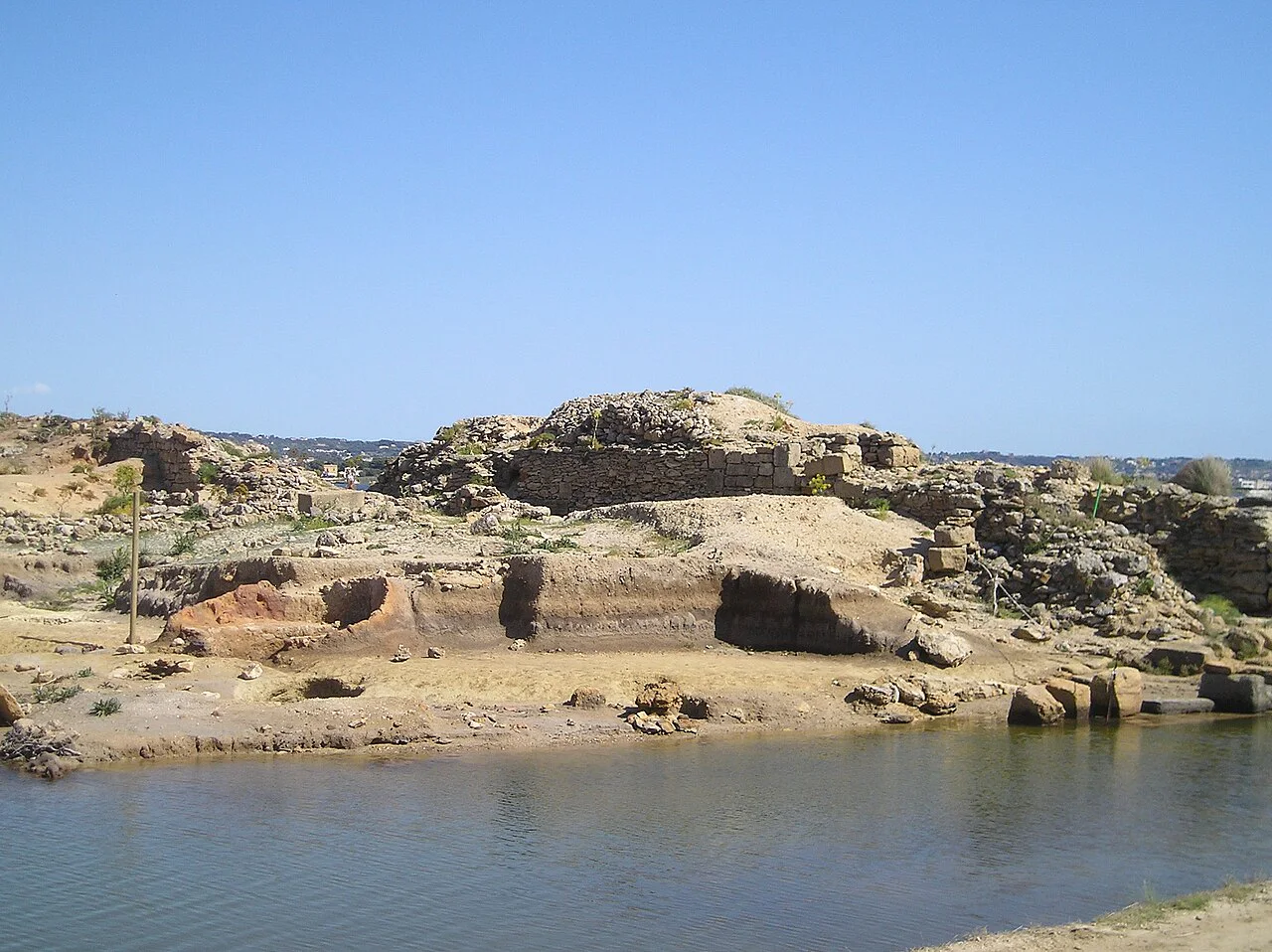
Marsala · 33 km
Mozia
Content & sources
Verity Cridland · CC BY 2.0
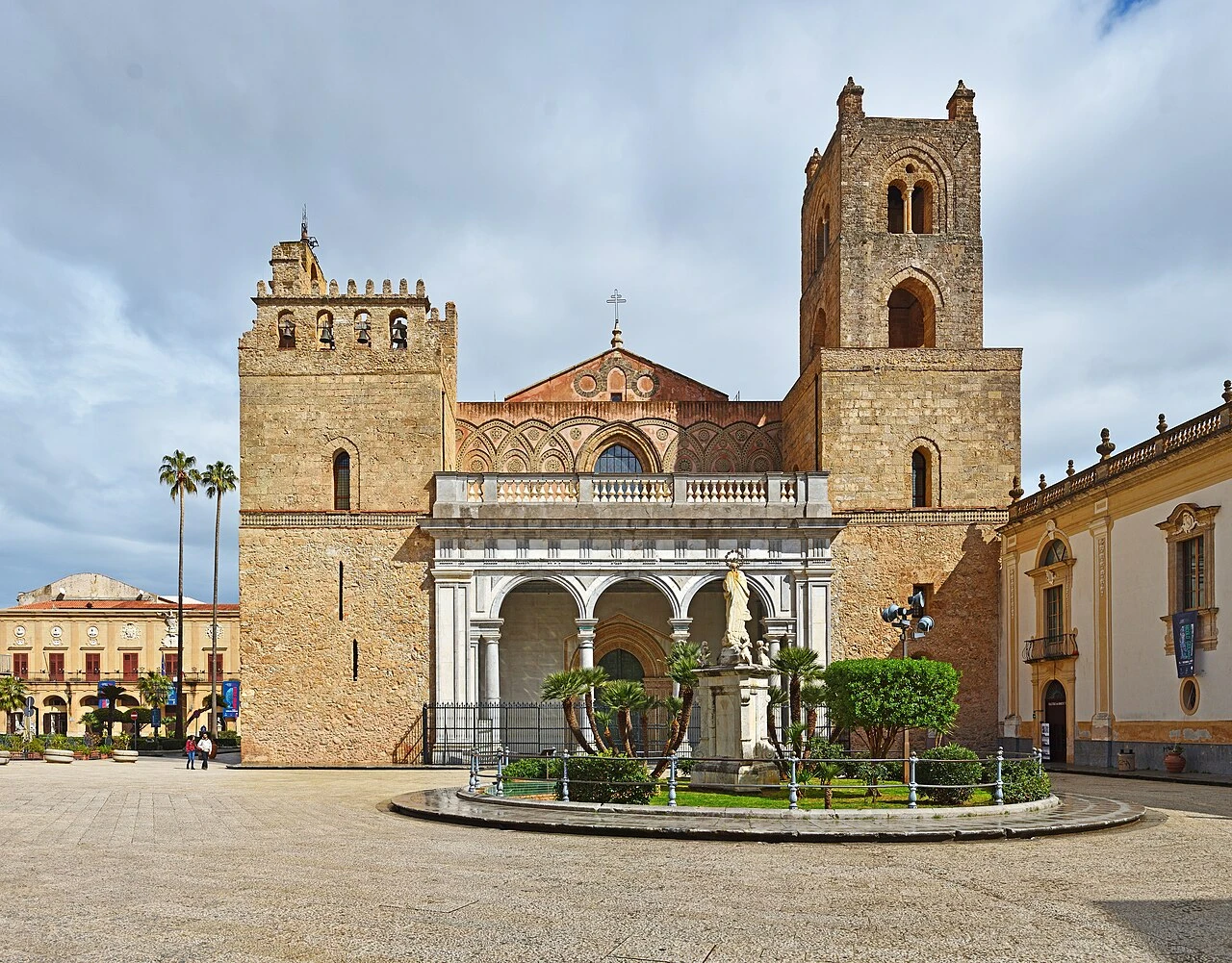
Monreale · 43 km
Cattedrale di Monreale
Content & sources
Photo: Ludvig14 · CC BY-SA 4.0
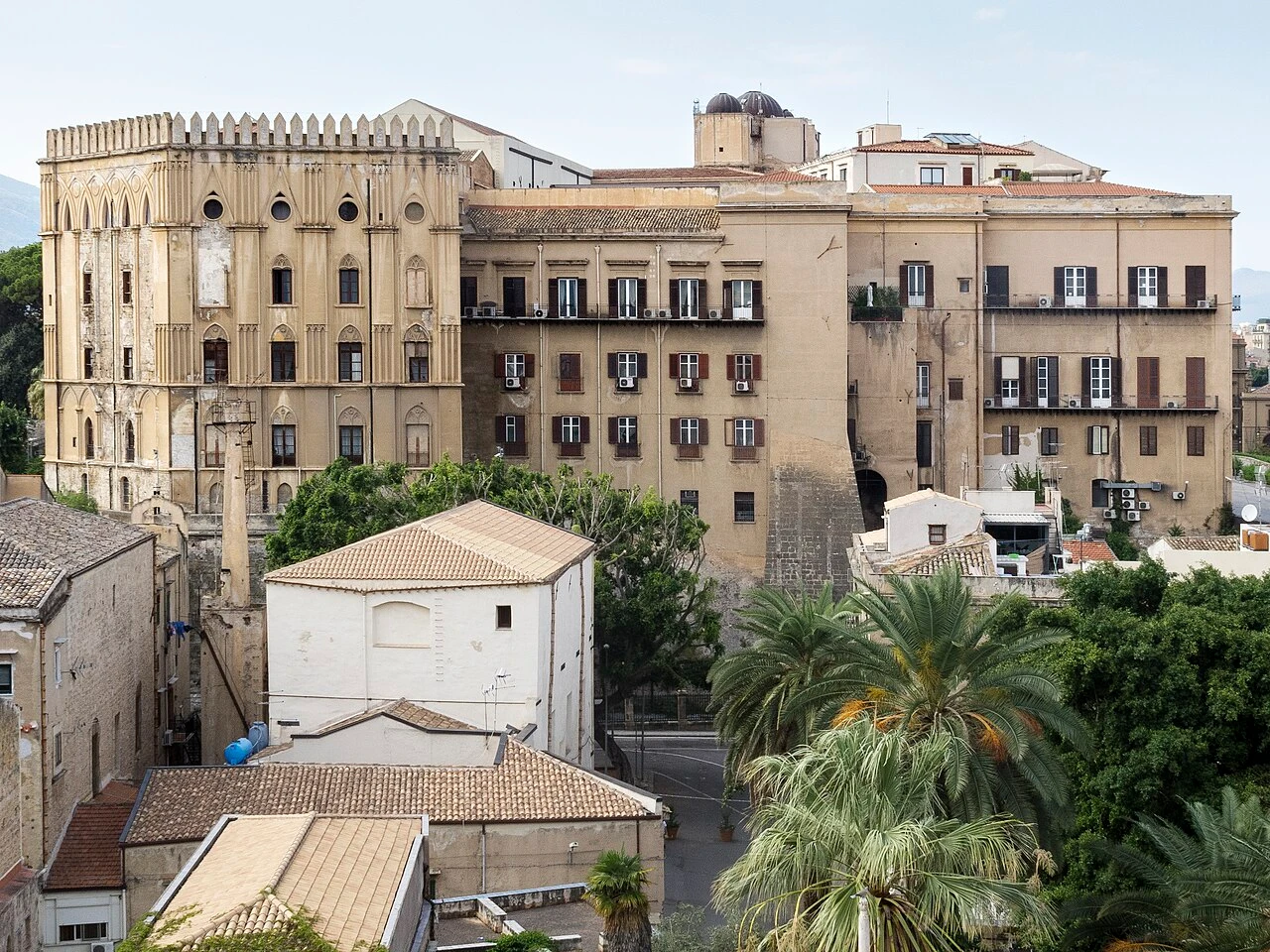
Palermo · 49 km
Palazzo dei Normanni
Content & sources
Photo: Jules Vaulont · CC BY-SA 4.0
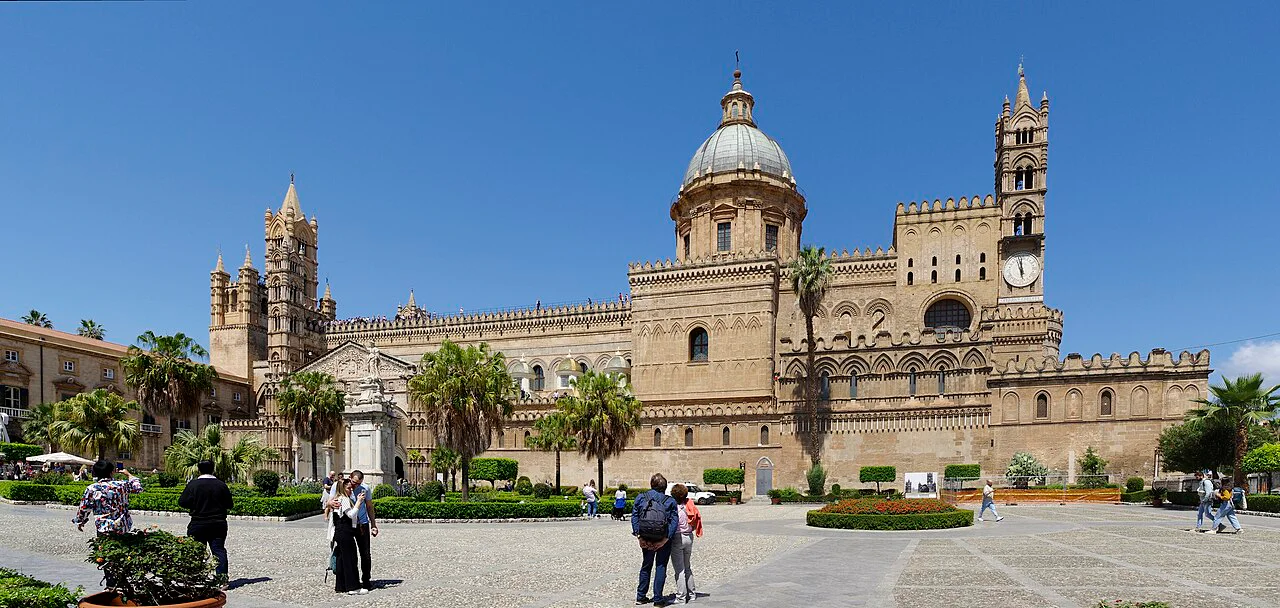
Palermo · 50 km
Cattedrale di Palermo
Content & sources
Photo: Berthold Werner · CC BY-SA 4.0