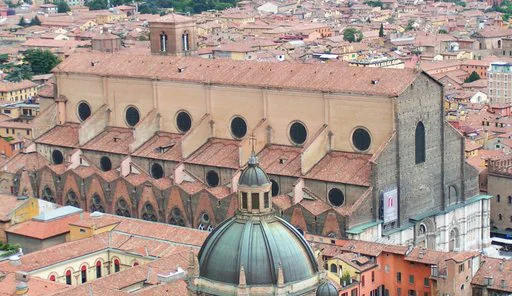
 Stanza / Audio guide
Content & sources
Stanza · Audio guide
Basilica di San Petronio Audio Guide
A place to remember. A story to take with you.
The Basilica of San Petronio is a minor basilica located in Bologna, Italy, that dominates Piazza Maggiore. It is dedicated to the city's patron saint, Saint Petronius, and has been the seat of his relics…
Download Stanza, then search for “Basilica di San Petronio”.
About the tour
One guide. Your kind of visit.
The Basilica of San Petronio is a minor basilica located in Bologna, Italy, that dominates Piazza Maggiore. It is dedicated to the city's patron saint, Saint Petronius, and has been the seat of his relics since 2000.
Ready when you are.
- 01Get the free Stanza app.
iOS & Android
- 02Find your guide.
“Basilica di San Petronio”
- 03Download before you go.
Works offline
Audio guide / 13 narrated stops
Inside the guide
Get to know a few of the stories before you go. Open a stop to read more.
01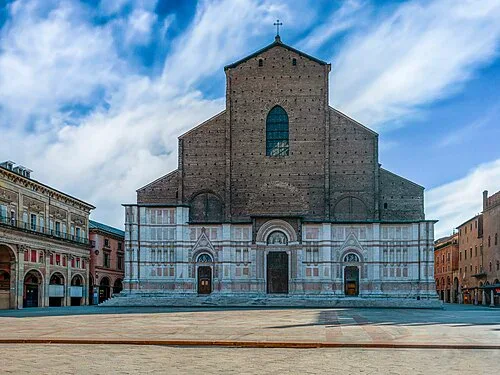 Piazza Maggiore and the Unfinished Façade
The Unfinished Façade from Piazza Maggiore
The Basilica of San Petronio dominates Piazza Maggiore, the main square of Bologna. The church began as the city's own project. In 1388, the city council decided to build a civic temple in honour of Saint Petronius. He had been bishop of Bologna in the fifth century. In 1253, the city had made him its patron. The first stone went in during a solemn procession in June 1390. The lower part of the front is marble panels on a red ground, with three doorways. Above it, the brick is still bare. Work on the front began in 1538, and it has never been finished. To make room for the church, most of one district was pulled down, including at least eight churches and towers. The city handed the church to the diocese in 1929. It was not consecrated until 1954.
Photo: Vanni Lazzari · CC BY-SA 4.0
02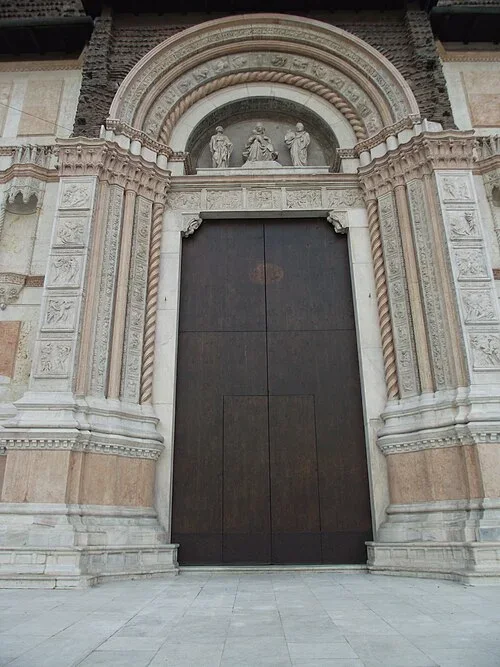 Jacopo della Quercia's Porta Magna
Porta Magna: The Main Doorway
Jacopo della Quercia, a sculptor from Siena, was commissioned to decorate the Porta Magna, the main doorway, in 1425. He died in 1438, and the work was cut short. Old Testament scenes run down the pillars on either side of the door. Above them, eighteen prophets line the arch. New Testament scenes fill the beam across the top of the doorway. The spiral columns around the arch are carved to look like twisted rope. In the lunette, the half-moon space above the door, a Madonna and Child appear with Saint Ambrose and Saint Petronius. The doorway still lacks its cusp, the pointed top piece. Michelangelo called that Madonna the most beautiful Madonna of the fifteenth century.
Photo: Parsifall · CC BY-SA 4.0
03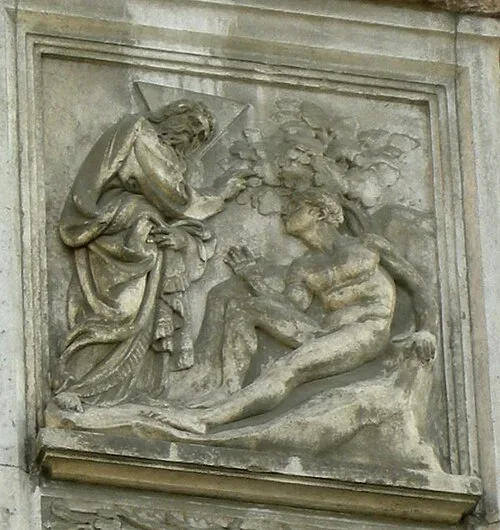 Jacopo della Quercia's Porta Magna
Genesis Relief: The Creation of Adam
Michelangelo studied the Genesis panels on this doorway with great care. This panel appears to show the Creation of Adam. A man lies stretched out on the ground, and a figure in long, flowing robes leans down toward him, one hand reaching out. Leafy branches fill the space behind them. The figures are carved in low relief, so they rise only slightly from the stone. Some poses of figures in the Sistine Chapel show what Michelangelo learned from panels like this one.
Listen in the appPhoto: Sailko · CC BY-SA 3.0
04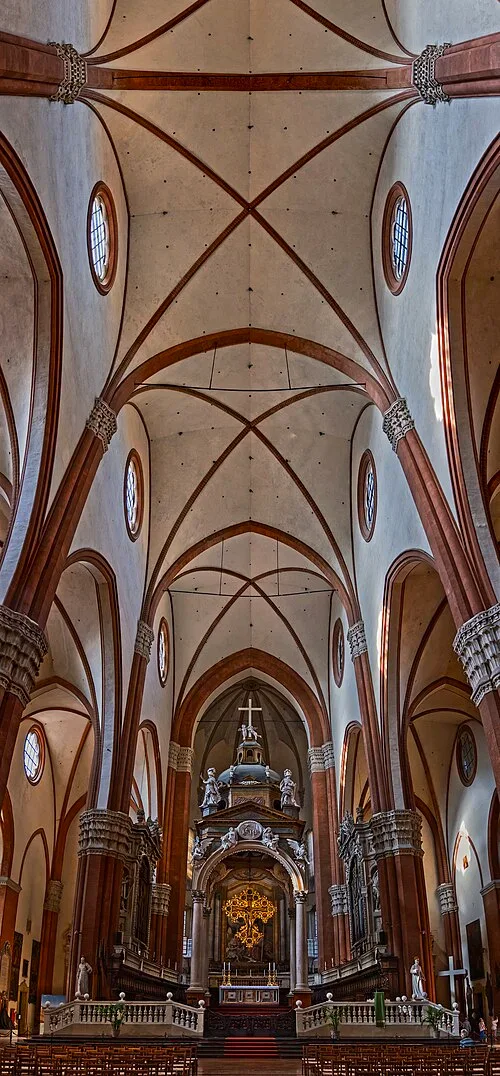 The Grand Gothic Nave and Vaults
The Central Nave and Vaults
The vault of the central nave rises about forty-four metres above the floor. Its ribs and piers are reddish brick, and its arches are pointed, in the Gothic manner. In 1514, the architect Arduino degli Arriguzzi was given a far larger plan. He had first been sent to Florence to study the dome of the cathedral there, built by Brunelleschi. His design called for a huge dome over the centre and a cross-shaped church. It would have stretched 224 metres, and it aimed to be the largest church in Christendom. Work stopped once the first two pillars and two triangular supports for the dome were built. Legend says Pope Pius the Fourth stopped the plan in favour of the university palace, the Archiginnasio. The Archiginnasio was built close by, right across the spot where the left transept would have run. The larger church was never built.
Listen in the appPhoto: BrunoParisini-CFP · CC BY-SA 4.0
05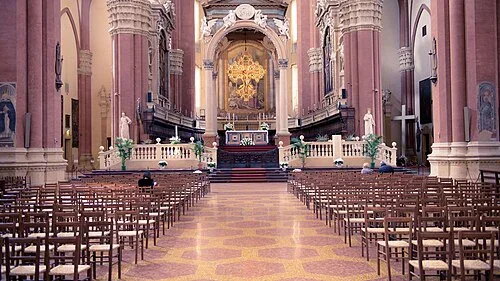 The Grand Gothic Nave and Vaults
The Nave from the Centre, Toward the High Altar
A coronation in Rome had once been considered for Charles the Fifth. Then imperial troops sacked Rome in 1527, and that idea was dropped. Bologna, an important city of the Papal States, was chosen instead. Its great basilica was still largely unfinished. The choice seemed sensible, but it was also, not very subtly, a way of reasserting papal rule over the city. The crowning took place in February 1530. Pope Clement the Seventh crowned him Holy Roman Emperor. The ceremony itself was held in the Chapel of Saint Abbondio, one of the side chapels, which was restored in neo-Gothic style in 1865. Rows of wooden chairs now fill the nave, with the high altar at its far end.
Listen in the appPhoto: Andrea Frascari · CC BY-SA 4.0
06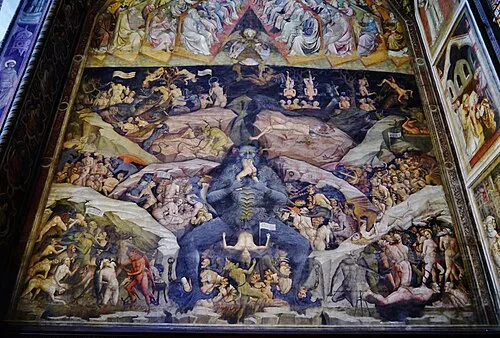 The Bolognini Chapel and Dante's Inferno
The Last Judgment and Dante's Hell (Chapel of the Magi)
Dante's Divine Comedy shapes this huge fresco, which covers most of the wall. It was painted in the fifteenth century by Giovanni da Modena, also known as Giovanni di Pietro Falloppi. At the top, the Last Judgment is shown, with the Coronation of the Virgin inside an almond-shaped halo. Below, Paradise and Hell fill the wall, with Hell at the bottom. Each group of sinners suffers a punishment of its own, as in Dante's poem. At the centre, a gigantic figure of Lucifer dominates the scene.
Listen in the appPhoto: Zairon · CC BY-SA 4.0
07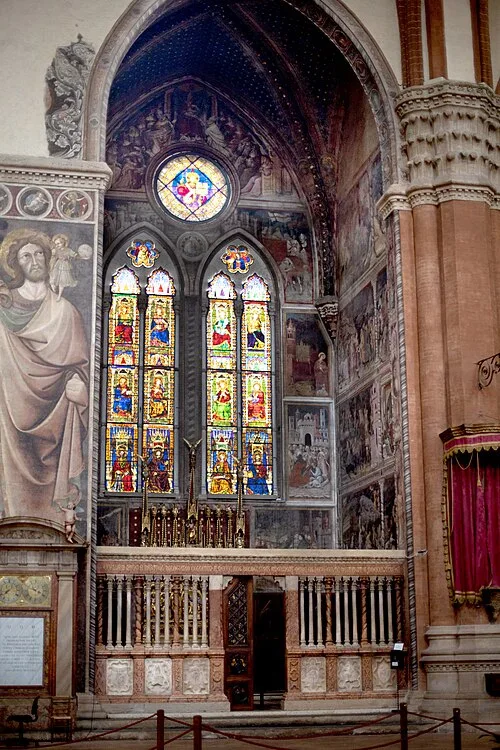 The Bolognini Chapel and Dante's Inferno
Chapel of the Magi: Altar End and Stained Glass
Many of the basilica's side chapels were held by families and civic groups, and this one was once of the Bolognini family. The marble railing in front of the altar is Gothic. Antonio di Vincenzo, the architect who had supervised the church's start, designed it in 1400. Above the railing, tall pointed windows hold stained glass, with a round window above them. The panels show figures in red, blue and gold. Painted scenes from the life of Saint Petronius fill the back wall. The chapel takes its name from the Magi, the Three Kings, whose story is painted on the right wall.
Listen in the appPhoto: Fabrizio Garrisi · CC BY-SA 4.0
08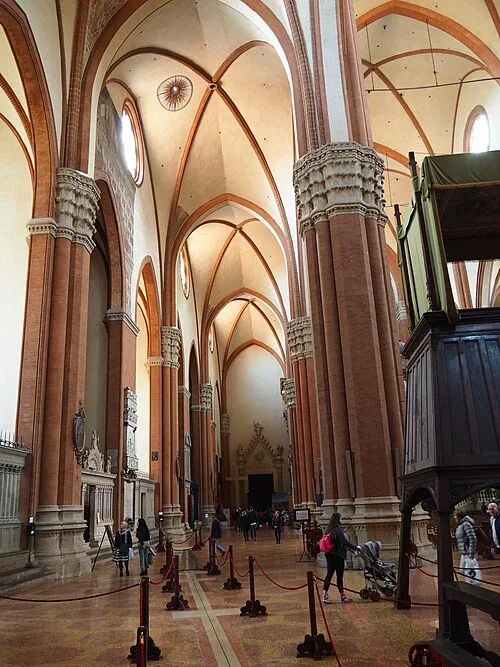 Cassini's Solar Meridian Line
Left Aisle: Cassini's Meridian Route
Inlaid in the floor of the left aisle, a meridian line is one of the largest astronomical instruments in the world. It is sixty-six point eight metres long. The astronomer Giovanni Domenico Cassini designed it in 1655. He taught astronomy at the university. A meridian line does not show the time of day. Instead, it shows where the sun falls at local noon. It replaced an earlier line, which stopped working in 1656, when a wall at the back of the left aisle was pulled down. Cassini finished the new line in December 1657. Cassini and Domenico Guglielmini later published an illustrated account of how the line was made, in 1695.
Listen in the appPhoto: MarkPagl · CC BY-SA 4.0
09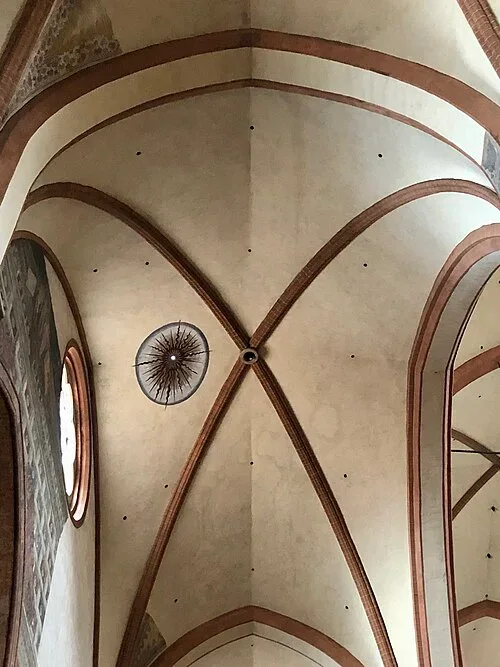 Cassini's Solar Meridian Line
East Nave Vault with Meridian Oculus
High in the church wall, about twenty-seven metres up, a small hole lets sunlight in. The hole is only twenty-seven millimetres across. At local noon, the sunlight makes an oval of light on the floor, falling exactly on the line. Where that oval sits along the line gives the sun's height at noon each day. Because the hole is smaller than the sun's apparent size, it works like a pinhole. That is the same principle as an old camera obscura. Cassini called the meridian a heliometer, a sun-measurer. In winter the oval was more than a metre and a half across. In summer it shrank to under thirty centimetres. Cassini found that the sun's size did not change in the same way as its speed. That meant the sun's uneven motion was real, not just an effect of how it looked. Kepler's second law says the Earth moves faster when it is nearer the sun. Cassini's line was probably the first experimental test of that law.
Listen in the appPhoto: Richard 00 00 00 00 · CC BY-SA 4.0
10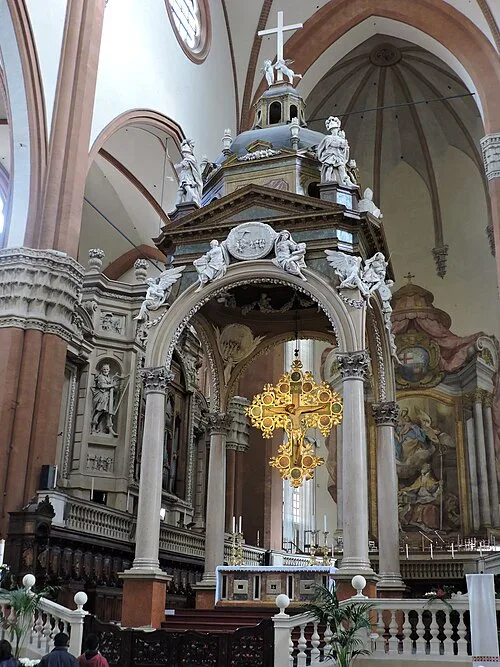 The Presbytery, Ciborium, and Historic Organ
Vignola's Ciborium over the High Altar
A ciborium, a canopy carried on columns, covers the high altar of this Gothic church. Its columns and arch are classical, a Renaissance layer added inside the older building. Sculpted angels, many with wings, crowd the top, and a cross rises above them. A gilded, cross-shaped ornament hangs in front of the altar. Renaissance builders often added canopies like this to older churches. Jacopo Barozzi da Vignola built this ciborium in 1547.
Listen in the appDimitris Kamaras from Athens, Greece · CC BY 2.0
- 11
Lorenzo da Prato's Organ Case
A carved organ from the 1470s, described as the oldest surviving Italian organ.
- 12
Cross of the Holy Apostles, One of the Four City Crosses
A cross that tradition links to the first walls of the city, brought indoors in 1798.
- 13
Chapel of Saint Petronius
A gilded side chapel dedicated to Saint Petronius, and the move of his relics to the basilica.
Basilica di San Petronio
Frequently asked questions
How much does the guide cost?
Free app download. Listed guide price: $0.99. Guide price shown in the app. Audio guide only. Venue admission is separate.
Can I listen without internet?
Yes. Download the guide’s audio, images, and maps in the app before your visit. Your downloaded content is then available offline.
Can I listen in my language?
This audio guide is available in 15 languages, including English.
Do I need to follow a schedule?
No. This is a self-guided experience. Choose your stops, pause whenever you like, and return to a story at your own pace.
At your own pace
Explore Basilica di San Petronio.
Download Stanza, then search for “Basilica di San Petronio”.
Free app download · Guide price shown in the app
Keep exploring
Nearby audio guides
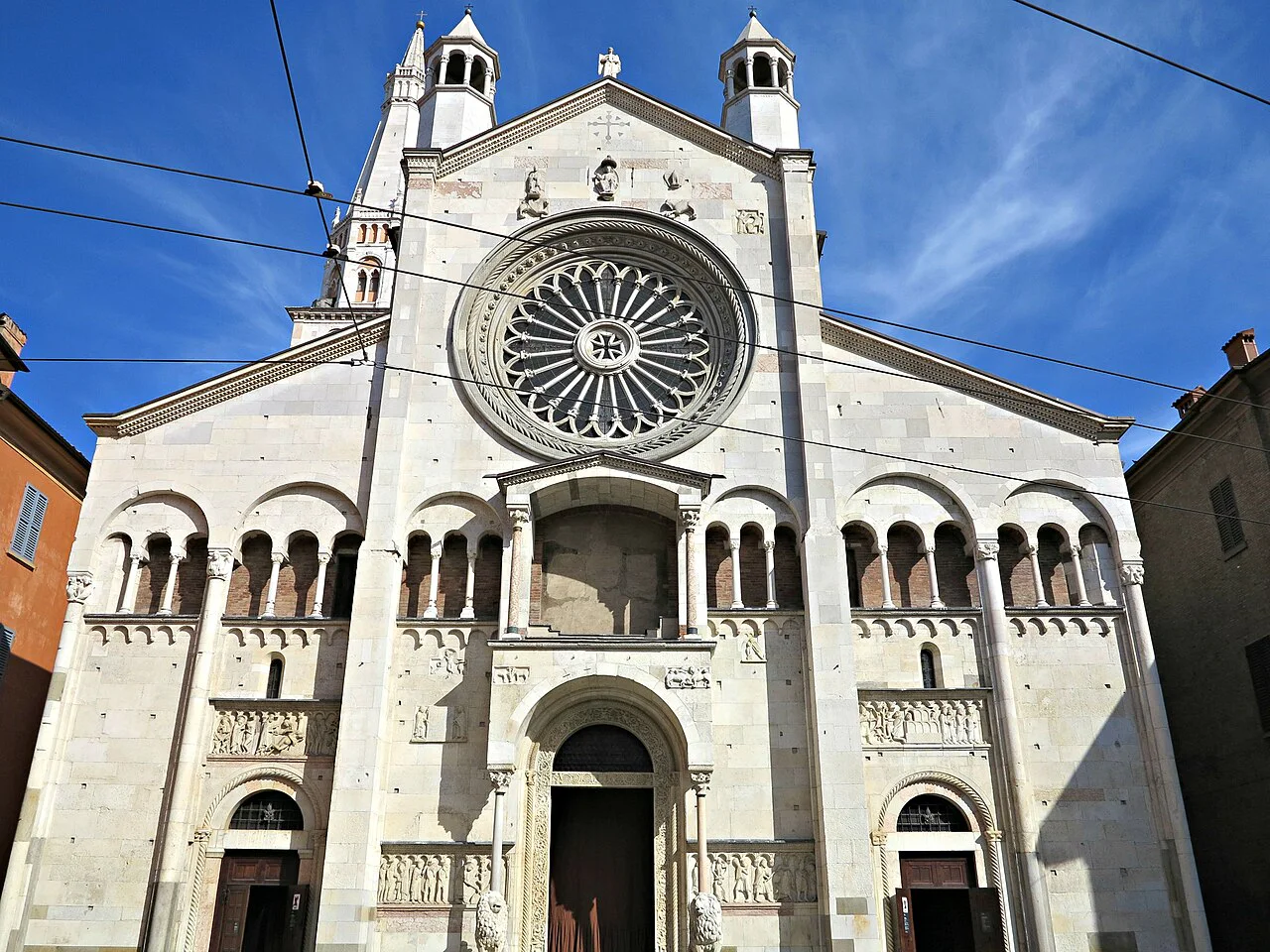
Modena · 37 km
Duomo di Modena
Content & sources
Photo: Mongolo1984 · CC BY-SA 4.0
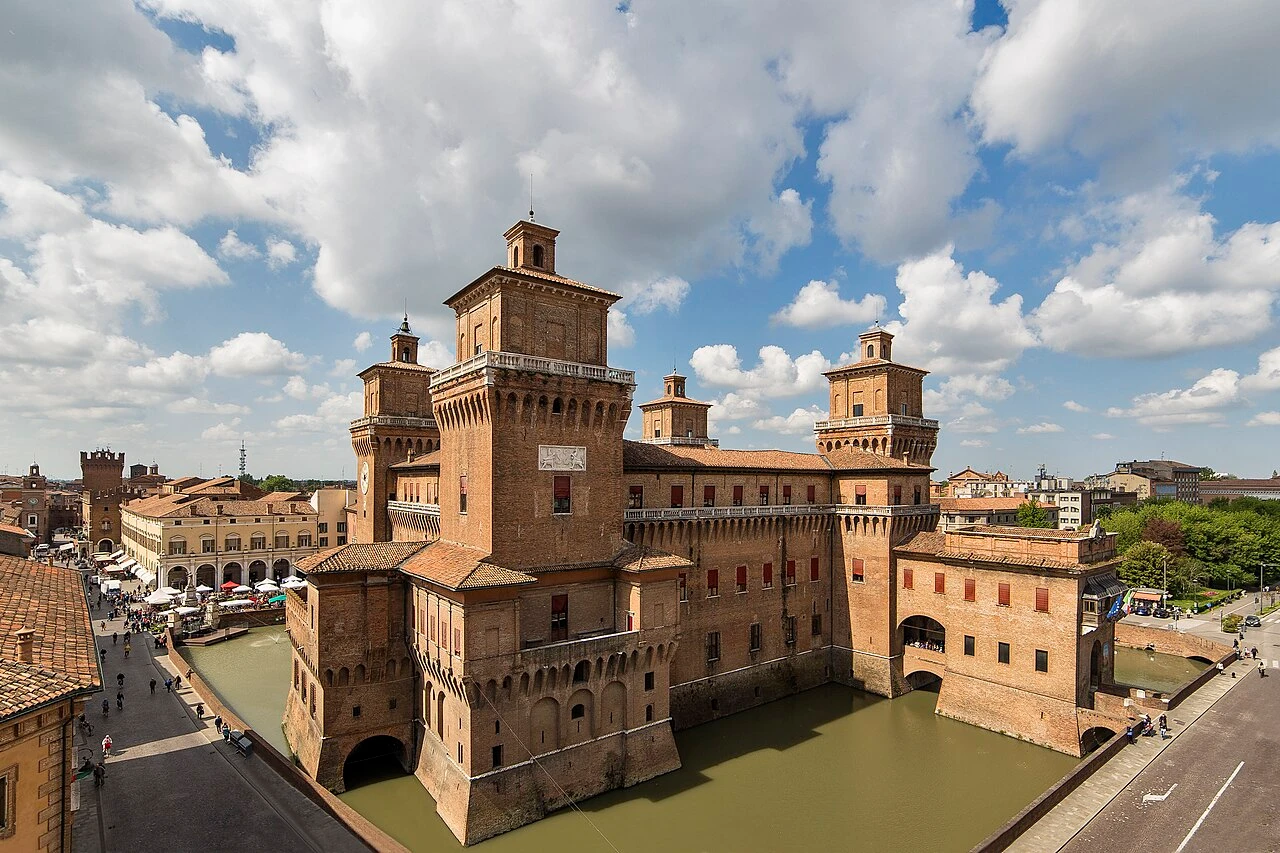
Ferrara · 44 km
Castello Estense
Content & sources
Photo: Nbisi · CC BY-SA 4.0
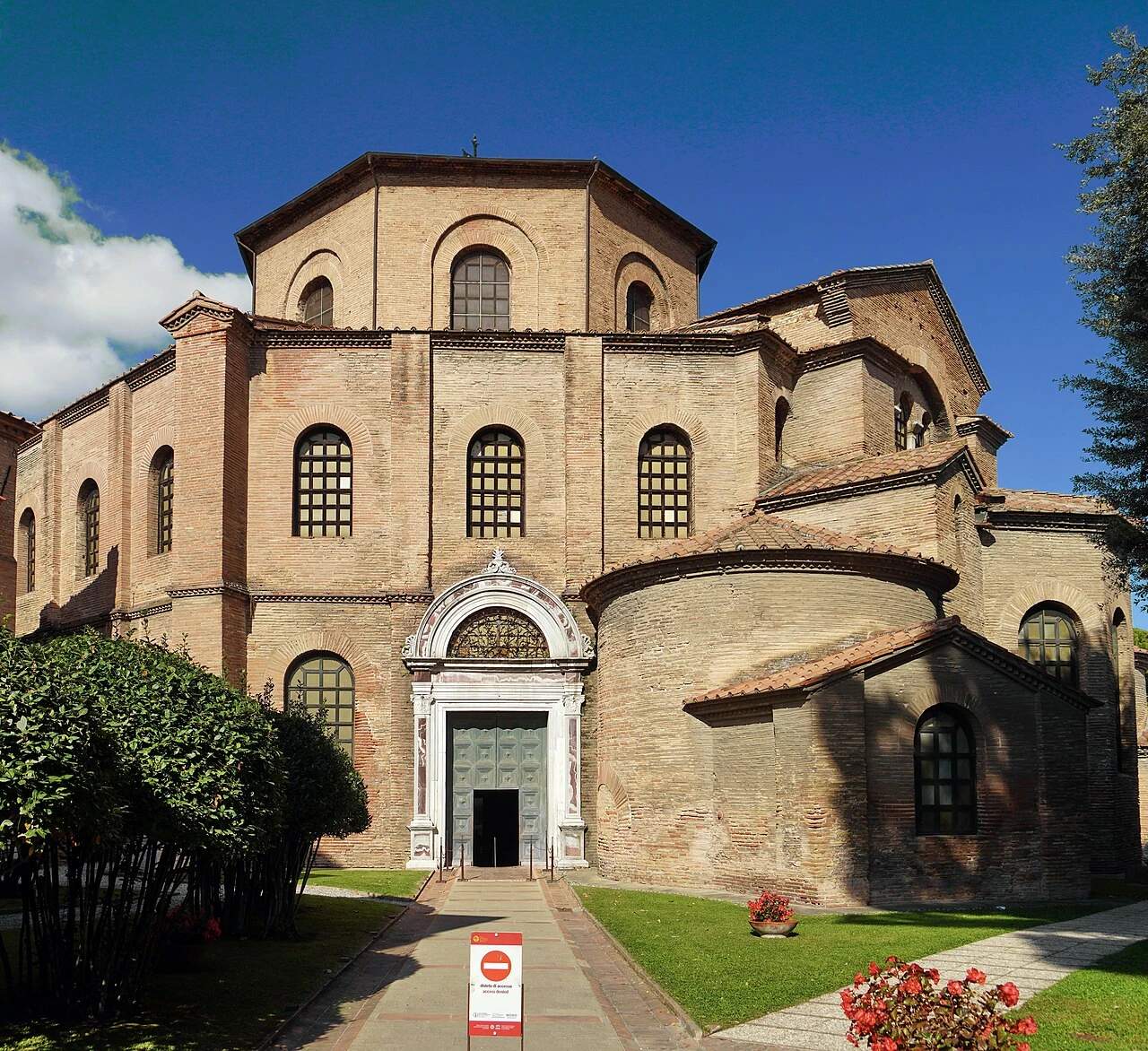
Ravenna · 68 km
Basilica of San Vitale
Content & sources
Commonists · CC BY-SA 4.0
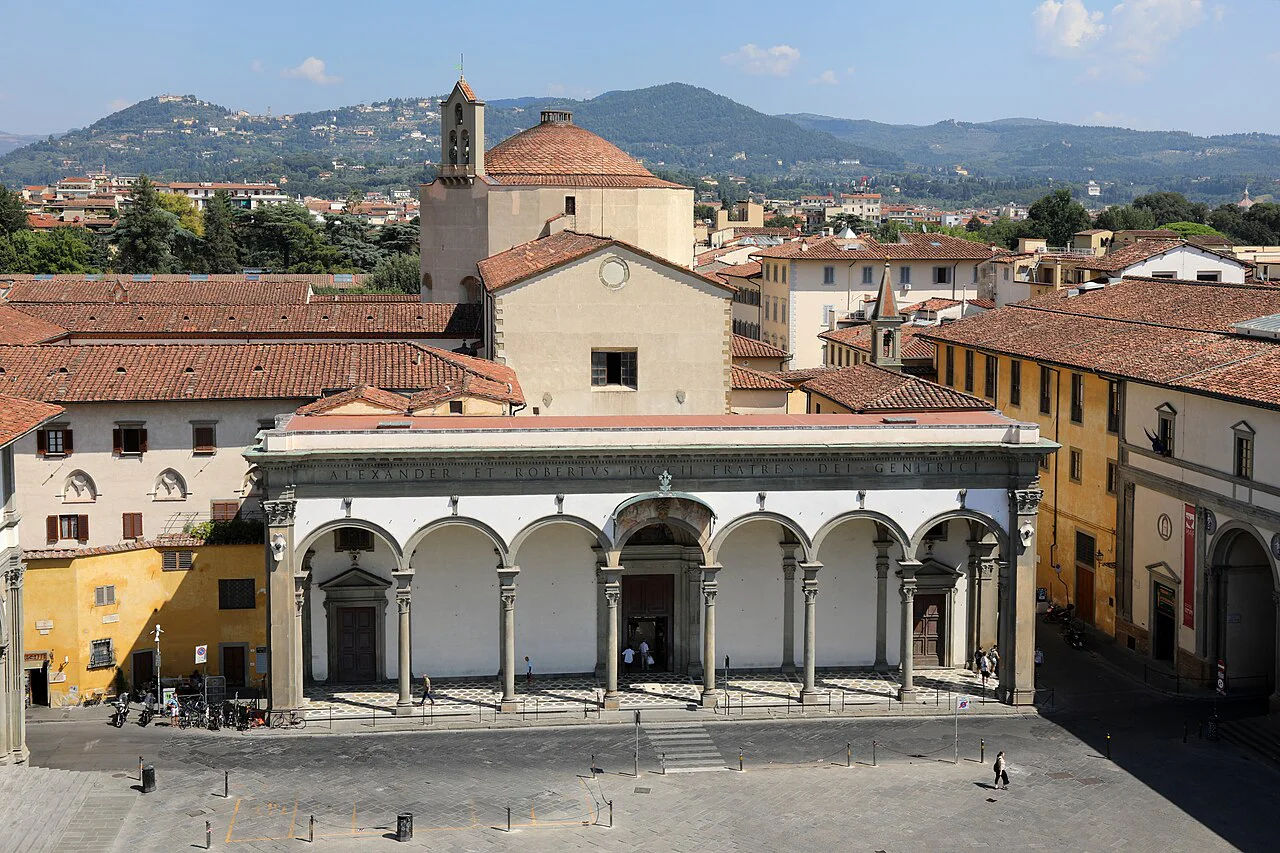
Florence · 80 km
Basilica della Santissima Annunziata
Content & sources
Francesco Bini · CC BY-SA 4.0