Languages
15Basilica di San Vitale Audio Guide
Basilica di San Vitale is a landmark in Ravenna, Italy. Explore it with Stanza's GPS-triggered offline audio guide — available in 15 languages.
Quick Facts
16
Stops
15
Languages
100%
Offline
📍 Ravenna, Italy · 44.4206°N, 12.1964°E
About Basilica di San Vitale
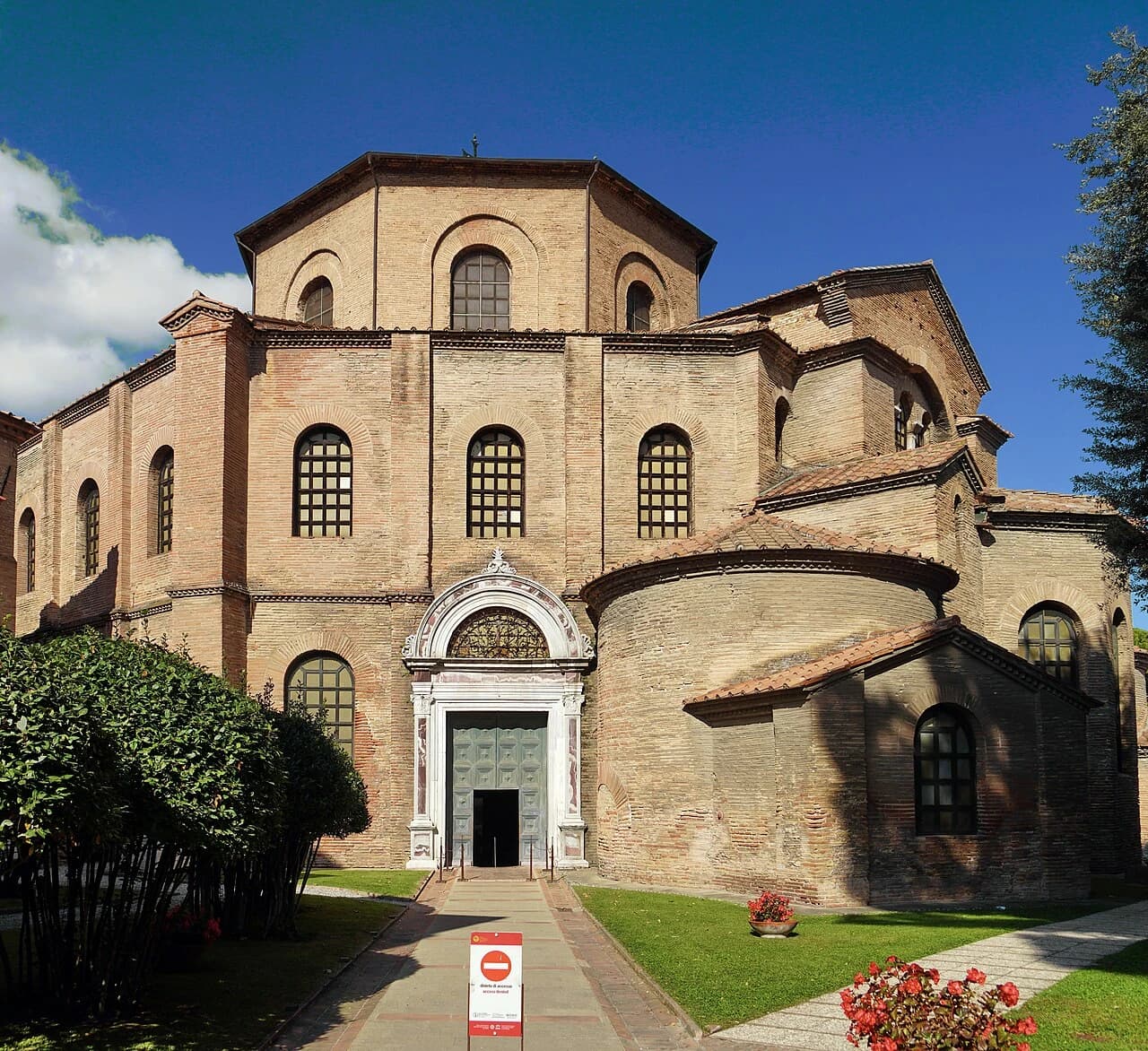
The Basilica of San Vitale is a 6th-century church in Ravenna, Italy, and a prominent example of early Christian Byzantine art and architecture. It is particularly famous for its extensive and well-preserved mosaics, depicting biblical scenes and imperial figures.
Basilica di San Vitale is also known as Basilica di San Vitale, Chiesa di San Vitale, San Vitale, Basilica di San Vitale, and 2 other names in various languages.
This self-guided audio tour features 16 narrated stops organized across 8 sections. As a basilica, Basilica di San Vitale offers a unique cultural experience in the heart of Ravenna, Italy.
The Stanza audio guide is available in 15 languages and works entirely offline — download the complete tour including audio narration, maps, and images before your visit. As you walk through Basilica di San Vitale, GPS-triggered narration plays automatically at each point of interest.
Last updated:
What you will hear
The Exterior and Monumental Entrance
Establishes the visual threshold and UNESCO World Heritage context. Includes the monumental portal and a general view of the basilica's unique brickwork.
The Octagonal Marvel
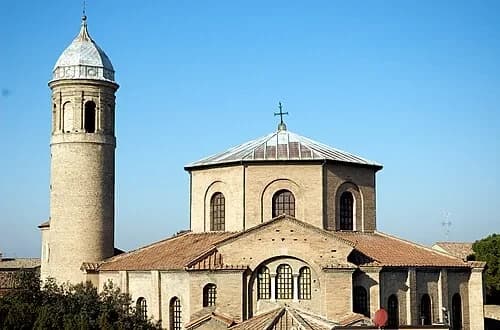
Construction of this architectural marvel began in 532 under the leadership of Bishop Ecclesius. What makes it immediately striking is its unique octagonal plan, a departure from the typical rectangular basilica shape of the era. This geometric precision creates a complex, centralized space that draws the eye upward and inward. As you observe the structure from the outside, notice the relatively simple brickwork. This was not an oversight by the builders; rather, it was a deliberate theological choice common in Byzantine design. The humble, earthy exterior is meant to represent the human body, which is mortal and plain. By contrast, the interior overflows with gold and light, symbolizing the immortal splendor of the human soul. This design approach was intended to prepare the faithful for a spiritual transition the moment they stepped through the doors. Financed largely by a wealthy banker named Julius Argentarius, the project took roughly fifteen years to complete. It remains one of the best-preserved examples of an early Byzantine church, standing today as a primary witness to the sophistication of the architects who worked during the reign of Emperor Justinian.
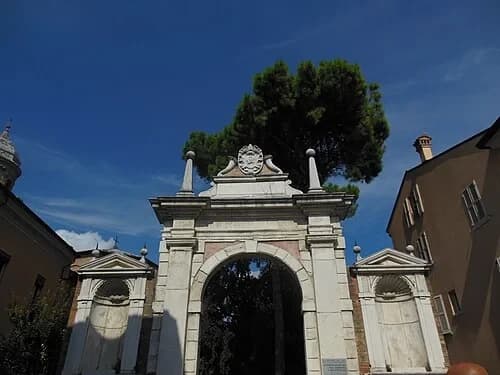
The Monumental Portal
The entrance to the basilica was designed with a specific psychological effect in mind. As you transition from the secular world of the city streets into the sacred precinct, notice the orientation of the entry vestibule, known as the narthex. Originally, visitors entered through a portal that was positioned at a sharp angle to the church's main axis. This was not a mistake or a result of land constraints; it was a deliberate architectural strategy. By placing the entrance off-center, the builders intended to momentarily disorient the visitor. As you move through this angled space, your line of sight is restricted. However, the moment you step through the inner doors, the grand, central octagonal space opens up before you in its full scale. This sudden reveal creates a sense of surprise and awe, effectively snapping the mind away from daily concerns and refocusing it on the spiritual atmosphere of the sanctuary. This technique, common in sophisticated Byzantine buildings, highlights the importance of the threshold—the boundary between the mundane world outside and the divine space inside. The geometry of the entrance essentially functions as a mental palate cleanser, clearing away the clutter of the city.
The Octagonal Nave and Basket Capitals
Explains the unique 'double-shelled' octagonal plan and focuses on the intricate Byzantine stonework.
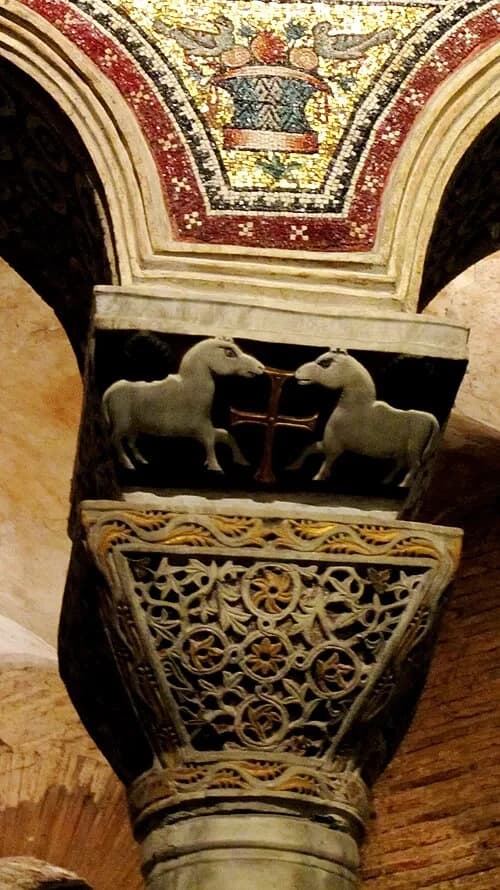
Byzantine Basket Capitals
Take a closer look at the capitals crowning the columns around the central space. Known as 'basket' capitals, these are hallmark features of Byzantine decorative art. Unlike the leafy Corinthian columns of ancient Rome, these capitals feature a dense, geometric interlacing pattern that resembles a woven basket. The stone has been deeply undercut using drills and chisels, a technique that allows light and shadow to play across the surface, making the solid material appear as light as lace or fine embroidery. Perched directly above each capital is another Byzantine innovation: the impost block. These four-sided, inverted pyramid-shaped blocks serve a crucial structural purpose. They transition the weight from the square base of the arches above down to the circular top of the column. This helps distribute the massive pressure of the upper walls more evenly. These blocks are often decorated with Christian symbols, such as crosses or stylized vegetation, which further enhances the visual complexity of the support system. The combination of the delicate, perforated capital and the solid, decorated impost block demonstrates the Byzantine desire to beautify every functional element of the building. The craftsmanship required to hollow out these intricate patterns without cracking the stone remains impressive.
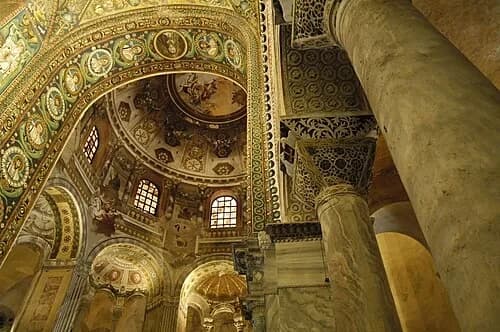
The Floating Dome
The soaring dome at the heart of the basilica is a masterpiece of early engineering. To achieve such height and stability without the massive, heavy walls of earlier Roman structures, the builders employed a clever technique using hollow terracotta tubes fitted into each other. Known as tubi fittili, these tapered clay pipes were arranged in a spiraling pattern. This method created a dome that was significantly lighter than one made of solid masonry or concrete. By reducing the overall weight, the architects were able to support the structure with relatively slender pillars and arches, rather than thick, solid walls. This lightness allowed for the inclusion of numerous high windows around the base of the dome and throughout the upper galleries. As light pours through these openings, it strikes the polished surfaces below, creating an ethereal glow that makes the entire stone structure feel nearly weightless. The goal was to create an interior that felt less like a building and more like a celestial space. While you look up at the ceiling, imagine the precision required to link thousands of these clay tubes together. This innovative approach allowed San Vitale to achieve a sense of verticality and luminosity that would influence church architecture for centuries.
The Labyrinth of the Soul
Focuses on the symbolic floor mosaic located in the presbytery, representing the difficult path to purification.
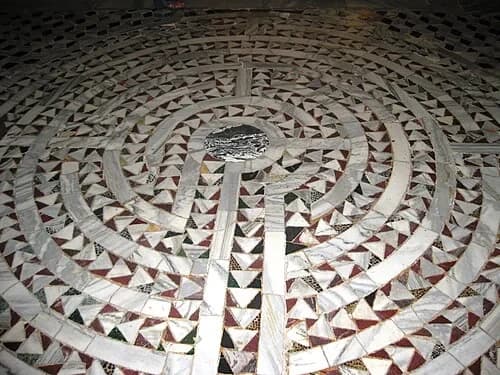
The Labyrinth of the Soul
Look down at the floor to find a fascinating detail inlaid directly into the marble. You will see a large, circular labyrinth design. This is not merely decorative; it carries deep symbolic meaning. In the early church, labyrinths were often used as a metaphor for the difficult, winding path that a person’s soul must travel through the world to reach purification. Unlike a maze, which has dead ends meant to confuse, a labyrinth has a single, continuous path that leads eventually to the center. For the faithful, following this path was a form of meditative prayer or a substitute for a long pilgrimage to Jerusalem. As you follow the lines with your eyes, notice the unevenness of the surface. The floor itself is ancient, and the ripples and dips in the stone are the physical record of nearly 1,500 years of footsteps. Generations of worshippers, monks, and visitors have crossed this space, slowly wearing down the marble. The various shades and patterns of the stones used in the floor were often salvaged from even older Roman buildings, a practice known as spolia. This recycled material grounds the basilica in its Roman past while looking forward to its Byzantine future.
The Apse and Christ Pantocrator
The theological heart of the basilica, showing a youthful Christ seated upon a blue globe.
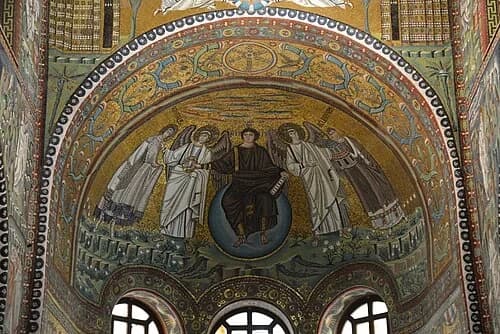
Christ the Ruler
The focus of the entire church is the magnificent apse mosaic, dominated by the figure of Christ the Redeemer. Notice that he is depicted in the early Byzantine style as a youthful, beardless man with flowing hair, seated upon a brilliant blue globe that represents the entire universe. This image presents him not as a suffering figure, but as a triumphant ruler and judge. He is flanked by two winged angels in white robes. On the far left, an angel presents Saint Vitalis, the martyr for whom this church is named. Vitalis is shown in rich imperial garb, reaching out to receive a golden crown of martyrdom from Christ. On the far right stands Bishop Ecclesius, who began the church's construction in the early 6th century. He is shown holding a small, detailed model of San Vitale itself, offering the building to the heavens. Below their feet is a lush, green landscape dotted with flowers and the four rivers of paradise flowing from the base of the throne. The entire scene is set against a background of shimmering gold leaf tiles, which catch the light and create a flickering, heavenly atmosphere. This composition perfectly blends local history with divine authority.
Empress Theodora and Her Retinue
The companion panel to Justinian, showcasing the Empress with her elaborate jewelry and court ladies.
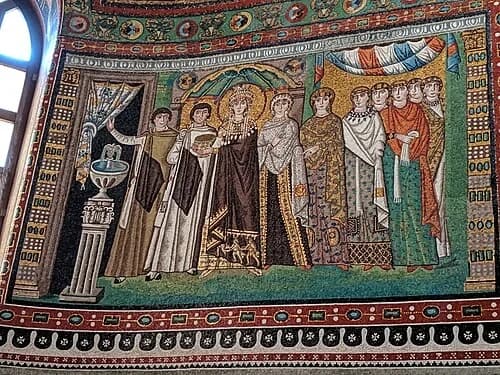
The Empress's Offering
On the wall facing Justinian is the panel depicting his wife, Empress Theodora, and her female court. Her figure is a striking display of imperial wealth; she wears a heavy purple cloak and a staggering amount of pearl and emerald jewelry that drips from her crown and collar. Theodora is shown in the middle of an oblatio, the formal ritual offering of a liturgical vessel. In her hands, she holds a large chalice encrusted with gems, which she is about to present. One of the most significant details is located on the hem of her purple robe: look closely, and you will see the figures of the Three Magi embroidered in gold. This is a deliberate iconographic link, comparing Theodora's imperial gift-giving to the biblical Magi who brought offerings to the Christ child. Unlike the Justinian panel, which has a plain background, Theodora is shown standing within an architectural setting featuring a fountain and a draped curtain. This mosaic is particularly poignant because Theodora died shortly after the church was consecrated, making this a posthumous tribute to her influence and piety. The vibrant colors and delicate shading of the faces demonstrate the highest level of skill reached by the mosaicists.
The Baroque Dome Frescoes
Contrasts the 6th-century mosaics with the 18th-century frescoes by Ubaldo Gandolfi.
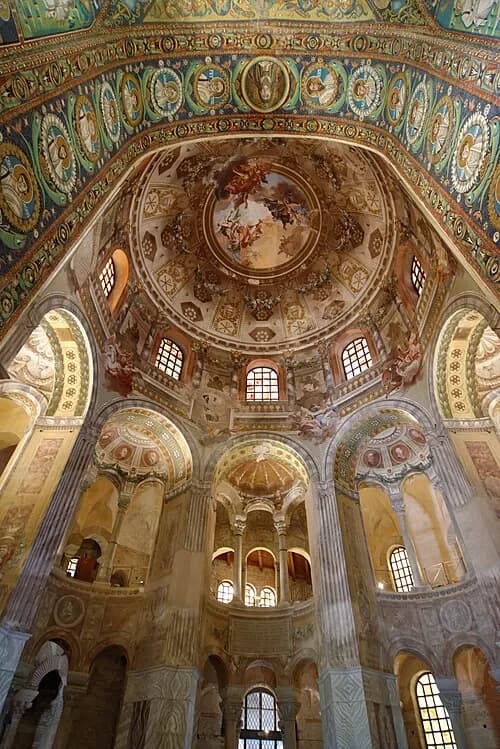
The Baroque Shift
While San Vitale is world-famous for its 6th-century mosaics, the building continued to evolve over more than a millennium. If you look up into the very highest reaches of the main central dome, you’ll see a dramatic shift in style. These are frescoes painted in the late 1700s by Ubaldo Gandolfi and his workshop. They depict a swirling, atmospheric scene of the heavens opening up. Notice how different this is from the mosaics we have been viewing. The Byzantine mosaics are rigid, flat, and rely on the shimmering quality of glass and gold to create their effect. In contrast, these Baroque-style frescoes use chiaroscuro—the play of light and shadow—to create a sense of three-dimensional depth and motion. Figures seem to float and tumble through the clouds, and the colors are softer, more earthy, and blended. This addition shows how subsequent generations sought to update the church to reflect the artistic tastes of their own time. This layering of centuries is common in Italian churches, where a single building can house treasures from the late Roman, Byzantine, and Renaissance periods all at once. The contrast between the ancient gold and the 18th-century clouds serves as a visual timeline.
The Sarcophagus of Isaac and Later Masterpieces
Features the 5th-century sarcophagus of a Byzantine exarch and the 16th-century painting of the saint's martyrdom.
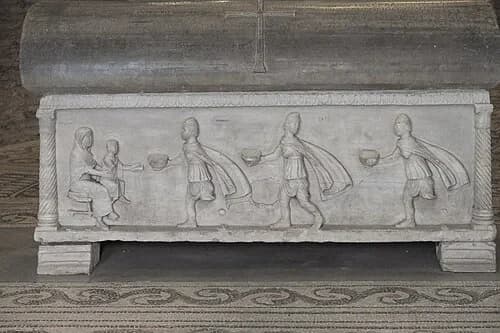
The Sarcophagus of Isaac
Tucked within the basilica is a significant artifact of imperial history: the Sarcophagus of Isaac. This 5th-century marble tomb is a fine example of late Roman and early Byzantine funerary art. Take a moment to examine the detailed relief carving on its side. It depicts the Adoration of the Magi, showing the three wise men in their characteristic caps approaching the Virgin Mary and the infant Christ. The carving is somewhat simplified compared to classical Roman sculpture, reflecting the shifting artistic priorities of the era toward clear, symbolic storytelling. The tomb belonged to Isaac, who served as the Exarch of Ravenna in the 7th century. The Exarch was essentially the governor or viceroy, representing the Byzantine Emperor's authority in Italy. The fact that such a high-ranking official was buried here underscores the basilica’s status as a site of immense political and religious importance. High-level administrators, military leaders, and wealthy patrons all vied for the prestige of being associated with San Vitale, even in death. The sarcophagus serves as a physical link to the people who actually lived and worked in Ravenna during its peak, reminding us that this building was the heart of a powerful imperial administration.
The National Museum of Ravenna
Concludes the tour at the adjacent museum, housed in the former Benedictine monastery, which contains further artifacts from the basilica.
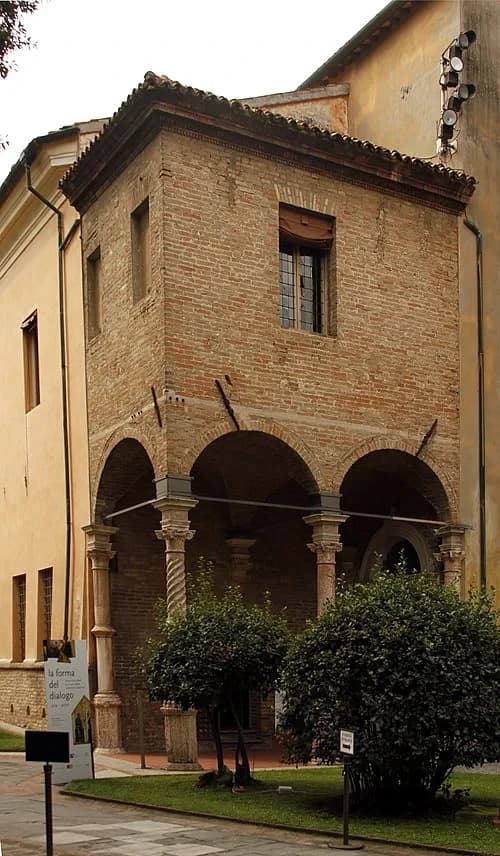
The Monastic Legacy
Stepping away from the golden glow of the mosaics, you encounter the serene environment of the former Benedictine monastery. This site evolved significantly from its origins as a modest 6th-century sanctuary. Throughout the Middle Ages and into the Renaissance, the religious community expanded the grounds into a sprawling monastic complex. Today, these historic buildings have been repurposed to house the National Museum of Ravenna, protecting a massive collection of Roman and Byzantine artifacts. The transition from the ornate, symbolic interior of the basilica to the functional monastic architecture offers a notable shift in atmosphere. Here, the focus moves from celestial gold to the grounded reality of local brickwork and open-air cloisters. These courtyards were originally designed for silence and communal life, providing a secluded retreat for the monks. As you explore the museum, you are walking through former refectories and dormitories that now showcase ancient icons and delicate ivory carvings. Before leaving, take a final look at the 16th-century cloister. The rhythmic pattern of the bricks and the simple, repeating arches of the arcade create a structured, peaceful environment. The weathered surfaces of the walls provide a final reminder of the site's long-standing role as a place of study and preservation.
Want to hear the rest?
Download the Stanza app to unlock all 16 stops and full GPS-guided navigation.
Frequently Asked Questions
How long does the Basilica di San Vitale audio tour take?
The Basilica di San Vitale audio guide includes 16 narrated stops. Most visitors spend 45 minutes to 1.5 hours exploring the complete tour, though you can listen at your own pace and skip or revisit any stop.
Is the Basilica di San Vitale audio guide available in my language?
Stanza supports 15 languages: English, Spanish, French, German, Italian, Portuguese, Russian, Japanese, Chinese, Korean, Arabic, Hindi, Polish, Dutch, Hebrew. Check the guide in the app to confirm the languages currently available for this tour.
Can I use the audio guide offline at Basilica di San Vitale?
Yes! Download the complete Basilica di San Vitale tour — including all audio, maps, and images — before your visit. The Stanza app works completely offline, so you don't need WiFi or mobile data at the venue.
How much does the Basilica di San Vitale audio guide cost?
The Stanza app is free to download. The current listed price for the Basilica di San Vitale audio guide is $2.99; app-store region and currency may affect the final price.
How do I use the Stanza audio guide at Basilica di San Vitale?
Download the free Stanza app, search for "Basilica di San Vitale", and download the tour. When you arrive at the venue, the app uses GPS to detect your location and automatically plays the relevant narration as you move between points of interest — completely hands-free.
What makes the Stanza audio guide different from other Basilica di San Vitale tours?
Stanza offers GPS-triggered narration that plays automatically as you walk through Basilica di San Vitale — no need to manually select stops. The tour is available in 15 languages, works fully offline, and includes 16 expertly narrated stops with images and historical context.
What other audio guides are available near Basilica di San Vitale?
Stanza offers multiple audio guides in Ravenna, Italy and nearby areas. After downloading the app, browse the map to discover all available tours near Basilica di San Vitale. Each guide can be downloaded for offline use.