Languages
15Basilica di Santa Croce Audio Guide
Basilica di Santa Croce is a landmark in Florence, Italy. Explore it with Stanza's GPS-triggered offline audio guide — available in 15 languages.
Quick Facts
30
Stops
15
Languages
100%
Offline
📍 Florence, Italy · 43.7685°N, 11.2627°E
About Basilica di Santa Croce
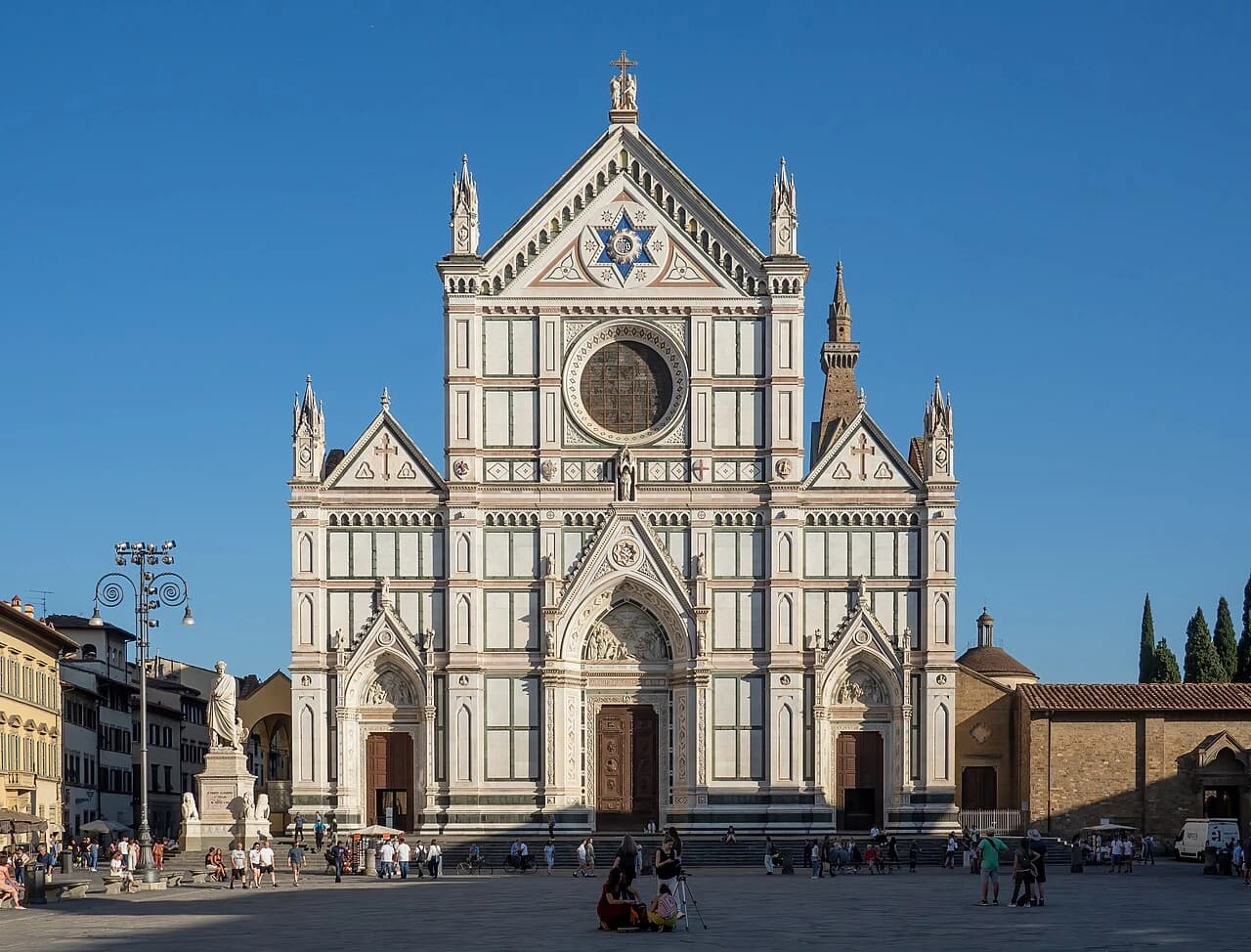
The Basilica of Santa Croce is a prominent Franciscan church in Florence, renowned as the burial place of notable Italians like Michelangelo, Galileo, and Machiavelli. It features magnificent Giotto frescoes and represents a major example of Italian Gothic architecture.
Basilica di Santa Croce is also known as Basilica of the Holy Cross, Church of Sant'Croce, Santa Croce, Chiesa di Santa Croce, and 1 other names in various languages.
This self-guided audio tour features 30 narrated stops organized across 8 sections. As a basilica, Basilica di Santa Croce offers a unique cultural experience in the heart of Florence, Italy.
The Stanza audio guide is available in 15 languages and works entirely offline — download the complete tour including audio narration, maps, and images before your visit. As you walk through Basilica di Santa Croce, GPS-triggered narration plays automatically at each point of interest.
Last updated:
What you will hear
The Pazzi Chapel
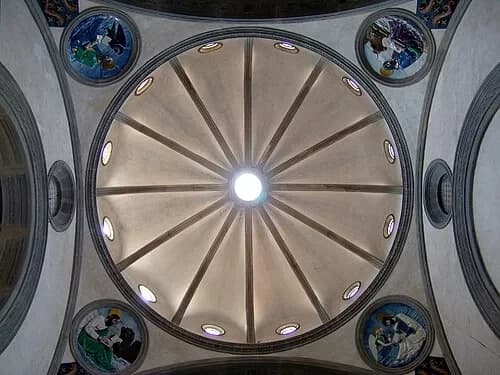
Focusing on Brunelleschi's Renaissance masterpiece and the terracotta roundels by Luca della Robbia.
Pazzi Chapel Dome
Inside the chapel, the interior space is defined by the striking contrast between the gray gray sandstone, known as pietra serena, and the clean white plaster. This color scheme emphasizes the structural lines and geometric forms of the architecture. Looking up, the umbrella dome is divided by twelve distinct ribs that draw the eye toward a central oculus, or circular opening, which lets in soft natural light. Small circular windows at the base of the dome provide additional illumination, creating a ring of light that makes the structure feel weightless. This design isn't just decorative; it reflects the Renaissance ideal of bringing mathematical, divine order to Earth through architecture. The clarity of the circle and the square here creates a space that feels calm, stable, and perfectly resolved. The dome acts as a focal point for the entire room, drawing the visitor’s attention toward the heavens in a quiet, organized manner.
The Tomb of Michelangelo
The first stop in the 'Temple of Italian Glories,' featuring the tomb of the Renaissance master designed by Vasari.
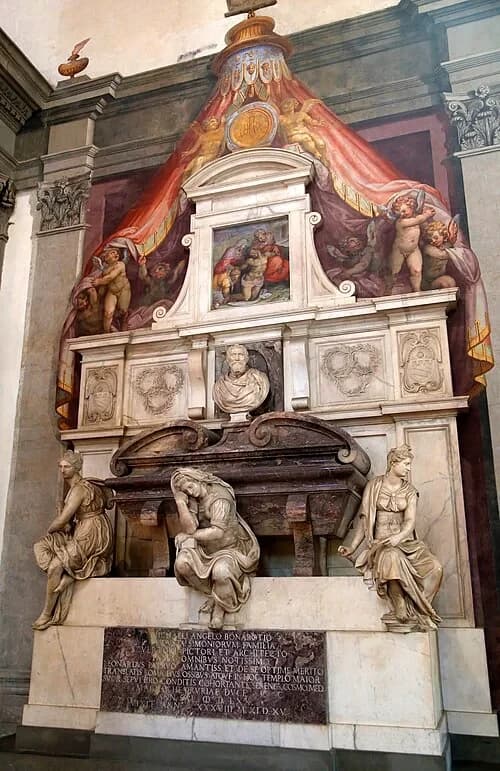
Tomb of Michelangelo Buonarroti
Giorgio Vasari · 17th century
Michelangelo Buonarroti, perhaps the most famous figure buried in Santa Croce, rests beneath this elaborate monument. Although he died in Rome in 1564, his body was famously smuggled back to Florence in a bale of hay to honor his final wish to be buried in his home city. Below the bust of the artist, three seated female figures weep in mourning. These allegories represent the three disciplines Michelangelo mastered during his long life: Painting, Sculpture, and Architecture. Each figure is positioned to show a different stage of grief, surrounding the sarcophagus of the man who transformed the course of Western art. The tomb is positioned along the right aisle of the church, serving as a primary pilgrimage site for art lovers from around the world. Its placement within the 'Temple of Italian Glories' ensures that Michelangelo remains at the center of the city’s cultural memory. The monument’s rich decorative elements and large scale reflect the immense respect Florence held for its favorite son.
The Machiavelli Monument
The tomb of the political philosopher Niccolò Machiavelli, another of the 'Italian Glories.'
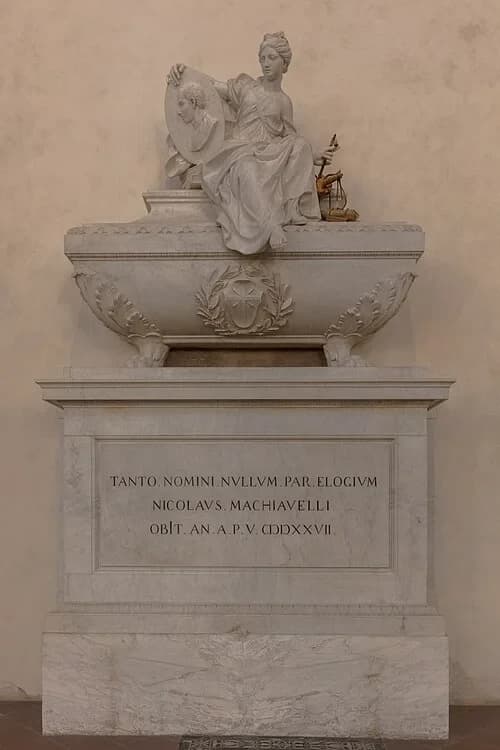
Niccolò Machiavelli
Look closely at the Latin inscription on the base: 'Tanto nomini nullum par elogium.' It translates to 'No praise is equal to so great a name.' This phrase reflects the deep respect Florence eventually sought to show for Niccolò Machiavelli, the author of 'The Prince.' While his name is often linked to cold-blooded political cunning, this 18th-century monument aims to reclaim him as a brilliant civic thinker and a dedicated patriot. Machiavelli served the Florentine Republic for years, and his political theories were born from the chaotic realities of 16th-century Italian power struggles. The seated figure above the inscription represents Politics or perhaps Justice, holding a medallion with the philosopher’s likeness. By placing him here among Italy’s greatest minds, the city celebrated his role as a precursor to modern political science rather than a teacher of ruthlessness. The simple, dignified lines of the monument reflect the Enlightenment period's preference for clarity and reason, providing a sober space to contemplate a legacy that continues to influence world leaders today.
The Cavalcanti Annunciation
Donatello's gilded limestone masterpiece, a landmark in Renaissance sculpture.
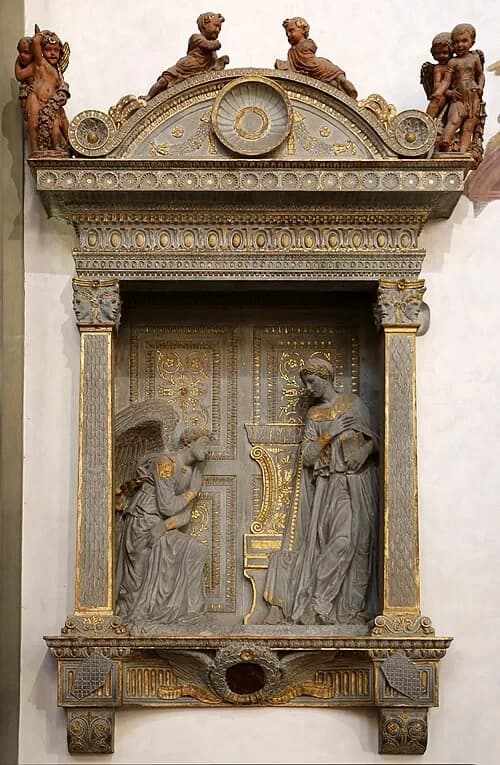
Cavalcanti Annunciation
Donatello · 1433 · rock
This masterpiece of gilded limestone was created by Donatello in the mid-1430s. It represents a significant leap forward in the history of sculpture because of how the artist handled depth and movement within a shallow space. Instead of a stiff, saintly figure, notice the very human reaction of Mary. She looks genuinely surprised and slightly hesitant, pulling her cloak around her as she turns away from the Angel Gabriel. This emotional realism was revolutionary, moving religious art away from detached icons toward relatable human experiences. Donatello’s playful side is visible at the very top of the pediment. Take a look at the terracotta putti, or cherubs, perched on the edges. They appear almost bored or mischievous, leaning over the side as if watching the scene below. The entire frame is heavily decorated with classical motifs and gold leaf, making the figures pop against the background. By using different levels of relief—some parts are almost flat, while others are nearly three-dimensional—Donatello creates a sense of deep architectural space on a relatively thin piece of stone.
Giotto's Fresco Cycles
The Bardi and Peruzzi chapels house the revolutionary frescoes by Giotto, marking the birth of naturalism in Western art.
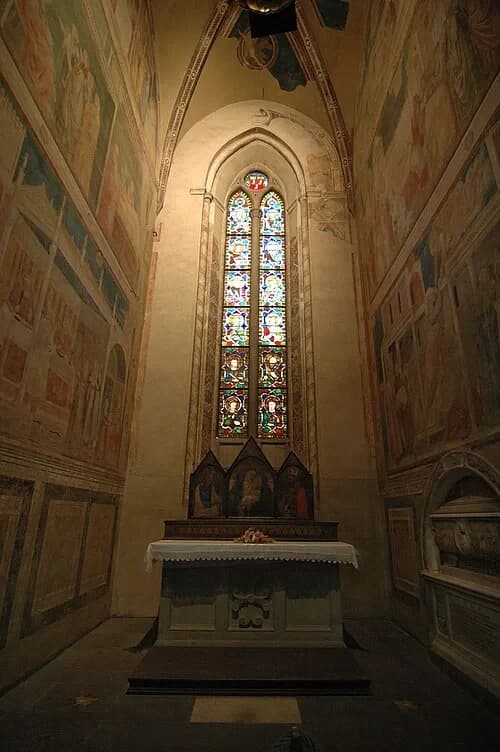
Peruzzi Chapel
Giotto · 1318
The Peruzzi Chapel was painted by Giotto slightly earlier than the neighboring Bardi Chapel, commissioned by another powerful banking family. It features stories dedicated to Saint John the Baptist and Saint John the Evangelist. You may notice that the figures here appear more faded or worn than in other parts of the church. This is due to Giotto’s use of the 'fresco secco' technique, where paint is applied to dry plaster rather than wet. While this method allowed him to include much finer details and a broader range of colors during creation, it is unfortunately far less durable than traditional fresco, leading to significant paint loss over the centuries. Despite the wear, the monumental scale of the figures is still apparent. Giotto focused on making the characters appear solid and heavy, grounding them in their surroundings. In the scenes of the Baptist’s life, you can see how he used architecture to frame the action, creating a sense of narrative flow. These paintings were highly influential for later artists, including Masaccio and Michelangelo, who came here to study Giotto's mastery of volume and composition. Even in their weathered state, they represent a key moment in the transition toward a more naturalistic style of art.
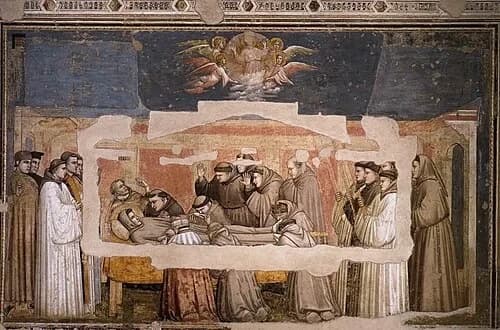
The Death of Saint Francis
In this specific scene within the Bardi Chapel, Giotto demonstrates why he is often called the 'father of Western painting.' Look at the faces of the friars gathered around the body of Saint Francis. Instead of the flat, symbolic expressions found in earlier Byzantine-style works, Giotto gives each man a unique, naturalistic reaction to grief. Some weep openly, while others bend over the body in quiet prayer or look toward the heavens in disbelief. This focus on emotional realism was a radical departure for the early 1300s. Giotto also revolutionized the use of space. Notice how the figures are arranged in a clear, three-dimensional setting. They have actual weight and volume, occupying a 'stage' that feels deep and realistic. This sense of perspective, though not yet mathematically perfect, allowed viewers to feel like they were standing in the room with the saints. By moving away from golden, abstract backgrounds and toward grounded, architectural environments, Giotto set the stage for the entire Italian Renaissance. He transformed painting from a collection of symbols into a medium that could tell powerful, human stories through light, shadow, and anatomy.
The Main Chapel and the Legend of the True Cross
The spiritual heart of the basilica, decorated with Agnolo Gaddi's vibrant fresco cycle.
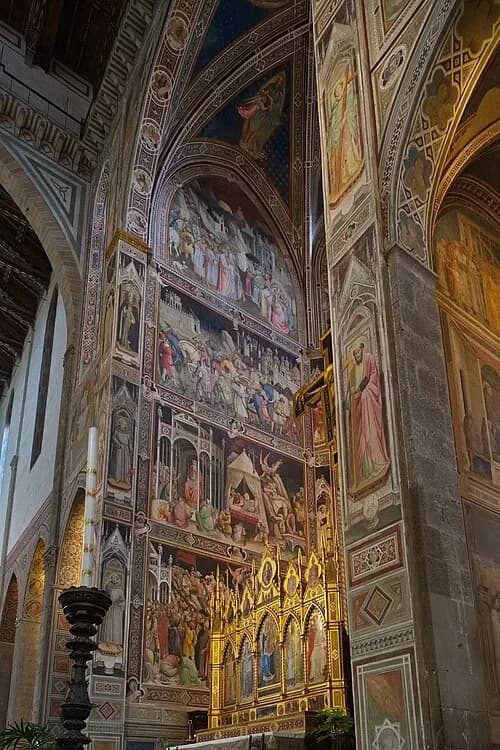
Legend of the True Cross
Agnolo Gaddi · 1380s · fresco
The High Altar is surrounded by a massive cycle of frescoes painted by Taddeo Gaddi, who was Giotto's most famous and dedicated student. This cycle tells the 'Legend of the True Cross,' a complex narrative that follows the wood used for Jesus' cross from its origins in the Garden of Eden to its eventual rediscovery by Empress Helena. This was a popular subject in medieval Europe, combining biblical history with later legends to create a grand, spiritual epic. As you look at these walls, notice the shift in style from Giotto’s earlier work. Gaddi’s compositions are more crowded and complex, filled with architectural details and many characters. He moved away from the simple, focused drama of his master toward a more decorative and descriptive narrative style. Each scene is packed with visual information, from the clothing of the figures to the detailed cityscapes in the background. The cycle begins on the upper right wall and wraps around the chapel, ending with the cross being carried into Jerusalem. It was designed to be read like a giant picture book by the congregation, most of whom could not read the Latin texts the stories were based on.
The Sacristy and Rinuccini Chapel
A beautifully preserved 14th-century interior with original furnishings and frescoes by Giovanni da Milano.
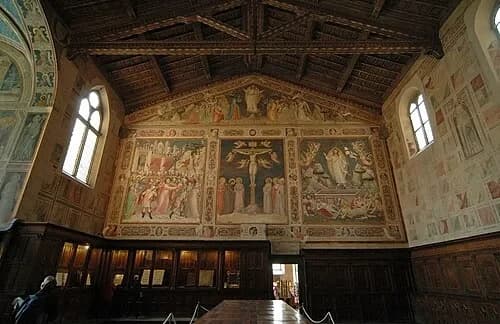
The Great Sacristy
Stepping into the sacristy is like stepping back 600 years. This large, vaulted room was where the Franciscan friars and priests prepared for mass. It remains remarkably intact, still featuring the original 14th-century wooden cabinets that were used to store liturgical vestments, chalices, and holy books. The dark wood and massive scale of these storage units reflect the importance and organization required to run such a large basilica. The walls are covered with frescoes, most notably the large Crucifixion scene on the far wall. This room provides a rare look at the daily operational life of the monks, which was a mix of intense labor and quiet prayer. Notice how the space feels different from the grand nave; it is more functional and focused on the practical needs of the clergy. Even the floor, worn down by centuries of footsteps, tells a story of constant use. The sacristy served as the bridge between the private world of the monastery and the public world of the church. Because it was less frequently renovated than the main chapels, it has preserved many original features that allow us to understand the architectural and spiritual atmosphere of the late Middle Ages.
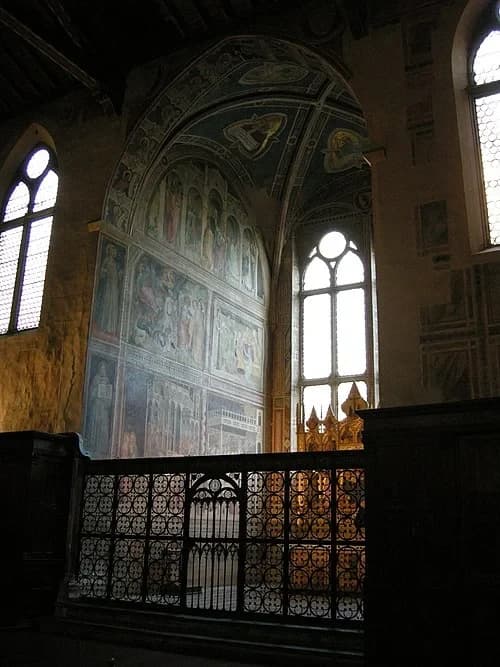
Rinuccini Chapel
Tucked away inside the sacristy, the Rinuccini Chapel is one of the best-preserved artistic spaces in all of Santa Croce. The frescoes here were painted by Giovanni da Milano in the 1360s and depict scenes from the life of the Virgin Mary and Mary Magdalene. This chapel is considered a peak example of the Gothic style in Florence, characterized by its elegant, elongated figures and high level of descriptive detail. Look closely at the faces and the architectural settings in the paintings. You can see a remarkable level of delicacy in the features and the way the artist rendered the textures of clothing and stone. Giovanni da Milano was influenced by the northern Gothic styles, which emphasized decorative beauty and intricate patterns. Unlike some of the more weathered frescoes in the main church, the colors here remain exceptionally vibrant. This preservation is partly because the chapel is somewhat sheltered within the sacristy, protecting it from the temperature swings and humidity changes found in the larger nave. The wrought-iron gate that protects the entrance is also a fine piece of 14th-century craftsmanship, designed to keep the space sacred and separate for the Rinuccini family who commissioned it.
Museum Highlights
Exploring the other treasures of the museum, including Donatello's gilded bronze Saint Louis and Gaddi's Tree of Life.
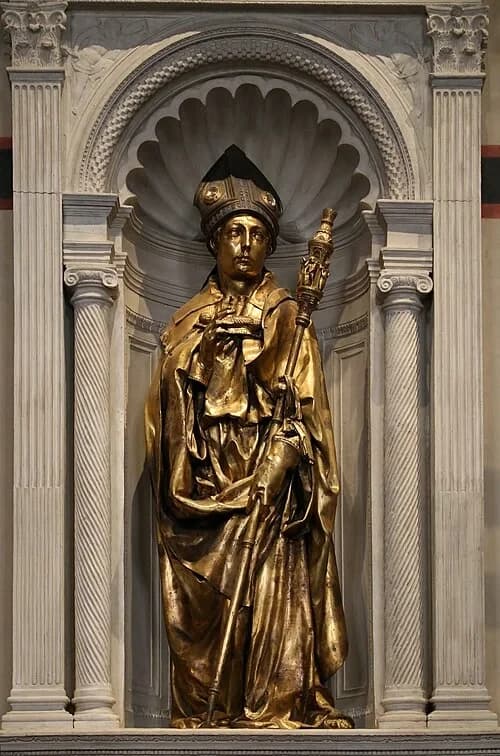
Saint Louis of Toulouse
Donatello · 1423 · bronze
Standing before you is a massive gilded bronze statue of Saint Louis of Toulouse, created by Donatello in the early 1420s. This work was originally commissioned for a niche on the exterior of the Orsanmichele church in Florence. Its scale is impressive, and the technique used to create it was highly complex. Donatello cast the statue in several separate bronze pieces and then covered them with thick gold leaf, which is why it still shines so brightly today. The statue's weight is enormous, and its construction was a major feat of engineering for the time. The subject, Louis of Toulouse, was a French prince who famously renounced his claim to the throne of Naples to join the Franciscan order as a humble friar. Donatello captured this duality in the sculpture; the saint wears a bishop's miter and carries a staff, yet his expression is one of deep humility. His robes are heavy and voluminous, almost swallowing his thin frame. This statue was later moved to Santa Croce, where it found a permanent home in the refectory. It serves as a reminder of the core Franciscan values of poverty and service, even among those born to the highest levels of power and wealth.
Want to hear the rest?
Download the Stanza app to unlock all 30 stops and full GPS-guided navigation.
Frequently Asked Questions
How long does the Basilica di Santa Croce audio tour take?
The Basilica di Santa Croce audio guide includes 30 narrated stops. Most visitors spend 45 minutes to 1.5 hours exploring the complete tour, though you can listen at your own pace and skip or revisit any stop.
Is the Basilica di Santa Croce audio guide available in my language?
Stanza supports 15 languages: English, Spanish, French, German, Italian, Portuguese, Russian, Japanese, Chinese, Korean, Arabic, Hindi, Polish, Dutch, Hebrew. Check the guide in the app to confirm the languages currently available for this tour.
Can I use the audio guide offline at Basilica di Santa Croce?
Yes! Download the complete Basilica di Santa Croce tour — including all audio, maps, and images — before your visit. The Stanza app works completely offline, so you don't need WiFi or mobile data at the venue.
How much does the Basilica di Santa Croce audio guide cost?
The Stanza app is free to download. Free and paid audio guides are available; current prices are shown in the app.
How do I use the Stanza audio guide at Basilica di Santa Croce?
Download the free Stanza app, search for "Basilica di Santa Croce", and download the tour. When you arrive at the venue, the app uses GPS to detect your location and automatically plays the relevant narration as you move between points of interest — completely hands-free.
What makes the Stanza audio guide different from other Basilica di Santa Croce tours?
Stanza offers GPS-triggered narration that plays automatically as you walk through Basilica di Santa Croce — no need to manually select stops. The tour is available in 15 languages, works fully offline, and includes 30 expertly narrated stops with images and historical context.
What other audio guides are available near Basilica di Santa Croce?
Stanza offers multiple audio guides in Florence, Italy and nearby areas. After downloading the app, browse the map to discover all available tours near Basilica di Santa Croce. Each guide can be downloaded for offline use.