Languages
15Abbey of Monte Cassino Audio Guide
Abbey of Monte Cassino is a landmark in Cassino, Italy. Explore it with Stanza's GPS-triggered offline audio guide — available in 15 languages.
Quick Facts
22
Stops
15
Languages
100%
Offline
📍 Cassino, Italy · 41.4900°N, 13.8140°E
About Abbey of Monte Cassino
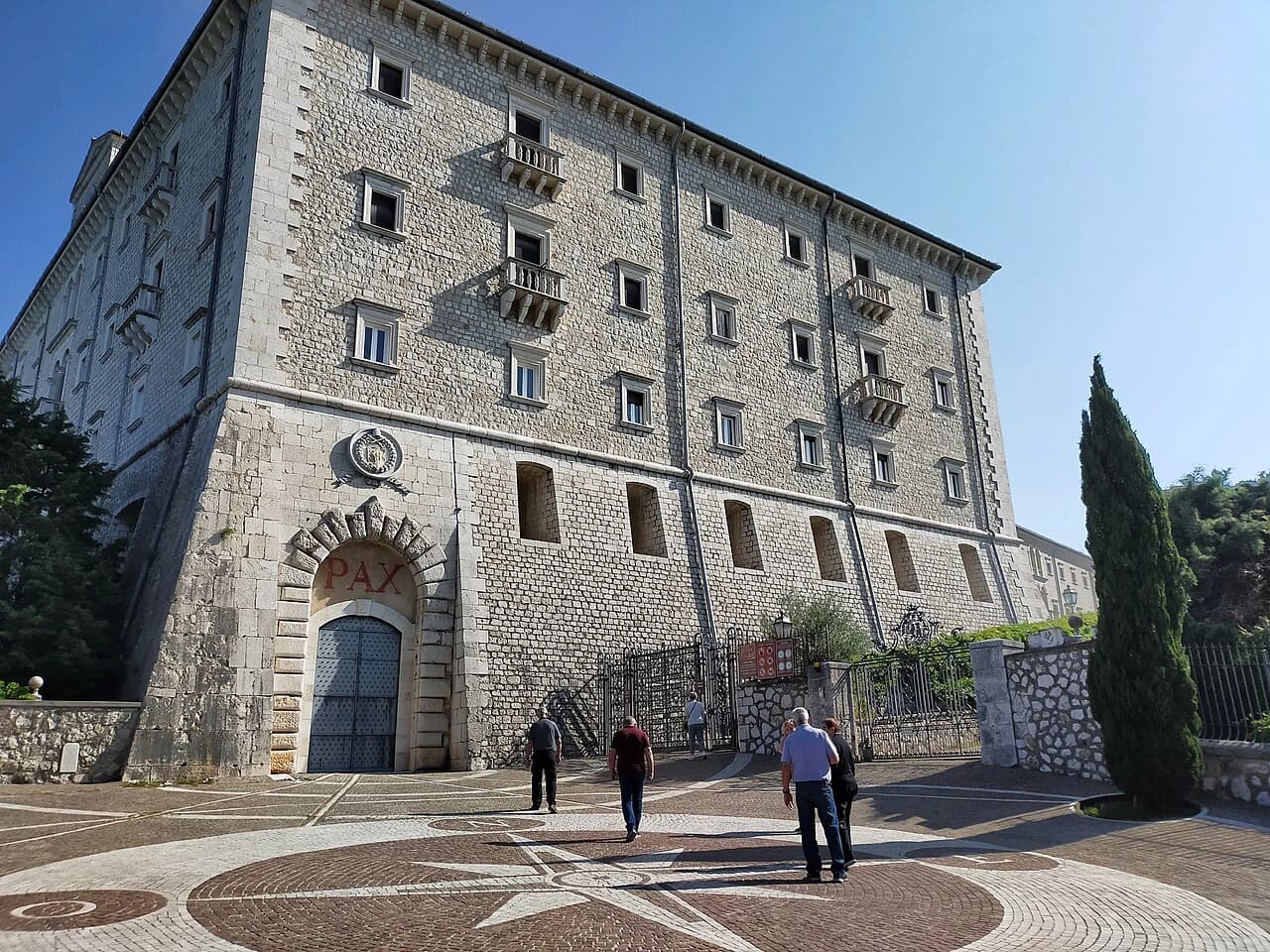
A historic Benedictine abbey located on a rocky hill, famous for its destruction and reconstruction during World War II. It serves as a spiritual center, seminary, and an Italian national museum.
Abbey of Monte Cassino is also known as Monte Cassino Abbey, Monte Cassino, Abbatia Territorialis Montis Cassini, Archicoenobium Montis Casini, and 9 other names in various languages.
This self-guided audio tour features 22 narrated stops organized across 6 sections, including The Entrance Cloister and Apollo's Legacy, The Bramante Cloister and Loggia del Paradiso, Cathedral of Santa Maria Assunta: The Phoenix Reborn, The High Altar and Monastic Heart, The Crypt of the Saints, The Battle and the Polish Military Cemetery. As a abbey, Abbey of Monte Cassino offers a unique cultural experience in the heart of Cassino, Italy.
The Stanza audio guide is available in 15 languages and works entirely offline — download the complete tour including audio narration, maps, and images before your visit. As you walk through Abbey of Monte Cassino, GPS-triggered narration plays automatically at each point of interest.
Last updated:
What you will hear
The Entrance Cloister and Apollo's Legacy
The first interior space, built on the site of the pagan temple Saint Benedict famously dismantled in 529.
The Entrance Cloister
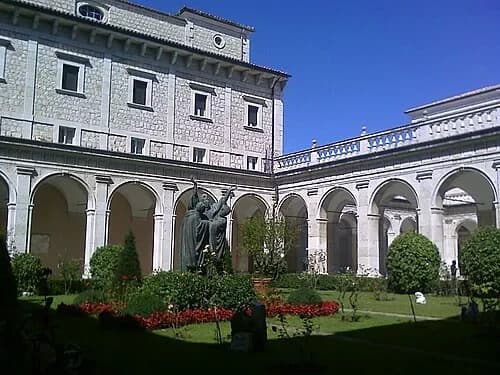
This peaceful entrance marks the exact spot where Saint Benedict transformed a pagan sanctuary into a center for Christian worship. When Benedict arrived on this summit in 529, tradition holds that he found a temple dedicated to the Roman god Apollo. In a decisive act of conversion, he smashed the pagan idol, toppled the altar, and burned the sacred grove. On these same foundations, he established a small oratory dedicated to Saint Martin of Tours, effectively claiming the peak for the Christian faith. This cloister serves as the symbolic start of the monastic journey, transitioning the visitor from the outside world into the structured life of the abbey. The architecture here creates a quiet atmosphere intended for reflection, mirroring the shift in purpose Benedict envisioned for the site. While the original oratory is gone, the layout follows a historical plan that honors the initial footprint of the monastery’s earliest days. It is the threshold where the history of Casinum ended and the legacy of Monte Cassino began. Modern visitors walk the same path through these arches as centuries of pilgrims before them.
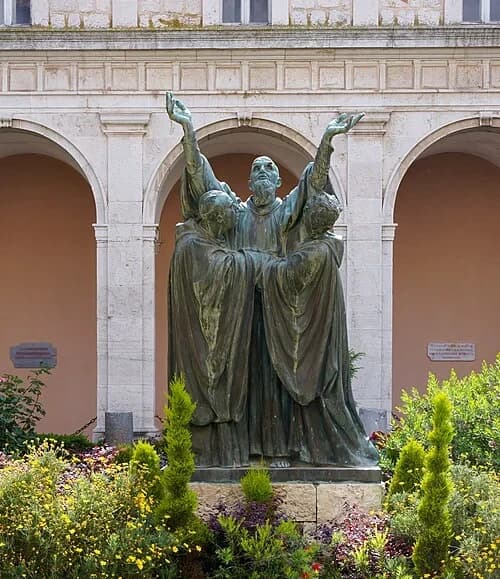
Saint Benedict of Nursia
The figure depicted in this statue is Saint Benedict of Nursia, the influential monk who drafted the fundamental rules of Western monastic life right here on this mountain. Around the year 529, he composed the Rule of Saint Benedict, a foundational text that established the principles of poverty, chastity, and obedience for religious communities. His core philosophy is summarized by the Latin phrase 'Ora et Labora,' meaning 'Pray and Work,' a balanced approach to life that helped shape the development of European civilization through the Middle Ages. In this statue, the saint is captured in an expressive pose, his arms raised in a gesture that captures his spiritual focus. The figure emphasizes the authority of the man who turned this mountaintop into a global center of learning and labor. His Rule provided a framework for stability in a chaotic era, ensuring that monasteries became preserves of knowledge and culture. This statue stands as a tribute to the individual whose vision for community life continues to influence monastic orders around the world today. Notice the detailed drapery of his robes and the focused expression on his face.
The Bramante Cloister and Loggia del Paradiso
Focuses on the Renaissance architecture of the central courtyard and the 'Loggia of Paradise' with its valley views.
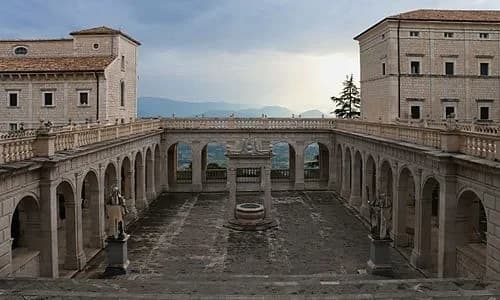
The Bramante Cloister
With its rhythmic arches and central well, this courtyard reflects the balanced proportions of high Renaissance architecture. At the center stands an octagonal cistern, a feature that was once essential for harvesting and storing rainwater on this high, dry mountain summit. While the clean lines and classical details suggest a structure centuries old, what you see here is a meticulous reconstruction. Following the total destruction of the abbey in World War II, architect Giuseppe Breccia Fratadocchi led the effort to rebuild the monastery using original plans and surviving fragments. The goal was to restore the harmony of the 16th-century design, which was influenced by the school of the architect Bramante. The resulting space provides a sense of order and serenity, characteristic of the Benedictine aesthetic. The pale stone and open galleries are designed to invite light and air into the heart of the monastery while maintaining a secluded environment for the resident monks. This cloister illustrates the post-war commitment to restoring the abbey's historical identity as precisely as possible, ensuring the Renaissance spirit was not lost. The symmetry of the double-arched porticos creates a perfect square around the central cistern.
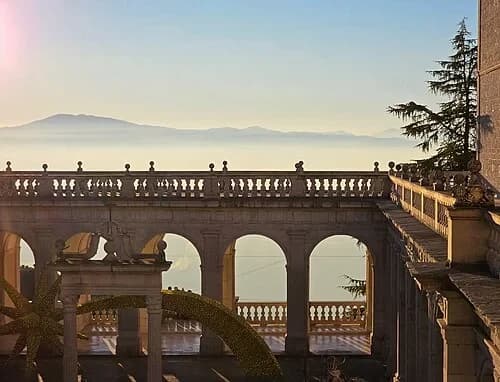
Loggia of Paradise
The sweeping view from this balcony across the Liri Valley explains why it earned the name Loggia del Paradiso, or the Loggia of Paradise. Standing here, the silence of the mountain is often punctuated only by the sound of the wind. However, this same breathtaking vantage point was a double-edged sword during the mid-20th century. The strategic military value of this height, overlooking the primary route to Rome, made the abbey a focus of intense combat during World War II. In February 1944, Allied forces, believing German troops were using the monastery as an observation post, launched a massive aerial bombardment that leveled the entire complex. The contrast between the current tranquility and the violent history of the site is profound. This balcony offers a moment to appreciate the natural beauty that inspired the monks while acknowledging the tactical significance that nearly led to the abbey’s permanent disappearance. The reconstruction has preserved this viewpoint, allowing visitors to once again look out over the landscape that has witnessed over a millennium of both prayer and conflict. On a clear day, the valley floor stretches out in a patchwork of green and gold below.
Cathedral of Santa Maria Assunta: The Phoenix Reborn
Introduces the main church, rebuilt 'where it was and as it was' after the 1944 destruction.
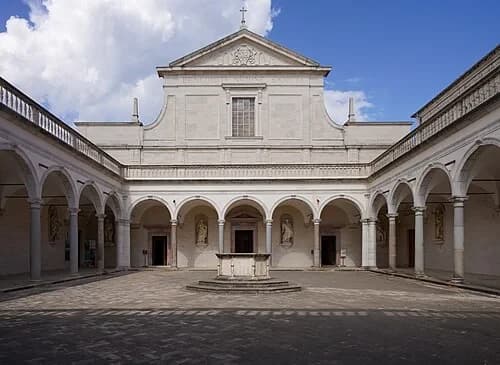
Cathedral Facade
The facade of the Cathedral of Santa Maria Assunta is a striking example of the restoration philosophy 'com'era, dov'era,' which translates to 'as it was, where it was.' When you look at the clean, white stone of the current structure, you are seeing a precise 1950s replica of the 17th-century Baroque original. The wartime bombing of 1944 had reduced the previous cathedral to a heap of rubble, but rather than building something modern, the decision was made to reconstruct the church exactly as it stood before the conflict. Every architectural detail, from the height of the pediment to the placement of the decorative elements, was meticulously recreated using historical photographs and surviving architectural drawings. This dedication to historical accuracy was intended to heal the cultural wound caused by the war and restore the spiritual heart of the monastery. The facade serves as the gateway to the abbey's most sacred interior, its classical proportions signaling the transition into a space designed for grand liturgy. It represents a monumental achievement in post-war reconstruction. Look for the Latin inscriptions and coats of arms that decorate the upper levels of the stonework.
The High Altar and Monastic Heart
Explores the most sacred area of the church, including the altar where Saint Benedict is buried and the grand organ.
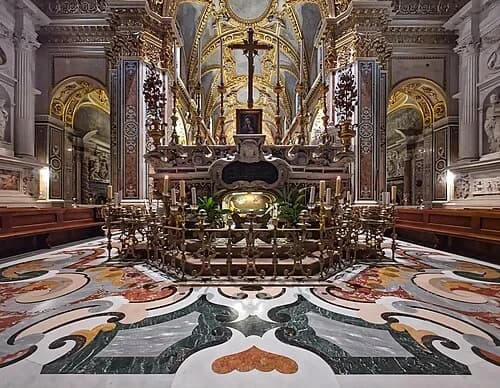
The High Altar
Positioned at the spiritual center of the cathedral, this high altar rests directly above the most significant site in the entire abbey. Deep beneath this structure lies the tomb of Saint Benedict and his twin sister, Saint Scholastica. For centuries, the monks claimed that the remains of their founder were safely interred here, despite rumors of theft or loss during various destructions. These claims were finally confirmed during the post-war reconstruction effort. In 1950, a careful archaeological excavation was conducted beneath the ruins of the altar, uncovering two skeletons that were scientifically identified as belonging to a man and a woman from the 6th century. This discovery solidified the abbey's status as a primary pilgrimage site, as the physical relics of the father of Western monasticism had miraculously survived the devastating 1944 bombing. Today, the altar is decorated with fine marble and metalwork, serving as a fitting monument for the siblings who established the monastic tradition on this mountain. It remains the focus of daily prayer and the ultimate destination for those visiting to honor the legacy of the Benedictine Order. The altar's intricate marble inlay reflects the same Baroque style found throughout the nave.
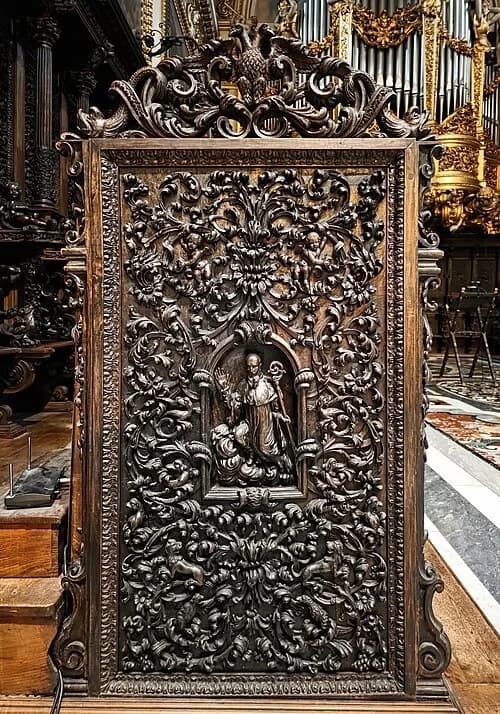
Baroque Wood Carvings
The choir stalls are a masterclass in Baroque craftsmanship, featuring dense relief work and symbolic figures carved with incredible detail. Look closely at the upper sections to find the double-headed eagle, a symbol often associated with the high-ranking patrons of the abbey. These stalls are where the monks spend several hours each day in communal prayer and meditation. The wood used here was carefully selected and carved to ensure that the voices of the monks would carry clearly through the church without the need for modern amplification. The acoustics of the choir area are designed so that even a soft chant can resonate throughout the nave. This environment of focused prayer is the heartbeat of the monastery, where the 'Ora' of the Benedictine Rule is physically enacted. Every figure and floral motif in the carvings serves to create a space of beauty intended to lift the mind toward the spiritual. Despite being reconstructions of the originals lost in 1944, these stalls maintain the historical atmosphere of the monastic choir, preserving the traditional setting for the monks' daily cycle of worship that has continued for over fifteen centuries. The dark, polished wood provides a somber contrast to the bright marble floor.
The Crypt of the Saints
The sacred lower level that survived the 1944 bombing, containing the remains of Benedict and Scholastica.
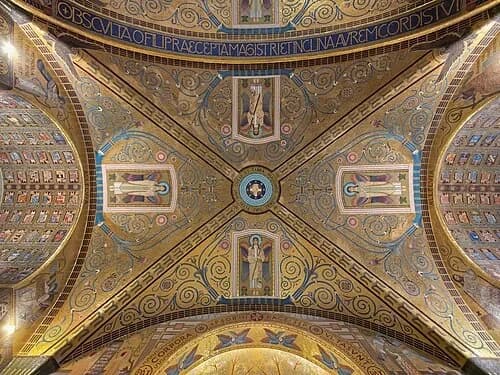
The Golden Mosaic Ceiling
The ceiling of the crypt is covered in a brilliant display of golden tesserae, creating a celestial canopy that has endured through crisis. The intricate patterns of gold are interwoven with Latin inscriptions that offer prayers and celebrate the divine. This vaulting survived the 1944 bombardment primarily because the crypt was built directly into the mountain's solid bedrock. While the massive cathedral above was reduced to rubble, the sheer weight and strength of the mountain shielded this lower chamber, allowing it to serve as a vital sanctuary during the height of the battle. The golden surfaces are designed to catch and reflect any available light, giving the underground space an ethereal, glowing quality. This use of mosaic is a nod to the ancient traditions of Christian art, where gold symbolized the light of heaven. The preservation of these mosaics was seen as a miracle by the surviving monks, providing a glimmer of hope and continuity amidst the total destruction of the rest of their home. Today, the ceiling remains one of the most striking features of the abbey, representing the literal and spiritual foundation upon which the monastery was rebuilt. Look for the stylized angelic figures that populate the corners of the vaults.
The Battle and the Polish Military Cemetery
Reflects on the 1944 destruction and the Polish soldiers who finally captured the ruins.
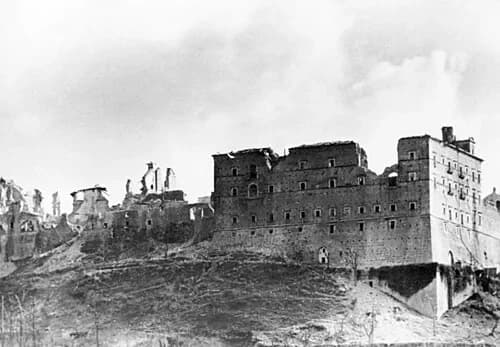
The Ruin of 1944
On February 15, 1944, the long history of the Abbey of Monte Cassino was nearly brought to an end. Allied forces, wrongly believing that German paratroopers were using the monastery as a fortified lookout and artillery position, launched a massive aerial assault. Over the course of the day, 1,000 tons of high explosives and incendiary bombs were dropped on the summit. The result was the total destruction of the historic structures, leaving only a jagged silhouette of broken walls. Tragically, historical records later confirmed that no German soldiers were actually inside the abbey at the time of the bombing. Instead, the buildings were occupied by approximately 230 Italian civilians who had sought refuge within the sacred walls, believing the monastery would be spared from the violence. All of them were killed in the strikes. Paradoxically, the destruction actually created a better defensive position; German troops moved into the rubble immediately after the bombing, using the ruins to hold off Allied advances for several more months. This image serves as a somber record of that loss, illustrating the moment when fifteen centuries of architecture were reduced to a pile of stone.
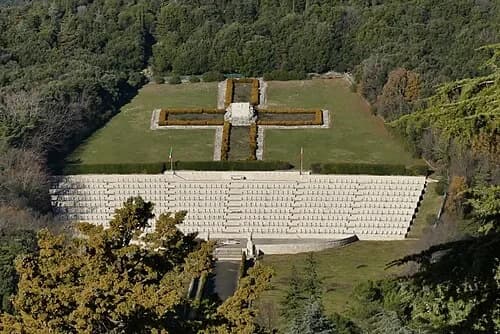
Polish Military Cemetery
Looking down toward the slopes of the mountain, you can see the Polish Military Cemetery, the final resting place for over 1,000 soldiers. The capture of Monte Cassino was one of the most difficult and bloody chapters of the Italian campaign. Between January and May 1944, Allied forces launched three major offensives to take the summit, all of which ended in failure and heavy casualties. It was not until the fourth battle in May that the 2nd Polish Corps, under the command of General Władysław Anders, finally succeeded in breaking the German lines. The fighting was brutal, often involving hand-to-hand combat among the ruins and rocky outcrops. On the morning of May 18, 1944, a patrol of the 12th Podolian Uhlans finally reached the ruins of the abbey and raised the Polish flag over the rubble. This cemetery was constructed shortly after the war ended, directly on the ground where the soldiers fell. The site remains a point of deep national significance for Poland, as these men fought for the liberation of Europe while their own homeland remained occupied. The rows of uniform crosses reflect the scale of the sacrifice required to finally open the road to Rome.
Want to hear the rest?
Download the Stanza app to unlock all 22 stops and full GPS-guided navigation.
Frequently Asked Questions
How long does the Abbey of Monte Cassino audio tour take?
The Abbey of Monte Cassino audio guide includes 22 narrated stops. Most visitors spend 45 minutes to 1.5 hours exploring the complete tour, though you can listen at your own pace and skip or revisit any stop.
Is the Abbey of Monte Cassino audio guide available in my language?
Stanza supports 15 languages: English, Spanish, French, German, Italian, Portuguese, Russian, Japanese, Chinese, Korean, Arabic, Hindi, Polish, Dutch, Hebrew. Check the guide in the app to confirm the languages currently available for this tour.
Can I use the audio guide offline at Abbey of Monte Cassino?
Yes! Download the complete Abbey of Monte Cassino tour — including all audio, maps, and images — before your visit. The Stanza app works completely offline, so you don't need WiFi or mobile data at the venue.
How much does the Abbey of Monte Cassino audio guide cost?
The Stanza app is free to download. The current listed price for the Abbey of Monte Cassino audio guide is $1.99; app-store region and currency may affect the final price.
How do I use the Stanza audio guide at Abbey of Monte Cassino?
Download the free Stanza app, search for "Abbey of Monte Cassino", and download the tour. When you arrive at the venue, the app uses GPS to detect your location and automatically plays the relevant narration as you move between points of interest — completely hands-free.
What makes the Stanza audio guide different from other Abbey of Monte Cassino tours?
Stanza offers GPS-triggered narration that plays automatically as you walk through Abbey of Monte Cassino — no need to manually select stops. The tour is available in 15 languages, works fully offline, and includes 22 expertly narrated stops with images and historical context.
What other audio guides are available near Abbey of Monte Cassino?
Stanza offers multiple audio guides in Cassino, Italy and nearby areas. After downloading the app, browse the map to discover all available tours near Abbey of Monte Cassino. Each guide can be downloaded for offline use.