Languages
15Basilica di San Marco Audio Guide
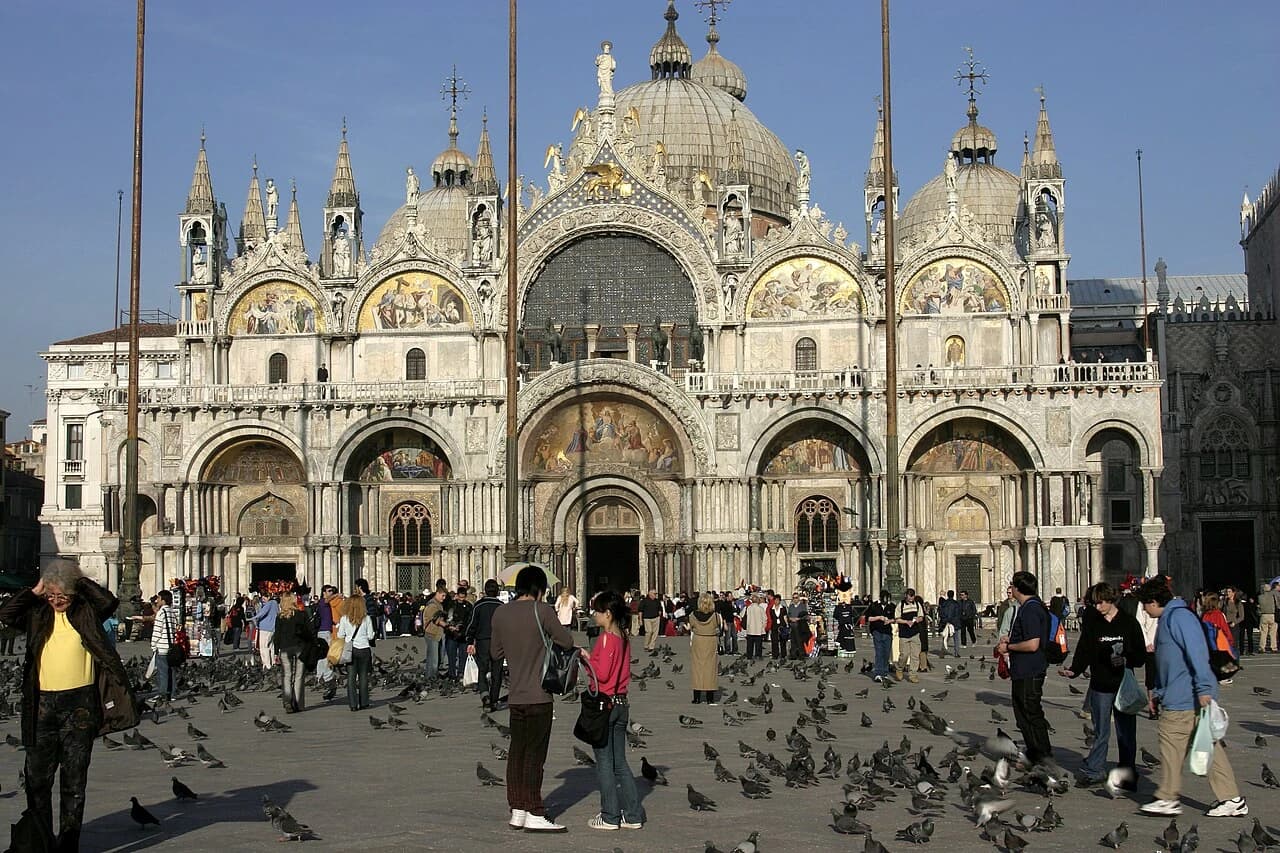
Basilica di San Marco is a landmark in Venice, Italy. Explore it with Stanza's GPS-triggered offline audio guide — available in 15 languages.
Quick Facts
25
Stops
15
Languages
100%
Offline
📍 Venice, Italy · 45.4344°N, 12.3397°E
About Basilica di San Marco
St Mark's Basilica is a magnificent cathedral in Venice, Italy, renowned for its opulent Byzantine architecture, intricate mosaics, and as a symbol of Venetian wealth and power. It has served as the patriarchal cathedral of Venice since 1807.
Basilica di San Marco is also known as Basilica San Marco, The Patriarchal Cathedral Basilica of Saint Mark, Patriarchal Cathedral Basilica of Saint Mark, Saint Mark's Basilica, and 8 other names in various languages.
This self-guided audio tour features 25 narrated stops organized across 8 sections. As a cathedral, Basilica di San Marco offers a unique cultural experience in the heart of Venice, Italy.
The Stanza audio guide is available in 15 languages and works entirely offline — download the complete tour including audio narration, maps, and images before your visit. As you walk through Basilica di San Marco, GPS-triggered narration plays automatically at each point of interest.
Last updated:
What you will hear
The Western Façade and Central Portal
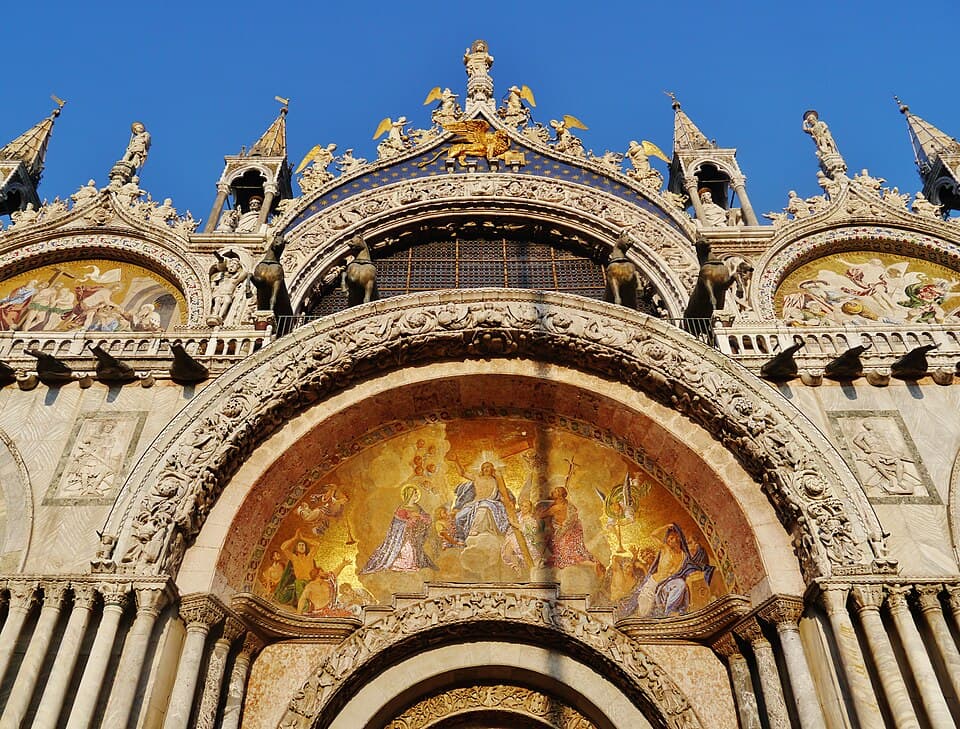
Establishing the grand exterior and the narrative of the Last Judgment. Need a wide shot and a detail of the central portal.
The Central Portal
The grand central portal commands attention with its layers of concentric arches that frame the main entrance. Each layer is covered in detailed carvings that reward a close look. In the inner bands, you can find figures representing the months of the year, showing seasonal activities, alongside personifications of various virtues. Above these intricate stone carvings, the large central mosaic depicts the Last Judgment. While this specific mosaic dates from the 19th century, it follows a long-standing tradition of placing this powerful theme at church entrances to remind visitors of their spiritual path. In the Middle Ages, this entire façade acted as a massive billboard. For travelers arriving by sea and stepping onto the pier, it broadcasted both the religious devotion of the city and its immense civic pride. The combination of holy imagery and high-quality craftsmanship was a clear sign of Venice's status as a world power. The sheer scale and complexity of this portal were designed to overawe every visitor before they even stepped foot inside the 'Golden Church.'
The Portal of Sant'Alipio
Focusing on the foundation story of Venice. This is the only surviving 13th-century mosaic on the facade.
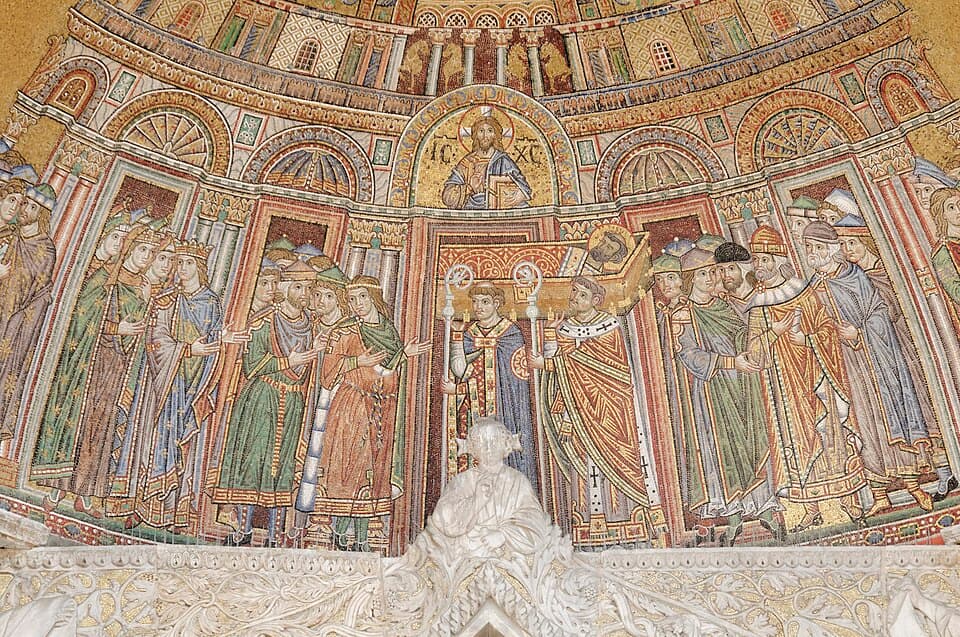
The Great Heist Mosaic
The story depicted here is one of the most famous and colorful legends in Venice. In the year 828, two merchants named Buono and Rustico traveled to Alexandria to retrieve the body of Saint Mark. To bypass the local guards, they reportedly hid the saint's remains in baskets and covered them with layers of pork—a substance the guards would not touch due to religious prohibitions. This mosaic captures the triumphant arrival of the relics in Venice. Notice the detailed figures of local officials and clergy gathered to receive the precious cargo with great solemnity. The shimmering gold tiles surrounding the scene are more than just decoration; in the language of Byzantine art, they signify the divine approval and holiness of the event. For Venetians, possessing the remains of an Apostle was a massive political and religious achievement, elevating the city's status among the powers of Europe. This mosaic serves as a permanent celebration of the cunning and devotion that brought the city its patron saint.
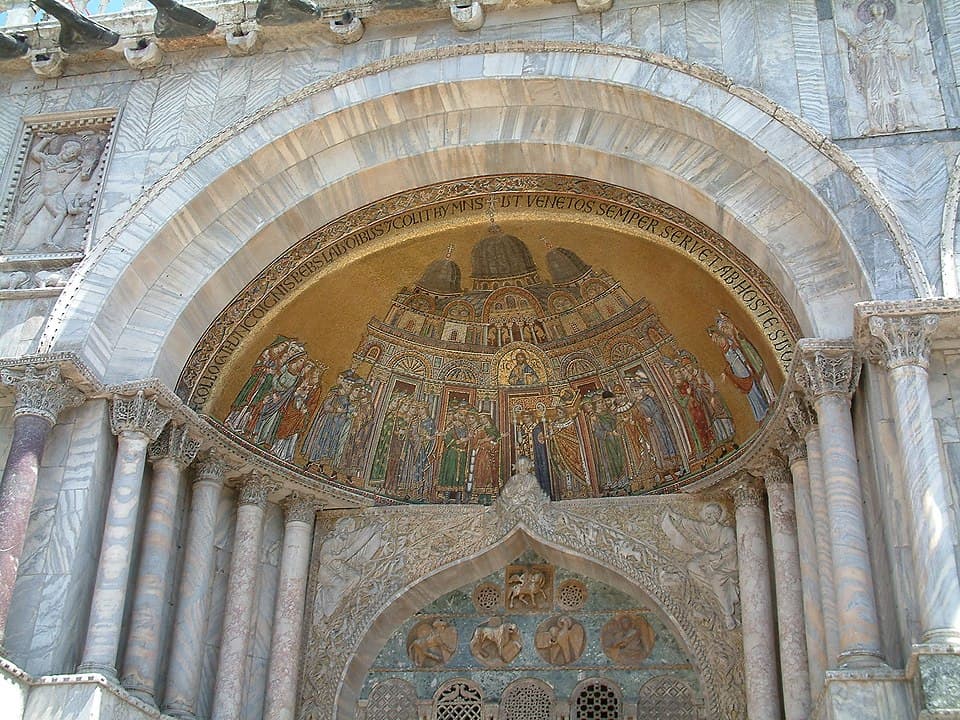
Portal of Saint Alipio
This portal is a must-see for anyone interested in the true history of the building. The mosaic tucked inside this arch is the only surviving 13th-century original remaining on the façade. It depicts a pivotal moment in Venetian history: the solemn procession carrying the body of Saint Mark into the very basilica where you are standing. If you look carefully at the representation of the church within the mosaic itself, you’ll notice something fascinating. It shows the basilica exactly as it looked in the 1200s. You can clearly see the distinct Byzantine domes and the earlier, simpler façade before the elaborate, pointed Gothic decorations were added to the roofline in later centuries. It is essentially a 700-year-old architectural record in tile, capturing the building's original appearance. This artwork provides a unique historical perspective, highlighting how San Marco evolved from a purely Byzantine-inspired structure into the ornate, multi-layered landmark we recognize today.
The Treasury of Spoils (Exterior Corner)
Consolidating the looted treasures from Constantinople: the Tetrarchs and the Pillars of Acre.
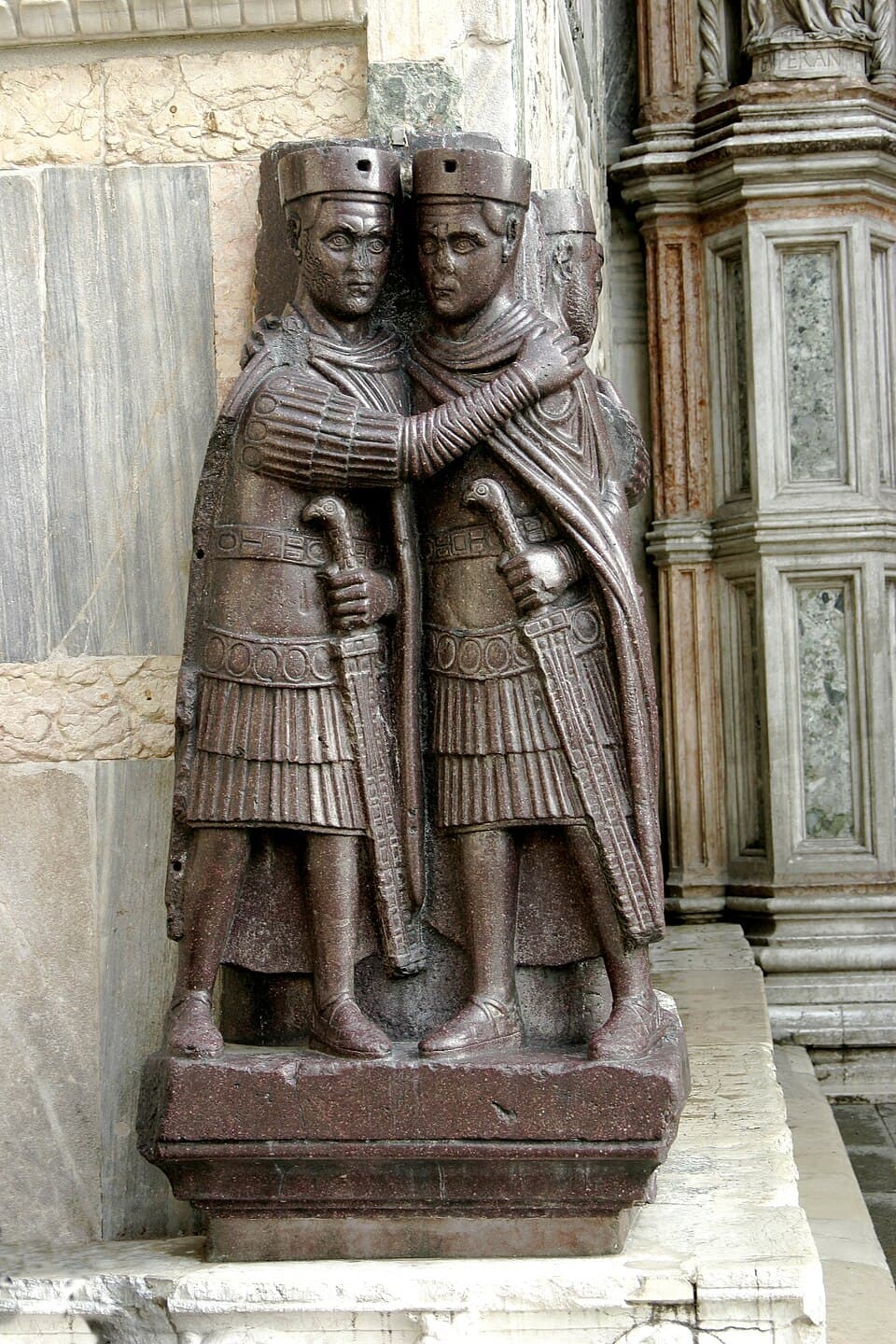
The Four Tetrarchs
These four figures, huddled together in an embrace, represent the Tetrarchs—four co-emperors who ruled the Roman Empire during the 4th century. They were originally located in Constantinople but were brought to Venice as part of the 'spolia,' or looted treasure, following the Fourth Crusade. Their stiff, blocky style is characteristic of Late Antique art, which moved away from realistic portraiture to emphasize the unity and stability of the imperial office. There is a tangible piece of evidence of their journey here: if you look closely, you’ll see that one of the figures is missing a foot. Interestingly, the missing piece was discovered during excavations in Istanbul in the 1960s. This find proved beyond a doubt that these statues were physically ripped from their original home and transported across the sea to serve as a trophy of Venetian conquest. Their presence on this exterior corner illustrates how the Republic literally built its identity out of the fragments of older, fallen empires.
The Narthex and the Genesis Dome
The entrance hall's narrative 'comic strip' of the Old Testament. Prioritizing the Creation cycle.
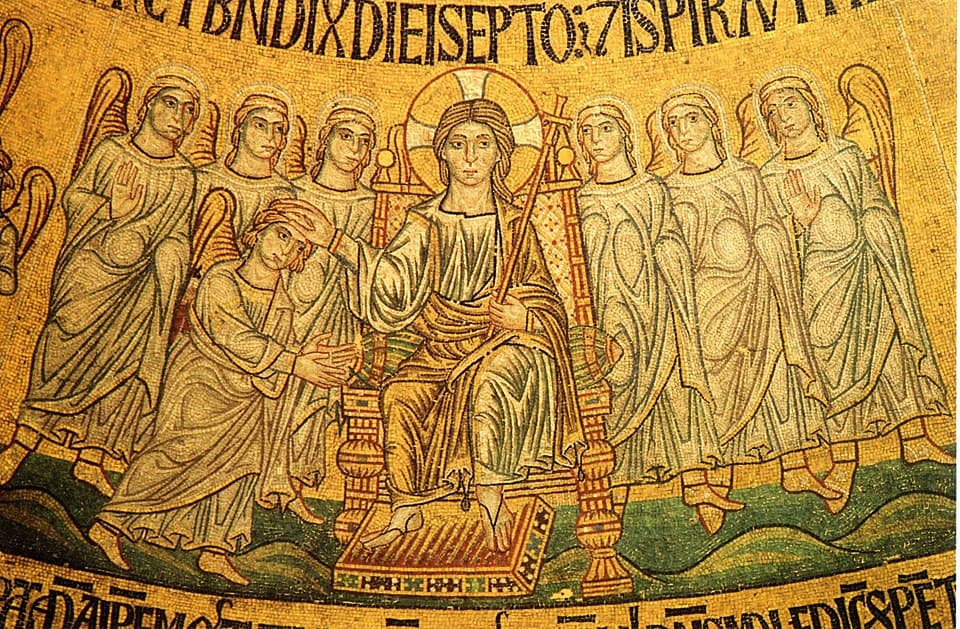
The Seventh Day
Identify the scene where the Creator rests and blesses the seventh day. He is depicted sitting on a throne, surrounded by seven angels, each representing one day of the week. This composition highlights the completion and perfection of the divine work. Take a moment to look at the individual mosaic tiles, known as tesserae. If you move slightly, you might notice that they are not set perfectly flat against the wall. The craftsmen deliberately set these small pieces of glass and gold at varying angles to catch the flickering light from candles or the soft sun filtering into the narthex. This technique makes the gold seem to vibrate and pulse with life, a shimmering effect that was central to the spiritual experience of the space. It transformed the static images into something dynamic and heavenly, reminding the observer that they were standing in a place where the earthly and divine worlds were meant to meet.
The Story of the Great Flood
Continuing the Old Testament narrative in the narthex with the story of Noah.

Noah and the Dove
In this particular detail, we see Noah reaching out from a small window in the side of the wooden Ark. He is receiving a dove that carries an olive branch, the traditional signal that the floodwaters have finally begun to recede and that dry land is nearby. It is a moment of peace and new beginnings after the storm. Pay close attention to the way the water is depicted below the vessel. The mosaicist used swirling, rhythmic patterns of blue and white tiles to represent the waves. This stylized approach to depicting nature is a signature technique of the Venetian-Byzantine workshops that decorated the basilica. The artists were not attempting to create a realistic, photographic picture of water; instead, they used these geometric patterns to suggest constant movement and depth. This combination of narrative clarity and decorative abstraction is what makes these medieval mosaics so unique and visually striking, even many centuries after they were first crafted.
The Golden Nave and Geometric Floor
The transition into the 'Church of Gold'. Includes the signature mosaics and the undulating floor.
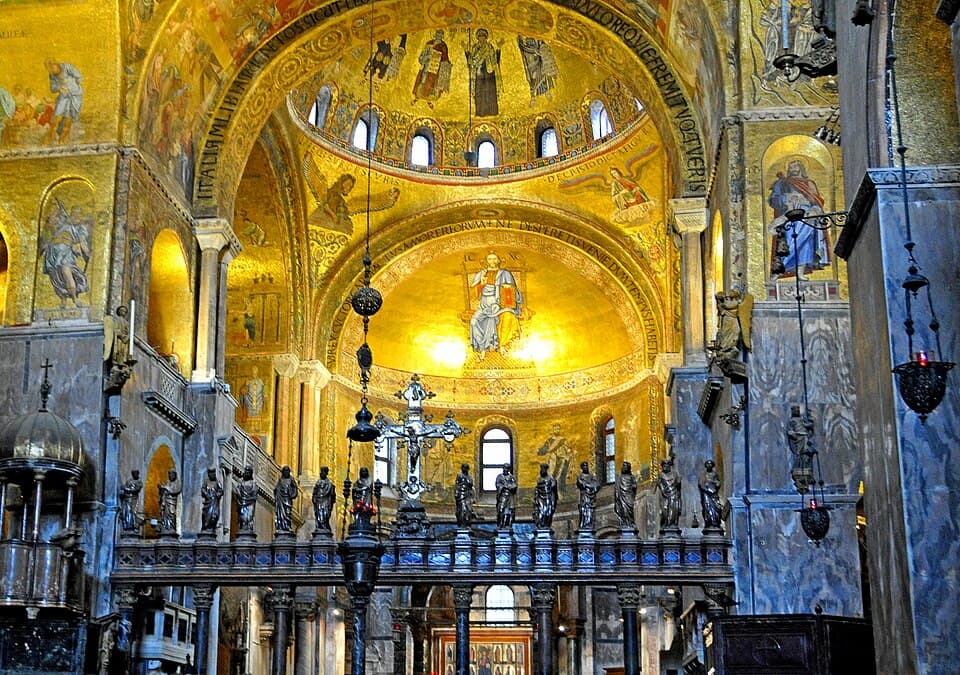
Dome of the Ascension
Directly above the center of the church is the Dome of the Ascension. It stands at an impressive interior height of approximately 28.15 meters. At the very center of the dome, you can see the figure of Christ ascending to heaven. Surrounding him in a wide circle are the Virgin Mary, two angels, and the twelve Apostles. The arrangement is strictly hierarchical, placing the most important divine figure at the highest physical point. Look at the base of the dome, where you’ll see sixteen windows. These weren't just for lighting; the light streaming through them was intended to represent the divine light of heaven itself, illuminating the gold mosaics and the figures of the saints below. As the sun moves across the sky throughout the day, the play of light inside the dome changes, creating a sense of movement and celestial presence. This architectural and artistic harmony was designed to draw every visitor's gaze upward, both physically and spiritually, toward the heavens.
The Treasury of San Marco
Housing the spoils of the Fourth Crusade. Focus on Byzantine metalwork.
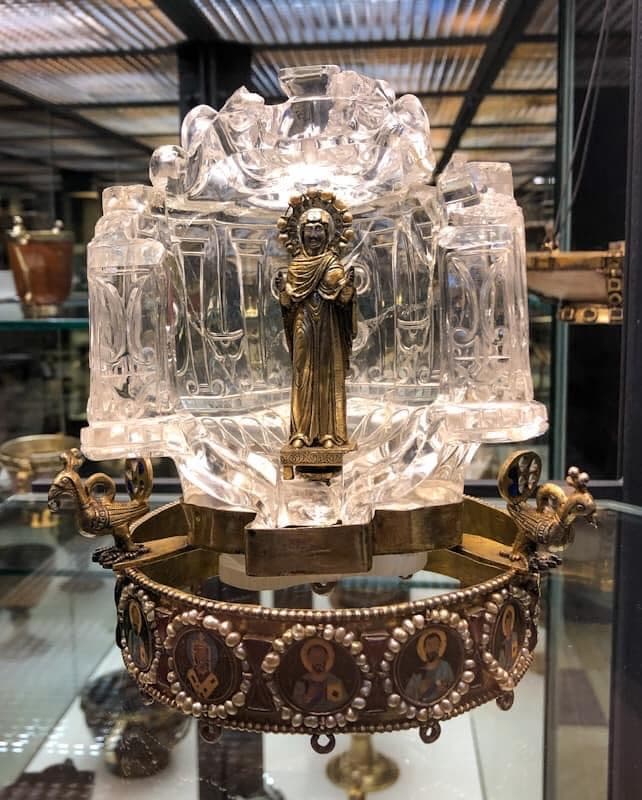
Treasury of San Marco
Within the Treasury of San Marco, you can find extraordinary examples of Byzantine metalwork, such as this piece dating back to the 9th century. Notice the fine enamel portraits decorating its surface, depicting the Emperor and various saints. These objects were not merely decorative; in their original context in Constantinople, they were often designed to be hung over altars or placed in prominent positions within a church as visible signs of imperial piety and devotion. Each portrait is a testament to the skill of Eastern craftsmen who could render expressive features in such a small and challenging medium. Like many of the treasures you have seen today, these objects arrived in Venice as spoils of war following the conquest of Constantinople. They represent the transfer of imperial power and prestige from the old Roman capital in the East to the rising maritime power of Venice. By displaying these objects, the Venetian Republic was claiming for itself the spiritual and political legacy of the Byzantine emperors, surrounding its own patron saint with the finest luxuries of the ancient world.
The Loggia dei Cavalli
The outdoor balcony featuring the horse replicas and the porphyry head of Carmagnola. Conclusion with a view.
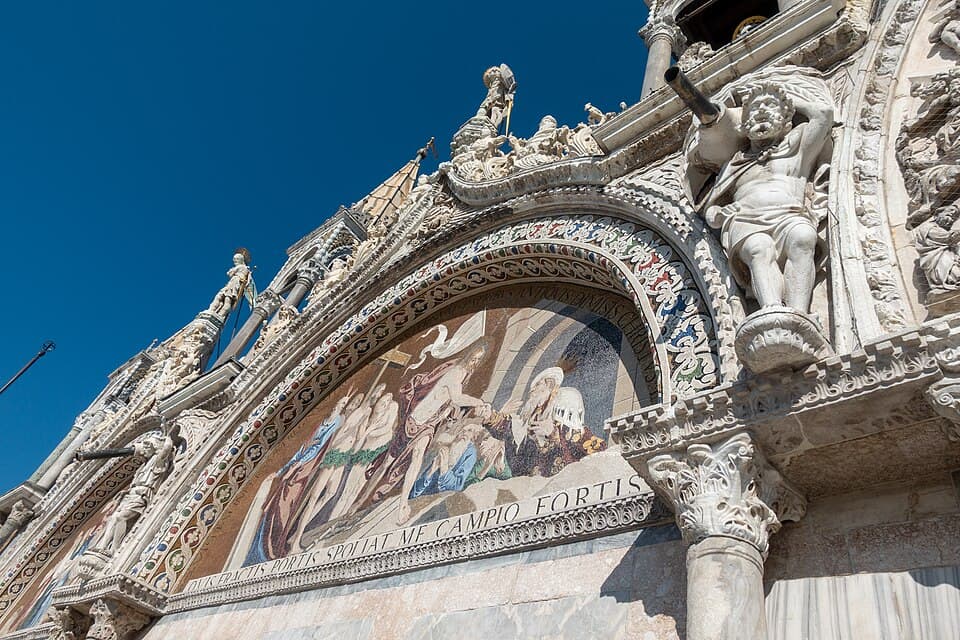
The Descent into Limbo
While standing on the outdoor loggia, look at the mosaic positioned above the portal to your left. This scene depicts the "Descent into Limbo," also known as the Harrowing of Hell. You can see the figure of Christ breaking open the gates of the underworld to rescue the souls of the righteous who died before his coming. In the Byzantine-Venetian tradition, this was a powerful symbol of victory over death and the promise of salvation. For the pilgrims who stood in the square centuries ago, looking up at these exterior mosaics, these images were more than just decoration; they were a public declaration of faith. The use of gold and vibrant colors ensured that even from a distance, the message was clear and inspiring. Standing here today, you are sharing the same vantage point as those countless visitors from the past. The mosaic connects the grand biblical narratives found inside the church with the bustling civic life of the piazza, reminding everyone who passed by of the spiritual foundation upon which the city of Venice was built.
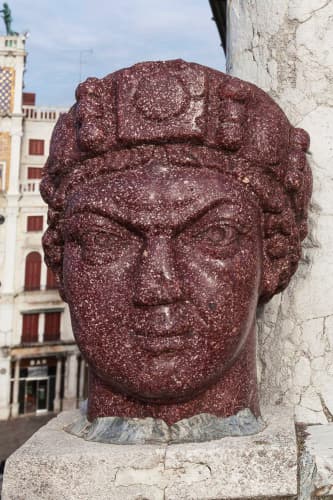
The Carmagnola Head
To conclude our tour, let's look at this distinctive head made of deep purple porphyry, fixed to the corner of the loggia railing. While historians generally identify this figure as a 6th-century Byzantine emperor, possibly Justinian, the people of Venice gave it a much grimmer nickname: "Carmagnola." This was the name of a famous mercenary general, Francesco Bussone, who was convicted of treason and beheaded by the Republic in 1432. The head became associated with his execution in the popular imagination. This object serves as a perfect final symbol for Saint Mark’s Basilica itself. Like so much of the building, it is a fragment taken from a distant land and a lost empire. The Venetians were master opportunists; they didn't just take these treasures, they repurposed them and gave them new Venetian identities. This porphyry head, once an imperial portrait in the East, became a local landmark and a reminder of the Republic's power. It stands as a testament to a city built from the pieces of history, transformed into something uniquely and undeniably Venetian.
Want to hear the rest?
Download the Stanza app to unlock all 25 stops and full GPS-guided navigation.
Frequently Asked Questions
How long does the Basilica di San Marco audio tour take?
The Basilica di San Marco audio guide includes 25 narrated stops. Most visitors spend 45 minutes to 1.5 hours exploring the complete tour, though you can listen at your own pace and skip or revisit any stop.
Is the Basilica di San Marco audio guide available in my language?
Stanza supports 15 languages: English, Spanish, French, German, Italian, Portuguese, Russian, Japanese, Chinese, Korean, Arabic, Hindi, Polish, Dutch, Hebrew. Check the guide in the app to confirm the languages currently available for this tour.
Can I use the audio guide offline at Basilica di San Marco?
Yes! Download the complete Basilica di San Marco tour — including all audio, maps, and images — before your visit. The Stanza app works completely offline, so you don't need WiFi or mobile data at the venue.
How much does the Basilica di San Marco audio guide cost?
The Stanza app is free to download. The current listed price for the Basilica di San Marco audio guide is $2.99; app-store region and currency may affect the final price.
How do I use the Stanza audio guide at Basilica di San Marco?
Download the free Stanza app, search for "Basilica di San Marco", and download the tour. When you arrive at the venue, the app uses GPS to detect your location and automatically plays the relevant narration as you move between points of interest — completely hands-free.
What makes the Stanza audio guide different from other Basilica di San Marco tours?
Stanza offers GPS-triggered narration that plays automatically as you walk through Basilica di San Marco — no need to manually select stops. The tour is available in 15 languages, works fully offline, and includes 25 expertly narrated stops with images and historical context.
What other audio guides are available near Basilica di San Marco?
Stanza offers multiple audio guides in Venice, Italy and nearby areas. After downloading the app, browse the map to discover all available tours near Basilica di San Marco. Each guide can be downloaded for offline use.