Languages
15Ponte di Rialto Audio Guide
Ponte di Rialto is a landmark in Venice, Italy. Explore it with Stanza's GPS-triggered offline audio guide — available in 15 languages.
Quick Facts
23
Stops
15
Languages
100%
Offline
📍 Venice, Italy · 45.4380°N, 12.3356°E
About Ponte di Rialto
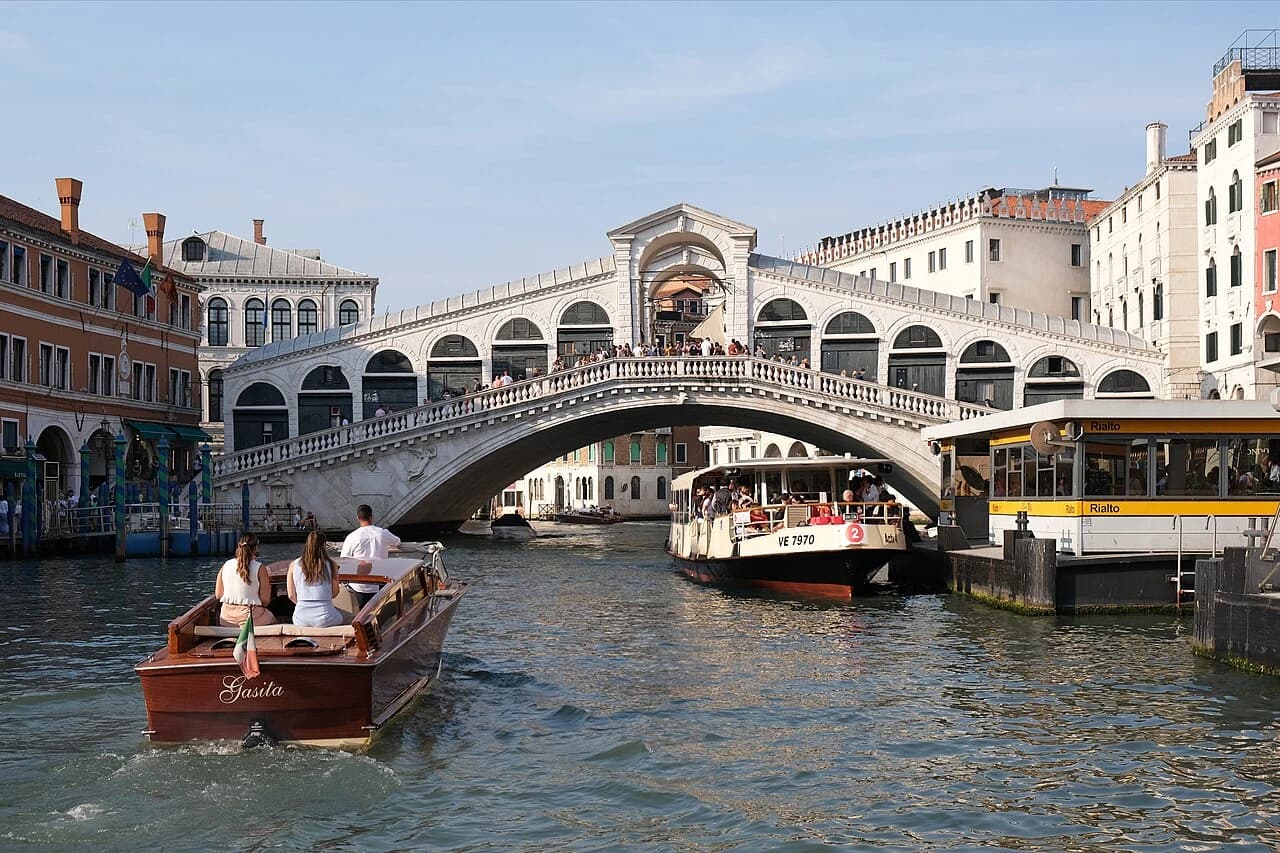
The Rialto Bridge is one of the four historic bridges spanning the Grand Canal in Venice, Italy. It is an iconic stone arch bridge, renowned for its architectural beauty and the shops built into its structure.
Ponte di Rialto is also known as Ponte di Rialto, ponte di Rialto.
This self-guided audio tour features 23 narrated stops organized across 9 sections. As a landmark, Ponte di Rialto offers a unique cultural experience in the heart of Venice, Italy.
The Stanza audio guide is available in 15 languages and works entirely offline — download the complete tour including audio narration, maps, and images before your visit. As you walk through Ponte di Rialto, GPS-triggered narration plays automatically at each point of interest.
Last updated:
What you will hear
The Grand Threshold (San Marco side)
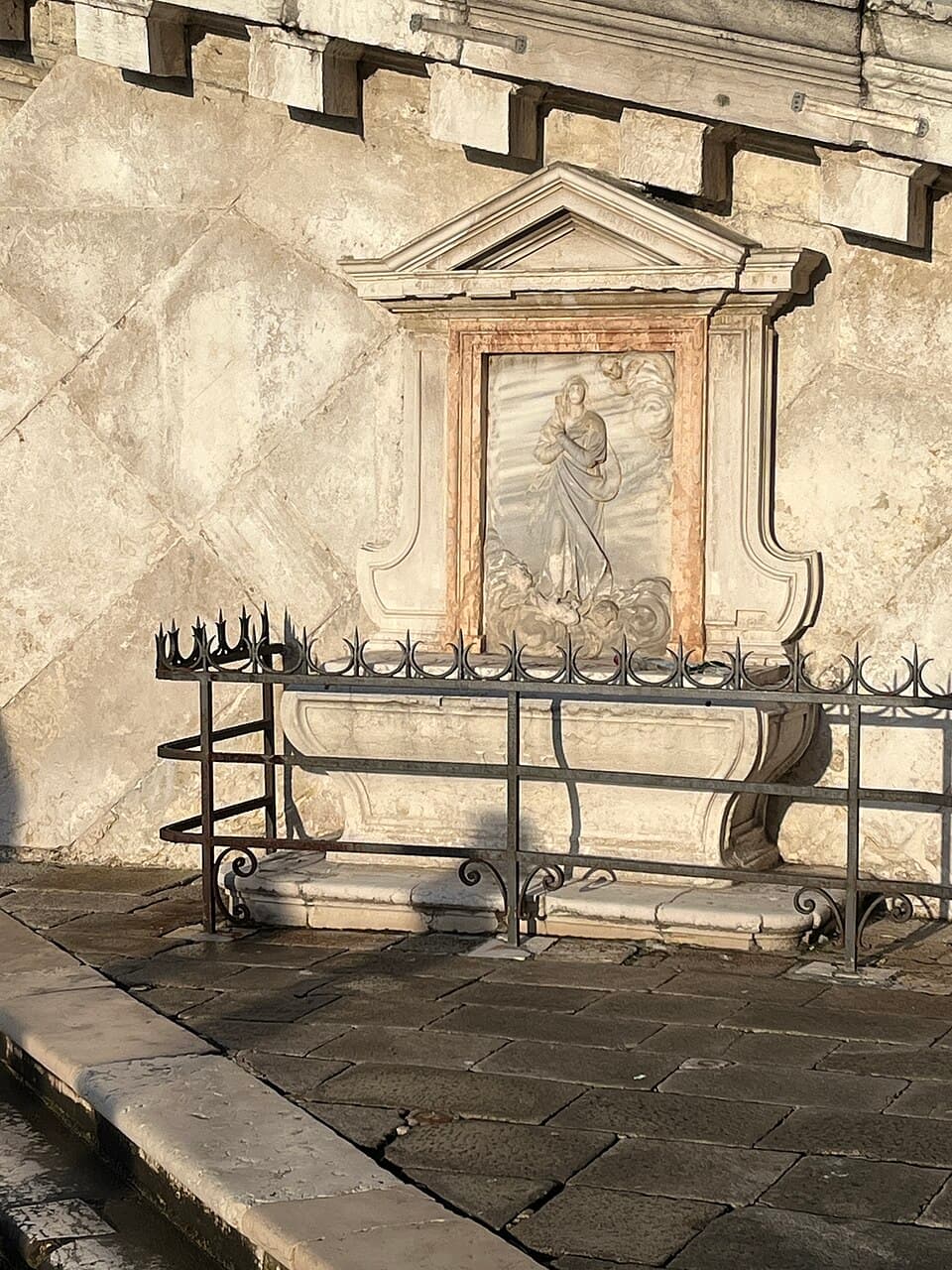
Start here to appreciate the bridge's southern face and the pristine Istrian stone following the recent restoration. Look for the Annunciation reliefs on the spandrels of the arch.
The Archangel Gabriel
On the opposite spandrel from the Virgin Mary, the figure of the Archangel Gabriel completes the sacred Annunciation scene. He is depicted in the moment of arrival, his presence balancing the composition of the great arch. These religious reliefs were not merely decorative; they served a protective function for the maritime Republic. Every galley, gondola, and merchant ship entering the city’s primary market district would pass beneath these figures. They were placed here to offer a silent blessing to the sailors and traders who were the lifeblood of the Venetian economy. The placement of such holy figures on a major commercial thoroughfare reflects the unique Venetian worldview, where faith and finance were inextricably linked. The bridge served as the gateway to the Rialto market, the wealthiest commercial hub in the world during the Renaissance. As you look at the Archangel, imagine the hundreds of thousands of vessels that have glided under his watchful eyes over the centuries, carrying spices from the East, silks from the Silk Road, and travelers from every corner of the globe into the heart of the city.
The Audacious Stone Arch
Examine the engineering feat of Antonio da Ponte's single 28-meter span, which stands on a foundation of 12,000 submerged elm piles.
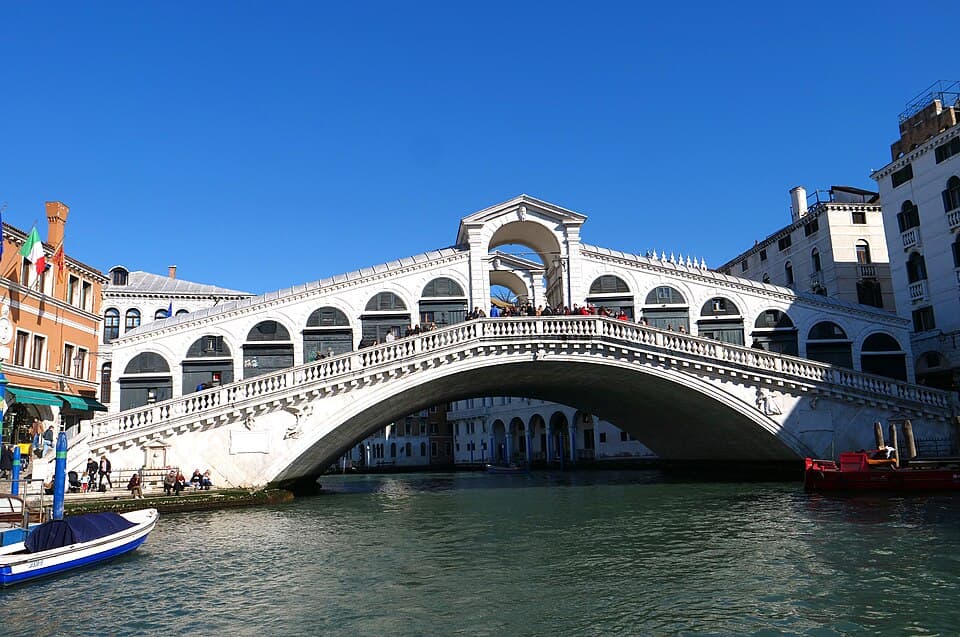
The Central Portico
The summit of the Rialto Bridge is marked by an elegant central portico where the structure’s three pedestrian walkways converge. This architectural peak serves as both a structural anchor and a scenic lookout. Standing at this height, the arch rises 7.32 meters above the water of the Grand Canal. This specific measurement was not chosen by chance; it was a critical requirement for the bridge's functionality. During the heyday of the Venetian Republic, the Grand Canal was filled with large galleys and merchant ships with tall masts. Antonio da Ponte designed the bridge with sufficient clearance to allow these massive vessels to pass underneath without the need to lower their masts, ensuring that the city's vital trade routes remained unobstructed. The portico itself features classic Renaissance archways that mirror the shape of the main span below. It provides a moment of shelter and a transition point for the thousands of people who cross the bridge every hour, moving between the bustling markets and the administrative centers of the city. From here, the sheer scale and ambition of the 16th-century design become truly apparent.
The Grand Canal Panorama
Climb the outer stairs to reach the most famous viewpoint in Venice, overlooking the 'S' curve of the Grand Canal.
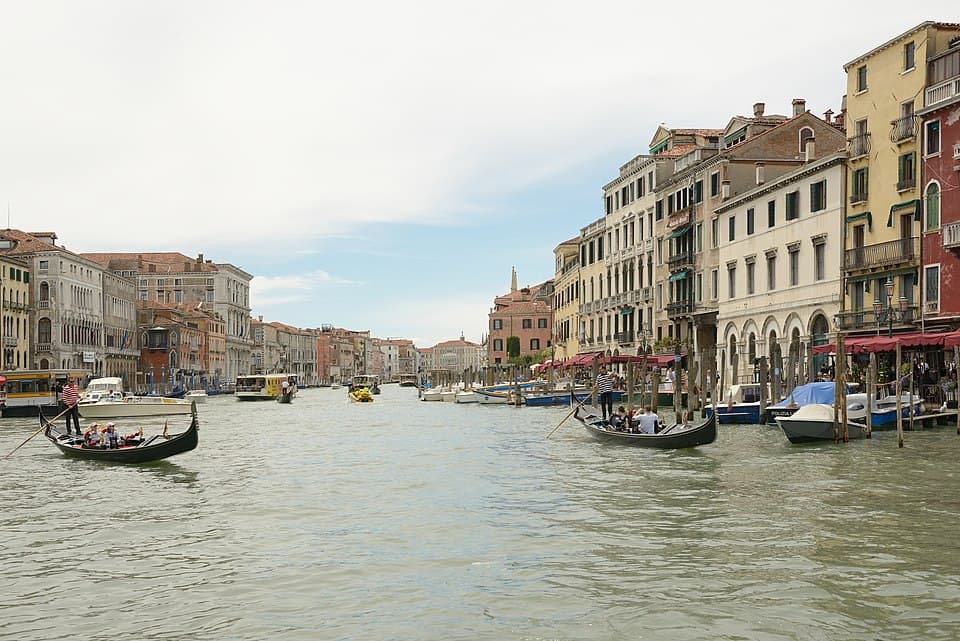
View Toward the Market
Looking out toward the area known as the Rialto Market, you can see the true reason for this bridge's existence. For centuries, the Rialto was the commercial engine of the Venetian Republic, a place where goods from across the globe were traded and prices were set for the known world. The bridge served as the essential umbilical cord connecting the administrative and religious center of the city at San Marco with this bustling marketplace. On the market side, you would find the banks, the vegetable stalls, and the legendary fish market. Traders, merchants, and common citizens crossed this span to conduct the business that made Venice a global superpower. Even today, the area retains much of its commercial character, with vendors selling fresh produce and local catches. The bridge wasn't just a way to cross the water; it was a vital piece of infrastructure that ensured the city's wealth could flow freely from the ships to the warehouses and into the hands of the merchants. From this viewpoint, you can imagine the historical noise and chaos of a district that was once the commercial capital of the Mediterranean.
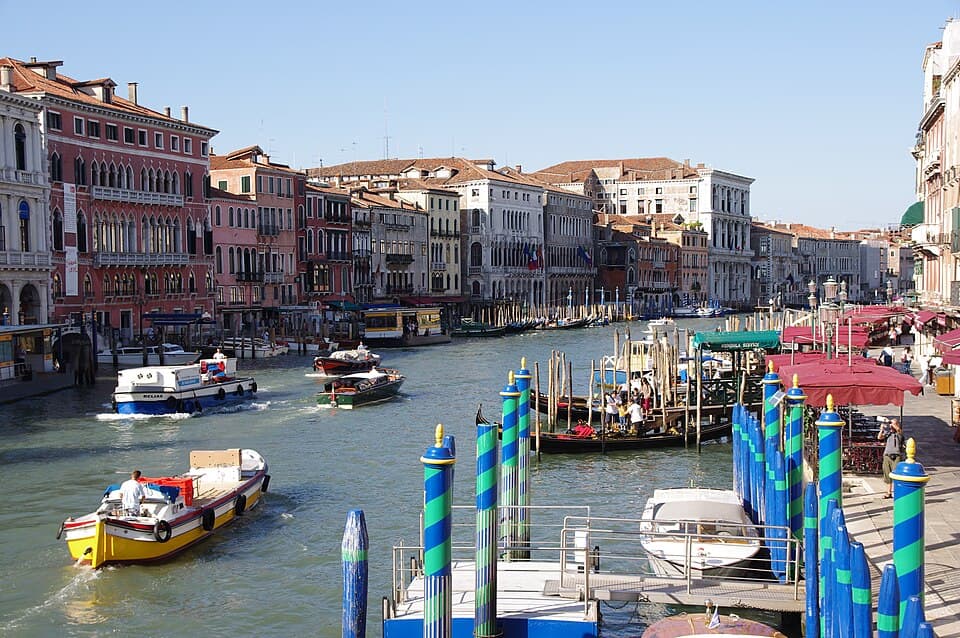
View from the South Balustrade
Standing at the southern balustrade, you are treated to one of the most iconic vistas in the world: the sweeping 'S' curve of the Grand Canal. Below, the water is a hive of activity, with vaporetti, water taxis, and traditional gondolas navigating the busy channel. The banks, or 'fondamenta,' are lined with historic palaces and vibrant cafes, their awnings adding splashes of color to the weathered stone facades. This permanent stone view stands in sharp contrast to the history of this specific location. Before this stone bridge was built, a wooden structure spanned the canal here. That bridge was famous for its central drawbridge mechanism, but it was also tragically unstable. In 1444, during a massive wedding procession, the weight of the crowds proved too much, and the wooden bridge collapsed into the water. Today’s solid stone balustrade offers a much more secure vantage point to soak in the sensory experience of Venice—the sound of water lapping against stone, the call of gondoliers, and the timeless rhythm of a city built entirely on the sea.
The Summit Portico
The architectural peak of the bridge, where the three walkways meet under a central stone portico.
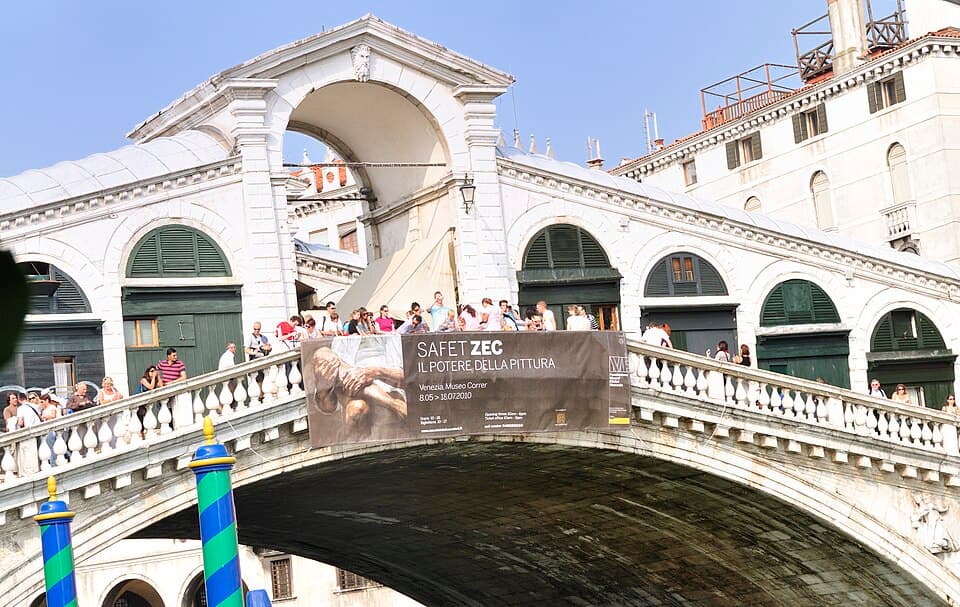
The Pedestrian Ramps
The Rialto Bridge is remarkably wide, measuring 22.1 meters across. This generous width was a deliberate design choice to manage the intense pedestrian traffic of the city. The bridge is divided into three distinct paths. Two paths run along the outer edges of the bridge, bordered by the stone balustrades, offering the famous views of the Grand Canal. The third, wider path runs through the center of the structure, flanked by two rows of small shops. This layout allows for a continuous flow of people; locals can hurry through the center while visitors linger at the edges to take photographs. The energy on these ramps is constant and vibrant, reflecting the bridge's role as a major thoroughfare. Whether it is the early morning rush of market workers or the late-evening stroll of visitors, the stone ramps are rarely silent. The sheer scale of the walkways was unprecedented for a bridge of its time and highlights the Republic's forward-thinking approach to urban planning in a densely populated island city that has always relied on foot traffic.
The Northern Face (Patron Saints)
The side of the bridge facing the train station features reliefs of Venice's primary protectors, Saints Mark and Theodore.
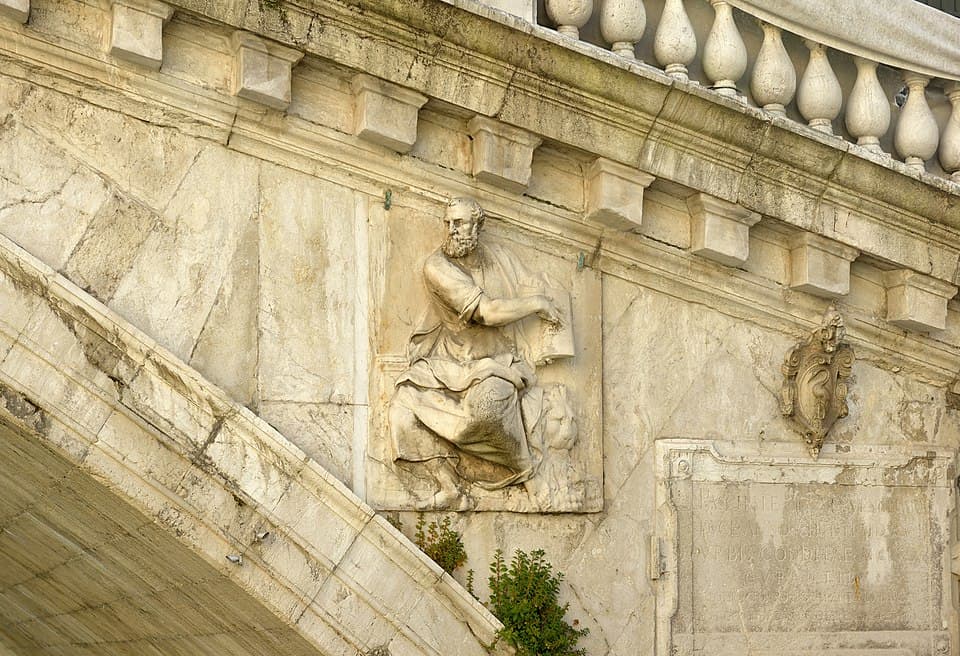
Relief of Saint Mark
On the northern face of the bridge, you will find a relief dedicated to Saint Mark, the primary patron saint of Venice. He is depicted alongside a winged lion, which you can see resting at his feet. The lion of Saint Mark is the most recognizable symbol of the city, appearing on its flags, its coins, and its public buildings throughout the former Venetian Empire. For the Venetians, the lion represented not just the saint, but the strength, majesty, and sovereignty of the Republic itself. By including this relief on the bridge, the builders were making a clear political statement: this structure, and the commerce it facilitated, belonged to the Republic under the protection of its patron. Notice how the figure of the saint is carved with a sense of dignity and authority. Just as the Annunciation scene on the southern side connected the bridge to the city's foundation, this relief connects it to the city's ongoing power. It serves as a reminder that every aspect of life in Venice, from the grandest bridge to the smallest market stall, was lived under the watchful eye of Saint Mark.
The San Polo Gateway
Descending into the San Polo district, you pass the administrative palaces that managed the Republic's wealth.
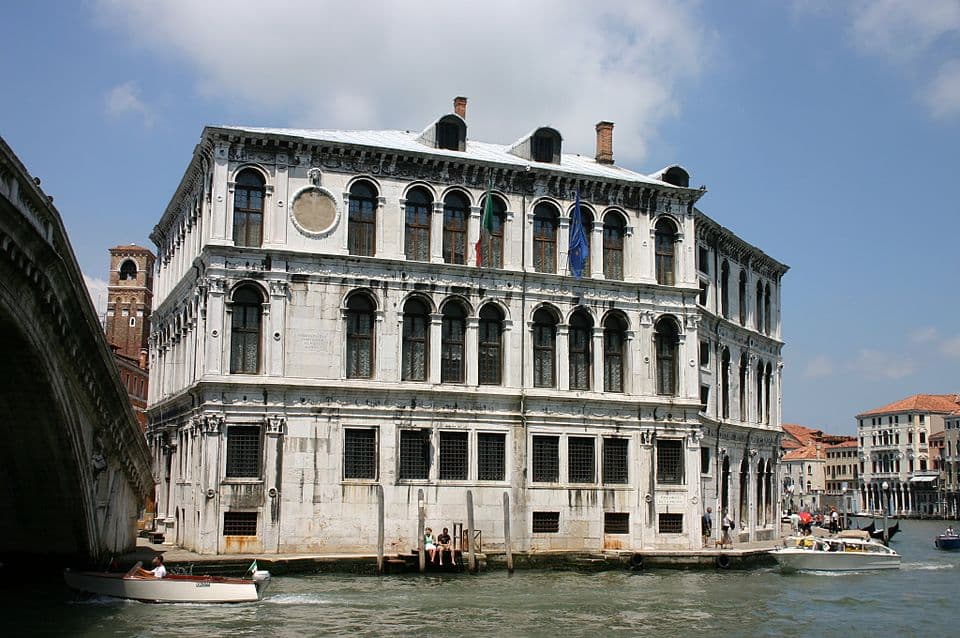
The Finance Palace
At the base of the bridge stands the Palazzo dei Camerlenghi, a grand Renaissance building that served as the headquarters for the Venetian Republic's financial treasurers. In a city built on trade, this was one of the most important administrative buildings, responsible for managing the state's wealth and collecting taxes from the busy Rialto market. The building’s location was strategic; no merchant could bring goods over the bridge or through the market without being within sight of the tax office. There is a charming local legend associated with this palace and the construction of the Rialto Bridge. It is said that two local skeptics were so convinced the stone bridge would collapse that they made a bet. One claimed she would burn herself if it stayed up, while the other said he would grow a third leg. If you look closely at the capitals of the columns on this palace, you might find two small, mocking carvings that supposedly represent these two doubters, forever immortalized in stone for their lack of faith in Antonio da Ponte’s design.
San Giacomo di Rialto
Visit the church traditionally considered the oldest in Venice, famous for its massive 24-hour clock and connection to the market's founding.
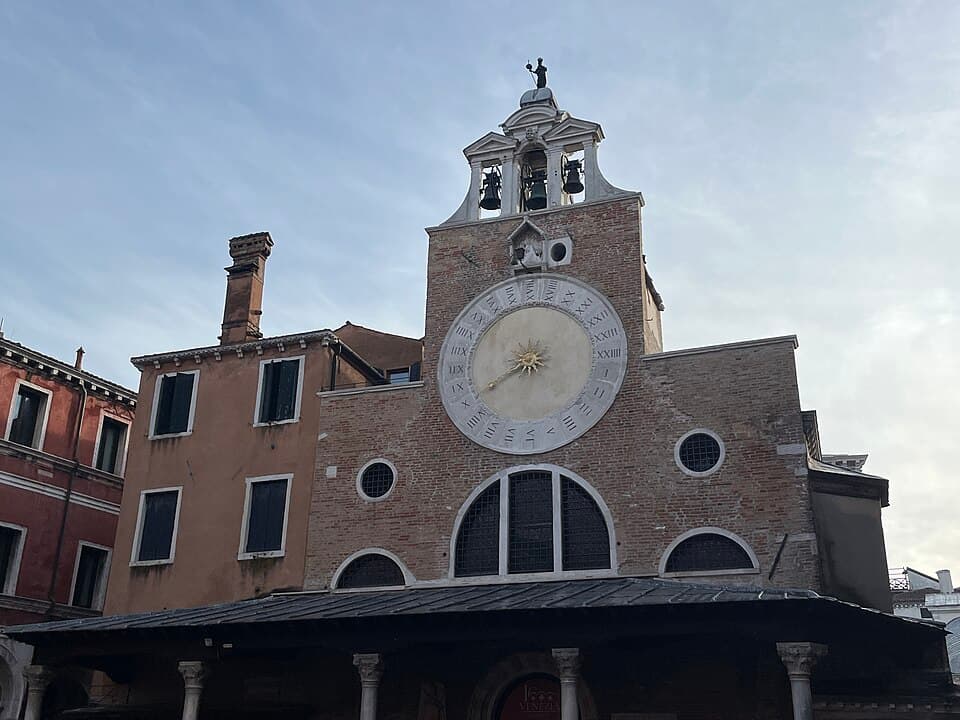
Church of San Giacomo di Rialto
Standing directly across from the busy market square is the Church of San Giacomo di Rialto. While much of the city's early history is debated, local tradition holds this to be the very first church founded in Venice, possibly dating back to the city's legendary birth in the 5th century. Its most striking feature is not found inside, but rather on its exterior: a massive 24-hour clock face positioned high above the portico. Notice how the dial is divided into twenty-four sections rather than the twelve we are commonly used to today. This wasn't merely a decorative addition; it was the heartbeat of the commercial district. In an era before personal watches, this clock dictated the opening and closing times of the surrounding markets. For the merchants trading precious spices, silks, and gold, these hands determined when the day’s business could legally begin and end. The church itself serves as a quiet counterpoint to the frenetic energy of the square, its facade weathered by centuries of salt air and commerce. It remains a physical reminder that in the heart of Venice, faith and trade have always lived side-by-side, with the clock serving as the ultimate arbiter of time for both.
The Fondaco dei Tedeschi
This former warehouse for German merchants highlights the international trade that made Rialto the center of the world's economy.
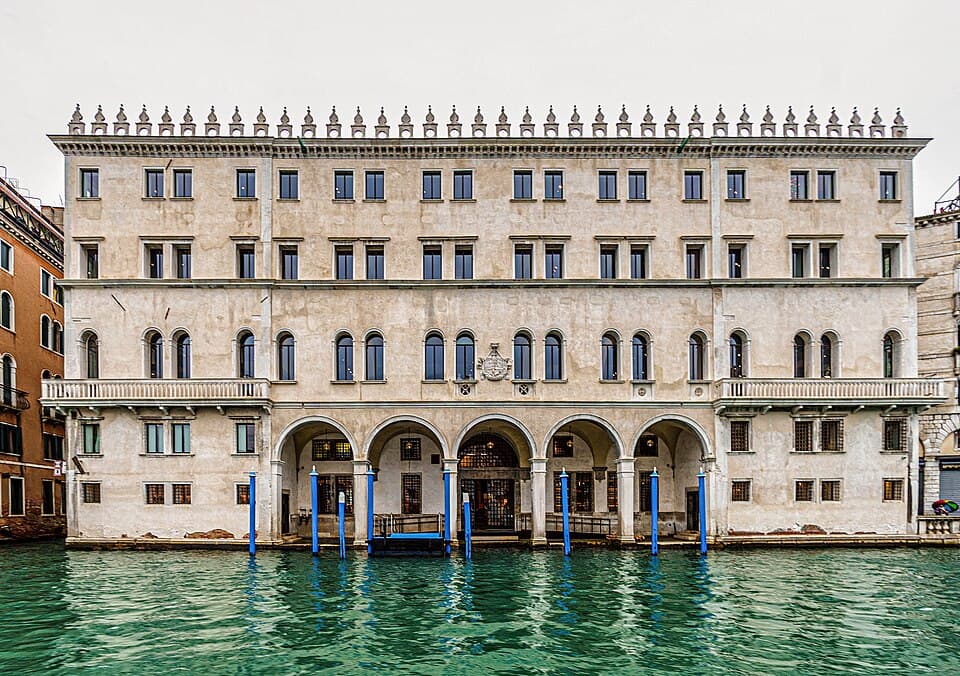
The German Warehouse
Facing the Grand Canal at the foot of the bridge stands a massive, imposing structure known as the Fondaco dei Tedeschi, or the German Warehouse. In the heyday of the Venetian Republic, this building was a high-security complex that served as both the living quarters and the warehouse for German-speaking merchants. It stands as a testament to the truly international character of the Rialto district. Venice was the primary gateway between the East and the West, and the Republic required foreign traders to stay in specific 'fondachi' like this one to ensure their goods could be taxed and their movements monitored. Inside these walls, merchants from Nuremberg, Vienna, and beyond traded metals, furs, and textiles for the spices, silks, and dyes arriving from the Orient. It was a self-contained world of commerce, featuring bedrooms, offices, and vast storage halls surrounding a central courtyard. The scale of the building reflects the immense wealth that flowed through these international partnerships. While the vibrant frescoes that once decorated the exterior have long since faded, the building's sheer size continues to remind us that the Rialto was once the premier global marketplace of Europe.
The Rooftop Climax
Conclude your tour with a spectacular view from above, looking back at the bridge and the winding canal from the Fondaco's terrace.
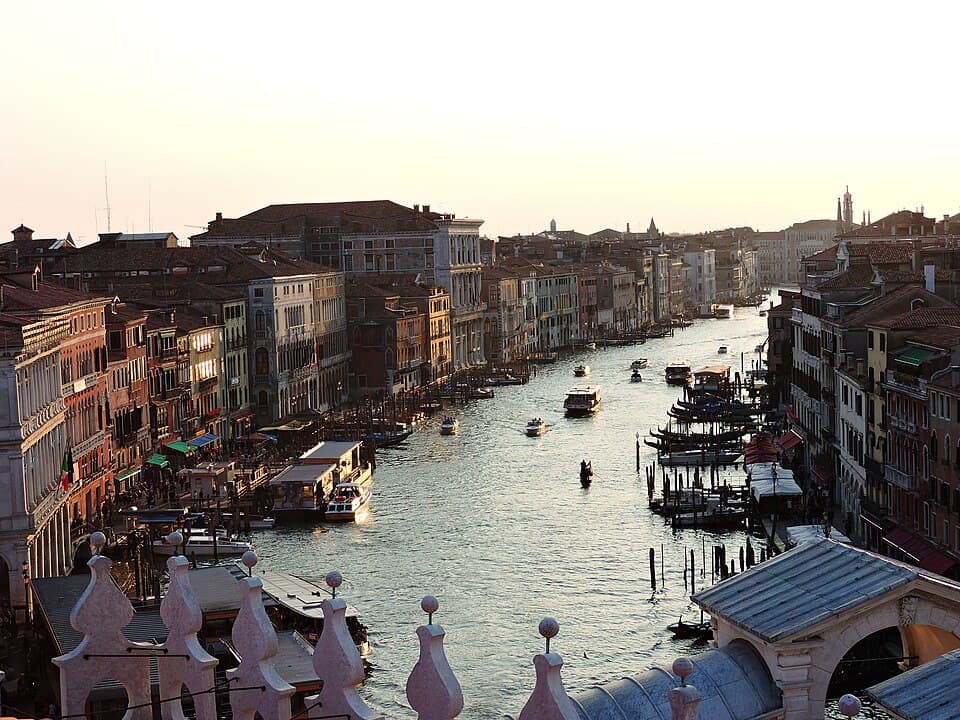
Sunset Over the Rialto
As evening falls over the Grand Canal, the Rialto Bridge takes on a timeless quality. This structure is a remarkable survivor, having withstood the tremors of earthquakes, the heat of nearby fires, and the physical wear of millions of footsteps over more than four hundred years. It has remained the steadfast witness to the city's evolution from a global superpower to a modern cultural treasure. The bridge's enduring spirit is perhaps best captured by a famous line from William Shakespeare's 'The Merchant of Venice,' where the character Shylock asks, 'What news on the Rialto?' For centuries, this wasn't just a line of dialogue; it was a daily reality. This bridge was the place where information was traded as fiercely as spice or gold. News of sunken ships, shifting alliances, and market prices all passed through here first. Even today, amidst the crowds of travelers and the hum of boat engines, the bridge retains that sense of being a vital hub. It remains the essential link, a place of encounter where the world meets Venice. As the light fades, the Istrian stone seems to glow, a monument to the resilience and ambition of the Venetian people.
Want to hear the rest?
Download the Stanza app to unlock all 23 stops and full GPS-guided navigation.
Frequently Asked Questions
How long does the Ponte di Rialto audio tour take?
The Ponte di Rialto audio guide includes 23 narrated stops. Most visitors spend 45 minutes to 1.5 hours exploring the complete tour, though you can listen at your own pace and skip or revisit any stop.
Is the Ponte di Rialto audio guide available in my language?
Stanza supports 15 languages: English, Spanish, French, German, Italian, Portuguese, Russian, Japanese, Chinese, Korean, Arabic, Hindi, Polish, Dutch, Hebrew. Check the guide in the app to confirm the languages currently available for this tour.
Can I use the audio guide offline at Ponte di Rialto?
Yes! Download the complete Ponte di Rialto tour — including all audio, maps, and images — before your visit. The Stanza app works completely offline, so you don't need WiFi or mobile data at the venue.
How much does the Ponte di Rialto audio guide cost?
The Stanza app is free to download. The current listed price for the Ponte di Rialto audio guide is $4.99; app-store region and currency may affect the final price.
How do I use the Stanza audio guide at Ponte di Rialto?
Download the free Stanza app, search for "Ponte di Rialto", and download the tour. When you arrive at the venue, the app uses GPS to detect your location and automatically plays the relevant narration as you move between points of interest — completely hands-free.
What makes the Stanza audio guide different from other Ponte di Rialto tours?
Stanza offers GPS-triggered narration that plays automatically as you walk through Ponte di Rialto — no need to manually select stops. The tour is available in 15 languages, works fully offline, and includes 23 expertly narrated stops with images and historical context.
What other audio guides are available near Ponte di Rialto?
Stanza offers multiple audio guides in Venice, Italy and nearby areas. After downloading the app, browse the map to discover all available tours near Ponte di Rialto. Each guide can be downloaded for offline use.