Languages
15Basilica di San Lorenzo Audio Guide
Basilica di San Lorenzo is a landmark in Florence, Italy. Explore it with Stanza's GPS-triggered offline audio guide — available in 15 languages.
Quick Facts
18
Stops
15
Languages
100%
Offline
📍 Florence, Italy · 43.7750°N, 11.2539°E
About Basilica di San Lorenzo
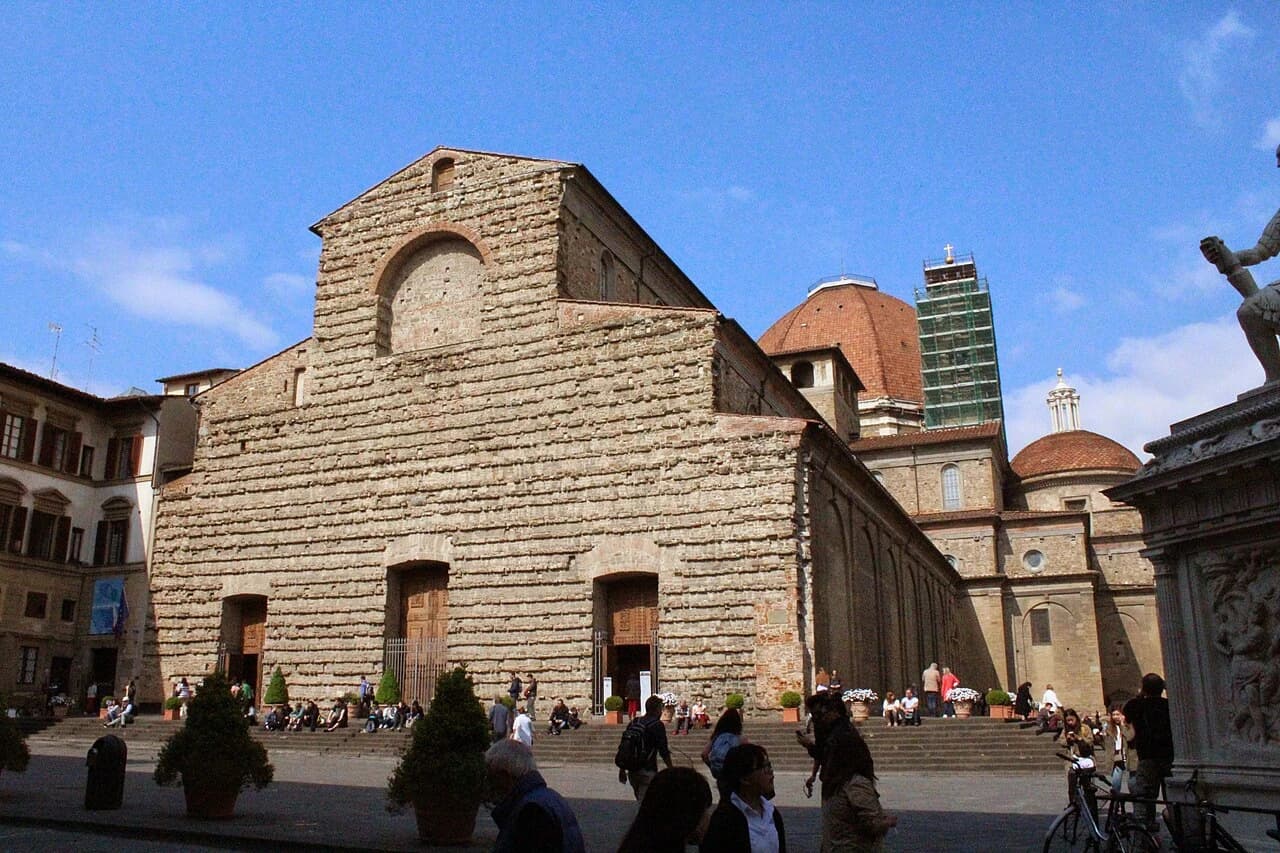
The Basilica of San Lorenzo is one of the oldest churches in Florence and serves as the burial place of all the principal members of the Medici family. It is a landmark of Renaissance architecture, featuring designs by Filippo Brunelleschi and Michelangelo.
Basilica di San Lorenzo is also known as San Lorenzo, Florence, Basilica di San Lorenzo, San Lorenzo church, San Lorenzo (Florence), and 2 other names in various languages.
This self-guided audio tour features 18 narrated stops organized across 9 sections. As a basilica, Basilica di San Lorenzo offers a unique cultural experience in the heart of Florence, Italy.
The Stanza audio guide is available in 15 languages and works entirely offline — download the complete tour including audio narration, maps, and images before your visit. As you walk through Basilica di San Lorenzo, GPS-triggered narration plays automatically at each point of interest.
Last updated:
What you will hear
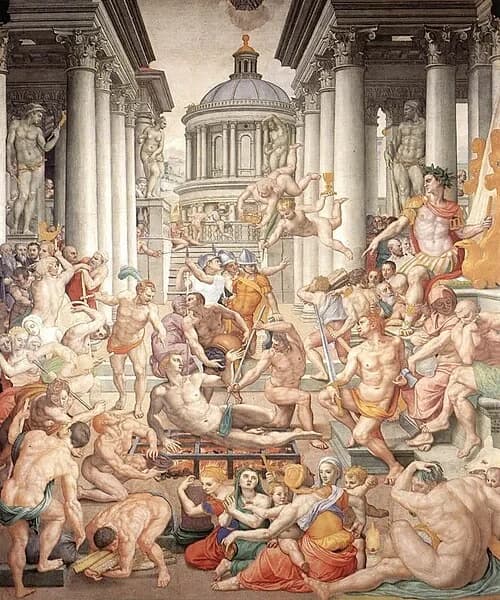
The Martyrdom of Saint Lawrence
A look at Bronzino's Mannerist masterpiece, which provides a dramatic contrast to the church's architectural restraint.
Martyrdom of Saint Lawrence
Bronzino · 1560s · fresco, plaster, tempera
Moving deeper into the basilica, this large-scale fresco by Bronzino offers a dramatic shift away from the calm, rational lines of Brunelleschi’s architecture. Completed in the mid-16th century, it depicts the martyrdom of Saint Lawrence, the church's patron saint. Tradition holds that he was executed by being roasted alive on a gridiron, a scene rendered here with intense, almost frozen energy. Look at the sheer number of figures packed into the frame. This complexity is a hallmark of Mannerism, a style that favored artifice and technical virtuosity over the balanced simplicity of the High Renaissance. Bronzino used this commission to showcase his absolute mastery of the human form. Observe the exaggerated musculature and the twisting, serpentine poses of the figures—both the saint and his executioners. Each limb and torso is meticulously modeled, yet the overall composition feels crowded and tense rather than natural. The way the figures overlap and fill every corner of the scene creates a sense of restless movement. It is a powerful example of how art in Florence evolved toward greater emotional intensity and formal display, using the suffering of a saint to demonstrate the artist's own incredible skill.
Donatello’s Bronze Pulpits
Focusing on the final, expressive works of Donatello located in the nave.
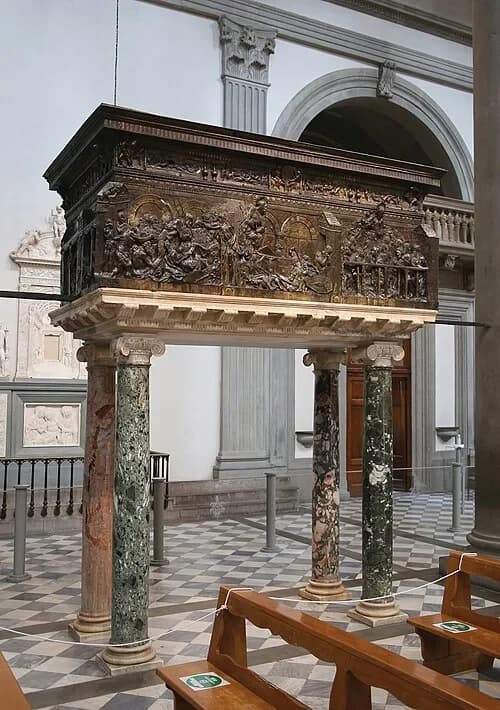
The Resurrection Pulpit
Donatello · 1460 · bronze
While Donatello designed these bronze pulpits in the 1460s, they weren't actually assembled and installed in their current positions until 1515. This particular pulpit focuses on the 'Resurrection' and 'Ascension' of Christ, continuing the experimental spirit seen in its companion. Take a moment to study the perspective used in these low-relief carvings. Donatello employed a technique that makes the figures appear to break through the traditional boundaries of the frame. In some scenes, heads and limbs seem to spill out toward the viewer, blurring the line between the artistic world and our own. This was a radical move in the 15th century, moving away from the idea of the artwork as a self-contained window. The composition of the Resurrection itself is unconventional; instead of a triumphant, upright figure, Christ is shown rising with a sense of heavy, physical effort, reflecting the artist's interest in the weight of human experience. The background details and architecture within the panels are equally complex, creating deep, recessed spaces that invite closer inspection. By breaking the frame and utilizing such dynamic, unusual angles, Donatello pushed the possibilities of relief sculpture to their limits, influencing generations of Florentine artists who would follow in his footsteps.
The Old Sacristy
Visiting the oldest part of the Renaissance church, representing the perfect cube-and-sphere geometry of Brunelleschi.
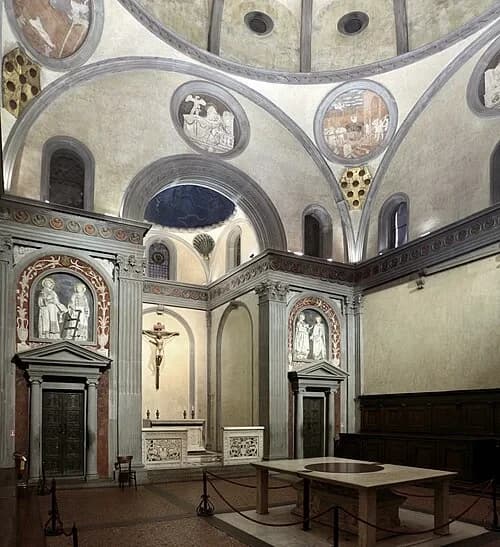
Old Sacristy
Filippo Brunelleschi · 1421 · limestone
The Old Sacristy is the oldest completed part of the basilica and serves as the definitive expression of Filippo Brunelleschi's architectural ideals. The space is a masterclass in geometry: a perfect cube base topped by a hemispherical dome. This 1:1 ratio creates a sense of absolute stability and divine order. Built between 1421 and 1440, it was funded by Giovanni di Bicci de' Medici, who intended it as a burial chapel for himself and his wife. Their sarcophagus sits centrally beneath the marble table in the middle of the room. Beyond the architecture, this space is famous for the collaboration between Brunelleschi and the sculptor Donatello. Look into the corners and above the doorways; you will see large, circular reliefs known as 'tondi.' These colored terracotta works, depicting the life of Saint John the Evangelist and the four Evangelists, were crafted by Donatello. While Brunelleschi reportedly felt the sculptures were too distracting for his pure architectural lines, the combination of his rational space and Donatello’s expressive figures has become iconic. The pale walls and dark stone accents echo the design of the nave, reinforcing the idea of a clear, readable environment where every element is governed by proportion and light.
The Martelli Chapel
A stop to see the early Renaissance masterpieces of Lippi and Donatello's workshop.
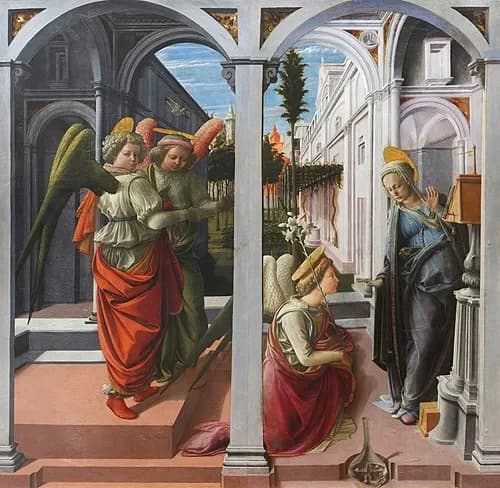
Martelli Annunciation
Filippo Lippi · 1445 · tempera, wood
Tucked away in the Martelli Chapel is this masterpiece by Fra Filippo Lippi, a painter who significantly influenced the direction of the Florentine Renaissance. Painted around 1440, the Martelli Annunciation is celebrated for its soft, luminous light and the way it brings a sense of earthly reality to a divine encounter. Look at the architecture within the painting; it reflects the real-world buildings of Florence, grounding the biblical event in a familiar setting. Lippi filled the scene with symbolic details that reward a closer look. In the background, you can see a 'hortus conclusus,' or enclosed garden, which was a traditional symbol of Mary’s purity. More subtly, in the very foreground, sits a clear glass carafe. The light passing through the glass without breaking it was a common metaphor for the miraculous nature of the conception. Lippi’s figures of Mary and the Angel Gabriel possess a gentle, human quality that was revolutionary at the time. Their poses are graceful, and their expressions suggest a quiet, personal exchange rather than a distant, iconic event. This approachable style, combined with meticulous attention to domestic and botanical detail, paved the way for later artists like Botticelli and Leonardo da Vinci, who would continue to blend the sacred with the natural world.
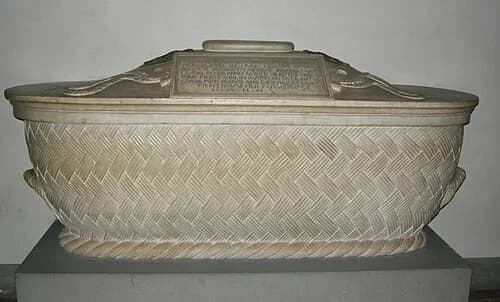
Martelli Sarcophagus
Donatello · 1455 · marble
Near the Annunciation painting, you will find a truly remarkable piece of funerary art: the Martelli Sarcophagus. What makes this tomb stand out is its unique exterior decoration. The artist, likely from the immediate circle of Donatello, carved the marble with a dense, rhythmic pattern that mimics the appearance of a woven basket. This 'basket-weave' effect is a stunning demonstration of technical virtuosity. It takes the cold, unyielding surface of the stone and gives it the visual texture of something organic and flexible, like wicker or reeds. This level of craftsmanship was highly prized by the Medici and their close associates, the Martelli family, who supported a wide variety of experimental artistic techniques. Beyond its beauty, the sarcophagus reflects the Renaissance interest in 'virtuosismo'—the ability to perform difficult artistic feats for their own sake. By turning marble into 'weaving,' the sculptor challenged the viewer's perception of material and form. The lid is equally detailed, featuring inscriptions and heraldic symbols that identify the family. This object reminds us that the art within San Lorenzo isn't just found on the walls or in the major sculptures, but in every corner, where even functional items like tombs were treated as opportunities for groundbreaking creative expression.
The Cloister of the Canons
Stepping outside into the peaceful courtyard that connects the church to the library.
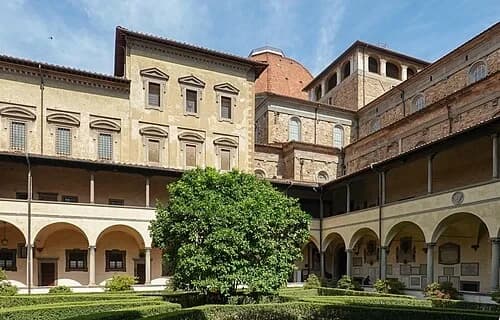
Cloister of San Lorenzo
Stepping out into the Cloister of San Lorenzo provides a refreshing change of pace. Built between 1457 and 1462, this two-story courtyard was designed by Antonio Manetti, a devoted follower of Brunelleschi. The architecture here carries forward the master’s love for clear, rhythmic proportions. Observe the rows of slender columns and the perfect repetition of the arches, which create a sense of order and peace. This space served a very practical purpose for the resident clergy; it was a place for meditation, exercise, and quiet study. Historically, the central garden was once filled with orange trees, their scent drifting through the open corridors. Beyond its role as a sanctuary, the cloister acts as the vital physical link between the various parts of the complex, connecting the main church with the famous Laurentian Library. As you walk along the shaded paths, look at the walls, which are often lined with memorial plaques and architectural fragments from earlier versions of the church. The combination of the open sky, the greenery, and the mathematical harmony of the stonework creates a sensory palette cleanser, allowing you to process the incredible density of the art you’ve seen inside before continuing your journey through the Medici legacy.
The New Sacristy Architecture
A transition to Michelangelo’s funerary chapel, where architecture and sculpture become one.
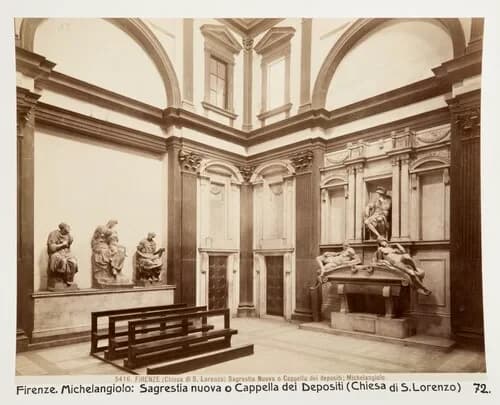
New Sacristy
Michelangelo
Stepping into the New Sacristy, or 'Sagrestia Nuova,' you enter a space where Michelangelo was given total creative control over both the building and the monuments within it. Commissioned in 1520 by the Medici family, this room was intended to house the tombs of several prominent family members. While it shares the same basic square footprint and color palette of 'pietra serena' and white plaster as Brunelleschi’s Old Sacristy, the feel is entirely different. Michelangelo pushed the height of the walls further, creating a much more vertical and dramatic space. The architectural details, like the recessed windows and the heavy cornices, feel active and muscular, as if the stone itself is under pressure. This isn't just a room; it’s a temple designed specifically for the dead. The white marble of the tombs stands out sharply against the grey architectural frames, drawing your eye upward toward the dome. Michelangelo used this space to explore themes of mortality and time, creating a somber, meditative atmosphere. Every element, from the way the light enters the high windows to the positioning of the statues, was carefully choreographed to elevate the family's memorial into a timeless work of art that feels as much like a sculpture as it does a building.
Tomb of Giuliano de' Medici
Examining the allegorical figures of Night and Day on the tomb of the Duke of Nemours.
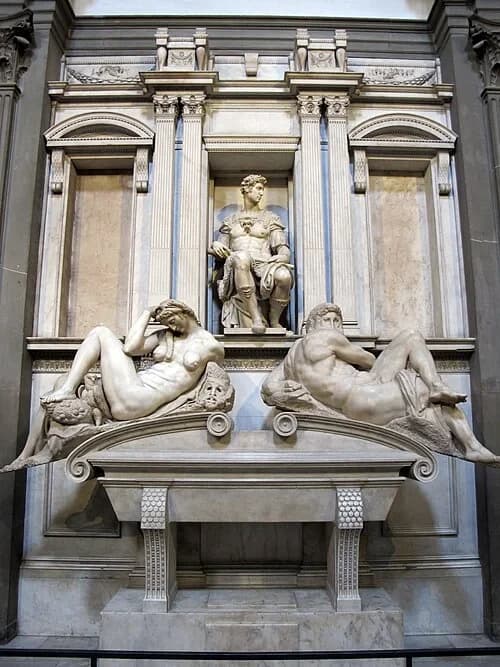
The Duke and the Allegories of Time
Dominating one wall of the New Sacristy is the tomb of Giuliano de' Medici, the Duke of Nemours. Above the sarcophagus, Giuliano is depicted as an idealized, active commander, looking out into the room. However, the most famous elements are the two reclining figures below him: 'Night' and 'Day.' These allegories represent the cycle of time that eventually consumes all human life and achievement. Study the profound contrast in the way Michelangelo carved these two figures. 'Night' is a smooth, highly polished female form, her body twisted in a deep, restless sleep. Surrounding her are symbols of the dark—an owl, a mask, and a cluster of poppies. In contrast, 'Day' is a massive, muscular male figure whose face is left rough-hewn and unfinished. This 'non-finito' technique gives 'Day' a sense of raw, emerging power, as if he is struggling to wake. Together, they create a sense of eternal movement. No matter how much glory a person achieves in their life, Michelangelo suggests that the relentless alternation of light and dark will eventually overtake them. The tension between the polished and the raw, the active duke and the weary allegories, makes this one of the most poignant meditations on mortality in the history of Western art.
Tomb of Lorenzo de' Medici
Viewing the contemplative Duke of Urbino and the figures of Dawn and Dusk.
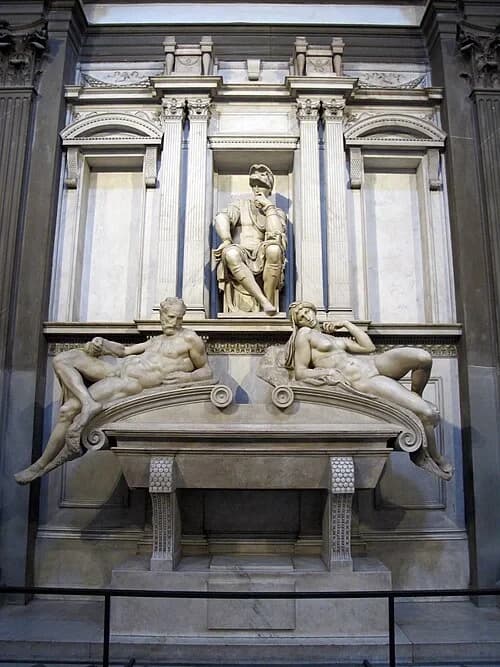
Dawn and Dusk
Facing the tomb of Giuliano is the monument to Lorenzo de' Medici, the Duke of Urbino. While Giuliano was portrayed as an active leader, Michelangelo chose to depict Lorenzo in a deeply contemplative pose, often referred to as 'Il Pensieroso,' or The Thinker. His face is shrouded in shadow by his helmet, suggesting a mind turned inward. Beneath him lie the reclining allegories of 'Dawn' and 'Dusk.' Look at the figure of 'Dawn' on the left. Unlike the typical Renaissance depictions of a fresh, hopeful morning, Michelangelo’s Dawn appears weary and burdened. She seems to wake with a sigh, as if she is reluctant to face another day in a world of sorrow. This heavy-lidded, melancholic expression is believed to reflect Michelangelo’s own somber state of mind during this period of political upheaval in Florence. Her companion, 'Dusk,' is a male figure whose body seems to be sinking into a heavy, terminal exhaustion. The relationship between these four figures across the room—Night, Day, Dawn, and Dusk—creates a complete cycle of time. By placing the contemplative Lorenzo above these weary temporal symbols, Michelangelo underscores the futility of human ambition against the slow, grinding turn of the universe, ending our focus on these great Medici tombs with a sense of quiet reflection.
Michelangelo’s Secret Room
A look at the hidden chamber discovered beneath the New Sacristy, where Michelangelo hid from a death sentence.
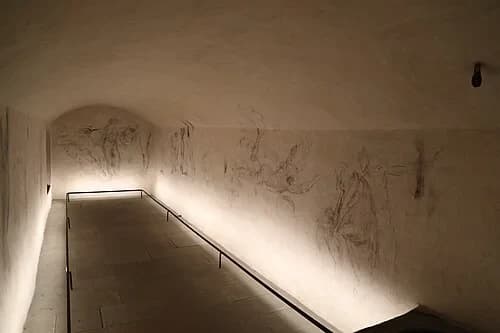
Michelangelo's Secret Room
In 1975, a trapdoor concealed under a wardrobe revealed one of the most significant artistic discoveries of the twentieth century. This narrow, windowless room served as a sanctuary for Michelangelo for three months in 1530. At the time, the Republic of Florence had fallen, and the returning Medici family sought vengeance against those who had supported the city's defense—including Michelangelo. Fearing a death sentence from the Pope, the artist retreated into the shadows of this subterranean space. During his confinement, Michelangelo used the walls as a canvas for his thoughts. Using charcoal and chalk, he sketched dozens of figures, some reaching over life-size. These drawings are not finished works but rather ghostly memories of his past achievements and blueprints for future ideas. You can recognize echoes of the figures from the Sistine Chapel ceiling and early studies for the tombs upstairs. They offer a rare, intimate glimpse into the artist's mind as he worked from memory in near-total isolation. The sketches remain on the plaster walls today, a silent record of a master artist waiting for the political storm to pass so he could return to the light.
Want to hear the rest?
Download the Stanza app to unlock all 18 stops and full GPS-guided navigation.
Frequently Asked Questions
How long does the Basilica di San Lorenzo audio tour take?
The Basilica di San Lorenzo audio guide includes 18 narrated stops. Most visitors spend 45 minutes to 1.5 hours exploring the complete tour, though you can listen at your own pace and skip or revisit any stop.
Is the Basilica di San Lorenzo audio guide available in my language?
Stanza supports 15 languages: English, Spanish, French, German, Italian, Portuguese, Russian, Japanese, Chinese, Korean, Arabic, Hindi, Polish, Dutch, Hebrew. Check the guide in the app to confirm the languages currently available for this tour.
Can I use the audio guide offline at Basilica di San Lorenzo?
Yes! Download the complete Basilica di San Lorenzo tour — including all audio, maps, and images — before your visit. The Stanza app works completely offline, so you don't need WiFi or mobile data at the venue.
How much does the Basilica di San Lorenzo audio guide cost?
The Stanza app is free to download. Free and paid audio guides are available; current prices are shown in the app.
How do I use the Stanza audio guide at Basilica di San Lorenzo?
Download the free Stanza app, search for "Basilica di San Lorenzo", and download the tour. When you arrive at the venue, the app uses GPS to detect your location and automatically plays the relevant narration as you move between points of interest — completely hands-free.
What makes the Stanza audio guide different from other Basilica di San Lorenzo tours?
Stanza offers GPS-triggered narration that plays automatically as you walk through Basilica di San Lorenzo — no need to manually select stops. The tour is available in 15 languages, works fully offline, and includes 18 expertly narrated stops with images and historical context.
What other audio guides are available near Basilica di San Lorenzo?
Stanza offers multiple audio guides in Florence, Italy and nearby areas. After downloading the app, browse the map to discover all available tours near Basilica di San Lorenzo. Each guide can be downloaded for offline use.