Languages
15Palazzo Ducale Audio Guide
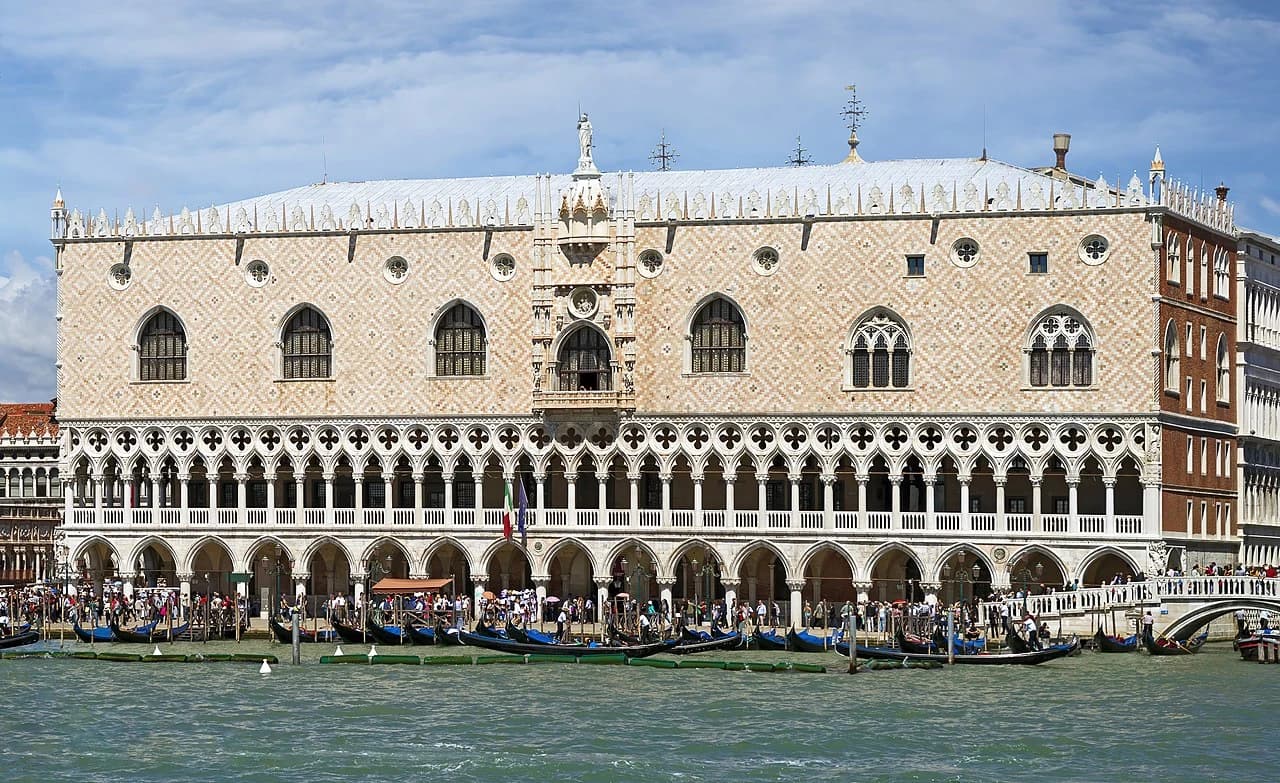
Palazzo Ducale is a landmark in Venice, Italy. Explore it with Stanza's GPS-triggered offline audio guide — available in 15 languages.
Quick Facts
35
Stops
15
Languages
100%
Offline
📍 Venice, Italy · 45.4337°N, 12.3404°E
About Palazzo Ducale
The Doge's Palace is a historic palace located in Venice, Italy, that served as the residence of the Doge of Venice, the supreme authority of the former Republic of Venice. It is a masterpiece of Venetian Gothic architecture and is now a museum.
Palazzo Ducale is also known as Palazzo ducale, Palazzo Ducale, Palazzo Ducale di Venezia, Palazzo Dogale, and 1 other names in various languages.
This self-guided audio tour features 35 narrated stops organized across 6 sections, including Porta della Carta, The Central Courtyard, The Loggia & Museo dell'Opera, Scala d'Oro (The Golden Staircase), The Institutional Chambers, The Bridge of Sighs. As a palace, Palazzo Ducale offers a unique cultural experience in the heart of Venice, Italy.
The Stanza audio guide is available in 15 languages and works entirely offline — download the complete tour including audio narration, maps, and images before your visit. As you walk through Palazzo Ducale, GPS-triggered narration plays automatically at each point of interest.
Last updated:
What you will hear
Porta della Carta
The ceremonial gateway connecting the palace to St. Mark's Basilica.
The Kneeling Doge
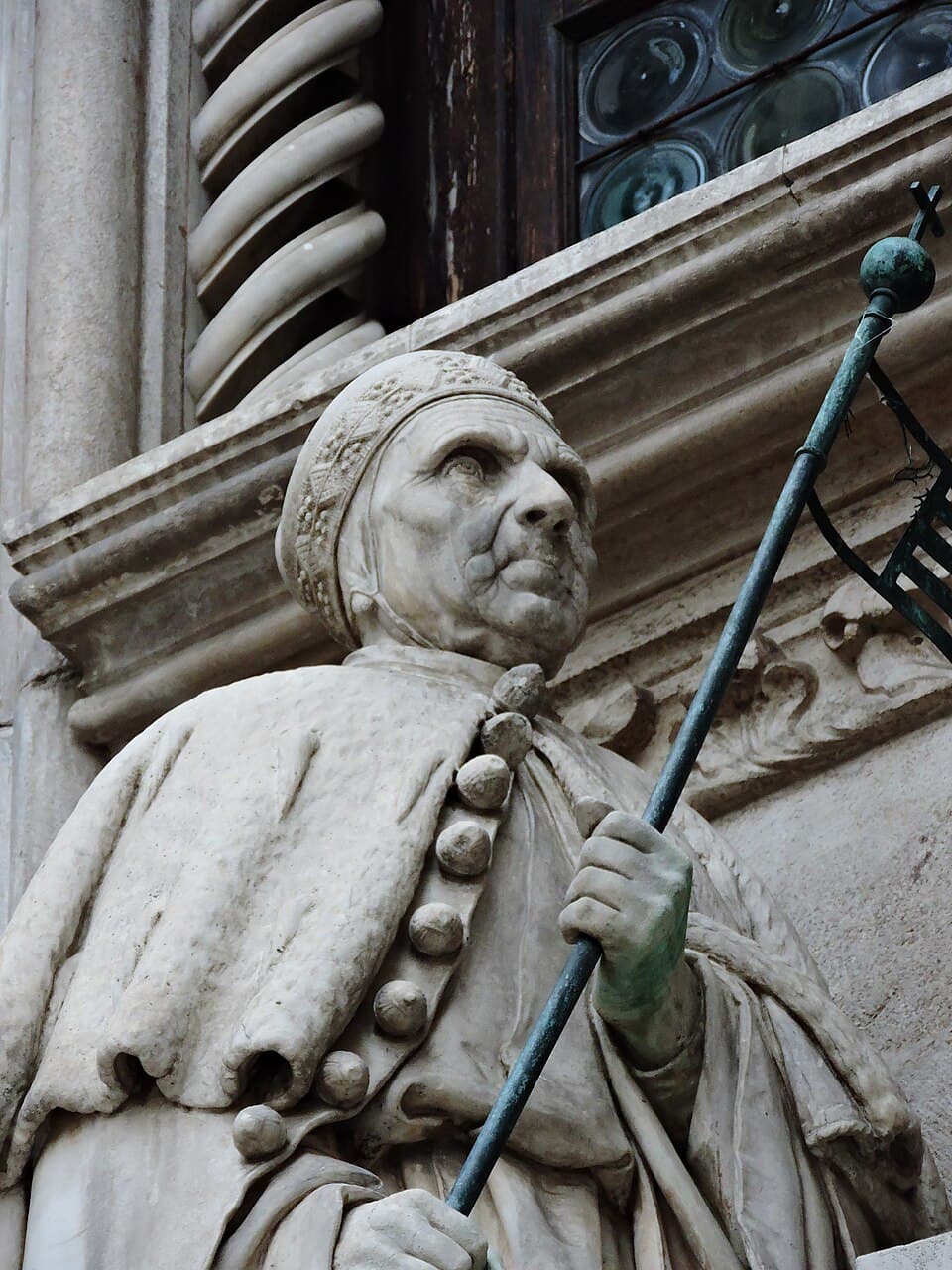
Looking closely at the figure of Doge Francesco Foscari, you can see the profound humility intended by the sculptor. In an era when most European monarchs portrayed themselves as absolute, divinely appointed rulers standing tall over their subjects, the Venetian Doge is depicted kneeling. This was a calculated piece of political propaganda. It signaled that the Doge was not a king, but rather the first citizen of a Republic, bound by its laws and subservient to the state, represented here by the winged Lion of Saint Mark holding the Gospel. The sculpture you see today is actually a faithful 19th-century replica. The original 15th-century masterpiece was destroyed in 1797 during the fall of the Republic, when Napoleonic troops sought to erase symbols of the old regime. Despite being a later replacement, the replica preserves the essential spirit of the original work, ensuring that this message of republican duty and civic piety remains a permanent fixture of the palace entrance.
The Central Courtyard
The administrative heart where the palace's various functions converged.
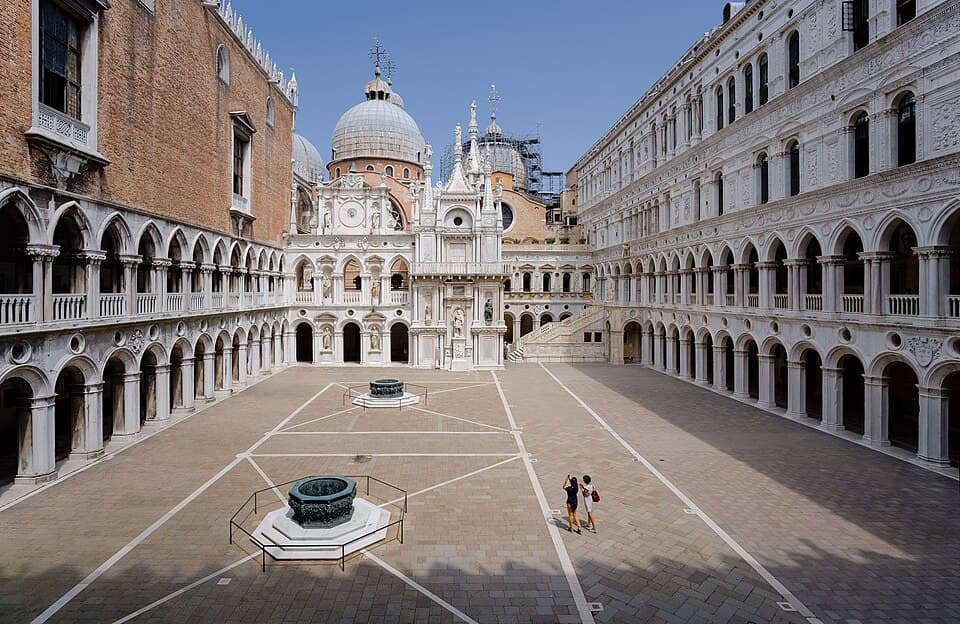
The Central Courtyard
As you enter the central courtyard, the atmosphere shifts from the public bustle of the square to a more dignified, enclosed space. This was the engine room of the Republic. Take a look around and notice the architectural transition. On some sides, you see the functional, exposed brickwork of the older Gothic wings. Contrast this with the eastern facade, which is a triumph of ornate Renaissance design, decorated with elaborate carvings and classical columns. This courtyard was once the center of Venetian administrative life. Imagine it filled not with tourists, but with the people who kept the state running: busy lawyers in black robes, government clerks carrying stacks of parchment, and humble petitioners waiting for a chance to be heard by the courts. It was a place where justice was administered and the daily business of an empire was debated. The wide, paved expanse provided a sense of openness and transparency, reflecting the Republic's pride in its structured, bureaucratic system of governance.
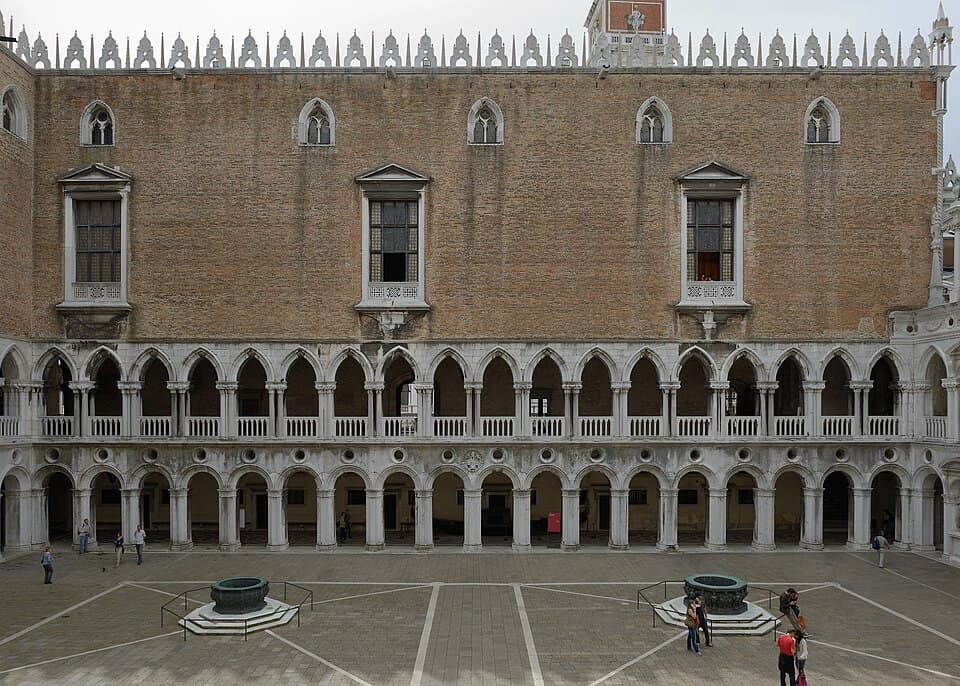
The Bronze Well-Heads
In the center of the courtyard sit two magnificent bronze well-heads, cast with intricate relief patterns. While they are beautiful objects of art, their primary purpose was strictly practical. In Venice, a city famously surrounded by water, fresh water was actually a rare and precious luxury. Because the lagoon is salt water, the Venetians had to engineer a complex system to survive. These well-heads sit directly above massive underground cisterns. These chambers were lined with clay and filled with layers of sand to act as natural filters. Rainwater from the courtyard and palace roofs was channeled into these filters, eventually collecting as clean, drinkable water at the bottom. These wells supplied the hundreds of officials, guards, and workers who spent their days within the palace complex. The high level of artistry found on these well-heads reflects the importance the Republic placed on its water supply, treating the source of life with the same reverence as the halls of government themselves.
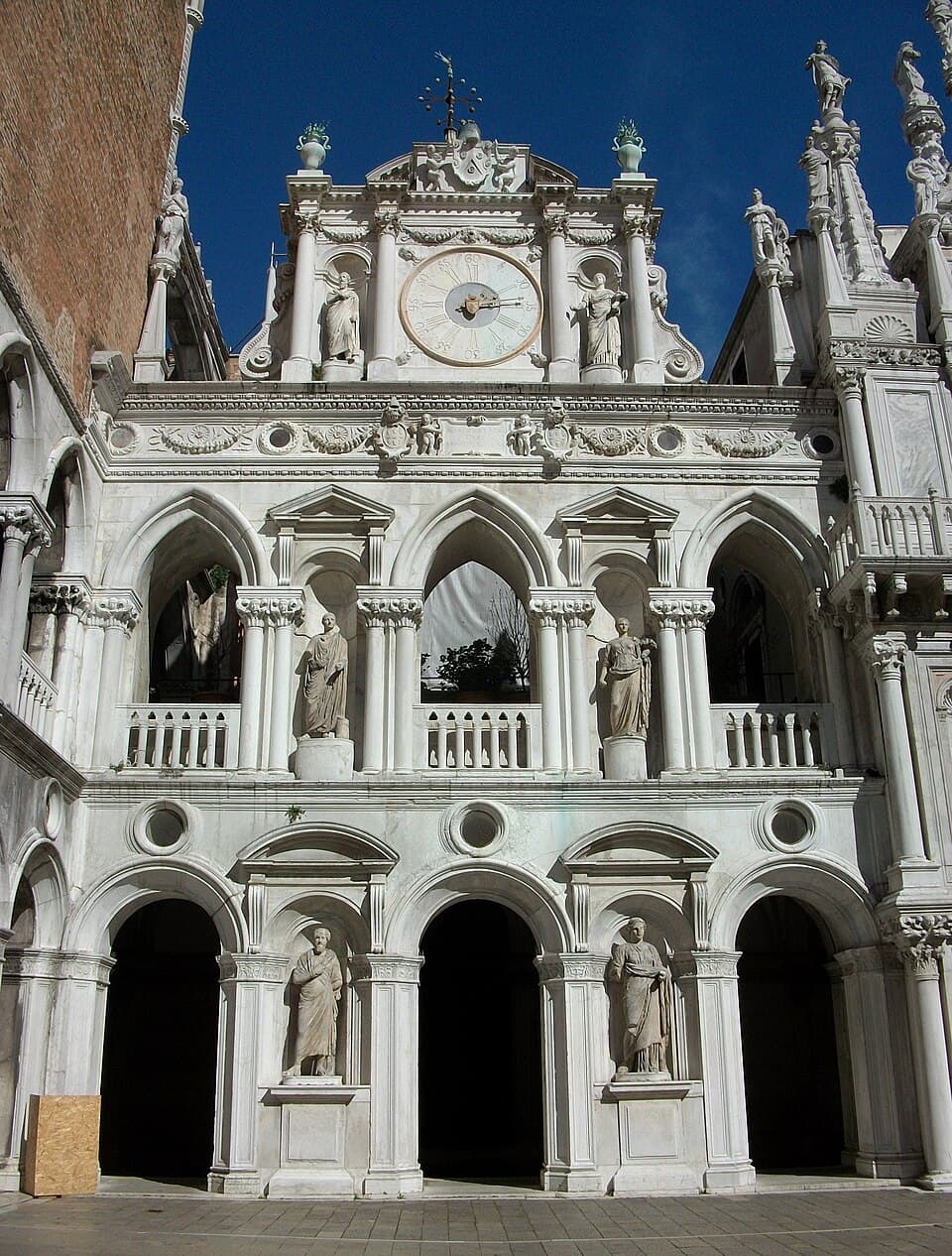
The Foscari Arch
Directly ahead is the Foscari Arch, a triumphal structure that serves as a bridge between the palace's Gothic and Renaissance sections. It is a stunning architectural transition, designed to celebrate the glory of the Republic. If you look toward the top, you will see a prominent astronomical clock. This is not just a device for telling time; it is a symbol of the Venetian obsession with precision. As a maritime empire, Venice’s survival depended on a deep understanding of the stars, tides, and navigation. This clock reflected that specialized knowledge, tracking the movements of celestial bodies alongside the hours of the day. For the politicians and administrators walking beneath it, the clock served as a reminder that the state’s decisions should be as orderly and reliable as the heavens themselves. The arch itself is richly decorated with figures and classical motifs, serving as a grand backdrop for the state processions that would frequently move through the courtyard, reinforcing the idea that Venice was a city where time, science, and power were perfectly synchronized.
The Loggia & Museo dell'Opera
Exploring the ground floor arcades and the original architectural fragments.
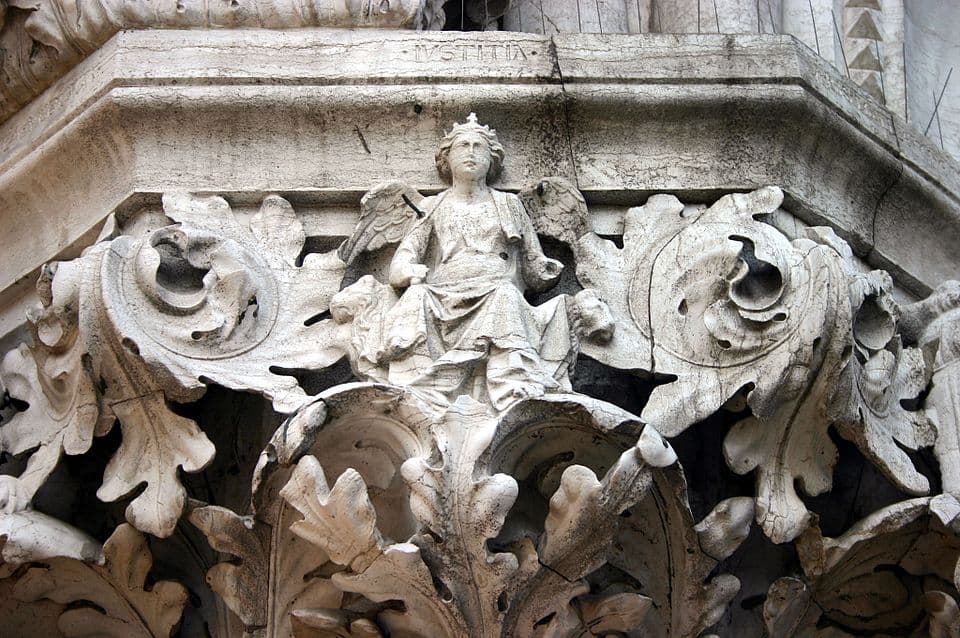
The Pillar of Justice
Direct your attention to the capital of the corner column, where you can find a detailed carving depicting 'Justice.' This figure was not chosen at random; the concept of impartial, efficient justice was the very foundation of the Venetian Republic's identity. Venetians took great pride in their legal system, believing it to be superior to the arbitrary rule of monarchs found elsewhere in Europe. In the carving, you can see Justice portrayed as a regal figure holding her traditional symbols: a sword, representing the power to enforce the law, and a set of scales, representing the careful weighing of evidence. The intricacy of the stonework here—surrounded by lush foliage and other symbolic figures—shows the care the Republic took in decorating even the smallest architectural details with profound meaning. By placing Justice on the exterior of the palace, the state was making a public promise to its citizens and a warning to its enemies that within these walls, the law was supreme and the scales were always balanced.
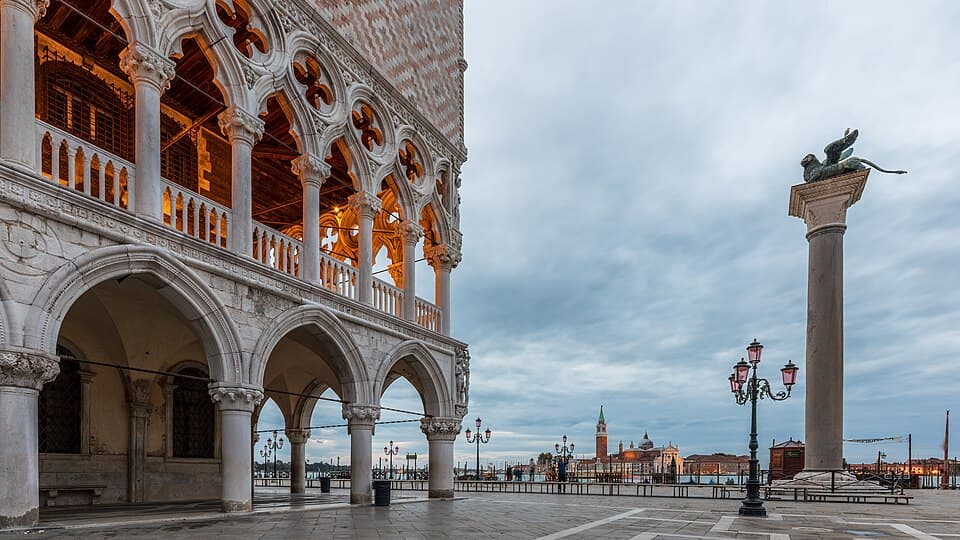
Gateway to the Lagoon
Stand for a moment under the arcade and look out toward the island of San Giorgio Maggiore, visible across the water. This view provides a beautiful contrast that helps reinforce the 'Aesthetic Paradox' you encountered at the start of your visit. Notice the shift in atmosphere. Behind you is the dense, heavy stone architecture of the palace—a monument to human order and political power. In front of you is the open, breezy light of the lagoon, where the sky and water seem to merge. This openness is a key part of the palace’s design. The ground-floor colonnade acts like a permeable border, allowing the light and the sea air to flow through the structure. It is a reminder that although the palace is a massive and solid fortress of government, it is also a part of the water. The Republic's power was never isolated behind thick, windowless walls; it was always connected to the lagoon that protected and enriched it. This balance between the heavy stone and the airy horizon captures the unique spirit of Venice—a city of solid stone that lives and breathes with the tides.
Scala d'Oro (The Golden Staircase)
The glittering path taken by dignitaries to reach the institutional chambers.
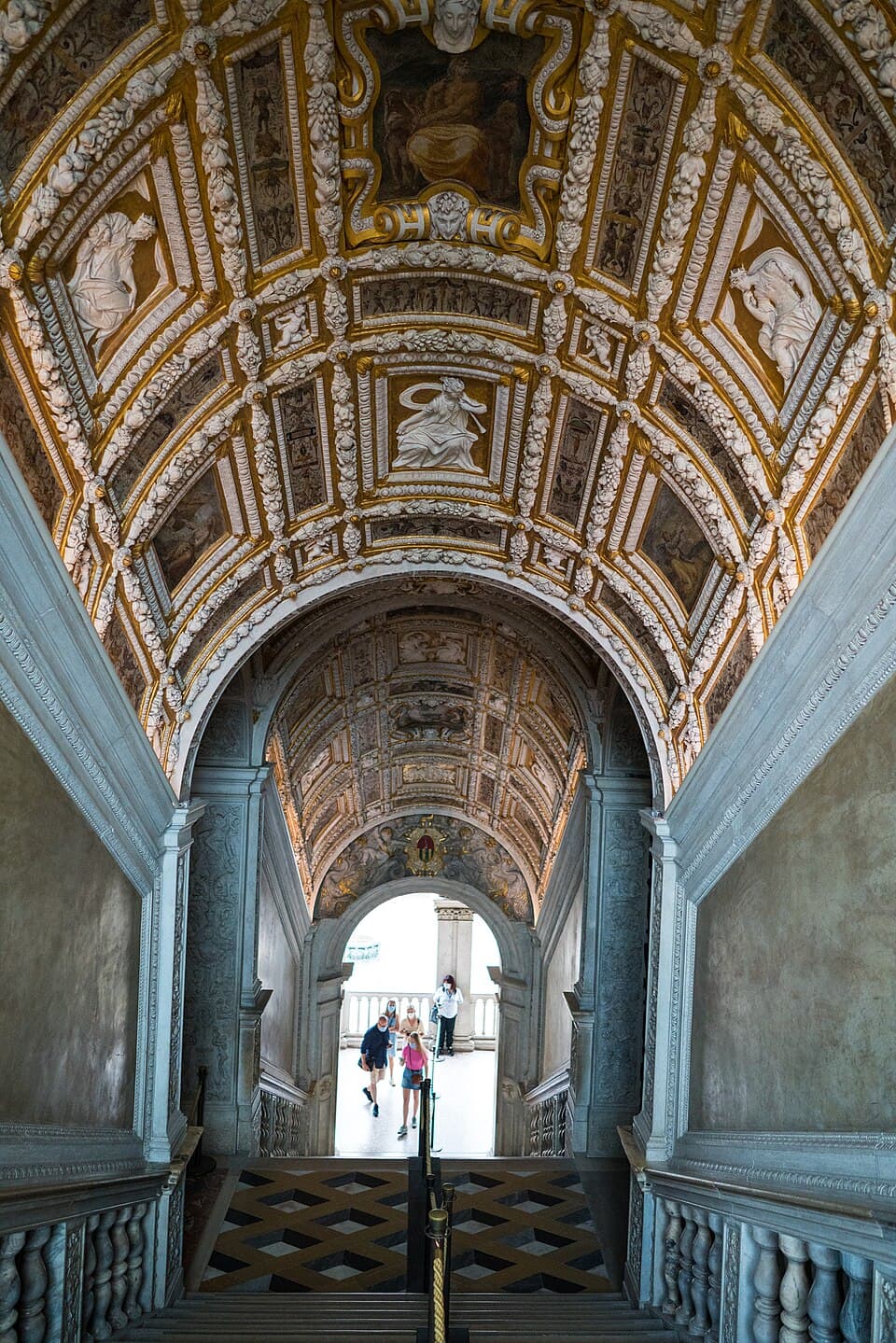
The Golden Staircase
As you begin your ascent up the Scala d'Oro, or the Golden Staircase, you are entering one of the most exclusive spaces in the palace. This was not a thoroughfare for the general public. Instead, it was the ceremonial path reserved for high-ranking government officials and foreign ambassadors on their way to meet the Doge. The sensory experience is intended to be overwhelming. Look up at the barrel-vaulted ceiling, which is encrusted with genuine gold leaf and intricate white stuccos. The shimmering gold and the delicate carvings were designed to reflect the light and create a sense of divine splendor. This was architectural propaganda at its most direct: by the time an ambassador reached the top of these stairs, they had been physically immersed in the Republic’s immense wealth. The staircase served as a psychological transition, preparing visitors for the even more magnificent halls of government that lay ahead. It sent a clear message that they were entering the inner sanctum of a state that possessed both the resources and the artistic taste of a world power.
The Institutional Chambers
The grand halls where the Senate and the Collegio governed the city.

Neptune Offering Gifts to Venice
Giovanni Battista Tiepolo · 1740s · oil paint
In this 18th-century painting, the celebrated artist Giambattista Tiepolo captures the core of Venice’s identity through allegory. The scene depicts Neptune, the powerful god of the sea, pouring out a bounty of gold coins and precious coral at the feet of a regal woman who personifies the city of Venice. Notice the contrast in Tiepolo’s style compared to the earlier Renaissance works in the palace; his approach is much lighter and more airy, with a bright, sun-drenched palette that gives the scene a sense of weightlessness. Venice is shown reclining comfortably, draped in rich fabrics and wearing a crown, accepting the sea's tribute as her birthright. This painting is a late but powerful reiteration of the Republic's oldest claim: that its wealth and stability were gifts directly from the ocean. By showing the god of the sea himself in a position of service, the artwork reinforces the idea of Venice’s maritime supremacy. Even as the Republic’s real-world power began to wane in the 1700s, this image of an unending, divine tribute ensured that the palace walls continued to project an aura of timeless prosperity and unchallenged oceanic dominance. It is a masterclass in using light and mythology to create a lasting piece of state propaganda.
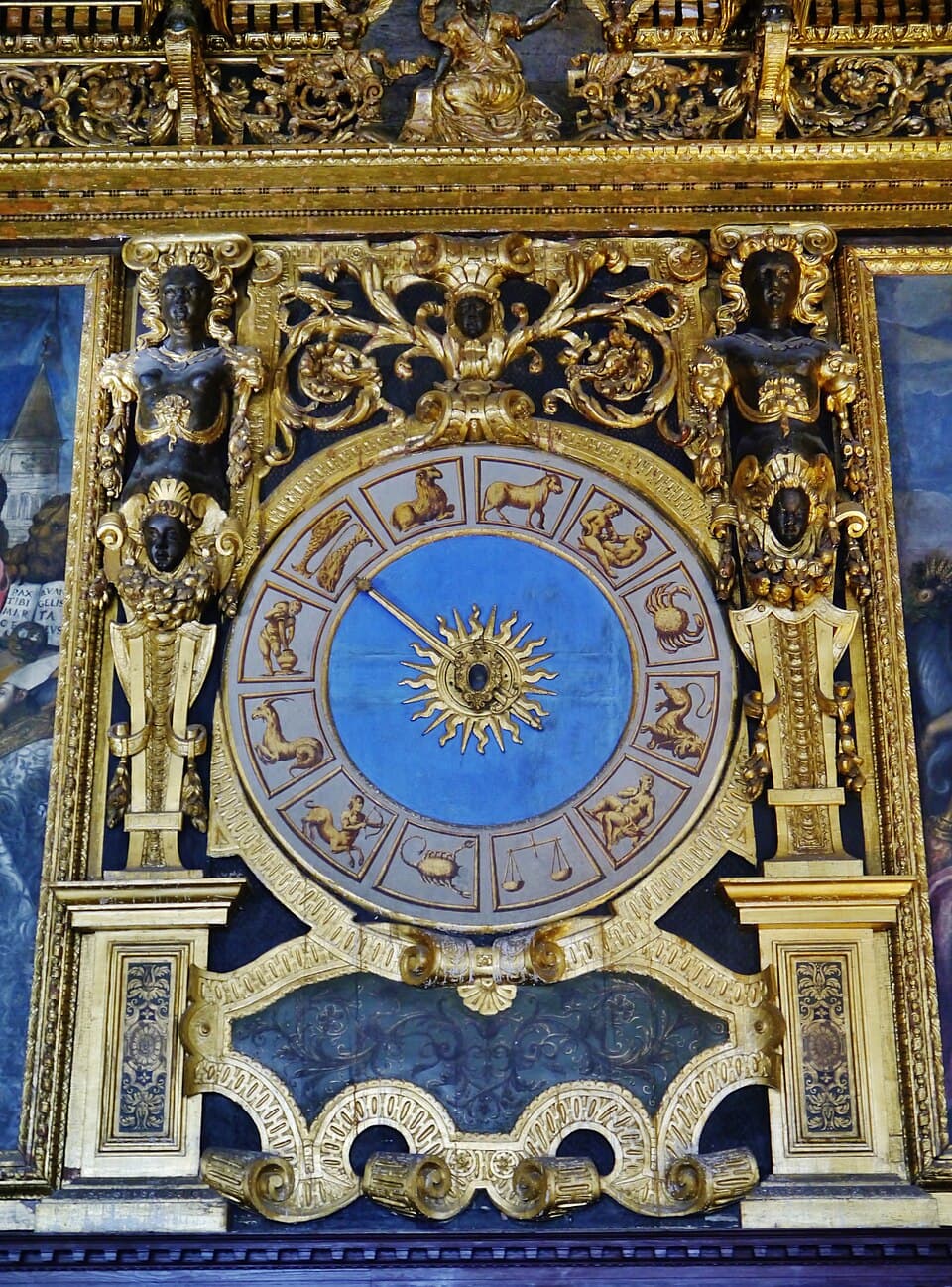
The Senate Clock
Positioned within the Senate Chamber, this remarkable astronomical clock served a purpose far beyond simply telling the time. Notice its unusual face, which is divided into 24 hours rather than the 12 we use today. It also features the signs of the zodiac, tracking the movements of the sun and the stars. For the Venetian senators, this clock was a symbolic instrument. It represented the idea that the laws and decisions made within these walls should be in perfect harmony with the natural order of the universe and the 'time' of the Republic. The clock’s intricate design, with its central sunburst and surrounding figures, reflects Venice’s obsession with precision. As a maritime power, the city depended on the stars and accurate timing for navigation; that same scientific rigor was applied to its governance. Every debate and vote occurred under the watchful eye of this celestial timepiece, reminding the senators that their actions were part of a larger, cosmic history. It stands as a testament to the Venetian belief that their state was not just a human creation, but a reflection of a divine and orderly world, where every moment was an opportunity to steer the Republic toward a prosperous future.
The Bridge of Sighs
The enclosed link between the halls of justice and the new prisons.
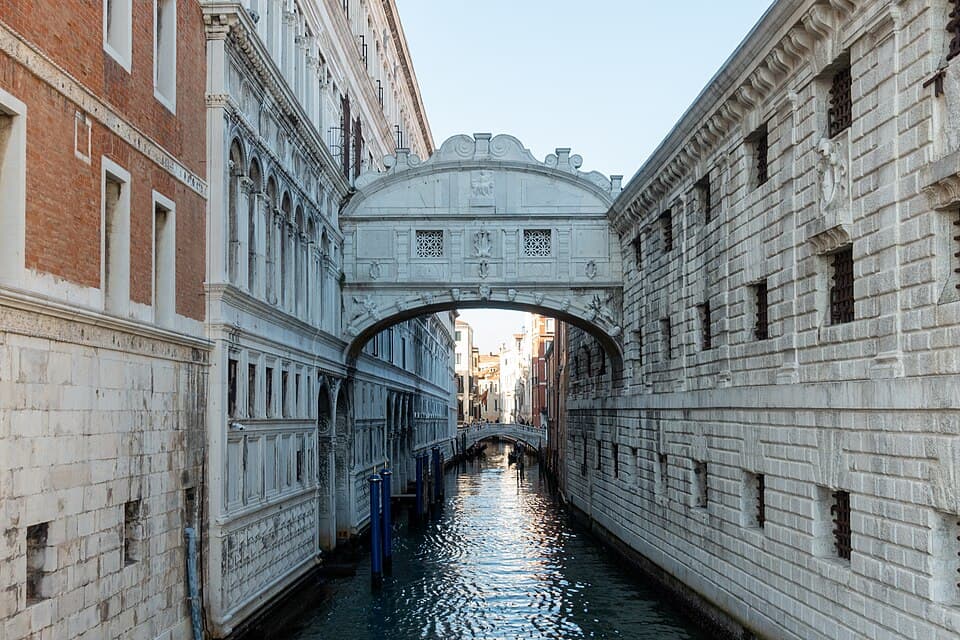
The Bridge of Sighs
From the outside, the Bridge of Sighs is one of Venice's most romantic landmarks, but its historical function was far more somber. Built in the early 17th century from white limestone, this enclosed bridge was designed to connect the courtrooms inside the Doge's Palace directly to the 'Prigioni Nuove,' or the New Prisons, located across the narrow canal. This allowed for the secure and private transfer of prisoners after they had been sentenced. Its famous name was popularized in the 19th century by the poet Lord Byron. According to the legend, prisoners crossing the bridge would look out through the small stone lattice windows and sigh with despair as they caught their last glimpse of the beautiful lagoon and the freedom they were leaving behind. While the term 'Bridge of Sighs' is a romantic invention, the bridge itself represents the final step in the Venetian system of justice. It marks the transition from the golden splendor and high-stakes politics of the palace to the cold, dark reality of incarceration. The bridge’s elaborate Baroque exterior, with its delicate carvings and arched form, masks the grim purpose for which it was built, standing as a permanent link between the city’s public magnificence and its private punishments.
Want to hear the rest?
Download the Stanza app to unlock all 35 stops and full GPS-guided navigation.
Frequently Asked Questions
How long does the Palazzo Ducale audio tour take?
The Palazzo Ducale audio guide includes 35 narrated stops. Most visitors spend 45 minutes to 1.5 hours exploring the complete tour, though you can listen at your own pace and skip or revisit any stop.
Is the Palazzo Ducale audio guide available in my language?
Stanza supports 15 languages: English, Spanish, French, German, Italian, Portuguese, Russian, Japanese, Chinese, Korean, Arabic, Hindi, Polish, Dutch, Hebrew. Check the guide in the app to confirm the languages currently available for this tour.
Can I use the audio guide offline at Palazzo Ducale?
Yes! Download the complete Palazzo Ducale tour — including all audio, maps, and images — before your visit. The Stanza app works completely offline, so you don't need WiFi or mobile data at the venue.
How much does the Palazzo Ducale audio guide cost?
The Stanza app is free to download. The current listed price for the Palazzo Ducale audio guide is $2.99; app-store region and currency may affect the final price.
How do I use the Stanza audio guide at Palazzo Ducale?
Download the free Stanza app, search for "Palazzo Ducale", and download the tour. When you arrive at the venue, the app uses GPS to detect your location and automatically plays the relevant narration as you move between points of interest — completely hands-free.
What makes the Stanza audio guide different from other Palazzo Ducale tours?
Stanza offers GPS-triggered narration that plays automatically as you walk through Palazzo Ducale — no need to manually select stops. The tour is available in 15 languages, works fully offline, and includes 35 expertly narrated stops with images and historical context.
What other audio guides are available near Palazzo Ducale?
Stanza offers multiple audio guides in Venice, Italy and nearby areas. After downloading the app, browse the map to discover all available tours near Palazzo Ducale. Each guide can be downloaded for offline use.