Stanza · Audio guide
Basilica della Santissima Annunziata Audio Guide
A place to remember. A story to take with you.
The Basilica della Santissima Annunziata is a Renaissance-style, Catholic minor basilica in Florence, Italy. It is considered the mother church of the Servite Order.
Download Stanza, then search for “Basilica della Santissima Annunziata”.
About the tour
One guide. Your kind of visit.
The Basilica della Santissima Annunziata is a Renaissance-style, Catholic minor basilica in Florence, Italy. It is considered the mother church of the Servite Order.
Ready when you are.
- 01Get the free Stanza app.
iOS & Android
- 02Find your guide.
“Basilica della Santissima Annunziata”
- 03Download before you go.
Works offline
Audio guide / 14 narrated stops
Inside the guide
Get to know a few of the stories before you go. Open a stop to read more.
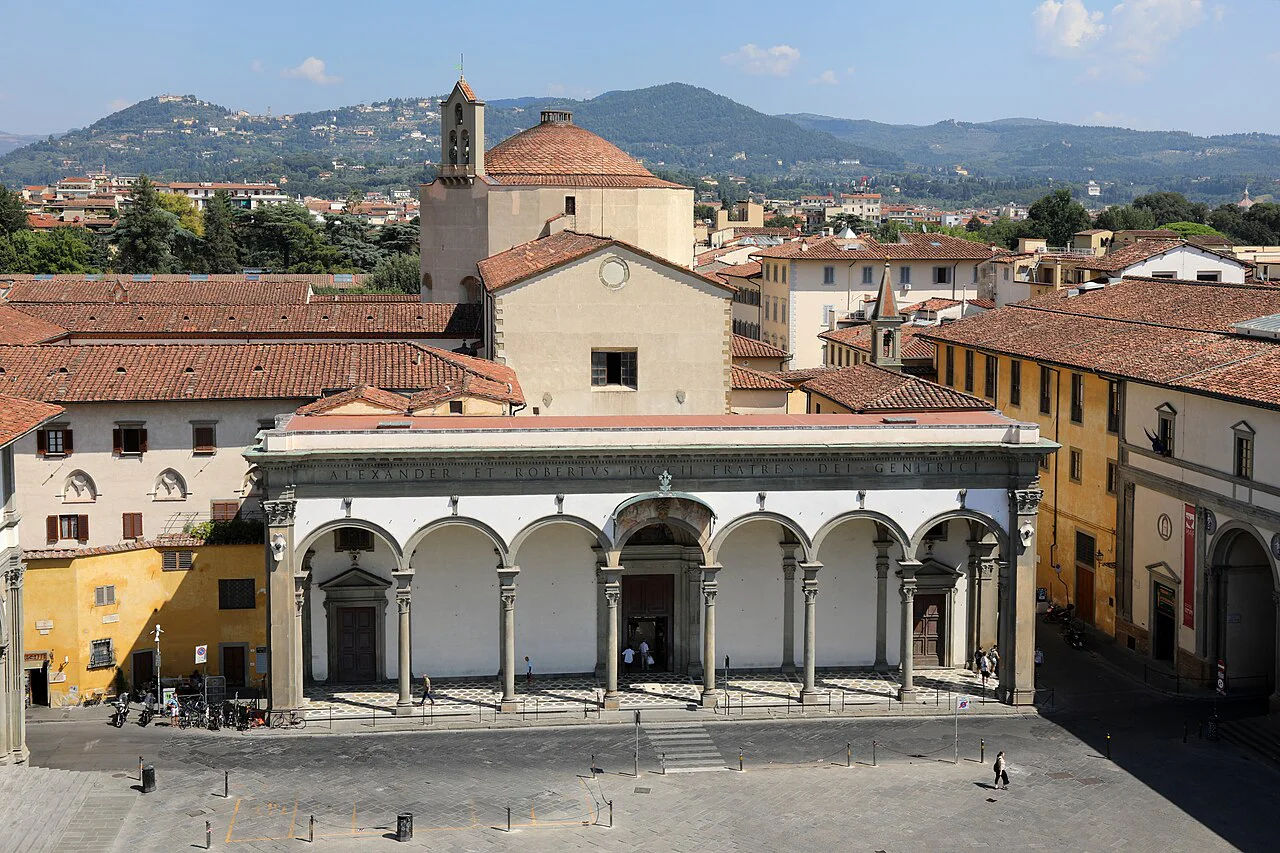
01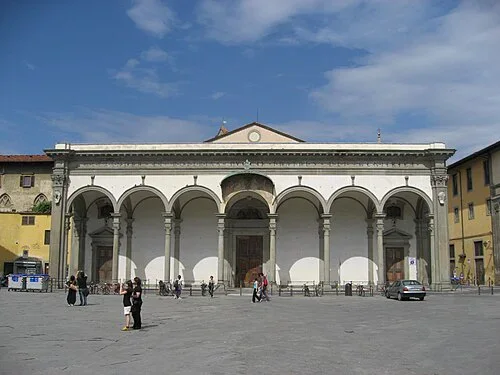 Exterior Portico and Piazza Facade
The church was founded in 1250 by the first members of the Servite Order. Its name means the Most Holy Annunciation, and it became the mother church of that order. Today it is Florence's principal Marian shrine. In January 1806, Pope Pius the Seventh raised it to the rank of minor basilica. Its façade was added in 1601 by the architect Giovanni Battista Caccini. He modelled it on the front of Brunelleschi's Foundling Hospital, which defines the eastern side of the square. For centuries the church stood at the heart of city life. The Tuscan New Year, on the twenty-fifth of March, was one of the occasions tied to it.
Photo: Gryffindor · CC BY-SA 3.0
02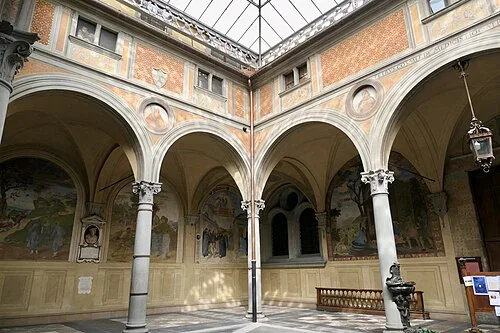 Chiostrino dei Voti (The Atrium of Vows)
Chiostrino dei Voti
Pilgrims who came to venerate the miraculous painting often left wax offerings. Many were life-size models of the donor, and some came complete with horses. A votive offering is a gift made to fulfil a vow, and this small forecourt filled up with them. Its name, the Chiostrino dei Voti, comes from that custom. By the late eighteenth century, some six hundred of these figures stood here. The court had become one of the city's great tourist attractions. In the end, the figures were melted down to make candles. Grand Duke Pietro Leopoldo of Lorraine, the story goes, suggested it. Some tellings give 1785 as the year. Others say 1786. In the nineteenth century the court was closed in with iron and glass, to shelter its frescoes from the weather. The court itself is credited to the architect Michelozzo.
Bruno Rijsman · CC BY-SA 2.0
03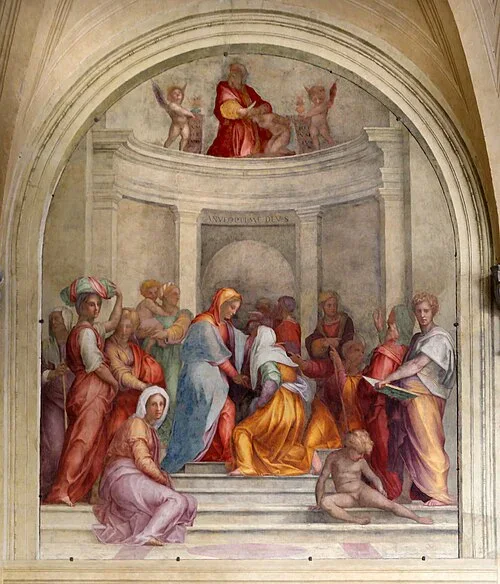 Chiostrino dei Voti (The Atrium of Vows)
Pontormo's Visitation
Pontormo's Visitation is thought to have been painted in place of his master, Andrea del Sarto, who would not finish this cycle. The Virgin receives the homage of her cousin, who kneels on a lower step in a yellow dress. That yellow clashes with the blue and red around it. Behind them, a colonnaded half-circle frames the meeting. Pontormo crowds the scene with so many figures that the space seems too small for them, and that gives the group a faint unease. The seated nude child in the foreground looks relaxed and a little melancholy. High above, an elderly man in red sits between two small angels. The decoration of this atrium began around 1460 and moved slowly for decades. Andrea del Sarto's work from 1509 sped it up, and Rosso Fiorentino was among the painters working here. That shared style, called the maniera, is what later art historians label Mannerism.
Listen in the appPhoto: Sailko · CC BY 3.0
04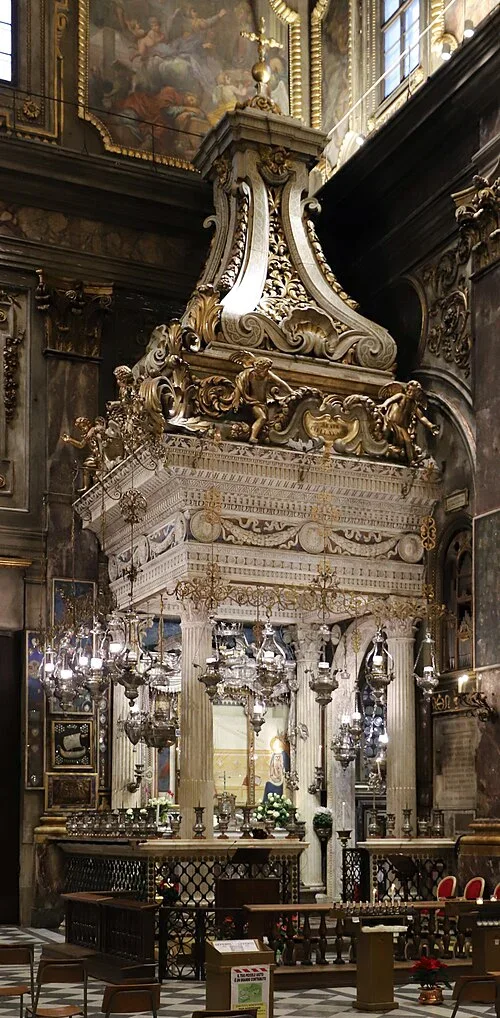 Michelozzo's Tempietto and the Miraculous Shrine
Tempietto of the Annunziata
The friars of the Servite Order decided to raise this marble shrine in 1447. A member of the Medici family helped them. Michelozzo designed it, and the sculptor Pagno di Lapo Portigiani carried it out. It is usually dated to 1448. The shrine has four columns of Carrara marble. They are about five and a quarter metres tall. They support a carved band across the top, decorated with garlands, ribbons, and round medallions. The fresco that gives the church its name is kept inside. Above the canopy rises a much later spire, gilded and carved in wood, with small angels and a cross. The painter Il Volterrano designed that spire, and it was carved in 1674. Lamps hang in clusters around the marble, and candles burn on the altar below. Florentine brides traditionally come to leave their bouquets here.
Listen in the appFrancesco Bini · CC BY-SA 4.0
05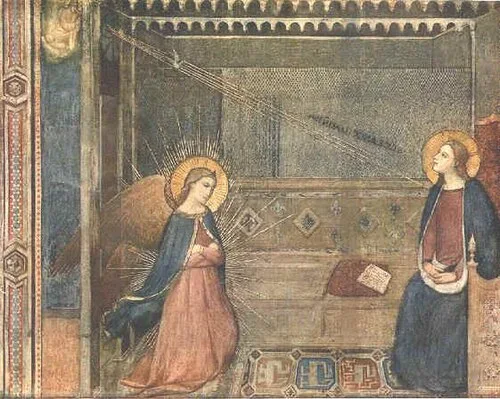 Michelozzo's Tempietto and the Miraculous Shrine
Miraculous Annunciation Fresco
According to a legend, the Servite monks asked a man named Bartolomeo to paint an Annunciation in 1252. He worked hard, but he could not paint the Virgin's face to his satisfaction. Losing heart, he fell into a strange sleep. When he woke, the face was already finished, and he credited an angel with the miracle. In this Annunciation scene, an angel kneels at the left, with rays of light running toward the Virgin. She sits at the right, beside a bench where a red book or cushion lies. A canopied, bed-like frame stands behind them. The painting drew growing devotion, and so the Gonzaga family of Mantua paid for a special tribune in 1444. Other estimates put the fresco itself around 1350, so the legend's date is uncertain. In time, the painting gave the church its name.
Listen in the appFollower of Giotto · Public domain
06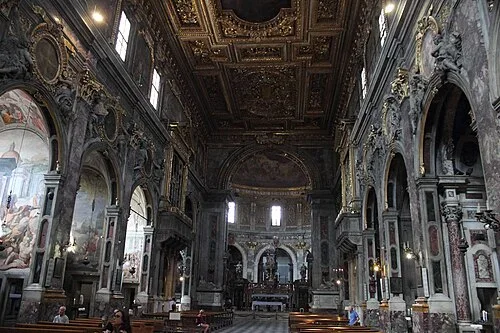 The Grand Nave and Baroque Ceiling
Much of the nave's Baroque look dates from the middle of the seventeenth century. The coffered ceiling is gilded, with a large painted Assumption at its centre. Tellings differ on the date and the painter. One gives 1644 and the painter Pietro Giambelli, working from designs by Baldassarre Franceschini. Another gives 1664 and credits Il Volterrano, whose real name was Baldassarre Franceschini, with the painting. A bridge spans the street, linking the basilica to the Palazzo della Crocetta, which now houses the archaeological museum. Its arch let a princess go to Mass without coming down into the street. She was Maria Maddalena de' Medici, sister of a grand duke, and she was in frail health. Above the second medallion on the right wall, a window with a gilded grate overlooks the chapel of the Madonna. It is called the Princes' window, and the grand ducal family could follow services from it in private.
Listen in the appMiguel Hermoso Cuesta · CC BY-SA 4.0
07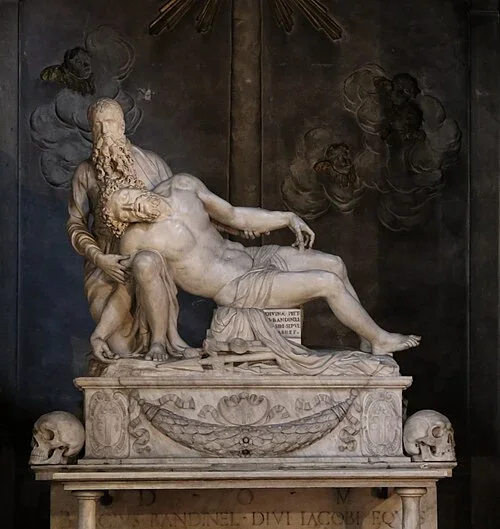 Right Nave: Baccio Bandinelli's Tomb and Pietà
Pietà by Baccio Bandinelli
This chapel belonged to the Pazzi family from 1340. In 1559 it passed to the sculptor Baccio Bandinelli and his descendants, and he made this marble group for his own tomb. The group was carved in Carrara marble in the middle of the sixteenth century. Giorgio Vasari says that Baccio's son, Clemente, began the group. Clemente died in 1555, and his father finished it. The figures fit inside a right-angled triangle, a geometric shape that makes the group feel almost abstract. Yet the two figures are anatomically precise and close to idealized. The body of Christ lies across the lap of the older man who holds him. On the base, relief portraits of Baccio and his wife sit at the corners beneath a carved garland, with the family's arms. The oldest organ in Florence stands in a gallery on the right wall of the nave.
Listen in the appPhoto: Sailko · CC BY 3.0
08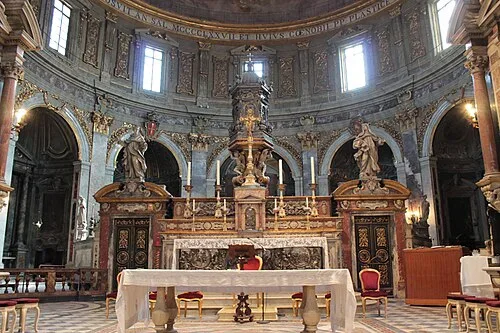 Alberti's Rotonda Tribuna and Volterrano's Dome
Rotonda Tribuna and High Altar
The first stone of the tribune was laid in 1444. Michelozzo, the brother of the Servite prior, was given the job first. Money later ran short, and the friars offered the patronage of the building to Ludovico the Third Gonzaga, Marquis of Mantua. The marquis admired the architect Leon Battista Alberti. In 1469, the commission passed to Alberti. His plan had to fit the foundations already in place, and those limited what he could do. Alberti died before the work was finished. Completion is usually dated to 1481. The round tribune is a domed space, with altar niches set around its edge. The high altar stands at the centre beneath a tall, ornate canopy. Two large statues on pedestals flank it.
Listen in the appJohn Samuel · CC BY-SA 4.0
09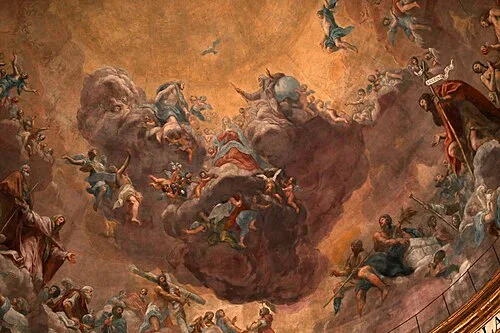 Alberti's Rotonda Tribuna and Volterrano's Dome
Volterrano's Dome
Cosimo the Third, Grand Duke of Tuscany, commissioned this late Baroque dome in 1680. The painter Il Volterrano began work that year. He painted the whole dome in just three years. At the centre, the Virgin is crowned in the presence of the Trinity, amid a swirl of clouds and angels. Around her, saints and prophets from the Old and New Testaments crowd the scene. The painter worked out this scheme himself. On the right, a robed figure holds up a banner. The painting covers the dome over the choir.
Listen in the appBaldassare Franceschini · CC BY 3.0
10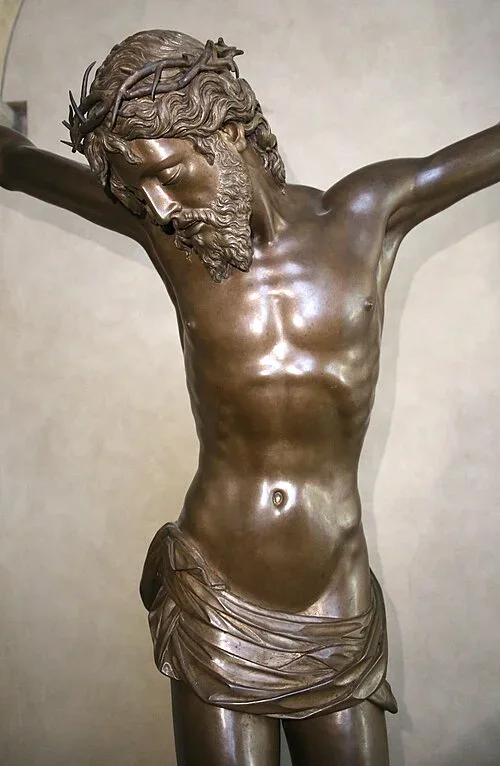 Giambologna's Funerary Chapel
Giambologna's Bronze Crucifix
The chapel was founded in 1444 by the Pucci family. Once the tribune was finished, with the Marquis of Mantua's financial help, the marquis reserved the chapel's patronage for himself. It later passed to the Dolce family. In 1594 it passed to the sculptor Giambologna, who made it his funerary chapel. He designed its architecture in pietra serena, a grey stone traditional in Florence. In 1598 he made the bronze crucifix. He also made six bronze reliefs of the Passion. All of them were in place when the chapel was inaugurated that same year. Above the sarcophagus holding the remains of Giambologna and Pietro Tacca hangs a Pietà by Jacopo Ligozzi. The bronze Christ wears a crown of thorns, and his head is bowed. A loincloth falls at his hips, and the dark bronze gleams. After restoration, this bronze was displayed for a time in a temporary setting.
Listen in the appFrancesco Bini · CC BY-SA 4.0
- 11
The Holy Trinity, St Jerome, and Two Saints
A painted Trinity lost for centuries and found by chance in the 1930s, with a saint whose robe looks carved from marble.
- 12
Madonna del Sacco (Madonna with the Sack)
A lunette painted in 1525 to fulfil a vow, named for the sack that Joseph leans against.
- 13
Cappella di San Luca (Chapel of the Painters)
The chapel that artists have owned since 1565, with a burial vault beneath its floor and a marble opening that leads down to it.
- 14
St Luke Painting the Virgin (Vasari)
A painting of Saint Luke at his easel, and what it suggests about the painters who claimed a place in this church.
Basilica della Santissima Annunziata
Frequently asked questions
How much does the guide cost?
Free app download. Listed guide price: $0.99. Guide price shown in the app. Audio guide only. Venue admission is separate.
Can I listen without internet?
Yes. Download the guide’s audio, images, and maps in the app before your visit. Your downloaded content is then available offline.
Can I listen in my language?
This audio guide is available in 15 languages, including English.
Do I need to follow a schedule?
No. This is a self-guided experience. Choose your stops, pause whenever you like, and return to a story at your own pace.
At your own pace
Explore Basilica della Santissima Annunziata.
Download Stanza, then search for “Basilica della Santissima Annunziata”.
Free app download · Guide price shown in the app
Keep exploring
Nearby audio guides
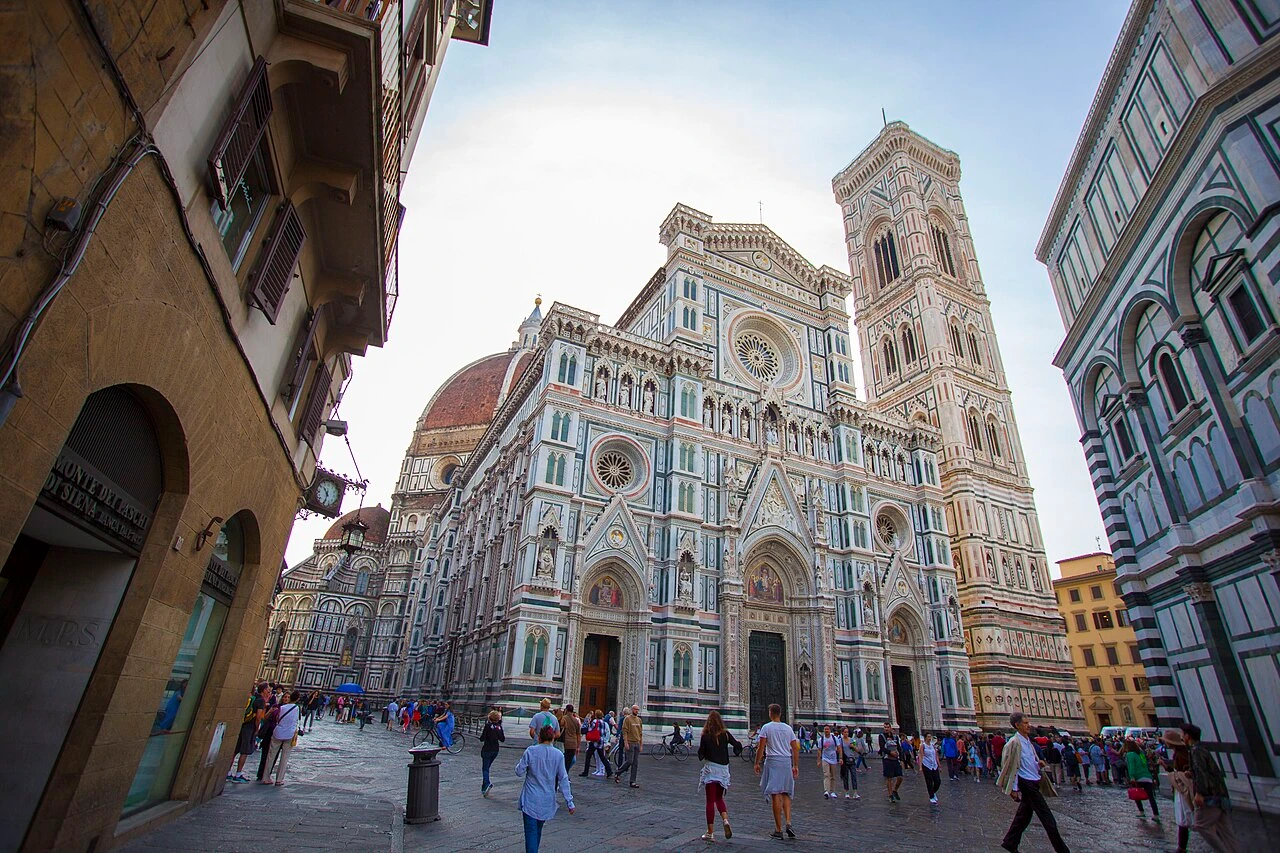
Florence · 1 km
Florence Cathedral
Content & sources
Photo: ScareCriterion12 · CC BY-SA 4.0
Florence · 1 km
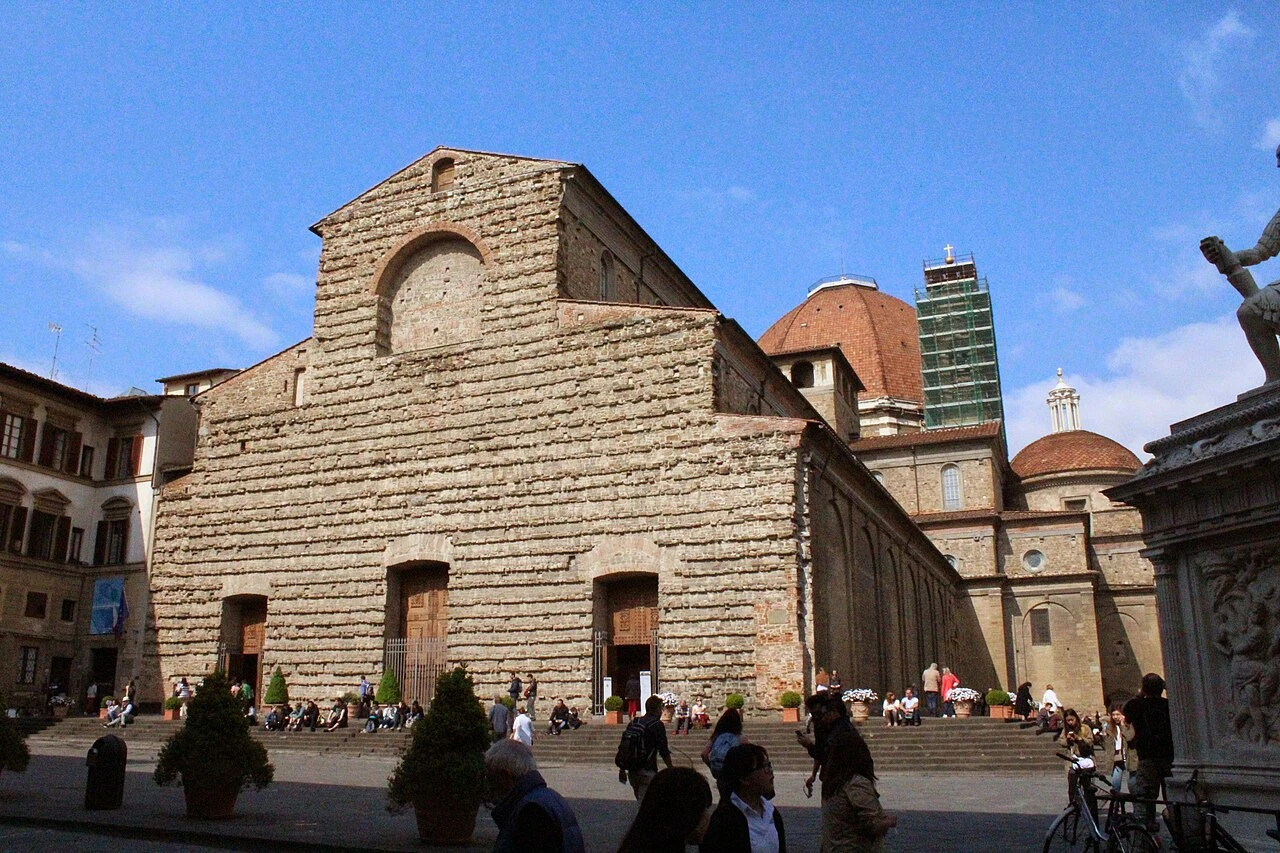
Basilica of San Lorenzo
Content & sources
Nelson Pérez · CC BY-SA 3.0
Florence · 1 km
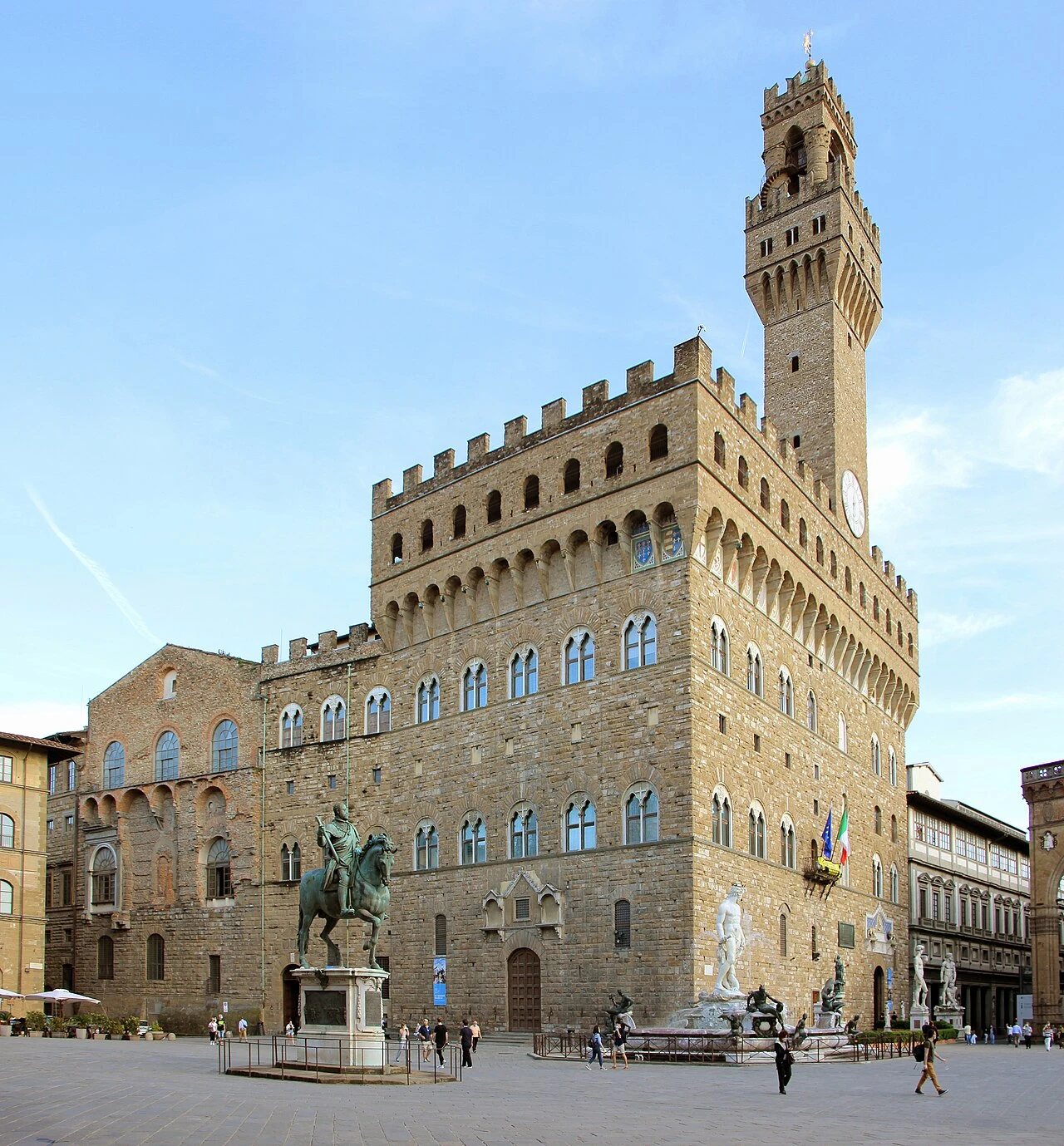
Palazzo Vecchio
Content & sources
Francesco Bini · CC BY-SA 4.0
Florence · 1 km
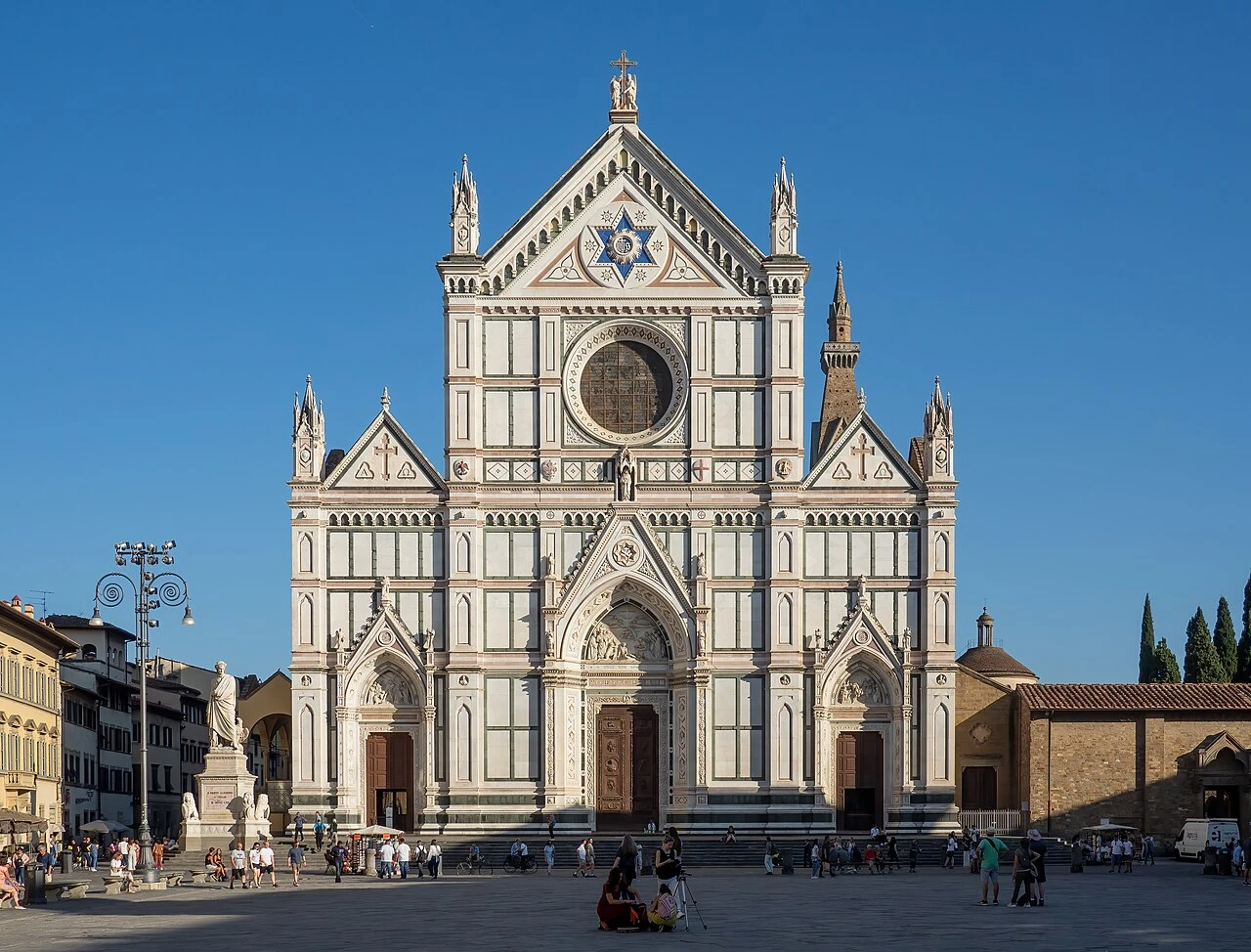
Basilica of Santa Croce
Content & sources
Photo: Rhododendrites · CC BY-SA 4.0