Stanza · Audio guide
Basilica di San Miniato al Monte Audio Guide
A place to remember. A story to take with you.
San Miniato al Monte is a basilica in Florence, Italy, located at one of the highest points in the city. It is considered one of the finest Romanesque structures in Tuscany and one of the most scenic churches…
Download Stanza, then search for “Basilica di San Miniato al Monte”.
About the tour
One guide. Your kind of visit.
San Miniato al Monte is a basilica in Florence, Italy, located at one of the highest points in the city. It is considered one of the finest Romanesque structures in Tuscany and one of the most scenic churches in Italy.
Ready when you are.
- 01Get the free Stanza app.
iOS & Android
- 02Find your guide.
“Basilica di San Miniato al Monte”
- 03Download before you go.
Works offline
Audio guide / 14 narrated stops
Inside the guide
Get to know a few of the stories before you go. Open a stop to read more.
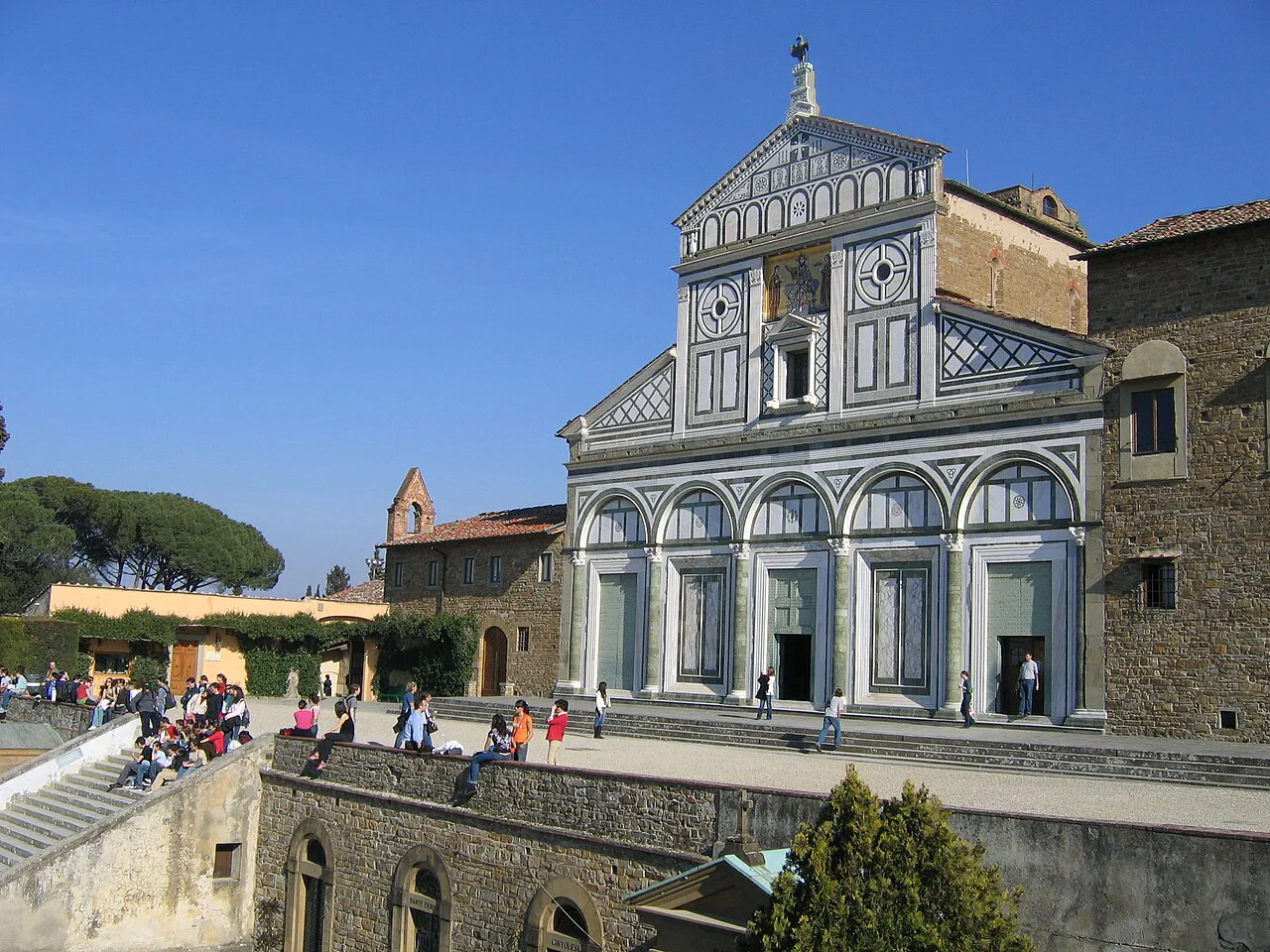
01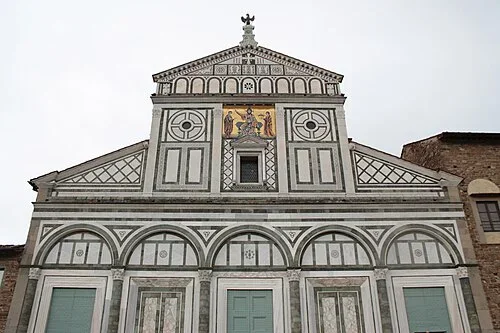 Hilltop Esplanade and Romanesque Façade
Façade of the Basilica of San Miniato al Monte
The name means Saint Minias on the Mountain. The basilica sits on one of the highest points in Florence, beside an Olivetan monastery. It has been described as one of the finest buildings in Tuscany in the Romanesque style. Romanesque is a medieval style known for its round arches. A chapel already stood on this hilltop by the eighth century. The present basilica was begun in 1013 by Bishop Alibrando. Emperor Henry the Second gave it an endowment, a fund to keep it running. Its front is covered in white and dark green marble, cut into geometric panels. A row of arched openings runs across the lower part of the front. At the peak of the gable stands an eagle.
John Samuel · CC BY-SA 4.0
02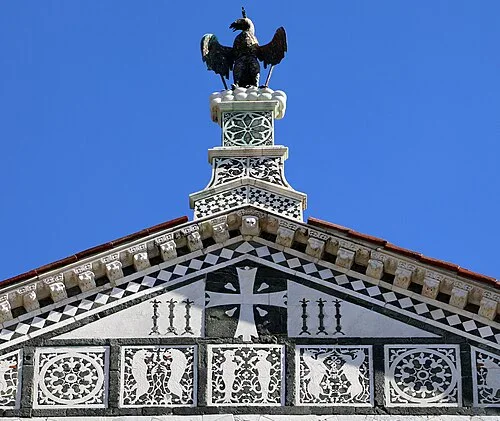 Hilltop Esplanade and Romanesque Façade
The Arte di Calimala Eagle on the Upper Façade
The eagle that crowns the façade was the emblem of the Calimala guild, the cloth merchants of Florence. The guild financed the façade, which was probably begun about 1090. Its upper parts date from the twelfth century or later. From 1288 the guild was also responsible for the basilica's upkeep. Beneath the eagle, a tiered pedestal carries round panels with rosette patterns. Across the gable, a cross stands at the centre, flanked by inlaid geometric panels. Along the roofline, black and white checks form a band.
Francesco Bini · CC BY-SA 4.0
03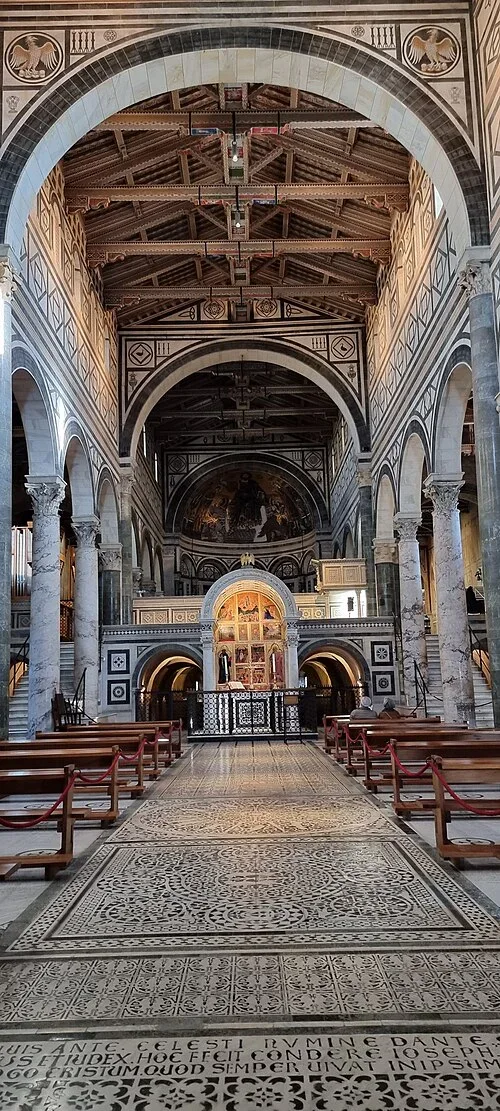 The Central Nave and 1207 Zodiac Pavement
Nave Looking Toward the Raised Choir and Apse
The basilica is built on two levels. The nave runs at ground level, and the choir sits on a raised platform above a large crypt. The choir was raised this way when the basilica was first built, and it has changed little since. Tall columns line the nave, with rounded arches running from one to the next. Above the arches, the walls are covered with panels of patterned marble. The roof is open timber, its beams running the length of the nave. The floor in the foreground carries a band of lettering.
Listen in the appPhoto: Fotografa65 · CC BY-SA 4.0
04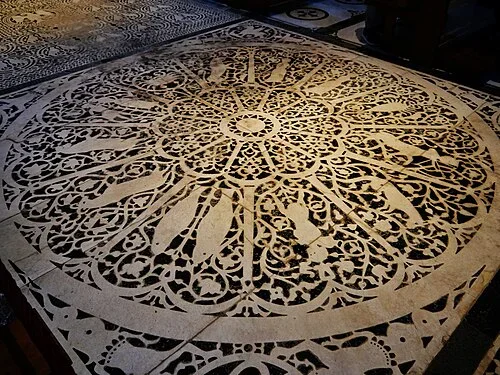 The Central Nave and 1207 Zodiac Pavement
Zodiac Detail of the Nave Pavement (1207)
The technique behind this pavement is called opus sectile. Cut pieces of stone are fitted together to make a pattern. This circle has a small centre, with shapes radiating outward like rays. Interlaced lines weave between the rays and fill the circle. The design is known as a zodiac, though the individual signs are hard to pick out. The pavement dates from 1207.
Listen in the appPhoto: Zairon · CC BY 4.0
05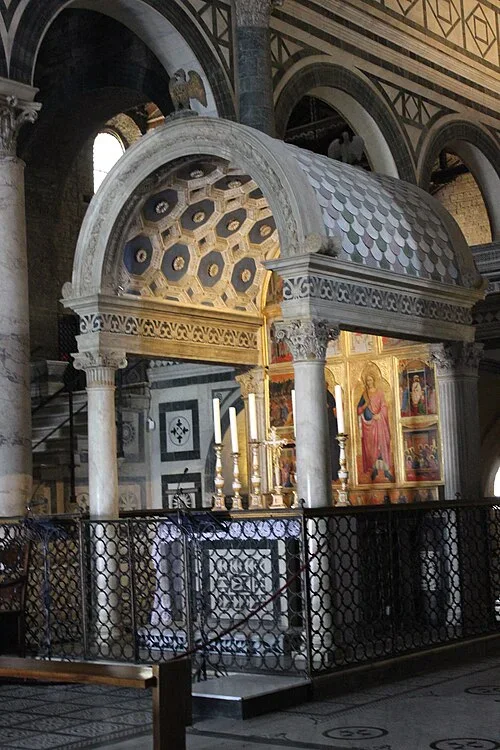 Michelozzo's Chapel of the Crucifix
Chapel of the Crucifix in the Nave
The freestanding canopy in the middle of the nave is known as the Chapel of the Crucifix. Michelozzo designed it in 1448, with columns topped by carved capitals. Its vault has terracotta decoration by Luca della Robbia. The canopy originally housed the crucifix known as miraculous, which is now in the church of Santa Trinita. The painted panels set into the canopy were long thought to be by Agnolo Gaddi.
Listen in the appPhoto: Tulumnes · CC BY-SA 4.0
06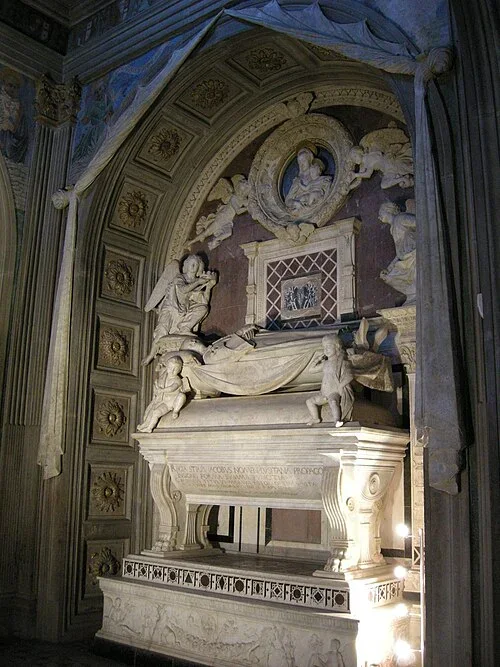 Chapel of the Cardinal of Portugal
Tomb of the Cardinal of Portugal
Cardinal James of Lusitania was Portugal's ambassador to Florence when he died there in 1459. A memorial chapel was built for him during the 1460s. The chapel is seen as one of the most magnificent funerary monuments of the Italian Renaissance. Its tomb was made by the brothers Antonio and Bernardo Rossellino. The cardinal lies stretched out on top of it in marble, with angels around him. A round relief sits high above him. The tomb is the only one in the basilica.
Listen in the appPhoto: Sailko · CC BY 2.5
07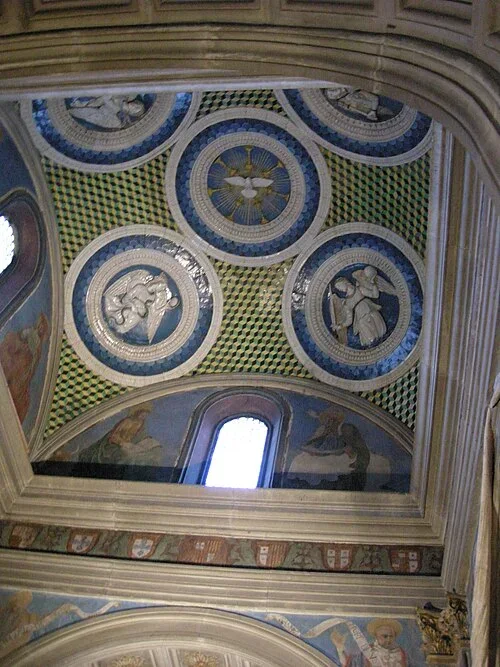 Chapel of the Cardinal of Portugal
Ceiling of the Chapel of the Cardinal of Portugal
The Cardinal of Portugal's chapel was a joint effort of several Florentine artists. Antonio Manetti designed it, but he died before the work was finished. Antonio Rossellino completed it after him. A group of painters decorated the walls. Luca della Robbia made the roundels on the ceiling in glazed terracotta. Glazed terracotta is baked clay with a glassy coating. A dove sits in the central roundel, with four figure roundels around it. Below, painted shields line the wall.
Listen in the appPhoto: Sailko · CC BY 2.5
08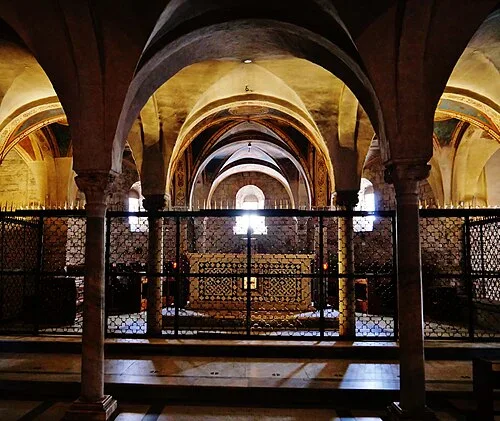 The Sunken Romanesque Crypt
Romanesque Crypt Beneath the Raised Choir
The oldest part of the basilica is the crypt, and it is tied to Saint Minias. Arches on columns carry its vaults, and an altar stands behind iron grilles. According to the legend, Minias was an Armenian prince who served in the Roman army under Emperor Decius. After he became a hermit, he was denounced as a Christian. He was brought before the emperor, who was camped outside the gates of Florence. The emperor ordered him thrown to wild beasts. A panther was sent against him, but it would not devour him. The emperor then had him beheaded in his presence. The story goes that he picked up his head, crossed the Arno, and walked up the hill to his hermitage. Tradition says the high altar holds his bones. There is evidence, though, that his bones were moved to Metz before the present basilica was built.
Listen in the appPhoto: Zairon · CC BY 4.0
09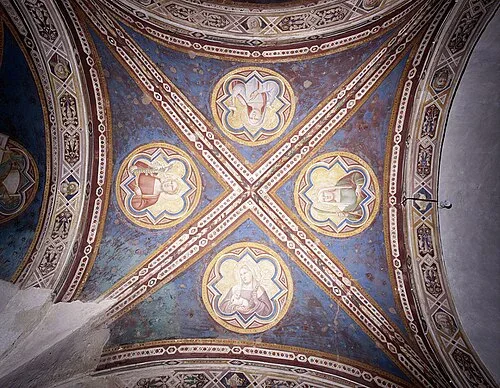 The Sunken Romanesque Crypt
Vault Frescoes Attributed to Taddeo Gaddi
The frescoes in the crypt's vaults are attributed to Taddeo Gaddi. Diagonal bands cross the ceiling and divide it into four sections. In each section, a round medallion holds a half-length figure, shown from the waist up, against a blue ground. Each medallion is bordered by gold and red ornament.
Listen in the appTaddeo Gaddi · Public domain
10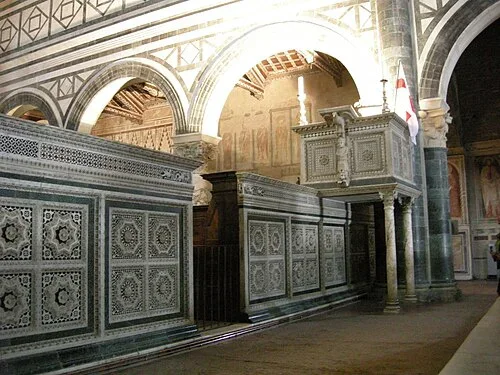 The Raised Presbytery, Pulpit and Apse Mosaic
Marble Choir Screen and Pulpit (1207)
A marble screen runs along the raised choir, and a pulpit stands beside it. The screen's panels are inlaid with geometric designs and rosettes. They run in a long row, and each panel has its own pattern. The pulpit rises on slender columns, with its front covered in inlaid marble. Both were made in 1207, the same year as the nave pavement.
Listen in the appPhoto: Sailko · CC BY 2.5
- 11
Apse Mosaic: Christ with the Virgin and Saint Minias (1297)
A gold-ground mosaic of 1297 showing Christ with the Virgin and a saint the inscription calls king of Armenia.
- 12
Sacristy with the Life of Saint Benedict Frescoes
A sacristy with a fresco cycle on the life of Saint Benedict, painted in 1387, and a monastery's changing custodians.
- 13
Campanile and Porte Sante Cemetery
A bell tower used as an artillery post in the 1530 siege, beside a walled cemetery laid out in 1854.
- 14
Panorama of Florence from the Abbey
The view over Florence from the hilltop, and the people who held this height over the centuries.
Basilica di San Miniato al Monte
Frequently asked questions
How much does the guide cost?
Free app download. Listed guide price: $0.99. Guide price shown in the app. Audio guide only. Venue admission is separate.
Can I listen without internet?
Yes. Download the guide’s audio, images, and maps in the app before your visit. Your downloaded content is then available offline.
Can I listen in my language?
This audio guide is available in 15 languages, including English.
Do I need to follow a schedule?
No. This is a self-guided experience. Choose your stops, pause whenever you like, and return to a story at your own pace.
At your own pace
Explore Basilica di San Miniato al Monte.
Download Stanza, then search for “Basilica di San Miniato al Monte”.
Free app download · Guide price shown in the app
Keep exploring
Nearby audio guides
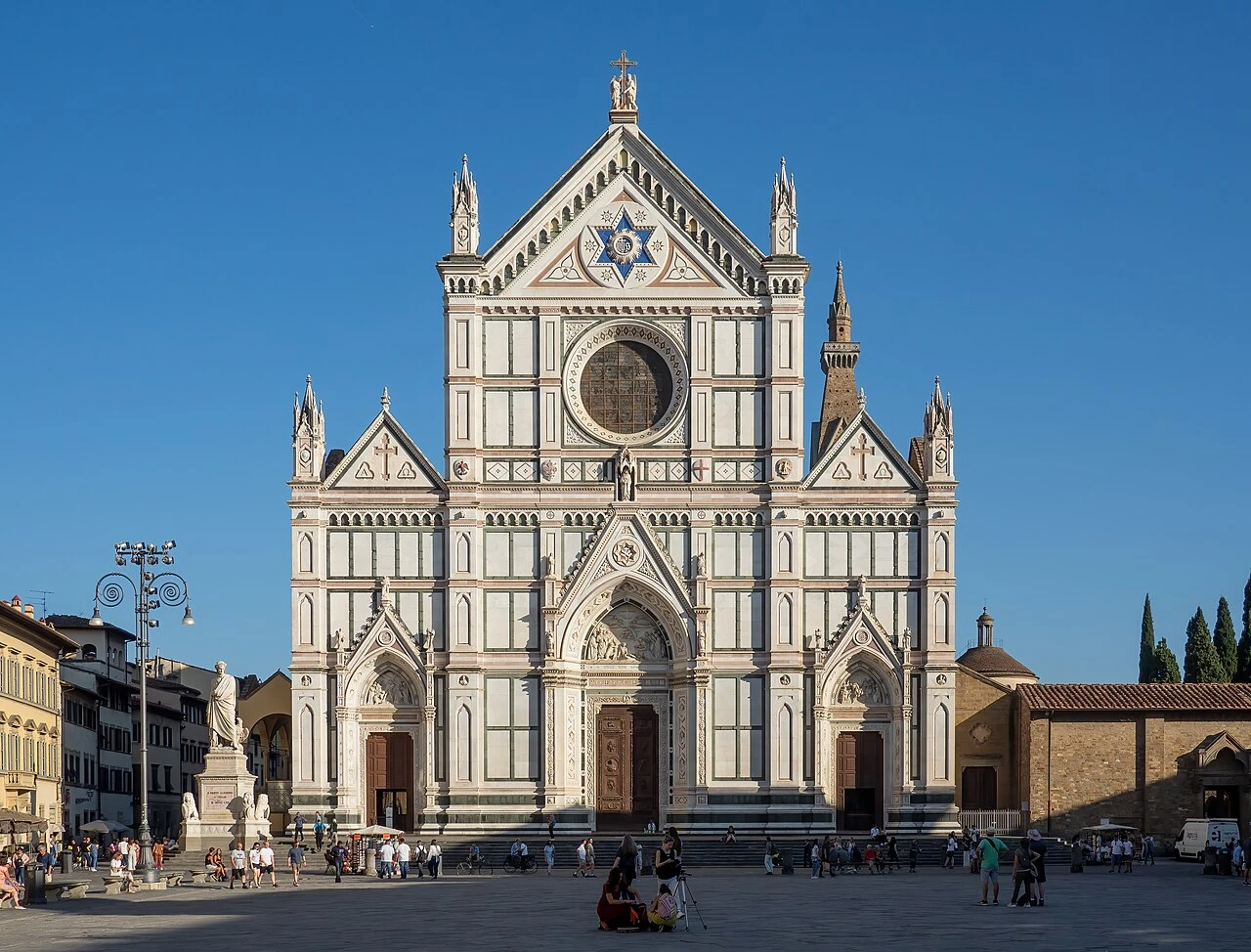
Florence · 1 km
Basilica of Santa Croce
Content & sources
Photo: Rhododendrites · CC BY-SA 4.0
Florence · 1 km
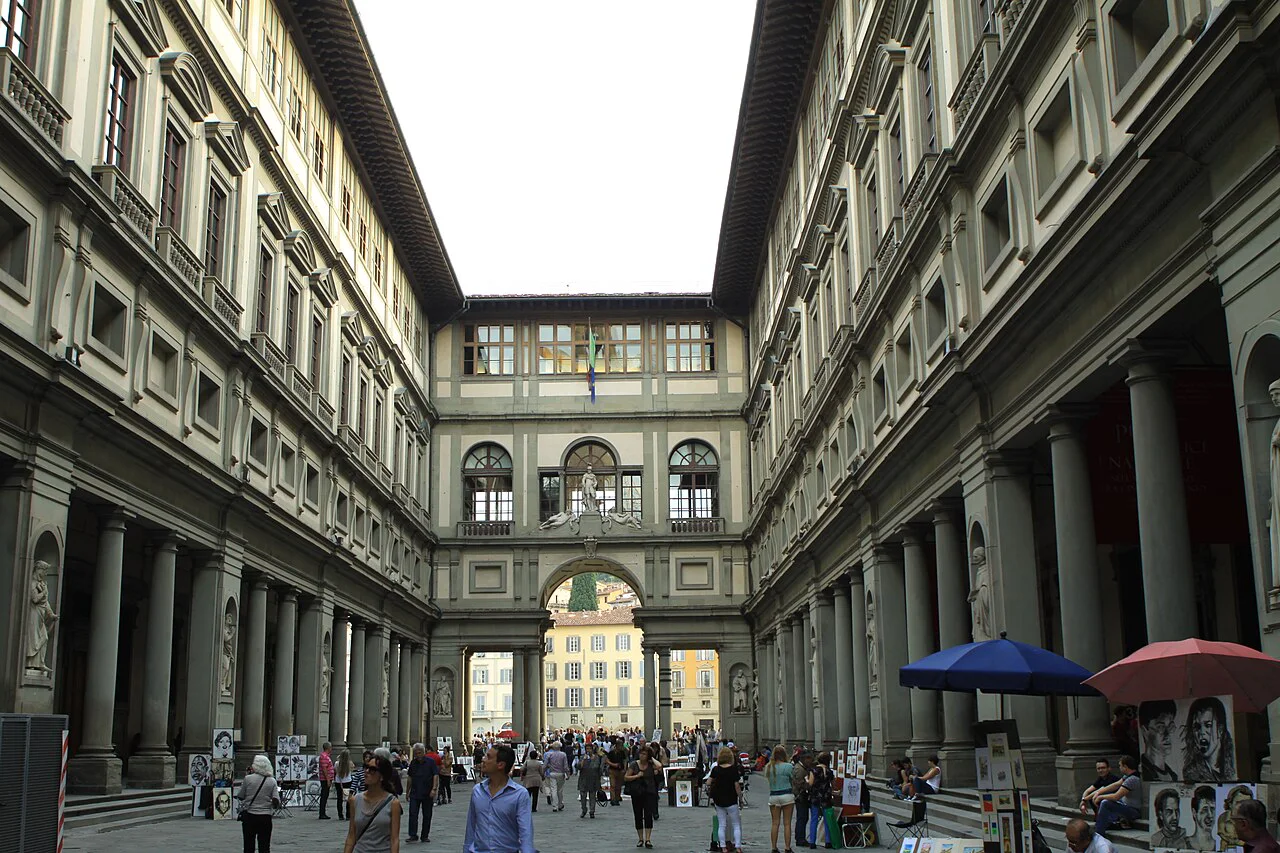
Uffizi Gallery
Content & sources
Arek N. · CC BY-SA 3.0
Florence · 1 km
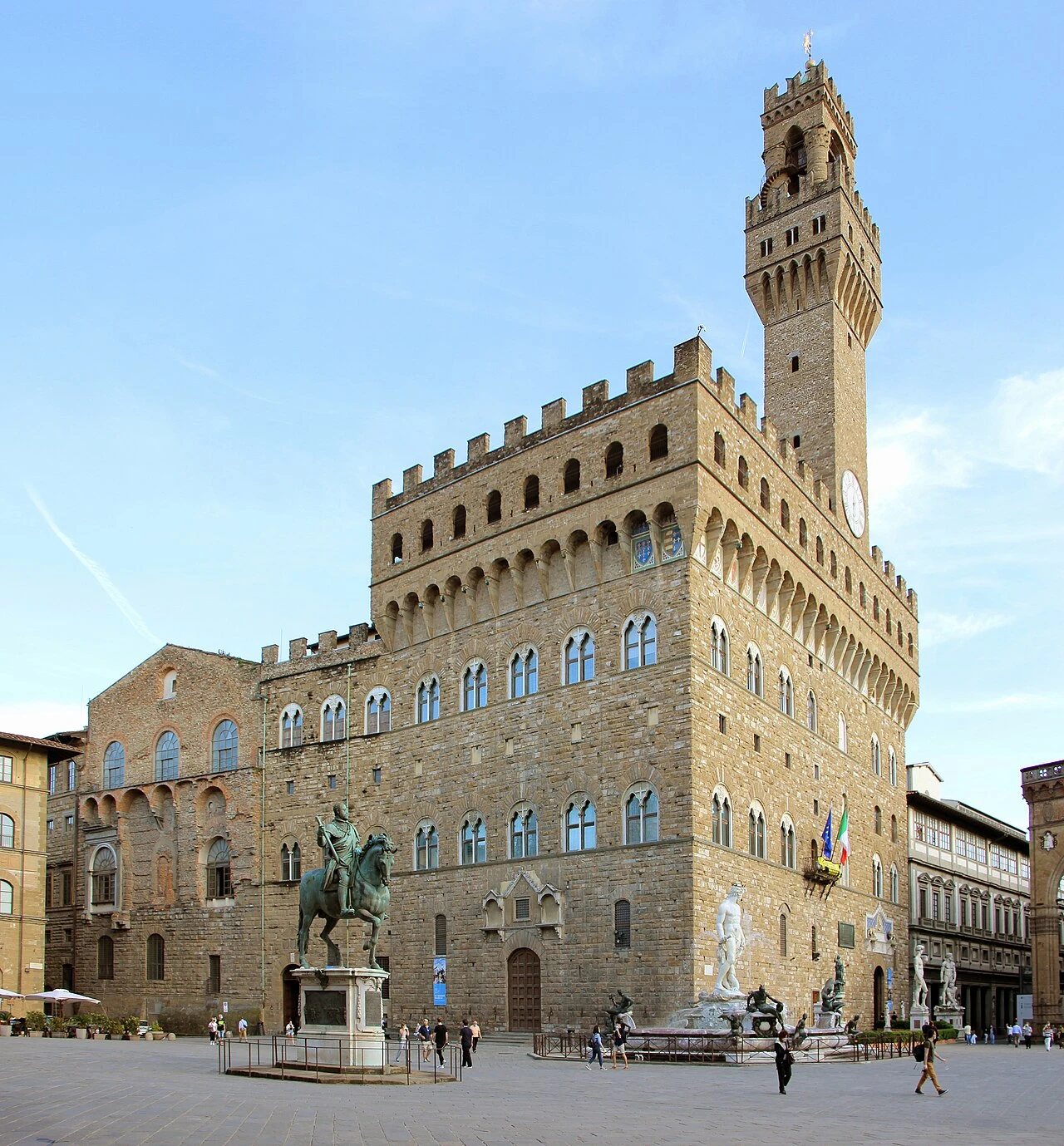
Palazzo Vecchio
Content & sources
Francesco Bini · CC BY-SA 4.0
Florence · 1 km
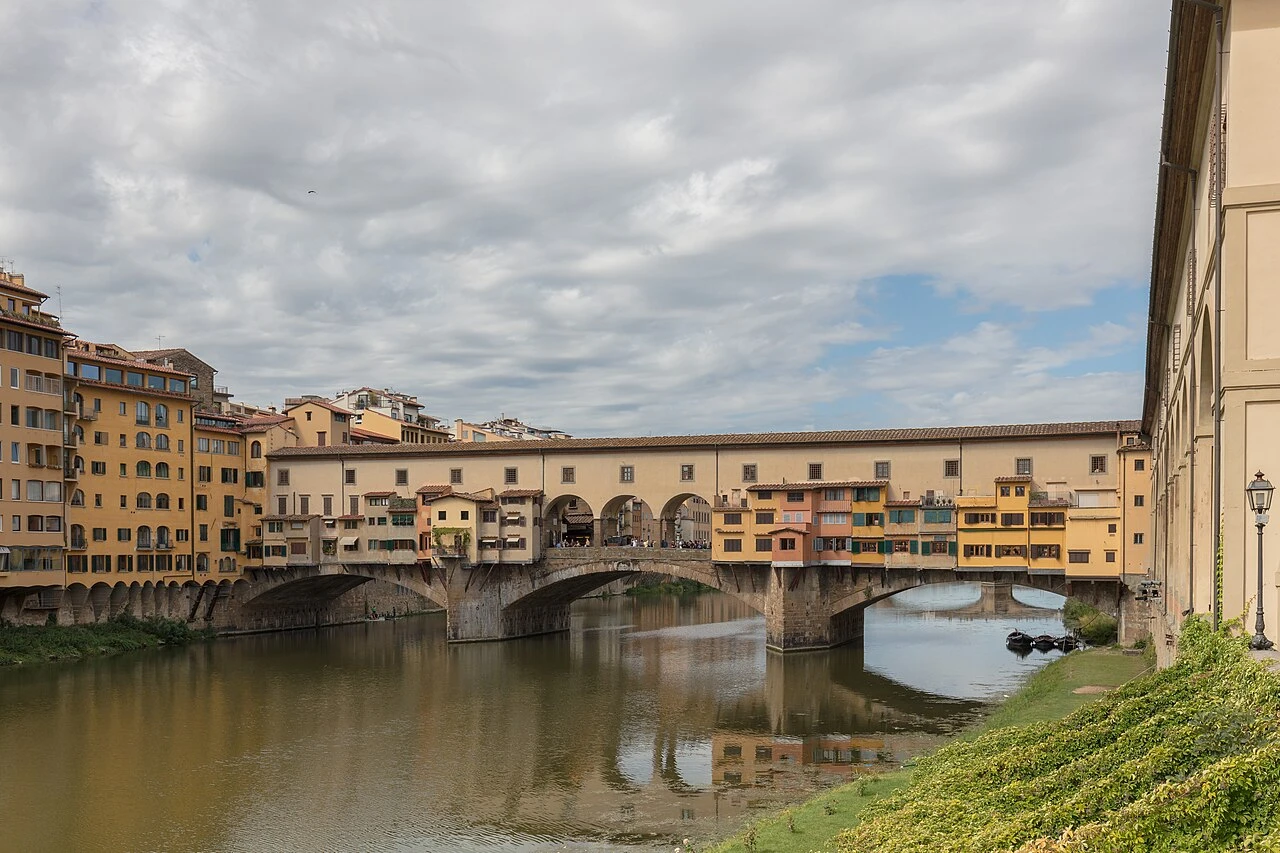
Ponte Vecchio
Content & sources
Diego Delso · CC BY-SA 4.0