Stanza · Audio guide
Palazzo Ducale di Mantova Audio Guide
A place to remember. A story to take with you.
The Palazzo Ducale is a group of buildings in Mantua that served as the residence of the Gonzaga family. It is a vast architectural ensemble featuring significant artistic works, including the famous Camera…
Download Stanza, then search for “Palazzo Ducale di Mantova”.
About the tour
One guide. Your kind of visit.
The Palazzo Ducale is a group of buildings in Mantua that served as the residence of the Gonzaga family. It is a vast architectural ensemble featuring significant artistic works, including the famous Camera degli Sposi.
Ready when you are.
- 01Get the free Stanza app.
iOS & Android
- 02Find your guide.
“Palazzo Ducale di Mantova”
- 03Download before you go.
Works offline
Audio guide / 21 narrated stops
Inside the guide
Get to know a few of the stories before you go. Open a stop to read more.
01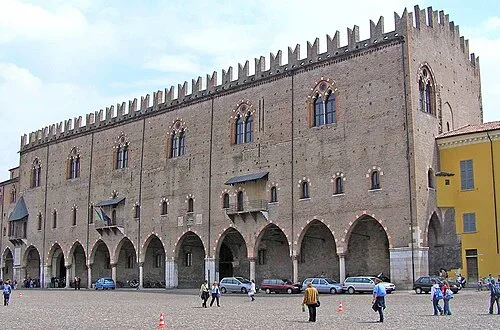 Piazza Sordello and Medieval Origins
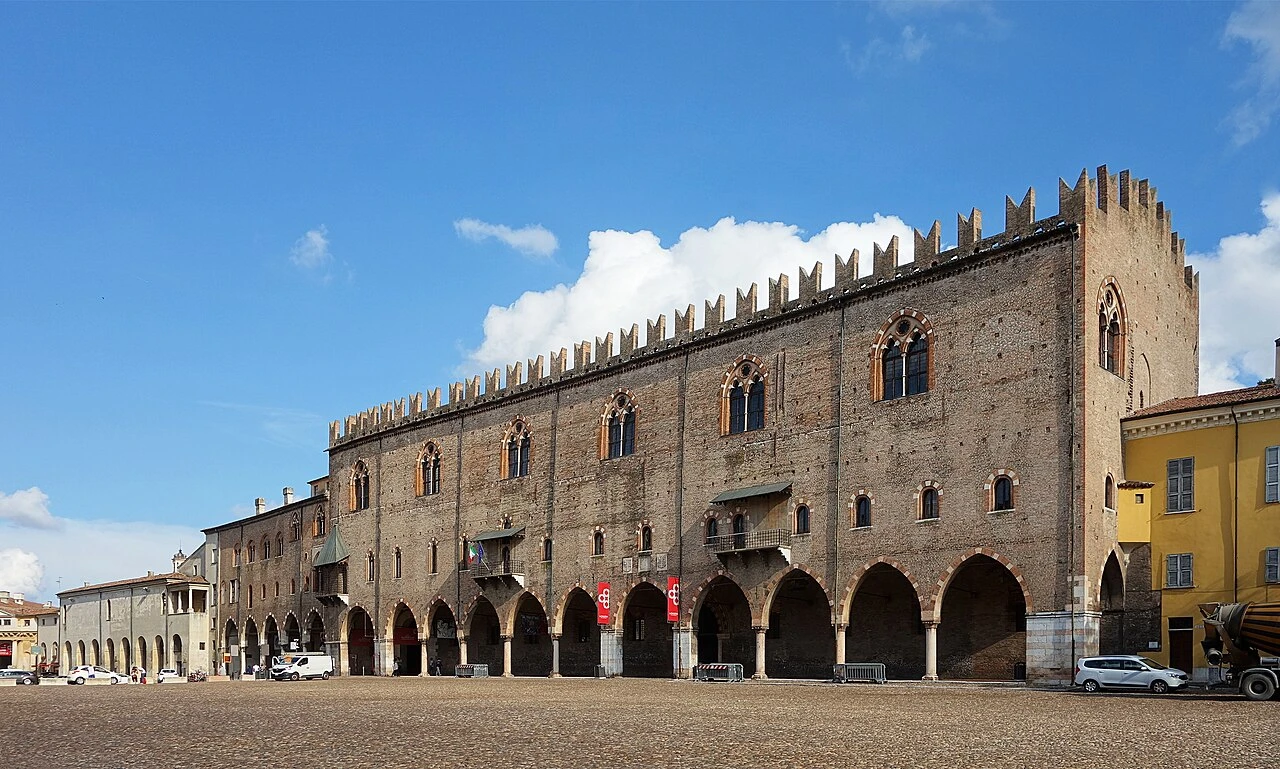
The Medieval Facade on Piazza Sordello
Welcome to the Palazzo Ducale, the palace that ruled Mantua. The long brick facade with its arched portico and jagged battlements faces Piazza Sordello, and it has looked out on this square for centuries. Behind it lies not one building but a small city: more than five hundred rooms, seven gardens and eight courtyards, covering over thirty-five thousand square metres. Several European palaces are larger, among them the Vatican and the Louvre. From 1308 this was the official residence of Mantua's rulers, first the Bonacolsi, then the Gonzaga, who rose from lords to marquesses to dukes. Nobody built it all at once. Each duke added a wing for himself and his art collection, over nearly four hundred years. The oldest part, the Palazzo del Capitano, was commissioned by Guido Bonacolsi at the end of the thirteenth century, and its great portico facade survives largely unchanged. What follows is the story of a building shaped by power, and by the art that power bought.
User:BMK · CC BY-SA 2.0 de
02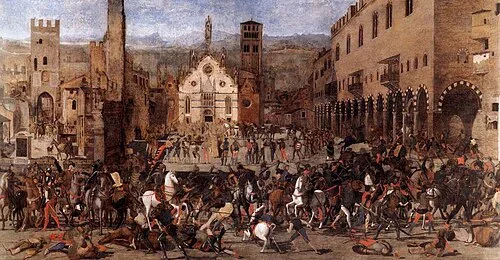 Piazza Sordello and Medieval Origins
Domenico Morone's Battle between the Gonzaga and the Bonacolsi
In 1328 the Gonzaga seized Mantua by force, and this painting shows how. Domenico Morone painted the scene in 1494, more than a century and a half after the event, so it is a memory of the founding violence rather than a record of it. Riders and foot soldiers churn across a crowded square as the old lords of the city, the Bonacolsi, are driven out. Their lord, Rinaldo Bonacolsi, known as Passerino, was killed in the coup. From that day the Gonzaga held Mantua, and this palace became their seat. The story does not end with Passerino's death, if the legend is true. The family is said to have kept his embalmed body on display, mounted on a taxidermied hippopotamus they had acquired in the early seventeenth century, like a strange dynastic talisman. Around 1700 the mummy was thrown into the lake. The hippopotamus fared better: in 1783 the Austrian government sent it to the natural history museum in Pavia, where it remains.
Domenico Morone · Public domain
03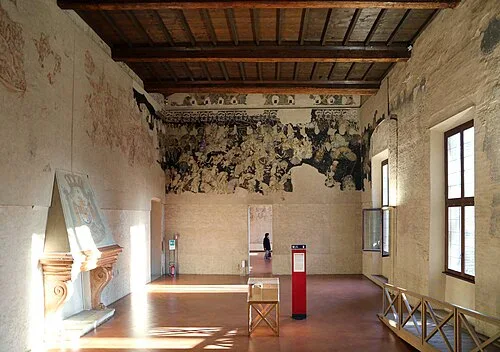 Corte Vecchia: Pisanello's Arthurian Tournament Hall
The Pisanello Room: A Chivalric Epic
Antonio Pisano, known as Pisanello, painted a grand cycle of Arthurian frescoes in this room between 1433 and 1437. The hall now carries his name. Its subject was the Battle of Louverzep, an episode from the legends of King Arthur and Lancelot. The patron, Gianfrancesco Gonzaga, appears in the work himself, among the knights. Arthurian stories were hugely popular at the time because they set the pattern of chivalric behaviour: courage, honour, the rules of the tournament. Pisanello's cycle was meant to place the Gonzaga inside that world, glorifying the family through painted chivalry. For reasons nobody knows, it was never finished. What remains are fragments on bare plaster: knights, horses and helmets fading in and out of the wall, a tournament half-erased by time.
Listen in the appPhoto: Sailko · CC BY 3.0
04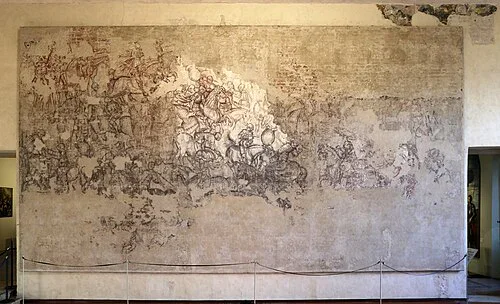 Corte Vecchia: Pisanello's Arthurian Tournament Hall
The Sinopia: How a Masterpiece Was Lost and Found
The frescoes survived by being buried. By the late sixteenth century they had been covered with faux marble decoration. In 1701 a frieze of Gonzaga portraits went up above them, running from the first Luigi to the last Ferdinando Carlo, and the room became known as the Hall of the Princes. Around 1810 a neoclassical update was added on top of that. Three layers of changing fashion, and Pisanello underneath, forgotten. The rediscovery came in the twentieth century. The superintendent Giovanni Paccagnini noticed faded painted traces emerging near the attic, and guessed that something important lay behind the later decoration. He was right. Between 1965 and 1970 the frescoes were uncovered and restored. This great drawing on the wall is a sinopia, the sketch made directly on the plaster before the colours went on, and it shows the battle composition at an early stage. Today the room displays both the recovered fragments and these preparatory drawings, two states of the same lost masterpiece.
Listen in the appPhoto: Sailko · CC BY 3.0
05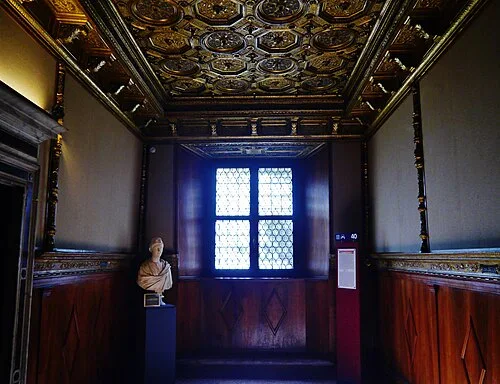 Apartment and Studiolo of Isabella d'Este
Isabella d'Este's Studiolo
Isabella d'Este has been called the first lady of the Renaissance, and this room helps explain why. In 1519, a widow, she left her quarters in the castle and moved to the ground floor of the Corte Vecchia, into apartments known as the widow's rooms. In the private wing called the Grotta she installed the wooden furnishings and art collections from her two famous studioli. Her first studiolo, in the castle, held paintings commissioned between 1496 and 1506 from Mantegna, Perugino and Lorenzo Costa, with Correggio added later. Those pictures hang in the Louvre today. What survives in Mantua is the setting: a gilded coffered ceiling, warm wooden walls, a marble bust beside the lattice window. It is a room made for thinking and collecting, not for ceremony.
Listen in the appPhoto: Zairon · CC BY-SA 4.0
06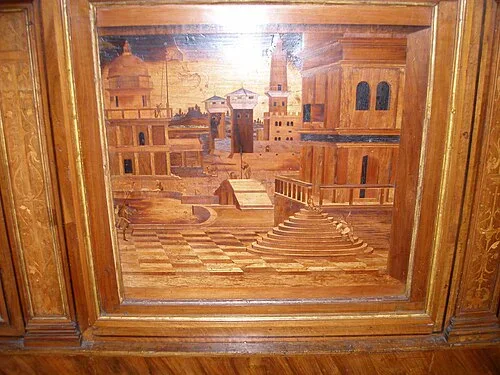 Apartment and Studiolo of Isabella d'Este
Perspective in Wood: The Studiolo's Intarsia
Even the furniture in Isabella's rooms played the same game as the painters. This panel is intarsia, an image made by fitting together pieces of different coloured woods. The craft grew up alongside perspective painting, and it uses the very same tricks. Receding pavements, stairways, towers and domes that seem to open a window in solid wood. In this palace, deceiving the eye became something of a house specialty, and it reaches its most famous form in Mantegna's painted ceiling in the Castello di San Giorgio.
Listen in the appKlaus Graf · CC BY-SA 3.0
07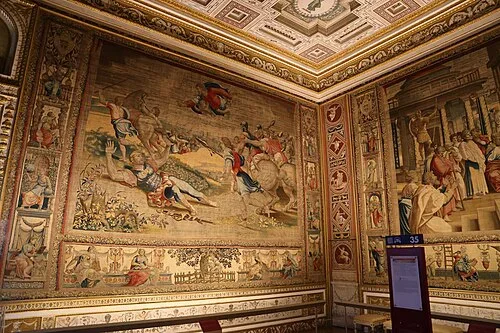 The Raphael Tapestry Apartment
The Tapestry Apartment
Nine monumental tapestries hang in these rooms, woven by hand in Flanders. Their road here was long. Around 1552 Cardinal Ercole Gonzaga bought them in Brussels to furnish what was then called the Green Apartment. In his will of 1563 he left them to his nephew, Duke Guglielmo, with a wish: that they adorn the Palatine Basilica of Santa Barbara. There they stayed for two centuries. Then came neglect. The tapestries ended up forgotten in the palace storerooms, until a restoration in 1799 brought them back to light. They were hung in this apartment, four rooms adapted for them, with three lined wall to wall in woven cloth. From private apartment to basilica, from storeroom to museum, few objects in the palace have changed homes so often.
Listen in the appPhoto: Sailko · CC BY 3.0
08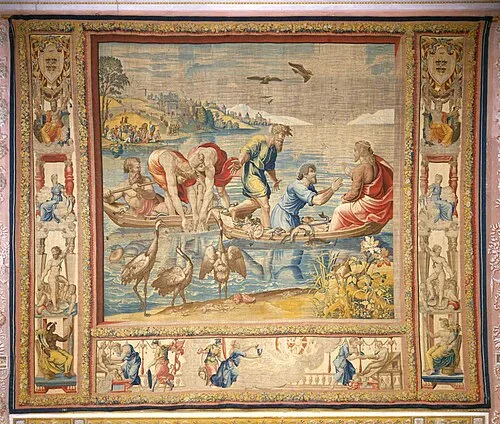 The Raphael Tapestry Apartment
The Miraculous Draft of Fish: Raphael Woven in Flanders
The Miraculous Draft of Fish shows fishermen hauling in an impossible catch, with Christ at the shore. The design comes from Raphael. These nine tapestries were woven from his preparatory cartoons, the very same designs used for the famous Raphael tapestries made for the Sistine Chapel in the Vatican. Raphael drew; Flemish weavers translated his invention into wool and silk, thread by thread. The scene comes from the Gospel of Luke, though the series as a whole is known as the Acts of the Apostles, and it was woven at full monumental scale. For a princely family, owning a set of Raphael's designs in woven form was prestige made visible, painting as politics in cloth.
Listen in the appAnonymousUnknown author · Public domain
09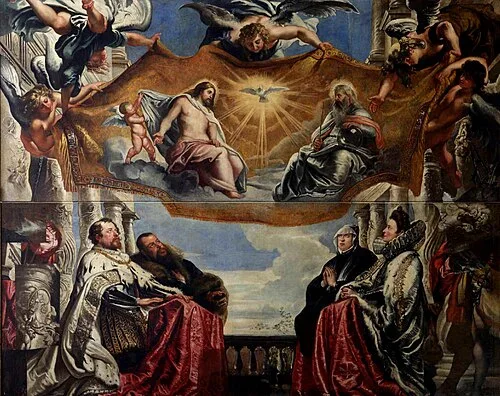 Domus Nova: Hall of the Archers and the Scala Santa
Rubens in Mantua: The Gonzaga Altarpiece
Peter Paul Rubens came to Mantua as a young painter in Gonzaga service, and Italy formed him. In 1605 he painted this colossal altarpiece for the Church of the Holy Trinity in the city. It was the central panel of a triptych, and it is now partially mutilated. Above, angels draw back a curtain to reveal the Trinity in heaven. Below, the ruling family kneels in adoration: Duke Vincenzo with his wife Eleanor de' Medici in the foreground, and behind them his father Guglielmo with Eleanor of Austria. A dynasty painting itself into a sacred image, at full ceremonial scale. The triptych did not stay together. The Transfiguration of Christ is now in Nancy, the Baptism of Christ in Antwerp; only the central canvas remains in Mantua. This hall, the Sala degli Arcieri in the Domus Nova, now displays paintings from suppressed churches and monasteries, works that arrived here after their original homes were dissolved.
Listen in the appPeter Paul Rubens · Public domain
10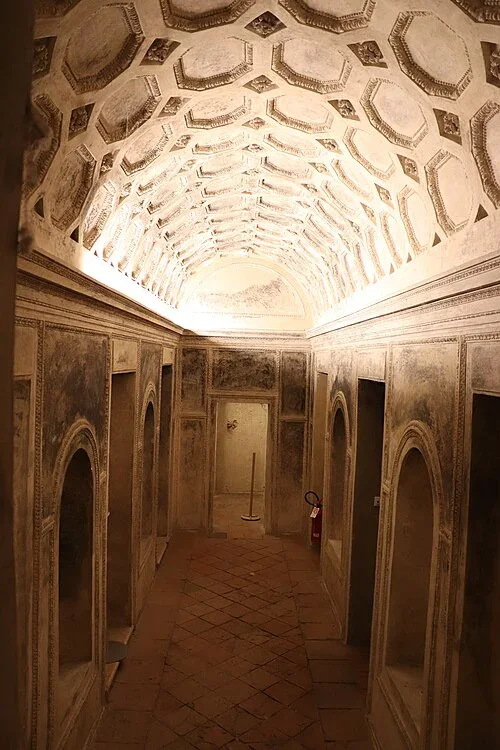 Domus Nova: Hall of the Archers and the Scala Santa
The Scala Santa in Miniature - and the Dwarfs' Legend
For generations, visitors were told these tiny rooms were built for the Gonzaga court dwarfs. Low ceilings, miniature stairways, small doorways, the story seemed obvious, and the spaces were called the Dwarfs' Apartment until 1979. That year the scholar Renato Berzaghi dismantled the myth using archival documents. The truth is devotional. Duke Ferdinando Gonzaga, a cardinal before he became duke, commissioned Antonio Maria Viani to build a reduced-scale replica of the Scala Santa of Rome, the Holy Stairs at San Giovanni in Laterano. He placed it under his own apartment in the Domus Nova, a private shrine for prayer. The long vaulted corridor with its coffered ceiling copies the Roman original in miniature, and the area was once known as the Catacombs in Corte.
Listen in the appHuthBerlin · CC BY 4.0
- 11
The Hall of Troy: Giulio Romano's Mannerist Epic
Giulio Romano's new theatrical style, with the Trojan War swirling across a painted ceiling.
- 12
Ajax Defending Patroclus: Drama without Rules
One scene from the Hall of Troy, where Giulio Romano pushes classical painting to its dramatic limits.
- 13
The Cavallerizza: A Stage for Warhorses
A palace courtyard built as a showroom for the Gonzaga's famous warhorses.
- 14
The Galleria della Mostra and the Lost Celeste Galeria
The long gallery that once displayed one of the great art collections of its age, and how it was scattered.
- 15
Santa Barbara: The Court's Own Basilica
Duke Guglielmo's private basilica inside the palace, and the Gonzaga buried beneath it.
- 16
The Antegnati Organ and Sacred Music
The Renaissance organ that made worship in Santa Barbara a musical event.
- 17
Castello di San Giorgio: Fortress and Prison
The brick fortress at the heart of the palace, later an Austrian prison for Italian patriots.
- 18
Bertani's Grand Staircase
The frescoed staircase by Bertani that climbs from the state rooms into the castle.
- 19
Mantegna's Camera degli Sposi: The Court in Paint
Mantegna's Camera Picta, a private bedchamber painted as a total portrait of the Gonzaga court.
- 20
The Oculus: A Ceiling Open to the Sky
The painted oculus that opened the Renaissance ceiling to the sky.
- 21
The Meeting: Closing the Gonzaga Story
The Meeting scene, where the marquess greets his son the cardinal before an imagined Rome, and the tour's closing thought.
Palazzo Ducale di Mantova
Frequently asked questions
How much does the guide cost?
Free app download. Listed guide price: $1.99. Guide price shown in the app. Audio guide only. Venue admission is separate.
Can I listen without internet?
Yes. Download the guide’s audio, images, and maps in the app before your visit. Your downloaded content is then available offline.
Can I listen in my language?
This audio guide is available in 15 languages, including English.
Do I need to follow a schedule?
No. This is a self-guided experience. Choose your stops, pause whenever you like, and return to a story at your own pace.
At your own pace
Explore Palazzo Ducale di Mantova.
Download Stanza, then search for “Palazzo Ducale di Mantova”.
Free app download · Guide price shown in the app
Keep exploring
Nearby audio guides
Mantua · 1 km
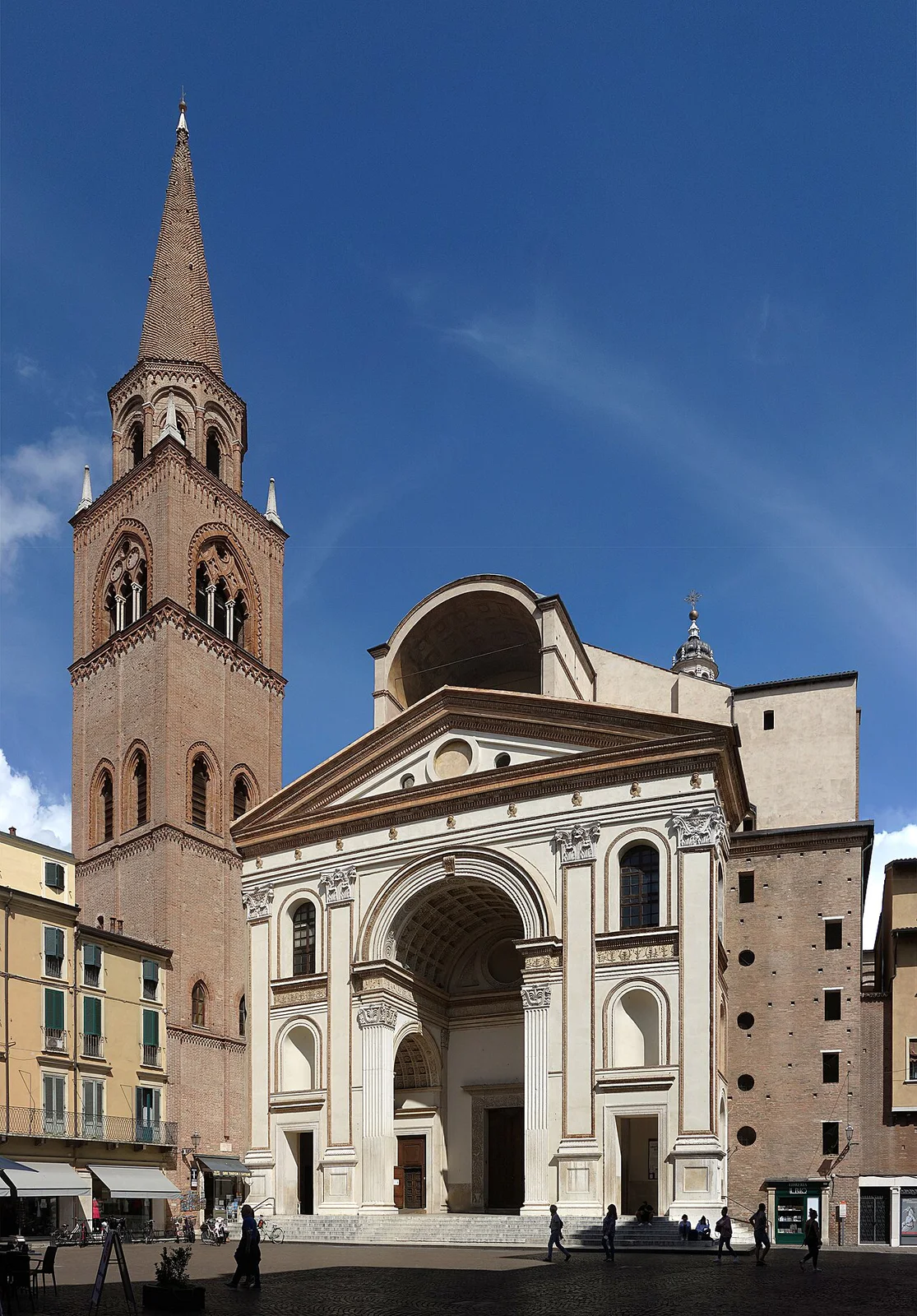
Basilica di Sant'Andrea
Content & sources
Photo: Velvet · CC BY-SA 4.0
Mantua · 2 km
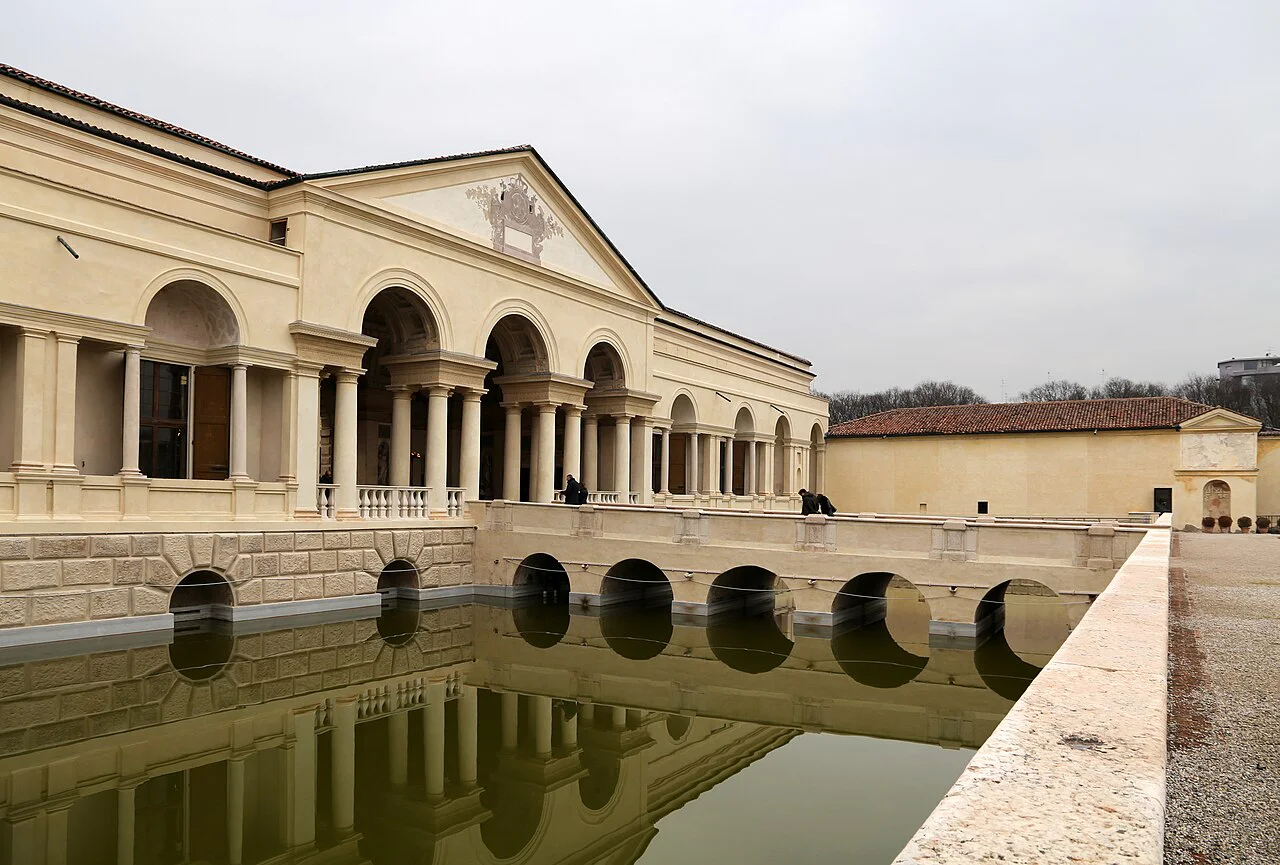
Palazzo Te
Content & sources
Photo: Sailko · CC BY 3.0
Verona · 34 km
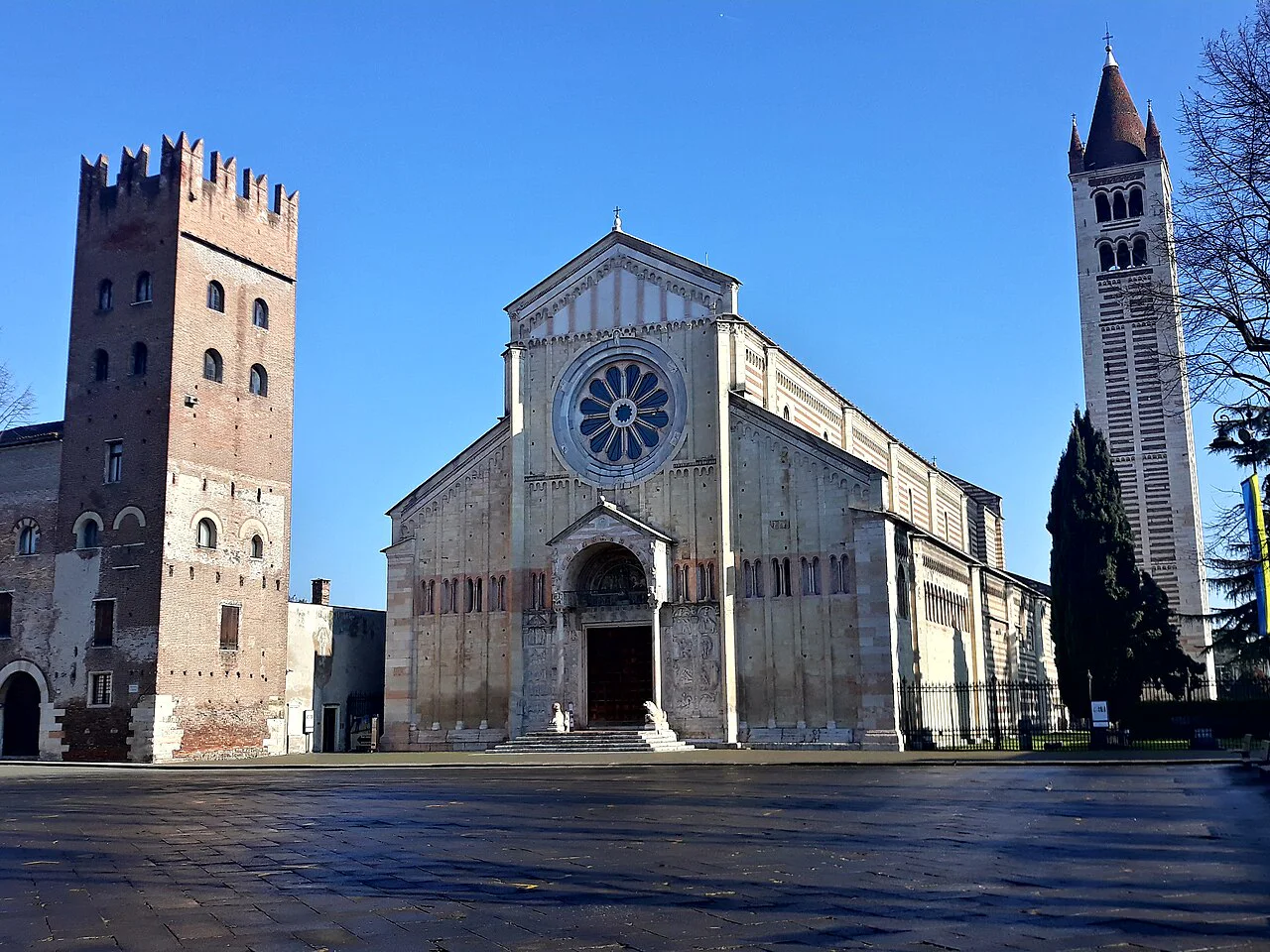
Basilica di San Zeno
Content & sources
Photo: Adert · CC BY-SA 4.0
Verona · 34 km
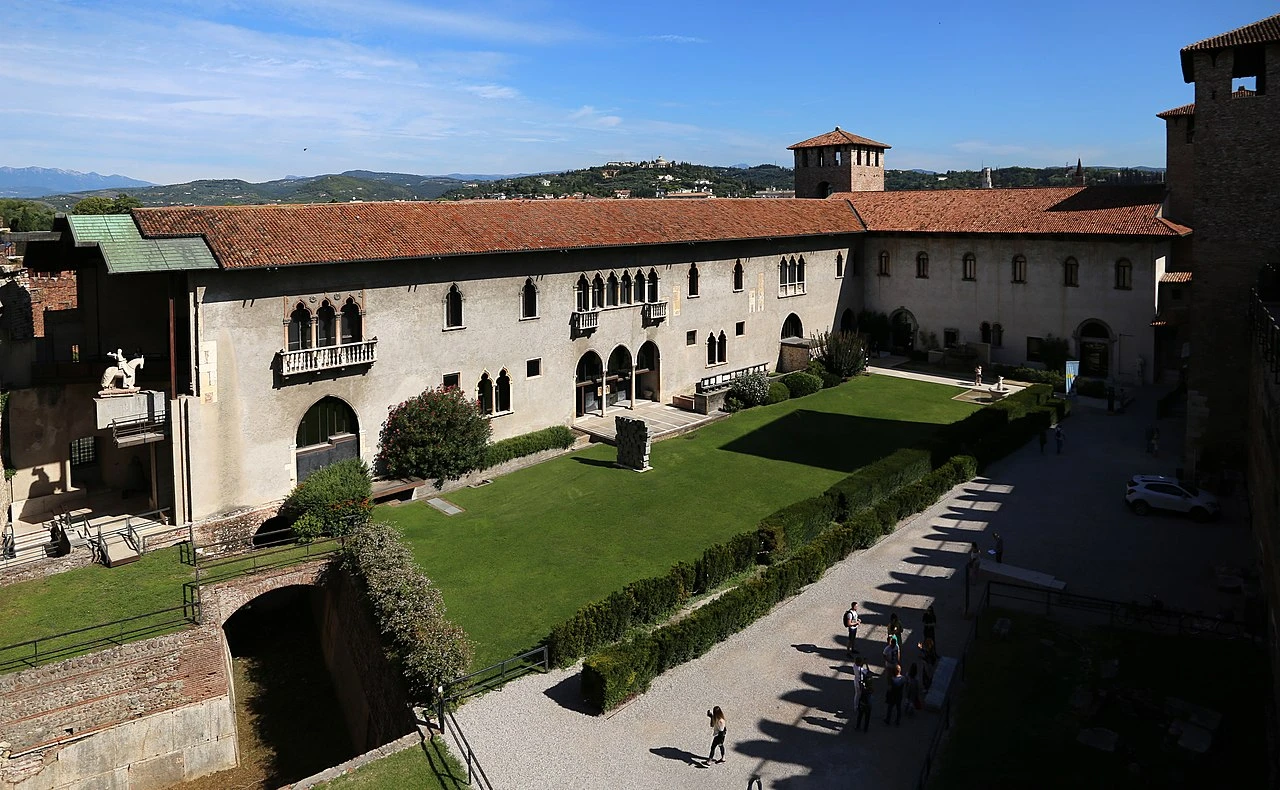
Castelvecchio Museum
Content & sources
Photo: Sailko · CC BY-SA 4.0