Stanza · Audio guide
Basilica di San Zeno Audio Guide
A place to remember. A story to take with you.
The Basilica of San Zeno is a Catholic place of worship located in the San Zeno district of Verona. It is considered one of the masterpieces of medieval architecture.
Download Stanza, then search for “Basilica di San Zeno”.
About the tour
One guide. Your kind of visit.
The Basilica of San Zeno is a Catholic place of worship located in the San Zeno district of Verona. It is considered one of the masterpieces of medieval architecture.
Ready when you are.
- 01Get the free Stanza app.
iOS & Android
- 02Find your guide.
“Basilica di San Zeno”
- 03Download before you go.
Works offline
Audio guide / 13 narrated stops
Inside the guide
Get to know a few of the stories before you go. Open a stop to read more.
01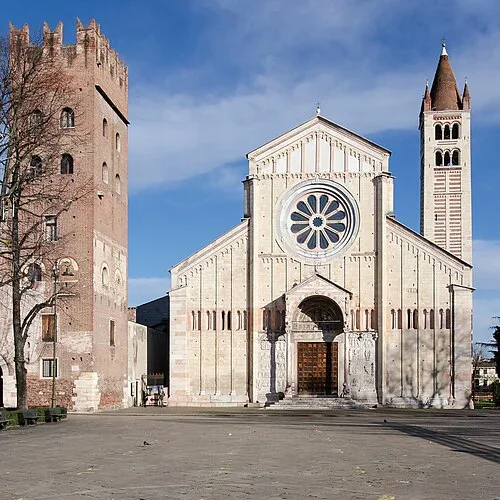 Piazza San Zeno and the Romanesque Facade
Basilica di San Zeno from the Piazza
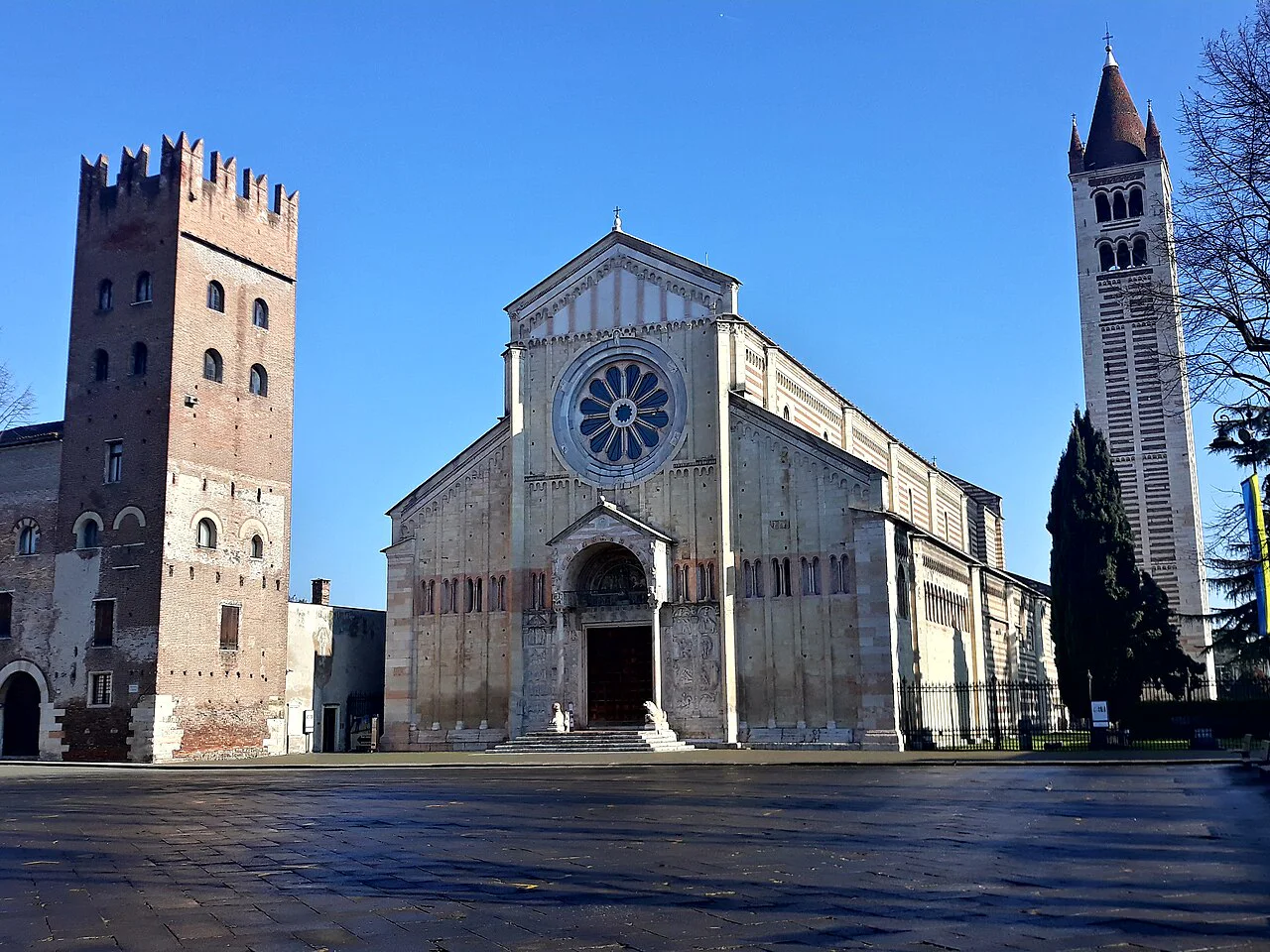
Saint Zeno, a bishop of Verona, is believed to have died in the later fourth century. Tradition says he was buried near the spot where this basilica now stands. A notary named Coronato, writing at the end of the seventh century, said a church was built above the bishop's tomb in his honour. At least five other religious buildings had stood on this site before the basilica rose. Raiders from Hungary, the Magyars, ravaged northern Italy in the late ninth and early tenth centuries. This basilica suffered serious damage in those raids. It was later rebuilt in the Romanesque style, and much of its medieval layout has survived. It is often described as one of the most harmonious Romanesque buildings in northern Italy. The pale front faces the square, with a great round window high in the centre, above the porch. A crenellated brick tower rises beside the front, and a striped bell tower stands on the other side. Alongside the basilica are the surviving buildings of the old abbey, including its cloister. In 1973 the basilica was raised to the rank of minor basilica, and it still serves a parish.
This Photo was taken by Andrea Bertozzi. Feel free to use my photos, but please mention me as the author and send me a message. · CC BY-SA 4.0
02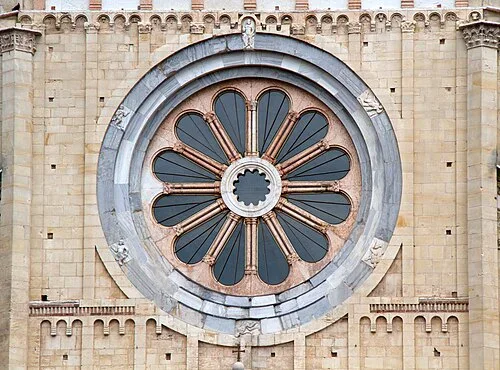 Piazza San Zeno and the Romanesque Facade
The Wheel of Fortune Rose Window
The great round window above the entrance is known as the Wheel of Fortune. The stonecutter Brioloto de Balneo designed it, and the name comes from its symbolism. In the Latin sense, Fortune means destiny, the force that lifts people up and brings them down. The window is divided into twelve sectors by pairs of red marble shafts, with carved capitals of leaves and animals. At its centre sits a hub, crowned with twelve lobes. Three steps of white and blue marble frame the outside. On the outermost step sit six figures carved in Greek marble, and together they show the turns of destiny. The two at the top and bottom stand for the highest prosperity and its complete loss. The side figures show the passages in between. One shows the fall from happiness into misery, and the other the return to good fortune. Small carved figures also sit in the stone around the window. Carved on the hub, two short Latin inscriptions give Fortune her own voice. On the outside, she says she alone rules mortals, raising some up and casting others down. On the inside, she says she clothes the bare and strips those who think themselves ready. Anyone who trusts in her, she warns, will leave mocked.
Tony Hisgett from Birmingham, UK · CC BY 2.0
03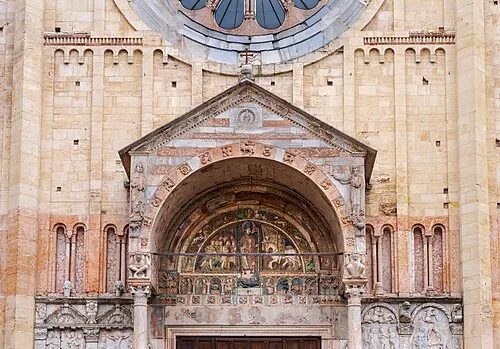 Piazza San Zeno and the Romanesque Facade
Master Niccolò's Porch and Lunette
Master Niccolò signed this porch, and it dates to the twelfth century. Later changes have probably softened its original harmony. A single gable roof rests on two crouching telamons, carved male figures who bear the weight. Reliefs of two saints continue the lines of those supports. At the base, two lions guard the threshold. They are shown pinning down intruders beneath their paws, keeping out anyone unworthy to enter. The two columns stand for law and faith. Higher up, a lamb and the hand of God in blessing appear on the arch. The Latin inscription, in translation, reads: May the right hand of God bless the peoples who enter to ask for holy things. Above the doorway is the lunette, a half-round panel carved in 1138. The carving marks the birth of Verona's medieval commune, the city's own government. In the centre stands Saint Zeno, trampling the devil underfoot. On the right, mounted nobles and merchant families ride. On the left stand foot soldiers, prosperous commoners who were rising in the city. Saint Zeno hands a banner to the Veronese, a formal act with sacred authority. The lettering beside it says the bishop gives the people a banner worth defending, and that Saint Zeno gives the standard with a serene heart. The porch and the portal came from an earlier front of the basilica. They were taken down and rebuilt here, with some adjustments.
Listen in the appPhoto: NorbertNagel · CC BY-SA 4.0
04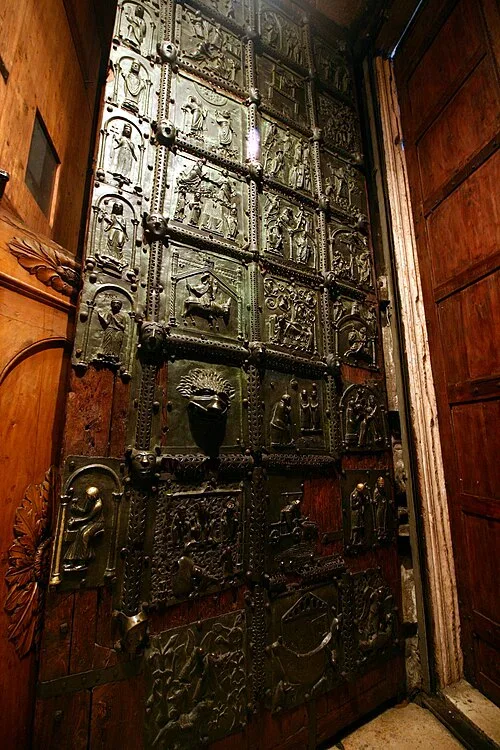 The Archaic Bronze Portal
The Left Bronze Door
Each of these bronze panels was cast on its own, in a small mould. The method was simple, and it made mistakes easier to correct. In Germany, it was more common to make the bronze in one single casting. Here the panels are fixed to the wooden leaves with large iron nails, and the frames are studded with knobs. Near the middle of the leaf, a mask-like head looks out from the bronze. Scholars have debated where this style comes from. The art historian Pietro Toesca called the portal German art of the late twelfth century, and others have accepted that view. Arslan drew parallels with the medieval portal of Hildesheim Cathedral, in Germany.
Listen in the appJosé Luiz · CC BY-SA 4.0
05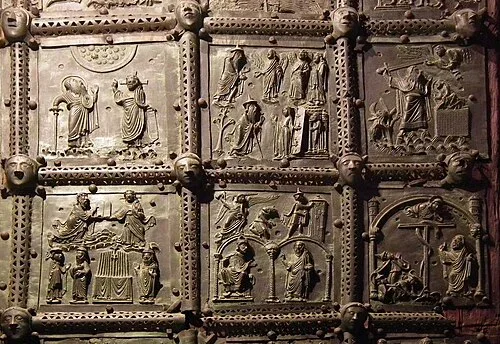 The Archaic Bronze Portal
Bronze Door Panels
Time and theft have left this portal damaged and disordered. Even so, it is generally counted among the most interesting bronze doors of its kind in Italy. Seventy-three panels of different sizes are fixed to the wood, and they follow no obvious symmetry. The larger panels fill the middle of each leaf. Figures, some standing and some seated, rise in relief within them, and many surfaces have worn down. One scene lower on the right seems to show a cross, though its details are hard to make out.
Listen in the appMattana · CC BY-SA 3.0
06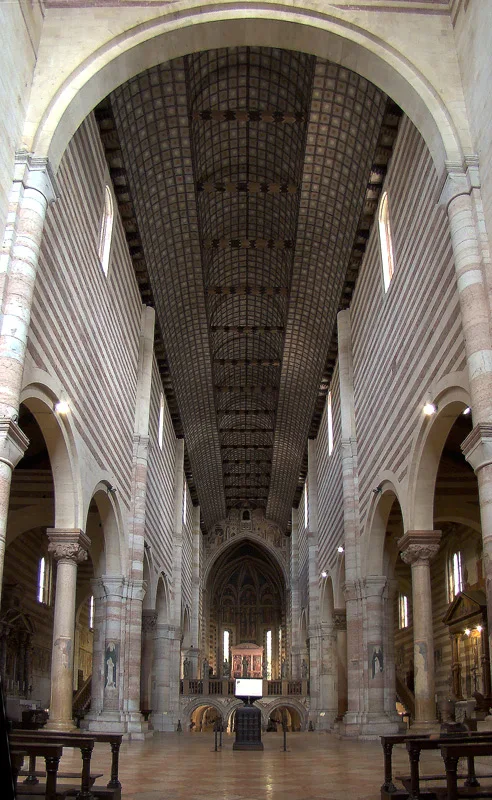 The Nave and the Ship's Keel Ceiling
Nave with Wooden Ship-Hull Ceiling
The Romanesque rebuilding of the basilica began around the end of the eleventh century. Then came the devastating earthquake of 1117, which interrupted the work. Building continued afterward, and by about 1138 much of the present basilica was complete. The plan has three aisles. Heavy piers alternate with columns down each side. Many capitals are carved with animal motifs. Some of the Corinthian capitals were reused from older Roman buildings. The walls are banded in pale and reddish stripes. Above the nave runs a wooden ceiling shaped like the hull of an upturned ship. It was made between 1385 and 1389, during the Gothic renovation of the building. It is regarded as a work of art in its own right, able to rival the famous ceiling of San Fermo Maggiore in Verona. In the corner between the entrance wall and the left side wall stands a large red porphyry basin, more than two metres across. Porphyry is a hard red stone. The basin came from the city's Roman baths of the second century. Legend says the devil carried it from Syria to Verona on Saint Zeno's orders. The damage visible on its rim, the story goes, is the mark of his claws.
Listen in the appPhoto: Tango7174 · CC BY-SA 4.0
07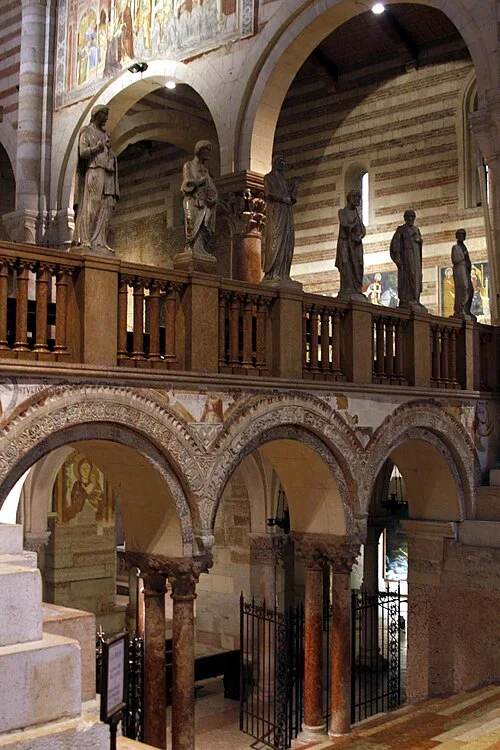 The Nave and the Ship's Keel Ceiling
The Pontile Screen and Crypt Entrance
Thirteen statues crown the raised screen, called the pontile, that divides the nave from the chancel. Below them, a row of carved arches frames a gated opening that leads toward the crypt. The statues have long, thin bodies, and their limbs look almost drawn in. Their hair falls in many carved locks, and their robes are cut into careful folds. Up close, traces of the original colour can still be seen. For a long time, tradition gave the statues to the stonecutter of the great round window. Most historians think a single carver made them all. The scholar Géza de Francovich proposes instead that two sculptors worked on them. In his view, the finer hand carved Christ and several of the apostles. Whoever carved them, the figures seem to show the stretched forms of early German Gothic art. Scholars link that to Verona's close ties with the German world under Ezzelino the Third da Romano, an ally of the emperor Frederick the Second.
Listen in the appJosé Luiz · CC BY-SA 4.0
08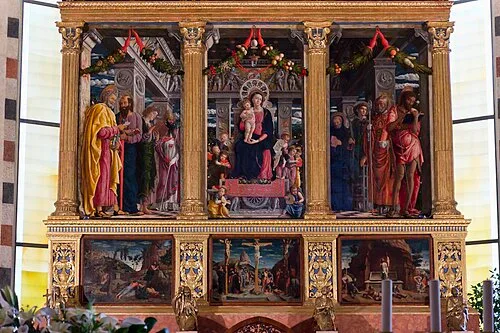 The Elevated Presbytery and High Altar
Mantegna's San Zeno Altarpiece
Four gilded columns frame Andrea Mantegna's altarpiece, and painted garlands hang between them. Mantegna painted it in tempera on panel, and it is considered a masterpiece of Italian Renaissance painting. The upper section shows the Madonna and Child enthroned among saints. Below, the predella holds scenes from the life of Jesus. The altarpiece has had a difficult journey. French troops took it in 1797. The central panel came back to Verona in 1815. The predella panels did not come back. Three of them went to France, and today the Crucifixion hangs in the Louvre, in Paris, while the Resurrection and the Agony in the Garden are in Tours. The predella panels in the church are copies, made by Paolino Caliari, a descendant of the great Veronese painter. During the First World War, the altarpiece was moved to the civic museum for safekeeping. Between 1927 and 1931, the superintendent Alessandro Da Lisca led the campaign to bring it back into the church. At the end of 1930, a new high altar was built, its masonry set on the old foundation block.
Listen in the appPhoto: Jean-Christophe BENOIST · Public domain
09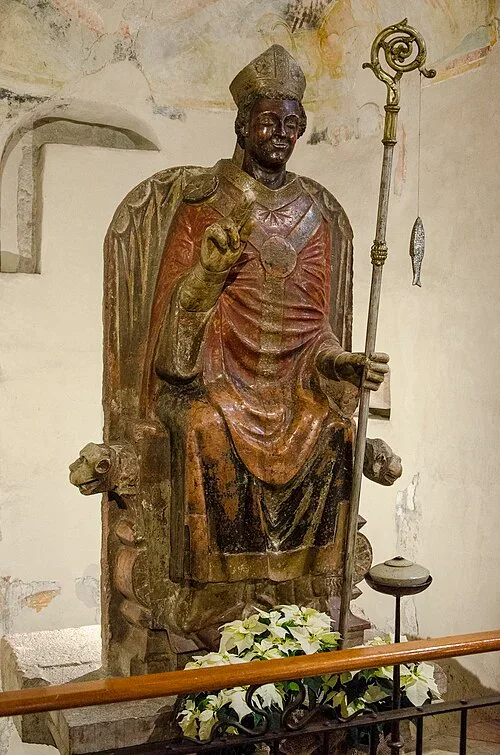 The Elevated Presbytery and High Altar
Statue of San Zeno che ride
Nobody knows who carved this statue, but the people of Verona treasure it for one thing: the saint is smiling. Locals call it San Zeno che ride, Saint Zeno who laughs. Many saints carved in stone look solemn, or gaze up toward heaven. This Saint Zeno has a broad, kindly smile. He sits on a throne with arms that end in lion heads, and his right hand is raised in blessing. He wears a bishop's mitre and holds a crozier, the staff that marks a bishop's office. The statue is made mainly of red Verona marble, painted in places, with some parts in Greek marble. Its back is left rough, which suggests it was meant to stand high up, set into a wall. It sits in the small apse on the left side of the basilica. Scholars do not agree on its date. Some place it in the twelfth century, and others in the thirteenth. Scholars can only guess why the carver chose a smile. Some have compared the face to those on the Scaliger tombs. Others point to the Easter laugh, a ritual more common in German lands.
Listen in the appThis Photo was taken by Andrea Bertozzi. Feel free to use my photos, but please mention me as the author and send me a message. · CC BY-SA 4.0
10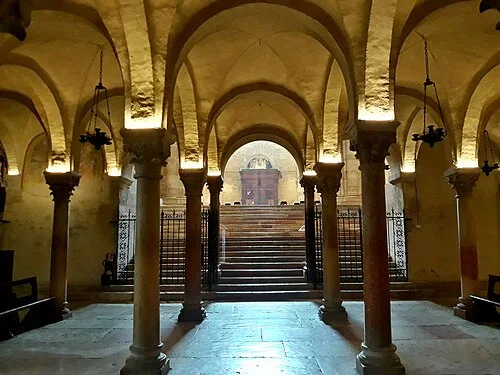 The Subterranean Crypt of Saint Zeno
Subterranean Crypt Column Hall
All but three of the capitals in this crypt date to the tenth century. The other three are older pieces, reused from an earlier Roman-era building. The carvers filled the capitals with many subjects. There are floral motifs, leaves, and wreaths. Some show animals and mythical monsters, and others show human heads or hunting scenes. Many show a clear influence from Byzantine art, the art of the Eastern Roman world. A love story is also linked to the crypt. Local tradition says Romeo and Juliet were married here in secret. It is only a legend, inspired by Shakespeare's play. The wedding, the story goes, took place among these carved capitals.
Listen in the appPhoto: NorbertNagel · CC BY-SA 4.0
- 11
Reliquary of Saint Zeno in the Crypt
How a king and a bishop decided to move Saint Zeno's body into the crypt, and where it rests today.
- 12
The Romanesque Cloister Arcade
A cloister of red marble columns, a monks' tomb built by an abbot, and German monks who became the abbey's masters.
- 13
The Side Wall and Crenellated Brick Tower
A side wall built in layers of brick and stone, and a legend of 589 in which the old church sheltered many Veronese.
Basilica di San Zeno
Frequently asked questions
How much does the guide cost?
Free app download. Listed guide price: $0.99. Guide price shown in the app. Audio guide only. Venue admission is separate.
Can I listen without internet?
Yes. Download the guide’s audio, images, and maps in the app before your visit. Your downloaded content is then available offline.
Can I listen in my language?
This audio guide is available in 15 languages, including English.
Do I need to follow a schedule?
No. This is a self-guided experience. Choose your stops, pause whenever you like, and return to a story at your own pace.
At your own pace
Explore Basilica di San Zeno.
Download Stanza, then search for “Basilica di San Zeno”.
Free app download · Guide price shown in the app
Keep exploring
Nearby audio guides
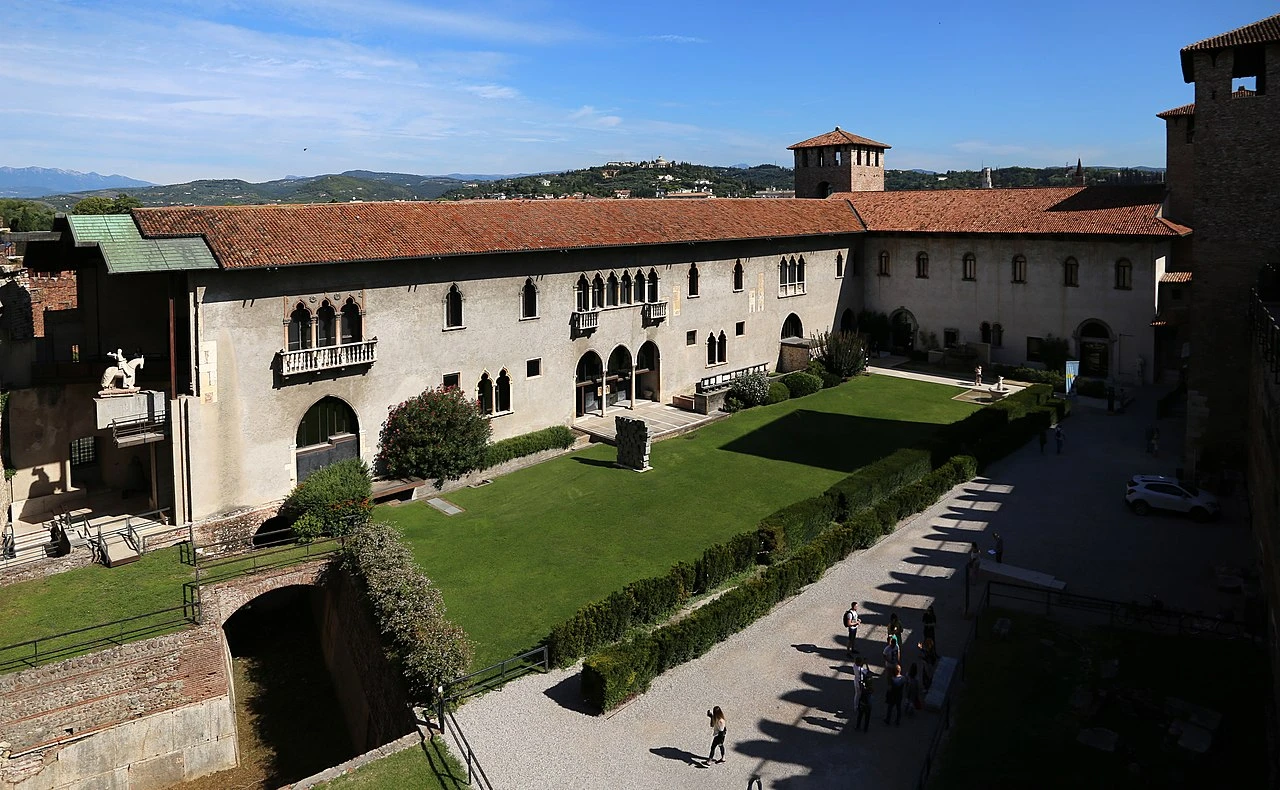
Verona · 1 km
Castelvecchio Museum
Content & sources
Photo: Sailko · CC BY-SA 4.0
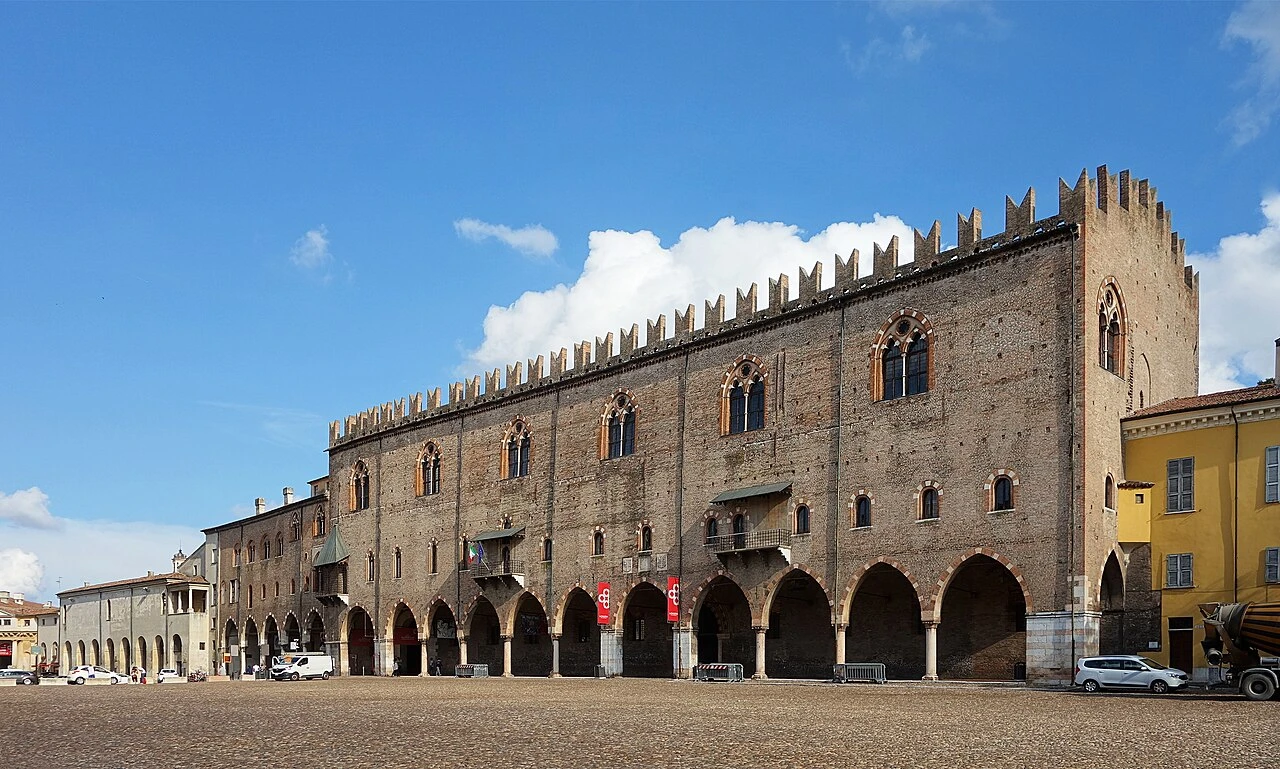
Mantua · 34 km
Palazzo Ducale di Mantova
Content & sources
Photo: Velvet · CC BY-SA 4.0
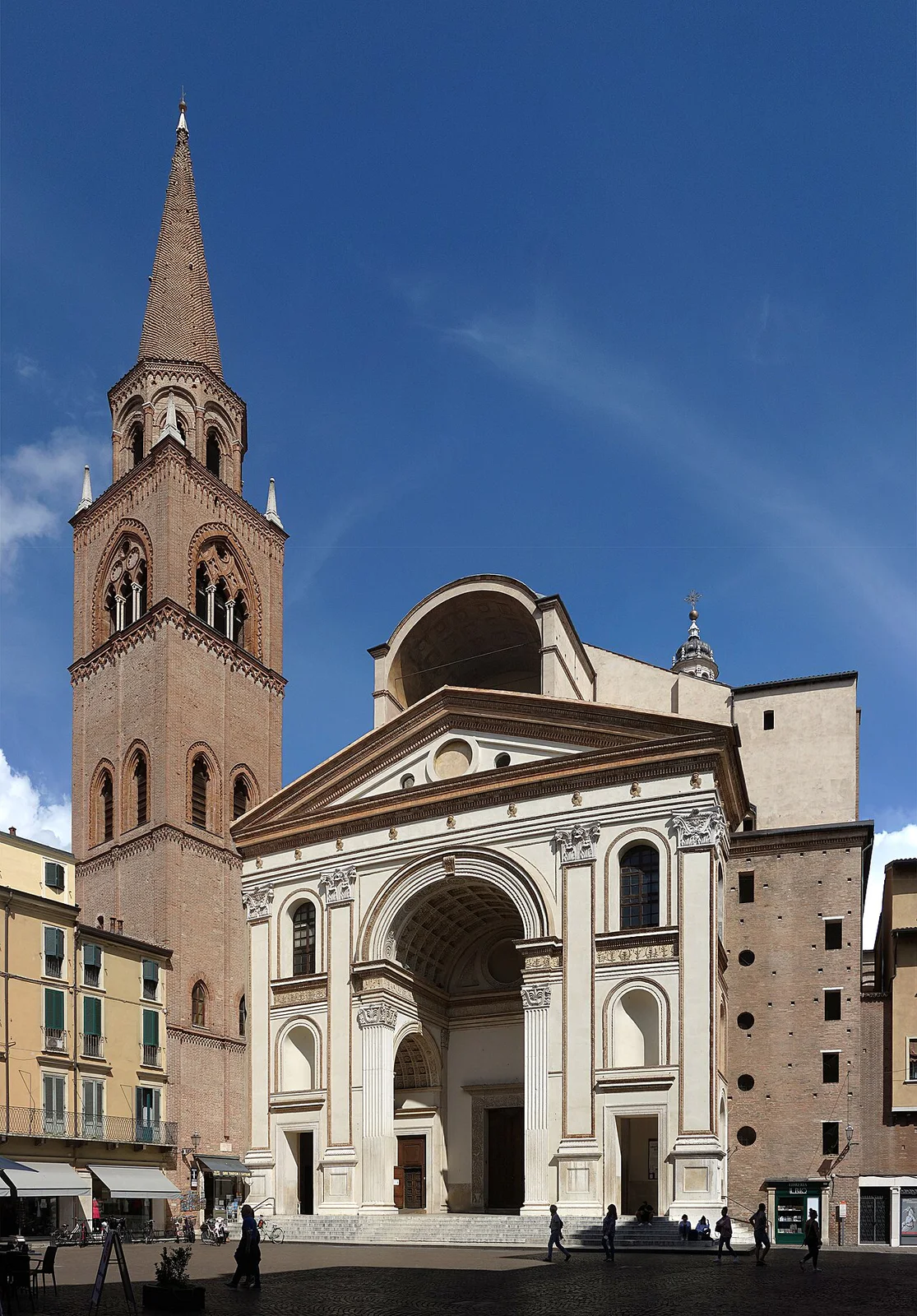
Mantua · 35 km
Basilica di Sant'Andrea
Content & sources
Photo: Velvet · CC BY-SA 4.0
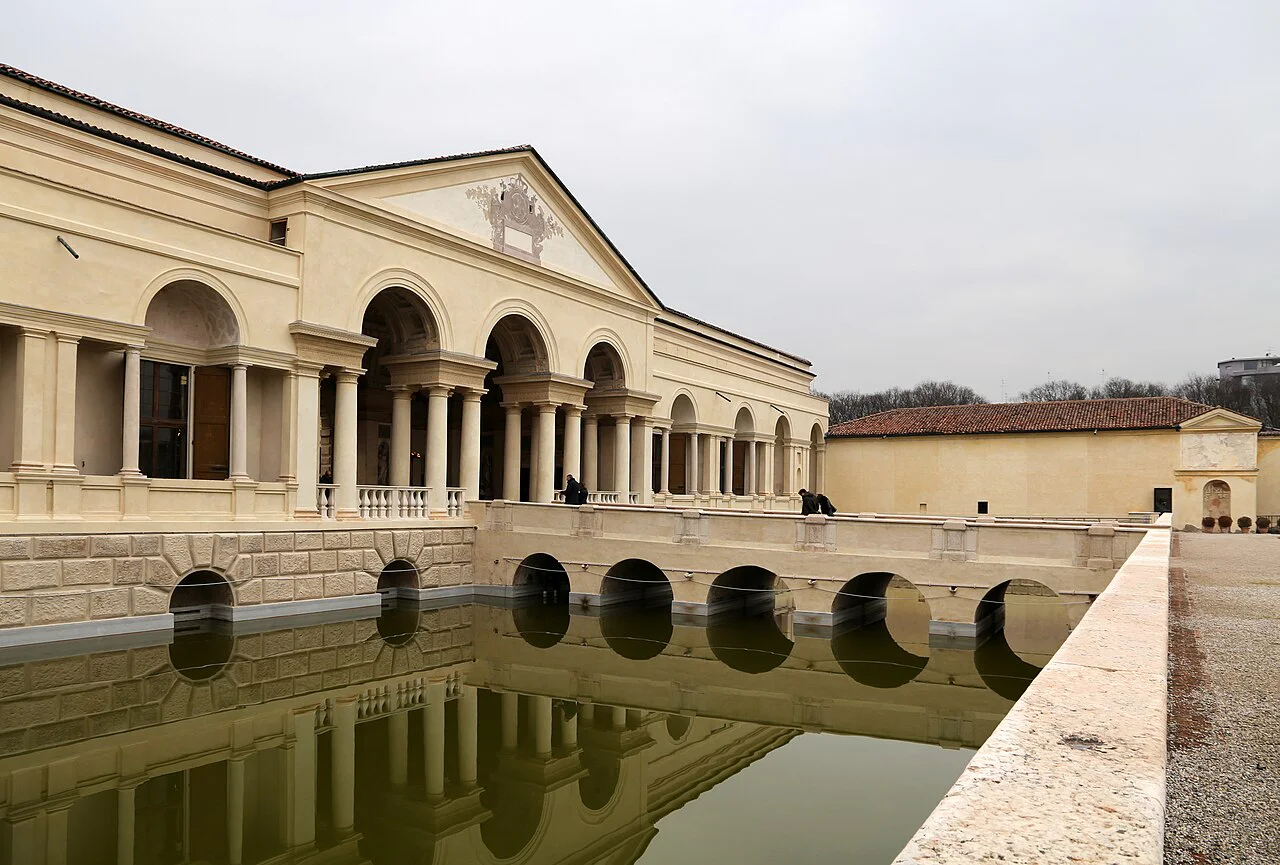
Mantua · 36 km
Palazzo Te
Content & sources
Photo: Sailko · CC BY 3.0