Stanza · Audio guide
Leaning Tower of PisaAudio guide
A place to remember. A story to take with you.
A medieval bell tower in Pisa, Italy, famous for its unintentional tilt.
Download Stanza, then search for “Leaning Tower of Pisa”.
About the tour
One guide. Your kind of visit.
A medieval bell tower in Pisa, Italy, famous for its unintentional tilt.
Ready when you are.
- 01Get the free Stanza app.
iOS & Android
- 02Find your guide.
“Leaning Tower of Pisa”
- 03Download before you go.
Works offline
Audio guide / 19 narrated stops
Inside the guide
Get to know a few of the stories before you go. Open a stop to read more.
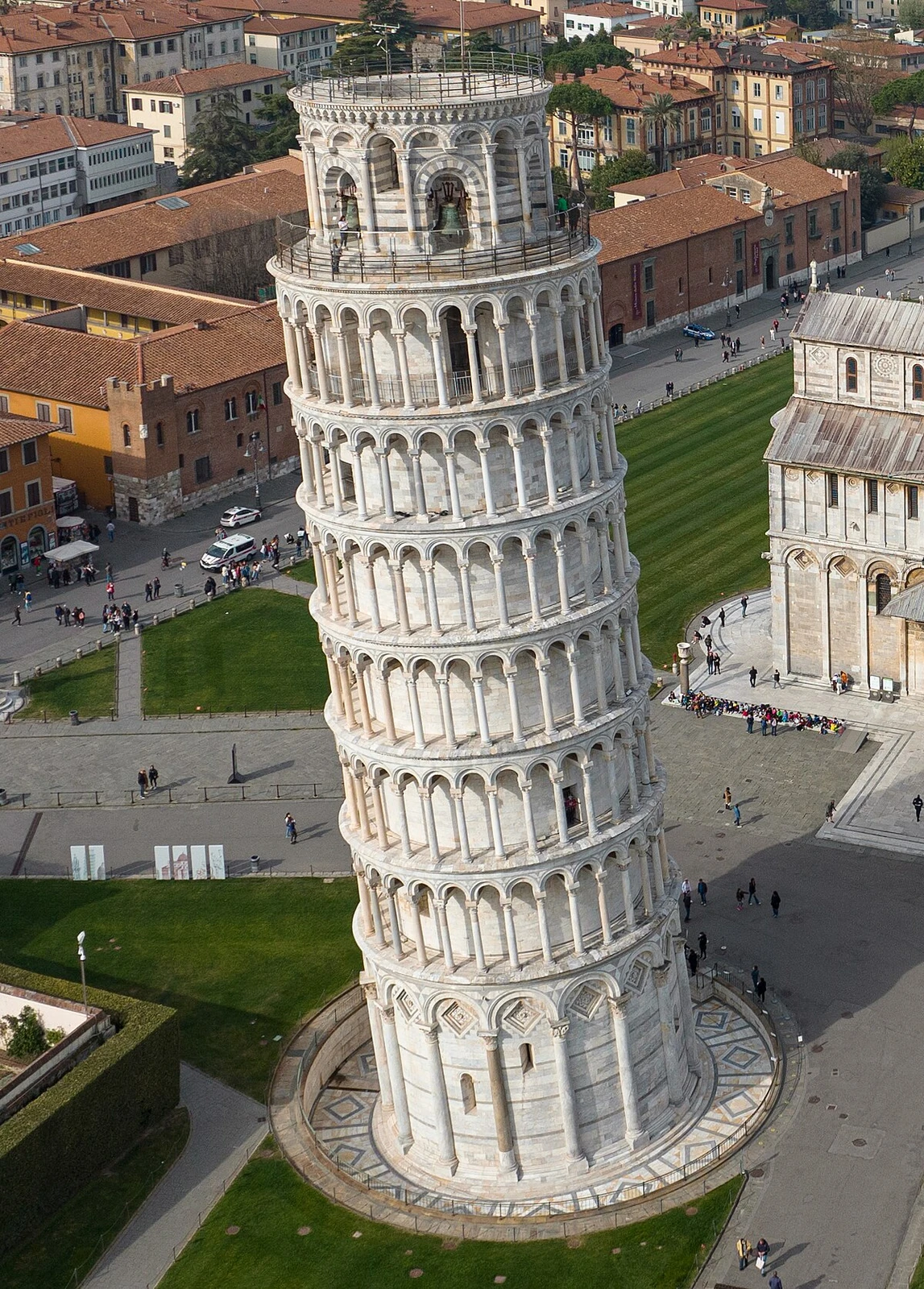
01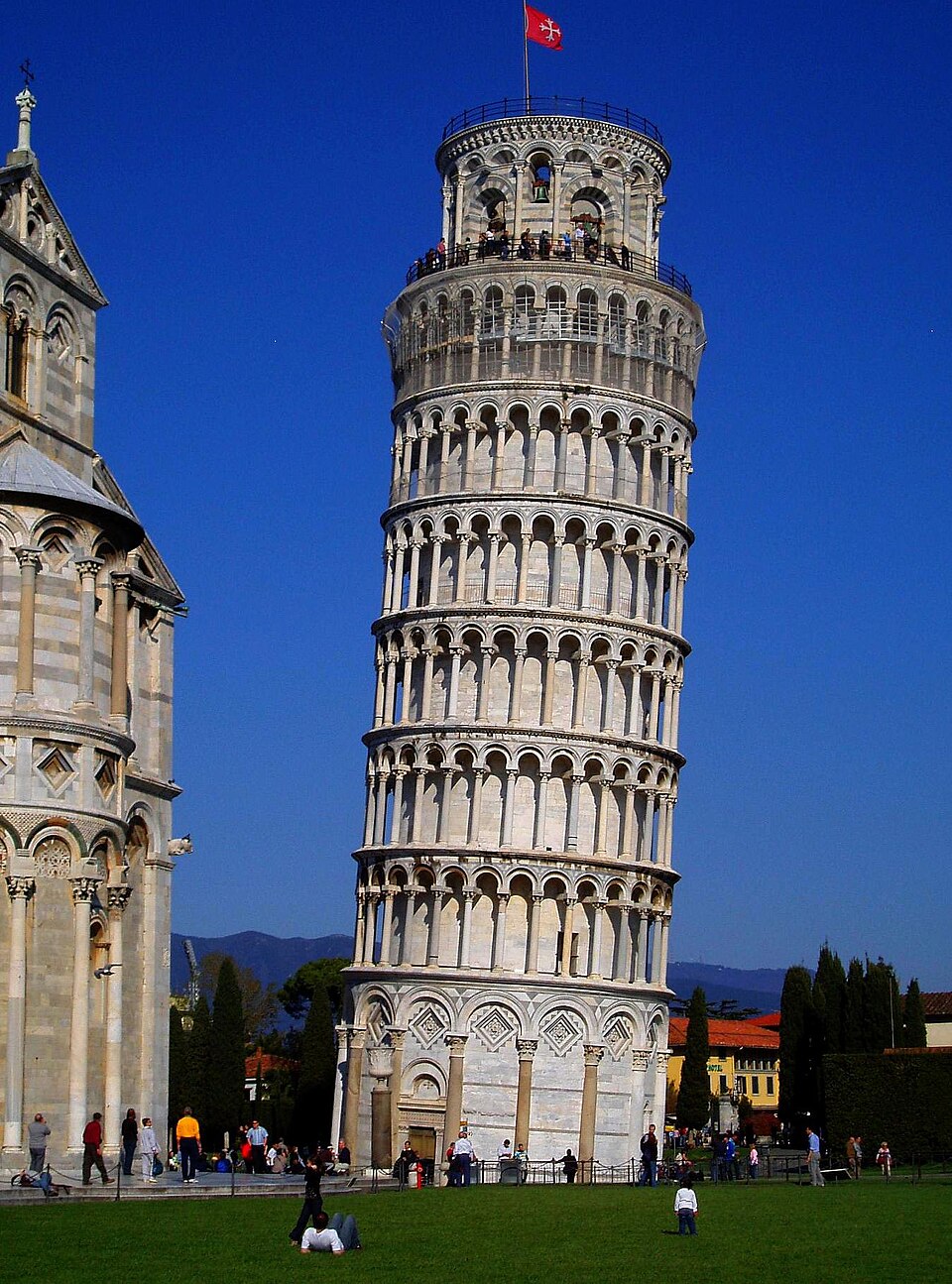 The Piazza dei Miracoli: Facing the TiltThe Leaning Landmark
This freestanding bell tower, known simply as the Leaning Tower, stands roughly 56 meters tall and weighs a staggering 14,453 tonnes. It currently tilts at an angle of 3.97 degrees. Construction began on August 9, 1173, and spanned 199 years. The primary cause for the lean lies hidden beneath the grass. The tower was built on a foundation only three meters deep—far too shallow for a structure of this immense weight. Furthermore, it sits on unstable subsoil composed of clay and sand. As the ground shifted over the centuries, the tower began its slow descent. Intricate arches decorate each level, leading up to the bell chamber at the very top. Even today, visitors explore the balconies, while a red flag with a white cross flies from the summit.
Lee Cannon · CC BY-SA 2.0
02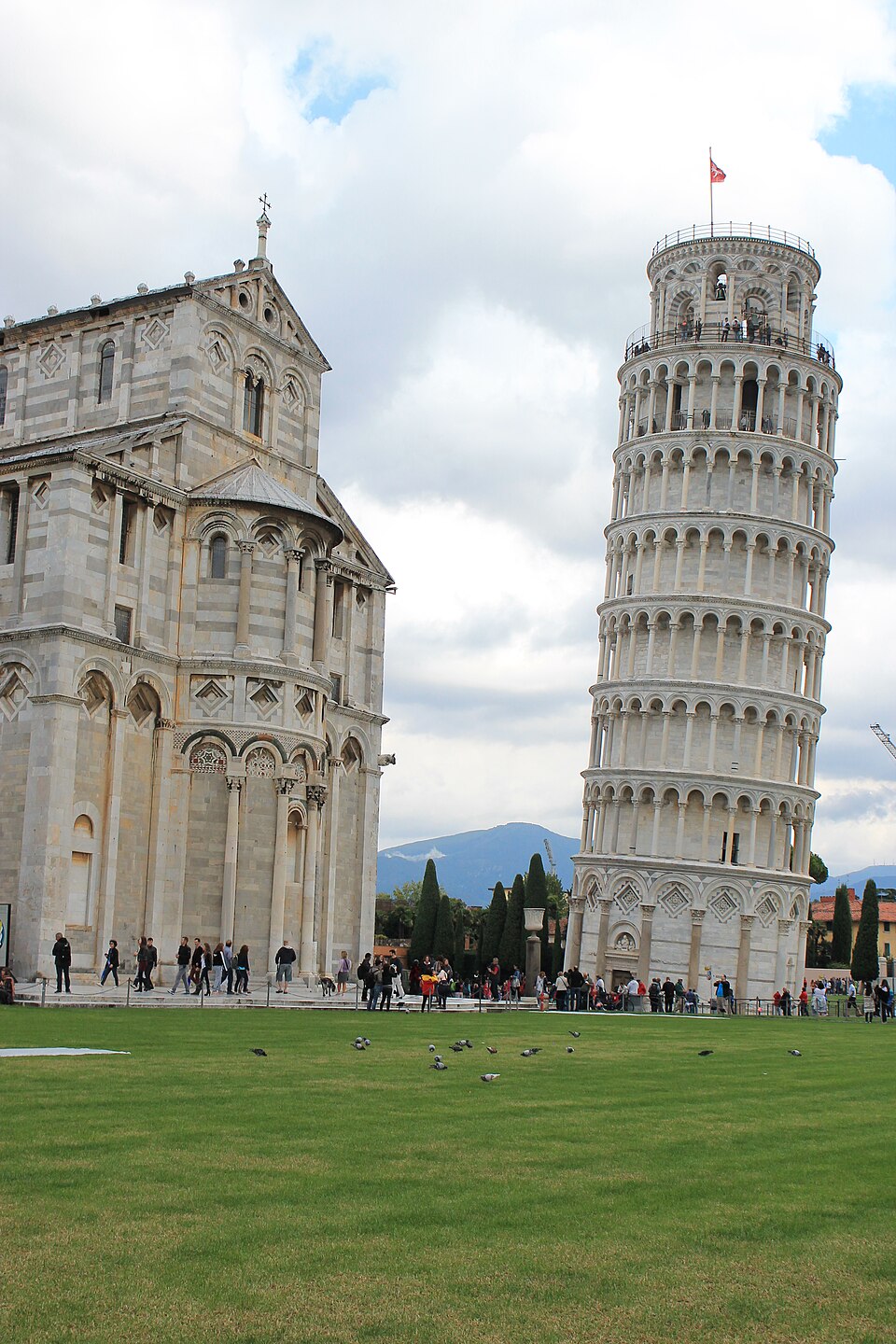 The Piazza dei Miracoli: Facing the TiltThe Cathedral and Campanile
Looking at this scene, you are witnessing one of the most famous architectural pairings in the world. While the leaning tower often steals the spotlight, it’s important to remember its original purpose: it is the 'Campanile,' or bell tower, for the grand Cathedral standing right beside it. These two buildings are the centerpieces of the Piazza dei Miracoli, or the 'Square of Miracles.' If you look closely at their exteriors, you’ll notice a beautiful architectural harmony. Both structures are adorned with rows of delicate arches and columns, creating a consistent visual rhythm across the site. The pale stone facades were intended to reflect the light and showcase the prestige of the city during its historical peak. It is a bit of a historical irony that the tower, which was designed as a secondary structure to the massive Cathedral, has become the more famous of the two. The Cathedral was built to be the primary place of worship and a monument to the city’s glory, while the tower was simply meant to hold the bells that called the faithful to prayer. Today, they stand together as a testament to both human ambition and the unpredictability of the ground beneath them. As you take in the view, consider how the tilt of the Campanile changes your perception of the grand, steady Cathedral beside it.
John Samuel · CC BY-SA 4.0
03 The Piazza dei Miracoli: Facing the TiltA Study in Slant
From this specific angle, you can truly appreciate the visual drama of one of the world’s most famous architectural accidents. The straight, vertical lines of the neighboring Cathedral provide a stark, rigid frame for the tower’s lean, creating a moment of tension frozen in stone. Historical records suggest that by the time builders reached the second floor in 1178, the structure had already begun its fateful tilt, sinking into the unstable soil beneath. Rather than abandoning the project, the builders continued upward over the following decades. Rhythmic tiers of arches and delicate columns wrap around the exterior, creating a complex play of light and shadow across the weathered surface. Despite the lace-like appearance of these arcades, they bear the immense weight of a structure that appears to be in a perpetual state of falling. The lean feels almost surreal from here, challenging your sense of balance.
Listen in the appPhoto: Jean-Christophe BENOIST · CC BY 2.5
04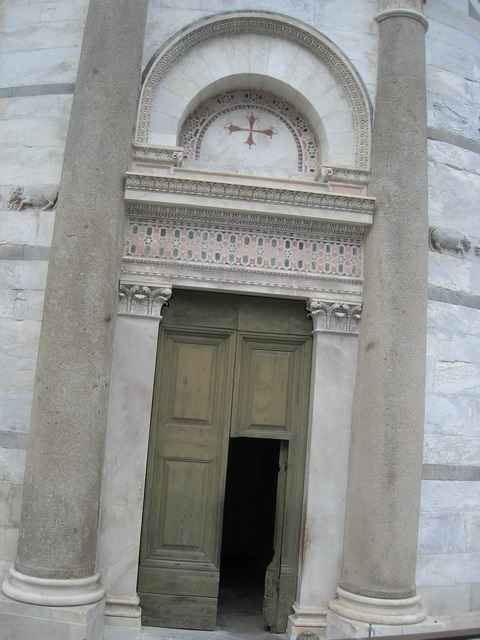 The Ornate Base and the Foundation FlawThe Romanesque Portal
This portal is a classic example of Pisan Romanesque architecture, characterized by heavy stone columns and an elegant semi-circular arch, or tympanum, featuring a simple cross at its center. Above the door lintel, delicate geometric patterns and inlays demonstrate the sophisticated craftsmanship of the era. Faint relief carvings of animals flank the entrance, adding a touch of nature to the monumental stone. The identity of the architect remains a subject of historical debate, with the work traditionally attributed to either Bonanno Pisano or Diotisalvi. Regardless of who held the chisel, the result is a doorway that feels grounded even as the structure above it tilts. In 1934, Benito Mussolini ordered the tower’s lean to be 'corrected.' Engineers drilled holes around this base and pumped in 80 tons of concrete to solidify the foundations. The plan backfired; the sheer weight of the concrete pushed the tower deeper into the soft, marshy soil, causing it to sink and lean further. The weathered green wooden doors have seen centuries of visitors.
Listen in the appLonewolf1976 (talk) · CC BY-SA 3.0
05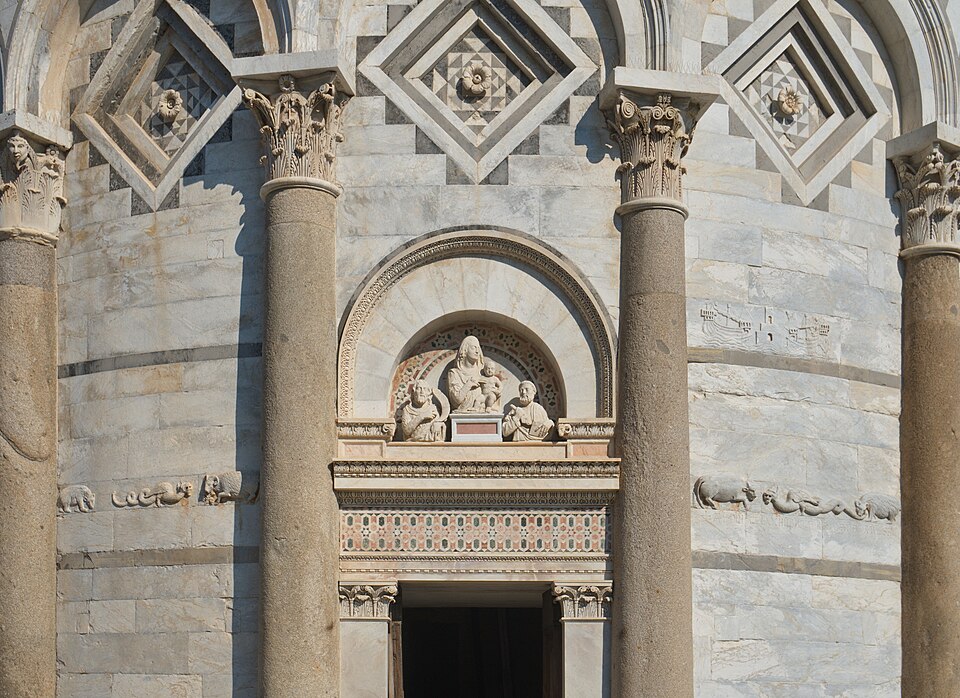 The Ornate Base and the Foundation FlawThe Entrance Lunette
The semi-circular space directly above the entrance is known as a lunette. It houses a sculptural group where the Madonna sits at the heart, cradling the Christ Child. They are joined by two figures—likely saints or donors—who appear to be in quiet contemplation. While time has softened the stone, the figures still convey a sense of serene authority. Beyond the central figures, recurring diamond shapes called lozenges and shallow 'blind arches' decorate the stonework. These elements are signature hallmarks of Pisan Romanesque architecture. In an era when Pisa was a dominant maritime power, this elaborate style displayed the city’s wealth and religious commitment. Alternating bands of light and dark stone create a rhythmic, textured effect. Just above the door frame, a narrow frieze is populated by small, mysterious creatures and animal figures. These intricate carvings and the detailed capitals atop the columns demonstrate the high level of craftsmanship that went into every inch of the tower.
Listen in the appPhoto: MenkinAlRire · CC BY-SA 4.0
06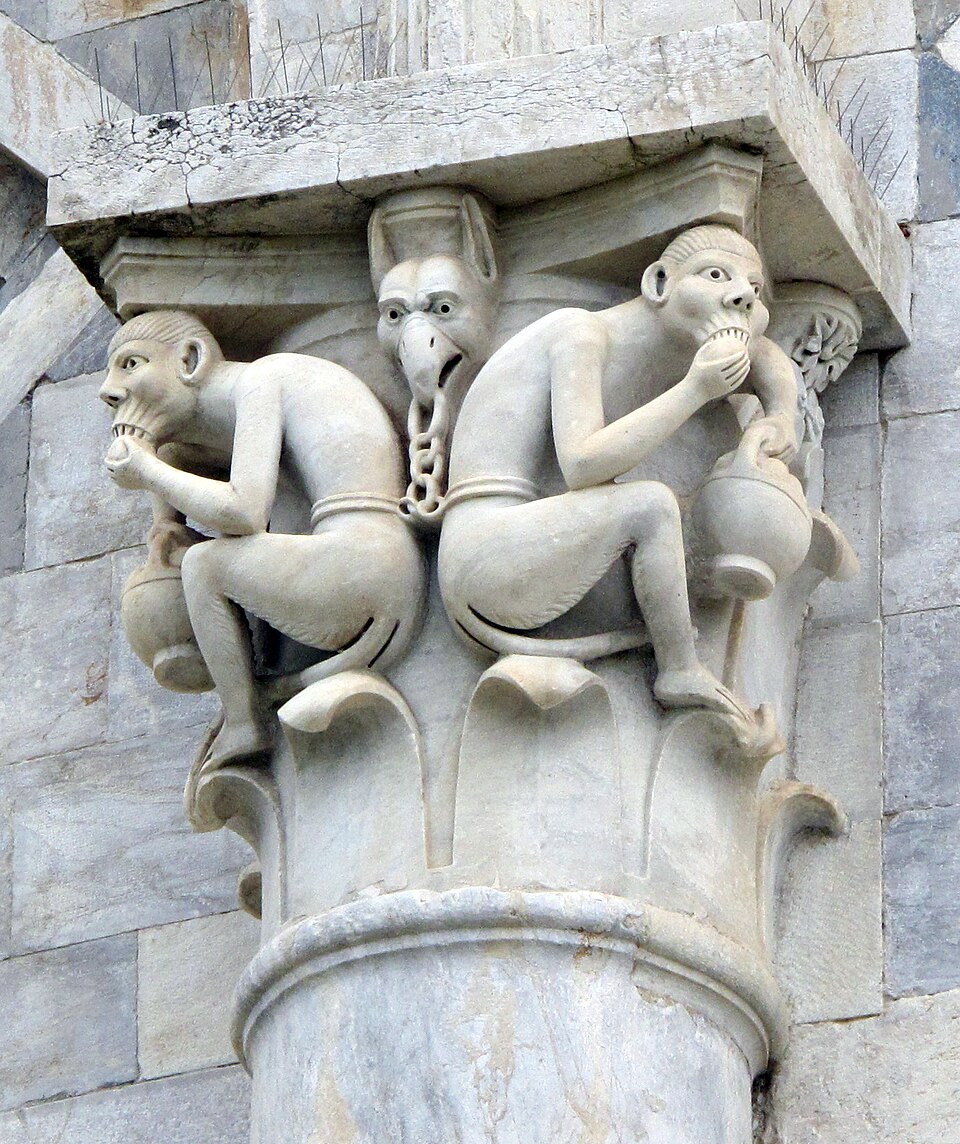 The Ornate Base and the Foundation FlawThe Monkey Capital
While the tower is famous for its tilt, a closer look at its architectural details reveals hidden character. This specific column capital, known as the 'Monkey Capital,' showcases the whimsical creativity of medieval stonemasons. Two figures on either side are carved with human-like postures, crouched down and seemingly preoccupied with the small vessels or jugs they hold. One appears to be eating or drinking. In the center, a stylized, bird-like creature with a sharp beak and wide eyes wears what looks like a heavy chain around its neck. Below them, the base of the capital is decorated with traditional stylized leaves. In the context of a grand religious monument, these 'grotesques' served a specific purpose. Medieval artists frequently included animals to represent the natural world or to act as symbols of human folly and earthly desires. These carvings offer a rare moment of levity amidst the formal design. You can still see the tool marks left by the anonymous craftsmen who worked on these stones centuries ago.
Listen in the appPhoto: Sailko · CC BY-SA 4.0
07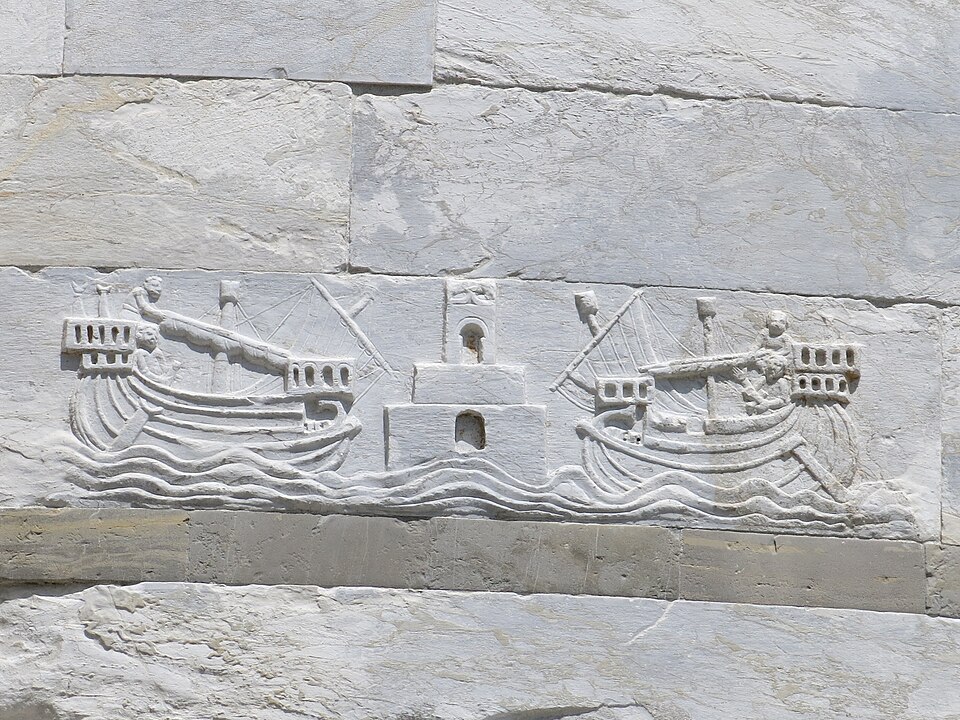 The Ornate Base and the Foundation FlawReliefs of the Sea
Set into the stone blocks of the tower’s base is a remarkable relief depicting a symbolic maritime scene. Two sailing vessels approach a central, tiered tower that likely represents a lighthouse or a fortified harbor entrance. Beneath the hulls, stylized, undulating lines represent the waves of the Mediterranean. Small figures—perhaps sailors or merchants—man the decks. The visual style is characteristic of the Romanesque period, with simplified, bold forms prioritizing clear storytelling. This carving serves as a reminder of Pisa’s historical identity as one of Italy’s four dominant Maritime Republics. Wealth and influence were built upon the sea, with merchant fleets projecting power across the Mediterranean. The central tower is often interpreted as the lighthouse of Porto Pisano, the city's ancient gateway. These images were integrated directly into the fabric of the building. Some historians believe these stones were reused from an older building—a common practice known as 'spolia'—while others think they were specifically commissioned to celebrate naval triumphs.
Listen in the appPhoto: Tangopaso · Public domain
08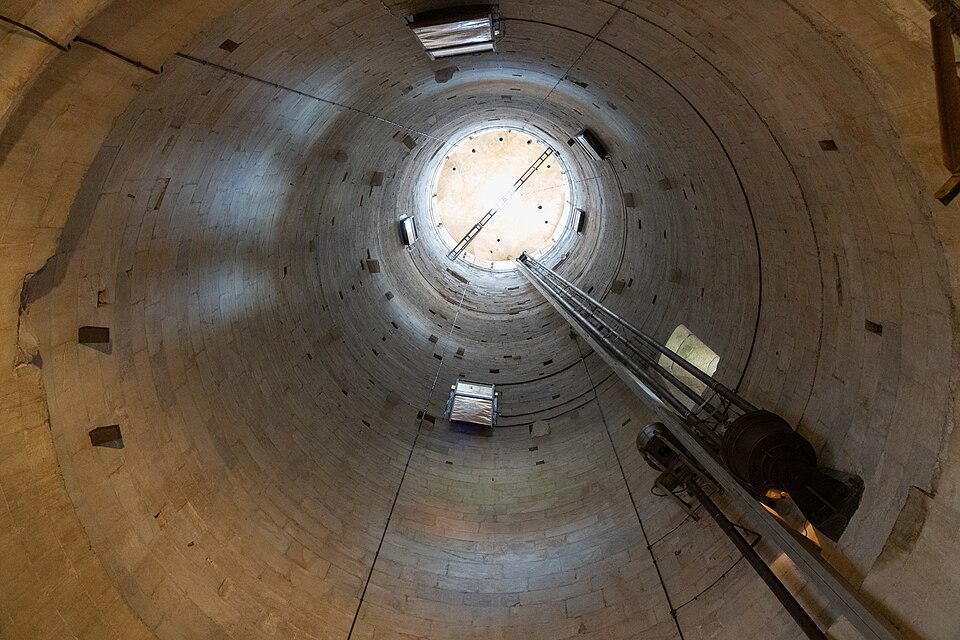 Climbing the Hollow CoreThe Hollow Core
Standing here and looking directly upward, you are witnessing the secret interior of one of the world’s most famous landmarks. It is often a surprise to visitors that the Leaning Tower of Pisa is not a series of solid floors, but is essentially a massive, hollow stone cylinder. From this perspective, the architectural drama of its construction becomes visible in a way you can’t see from the outside. As your eyes follow the stone walls up toward the light at the summit, take a moment to look closely at the alignment. You might notice that the tower isn’t actually a straight line leaning over; it possesses a subtle, organic bend known as the 'Banana' curvature. This was a deliberate, if desperate, engineering choice. Around 1272, after a long pause in construction, engineers realized the tower was sinking and tilting dangerously. In an attempt to pull the structure back toward the vertical, they began building the remaining upper floors with one side taller than the other. They hoped that by adding more weight to the side opposite the lean, they could rectify the center of gravity. While it didn't stop the tilting, it resulted in this unique, curved silhouette. This hollow core serves as a vertical timeline of that struggle—a place where you can see medieval problem-solving etched into the very masonry. It’s a reminder that this world-famous tilt wasn't just a mistake, but a challenge that builders spent centuries trying to overcome.
Listen in the appEric Kilby · CC BY-SA 2.0
09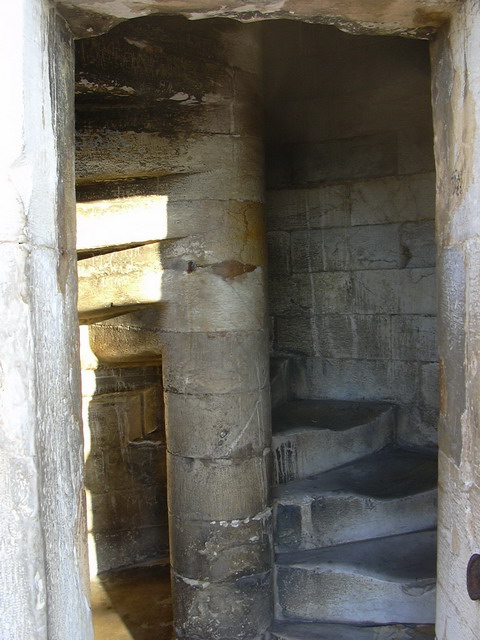 Climbing the Hollow CoreThe Spiral Climb
Step inside the thick stone walls of the Torre di Pisa and you leave the world of perfect verticality behind. This narrow spiral staircase, captured here around the tower’s sixth floor, offers a tactile history of one of the world's most famous architectural accidents. As you ascend these 296 steps, pay close attention to the stones beneath your feet. They are heavily indented and worn smooth—a physical record of the millions of pilgrims and tourists who have wound their way upward over the centuries. But it is the physical sensation of the climb that is most remarkable. Because the tower leans at such a significant angle, the physics of your journey change with every rotation. One moment, you may feel a strange pressure pushing you against the outer wall; the next, the floor seems to fall away, making you feel as though you are leaning into the central pillar. It is a disorienting, almost dizzying experience that forces your body to constantly recalibrate its sense of balance. The light filtering in comes from the narrow openings that lead out to the tower's external galleries. This interplay of shadow and sun highlights the rough-hewn texture of the masonry, reminding us of the ancient craftsmanship required to build such a massive structure. As you continue, consider the generations of people who have navigated these same tight turns, each one feeling that same peculiar pull of gravity that makes this climb unlike any other in the world.
Listen in the appLonewolf1976 (talk) Original uploader was Lonewolf1976 at en.wikipedia · CC BY-SA 3.0
10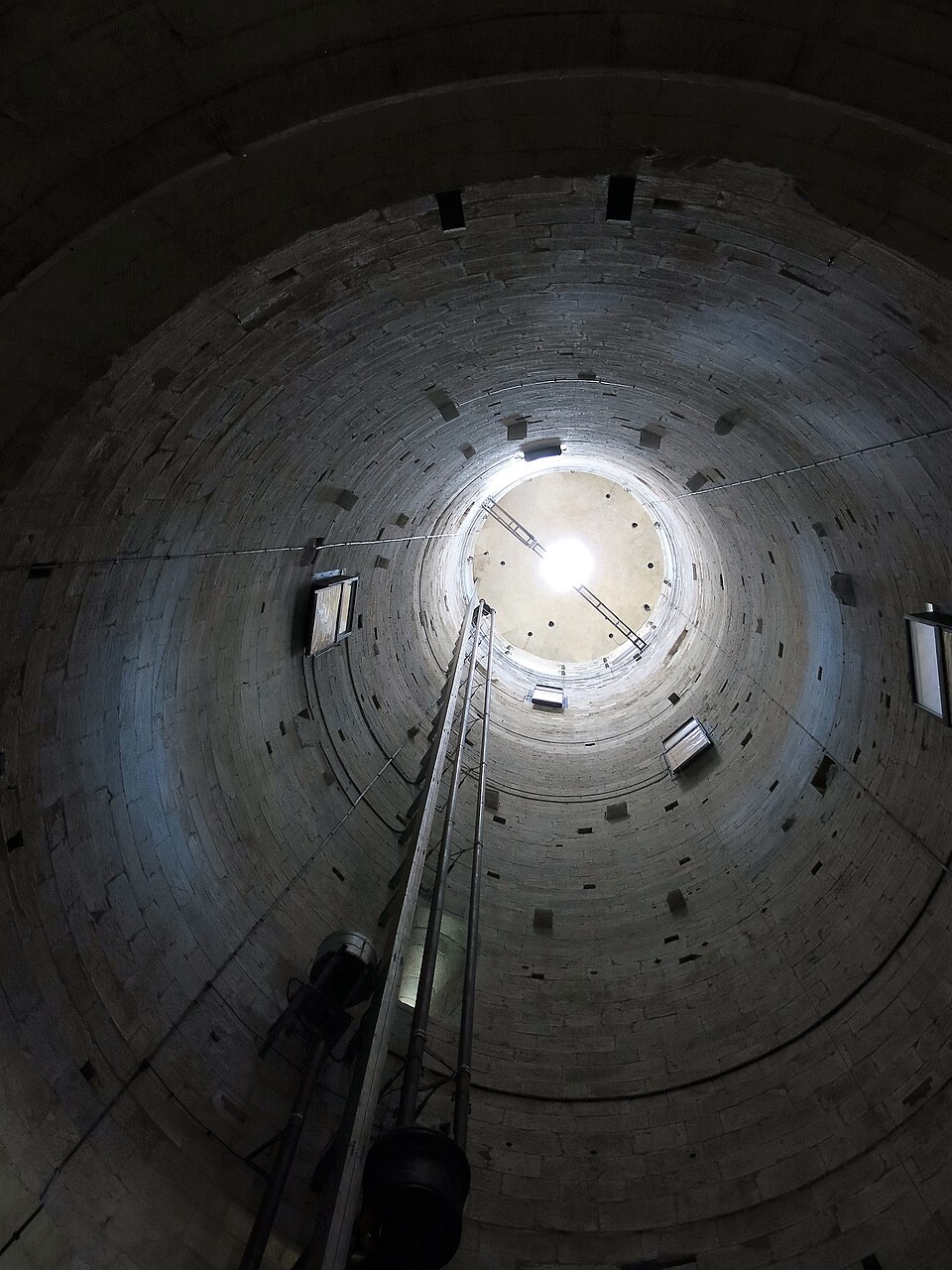 Climbing the Hollow CoreA Living Monument
The inside of the tower reveals a tale of modern ingenuity fighting to save a medieval masterpiece. For centuries, the lean increased to a critical point, and by the late 20th century, the structure was in danger of collapse. A massive restoration project in the 1990s succeeded in pulling the tower back by approximately 45 centimeters. This subtle shift was enough to stabilize the foundation and ensure the tower would remain standing. The stone walls are lined with a modern nervous system of cables and sensors. These act as a digital 'pulse,' tracking minute movements and structural stresses in real-time. This data allows engineers to understand exactly how the building reacts to the elements and the passage of time. The ancient, rough-hewn stone of the original construction is now framed by the sleek, functional lines of contemporary technology. The tower requires constant care and the best of modern science to endure.
Listen in the appPhoto: Tangopaso · Public domain
Leaning Tower of Pisa
Frequently asked questions
How much does the guide cost?
Free app download. Listed guide price: $1.99. Guide price shown in the app. Audio guide only. Venue admission is separate.
Can I listen without internet?
Yes. Download the guide’s audio, images, and maps in the app before your visit. Your downloaded content is then available offline.
Can I listen in my language?
Stanza supports 15 languages. Check the app for the languages available for this guide.
Do I need to follow a schedule?
No. This is a self-guided experience. Choose your stops, pause whenever you like, and return to a story at your own pace.
At your own pace
Explore Leaning Tower of Pisa.
Download Stanza, then search for “Leaning Tower of Pisa”.
Free app download · Guide price shown in the app
Keep exploring
Nearby audio guides
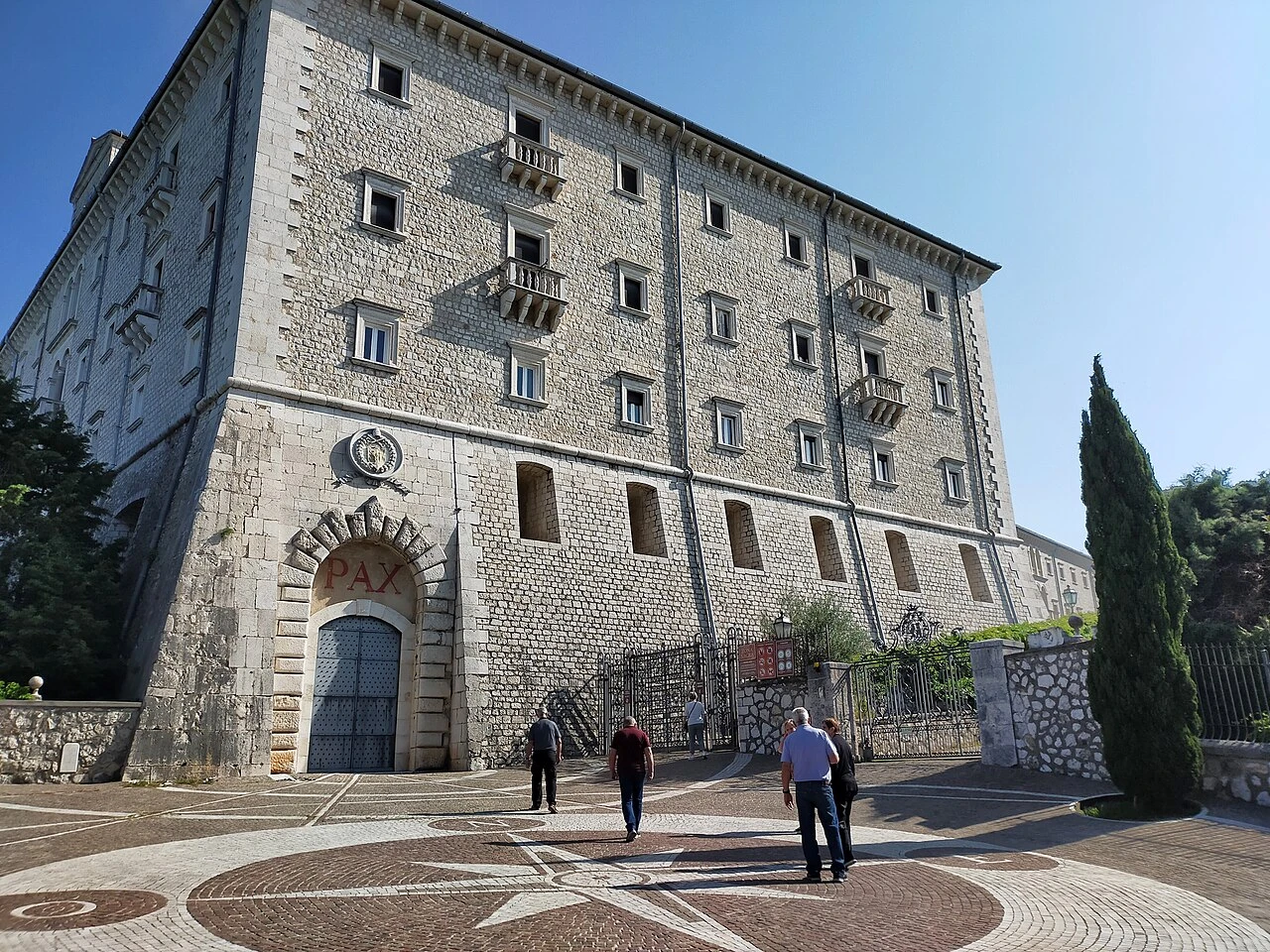
Cassino
Abbey of Monte Cassino
Content & sources
Photo: Marica Massaro · CC BY-SA 4.0
Rome
Basilica of San Clemente
Content & sources
Photo: Labicanense · CC BY-SA 4.0
Assisi
Basilica of St. Francis of Assisi
Content & sources
Hagai Agmon-Snir حچاي اچمون-سنير חגי אגמון-שניר · CC BY-SA 4.0
Florence
Basilica of San Lorenzo
Content & sources
Nelson Pérez · CC BY-SA 3.0