Stanza · Audio guide
Teatro greco di Siracusa Audio Guide
A place to remember. A story to take with you.
The Greek theatre of Syracuse is an ancient Greek theatre located on the south slopes of the Temenite hill in Sicily. It was first built in the 5th century BC and is part of a UNESCO World Heritage Site.
Download Stanza, then search for “Teatro greco di Siracusa”.
About the tour
One guide. Your kind of visit.
The Greek theatre of Syracuse is an ancient Greek theatre located on the south slopes of the Temenite hill in Sicily. It was first built in the 5th century BC and is part of a UNESCO World Heritage Site.
Ready when you are.
- 01Get the free Stanza app.
iOS & Android
- 02Find your guide.
“Teatro greco di Siracusa”
- 03Download before you go.
Works offline
Audio guide / 10 narrated stops
Inside the guide
Get to know a few of the stories before you go. Open a stop to read more.
01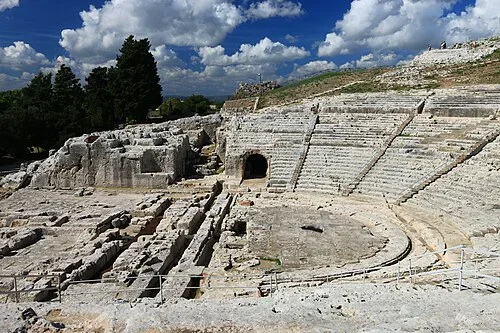 The Lower Approach and Rock-Cut Cavea
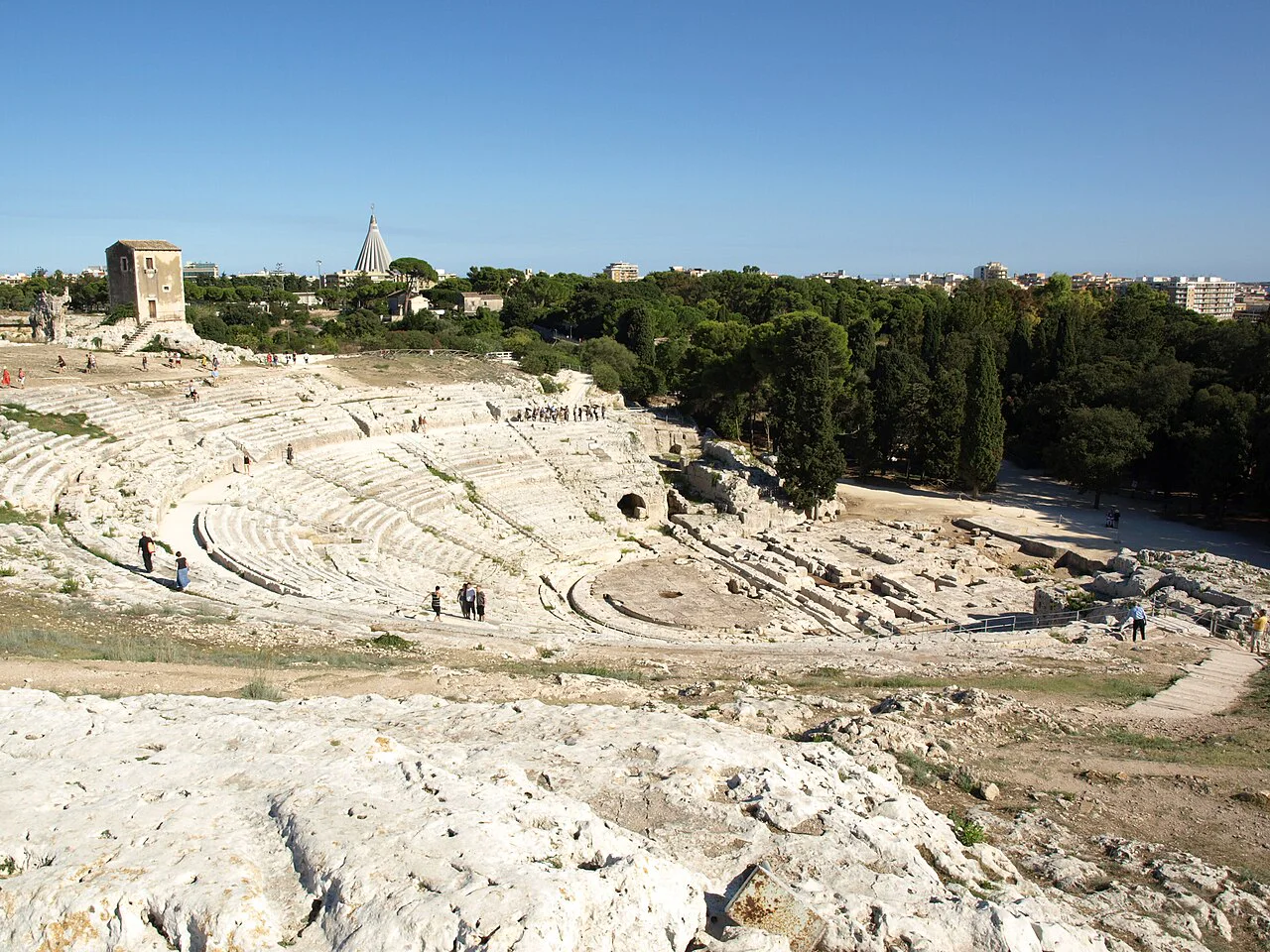
The Greek Theatre from the Lower Approach
Welcome to the Greek theatre of Syracuse, on the south slope of the Temenite hill above the modern city. It was first built in the fifth century BC, and it was rebuilt more than once over the following centuries. Today it forms part of a UNESCO World Heritage Site, Syracuse and the Rocky Necropolis of Pantalica. In Greek practice, theatres like this one were built for drama, and plays were staged at festivals. But this place also served the city's public life. The writer Plutarch tells how an angry bull escaped during a citizen assembly held here in 355 BC. It is one of the largest theatres in the Greek world.
Listen in the appBenjamin Smith · CC BY-SA 4.0
02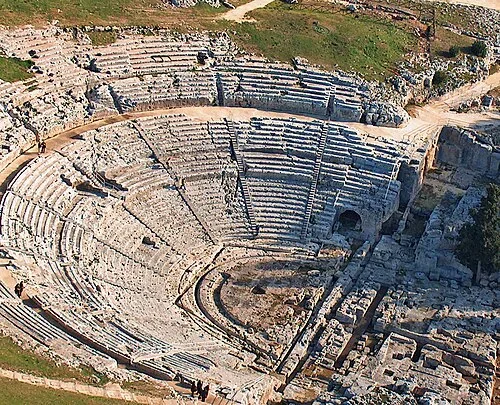 The Lower Approach and Rock-Cut Cavea
The Rock-Cut Seating Bowl from Above
Most of the rows were carved straight out of the hillside rock. At first there were sixty-seven of them. The seating, known as the cavea, measures about one hundred and thirty-nine metres across. Access stairs divide the seating into nine wedge-shaped sections. The Latin word for these is cunei, meaning wedges. The top rows were different. They were built up on a raised bank, held up by a retaining wall, and that upper part has since been destroyed. The seats look out over the bay of the harbour and the island of Ortygia. Near the centre of the seating, a platform was cut into the rock. It may have been kept for the most important people.
Listen in the appfotovideomike from Italia (Michele Ponzio, @michele_ponzio) · CC BY-SA 2.0
03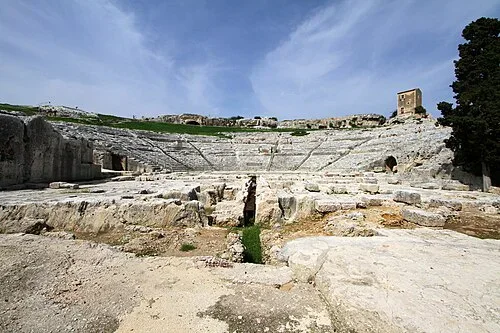 The Orchestra and Stage Foundations
The Orchestra Floor
The orchestra is the performance floor, the level space between the seats and the stage. In Greek theatres in general, a chorus sang and moved on a floor of this kind. In the original Greek design, a wide drain called the euripus ran around the orchestra. Outside it, a strip of ground before the first steps let the audience in. Later, under the Romans, the old drain was buried. A narrower new canal was dug much closer to the seats. This change may date to when the Romans founded a colony here, early in the Augustan age. Before the change, the orchestra was sixteen metres across. Afterwards it was just over twenty-one metres across. Later still, in the late Roman period, the floor was adapted for water games. No changes made for gladiator fights survive here, so those shows were probably held in the city's amphitheatre.
Listen in the appCarlo Pelagalli · CC BY-SA 3.0
04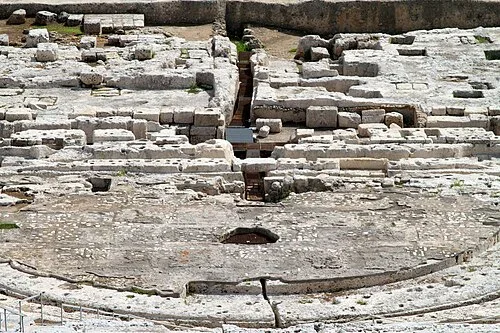 The Orchestra and Stage Foundations
Stage Cuttings and the Under-Floor Passage
The stage building, called the skene, has been entirely destroyed. Only cuts in the bedrock show where its foundations stood. These cuts come from several building phases, and they are hard to read. One feature stands out, a passage dug beneath the orchestra. A staircase leads down to it from the stage, and it ends in a small room. It probably belongs to the time of King Hieron the Second. It may be the so-called Stairs of Charon, a name taken from Charon, the ferryman of the dead in Greek myth. It may have given actors sudden entrances and exits. A trench for the front curtain probably belongs to the same period. In ancient theatres, the curtain did not fall from above. It rose from below.
Listen in the appCarlo Pelagalli · CC BY-SA 3.0
05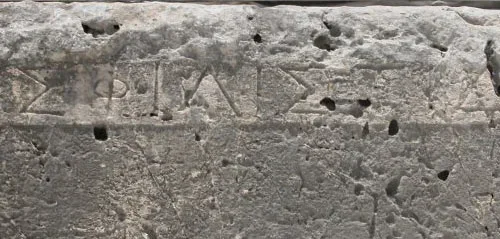 The Diazoma and Royal Inscriptions
The Diazoma Inscriptions
Halfway up the seating runs a walkway called the diazoma, which splits the seats into two parts. Carved inscriptions appear on its walls, and each wedge of seats has its own. The inscriptions name the divine figures Olympian Zeus and Herakles. Others name members of the royal family, including Hieron the Second himself and his wife Philistis. His son and his daughter-in-law appear too. Because of these names, some scholars have used the inscriptions to help date the building or its rebuilding. The theatre seems to have been renovated after 238 BC. The work was certainly done before Hieron the Second died in 215 BC. That renovation gave the theatre the form it has today.
Listen in the appPhoto: Mikystar · Public domain
06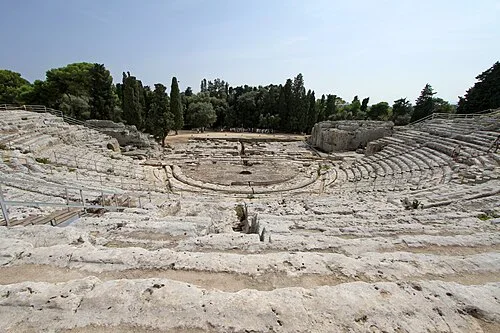 The Upper Cavea and Civic Assembly
The Upper Cavea and the Living Performances
At the end of the eighteenth century, interest in the theatre came back. Scholars and travellers wrote about it and made drawings of it. In the nineteenth century, Landolina and Cavallari freed the monument from the earth that had built up over it. In 1914 the National Institute of Ancient Drama, known as INDA, began staging Greek plays here. Its first production was Aeschylus's tragedy Agamemnon. Long before that, Aeschylus had put on another play, The Aetnans, in Syracuse. Each season now runs from May to July, and thousands of spectators come from around the world. Concerts and prize-givings are held here too, but their number is tightly limited to protect the stone. The plays are performed at sunset, in Italian, with no sound system.
Listen in the appCarlo Pelagalli · CC BY-SA 3.0
07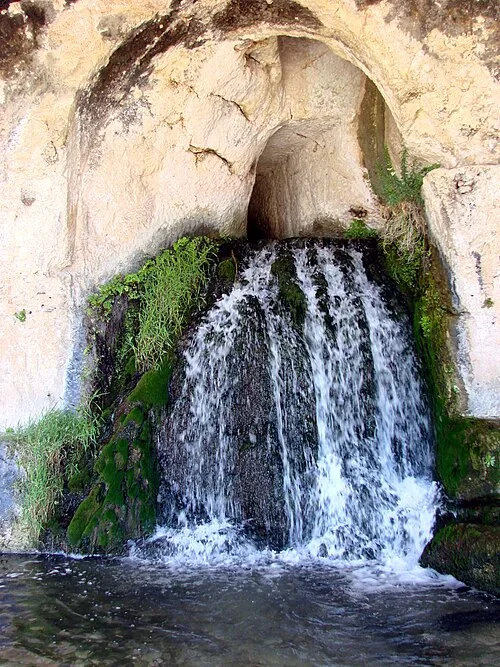 The Grotta del Ninfeo and Sacred Fountain
Water Falling from a Rock-Cut Arch
The ancient Greek aqueduct that served the theatre was known as the aqueduct of the nymphaeum, and it ended in a chamber cut into the rock above the seating. The cave was already there before the terrace was laid out. The builders framed it at the centre of the terrace's back wall with Doric carvings, of which only part of a frieze survives. Inside, the water ran into a tub lined with opus signinum, a waterproof mortar made with crushed pottery. From the tub it passed on into the theatre's own water system.
Listen in the appAllie_Caulfield · CC BY 2.0
08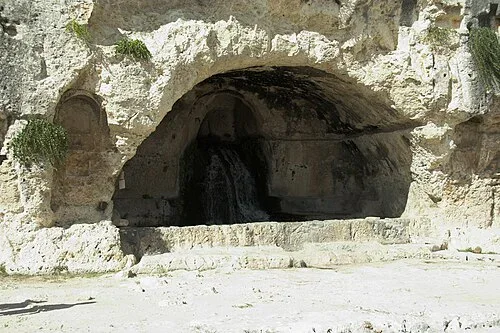 The Grotta del Ninfeo and Sacred Fountain
The Grotta del Ninfeo (Nymphaeum)
The arched opening leads into a chamber cut into the rock. A stepped ledge runs along its entrance, and niches are set into its walls. The chamber is about nine metres long, and its niches were probably meant for statues. The grotto and the terrace above the theatre might together have been the Mouseion. That was a sanctuary of the Muses, and perhaps the base of the company of actors. According to an anonymous ancient biography of Euripides, Dionysius, the tyrant of Syracuse, dedicated objects that had belonged to the poet here, as offerings. He had bought them in Greece at great cost.
Listen in the appPhoto: Zde · CC BY-SA 4.0
09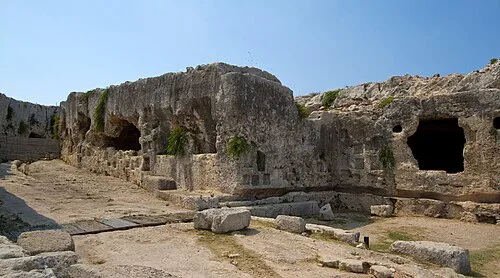 The Street of the Tombs
Early Travellers at the Theatre
The sunken road here, cut into the rock, is the Via dei Sepolcri, or Street of the Tombs. It leads up to the terrace above the theatre, which was also carved from the rock and once had a large portico along one side. Many travellers came to see this theatre while it lay abandoned. In 1625 the traveller Pietro Della Valle described it as a great theatre, not built of masonry but cut out of the hard stone, all in one piece and very large. In the eighteenth century the traveller Joseph Hermann von Riedesel spent two whole days examining it. The stage was already destroyed, yet he wrote that the grandeur of a building carved from the living mountain inspired respect and admiration. In 1788 the French traveller Vivant Denon, in his book Voyage en Sicile, wrote that despite its abandonment it remained one of the finest places in the world.
Listen in the apptrolvag · CC BY-SA 3.0
10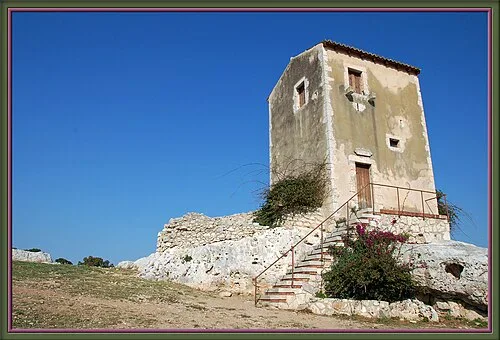 The Miller's Tower and Panoramic Overlook
The Casetta dei Mugnai (Millers' Cottage)
Beginning in 1526, Spanish forces under Charles the Fifth gradually stripped the theatre of its stone. They used the cut blocks to build new fortifications around Ortygia, the island part of Syracuse. This removal destroyed the scene building and the upper seats. After the second half of the sixteenth century, Pietro Gaetani, marquis of Sortino, brought the old aqueduct back into use. He paid for the work himself. The aqueduct carried water to the top of the theatre. That water allowed several mills to be set up on the seating. Of these mills, one building is still visible: the Casetta dei Mugnai, or Millers' Cottage, at the top of the seating.
Listen in the appDavid Evers · CC BY 2.0
Teatro greco di Siracusa
Frequently asked questions
How much does the guide cost?
Free app download. Listed guide price: $0.99. Guide price shown in the app. Audio guide only. Venue admission is separate.
Can I listen without internet?
Yes. Download the guide’s audio, images, and maps in the app before your visit. Your downloaded content is then available offline.
Can I listen in my language?
This audio guide is available in 15 languages, including English.
Do I need to follow a schedule?
No. This is a self-guided experience. Choose your stops, pause whenever you like, and return to a story at your own pace.
At your own pace
Explore Teatro greco di Siracusa.
Download Stanza, then search for “Teatro greco di Siracusa”.
Free app download · Guide price shown in the app
Keep exploring
Nearby audio guides
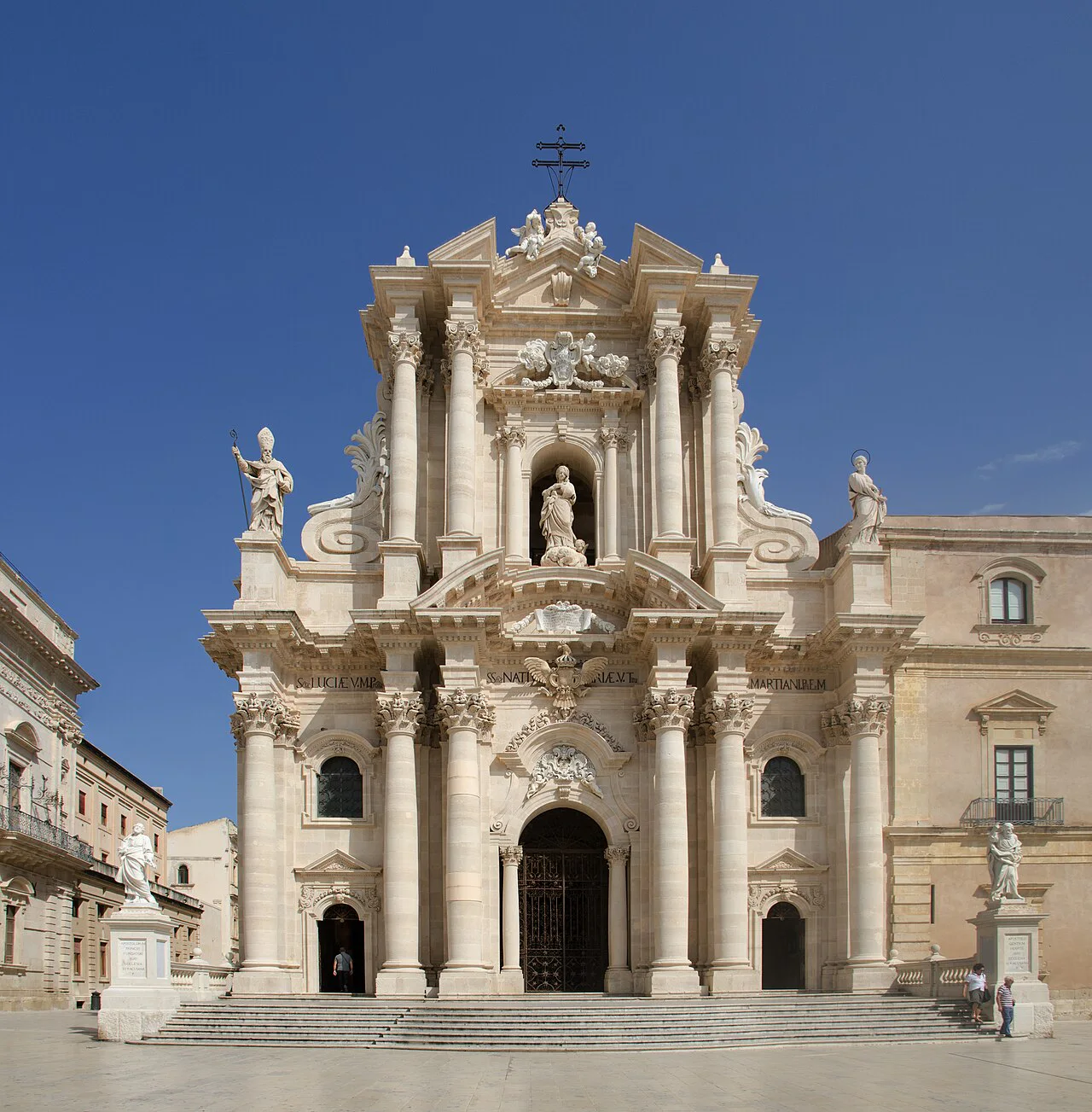
Syracuse · 2 km
Duomo di Siracusa
Content & sources
pjt56 --- · CC BY-SA 3.0
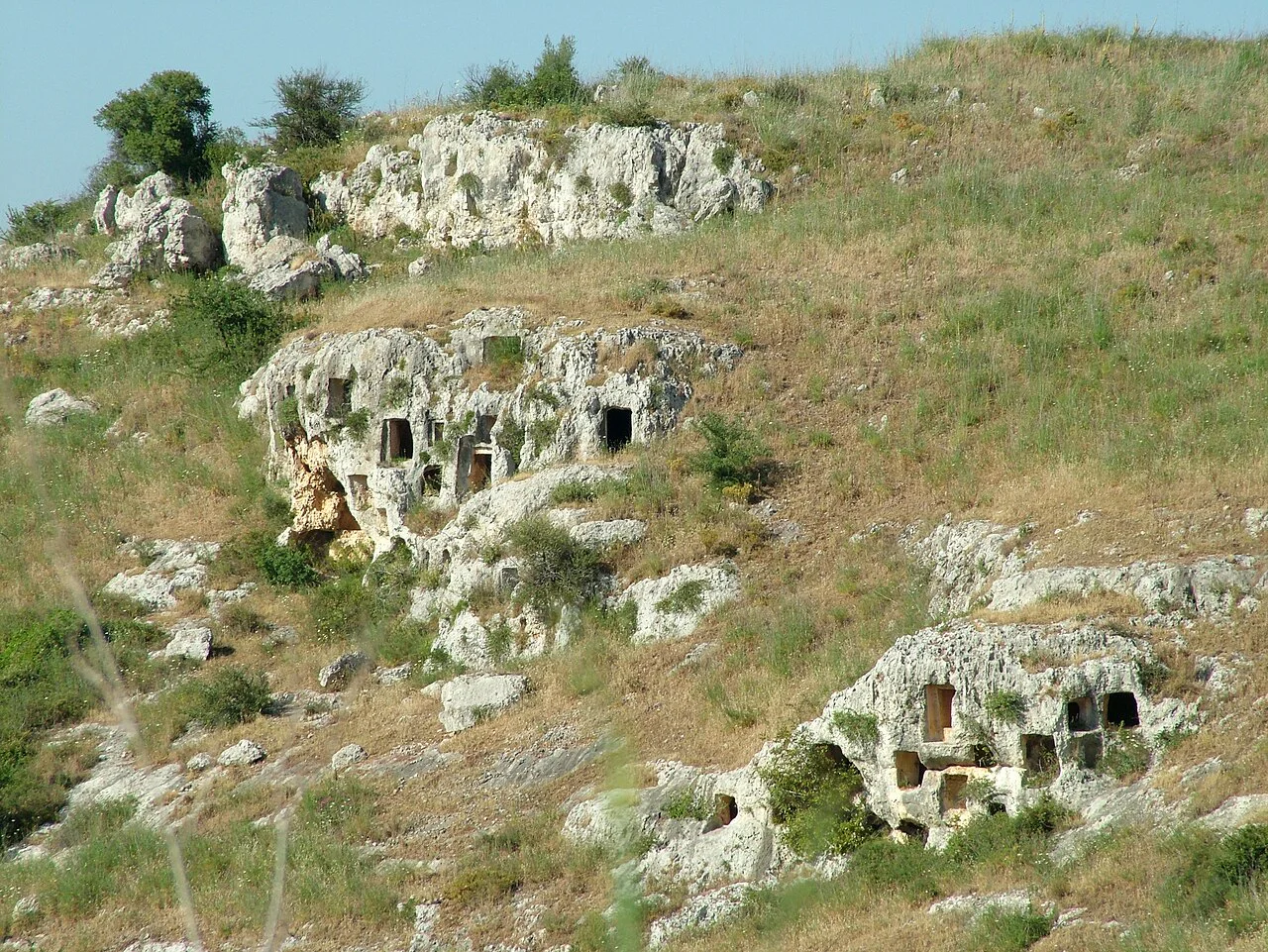
Sortino · 27 km
Pantalica
Content & sources
Photo: Clemensfranz · CC BY 2.5
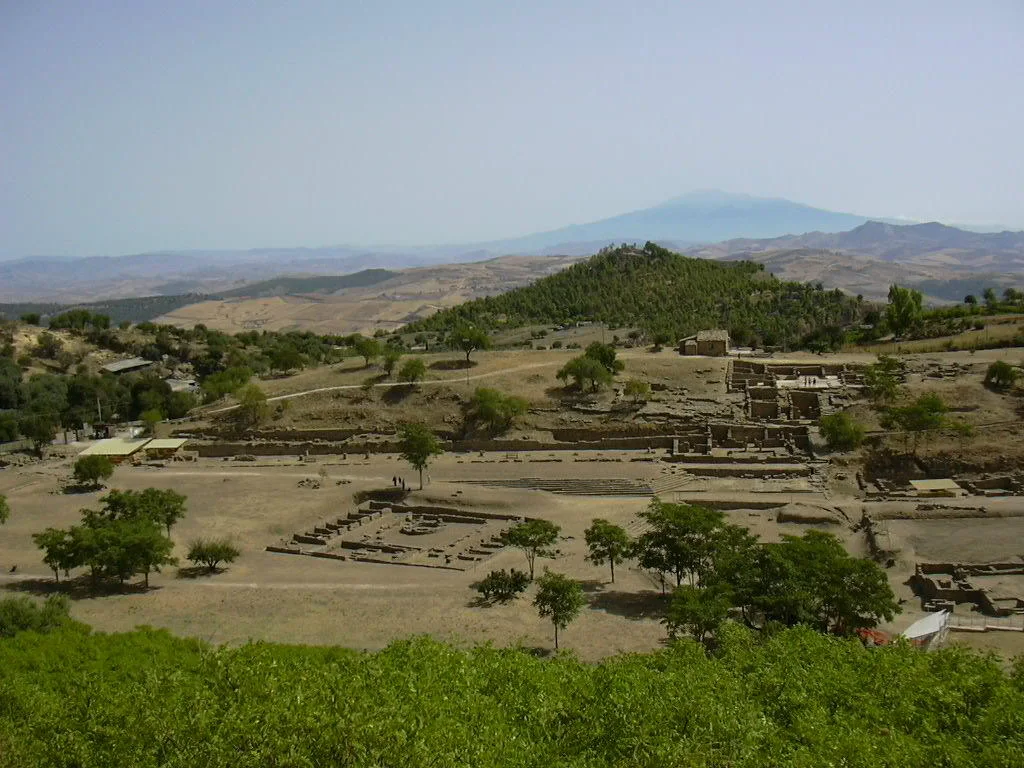
Aidone · 81 km
Morgantina
Content & sources
User:Morgantia07 · Public domain
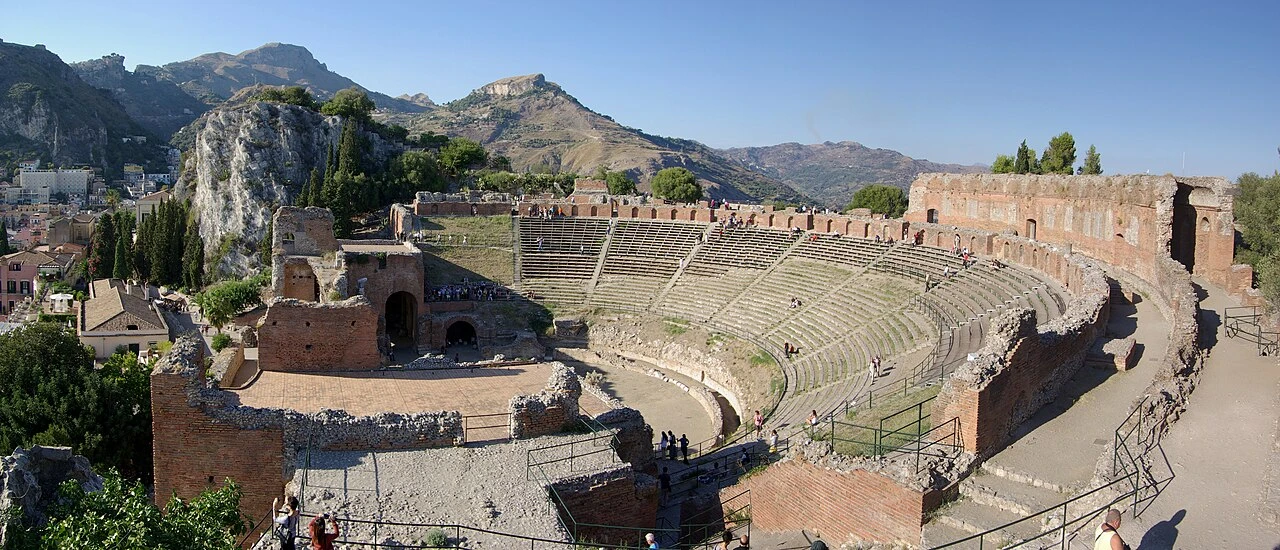
Taormina · 86 km
Ancient Theatre of Taormina
Content & sources
Photo: Berthold Werner · CC BY-SA 3.0