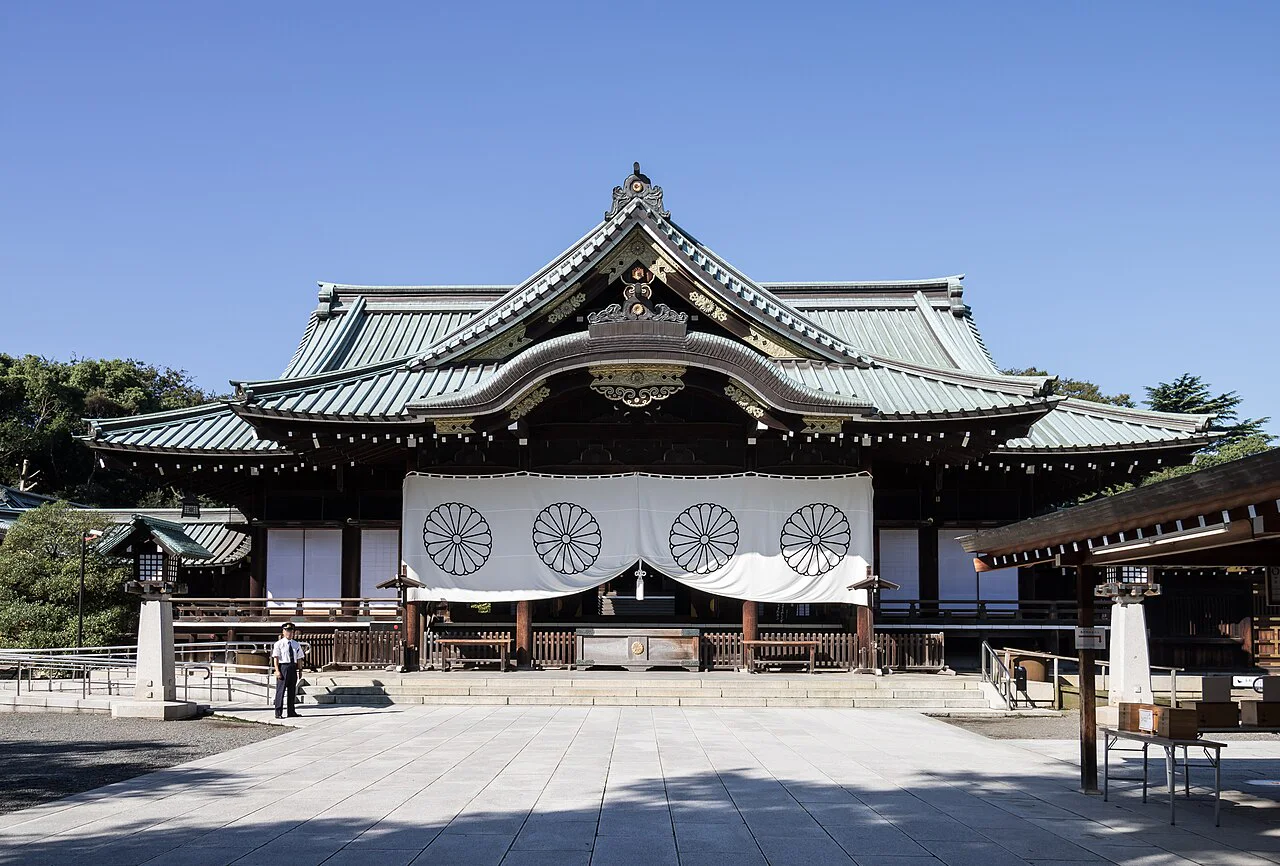
Stanza · Audio guide
靖国神社 Audio Guide
A place to remember. A story to take with you.
Yasukuni Shrine is a Shinto shrine located in Chiyoda, Tokyo. It was founded by Emperor Meiji in 1869 to commemorate those who died in service of Japan.
Download Stanza, then search for “靖国神社”.
About the tour
One guide. Your kind of visit.
Yasukuni Shrine is a Shinto shrine located in Chiyoda, Tokyo. It was founded by Emperor Meiji in 1869 to commemorate those who died in service of Japan.
Ready when you are.
- 01Get the free Stanza app.
iOS & Android
- 02Find your guide.
“靖国神社”
- 03Download before you go.
Works offline
Audio guide / 16 narrated stops
Inside the guide
Get to know a few of the stories before you go. Open a stop to read more.
01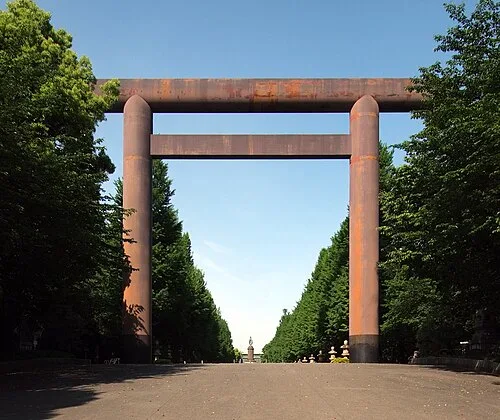 Daiichi Torii and the Founding Grounds
Daiichi Torii, the First Great Gate
Welcome to Yasukuni, a Shinto shrine in central Tokyo devoted to the war dead of Japan. Emperor Meiji founded it in 1869 to honor those who died in service of the nation, and its registers now hold more than two million names. The great steel gate here is the first of many thresholds. When it went up in 1921 it was the largest torii in the country, about twenty-five meters tall and thirty-four meters wide. Weather wore the original down until it was taken away in 1943. The gate standing now was raised in 1974. Beyond it a long, tree-lined causeway runs west toward the sanctuary.
Photo: Wiiii · CC BY-SA 3.0
02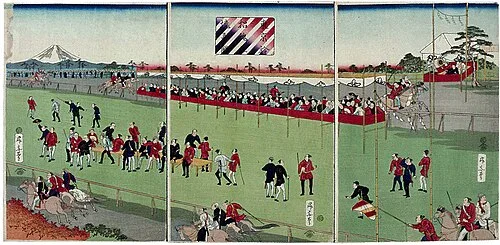 Daiichi Torii and the Founding Grounds
Shōkonsha Keiba, an 1870 Woodblock Print
Just after the Boshin War, the shrine was named Tokyo Shokonsha, the shrine to summon the souls. It became the head of a whole network of similar shrines across the country. This woodblock print dates to 1870, only the shrine's second year. The artist Shosai Ikkei recorded the first horse races ever run at the grounds, laid out along the edge of the shrine approach. The army entered its own military horses and opened the races to civilian riders as well. Crowds grew so thick that a later print showed spectators with hardly room to stand. Early winners received prizes such as pocket watches and wool cloth. A French circus even performed on the grounds in 1871.
Listen in the appShōsai Ikkei · Public domain
03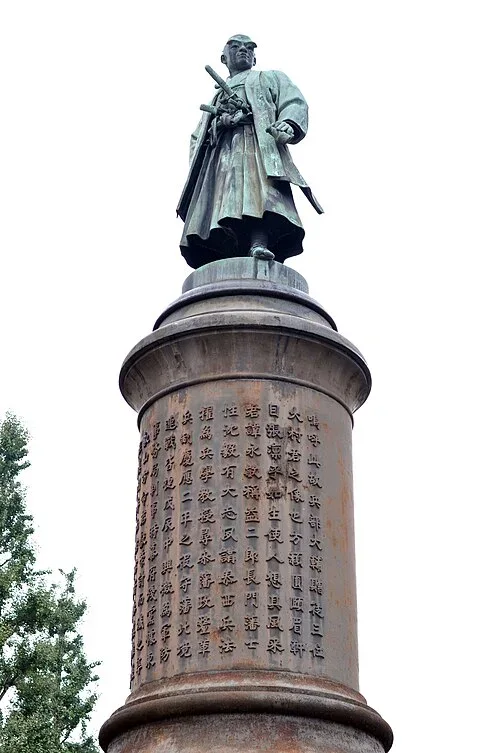 The Grand Causeway & Ōmura Masujirō Monument
Statue of Ōmura Masujirō
One figure along this causeway is not one of the rank and file. The bronze statue honors Omura Masujiro, remembered as the father of the modern Japanese army. Cast in 1893 by the sculptor Okuma Ujihiro, it was the first Western-style bronze statue in Japan. Omura built the new conscript army of the emperor, and he also championed the founding of this very shrine. The men whose souls are honored here served in the force he created. His figure stands in the robes of his own time, swords at his side, above a tall pedestal covered in long inscriptions.
Listen in the appŌkuma Ujihiro · Public domain
04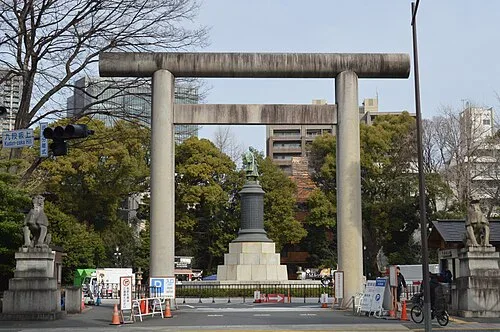 The Grand Causeway & Ōmura Masujirō Monument
Ishi Torii and the Yasukuni Swords
This stone torii at the south end of the causeway was dedicated in 1933. It ranks among the largest stone torii in Japan, and it marks a side entrance, the one that leads to the shrine's car parks, not the way to the sanctuary. Those were years when the military government sought central control over how the war dead were remembered, and Yasukuni took a more central role. Each enshrinement was announced in the government's official gazette, so that the dead could be treated as national heroes. The shrine grounds took on an unusual job in the same year as this gate. In July 1933 the Army Minister, Araki Sadao, founded the Japanese Sword Forging Association to supply swords for army officers, and its smiths worked inside the shrine precinct. In the twelve years until the war ended they made about eight thousand one hundred blades. Every smith took a working name beginning with the character Yasu, from Yasukuni, and the swords became known as Kudan swords, after the district.
Listen in the appPhoto: Asturio Cantabrio · CC BY-SA 4.0
05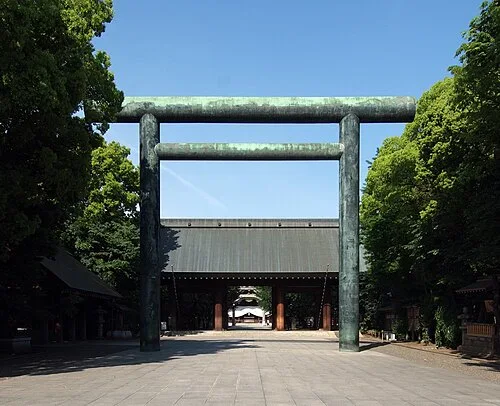 Daini Torii & Ritual Purification
Daini Torii, the Great Bronze Gate
The second great gate on the westward walk is cast entirely of bronze. It went up in 1887 to replace a wooden torii that had stood before it, and it remains the largest bronze torii in Japan. Its surfaces have weathered over the decades to a soft green. Each gate along this approach draws the visitor a step closer to the sanctuary, and the materials grow humbler as the way narrows, from steel to bronze and on toward wood. Through this one, the roof of the main hall already comes into view at the end of the path.
Listen in the appPhoto: Wiiii · CC BY-SA 3.0
06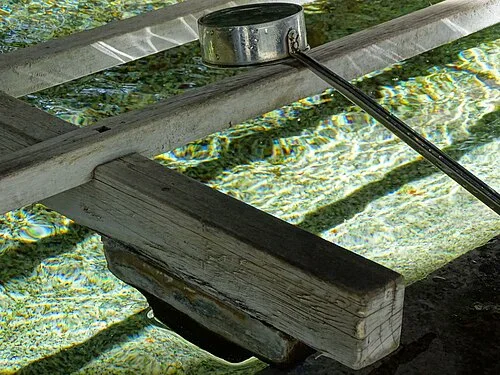 Daini Torii & Ritual Purification
Purification at the Water Font
Shinto worship begins with water. At a long trough like this one, visitors take up a wooden ladle, pour water over their hands, and rinse their mouths before approaching the gods. The shrine's main purification font was established in 1940. The gesture takes only a moment, but it marks the line between the everyday world and the sacred ground ahead. The calendar holds a grander version too, a Grand Purification Ceremony held each year on June the thirtieth.
Listen in the appAdam Jones from Kelowna, BC, Canada · CC BY-SA 2.0
07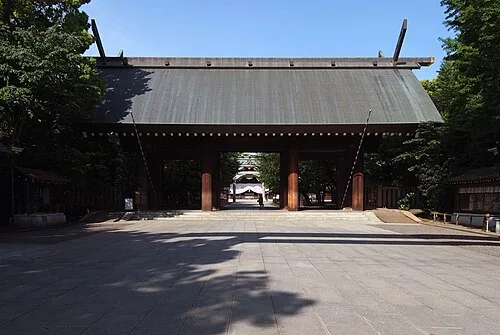 Shinmon Gate & Sacred Performance
Shinmon, the Imperial Gate
The last formal threshold before the sanctuary is the shinmon, the gate of the gods. It stands six meters tall, built of hinoki cypress, and was completed in 1934. Restoration work in 1994 renewed the timber. Gilded chrysanthemum emblems, each about a meter and a half across, adorn its two great doors. The gate has seen trouble as well. In December 2011 it was set on fire by an intruder. Through its opening, the courtyard of the inner shrine comes into view.
Listen in the appPhoto: Wiiii · CC BY-SA 3.0
08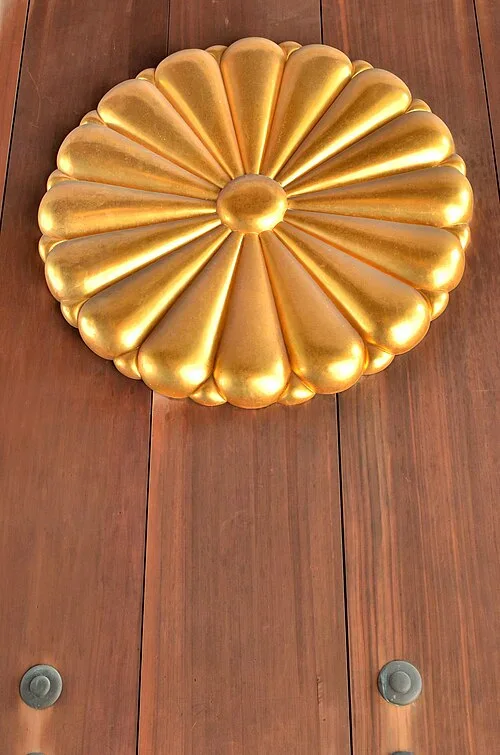 Shinmon Gate & Sacred Performance
The Imperial Chrysanthemum Crest
The sixteen-petal chrysanthemum on these doors is the seal of the imperial household, and the shrine's ties to the throne run deep. When it was founded in 1869, Emperor Meiji granted it an endowment of land, and in 1879 he gave it the name Yasukuni, taken from an ancient Chinese chronicle, the Zuo Zhuan, which says, "I use it to pacify the country." Imperial envoys were sent to its spring and autumn festivals, and again whenever new souls were enshrined, and on those days government officials were given a holiday. Emperor Meiji came in person more than once. On his second visit, in 1875, he gave one hundred yen, and in 1877, when the dead of the Satsuma Rebellion were enshrined, he gave a thousand. Emperor Shōwa paid a visit in 1934. The gate also keeps the shrine's daily hours. At six each morning the great drum in the hall of worship is struck twenty-one times and these doors are opened. At seven in the evening all the gates are closed.
Listen in the appDakiny · CC BY 2.0
09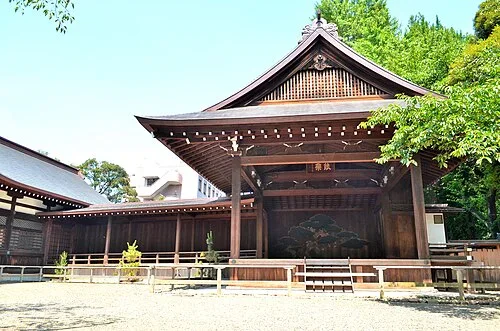 Shinmon Gate & Sacred Performance
The Nōgakudō, Shrine Stage of Sacred Performance
Beside the imperial gate stands a building unlike the others here: a complete Noh theater on shrine ground. It was first raised in 1881 in Shiba Park, across old Tokyo, and carried to Yasukuni in 1903. On its wooden stage, Noh drama and classical Japanese dance are performed for the divinities enshrined here. A performance at a shrine is not a show for an audience. It is an offering, like food or prayer, laid before the spirits. The shrine's taste for performance goes back a long way. Sumo was wrestled here at the very first festival in 1869, held to celebrate the shrine's founding. Exhibitions with professional wrestlers, grand champions among them, still take place at the Spring Festival almost every year, and the matches cost nothing to watch.
Listen in the appDakiny · CC BY 2.0
10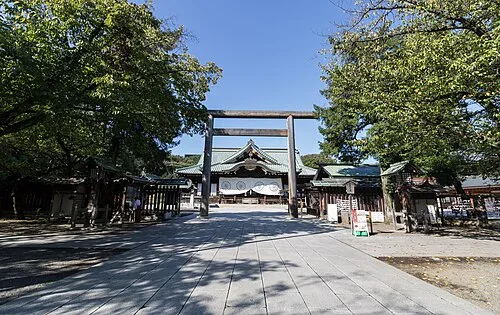 Haiden Forecourt & The Sacred Sanctuary
Chūmon Torii, the Last Gate
One last torii stands between this court and the hall of worship. It is the third and final gate of the westward walk. And it is young, as shrine timber goes. The Chūmon Torii was rebuilt in 2006 with cypress felled in Saitama Prefecture, north of Tokyo. Fresh wood, newly carved, in the twenty-first century. A shrine like this is not a monument left to its own devices. It is a living place of worship, and its timber is still being felled, shaped and joined for it.
Listen in the appPhoto: Kakidai · CC BY-SA 4.0
- 11
The Haiden, Hall of Worship
The main prayer hall of 1901, and the modern controversy over enshrined war criminals that this forecourt carries.
- 12
Toward the Inner Sanctuary
No graves, no ashes: how Yasukuni keeps its dead as names in handmade paper registers behind the main hall.
- 13
Chinreisha, the Spirit-Pacifying Shrine
The secluded 1965 shrine for war dead left out of the main sanctuary and for those of every other nation, beside the small Kyoto shrine that preceded Yasukuni itself.
- 14
Shinchi Teien, the Sacred Pond Garden
A Meiji-era stroll garden with a sacred pond and three teahouses, where the cherry blossoms carry a wartime farewell.
- 15
Yūshūkan, the War Memorial Museum
Japan's oldest war museum, founded in 1882, and the argument about history its exhibits still provoke.
- 16
C56 Locomotive, Closing Reflection
A steam locomotive from the Death Railway, and a closing thought on what it means to remember the dead.
靖国神社
Frequently asked questions
How much does the guide cost?
Free app download. Listed guide price: $1.99. Guide price shown in the app. Audio guide only. Venue admission is separate.
Can I listen without internet?
Yes. Download the guide’s audio, images, and maps in the app before your visit. Your downloaded content is then available offline.
Can I listen in my language?
This audio guide is available in 15 languages, including English.
Do I need to follow a schedule?
No. This is a self-guided experience. Choose your stops, pause whenever you like, and return to a story at your own pace.
At your own pace
Explore 靖国神社.
Download Stanza, then search for “靖国神社”.
Free app download · Guide price shown in the app
Keep exploring
Nearby audio guides
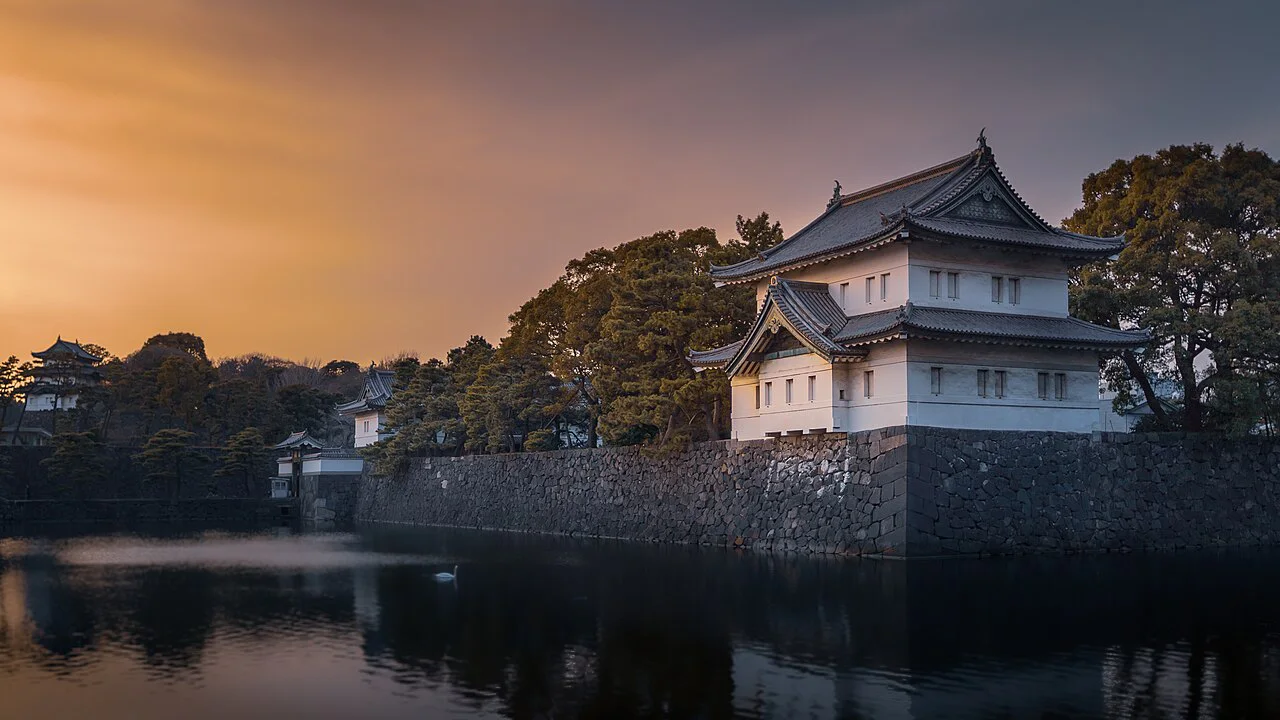
Tokyo · 2 km
皇居
Content & sources
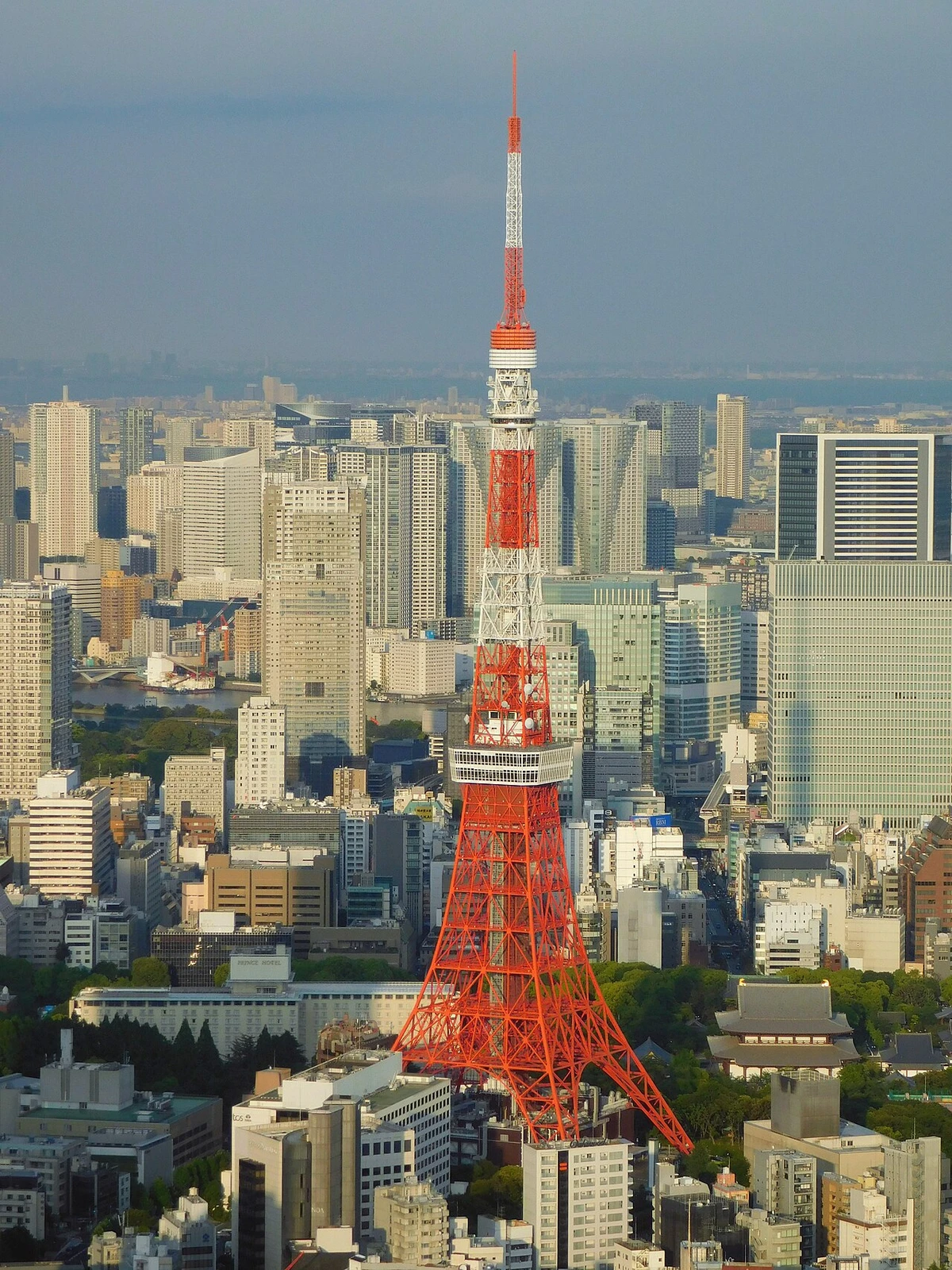
Minato · 4 km
Tokyo Tower
Content & sources
Photo: Akonnchiroll · CC BY-SA 4.0
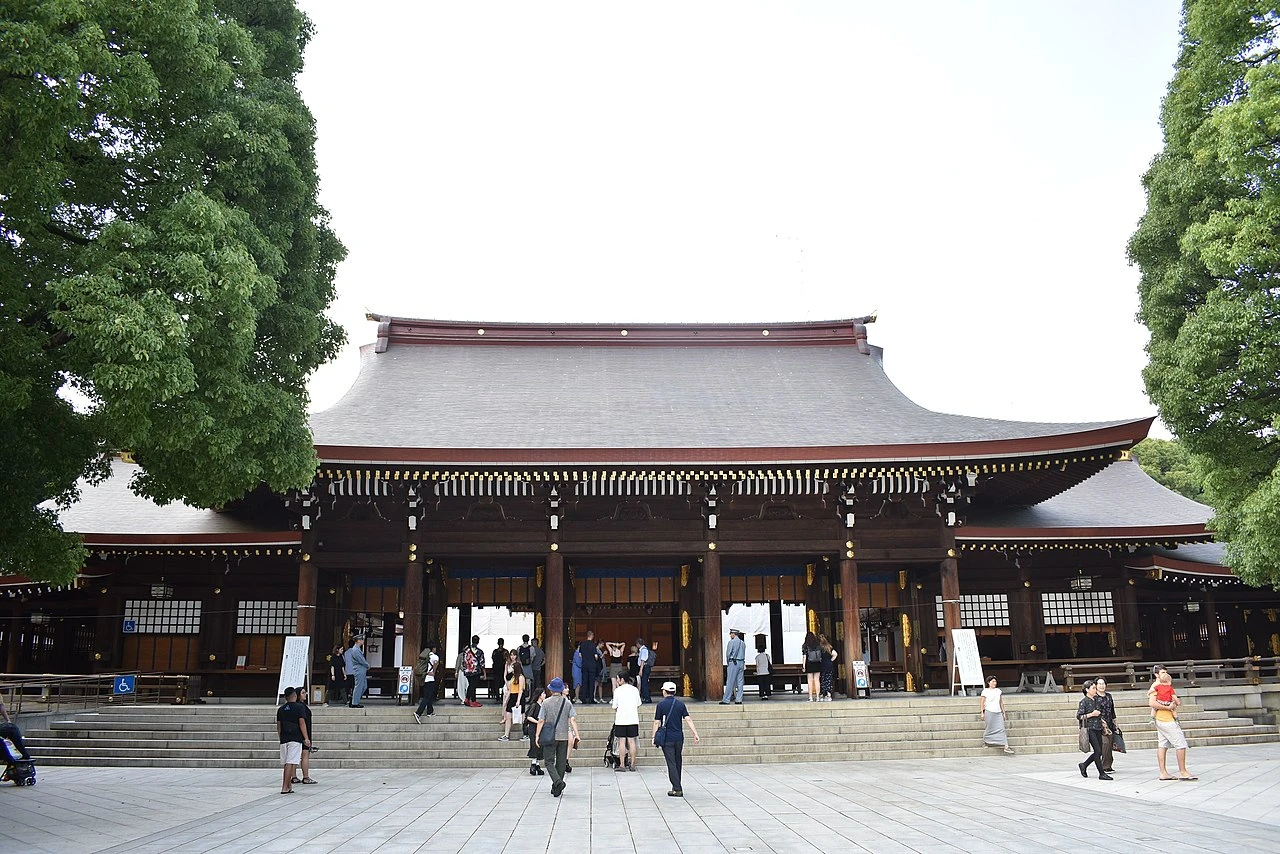
Shibuya · 4 km
Meiji Shrine
Content & sources
Tokuzo in Edomura · CC BY-SA 4.0
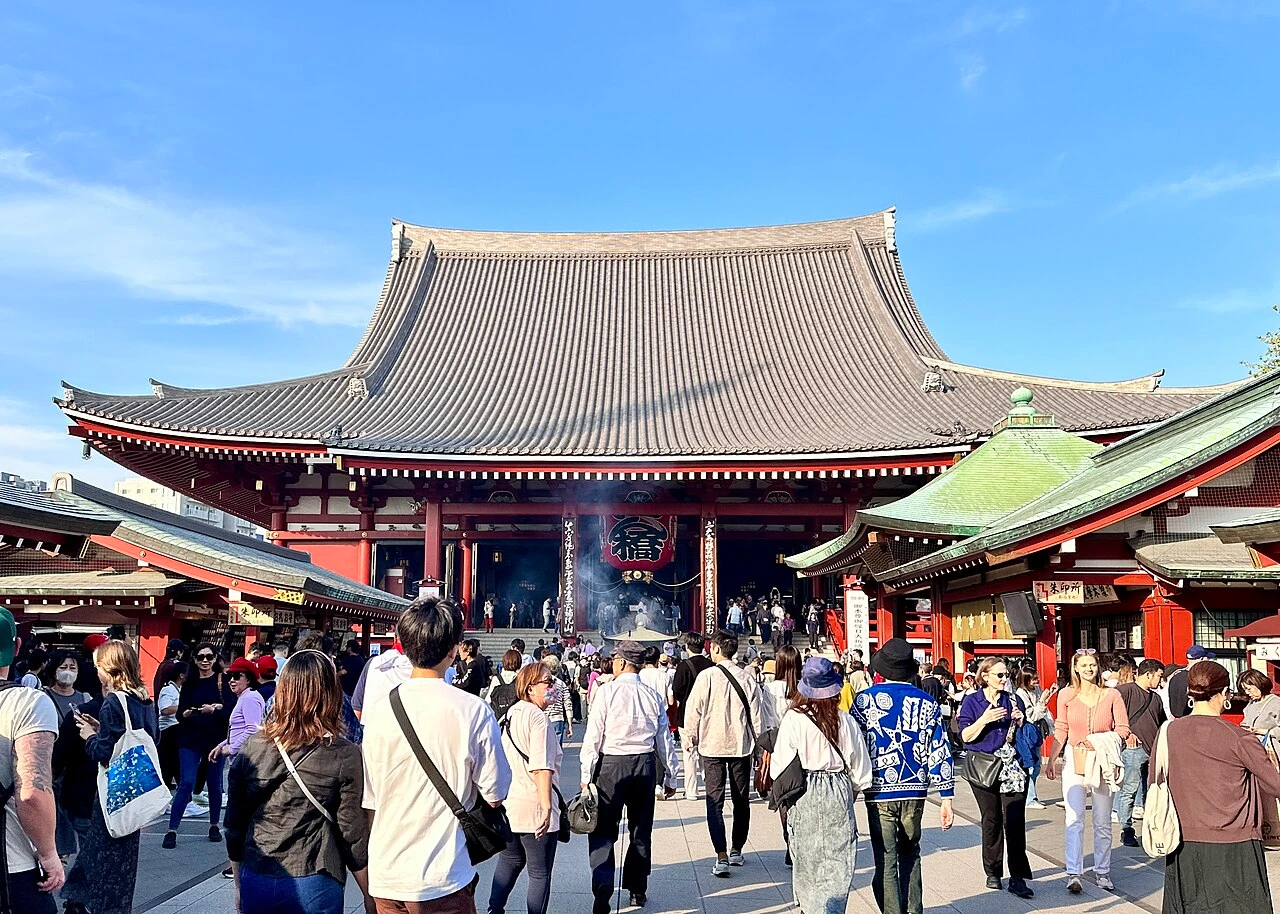
Taito · 5 km
Sensō-ji Temple
Content & sources
Photo: Akonnchiroll · CC0