Languages
15浅草寺 Audio Guide
浅草寺 is an archaeological site in Taito, Japan. Explore it with Stanza's guided offline audio tour — narrated in 15 languages.
Quick Facts
34
Stops
15
Languages
100%
Offline
📍 Taito, Japan · 35.7146°N, 139.7966°E
About 浅草寺
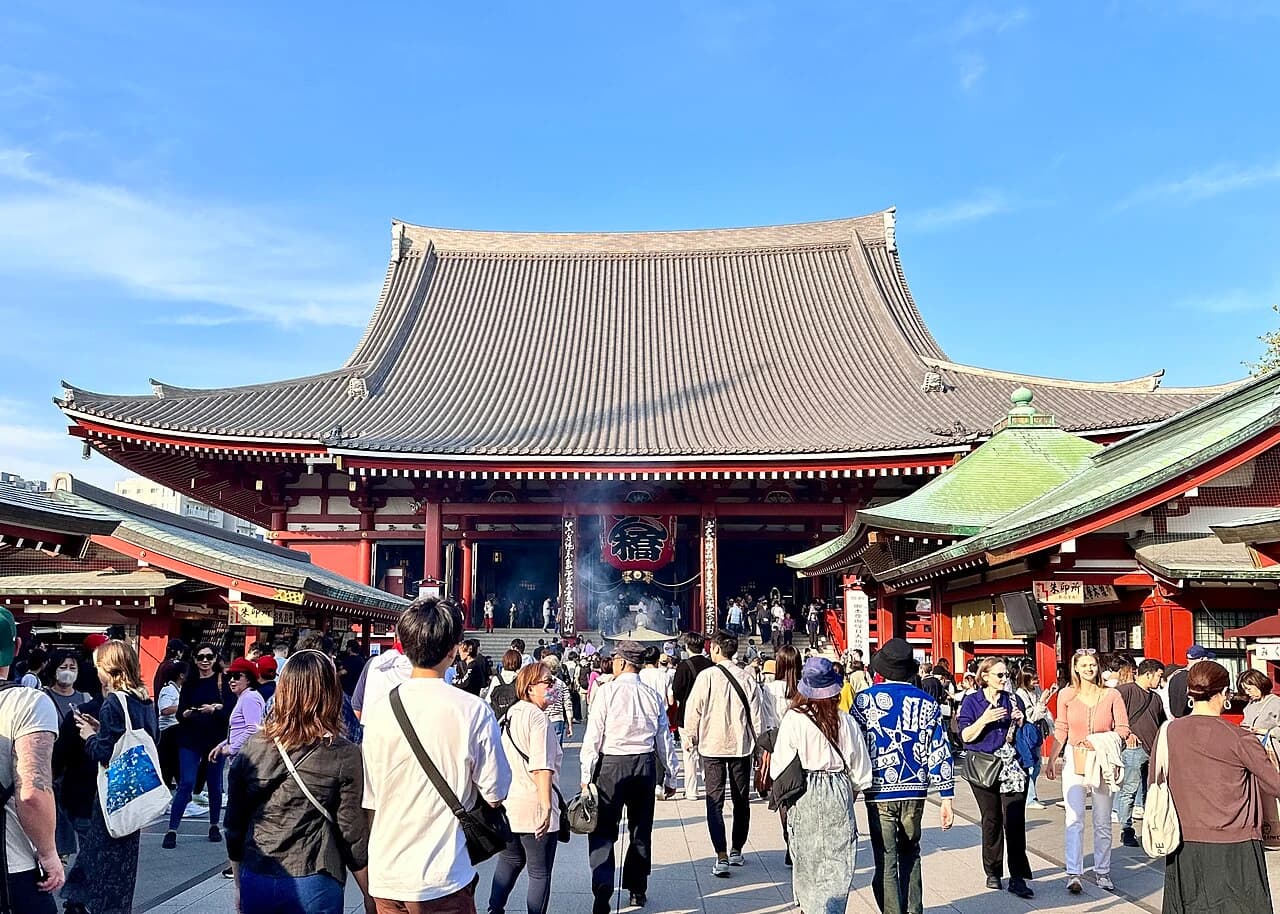
Sensō-ji Temple is an ancient Buddhist temple located in Asakusa, Tokyo, Japan. It is Tokyo's oldest temple, famous for its iconic Kaminarimon gate, Nakamise-dori shopping street, and vibrant cultural atmosphere.
This self-guided audio tour features 34 narrated stops organized across 8 sections. As a temple, 浅草寺 offers a unique cultural experience in the heart of Taito, Japan.
The Stanza audio guide is available in 15 languages and works entirely offline — download the complete tour including audio narration, maps, and images before your visit. As you walk through 浅草寺, GPS-triggered narration plays automatically at each point of interest.
Last updated:
What you will hear
Komagata Hall
The spiritual starting point of Sensō-ji, marking the spot where two fishermen pulled the golden Kannon statue from the Sumida River in 628 AD.
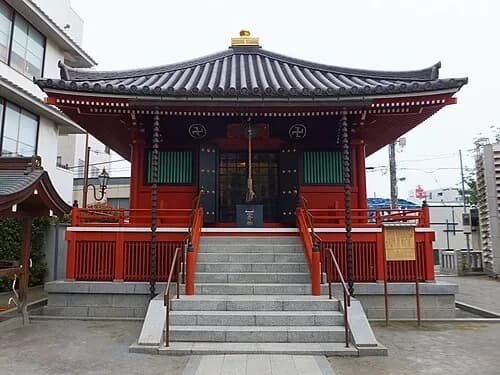
Komagata Hall
This small red hall commemorates the legendary founding of Sensō-ji. In the year 628, two local fisherman brothers, Hamanari and Takenari, were working on the nearby Sumida River. They cast their nets and pulled up a tiny golden statue of Kannon, the Goddess of Mercy. Unsure of what it was, they threw it back several times, but the statue miraculously returned to their net with every cast. Eventually, they realized its divinity and brought it ashore. This hall serves as the symbolic 'docking' point for the deity before she was eventually enshrined in the main temple complex. Unlike many other structures here, this hall specifically celebrates Kannon as a goddess of the water, reflecting her origin story in the river. Notice the simple architecture compared to the grander halls further in; it acts as a quiet gateway to the massive complex that grew from this singular, humble event. It remains a key site for those wishing to pay respects to the earliest roots of Asakusa’s spiritual life.
Kaminarimon (Thunder Gate)
Tokyo's most iconic landmark, featuring a 700kg red lantern and statues of Fūjin (Wind God) and Raijin (Thunder God).
The Panasonic Lantern Base
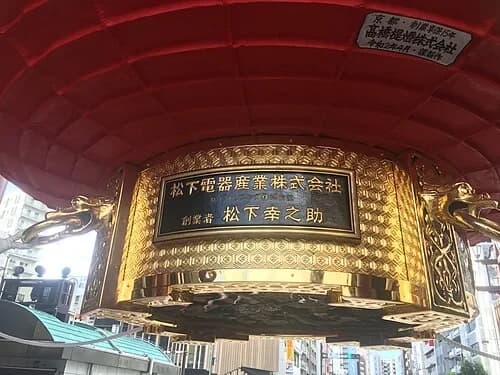
If you look at the lower rim of the giant lantern, you will see a name inscribed in the metal: Matsushita Konosuke. He was the visionary founder of the company now known as Panasonic. During the 1950s, Matsushita suffered from a chronic leg ailment that doctors struggled to treat. Seeking spiritual help, he prayed fervently at Sensō-ji for his recovery. When his health finally improved, he attributed his healing to the Goddess Kannon and fulfilled a vow to rebuild the Kaminarimon gate, which had been missing since the 19th century. His donation in 1960 restored this landmark to the city of Tokyo. This is why his name and the corporate title are still prominently displayed on this sacred object today. The lantern's paper body is traditionally replaced every ten years, but the durable metal base remains as a permanent reminder of this personal connection between the temple and a modern industrial titan.
Nakamise Shopping Street
One of Japan's oldest shopping streets, preserving the Edo-period tradition of temple-town commerce with 89 shops selling traditional snacks and souvenirs.
Nakamise Shopping Street
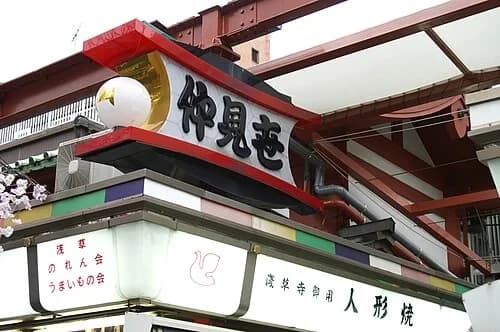
Stretching from the Thunder Gate to the inner temple grounds, Nakamise is one of the oldest shopping streets in Japan, with roots going back to the late 17th century. Historically, local residents who helped clean and maintain the temple were granted special permission to set up stalls here to serve visiting pilgrims. This created a 'monzen-machi,' a traditional town developed in front of a temple where commerce and spirituality coexist. Today, the street retains its Edo-period atmosphere with rows of shops selling everything from folding fans to traditional footwear. Look for stalls where snacks are prepared fresh before your eyes. Two local favorites are 'Ningyo-yaki,' small sponge cakes filled with sweet bean paste and shaped like temple bells or dolls, and 'Senbei,' which are savory toasted rice crackers. The presence of these shops ensures that the daily life and economic support of the community remain intertwined with the sacred functions of the temple nearby.
Hōzōmon (Treasure-House Gate)
This massive two-story gate houses the temple's treasures and features two fierce Niō guardian statues to ward off evil.
A-gyo Guardian
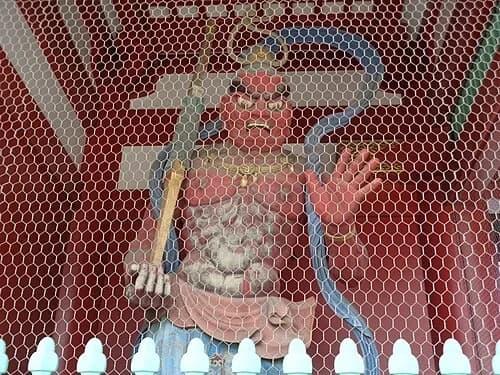
This is the A-gyo Niō, one of the two fierce guardians protecting the Treasure-House Gate. Take a moment to look at the incredible detail in the sculpture: the bulging veins in the arms, the tensed abdominal muscles, and the menacing, wide-eyed stare. This figure is essentially a spiritual bouncer. His mouth is open in the 'A' shape, which is the first letter of the Sanskrit alphabet, symbolizing the birth of the universe and the beginning of all things. You might notice small bits of paper stuck to the figure. Traditional pilgrims sometimes pelt the statue with chewed-up paper; if it sticks, it is believed that their specific prayer will be answered. The guardian’s aggressive stance and powerful form are intended to intimidate anyone who approaches the temple with a dishonest or malevolent heart, ensuring that only the sincere and respectful can pass into the presence of the Goddess Kannon.
Treasure-House Gate
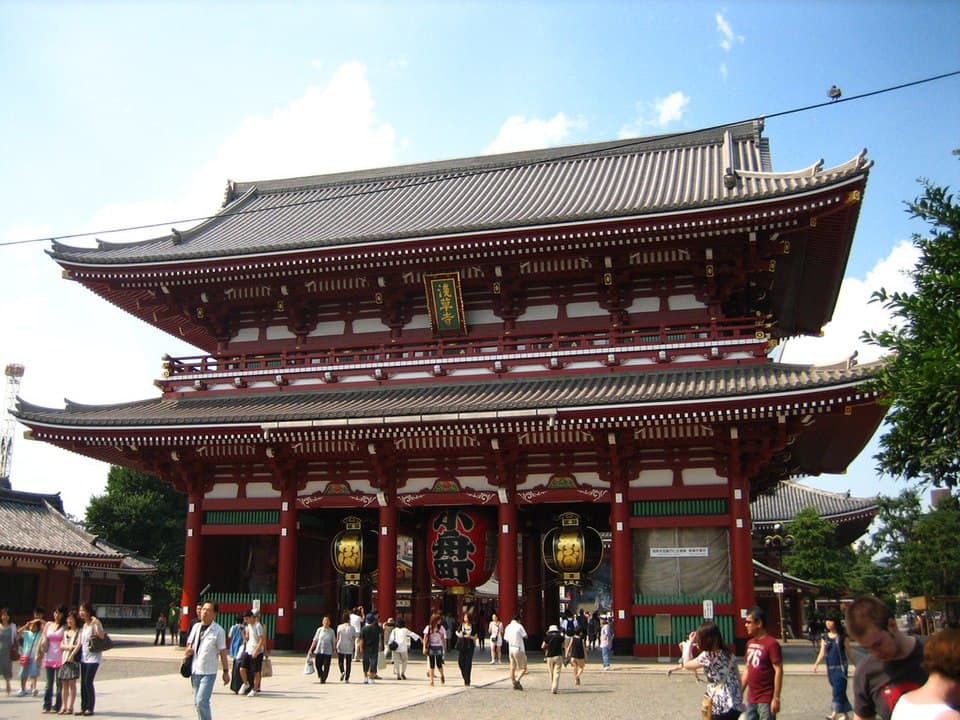
The Hōzōmon, or Treasure-House Gate, marks the inner entrance to the most sacred part of the temple complex. This massive two-story structure is not just a gateway; the upper floor contains a climate-controlled storage facility. Inside are thousands of 14th-century Buddhist sutras, or scriptures, which are designated as national treasures of Japan. The gate serves as a spiritual filter for those approaching the Main Hall. Notice the two large niches housing Niō guardian statues. These figures are symbolic of the beginning and end of all things. One is depicted with his mouth open, making the 'A' sound, while the other has his mouth closed, forming the 'Un' sound. Together, they represent the entirety of the universe and are believed to ward off any evil spirits or dishonest intentions. By passing through this gate, visitors are meant to leave worldly distractions behind and prepare their hearts for prayer at the altar ahead.
O-Waraji (Giant Straw Sandals)
Hanging on the back of the Hōzōmon, these 4.5-meter sandals represent the power of the Niō guardians, suggesting that an entity large enough to wear them protects the temple.
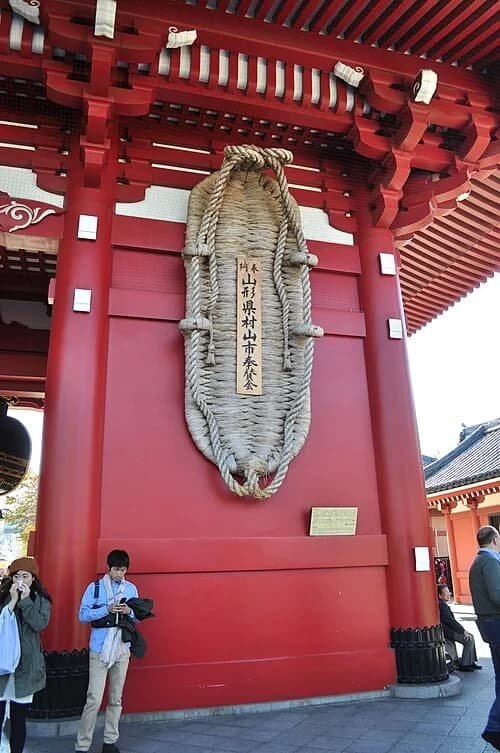
The Giant Straw Sandals of Senso-ji
Hanging on the back side of the Hōzōmon gate are two enormous straw sandals known as 'O-Waraji.' They are 4.5 meters long and weigh approximately 2,500 kilograms. While they are impressive as artifacts, their purpose is rooted in a clever psychological deterrent against evil spirits. According to local lore, if a wandering demon or mischievous spirit sees these gigantic shoes, they will assume that the Niō guardian who wears them must be of truly terrifying proportions. Fearing a confrontation with such a massive protector, the evil spirits are scared into fleeing the temple grounds. These sandals are not permanent; a new pair is hand-woven and donated every ten years by the people of Murayama City in Yamagata Prefecture. The process is a major community event and serves as a traditional offering to the temple. The sheer scale of the weaving highlights the dedication required to maintain the symbolic defenses of this sacred space.
Five-Storied Pagoda
Standing 53 meters tall, this pagoda contains sacred ashes of the Buddha and features a modern titanium roof that mimics traditional clay tiles.
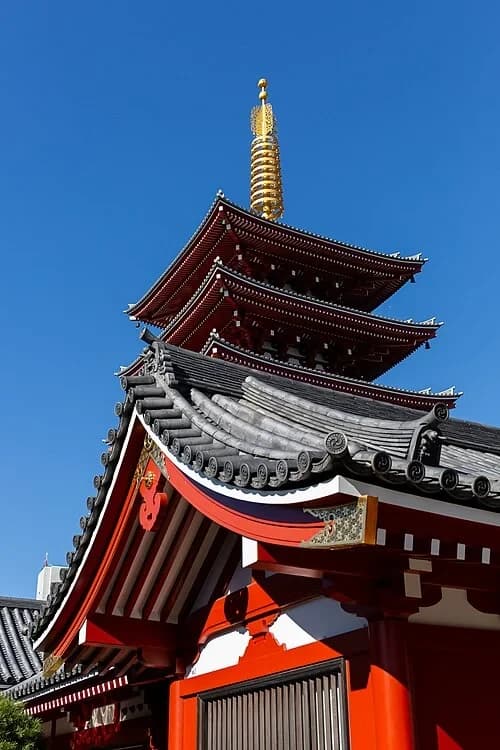
Five-Storied Pagoda
The Gojū-no-tō, or Five-Storied Pagoda, is one of the most recognizable landmarks in Asakusa. Unlike many buildings, you cannot enter a pagoda; it is designed as a vertical reliquary to hold sacred objects. At the very top level, it enshrines the ashes of the historical Buddha, which were gifted to Sensō-ji by a temple in Sri Lanka. The structure is a marvel of both ancient symbolism and modern engineering. Each of the five roofs represents a fundamental element in Buddhist philosophy: earth, water, fire, wind, and sky. While the pagoda looks like a traditional wooden structure, its current form, rebuilt in 1973, incorporates advanced technology. The roof tiles are actually made of titanium rather than heavy clay. This choice makes the entire building significantly lighter and more flexible, allowing it to withstand the frequent earthquakes that occur in the region. The golden spire at the top, the sōrin, reaches into the sky, marking the highest spiritual point of the temple grounds.
Dragon King Purification Fountain
Before entering the Main Hall, visitors wash their hands at this fountain featuring a bronze statue of Sāgara Ryūō, the Dragon King of the sea.
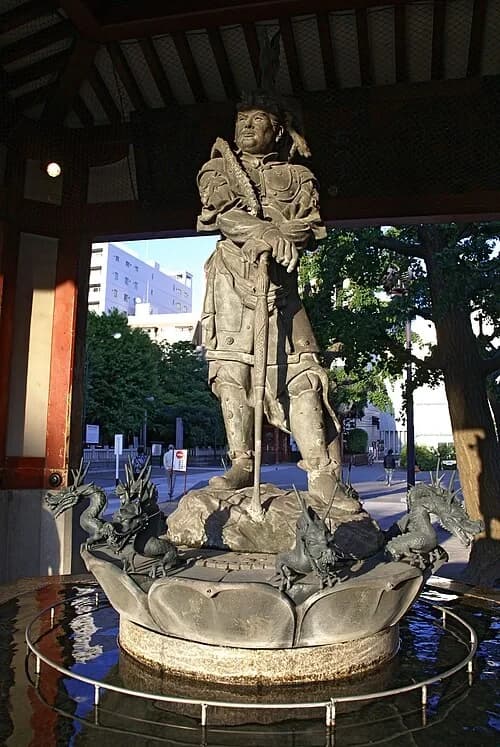
Statue of Sagara Dragon King
At the center of the purification fountain stands the bronze statue of Sāgara Ryūō, the Dragon King of the Sea. In Buddhist tradition, dragons are revered as masters of water and fierce protectors of the dharma, or faith. This specific figure was cast in 1703 and has remarkably survived the various fires and wars that destroyed many other parts of the temple complex over the centuries. Before entering the Main Hall, it is customary for visitors to perform 'temizu,' a ritual of washing the hands and mouth to purify both body and spirit. Notice the water flowing from the dragon heads surrounding the central figure, which serve as spouts for the basin. By engaging with the water guarded by the Dragon King, pilgrims acknowledge the need for cleanliness and respect before approaching the sacred image of Kannon. The statue’s enduring presence at the fountain reminds us of the long-standing tradition of water as a spiritual threshold in Japanese culture.
Sensō-ji Main Hall (Hondo)
The spiritual heart of Asakusa, rebuilt in 1958 with a titanium roof. It enshrines the hidden golden Kannon statue discovered nearly 1,400 years ago.
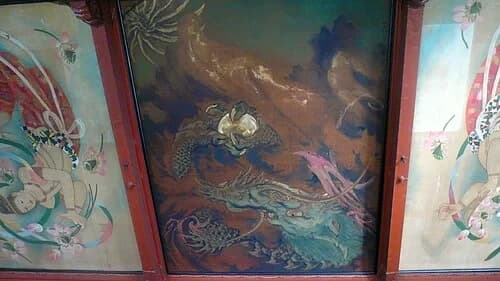
Dragon of the Clouds Ceiling Painting
High above the heads of the crowds in the Main Hall is a grand ceiling painting titled 'Dragon of the Clouds.' Created by the renowned Japanese artist Kawabata Ryushi, it was commissioned as part of the temple's post-war reconstruction. The dragon is depicted with incredible dynamism, its claws grasping a Nyoi-hōju, a sacred, wish-fulfilling jewel that symbolizes the granting of wisdom and the light of Buddhist teachings. Gold leaf highlights the dragon's scales and eyes, making it appear to glow in the dim light of the hall. This creature is not just decorative; it represents the protective power of Kannon and her ability to bring life-sustaining rain. The scale of the artwork was intended to match the massive proportions of the new hall, symbolizing the resilience and rebirth of Asakusa after the devastation of the war. Its fierce expression serves as a reminder of the strength required to protect spiritual truths in a changing world. Looking up at it offers a moment of awe before you return to the rituals at the altar.
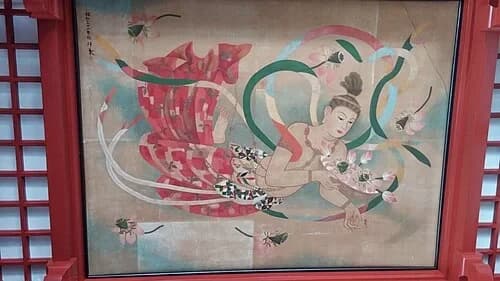
Celestial Maidens Ceiling Painting
Look up at the vibrant artwork overhead to see the Tennin, or celestial maidens, drifting through a golden sky. Painted by the artist Domoto Insho, these figures provide a delicate contrast to the fierce dragon seen elsewhere on the ceiling. They embody the elegance of the higher realms, depicted with flowing colorful robes and serene expressions as they drift among floating lotus blossoms. In Buddhist tradition, these divine beings are said to celebrate the presence of the Buddha by playing celestial music and scattering flowers through the air. The artist utilized vivid pigments and extensive gold leaf to create a sense of ethereal light, transforming the high ceiling into a symbolic gateway to another dimension. This immersive scene was intended to lift the spirits of worshippers, surrounding them with a vision of heavenly harmony that transcends the everyday world. As you stand beneath them, observe the sense of weightless movement captured in the brushwork, suggesting a permanent state of divine joy within the sacred space of the Main Hall.
Want to hear the rest?
Download the Stanza app to unlock all 34 stops and the complete guided audio tour.
Frequently Asked Questions
How long does the 浅草寺 audio tour take?
The 浅草寺 audio guide includes 34 narrated stops. Most visitors spend 45 minutes to 1.5 hours exploring the complete tour, though you can listen at your own pace and skip or revisit any stop.
Is the 浅草寺 audio guide available in my language?
Stanza supports 15 languages: English, Spanish, French, German, Italian, Portuguese, Russian, Japanese, Chinese, Korean, Arabic, Hindi, Polish, Dutch, Hebrew. Check the guide in the app to confirm the languages currently available for this tour.
Can I use the audio guide offline at 浅草寺?
Yes! Download the complete 浅草寺 tour — including all audio, maps, and images — before your visit. The Stanza app works completely offline, so you don't need WiFi or mobile data at the venue.
How much does the 浅草寺 audio guide cost?
The Stanza app is free to download. The current listed price for the 浅草寺 audio guide is $3.99; app-store region and currency may affect the final price.
How do I use the Stanza audio guide at 浅草寺?
Download the free Stanza app, search for "浅草寺", and download the tour. When you arrive at the venue, the app uses GPS to detect your location and automatically plays the relevant narration as you move between points of interest — completely hands-free.
What makes the Stanza audio guide different from other 浅草寺 tours?
Stanza offers GPS-triggered narration that plays automatically as you walk through 浅草寺 — no need to manually select stops. The tour is available in 15 languages, works fully offline, and includes 34 expertly narrated stops with images and historical context.
What other audio guides are available near 浅草寺?
Stanza offers multiple audio guides in Taito, Japan and nearby areas. After downloading the app, browse the map to discover all available tours near 浅草寺. Each guide can be downloaded for offline use.