 Stanza / Audio guide
Content & sources
Stanza · Audio guide
Fort Jesus Audio Guide
A place to remember. A story to take with you.
Fort Jesus is a fort located on Mombasa Island that was built between 1593 and 1596 to guard the Old Port of Mombasa. It is the only fort maintained by the Portuguese on the Swahili coast and represents an…
Download Stanza, then search for “Fort Jesus”.
About the tour
One guide. Your kind of visit.
Fort Jesus is a fort located on Mombasa Island that was built between 1593 and 1596 to guard the Old Port of Mombasa. It is the only fort maintained by the Portuguese on the Swahili coast and represents an early attempt by a Western power to influence Indian Ocean trade.
Ready when you are.
- 01Get the free Stanza app.
iOS & Android
- 02Find your guide.
“Fort Jesus”
- 03Download before you go.
Works offline
Audio guide / 12 narrated stops
Inside the guide
Get to know a few of the stories before you go. Open a stop to read more.
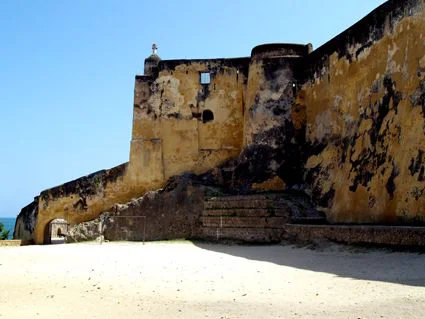
01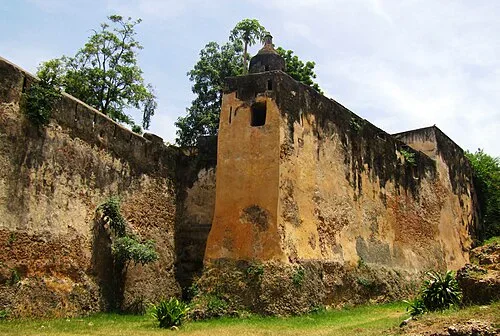 Outer Bastions and the Main Gate
The Outer Coral-Rag Ramparts
Welcome to Fort Jesus, on Mombasa Island, where the story of the whole Swahili coast is written in stone. This fortress went up between 1593 and 1596, on the orders of King Felipe the Second of Spain, who also ruled Portugal as Filipe the First. Its job was to guard the Old Port of Mombasa and the trade moving across the Indian Ocean. It is recognised as the first European-style fort outside Europe built to withstand cannon fire. The masonry, the building materials and the labour are believed to have come from the local Swahili people: Renaissance design, local hands. The ramparts stand about eighteen metres high today. The original Portuguese walls were three metres lower. The Omani Arabs, after they took the fort, added that extra height. What follows is the story of a fortress fought over by empires, now a museum.
Photo: Bertina Kanaka · CC BY-SA 4.0
02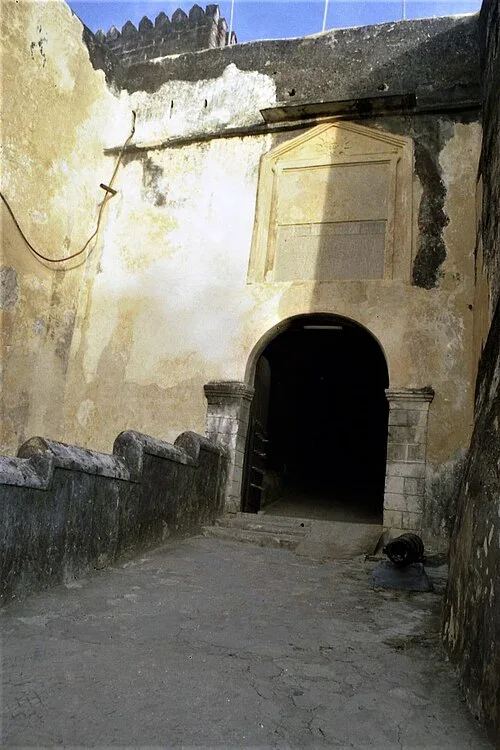 Outer Bastions and the Main Gate
The Main Gate and the Design of the Fort
The mind behind this fort came from Milan. Giovanni Battista Cairati was Chief Architect for Portuguese possessions in the East, and this was his last overseas work. He drew his inspiration from an Italian contemporary, Pietro Cataneo, while a master builder named Gaspar Rodrigues directed the work on the ground. The plan is Renaissance thinking in stone. Roughly square, with a bulwark at each corner, arranged so the guns of one bastion could sweep the approaches of its neighbours. From the air, people have long read the fort another way. The outline resembles a person lying on their back, head towards the sea. Whether Cairati intended it, no one can say for certain. What is certain is the speed. The whole fortress rose in just three years. Above the archway sits a carved stone panel, its worn lettering now beyond reading.
Photo: Bertina Kanaka · CC BY-SA 4.0
03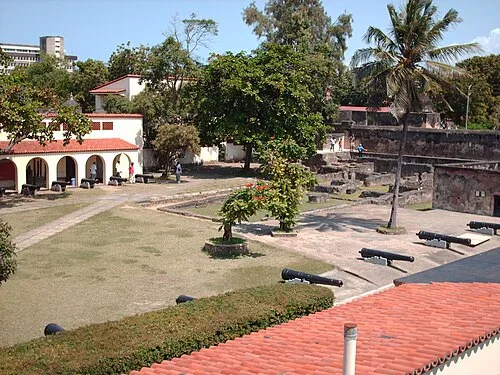 Central Parade Ground
The Central Parade Ground
This open court was the mustering heart of the garrison, where soldiers of whichever flag flew over the walls would have assembled. The compound covers about two and a half hectares, and its ground carries the marks of every occupation. Fort Jesus was captured and recaptured at least nine times. The first loss came in 1631, when Sultan Yusuf ibn al-Hasan of Mombasa seized the fort from the Portuguese. He held it for barely a year. The Portuguese took it back in 1632, then rebuilt and strengthened the defences, making the fort noticeably harder to fall. The greatest test of all came at the end of the century, and it belongs to the seaward guns, further along the tour. Here in the courtyard, cannon barrels from different eras now lie parked in rows, rivals of old sharing the same ground.
Listen in the appSandro Senn · Public domain
04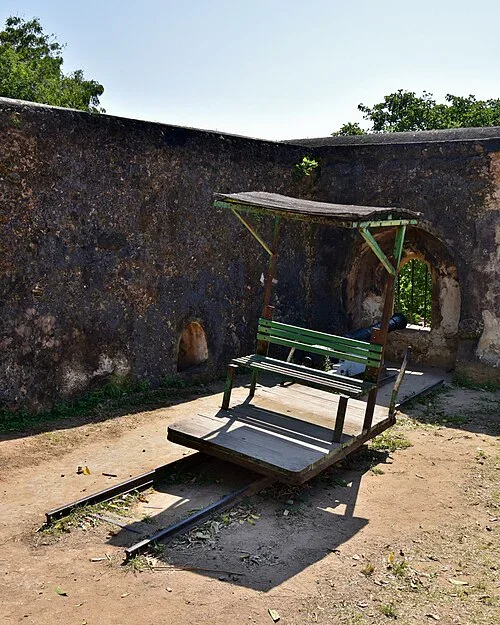 Central Parade Ground
Fortress Turned Prison
By the late nineteenth century the fort had lost its military purpose. After the East Africa Protectorate was established in 1895, the British turned Fort Jesus into a colonial prison. For more than sixty years these walls held prisoners instead of soldiers. The change came in 1958, when the fort was declared a historical monument and a national museum. Excavation fell to the archaeologist James Kirkman, who worked here from 1958 to 1971. He leaned heavily on external historical documents to make sense of what his digging uncovered, piecing the fort's layered past back together. Nearby, an old wooden trolley with a green bench rests on a short stretch of rail, its original purpose now a quiet mystery.
Listen in the appPhoto: Bahnfrend · CC BY-SA 4.0
05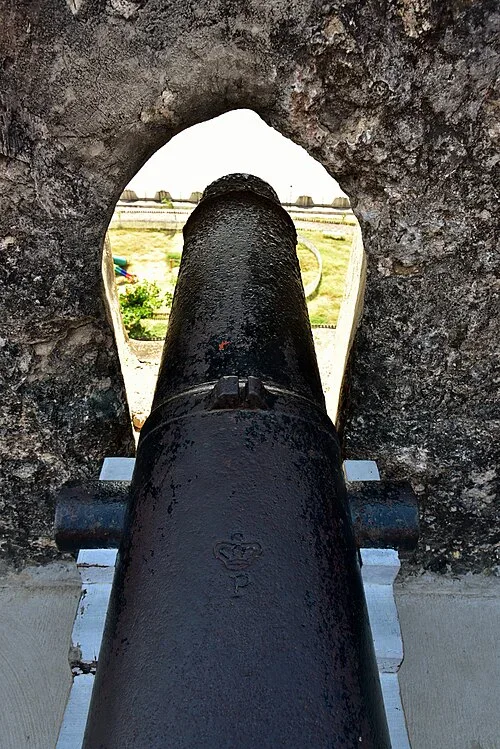 Defensive Battlements and Artillery Walk
Gun Embrasure on the Wall Walk
This gun sits in an arched embrasure, a narrowed opening that lets the barrel swing while shielding the crew behind it. The guns themselves tell the story of changing owners. The Portuguese cannon had a range of about two hundred metres. The later British iron guns reached three hundred, though they were shorter in the barrel. The barrel here bears a crown and royal stamp, a maker's mark from some distant foundry.
Listen in the appPhoto: Bahnfrend · CC BY-SA 4.0
06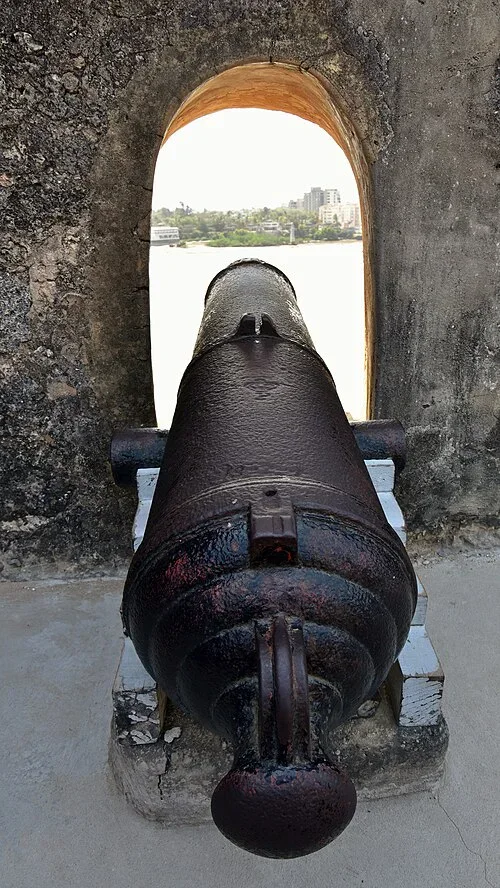 Defensive Battlements and Artillery Walk
The Sea-Facing Gun and the Great Siege
From this gun position the water opens out ahead, the approach any attacking fleet would have to take. It was this way, in 1696, that the great test began. Imam Saif bin Sultan of Oman laid siege to Fort Jesus, and the siege lasted nearly three years. The Portuguese garrison was cut off from relief by sea. Starvation and disease thinned their numbers month after month, until the defenders could hold no longer. On the thirteenth of December 1698 the Omanis breached the defences. The fall of the fort ended Portuguese dominance of this coast. Their return was brief. With help from the Swahili city-states they re-occupied the fort in 1728, and were gone again within a year. Whoever held this position commanded the sea road to Mombasa, and everyone knew it.
Listen in the appPhoto: Bahnfrend · CC BY-SA 4.0
07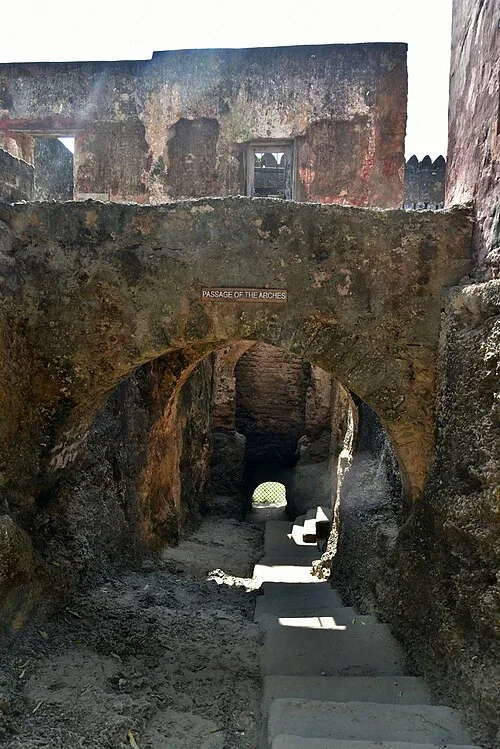 Passage of the Arches and Subterranean Chambers
Passage of the Arches
A small sign above the archway reads Passage of the Arches. Beyond it, steps lead down into corridors cut directly into the coral. These subterranean passages run from the courtyard toward protected chambers below, carved rather than built. Their purpose was survival under fire. A defender could move between positions, or bring up supplies, without ever showing himself to enemy guns on the surface. In a fortress that spent its life under threat of bombardment and blockade, that sheltered depth mattered as much as any wall. The most important thing waiting at the bottom of these steps was not a weapon at all.
Listen in the appPhoto: Bahnfrend · CC BY-SA 4.0
08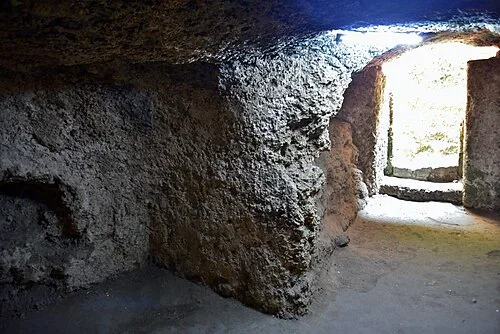 Passage of the Arches and Subterranean Chambers
The Cistern Chamber and the Arab Well
This rough-hewn chamber sits deep inside the coral, and water is the reason rooms like it exist. The Portuguese cut an open cistern into the fort to harvest rainwater, storing it within the walls. The Omani Arabs went further and sank a well, seventy-six feet deep, inside the compound. All that digging met a bitter disappointment. The water came up too salty to drink or cook with, good for nothing but washing. Still, the principle held. A garrison with water stored inside its own walls could endure a blockade that would starve out an unprepared town. In a siege measured in years, the cisterns below were worth as much as the cannons above.
Listen in the appPhoto: Bahnfrend · CC BY-SA 4.0
09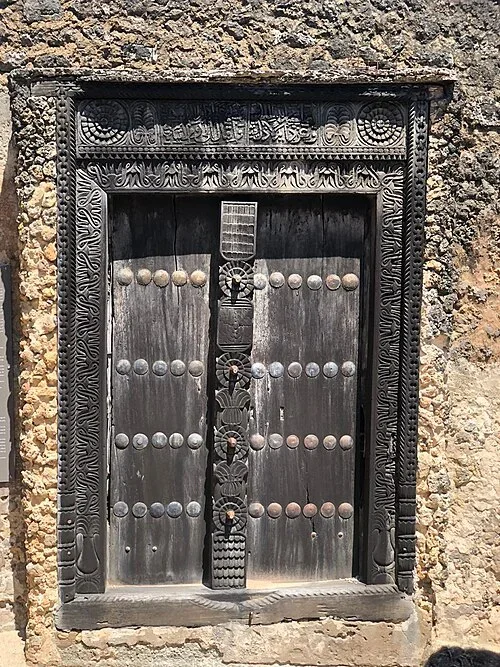 Oman House and Swahili Craftsmanship
Omani Doors and the Hall of Five Pillars
The carving on this door is dense and deliberate: geometric patterns, studs, and inscriptions along the frame. When the Omanis took the fort, they marked their occupancy in exactly this way, with verses from the Qur'an carved into wooden door posts and ceiling beams throughout. Doors like this one, set in coral stone walls, belong to the blended architecture of the place, Portuguese, Swahili and Omani work layered together. Inside the fort stands Oman House, remembered as the house of the Omani sultan who governed the East African coast. There is also a former meeting hall carried on five stone pillars, their number a deliberate echo of the Five Pillars of Islam. Faith, governance and craft, all cut into the fabric of a fortress.
Listen in the appPhoto: Juneakhwale · CC BY-SA 4.0
10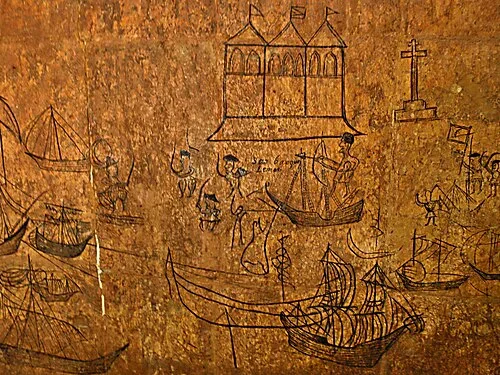 National Museum Galleries and Soldier Graffiti
Graffiti of the Portuguese Garrison
Scratched into plaster, in thin dark lines, is a whole world drawn from memory. Ships dominate the panel, hulls and rigging sketched over and over, some with sails set, some crowded with tiny figures. A many-towered building rises near the top, beside a tall cross. These are the handiwork of Portuguese soldiers and sailors, ordinary rank-and-file men posted to a garrison at the far edge of the world, waiting out long stretches of duty. They drew what filled their days: the vessels that were their link to home, the faith they carried, the people around them. A garrison whose entire purpose was the sea left a wall covered in ships.
Listen in the appDr Peter James Chisholm · CC BY-SA 4.0
- 11
Blue-Glazed Jar Fragment from the Museum
A ninth-century blue-glazed shard, a sign of how old the Indian Ocean trade was before any European arrived.
- 12
The Eastern Ramparts and the Harbour View
From the eastern ramparts: the harbour view that made the fort worth fighting for, and its life today.
Fort Jesus
Frequently asked questions
How much does the guide cost?
Free app download. Listed guide price: $0.99. Guide price shown in the app. Audio guide only. Venue admission is separate.
Can I listen without internet?
Yes. Download the guide’s audio, images, and maps in the app before your visit. Your downloaded content is then available offline.
Can I listen in my language?
This audio guide is available in 15 languages, including English.
Do I need to follow a schedule?
No. This is a self-guided experience. Choose your stops, pause whenever you like, and return to a story at your own pace.
At your own pace
Explore Fort Jesus.
Download Stanza, then search for “Fort Jesus”.
Free app download · Guide price shown in the app
Keep exploring
Audio guides — Kenya
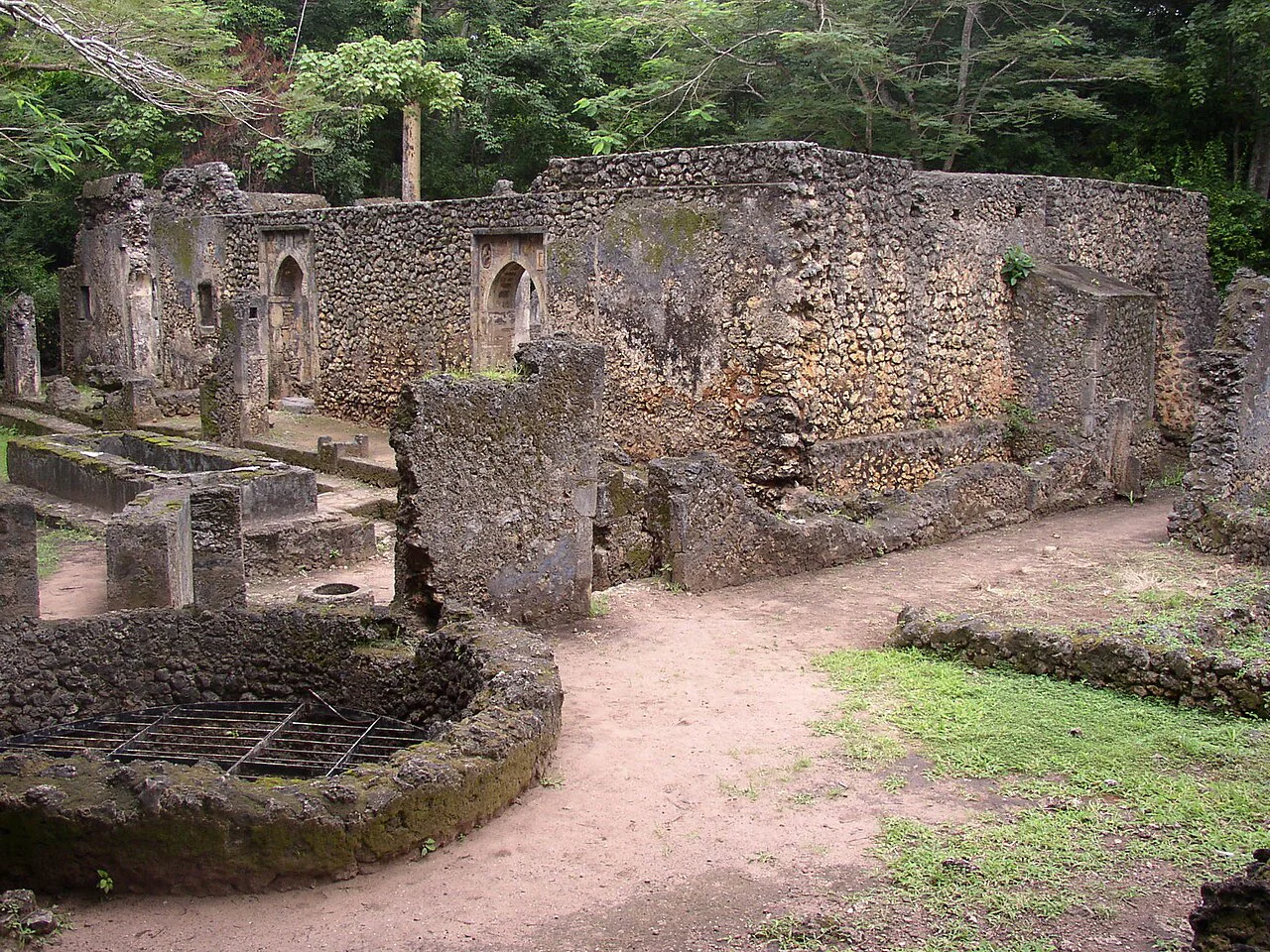
Watamu ward · 93 km
Ruins of Gedi
Content & sources
Photo: Mgiganteus · CC BY-SA 3.0
Ambohimanga Rova
Ambohimanga
Content & sources
Olivier Lejade · CC BY-SA 2.0
Kampala
Kasubi Tombs
Content & sources
Photo: Z thomas · CC BY 4.0