Stanza · Audio guide
Ruins of Gedi Audio Guide
A place to remember. A story to take with you.
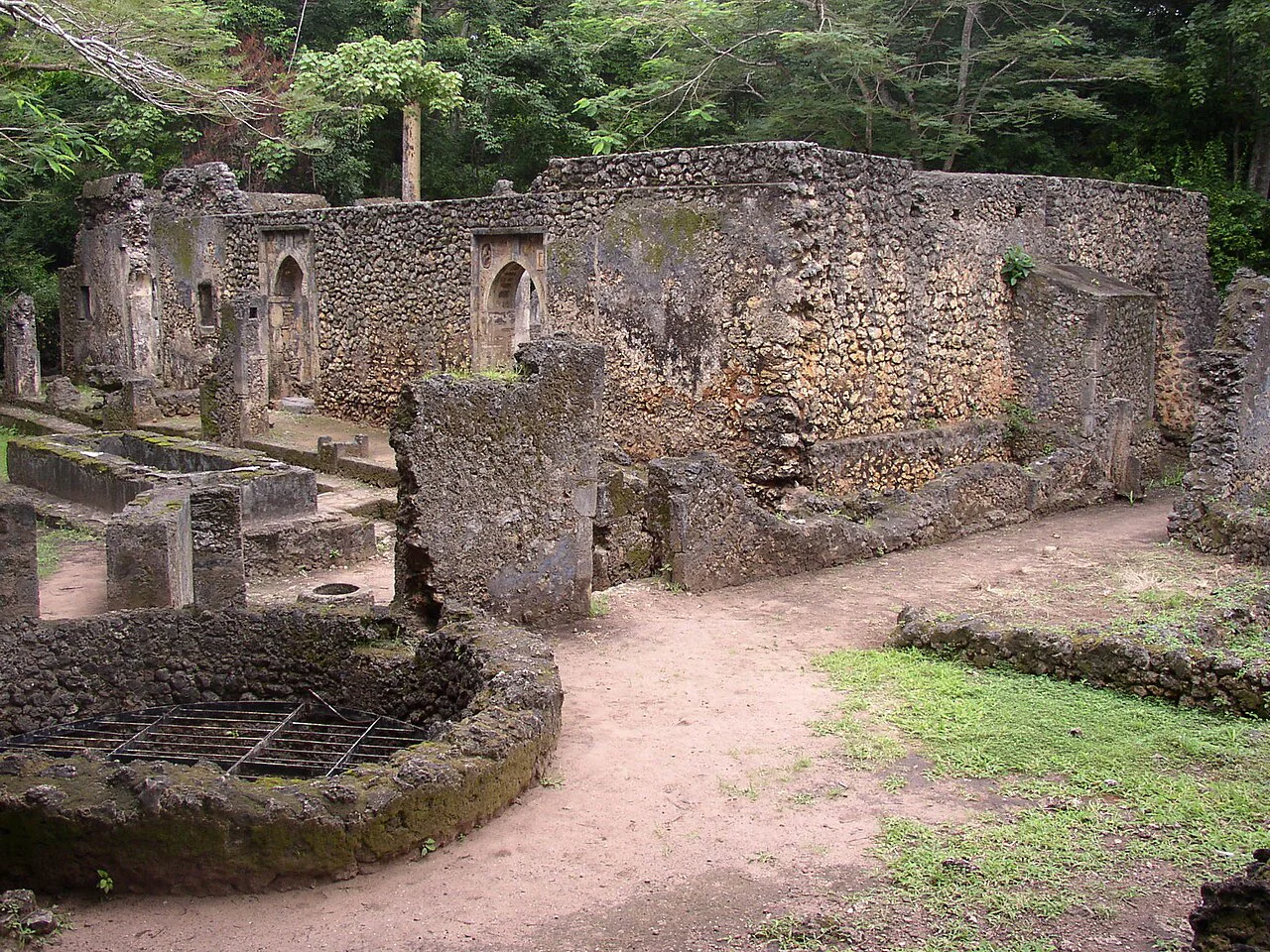
The Ruins of Gedi are a UNESCO World Heritage site located near the Indian Ocean coast of eastern Kenya. The site is situated within the Arabuko-Sokoke Forest adjacent to the town of Gedi.
Download Stanza, then search for “Ruins of Gedi”.
About the tour
One guide. Your kind of visit.
The Ruins of Gedi are a UNESCO World Heritage site located near the Indian Ocean coast of eastern Kenya. The site is situated within the Arabuko-Sokoke Forest adjacent to the town of Gedi.
Ready when you are.
- 01Get the free Stanza app.
iOS & Android
- 02Find your guide.
“Ruins of Gedi”
- 03Download before you go.
Works offline
Audio guide / 13 narrated stops
Inside the guide
Get to know a few of the stories before you go. Open a stop to read more.
01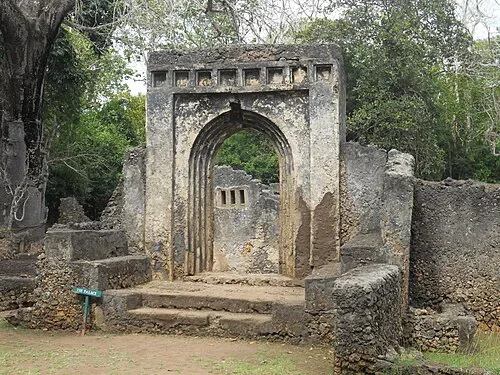 Site Entrance and Swahili Cultural Museum
Gateway into Gedi: A Swahili Stone Town in the Forest
Welcome to Gedi, a ruined Swahili stone town on the Kenyan coast. The arched gateway ahead is cut from coral rag, the porous stone that raised every building here. This walk follows the town from its entrance through palace, houses, mosque and tombs, out to the forest's edge. Gedi stands inside the Arabuko-Sokoke Forest, a strip of primeval woodland near the Indian Ocean. People settled here in the eleventh or early twelfth century, drawn by the sea trade moving up and down the coast. At its height the town filled a walled site of about forty-five acres. Mosques, a palace, houses and tombs all rose in stone, one storey high. In July 2024 UNESCO listed Gedi as a World Heritage site, Kenya's eighth. What lies ahead is a whole medieval town, abandoned and left to the trees.
Photo: Maclemo · CC BY-SA 3.0
02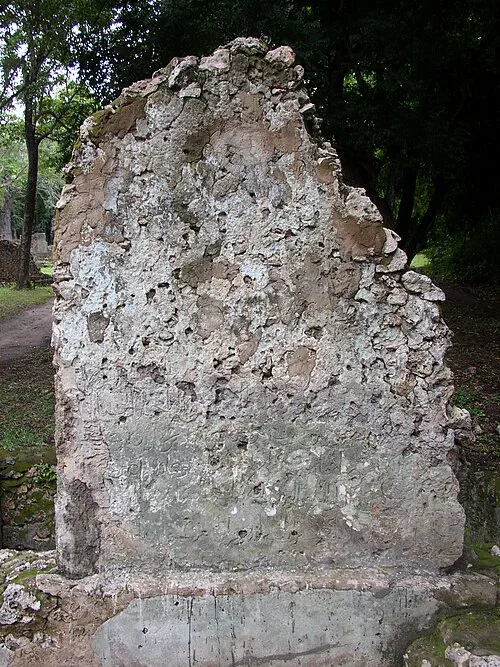 Site Entrance and Swahili Cultural Museum
Carved Stone Slab from Gedi
This worn slab sits in the site's Swahili Cultural Museum, and it points to how Gedi is known at all. No old document names the town. Its story comes from what excavators lifted out of the soil. Much of it arrived by sea. Chinese porcelain and celadon, Islamic glazed wares, and Venetian glass beads all reached Gedi's houses. So did two Chinese coins, the only struck coins found here. In return, Swahili coastal towns shipped out gold, ivory, mangrove poles and more. Everyday money closer to home was the cowrie shell. Excavators found cowries in the store rooms far more often than coins. One old estimate put the exchange at four hundred thousand cowries to a single gold dinar. A town of shopkeepers, then, measuring wealth by the shell.
Photo: Mgiganteus · CC BY-SA 3.0
03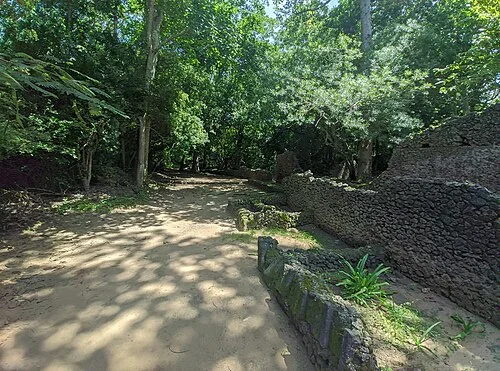 Outer Wall Gateway and Forest Trail
Along the Old Walls
A sandy path runs along the old coral walls, with the forest pressing close on both sides. Gedi was divided by two of them. The outer wall went up in the fifteenth century, about two and three-quarter metres high and forty-five centimetres thick, finished with a coat of plaster. The inner wall came later, and its gun ports have led scholars to link it with the Portuguese on the coast in the sixteenth century. But here is the puzzle. The archaeologist James Kirkman judged the walls and gates too slight to stop any serious attack. He thought they may have marked social boundaries instead, sorting the town's people into quarters. Even so, the inner wall, with its stronger look, has often been credited as a fortification. The argument has never quite been settled.
Listen in the appPhoto: Lebu Ayiga · CC BY-SA 4.0
04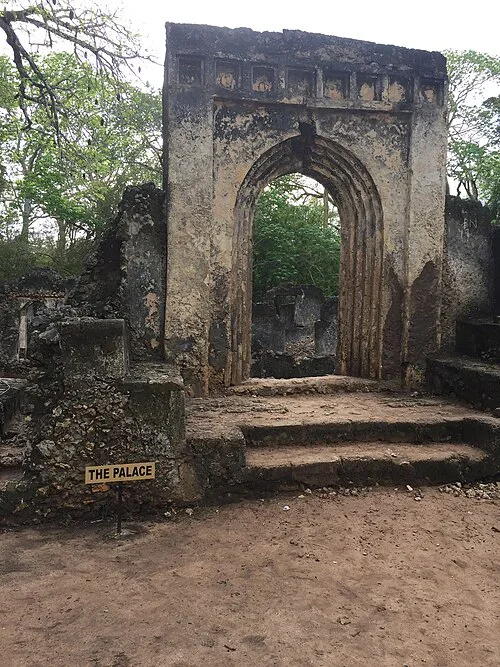 The Palace of the Sheikh
Under the tall arched entrance and its broad steps lay the palace of Gedi's sheikh, the town's ruler. Its plan was built for staging power. A large central hall sat at the heart of it, flanked by two anterooms, each with a courtyard of its own. Residential rooms opened off the main hall, where the sheikh's household lived. Two further courts handled formal business. One was the audience court, the other the reception court, and each was reached through its own gate. Visitors moved through threshold after threshold, and each one filtered who got near the ruler. The palace was excavated in 1963, clearing these rooms after centuries of rubble.
Listen in the appPhoto: Skaranja · CC BY-SA 4.0
05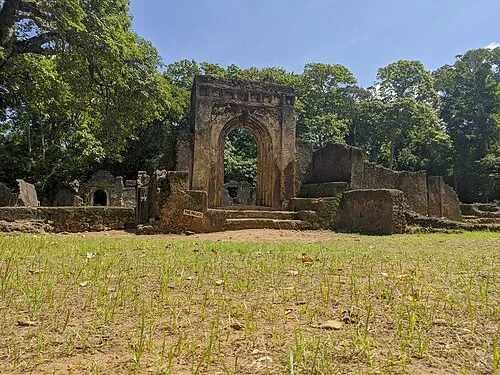 The Palace of the Sheikh
Coral Masonry: Built by Swahili Hands
This archway is a good place to study how Gedi was built. Every standing building here is coral rag, bonded with lime mortar burned from coral itself, and all of them are a single storey. Foundations ran shallow, often no deeper than thirty centimetres, filled with packed stones. The pointed archways were framed in square settings, and tombs and mosques carried carved or porcelain-inlaid decoration. For decades, though, the masonry was read wrongly. Early European observers took stone towns like this as proof of Arab colonists, and Kirkman's own report was titled The Arab City of Gedi. Later work on language, local pottery, food remains and earth-built neighbourhoods turned that story around. Gedi was an African Swahili town that adopted Islam and joined the ocean trade on its own terms. This arch was raised by local masons.
Listen in the appPhoto: Lebu Ayiga · CC BY-SA 4.0
06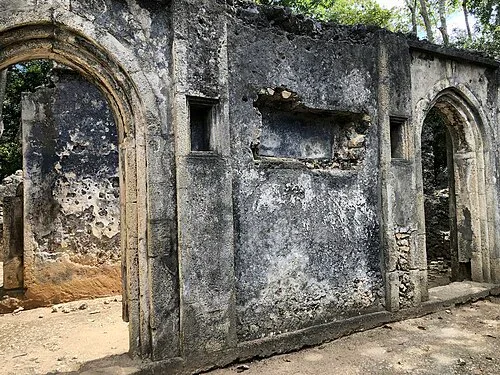 The Elite Stone Houses Complex
Inside an Elite Coral Stone House
Every surviving house at Gedi stands inside the inner wall, and all of them belonged to the town's elite. The four largest carry names of their own: the House on the Wall, the House on the West Wall, the House of the Dhow, and the Large House. Around the palace clusters a row of smaller homes with stranger names. The House of the Chinese Cash. The House of the Venetian Bead. The House of the Cowries. Each one is named for the object found in or near it when excavators moved the earth. The arched doorways and the recessed niches in these walls were the domestic finish of wealthy merchant homes, spaces for lamps, treasured wares and everyday things.
Listen in the appPhoto: LutzBruno · CC BY-SA 4.0
07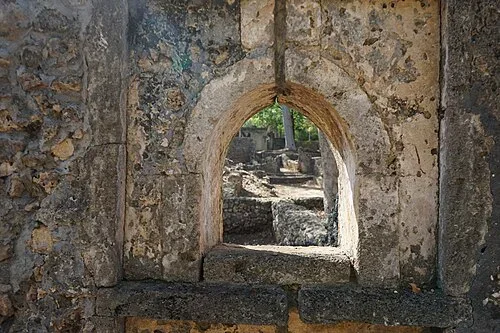 The Elite Stone Houses Complex
Through the Window: The Town Beyond the Stone
Through this small arched opening the ruins stretch away into the trees, and that view holds the rest of the story. The coral houses were only the stone skeleton of Gedi. Most of its people lived in earth-and-thatch dwellings, in the open ground between and beyond the two walls. Those houses have long since dissolved, but surveys of the terrain found dense concentrations of postholes, floors and broken pottery where they stood. Mapping of the neighbourhoods showed how the town grew around its monumental core. At its height in the fifteenth and sixteenth centuries, Gedi held roughly two thousand five hundred people, most of them outside the stone centre. Smaller farming settlements around the town supplied much of what it ate.
Listen in the appNina R · CC BY 2.0
08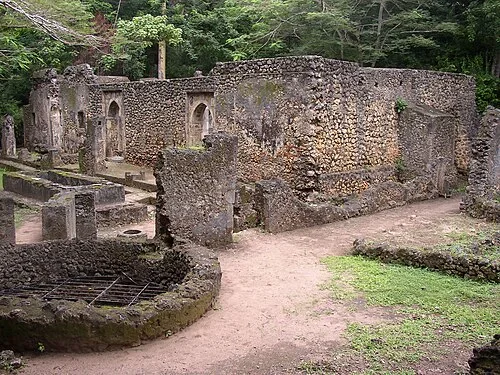 The Great Mosque and Ablution Facilities
The Great Mosque
The Great Mosque was the religious heart of the fifteenth-century town, a rectangular building inside the inner wall. Three entrances led in, and in the central room three rows of pillars carried the roof. The carving repays attention. Above one entrance, a relief shows a spear point flanked by a shield. On the east entrance, the architrave is engraved with a herringbone pattern. The builders gave this mosque unusual care below ground as well. Its walls, some fifty centimetres wide, extend more than a metre into the subsoil, among the deepest foundations at Gedi. The mosque was excavated in 1954. One curious feature is missing: none of Gedi's mosques has a minaret, and the absence has been taken to suggest Ibadite influence, though that remains a scholarly suggestion.
Listen in the appPhoto: Mgiganteus · CC BY-SA 3.0
09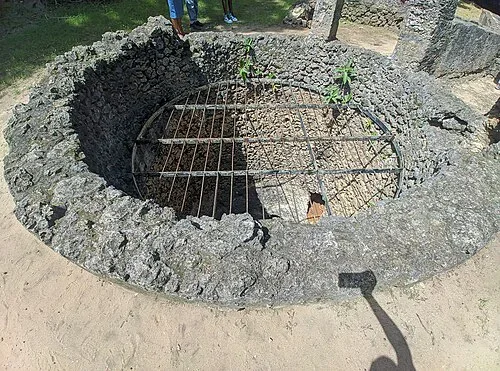 The Great Mosque and Ablution Facilities
The Ablution Well
This circular well of coral stone stands near the mosque, and washing before prayer was part of Muslim practice. Gedi's mosques held wells and washing facilities for just that purpose. But water here was bigger than ritual. The town laid its streets out in a grid pattern, and it built sumps to collect storm water. Many of its primary buildings had lavatories, plumbed into the fabric of the structure. Wells also stood in the courtyards of some houses. For a medieval town on the African coast, that is civic engineering of a high order, and it is one of the signatures of how carefully Gedi was organised.
Listen in the appPhoto: Lebu Ayiga · CC BY-SA 4.0
10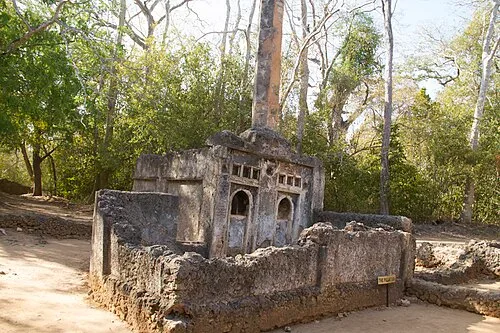 The Dated Pillar Tomb
Swahili Pillar Tombs
Rising over its base, the tall stone pillar marks one of Gedi's most striking monuments. Pillar tombs are masonry structures topped by a column, and they belong to a burial tradition of the medieval Swahili Coast. Gedi has four large ones within the inner wall. They marked the resting places of prominent townspeople, monuments to families with standing in the town. The decorative recessed panels on the masonry are a common feature of the tradition, and the arched niches at the base belong to it too. The most famous of the four carries a date, and that inscription is the next stop's story.
Listen in the appPhoto: Jeffmugendi · CC BY-SA 4.0
- 11
The Pillar and the Date: 1399
An Arabic inscription of 1399 on one tomb fixed the chronology of the entire town.
- 12
Roots Over Walls: The Abandoned Town
By the mid-1600s Gedi was empty, and no record says why the people left.
- 13
What Gedi Means
A baobab over the ruins, and the Giriama neighbours who still hold Gedi sacred.
Ruins of Gedi
Frequently asked questions
How much does the guide cost?
Free app download. Listed guide price: $0.99. Guide price shown in the app. Audio guide only. Venue admission is separate.
Can I listen without internet?
Yes. Download the guide’s audio, images, and maps in the app before your visit. Your downloaded content is then available offline.
Can I listen in my language?
This audio guide is available in 15 languages, including English.
Do I need to follow a schedule?
No. This is a self-guided experience. Choose your stops, pause whenever you like, and return to a story at your own pace.
At your own pace
Explore Ruins of Gedi.
Download Stanza, then search for “Ruins of Gedi”.
Free app download · Guide price shown in the app
Keep exploring
Audio guides — Kenya
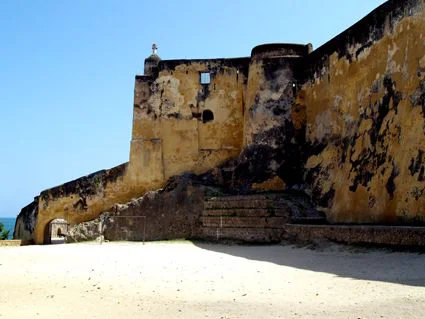
Mombasa County · 93 km
Fort Jesus
Content & sources
The original uploader was Zeljko at Croatian Wikipedia. · CC BY-SA 3.0
Ambohimanga Rova
Ambohimanga
Content & sources
Olivier Lejade · CC BY-SA 2.0
Kampala
Kasubi Tombs
Content & sources
Photo: Z thomas · CC BY 4.0