Stanza · Audio guide
Trakai Island Castle Audio Guide
A place to remember. A story to take with you.
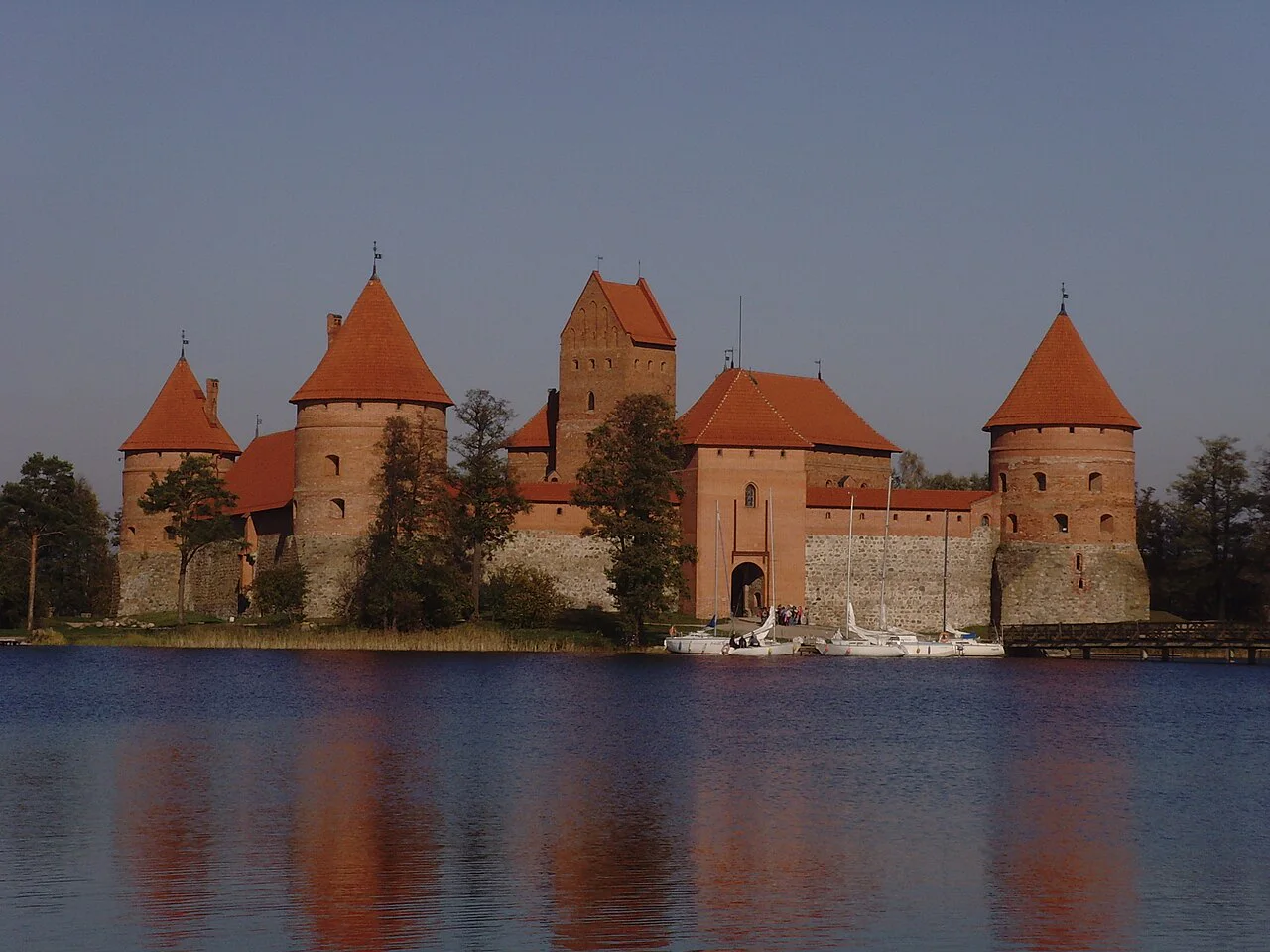
Trakai Island Castle is a 14th-century stone castle located on an island in Lake Galvė in Lithuania. It served as a major center of the Grand Duchy of Lithuania and held great strategic importance.
Download Stanza, then search for “Trakai Island Castle”.
About the tour
One guide. Your kind of visit.
Trakai Island Castle is a 14th-century stone castle located on an island in Lake Galvė in Lithuania. It served as a major center of the Grand Duchy of Lithuania and held great strategic importance.
Ready when you are.
- 01Get the free Stanza app.
iOS & Android
- 02Find your guide.
“Trakai Island Castle”
- 03Download before you go.
Works offline
Audio guide / 13 narrated stops
Inside the guide
Get to know a few of the stories before you go. Open a stop to read more.
01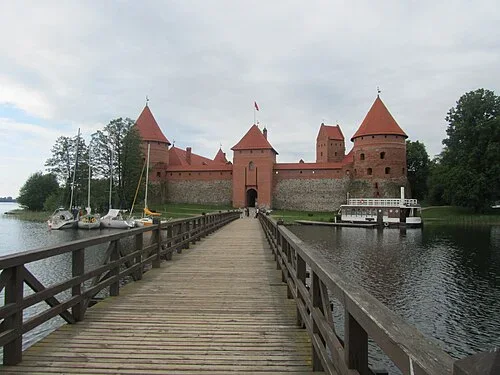 Lake Galvė Approach and Pilies Island
The Wooden Bridge to the Island Castle
A red-brick castle rises from an island in Lake Galvė, and a long wooden bridge runs out to it across the water. Trakai Island Castle was built as a stronghold, but it was also a home. Trakai was one of the main centers of the Grand Duchy of Lithuania, and its grand dukes lived in this castle. Water was the castle's first line of defense. An island is hard to storm, because an attacker must first cross the lake.
Photo: Reza1615 · CC BY-SA 3.0
02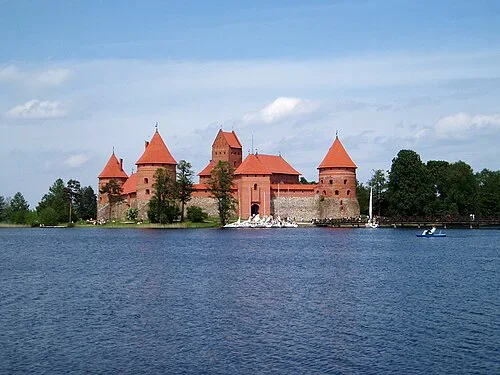 Lake Galvė Approach and Pilies Island
The Island Fortress on Lake Galvė
Grand Duke Kęstutis ordered this castle built in the second half of the fourteenth century. It stands on the largest of three lake islands. Research suggests that before building began, this site was three small islets, with marshy ground between them. That difficult ground shaped the castle's structure. The island castle was linked to the strengthening of an older castle on the Trakai peninsula, and Kęstutis moved his main residence here. The site is compact and irregular, covering nearly two hectares. This was a time of hard conflict with the Teutonic Order. In 1377 Teutonic knights attacked the castle, and it suffered major devastation.
darius_saulenas · CC BY 2.0
03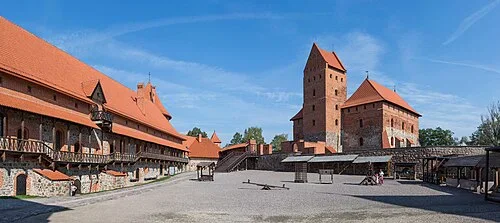 The Forecourt and Artillery Defenses
The Forecourt: Outer Bailey
The forecourt is the castle's outer yard, and it is almost trapezoid in shape. Its longest side is about fifty-five metres. Walls enclose the yard and link towers built at its corners. These walls were strengthened to a thickness of about two and a half metres. Against their inner faces stood casemates, which were fortified rooms built into the defenses. Close to the inner walls were stables, kitchens and other support buildings.
Listen in the appPhoto: Diliff · CC BY-SA 3.0
04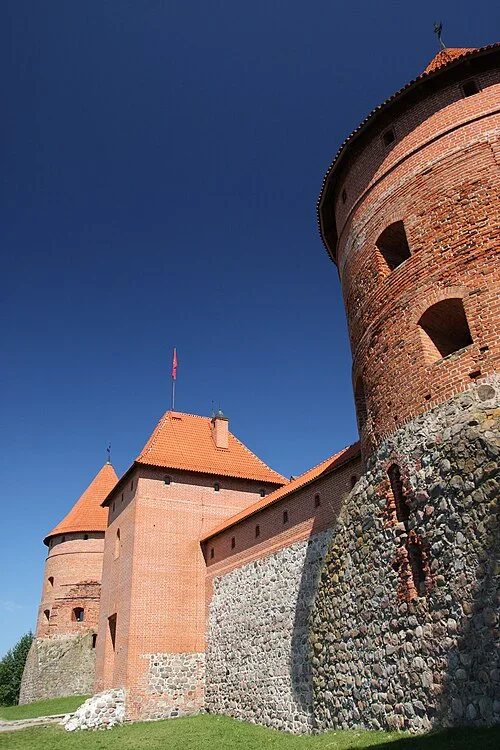 The Forecourt and Artillery Defenses
The Corner Towers
Three great towers stand at the corners of the forecourt. Each rises about eighteen metres. Each has five storeys. The lower part is a square stone base, and from the second floor up the tower is round. Much of the surface is faced with brick, and each tower has a cone-shaped tiled roof. The top storey was designed for soldiers, and it held many cannons. The chief enemy of the Grand Duchy was the Teutonic Order. In 1410 a Polish-Lithuanian army defeated the Order at Grunwald. The castle soon lost its military importance and was remade as a residence. Later it even served as a prison.
Listen in the appyeowatzup · CC BY 2.0
05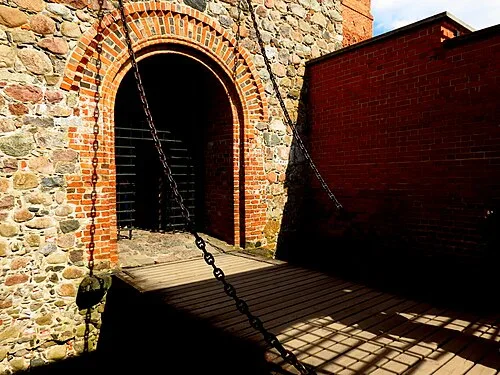 The Moat and the Ducal Keep
The Moat Crossing and Movable Gates
The chains hanging beside this arched gateway hint at how its gates worked. In the early fifteenth century, Lake Galvė stood several metres higher than it does today. The builders made use of that extra water. They separated the palace from the outer yard with a moat, just wide enough for small boats to sail through. Gates connected the two sides, and they could be raised if an enemy attacked. Apparently, during a truce with the Teutonic Order, the building work was supervised by a stonemason of that same Order. His name was Radike, and he oversaw the construction four years before the Battle of Grunwald.
Listen in the appxorge · CC BY-SA 2.0
06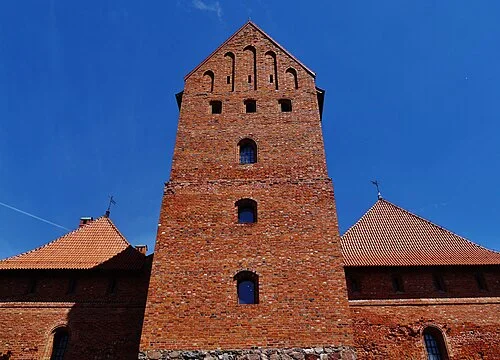 The Moat and the Ducal Keep
The Ducal Keep
The keep is a six-storey brick tower, added during the castle's second building phase. It rises about thirty-five metres. The keep did several jobs at once. It was another line of defense, and it held a chapel and living quarters. It was linked to the Ducal Palace. The castle's main material was so-called red Gothic brick. Stone was used only for the foundations and the upper parts of the buildings, towers and walls. The overall style is usually described as Gothic, with some Romanesque features. Glazed roof tiles, burned bricks and stained glass windows added decoration.
Listen in the appPhoto: Zairon · CC BY-SA 4.0
07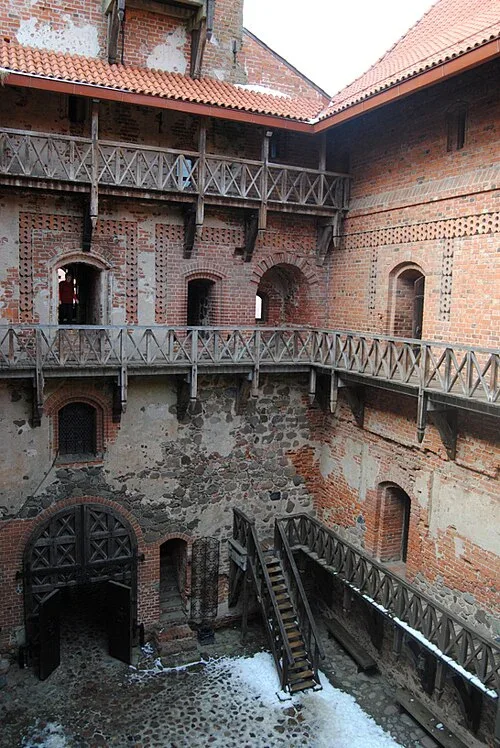 Ducal Palace Inner Courtyard
The Inner Courtyard and Wooden Galleries
Wooden galleries run around the inside of this courtyard, one level above another. The yard belonged to the multi-storey Ducal Palace. A wooden stair climbs from the yard up to the lower gallery. The galleries were used to reach various support facilities without going inside the palace itself.
Listen in the appPhoto: Petriukas · CC BY-SA 3.0
08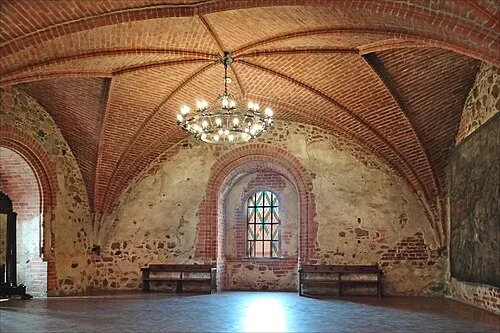 The Grand Ducal Hall and State Chambers
The Grand Ducal Hall
The entire southern wing of the palace was given over to the Ducal Hall. It was about twenty-one metres long. Its width was about ten metres. Only the Upper Palace in the Vilnius Castle complex could surpass it in proportions. Foreign envoys were welcomed in the Ducal Palace. Brick vaults curve overhead, and a tall arched window lights the room. In 1414 the Flemish traveler Guillebert de Lannoy described the castle. He wrote that it was completely new, built from bricks following French pattern. He also said the older castle on the shore was within cannon shot of this one.
Listen in the appdalbera from Paris, France · CC BY 2.0
09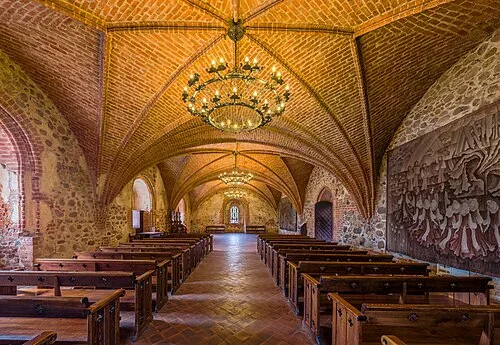 The Grand Ducal Hall and State Chambers
The Ducal Chapel
The castle chapel is a long room under a ceiling of brick vaults, with wooden benches set in rows. A chandelier hangs from the middle of the vaults. After the castle was remade as a residence, new frescoes were painted on its walls. Among them were Gothic frescoes showing Grand Duke Vytautas. Those frescoes did not survive. In 1822 Wincenty Smokowski copied what remained of them.
Listen in the appPhoto: Diliff · CC BY-SA 3.0
10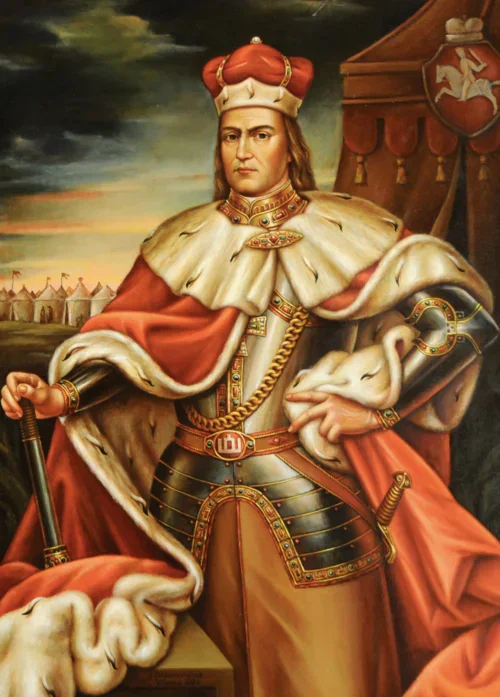 Treasury and the Legacy of Vytautas the Great
Grand Duke Vytautas the Great
Vytautas the Great was the son of Kęstutis, and he completed major works here around 1409. The castle held great strategic importance for the Grand Duchy. King Jogaila of Poland visited the castle thirteen times between 1413 and 1430. Vytautas died in this castle on the twenty-seventh of October, 1430, without ever being crowned King of Lithuania. The story goes that a crown sent to him by the emperor was intercepted on its way. Later artists showed him crowned, in royal robes and armor, though he never was.
Listen in the appUnknown Person · Public domain
- 11
Silver Ingots: Treasury of the Grand Dukes
Notched silver bars once used as money, and the state archive kept in the same castle.
- 12
The Castle in Ruins, c. 1870-1880
Broken walls rising from the water, and the long neglect that came before the nineteenth-century plans to save it.
- 13
The Castle Reborn
How a ruin was rebuilt in the Soviet years, and the museum that followed.
Trakai Island Castle
Frequently asked questions
How much does the guide cost?
Free app download. Listed guide price: $1.99. Guide price shown in the app. Audio guide only. Venue admission is separate.
Can I listen without internet?
Yes. Download the guide’s audio, images, and maps in the app before your visit. Your downloaded content is then available offline.
Can I listen in my language?
This audio guide is available in 15 languages, including English.
Do I need to follow a schedule?
No. This is a self-guided experience. Choose your stops, pause whenever you like, and return to a story at your own pace.
At your own pace
Explore Trakai Island Castle.
Download Stanza, then search for “Trakai Island Castle”.
Free app download · Guide price shown in the app
Keep exploring
Audio guides — Lithuania
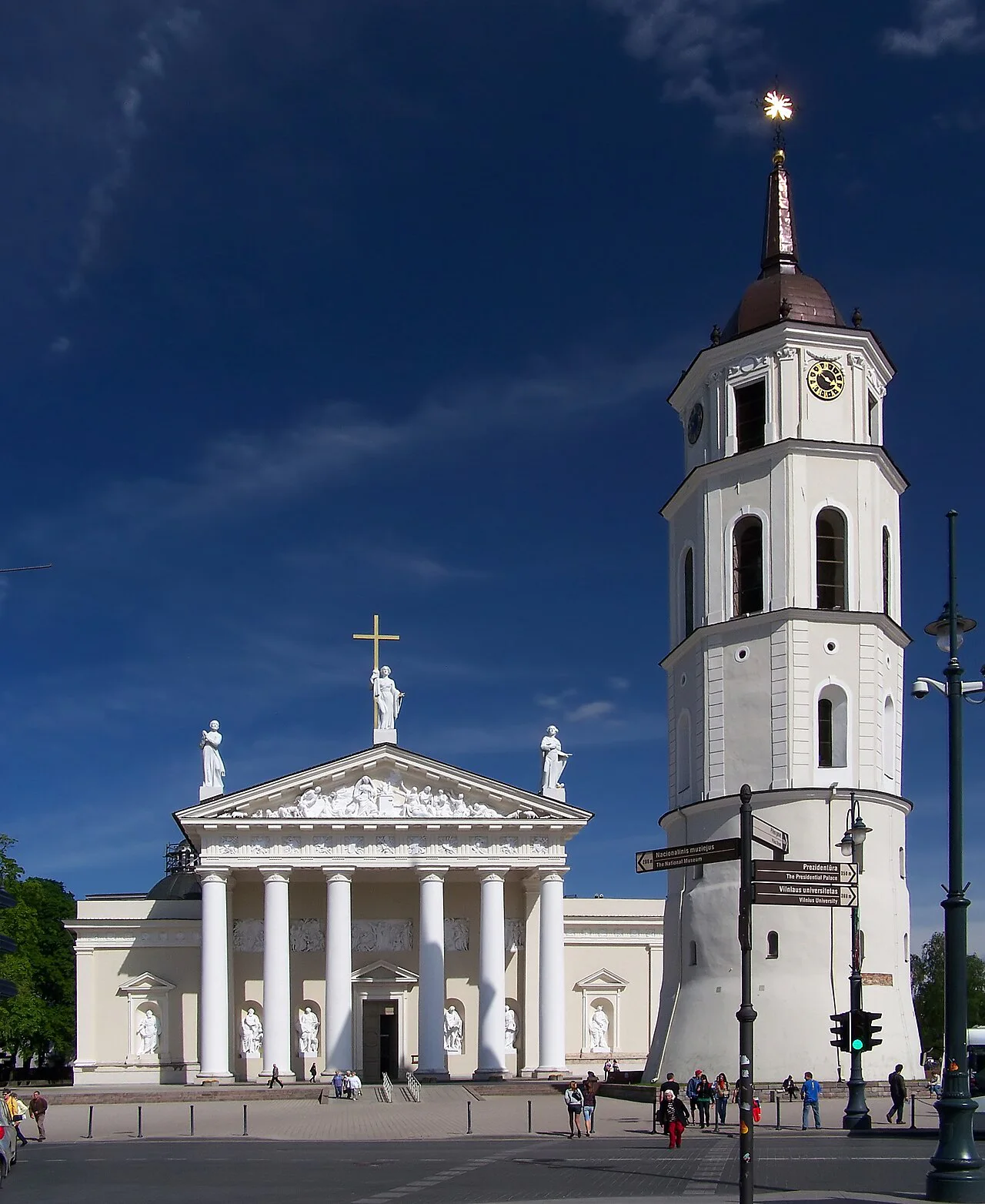
Vilnius · 23 km
Vilnius Cathedral
Content & sources
Lestat (Jan Mehlich) · CC BY-SA 3.0
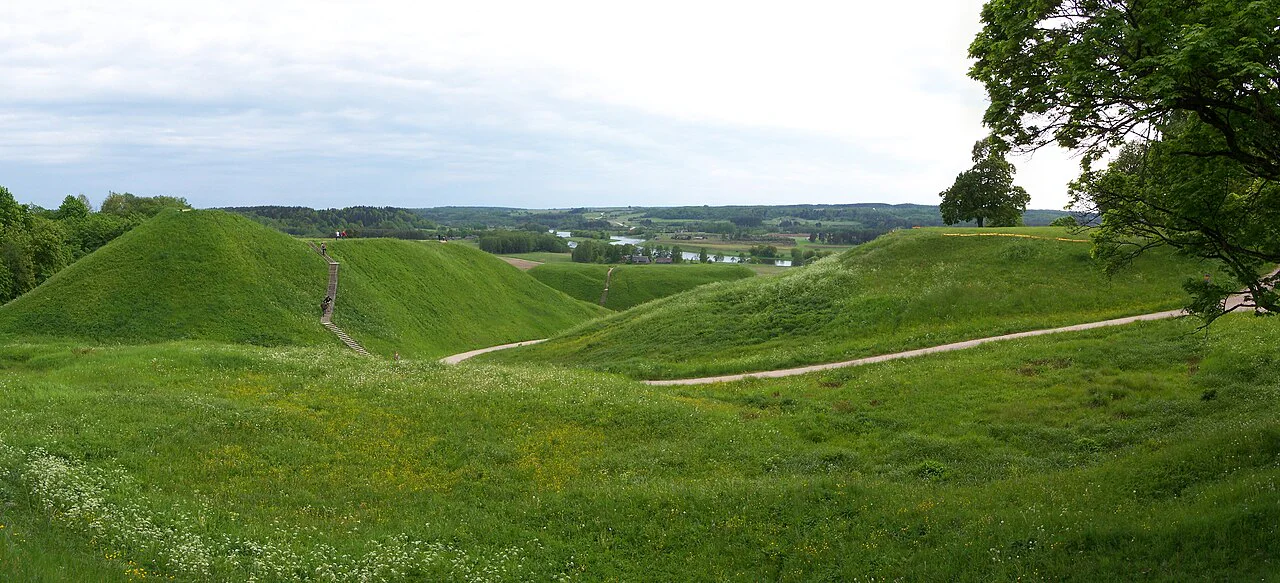
Kernavė · 26 km
Kernavė
Content & sources
Lestat (Jan Mehlich) · CC BY-SA 3.0
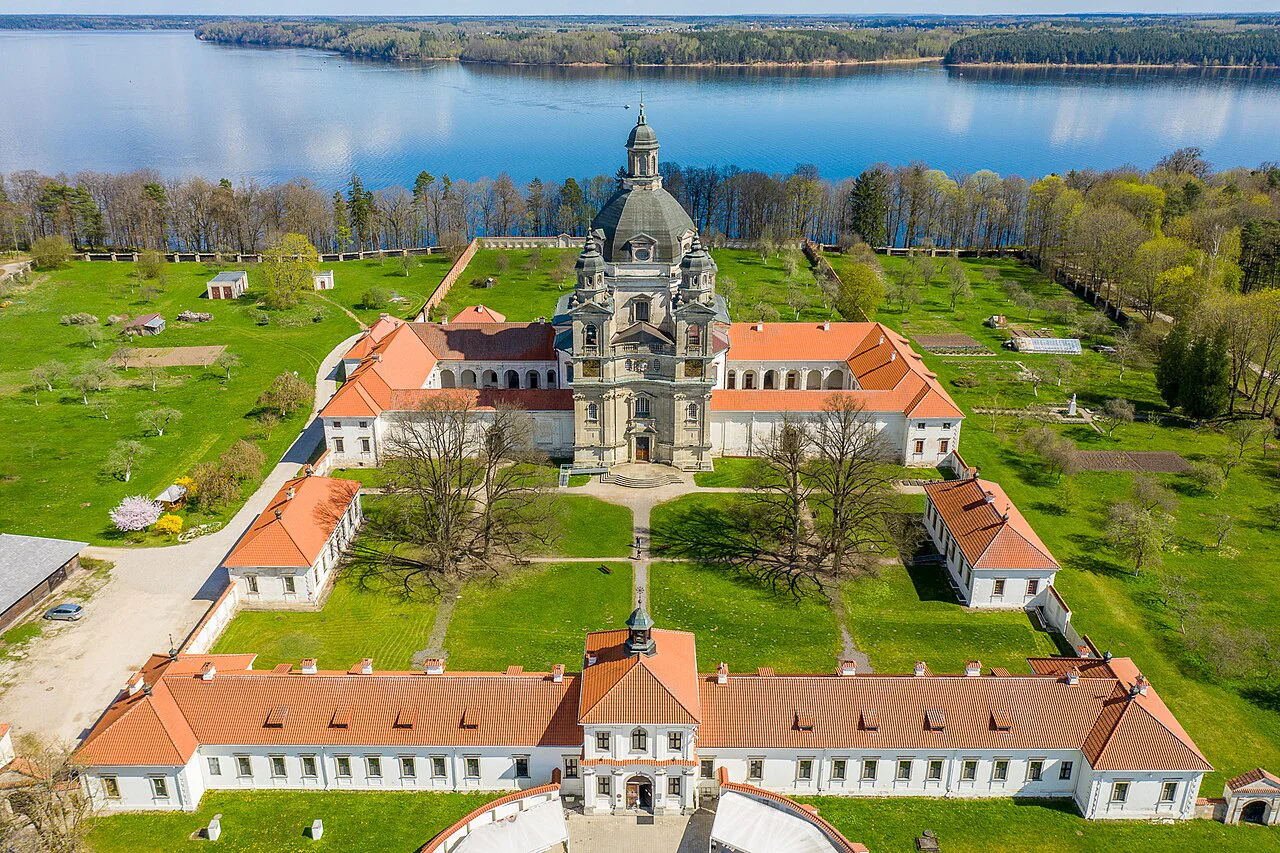
Kaunas · 64 km
Pažaislis Monastery
Content & sources
Augustas Didžgalvis · CC BY-SA 4.0
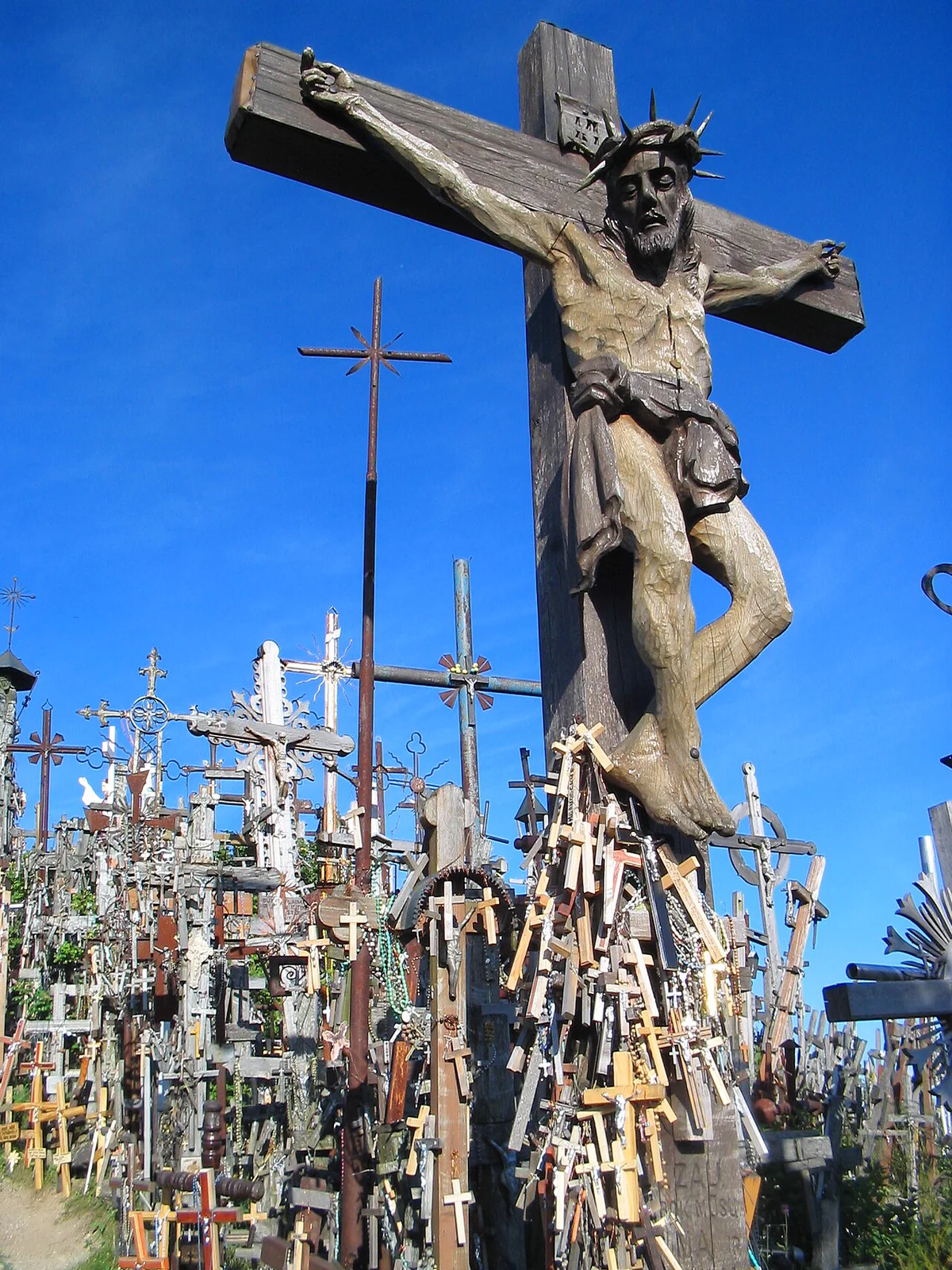
Jurgaičiai
Hill of Crosses
Content & sources
Thomas Stegh · CC BY-SA 3.0