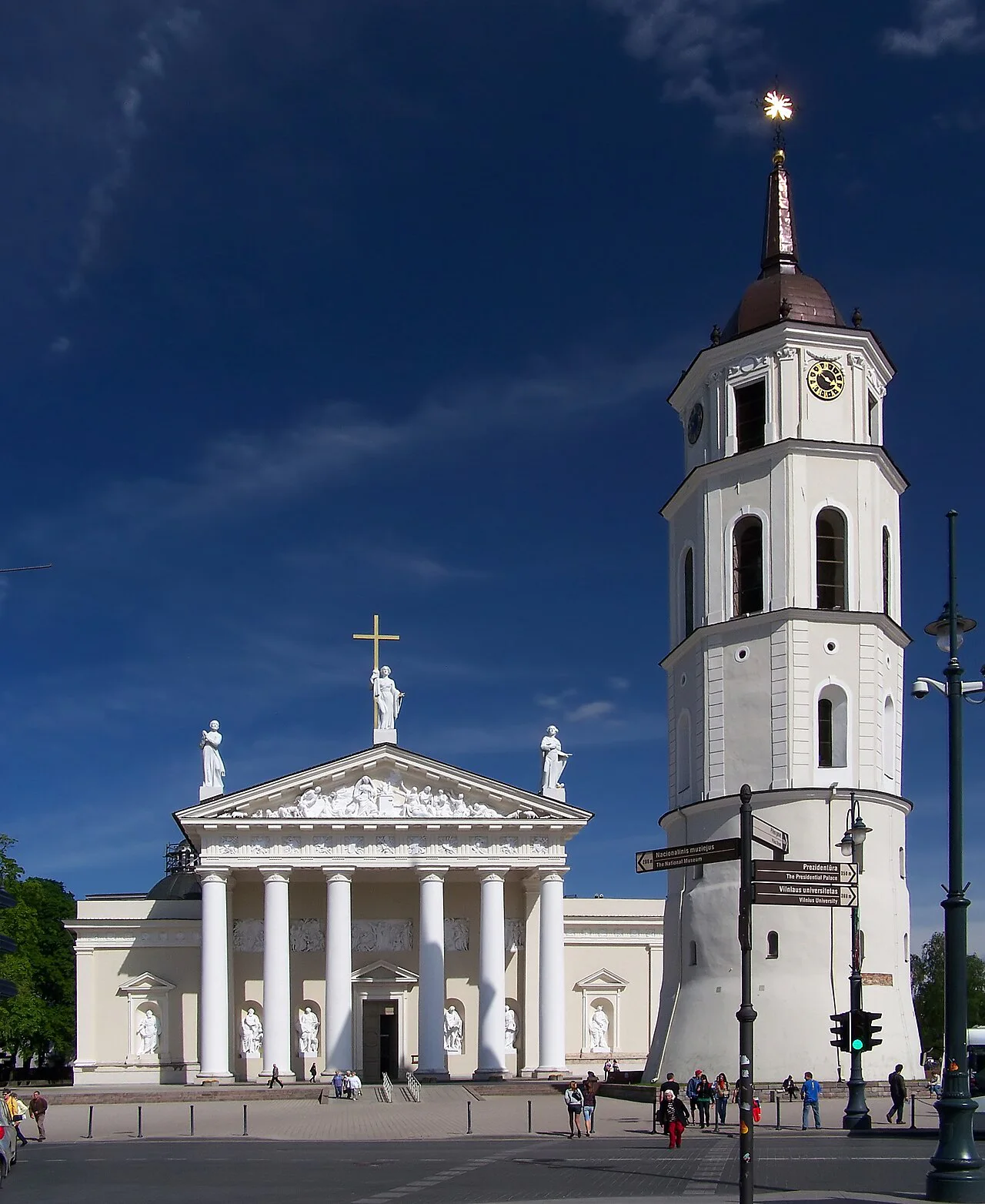
Stanza · Audio guide
Vilnius Cathedral Audio Guide
A place to remember. A story to take with you.
Vilnius Cathedral is the main Catholic cathedral in Lithuania. It is the heart of Catholic spiritual life in Lithuania.
Download Stanza, then search for “Vilnius Cathedral”.
About the tour
One guide. Your kind of visit.
Vilnius Cathedral is the main Catholic cathedral in Lithuania. It is the heart of Catholic spiritual life in Lithuania.
Ready when you are.
- 01Get the free Stanza app.
iOS & Android
- 02Find your guide.
“Vilnius Cathedral”
- 03Download before you go.
Works offline
Audio guide / 13 narrated stops
Inside the guide
Get to know a few of the stories before you go. Open a stop to read more.
01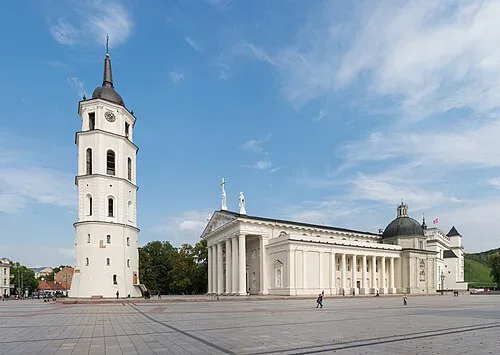 Cathedral Square and Detached Bell Tower
Vilnius Cathedral from Cathedral Square
Welcome to Vilnius Cathedral, the main Catholic church of Lithuania. Its full dedication is to two saints, Stanislaus and Ladislaus, and it is the heart of the country's Catholic life. The cathedral stands in Vilnius Old Town, on ground that once belonged to the Lower Castle of the grand dukes. The Old Town, with the cathedral among its landmarks, is on the UNESCO World Heritage list. The story here runs deep: a church founded with Lithuania's conversion, a stage for royal inaugurations, a burial place of rulers, rebuilt layer upon layer into the classical landmark seen today. Ahead lie the freestanding bell tower, the great columned portico, and the crypts beneath the floor.
Photo: Diliff · CC BY-SA 3.0
02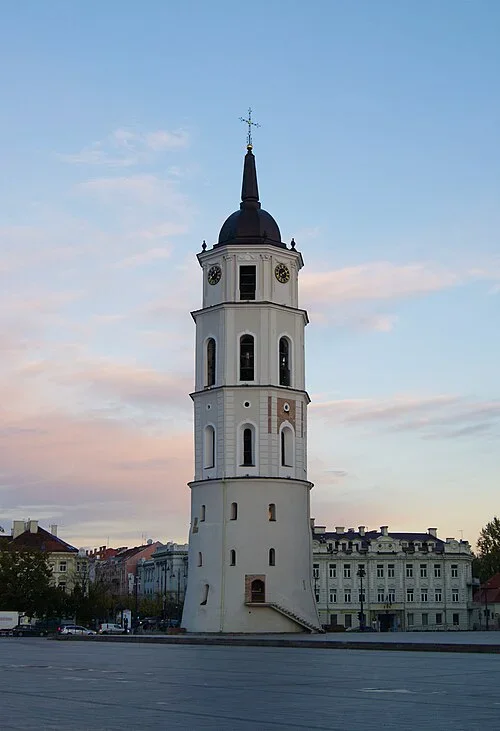 Cathedral Square and Detached Bell Tower
The Detached Bell Tower
The tall tower beside the cathedral began life as a fortress. It was one of the defensive towers of the Lower Castle, long before it rang any bells. In 1522 a bell tower was built on top of it, and the old stronghold became the cathedral's belfry. Its lowest tier is round and massive, rising on defensive foundations laid in the thirteenth century, in the former bed of the Vilnia River. Above it come the later octagonal tiers, one lighter than the last, to a total height of fifty-seven metres. Visitors can climb through those tiers, with the bells and the clock at the top.
Guillaume Speurt from Vilnius, Lithuania · CC BY-SA 2.0
03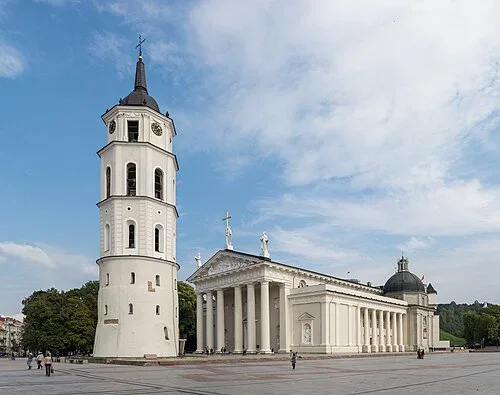 Neoclassical West Facade and Doric Portico
The Neoclassical West Facade and Doric Portico
In 1769 disaster struck the cathedral itself. The southern tower, raised during a seventeenth-century reconstruction, collapsed and brought down the vaults of the neighbouring chapel. Six people were killed. The Bishop of Vilnius, Ignacy Jakub Massalski, ordered a full rebuilding. Work began in 1779 to the design of Laurynas Gucevičius, and the church was consecrated in 1783, with the interior finished by 1801. Gucevičius gave the medieval church its strict classical face: a portico of six Doric columns across the whole front, crowned by a triangular pediment. Italian sculptor Tommaso Righi filled the facade with sculptures of the Four Evangelists. Some scholars hear echoes of Andrea Palladio in the building, or of Gucevičius's teacher Claude Nicolas Ledoux. How much of either is a matter of interpretation.
Listen in the appPhoto: Diliff · CC BY-SA 3.0
04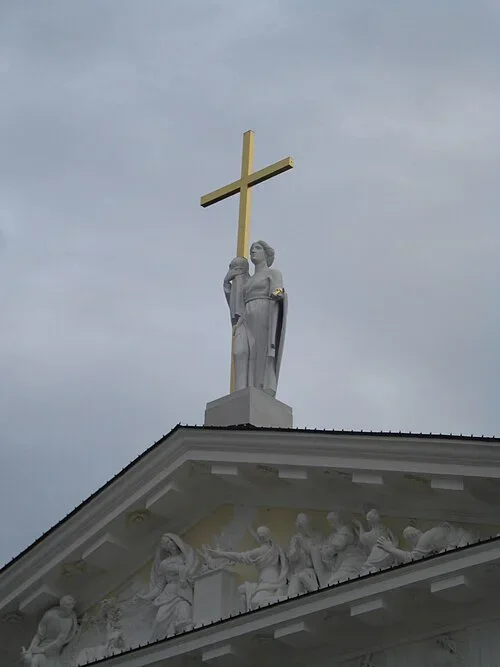 Neoclassical West Facade and Doric Portico
Saint Helena on the Pediment
High on the pediment stands Saint Helena, holding up a large cross and the nails with which Jesus was fastened to it. She is one of three roof figures: Saint Casimir on the south side, Saint Stanislaus on the north, Helena in the centre. Kazimierz Jelski created the sculptures between 1786 and 1792. In 1950 the Soviet anti-religious authorities took them down and destroyed them. For nearly half a century the pediment stood bare. Sculptor Stanislovas Kuzma recreated the group from historical drawings, and in 1997 the figures returned to the roof. Presumably Casimir originally stood for Lithuania, Stanislaus for Poland, and Helena's cross for the true cross, though that symbolism is not certain.
Listen in the appPhoto: Alma Pater · Public domain
05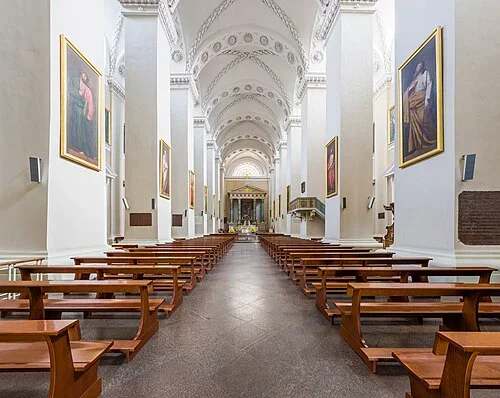 Central Nave and Organ Loft
The Central Nave
Inside, the cathedral is a hall of three naves, held up by sixteen massive square pillars. This nave was the stage of the Lithuanian state. Here the Grand Dukes of Lithuania were inaugurated, and the Bishop of Vilnius placed Gediminas' Cap on the monarch's head, a custom recorded until 1569. In 1529 the crown prince Sigismund II Augustus, later King of Poland, was crowned Grand Duke of Lithuania in this church. After 1569 the rulers of the commonwealth were elected instead, and the crowning here came to an end.
Listen in the appPhoto: Diliff · CC BY-SA 3.0
06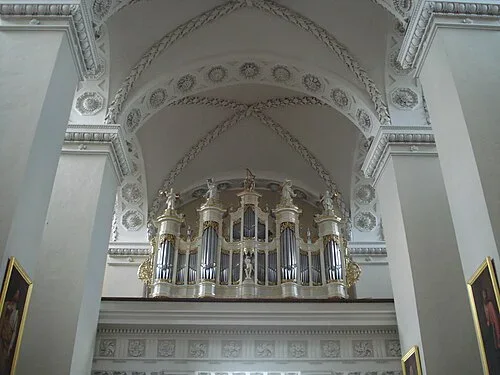 Central Nave and Organ Loft
The Organ Loft
Above the entrance, framed by the columns, sits the cathedral's ornate organ casing, white and gold. Music belongs here as much as ritual: this has always been a living, singing church. Its recent history was not. Under Soviet occupation the cathedral was converted into a warehouse. Masses resumed in 1988, though the building was still officially called the Gallery of Images. In 1989 its status as a cathedral was restored. Today, after a President of Lithuania takes the oath of office in the Seimas, a mass is celebrated here in the president's honour.
Listen in the appPhoto: Alma Pater · CC BY-SA 3.0
07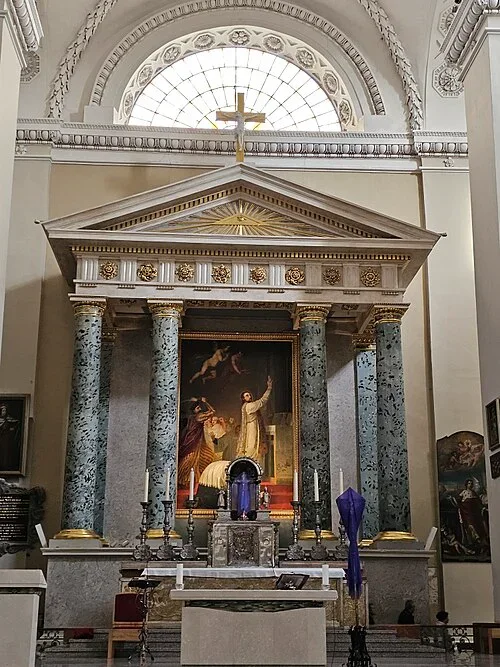 The High Altar
At the head of the nave stands the high altar, the spiritual centre of the church. The neoclassical altar replaced three separate altars that had stood against this wall in the first half of the eighteenth century. At its centre hangs Pranciškus Smuglevičius's painting of 1799, The Death of St Stanislaus, showing the death of the Bishop of Kraków, one of the cathedral's patron saints. In the niches on either side, Tommaso Righi set stucco allegories, Love of Neighbour and Love of God. Painter and sculptor share the one altar.
Listen in the appPhoto: Stela · CC BY-SA 4.0
08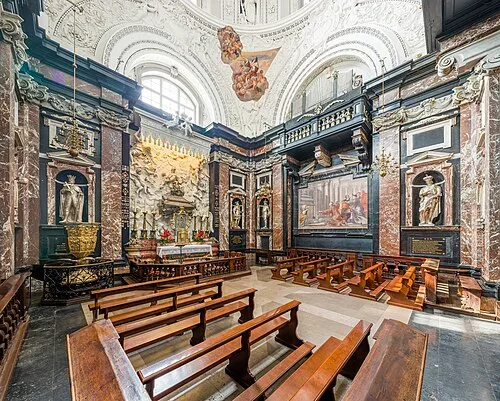 Baroque Chapel of Saint Casimir
The Chapel of Saint Casimir
The Chapel of Saint Casimir is the cathedral's great Baroque showpiece. It was built between 1623 and 1636 by the royal architect Costante Tencalla, begun at the initiative of Sigismund III Vasa and completed by his son Władysław IV. The walls are clad in Swedish sandstone and dark marble. In 1691 and 1692 the interior was redecorated: Michelangelo Palloni painted the frescoes, and Pietro Perti made the altar and the stuccowork. Sculptures of Jagiellon kings line the chapel, and one epitaph holds the heart of Władysław IV himself. The rest of that king's body lies in Wawel Cathedral in Kraków. More than anything here, the chapel speaks for the glory of the Polish-Lithuanian union.
Listen in the appPhoto: Diliff · CC BY-SA 3.0
09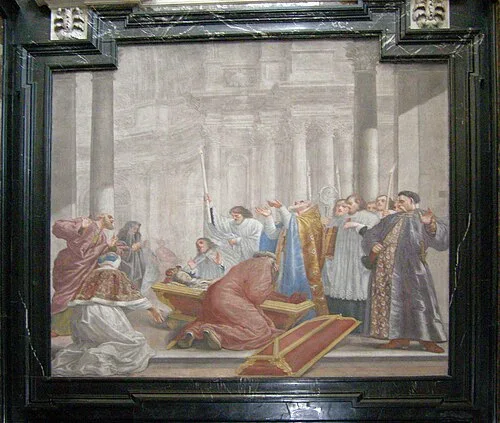 Baroque Chapel of Saint Casimir
Palloni's Opening of the Coffin of St Casimir
One painting in the chapel shows a solemn, crowded scene: the opening of the coffin of Saint Casimir. Casimir was a prince of the Jagiellon house who died in 1484 and was declared a saint in 1602, becoming Lithuania's patron. Michelangelo Palloni painted this scene in 1692, within the chapel's great redecoration. Clergy and dignitaries gather as the coffin is lifted open. What the scene commemorates lies at the centre of the chapel: the saint's relics in a silver sarcophagus, which drew pilgrims then and still do.
Listen in the appMichelangelo Palloni · CC BY-SA 4.0
10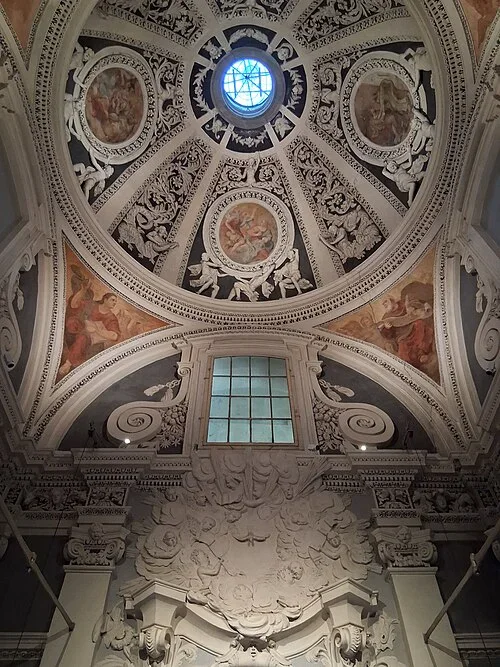 Valavičius and Exiles Chapels
The Valavičius Chapel Dome
This stuccoed dome, painted with the four evangelists, belongs to the cathedral's noble burial chapels. In the sixteenth and seventeenth centuries Lithuania's great families built chapels here as their own resting places, and the Valavičius chapel is the leading example. There are eleven side chapels in all. When Laurynas Gucevičius remodelled the cathedral, he unified their appearance, joining them with galleries and colonnades so the whole row reads as one design.
Listen in the appJodkovska · CC BY-SA 4.0
- 11
The Chapel of the Exiles
The quiet chapel that remembers the victims of the Soviet deportations.
- 12
The Royal Mausoleum in the Crypts
Royal tombs rediscovered after a flood, and the crowns hidden in 1939 that surfaced in 2024.
- 13
Lithuania's Oldest Fresco
The oldest wall painting in Lithuania, painted at the very moment of the country's conversion.
Vilnius Cathedral
Frequently asked questions
How much does the guide cost?
Free app download. Listed guide price: $0.99. Guide price shown in the app. Audio guide only. Venue admission is separate.
Can I listen without internet?
Yes. Download the guide’s audio, images, and maps in the app before your visit. Your downloaded content is then available offline.
Can I listen in my language?
This audio guide is available in 15 languages, including English.
Do I need to follow a schedule?
No. This is a self-guided experience. Choose your stops, pause whenever you like, and return to a story at your own pace.
At your own pace
Explore Vilnius Cathedral.
Download Stanza, then search for “Vilnius Cathedral”.
Free app download · Guide price shown in the app
Keep exploring
Audio guides — Lithuania
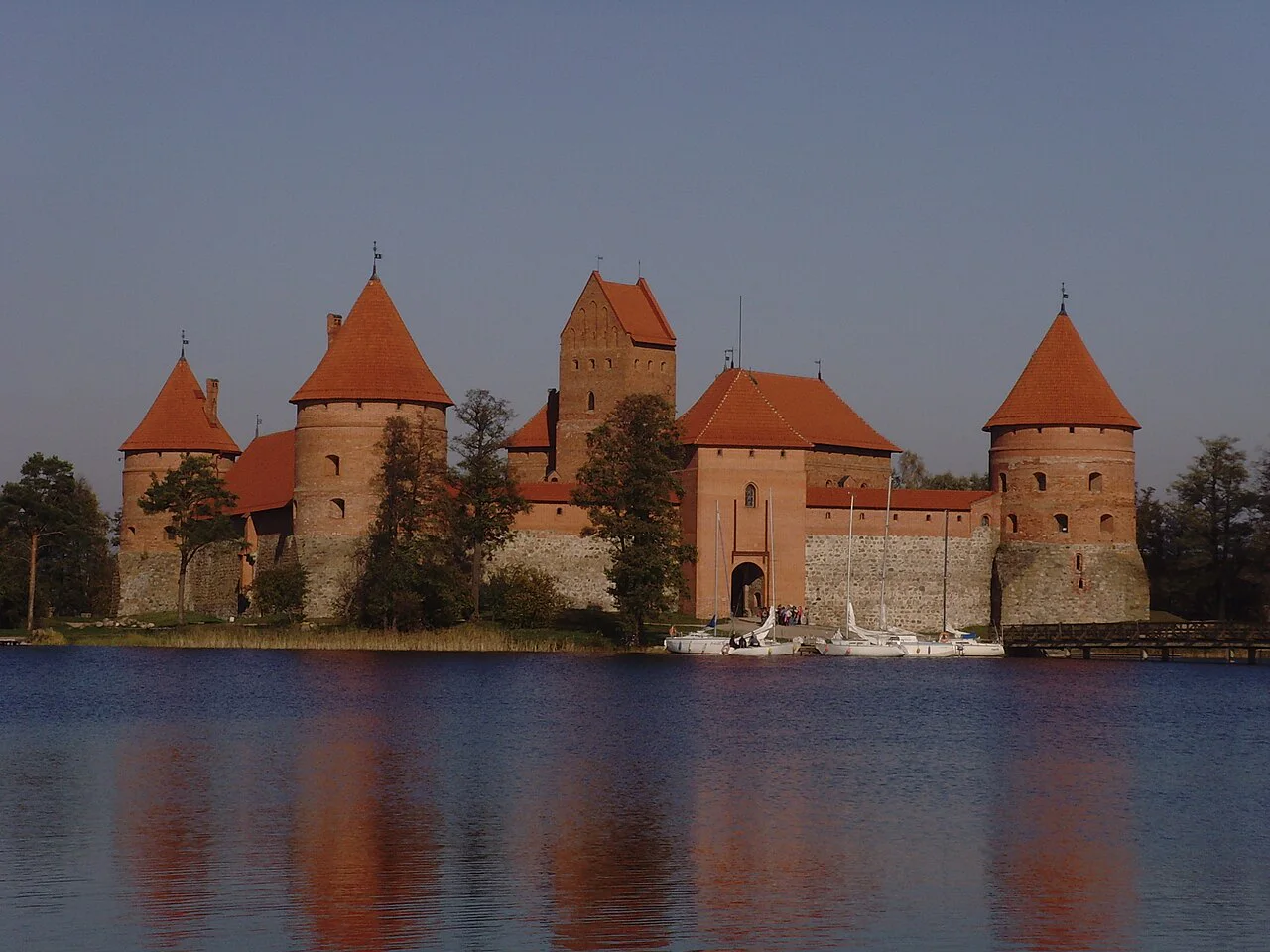
Trakai · 23 km
Trakai Island Castle
Content & sources
Ana · CC BY-SA 2.0
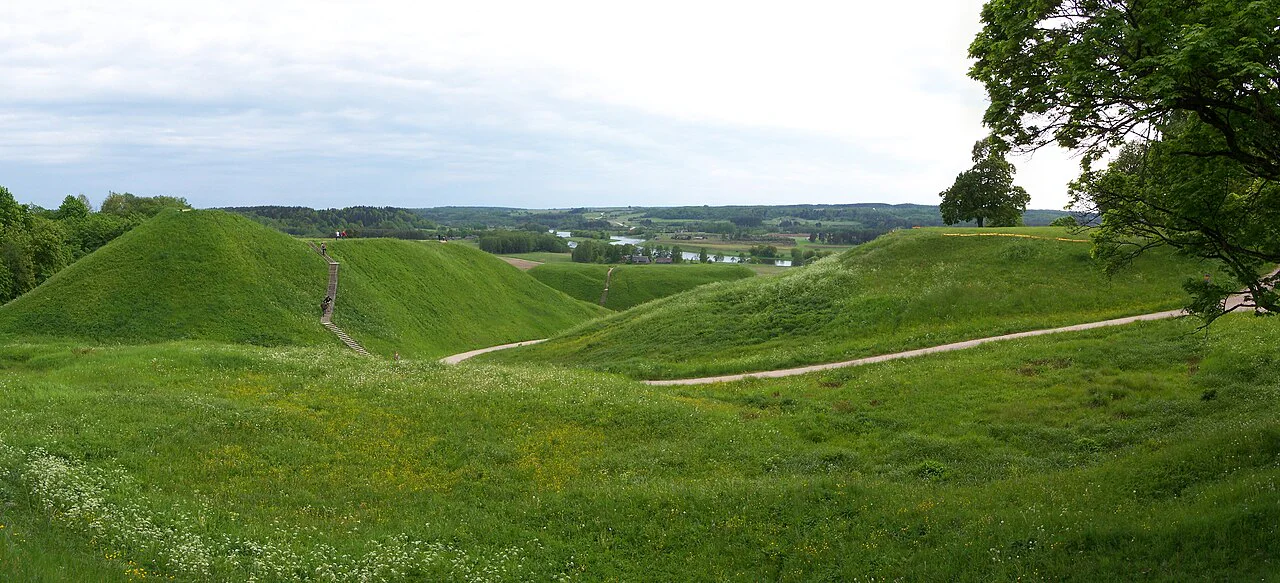
Kernavė · 36 km
Kernavė
Content & sources
Lestat (Jan Mehlich) · CC BY-SA 3.0
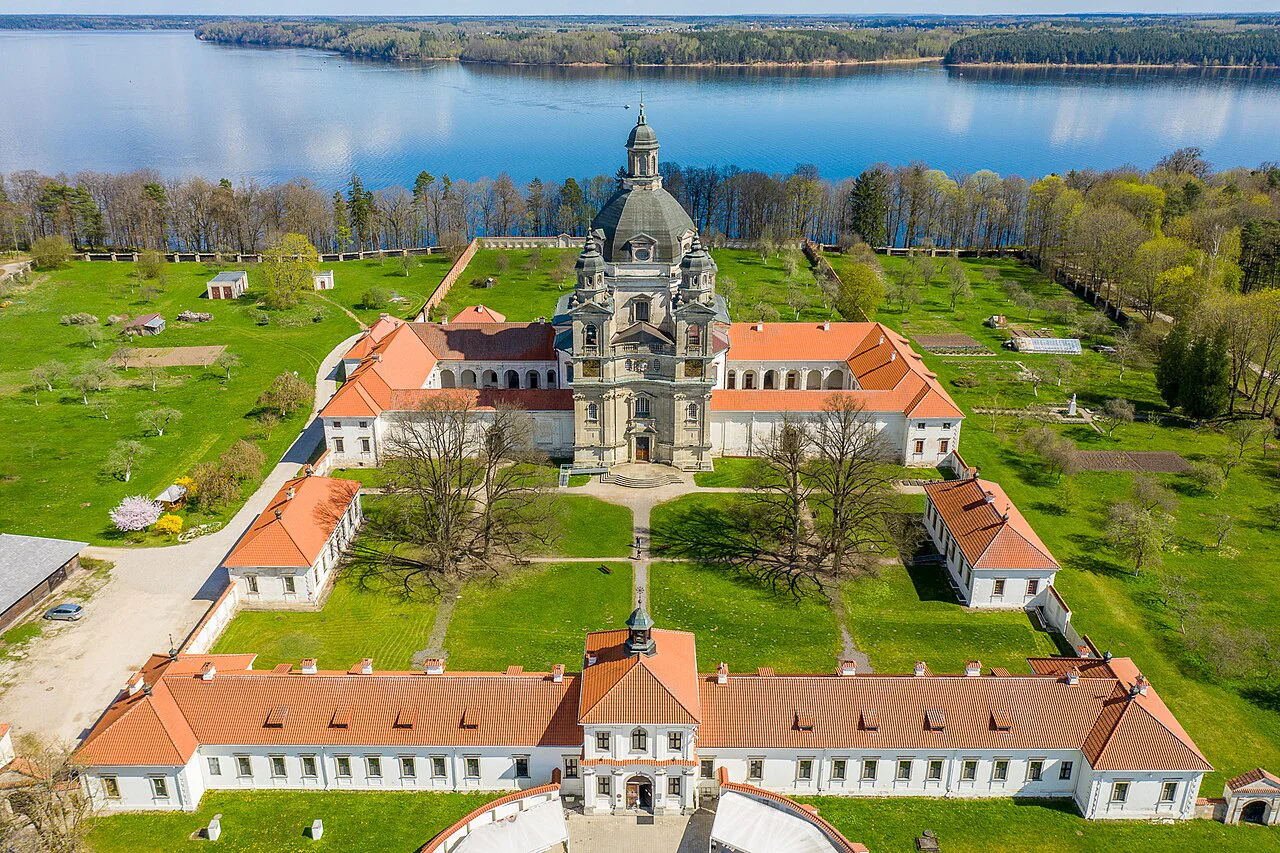
Kaunas · 84 km
Pažaislis Monastery
Content & sources
Augustas Didžgalvis · CC BY-SA 4.0
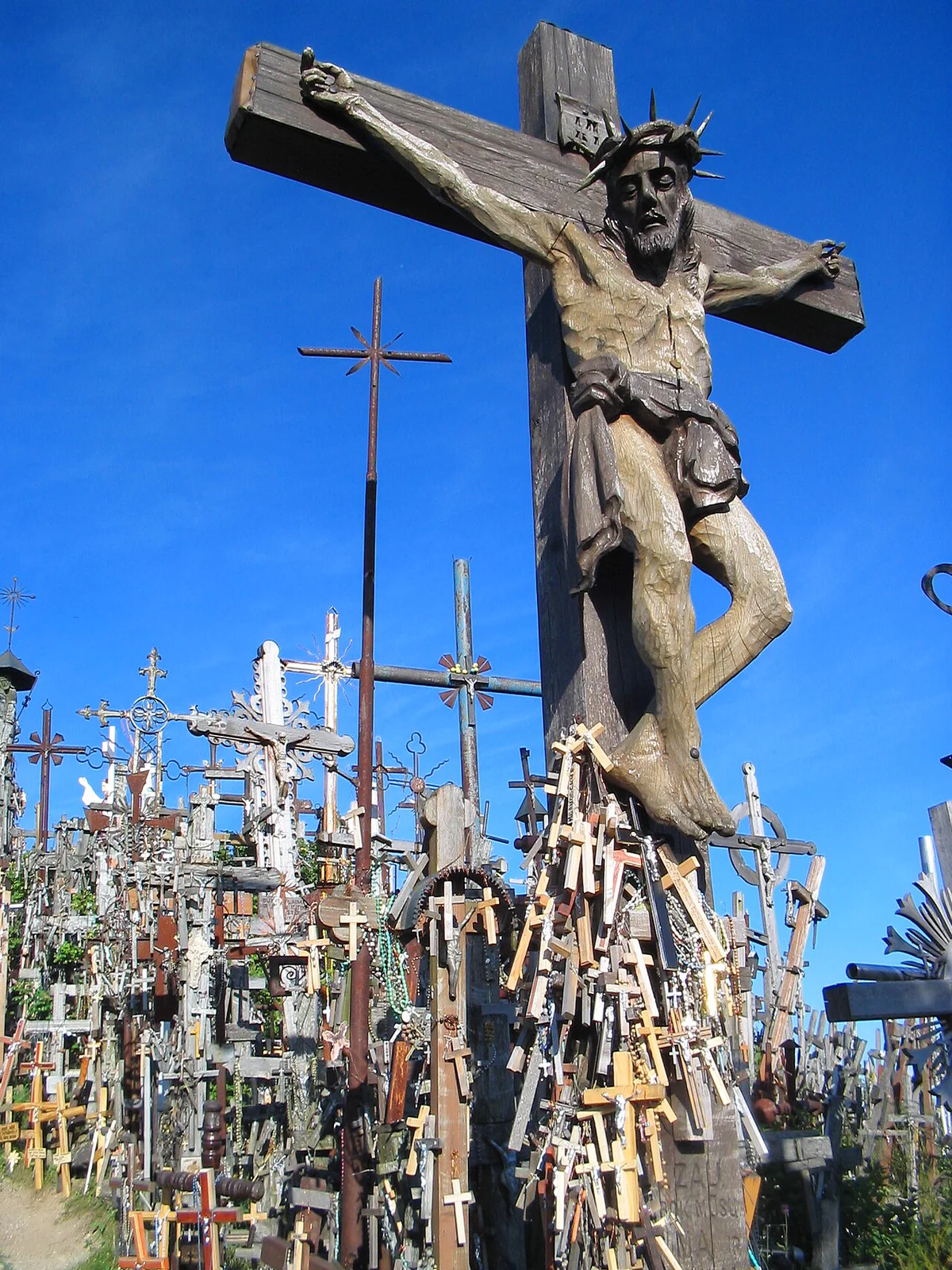
Jurgaičiai
Hill of Crosses
Content & sources
Thomas Stegh · CC BY-SA 3.0