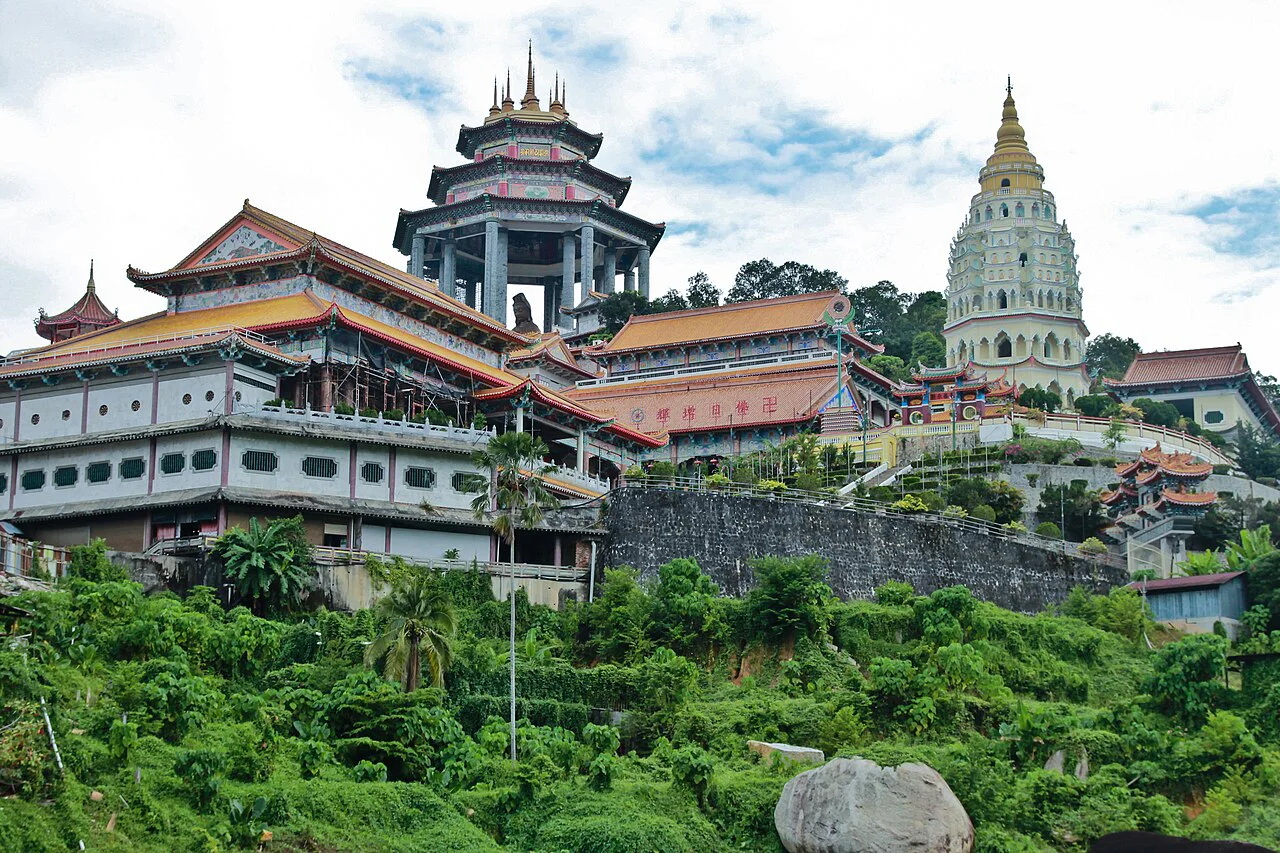
Stanza · Audio guide
Kek Lok Si Audio Guide
A place to remember. A story to take with you.
Kek Lok Si is the largest Buddhist temple in Malaysia. It serves as an important pilgrimage centre for Buddhists from across Southeast Asia.
Download Stanza, then search for “Kek Lok Si”.
About the tour
One guide. Your kind of visit.
Kek Lok Si is the largest Buddhist temple in Malaysia. It serves as an important pilgrimage centre for Buddhists from across Southeast Asia.
Ready when you are.
- 01Get the free Stanza app.
iOS & Android
- 02Find your guide.
“Kek Lok Si”
- 03Download before you go.
Works offline
Audio guide / 11 narrated stops
Inside the guide
Get to know a few of the stories before you go. Open a stop to read more.
01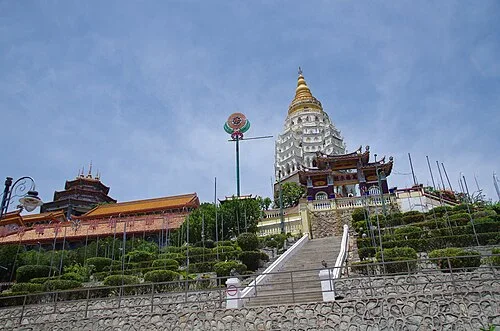 Covered Staircase Entrance at Air Itam
Welcome to Kek Lok Si, on the hillside at Air Itam on Penang island. It is the largest Buddhist temple complex in Malaysia, spreading across about thirty acres of slope. The name comes from Hokkien: kek-lok means supreme joy, a translation of the Sanskrit Sukhāvatī, the Pure Land of Buddhist teaching. Pilgrims travel here from Singapore, Hong Kong, the Philippines and across Southeast Asia. Most arrive the way generations of visitors have, by climbing a winding stairway up the hill. Its roofs shelter a whole street of little shops selling souvenirs, prayer beads and mementos. The climb is part of the journey, because the temple unfolds terrace by terrace above. From these lower steps, the golden crown of the pagoda is already visible among the trees.
Photo: Balou46 · CC BY-SA 4.0
02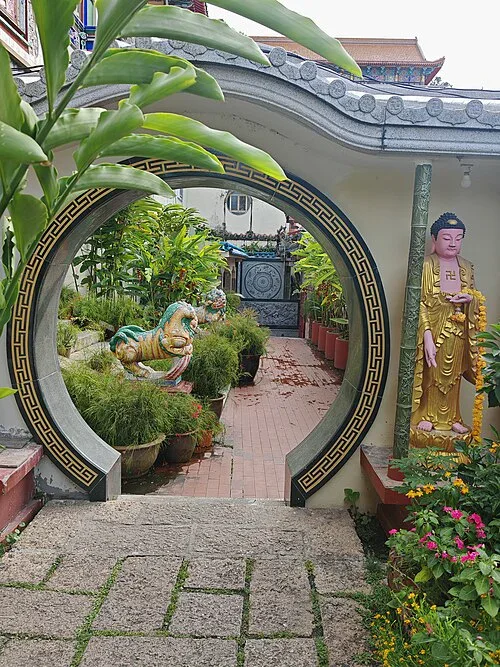 The Liberation Turtle Pond
Temple Garden and the Liberation Pond
On the way up the hill, the path passes a pond with a gentle name: the Liberation Pond. It belongs to a Buddhist practice called fang sheng, releasing captive animals as an act of merit-making. Turtles bought for the purpose are set free into the water, gaining merit for the giver and freedom for the animal, albeit a limited one. Merit-making sits at the heart of Buddhist devotion; a good deed done with pure intention earns spiritual credit. For pilgrims climbing toward the prayer halls, the pond is often their first act of devotion on the hill. All around, the temple's gardens hold fish ponds, flowers and round moon-shaped gateways like this one, framing the path in green.
Photo: Deepak-nsk · CC0
03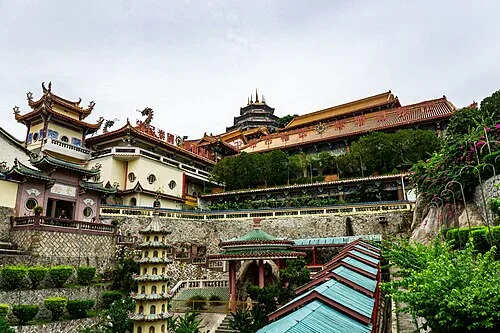 Lower Courtyard and Main Prayer Halls
Every temple starts with a piece of ground, and this one was given. In 1890 a Chan Buddhist monk named Beow Lean began building here. He had served at the Kushan Abbey in Fujian in China, and was chief monk at the Goddess of Mercy Temple on Pitt Street in George Town. The hills of Air Itam struck him as a spiritual place, facing the sea, and the spot was named Crane Mountain. The temple became a branch of the Buddhist Vatican at Drum Mountain in Fuzhou. A local man, Yeoh Siew Beow, donated the whole thirty-acre site. Five of Penang's leading Chinese businessmen, remembered as the Hakka tycoons, paid for the buildings, with Cheong Fatt Tze the most famous among them. Donors were honoured by dedicating structures and artefacts in their names. The main hall was finished in 1905, housing a shrine to Guanyin, the Goddess of Mercy. Worshippers said it resembled Amitabha Buddha's Western Paradise, the realm of supreme joy. That comparison gave the temple its name: Kek Lok Si.
Listen in the appPhoto: PenangLion · CC BY-SA 4.0
04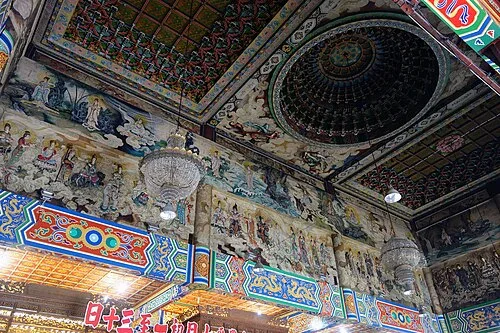 Lower Courtyard and Main Prayer Halls
Painted Ceiling of the Main Prayer Hall
Overhead, every surface is painted: rows of figures, coffered panels and a domed centre, all made for a hall of assembly and prayer. Halls like this once held a moment of imperial recognition. China's consular representative in Penang reported the new temple's grandeur to the Qing court. In 1904 the Guangxu Emperor invited Beow Lean to Beijing. The emperor bestowed on him seventy thousand volumes of psalms and other sacred works of Buddhism, though other accounts say seven thousand. He also granted edicts naming Beow Chief Priest of Penang, and declaring the temple at Air Itam head of all Chinese temples on the island. The abbot came home to a royal procession. The edict travelled in a rattan chair, the scriptures in pony-driven carts, with Penang's leading Chinese dignitaries in mandarin robes riding alongside.
Listen in the appPhoto: KQuhen · CC BY-SA 4.0
05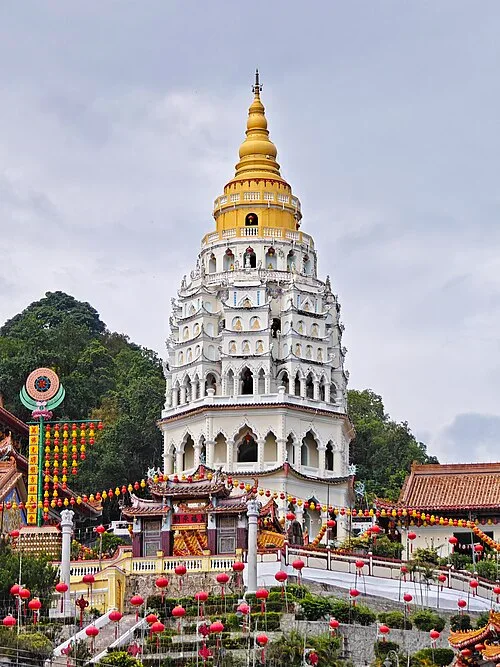 Ban Po Thar Pagoda (Pagoda of Ten Thousand Buddhas)
Ban Po Thar, the Pagoda of Ten Thousand Buddhas
Seven storeys rise toward a golden spiral crown. The pagoda is called Ban Po Thar, the Pagoda of Ten Thousand Buddhas, and it was completed in 1930. Work had begun some fifteen years earlier. The structure stands about thirty metres tall. Its design tells the story in three parts. The octagonal base is Chinese, the middle tier is Thai, and the spiral dome at the top is Burmese. That fusion mirrors the temple itself, where Mahayana and Theravada Buddhism meet. It also reflects the ethnic and religious diversity of the country. King Rama VI of Thailand laid the pagoda's foundation stone, so locals often call it the Rama Pagoda.
Listen in the appPhoto: DvTor8303 · CC0
06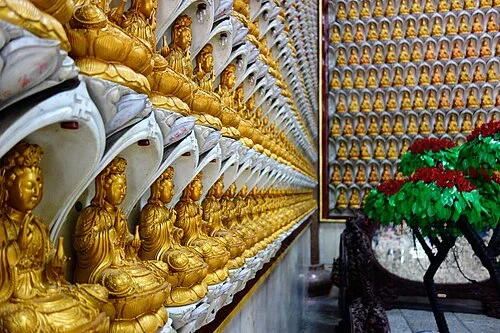 Ban Po Thar Pagoda (Pagoda of Ten Thousand Buddhas)
Wall of the Ten Thousand Buddhas
Inside, the pagoda earns its name. Walls of niches hold rows of seated Buddhas in alabaster and bronze, ten thousand statues in all. The idea of ten thousand Buddhas belongs to the Chinese Mahayana school of Buddhism. Yet the king who laid this pagoda's foundation, Rama VI, ruled over a Theravada country, so the two traditions meet again here. Later, another Thai king deepened the connection. King Bhumibol of Thailand donated a large statue of Buddha that is enshrined within the pagoda. Two generations of Thai royal patronage rest under this roof.
Listen in the appPhoto: KQuhen · CC BY-SA 4.0
07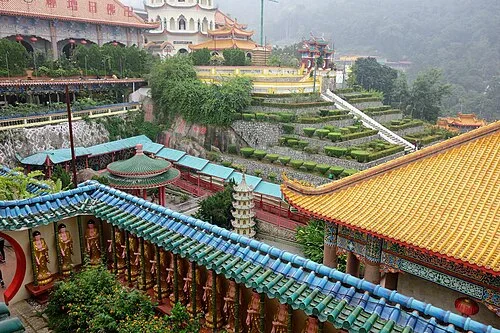 Middle Hill Terrace and Zodiac Garden
Middle Hill Terrace
From this terrace, the temple's shape makes sense: a hillside built in layers. Prayer halls, pavilions, fish ponds and flower gardens climb the slope, joined by covered walkways with bright tiled roofs. Monks and nuns live here permanently in a monastery on the grounds. To carry pilgrims up the later tiers, two lanes of inclined elevators run uphill, linked by an electric buggy service. Devotion takes many forms: counting prayer beads, burning incense, cash offerings, or simply bowing and clapping to let a deity know one has arrived. Higher up the terraces, statues of the twelve animals of the Chinese zodiac stand among the shrines. This is a working monastery as much as a monument.
Listen in the appPhoto: KQuhen · CC BY-SA 4.0
08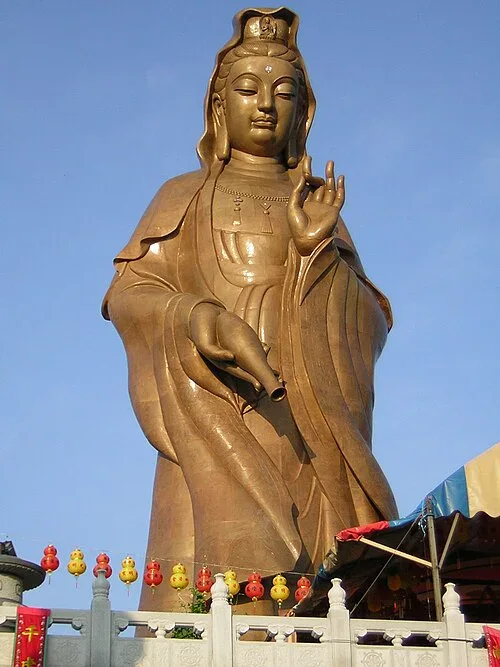 Giant Bronze Guanyin Statue & Octagonal Pavilion
Giant Bronze Guanyin Statue
The bronze figure on the hillside above the pagoda is Guanyin, the Goddess of Mercy. Completed in 2002, she stands just over thirty metres tall. At the time, only one Guanyin statue in the world was taller. She replaced an earlier statue in white plaster, which had been damaged by fire a few years before. She stands on a lotus base. In one hand she holds a vessel pouring holy water; the other hand is raised in a gesture of protection. Worshippers come to her especially with prayers for children, and women hoping to conceive beseech her by name. Around the great statue, one hundred smaller Guanyins, each two metres tall, keep her company.
Listen in the appPhoto: Flying Pharmacist · CC BY-SA 3.0
09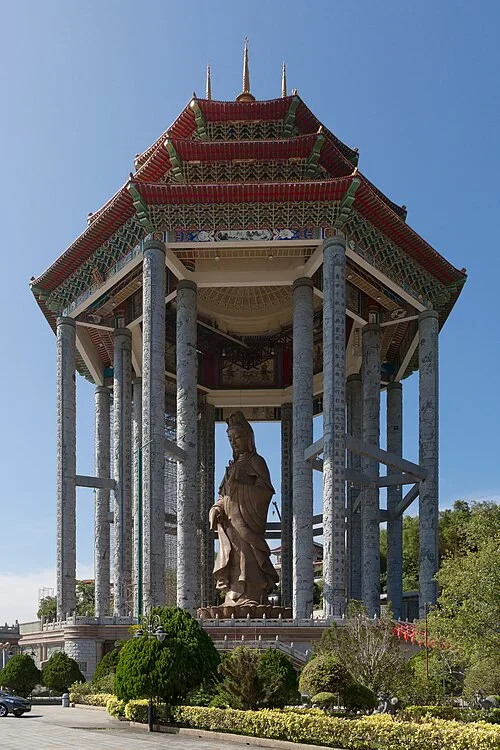 Giant Bronze Guanyin Statue & Octagonal Pavilion
Octagonal Pavilion over the Guanyin
The shelter above the statue is an engineering feat in its own right. It is octagonal, with three tiers of roof, and it reaches about sixty-one metres. Sixteen columns of bronze carry the whole structure. It was finished in 2009, seven years after the statue it protects. A hilltop is an exposed place for a colossal bronze figure, so the open-sided pavilion guards her from sun and rain while leaving her visible from far below. There is a quieter story in its height, too. The pavilion was deliberately kept lower than it might have been, so that its shadow would never fall on the nearby Penang State Mosque.
Listen in the appCEphoto, Uwe Aranas · CC BY-SA 3.0
10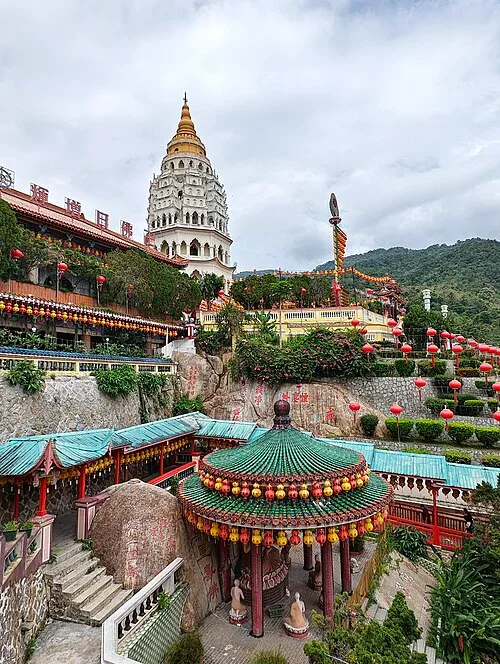 Summit Viewpoint & Annual Light Festival
Panoramic View over the Complex
From high ground, the whole enterprise comes into view. What began as a single main hall grew across forty years of building into this sprawling complex of temples, gardens and towers. The place is still alive, and still vulnerable. On a morning in October 2021, fire broke out and engulfed one of the temple buildings. By the time firefighters arrived, flames had taken hold, and about seventy percent of that building was destroyed. No one was hurt, and the cause was never determined. The temple repaired what burned and carried on, as it has through more than a century of change.
Listen in the appPhoto: Hweimeng · CC BY-SA 4.0
- 11
The Temple Illuminated: Closing Reflection
Thirty nights of lanterns after Chinese New Year, when the whole hillside becomes a sea of donated light.
Kek Lok Si
Frequently asked questions
How much does the guide cost?
Free app download. Listed guide price: $0.99. Guide price shown in the app. Audio guide only. Venue admission is separate.
Can I listen without internet?
Yes. Download the guide’s audio, images, and maps in the app before your visit. Your downloaded content is then available offline.
Can I listen in my language?
This audio guide is available in 15 languages, including English.
Do I need to follow a schedule?
No. This is a self-guided experience. Choose your stops, pause whenever you like, and return to a story at your own pace.
At your own pace
Explore Kek Lok Si.
Download Stanza, then search for “Kek Lok Si”.
Free app download · Guide price shown in the app
Keep exploring
Audio guides — Malaysia
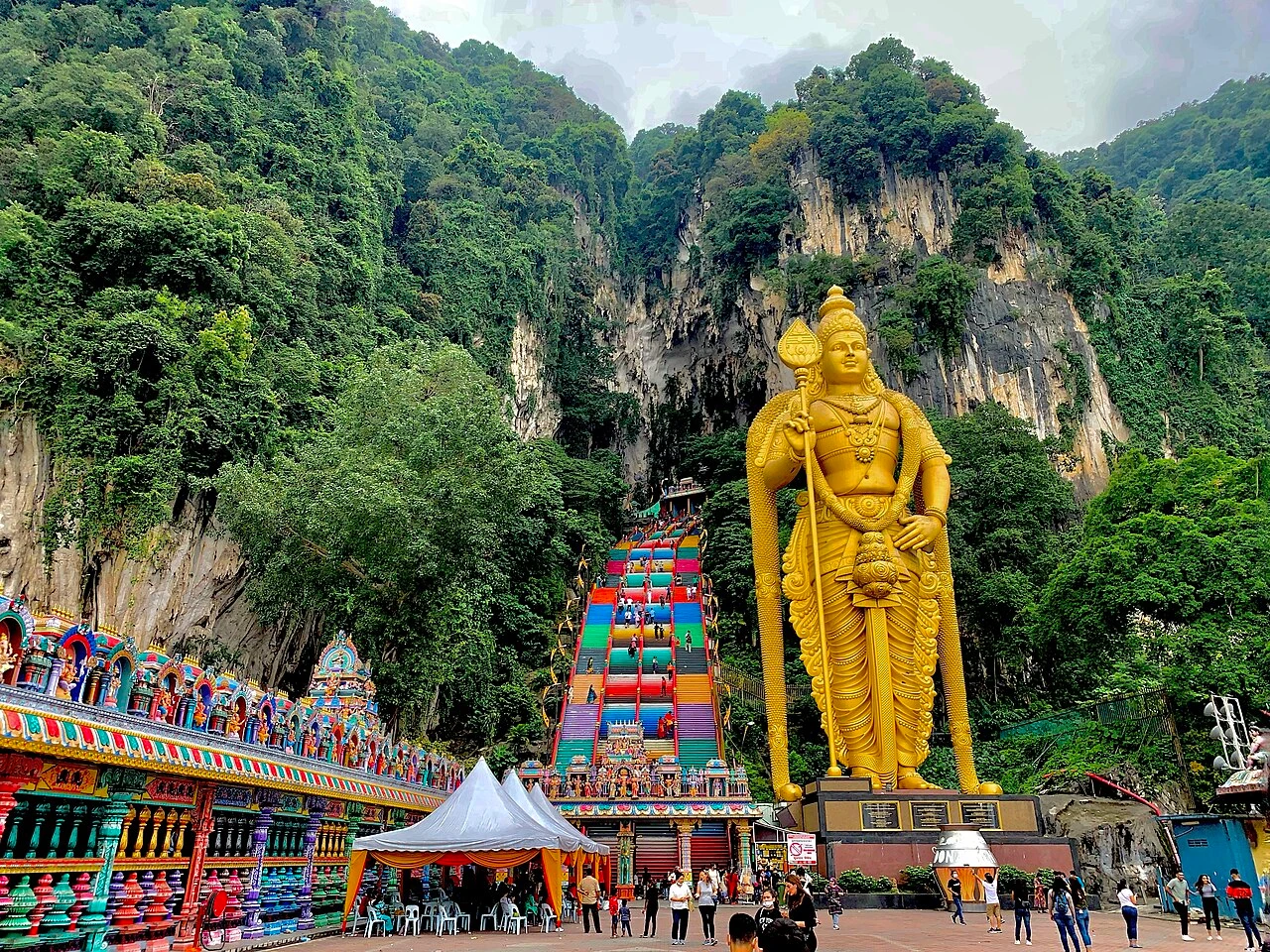
Kuala Lumpur
Batu Caves
Content & sources
Photo: Chainwit. · CC BY-SA 4.0
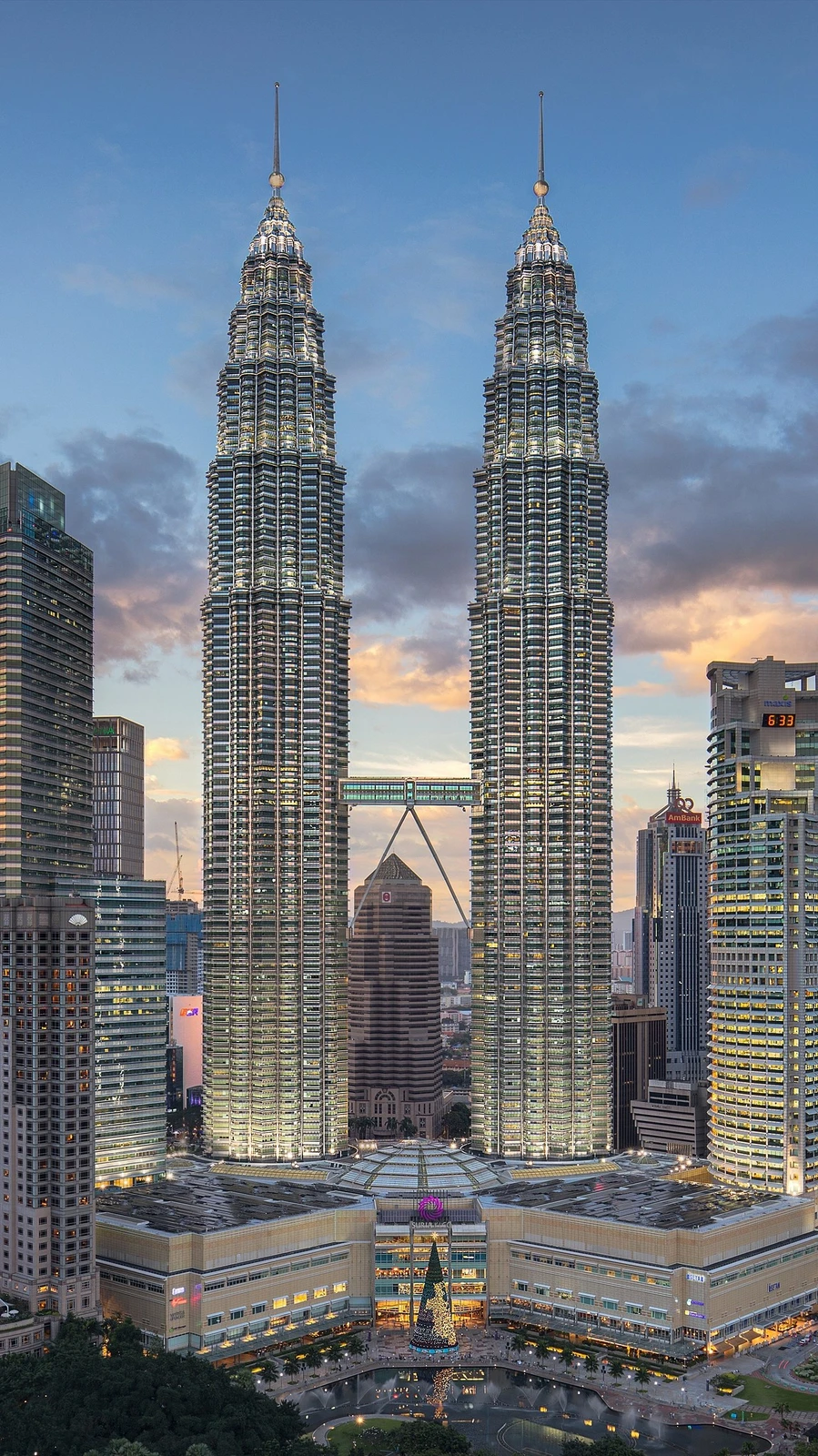
Kuala Lumpur
Petronas Towers
Content & sources
James Kerwin from Tbilisi · CC BY 2.0
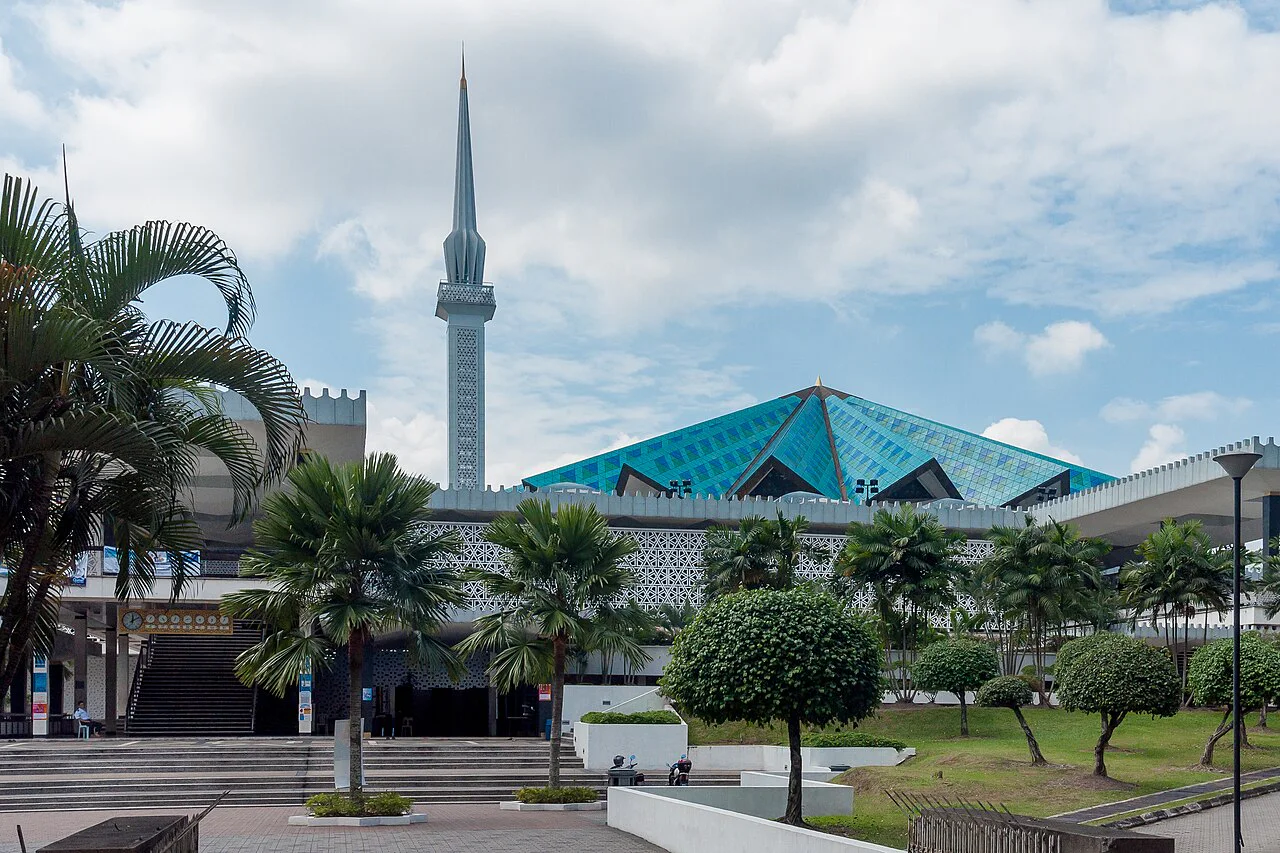
Kuala Lumpur
National Mosque of Malaysia
Content & sources
CEphoto, Uwe Aranas · CC BY-SA 3.0