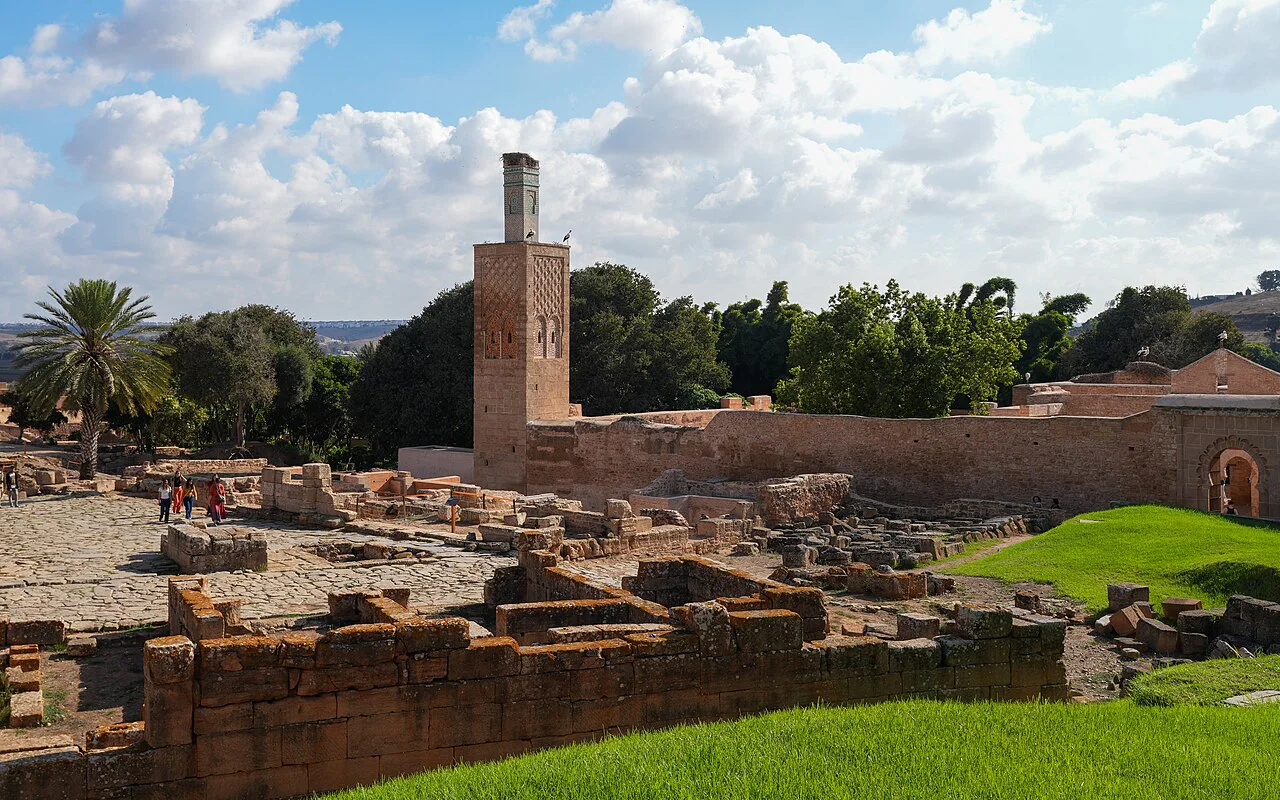
 Stanza / Audio guide
Content & sources
Stanza · Audio guide
Chellah Audio Guide
A place to remember. A story to take with you.
Chellah is a medieval fortified necropolis and ancient archaeological site in Rabat, Morocco. It is located on the south side of the Bou Regreg estuary.
Download Stanza, then search for “Chellah”.
About the tour
One guide. Your kind of visit.
Chellah is a medieval fortified necropolis and ancient archaeological site in Rabat, Morocco. It is located on the south side of the Bou Regreg estuary.
Ready when you are.
- 01Get the free Stanza app.
iOS & Android
- 02Find your guide.
“Chellah”
- 03Download before you go.
Works offline
Audio guide / 12 narrated stops
Inside the guide
Get to know a few of the stories before you go. Open a stop to read more.
01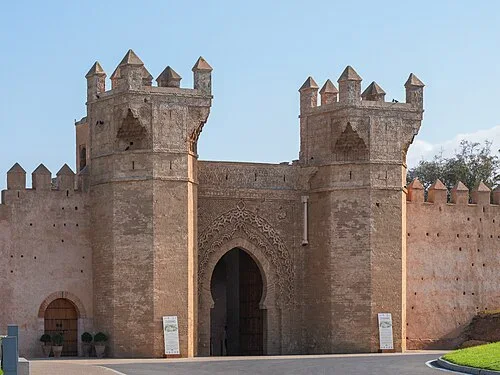 The Monumental Marinid Gate
Welcome to Chellah, on the edge of Rabat, where two cities lie stacked in one walled ground. Below are the ruins of Sala Colonia, a Roman port town. Above them, the Marinid sultans of the fourteenth century built a royal burial sanctuary. The gate ahead was their statement. Abu Sa'id Uthman II began it, and his son Abu al-Hasan finished it in July 1339. An inscription on the gate records that date, and calls the whole complex a ribat, a fortified religious retreat. The walls around the site are rammed earth, packed layer by layer in the old Moroccan way. They form a rough pentagon, pierced by three gates and studded with defensive towers. Each tower hides three levels inside. The most monumental of the gates is this one, built in brick and cut stone. Through it, the sultans turned ruined Roman ground into sacred ground. The visit ahead crosses both cities at once.
This Photo was taken by Timothy A. Gonsalves. Feel free to use my photos, but please mention me as the author. I would much appreciate if you send me an email tagooty@yahoo.com or write on my talk page, for my information. Please contact me before commercial use. Please do not upload an edited image here without consulting me. I would like to make corrections only at my own source to ensure that the changes improve the image and are preserved.Otherwise you may upload an edited image with a new name. Please use one of the templates derivative or extract. · CC BY-SA 4.0
02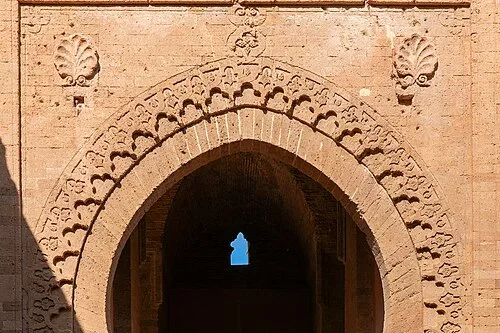 The Monumental Marinid Gate
Inside the Main Gate
The carvers gave this gate their best work. A pointed horseshoe archway forms the opening, and around it run two polylobed arch motifs, arches scalloped into soft lobes. The spandrels, the triangular corners above the arch, are filled with leafy arabesque patterns, each centred on a carved shell. A rectangular frieze called an alfiz frames the whole composition, carrying a Kufic inscription in angular Arabic letters that records the gate's construction. The design follows a lineage. Earlier Almohad builders raised monumental gates in Rabat, such as Bab er-Rouah, and the Marinids learned from them. The flanking towers rise on semi-octagonal bases, then shift to square turrets, the corners eased with muqarnas, the honeycomb carving beloved of Moroccan masters. Inside, the passage bends through a right angle. Anyone charging in would face a wall, not an open road. The inner face repeats the outer decoration, in a quieter key.
This Photo was taken by Timothy A. Gonsalves. Feel free to use my photos, but please mention me as the author. I would much appreciate if you send me an email tagooty@yahoo.com or write on my talk page, for my information. Please contact me before commercial use. Please do not upload an edited image here without consulting me. I would like to make corrections only at my own source to ensure that the changes improve the image and are preserved.Otherwise you may upload an edited image with a new name. Please use one of the templates derivative or extract. · CC BY-SA 4.0
03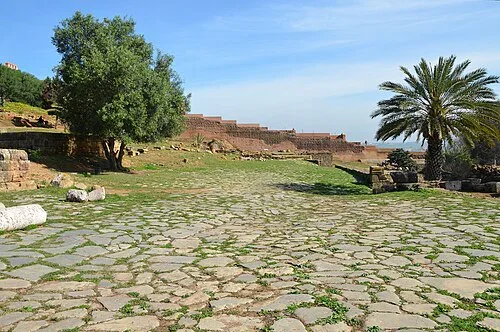 Decumanus Maximus of Sala Colonia
The Decumanus Maximus
More than a thousand years before any sultan, this paved street was the spine of a city. The Romans called it the decumanus maximus, the principal roadway of Sala Colonia. The story begins earlier still. Phoenician sailors worked down this Atlantic coast, and the settlement here was known as Shalat, a name that seems to come from the Punic word for rock. Jean Boube, who led the modern excavations, found neo-Punic objects from around the third century BC, evidence of a small trading post. Fragments of bowls reach back further, to the seventh century BC, though those may have arrived as trade goods rather than proof of settlers. The town later belonged to the kingdom of Mauretania, whose last kings ruled as clients of Rome. After King Ptolemy died in 40 AD, Rome annexed the region outright, creating the province of Mauretania Tingitana. Sala Colonia grew into a port on the Atlantic. Roman ships called here on the southwestward run toward Anfa and the purple island of Mogador. It was one of only two naval outposts on the province's coast. By the mid-second century, inscriptions show, the city held the rank of a municipium.
Listen in the appCarole Raddato from FRANKFURT, Germany · CC BY-SA 2.0
04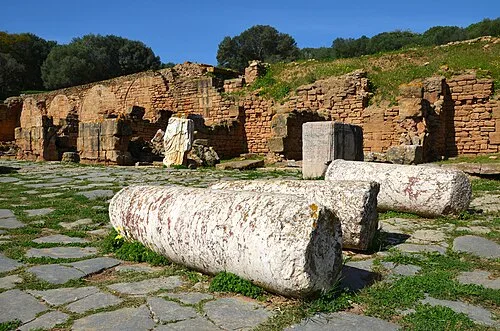 Decumanus Maximus of Sala Colonia
The Nine Shops
Shops lined the principal street, as they did in every Roman town. A row of nine vaulted chambers, called tabernae, opened onto a street beside the forum. Their vaulted ceilings formed part of the structure behind them. Marble columns have toppled across the flagstones, lying where they fell. This was the commercial heartbeat of Sala Colonia, goods and gossip passing under the arcade. And the ground is still giving up its secrets. In November 2023, a team of Moroccan archaeologists working outside the Marinid walls announced a first for the country. They uncovered a Roman port district, the first ever found in Morocco, dating from the early centuries of Roman rule. With it came a vaulted columbarium, a burial chamber of niches, and a life-sized statue of a goddess, headless, the first of its kind unearthed in the country in decades. The map of this city is still being redrawn.
Listen in the appCarole Raddato from FRANKFURT, Germany · CC BY-SA 2.0
05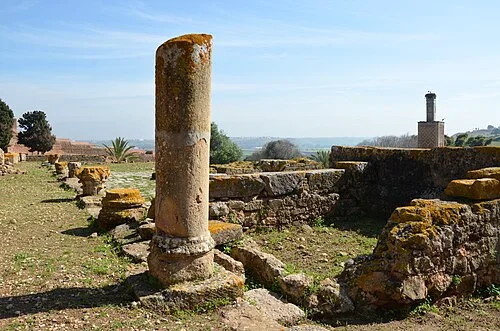 The Roman Forum and Capitolium
The Capitolium Temple
The largest building in this part of the Roman city stood here, and its dedication tells you what mattered. This was the capitolium, the official temple of the Capitoline triad, Jupiter, Juno and Minerva, the state gods of Rome. The temple rose on two levels, a rectangle of about forty-eight by twenty-six metres, with rounded corners on its western side. Inscriptions found on the site confirm it was built in the time of the emperor Hadrian, and it may have been inaugurated around 120 AD. The upper temple stood on a podium, ringed on three sides by a portico of thirty-two columns. Those upper walls have since collapsed. Below, vaulted chambers opened onto the paved area, forming the temple's substructure. What makes the building remarkable is who paid for it. Not the state, and not the emperor. A private citizen, a military official named Gaius Hosidius Severus, funded the whole temple and gifted it to the people of the city. Civic pride ran deep in this provincial port.
Listen in the appCarole Raddato from FRANKFURT, Germany · CC BY-SA 2.0
06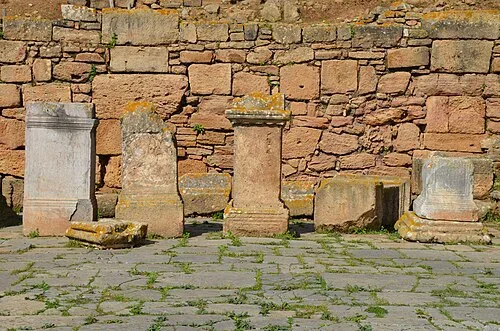 The Roman Forum and Capitolium
The Forum
Public life in Sala Colonia was written in stone, literally. The forum at the eastern end of the excavated city was its civic square. Along it stand the bases of honorary inscriptions, pedestals once dedicated to emperors and to the great magistrates of the city. Honour here was a physical thing, carved, erected, and seen by everyone who crossed the plaza. Beside the forum, on higher ground, stands a puzzle. A structure there holds five cellae, five chambers for deities, and nobody agrees how old it is. Jean Boube dated it to the mid-first century BC, which would make it Mauretanian, built before Rome annexed the region. Statues of the client kings Juba II and Ptolemy were found nearby, and Boube suggested the temple honoured them. Other archaeologists argued it belongs to the Roman period instead. More recent studies have swung back toward a pre-Roman date, based on the building techniques themselves. The argument is still open, and the temple keeps its secret.
Listen in the appCarole Raddato from FRANKFURT, Germany · CC BY-SA 2.0
07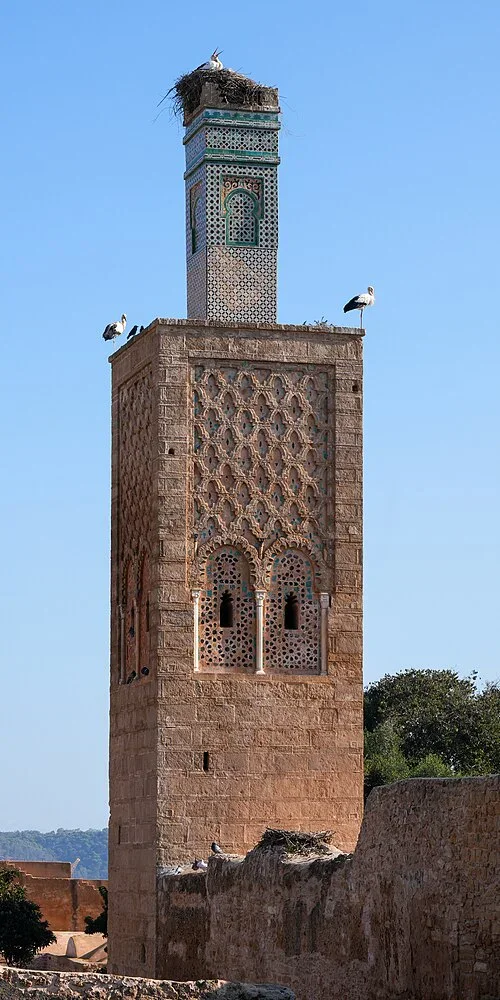 Marinid Mosque and Stork Minaret
The Minaret of the Khalwa
Beyond the Roman ruins, the ground changes character. This is the khalwa, the sacred enclosure the Marinids built around their dead. It holds a mosque, a college, a cemetery with mausoleums and several courtyards, crowded together by generations of building. Rising over it all is the minaret, about fifteen metres tall, visible from most of the site. Its shaft is square, in the traditional Moroccan manner. Each facade carries a sebka, a dense woven net of interlacing arches, set above two blind polylobed arches with small windows. The empty spaces inside the pattern are filled with zellij, the glazed mosaic tilework that glows green and blue against the stone. Scholars credit the minaret, and the college beside it, most likely to Sultan Abu Inan, though the evidence is not conclusive. And on the summit live the site's most famous residents. White storks nest at the top of the tower and in the trees around, and their colony has become an emblem of Chellah.
Listen in the appThis Photo was taken by Timothy A. Gonsalves. Feel free to use my photos, but please mention me as the author. I would much appreciate if you send me an email tagooty@yahoo.com or write on my talk page, for my information. Please contact me before commercial use. Please do not upload an edited image here without consulting me. I would like to make corrections only at my own source to ensure that the changes improve the image and are preserved.Otherwise you may upload an edited image with a new name. Please use one of the templates derivative or extract. · CC BY-SA 4.0
08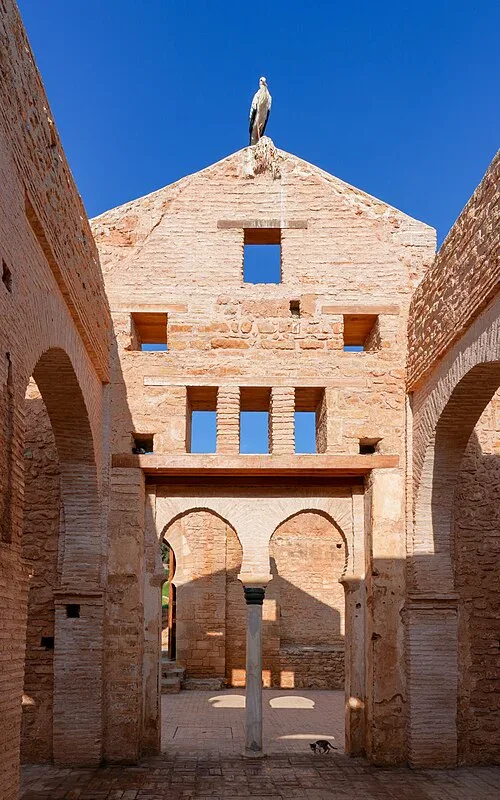 Marinid Mosque and Stork Minaret
The Madrasa of the Zawiya
The building beside the minaret was a place of learning and prayer. Two surviving inscriptions call it a zawiya, a Sufi religious house. Most scholars read it as a madrasa, an Islamic college, and its layout fits. An elongated rectangular courtyard holds a pool at its centre, fed by two small fountains at either end. A portico of marble columns once ringed the courtyard, though the columns are gone now. Behind the portico ran rows of small rooms, the sleeping quarters for students, with staircases up to a similar floor above. The courtyard was paved with intricate zellij, some of which survives. At one end, a doorway leads to the prayer hall, and in its back wall a mihrab marked the direction of Mecca. Unusually, a narrow passage runs right around the mihrab and behind it. It may have let pilgrims circumambulate the niche, walking around it as a devotional act. Then the silence came. The necropolis declined from the early fifteenth century, and it was pillaged soon after by a pretender to the throne. The Lisbon earthquake of 1755 damaged many of the remaining structures, and Chellah fell into ruin.
Listen in the appThis Photo was taken by Timothy A. Gonsalves. Feel free to use my photos, but please mention me as the author. I would much appreciate if you send me an email tagooty@yahoo.com or write on my talk page, for my information. Please contact me before commercial use. Please do not upload an edited image here without consulting me. I would like to make corrections only at my own source to ensure that the changes improve the image and are preserved.Otherwise you may upload an edited image with a new name. Please use one of the templates derivative or extract. · CC BY-SA 4.0
09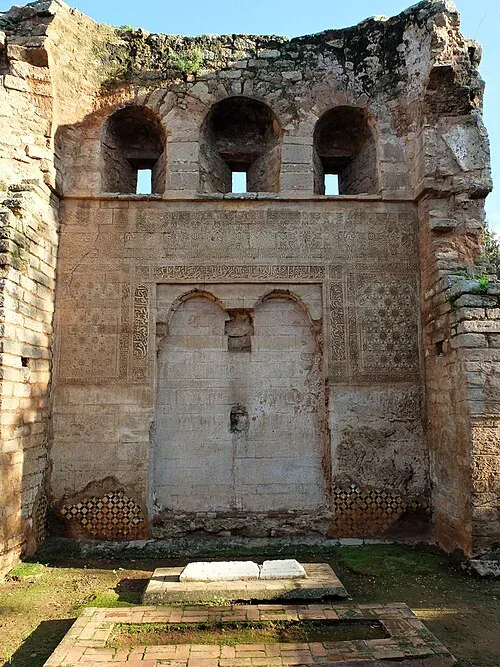 The Royal Necropolis and Mausoleum
Mausoleum of Sultan Abu al-Hasan
Abu al-Hasan, remembered as the Black Sultan, took the Marinid throne in 1331. He chose to be buried here, among the Roman ruins his family had walled into a sanctuary. His wife Shams al-Duha, the mother of his successor Abu Inan, was buried in the necropolis in 1349. Abu al-Hasan died in exile in 1351, and his body was brought back to lie near her. The ruined mausoleum standing here is his. It was probably his son who finished it, and Abu Inan also set up a charitable endowment, a waqf, to pay for the complex's running. Of all the tombs at Chellah, this one carries the richest carving. Its walls are covered in low-relief stone decoration, with verses from the Qur'an framed in friezes, and mosaic tilework once lined the lower walls. The marble tombstones themselves are no longer here. They were moved for safekeeping to the Museum of History and Civilizations in Rabat, where they remain. What stands in the enclosure is the mausoleum's shell.
Listen in the appPhoto: R Prazeres · CC BY-SA 4.0
10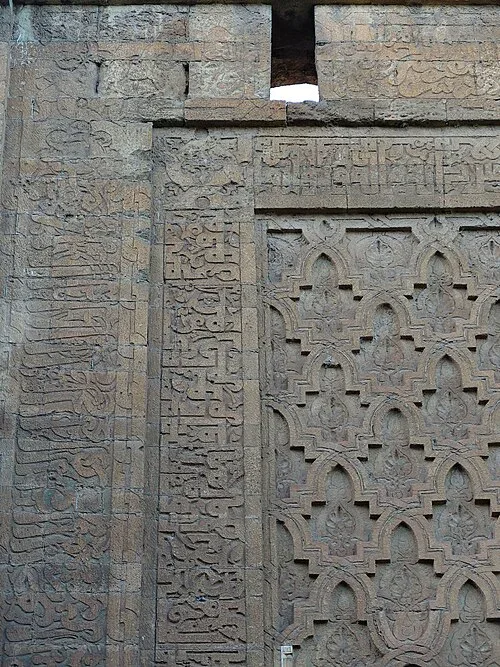 The Royal Necropolis and Mausoleum
Words Carved in Stone
Marinid stonemasons made inscriptions an art form, and this carved wall shows their craft. Bands of Arabic script weave through geometric carving, prayer and ornament on a single surface. Their finest works are the maqabriyyas, marble tombstones shaped like long triangular prisms, laid flat over the grave and carved with the dead person's names, titles and burial. One of them, kept in the Rabat museum, has travelled further than any stone should. It began as a Roman slab in Hispania Baetica, in southern Spain. Its back still bears a Roman inscription naming Aulus Caecina Tacitus, a governor of the province in the second half of the third century. Later the stone was reused for an Umayyad fountain in Cordoba, probably in the early eleventh century. Then it crossed to North Africa, and the Marinids carved the other face with the funerary inscription of Sultan Abu Ya'qub Yusuf. One slab, three civilisations, each carving over the last.
Listen in the appPhoto: R Prazeres · CC BY-SA 4.0
- 11
The Sacred Eel Pool
The Spring of Paradise, its dark pool of eels, and the gentle fertility legend of Lalla Chella.
- 12
The Sanctuary Gardens
Gardens, UNESCO listing and jazz festivals, the sanctuary's newest chapter after two millennia of layers.
Chellah
Frequently asked questions
How much does the guide cost?
Free app download. Listed guide price: $0.99. Guide price shown in the app. Audio guide only. Venue admission is separate.
Can I listen without internet?
Yes. Download the guide’s audio, images, and maps in the app before your visit. Your downloaded content is then available offline.
Can I listen in my language?
This audio guide is available in 15 languages, including English.
Do I need to follow a schedule?
No. This is a self-guided experience. Choose your stops, pause whenever you like, and return to a story at your own pace.
At your own pace
Explore Chellah.
Download Stanza, then search for “Chellah”.
Free app download · Guide price shown in the app
Keep exploring
Nearby audio guides
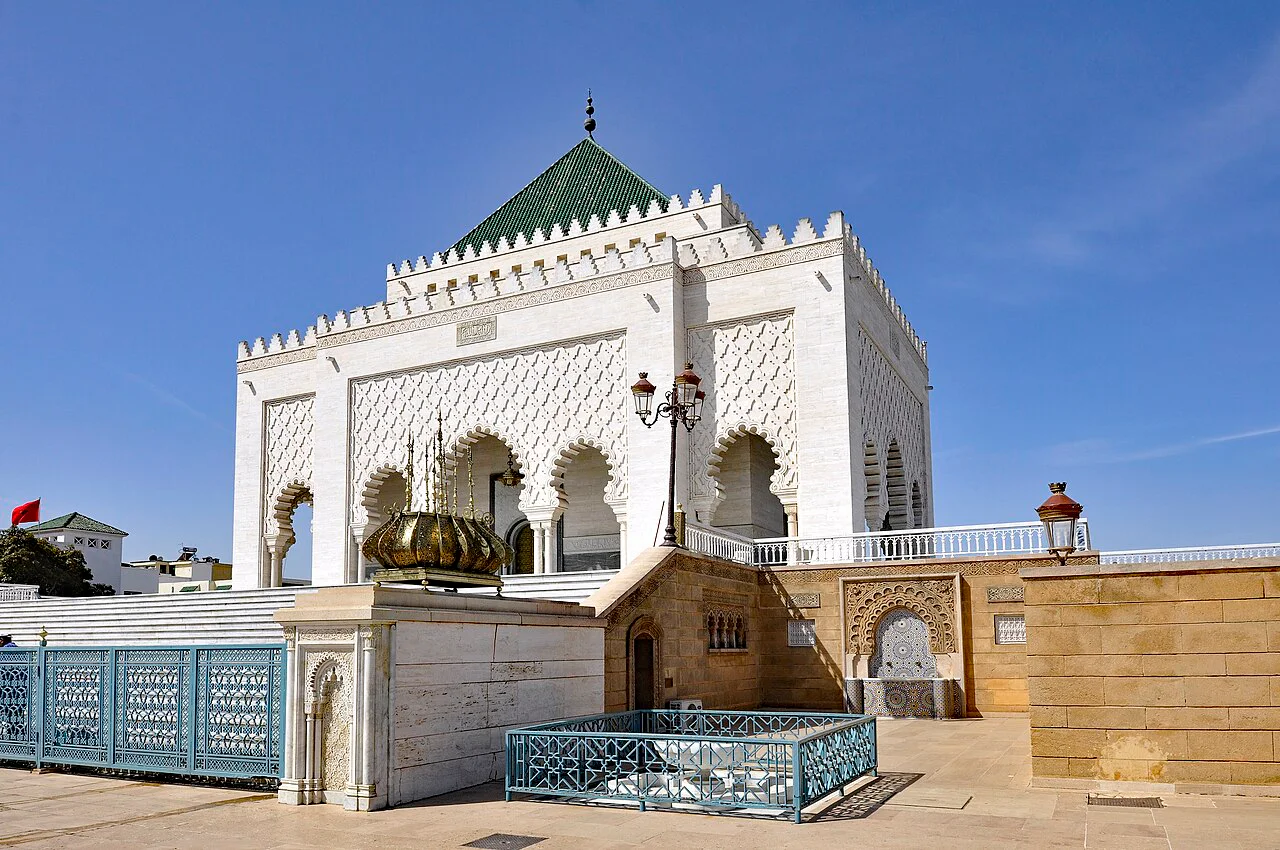
Rabat · 2 km
Mausoleum of Mohammed V
Content & sources
P. Hughes · CC BY 4.0
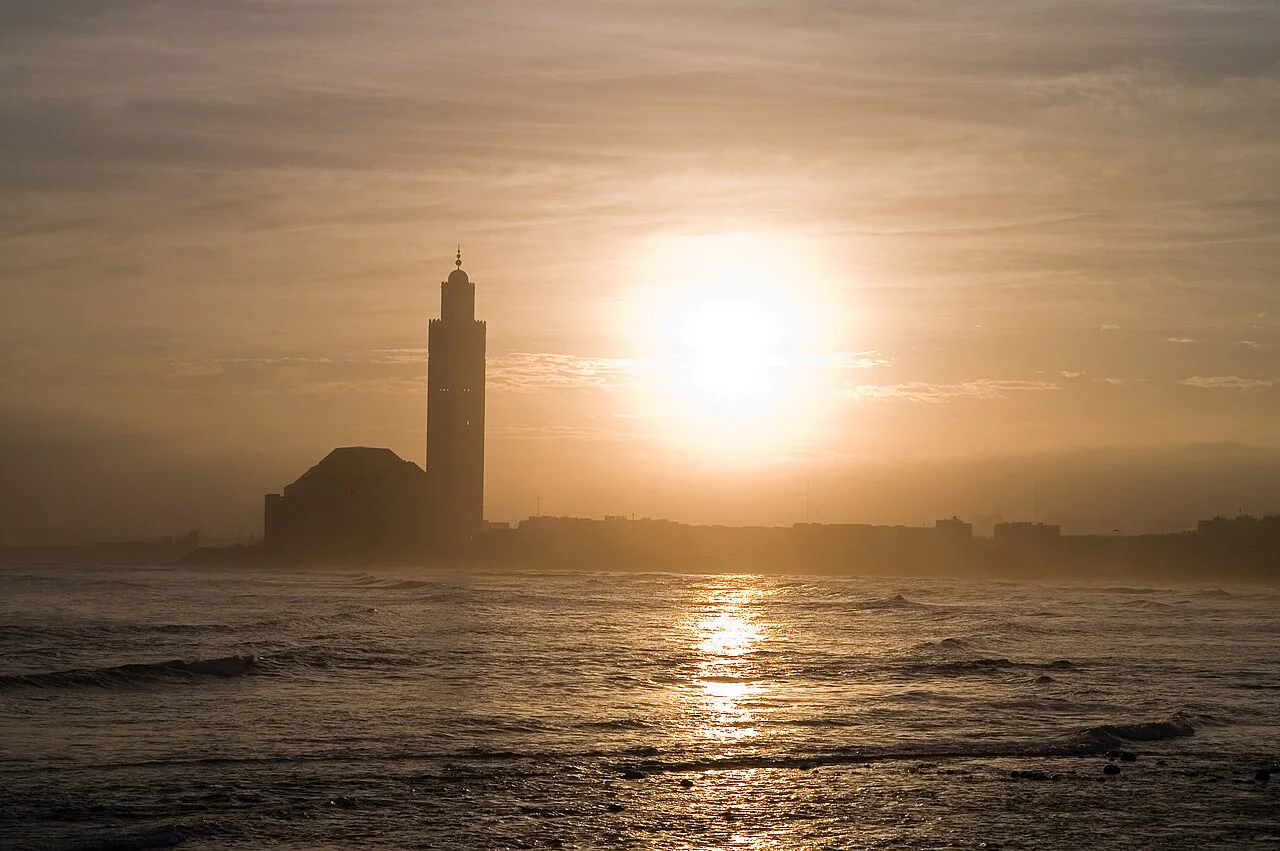
Casablanca · 87 km
Hassan II Mosque
Content & sources
Milamber's portfolio · CC BY 2.0
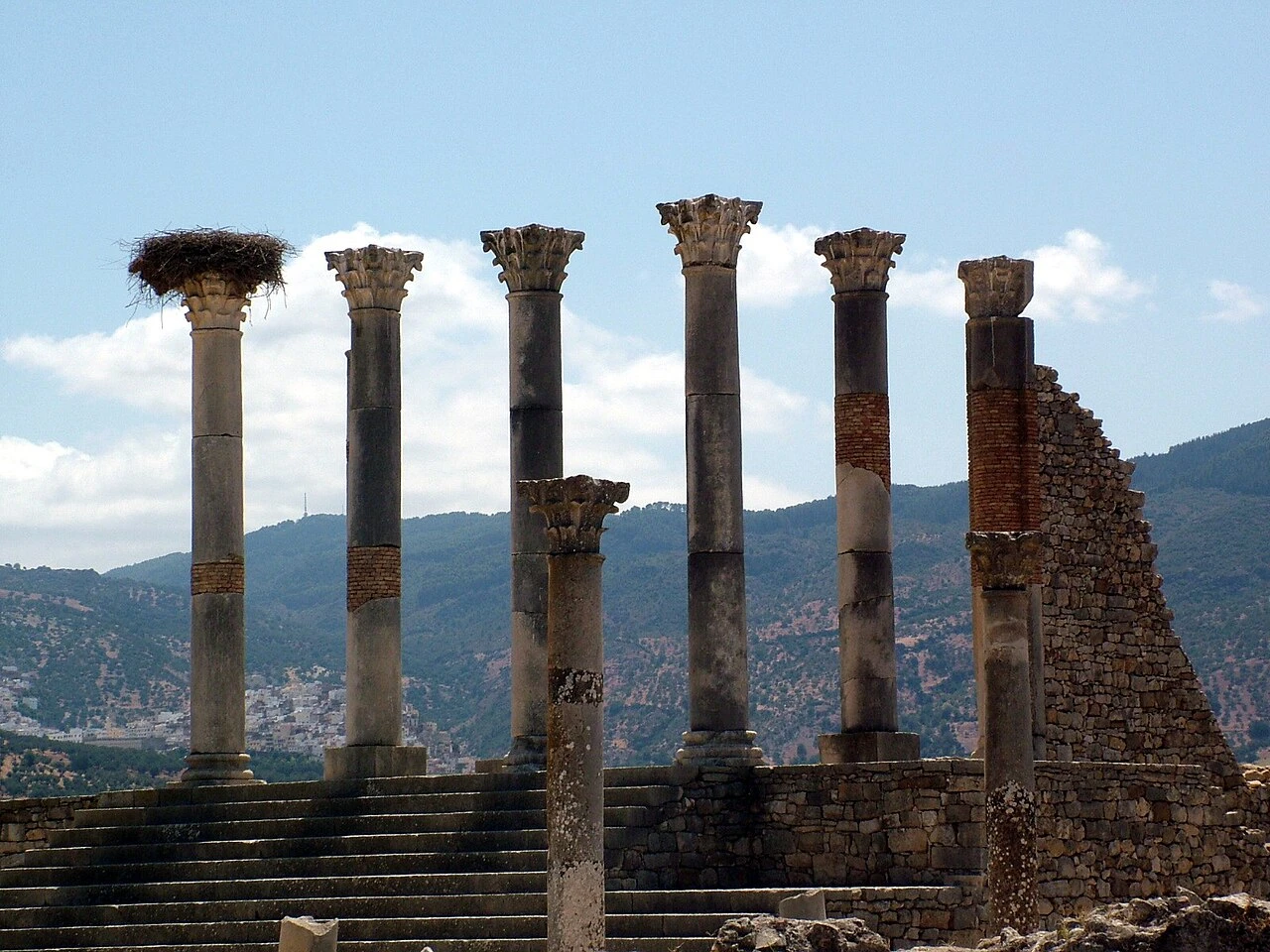
Volubilis · 117 km
Volubilis
Content & sources
Marcin Sochacki (Wanted) · CC BY-SA 4.0
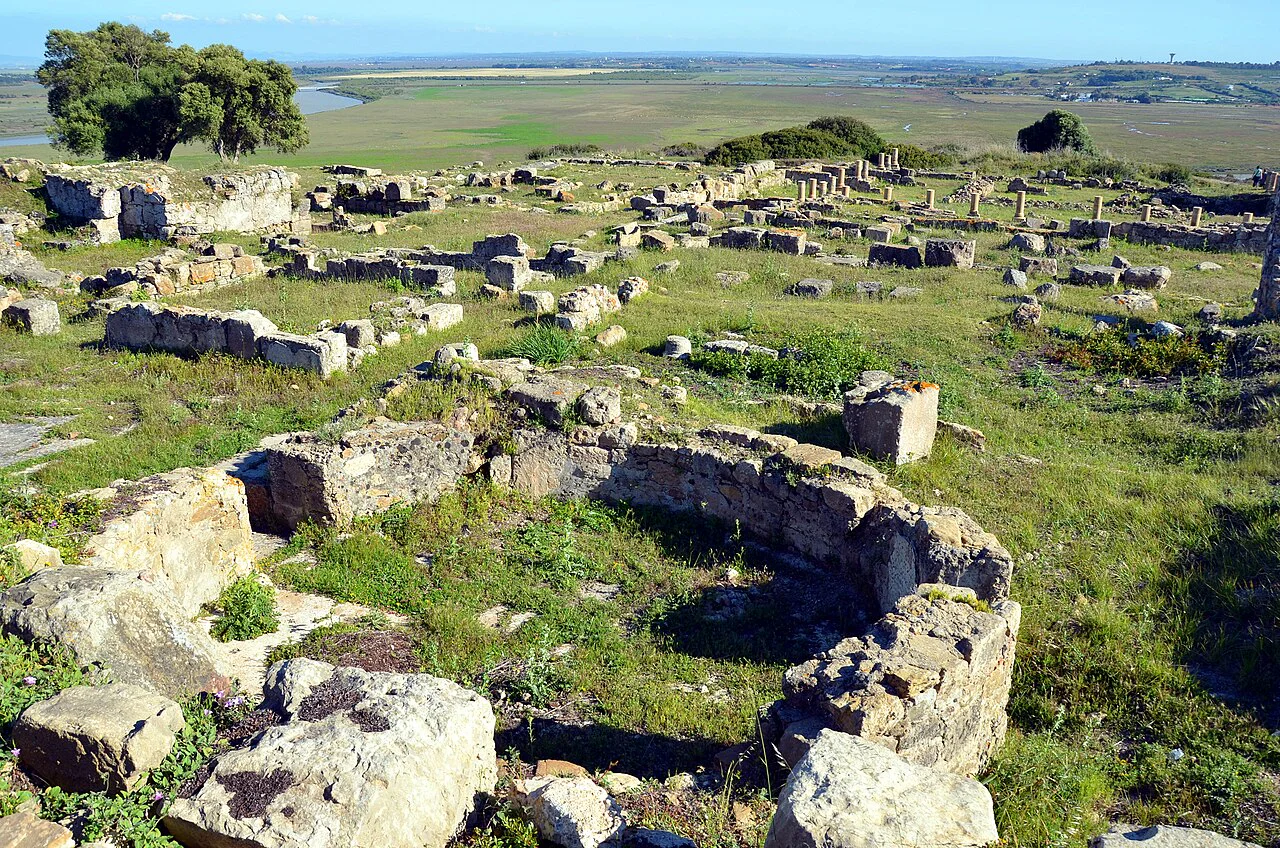
Larache · 148 km
Lixus
Content & sources
Maxim Massalitin / Maxim Massalitin · CC BY-SA 2.0