 Stanza / Audio guide
Content & sources
Stanza · Audio guide
Swayambhunath Audio Guide
A place to remember. A story to take with you.
Swayambhunath is an ancient religious architecture complex atop a hill in the Kathmandu Valley, revered by both Buddhists and Hindus. It is widely known as the 'Monkey Temple' due to the large population of…
Download Stanza, then search for “Swayambhunath”.
About the tour
One guide. Your kind of visit.
Swayambhunath is an ancient religious architecture complex atop a hill in the Kathmandu Valley, revered by both Buddhists and Hindus. It is widely known as the 'Monkey Temple' due to the large population of rhesus macaques inhabiting the site.
Ready when you are.
- 01Get the free Stanza app.
iOS & Android
- 02Find your guide.
“Swayambhunath”
- 03Download before you go.
Works offline
Audio guide / 13 narrated stops
Inside the guide
Get to know a few of the stories before you go. Open a stop to read more.
01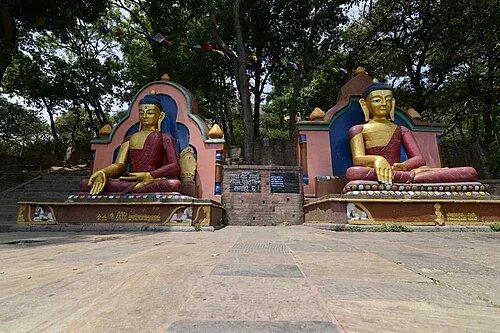 Eastern Base & Buddha Statues
The Eastern Base: Approach to the Self-Arisen Hill
Welcome to Swayambhunath, the ancient Buddhist sanctuary crowning a hill west of Kathmandu. The name means self-arising, or self-sprung, and the hill is venerated as the home of the primordial Buddha, the Adi-Buddha. Two large seated Buddha statues mark the start of the climb, painted in deep red and gold. Pilgrims have been coming up this hill for well over a thousand years. A damaged stone inscription records that King Vrsadeva ordered work here in 640 CE, and kings before and after him followed. For Buddhists, this ranks among the most ancient and important stupas anywhere, a place said to have hosted Buddhas of the past. In 1979 its outstanding value was recognised, and Swayambhunath joined the Kathmandu Valley's World Heritage listing. The climb ahead is old, and so is everything at the top of it.
Jorge Láscar from Melbourne, Australia · CC BY 2.0
02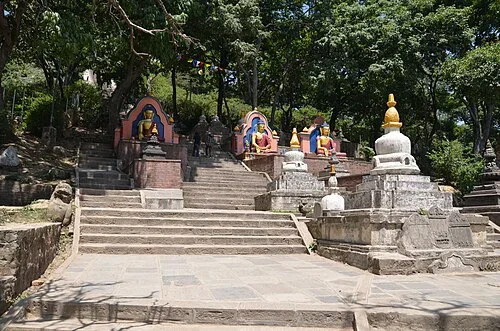 The 365-Step Pilgrimage Stairway
The Pilgrimage Stairway
The way up is a long stone stairway, rising through forest with small white shrines along the sides. The eastern staircase was commissioned in the seventeenth century by King Pratap Malla of Kathmandu. For pilgrims, the climb is part of the devotion, earned step by step under the trees. They share the slope with families of wandering monkeys, resident on the hill for as long as anyone remembers. The monkeys are so much a part of the place that the sanctuary is widely nicknamed the Monkey Temple. Locals treat them as part of the hill's sacred character, residents rather than intruders. Climb at a pilgrim's pace, and the forest does its work.
jt Guan · CC BY 3.0
03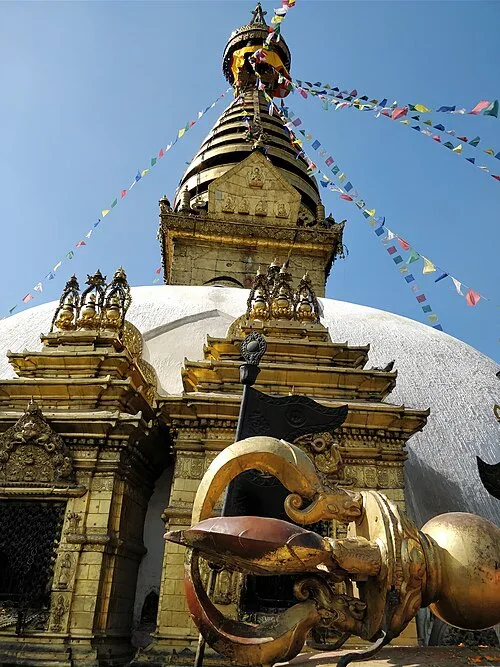 The Crest & The Great Vajra
The Great Vajra at the Crest
At the top of the stairway, the first sight is not the stupa. It is a monumental bronze thunderbolt, gilded and laid across a platform, greeting every pilgrim who finishes the climb. Behind it, the great white dome rises with its golden spire, prayer flags strung from its crown to the trees. The thunderbolt sits at the head of the eastern stairway, so the order of arrival is deliberate. The pilgrim passes the vajra first, then steps onto the summit terrace where the whole sanctuary opens out. The stupa beyond is the destination of the entire climb.
Listen in the appPhoto: Harsh Mahaseth · CC BY-SA 4.0
04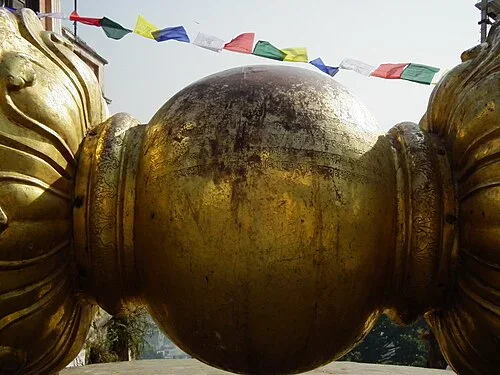 The Crest & The Great Vajra
The Vajra: Thunderbolt of Indestructible Truth
The great thunderbolt under the flags is a vajra, the central symbol of Vajrayana Buddhism. It stands for spiritual power that cannot be destroyed, and for truth hard as a diamond. In the scriptures of this tradition, the vajra cuts through illusion the way a thunderbolt splits the sky. The round platform beneath it is a mandala, a map of the sacred cosmos in bronze and brass. Set at the threshold of the summit, it marks the point where the ordinary hill ends and the sanctuary begins. Its gilded surface is worn dull in places, touched by countless hands and years of mountain air.
Listen in the appS Pakhrin from DC, USA · CC BY 2.0
05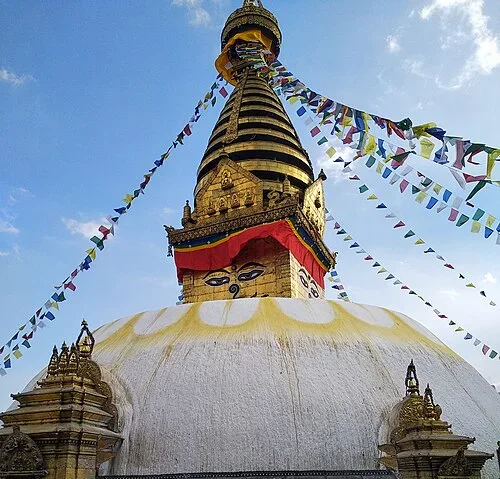 The Central Stupa & All-Seeing Eyes
The Main Stupa: Dome over the Self-Arisen Light
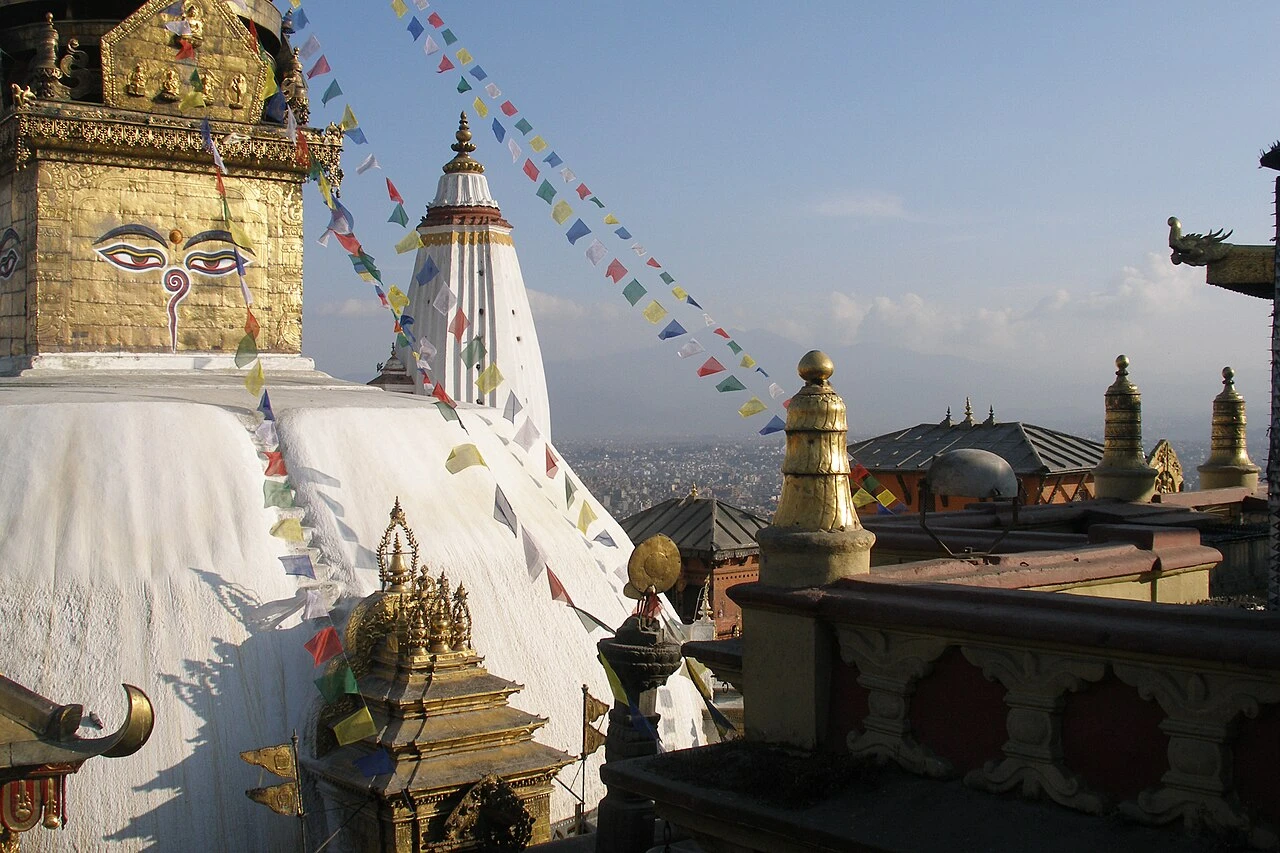
The great stupa rises in three parts, each with a meaning. The hemispherical dome sits at the base, rising directly from the path where pilgrims circle it. Above it stands the cubical structure painted with eyes, and above that, thirteen gilded bronze rings called the Trayodashabhuvana, the thirteen steps, standing for the thirteen stages on the way to nirvana. The founding story is told in the Swayambhu Purana. Kassapa Buddha returned to India and preached about the self-arisen light of this hill, and the king of Gaud, Prachandadev, came to see it. Prachandadev desired to build a great stupa to protect the light, so he concealed it beneath the dome, leaving only the stupa visible. He sought ordination from a devotee of Manjushri, became a monk, and established the stupa with its rites around it. In Vajrayana understanding, the dome represents the void from which the universe is created, so the whole monument is a picture of creation itself.
Listen in the appRohit Sharma · CC BY-SA 4.0
06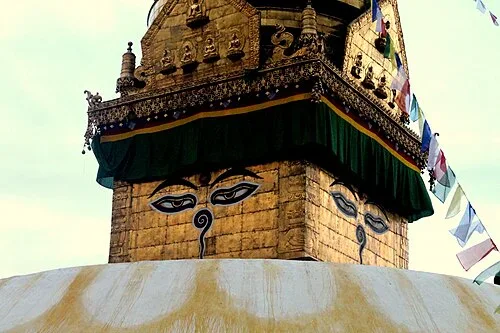 The Central Stupa & All-Seeing Eyes
The All-Seeing Eyes
Painted on the cube at the dome's crown, the Eyes of the Buddha gaze out in all four directions at once. Nothing escapes them, wherever in the world a watcher stands. Between the eyes curls a mark that looks like a question mark, traditionally read as the Nepali number one, a sign of unity. The gold around them is newer than it looks. In May 2010 the stupa was completely renovated, its first major renewal since 1921. The shrine was re-gilded using about twenty kilograms of gold, in a project begun in June 2008 and funded by the Tibetan Nyingma Meditation Center of California. That is why the harmika gleams the way it does today.
Listen in the appPhoto: Subhayabaal · CC BY-SA 3.0
07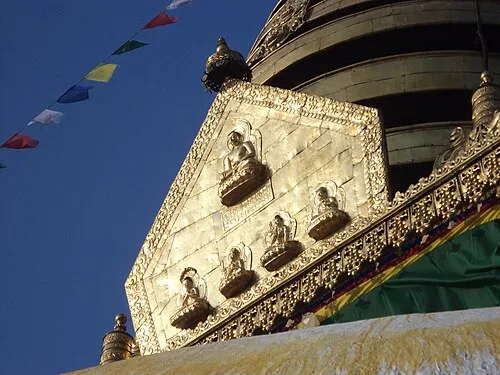 The Five Dhyani Buddha Niches
The Five Dhyani Buddhas
Around the dome's perimeter stand shrines to the five meditating Buddhas, the Dhyani Buddhas: Vairocana, Akshobhya, Ratnasambhava, Amitabha and Amoghasiddhi. Rows of their gilded seated figures cover the tier above the dome's base, each in its own niche. They are not historical teachers but celestial Buddhas of meditation, each facing a direction of the cosmos. The valley's creation legend explains why they belong here. When the thousand-petaled lotus bloomed with eternal light, the Five Great Buddhas appeared on its rays, one on each differently coloured beam. The shrines around the dome place that light permanently in bronze and gold.
Listen in the appPhoto: SuyogyaRT · CC BY-SA 4.0
08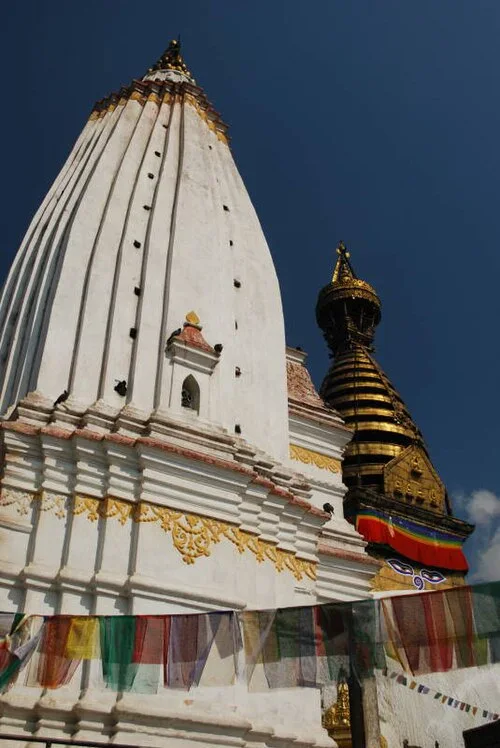 Pratappur and Anantapur Shikhara Temples
The Shikhara Temples of Pratap Malla
Beside the golden stupa soars a white tower in Hindu shikhara style, its curved spire climbing to a gilt finial. It was raised by Pratap Malla, the powerful Hindu king of Kathmandu, in the seventeenth century. His eastern stairway was already met on the climb, and this tower completes his mark on the hill. A Hindu king building Hindu temples inside a Buddhist complex was no accident. Numerous Hindu monarchs have long paid homage at Swayambhunath, and the shikhara towers stand here by design. Their stone rises against the stupa's dome, two architectures of two faiths sharing one summit.
Listen in the appDiego Tirira from Quito, Ecuador · CC BY-SA 2.0
09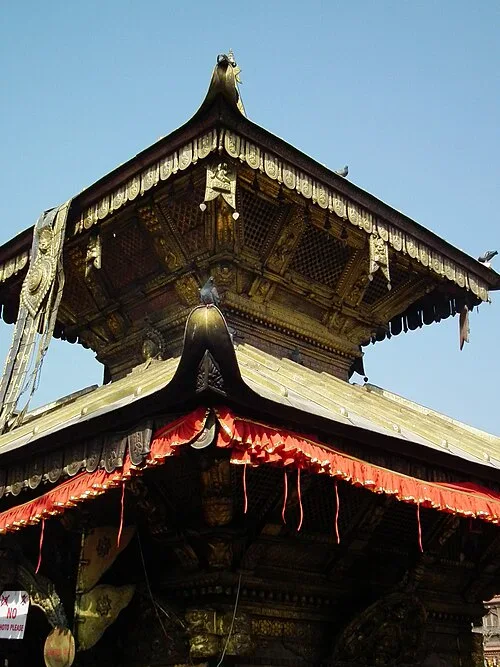 Hariti Goddess Temple Courtyard
The Hariti (Ajima) Temple
Near the main stupa stands a richly carved two-tiered pagoda with roofs of gilded tile, the temple of Hariti, known locally as Ajima. The scriptures tell her story here. When Gautama Buddha delivered a sermon at the stupa, Hariti, the fierce Dharma Protector goddess, was among the listeners. She prayed to the Buddha with a vow to serve and protect the Swayambhu Great Stupa, its vihars, Buddhist culture, and all children below twelve years of age. Her temple was then enshrined beside the main stupa, where she still stands guard. Buddhists and Hindus revere her alike, which makes this courtyard one of the clearest signs of the two faiths worshipping in unison.
Listen in the appS Pakhrin from DC, USA · CC BY 2.0
10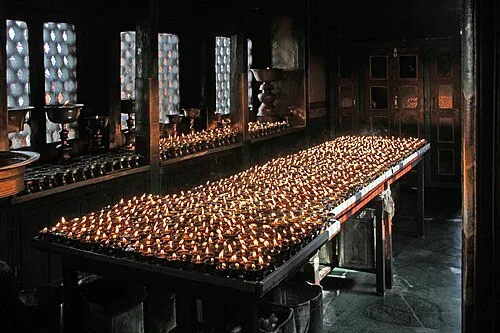 Hariti Goddess Temple Courtyard
The Lamp Offering Hall
Inside a dim hall near the temple courtyard, long tables hold hundreds of butter lamps, their flames filling the dark with a low golden glow. Pilgrims light them as offerings, day after day, and the hall never quite goes dark. This is what unbroken devotion looks like. The sanctuary has needed devoted hands before. In the fifteenth century the stupa had fallen into bad condition, and Sariputra, the Indian monk and abbot of Bodh Gaya, led its reconstruction, assisted by a king of the Malla dynasty. Tibetan masters have made the pilgrimage here for centuries, from Marpa Lotsawa down to lamas arriving today. The lamps, and the care, continue.
Listen in the appPhoto: Gerd Eichmann · CC BY-SA 4.0
- 11
The Maha Manjushree Shrine
The creation story of the valley: a sacred lake, a thousand-petaled lotus, and Manjushri's sword.
- 12
The Western Overlook
The view over the valley Manjushri drained, and a sanctuary that endures.
- 13
The Prayer Wheel Corridor
The daily rhythm of the stupa: walking clockwise, spinning the prayers set in the walls.
Swayambhunath
Frequently asked questions
How much does the guide cost?
Free app download. Listed guide price: $0.99. Guide price shown in the app. Audio guide only. Venue admission is separate.
Can I listen without internet?
Yes. Download the guide’s audio, images, and maps in the app before your visit. Your downloaded content is then available offline.
Can I listen in my language?
This audio guide is available in 15 languages, including English.
Do I need to follow a schedule?
No. This is a self-guided experience. Choose your stops, pause whenever you like, and return to a story at your own pace.
At your own pace
Explore Swayambhunath.
Download Stanza, then search for “Swayambhunath”.
Free app download · Guide price shown in the app
Keep exploring
Audio guides — Nepal
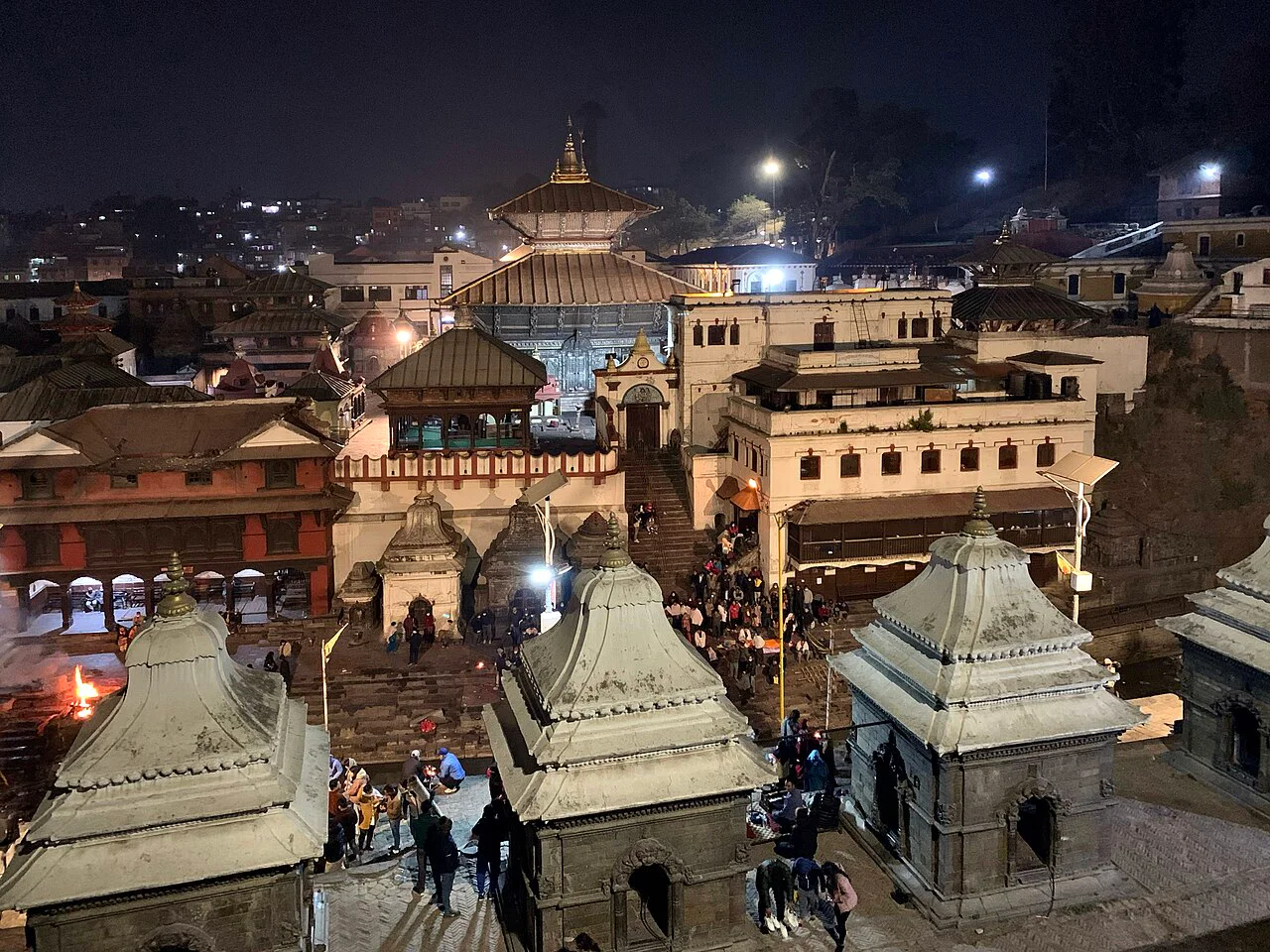
Kathmandu · 6 km
Pashupatinath Temple
Content & sources
Photo: Chainwit. · CC BY-SA 4.0
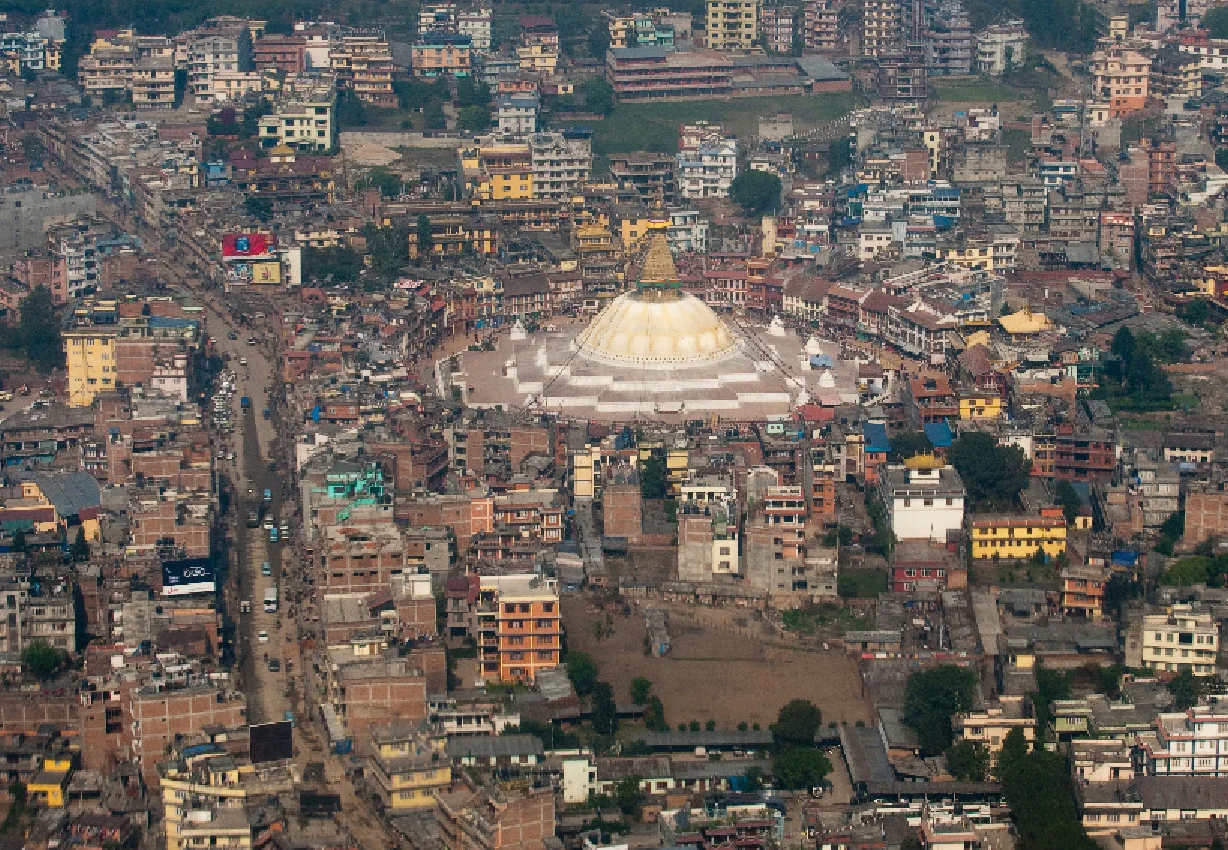
Kathmandu · 7 km
Boudha Stupa
Content & sources
Etter Studio · CC BY 2.0
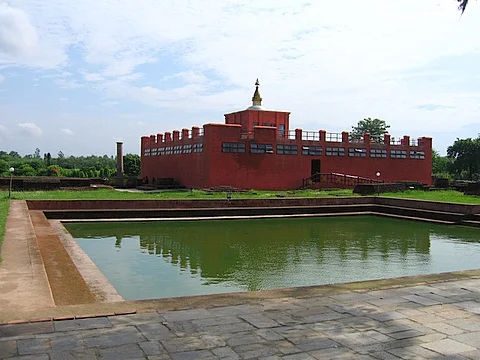
Lumbini
Maya Devi Temple, Lumbini
Content & sources
Wes Olson · CC BY-SA 2.5