Stanza · Audio guide
Boudha Stupa Audio Guide
A place to remember. A story to take with you.
Boudha Stupa is a major spiritual landmark located in Kathmandu, Nepal. It is the largest spherical stupa in Nepal and is considered to be the embodiment of the enlightened mind of all the Buddhas.
Download Stanza, then search for “Boudha Stupa”.
About the tour
One guide. Your kind of visit.
Boudha Stupa is a major spiritual landmark located in Kathmandu, Nepal. It is the largest spherical stupa in Nepal and is considered to be the embodiment of the enlightened mind of all the Buddhas.
Ready when you are.
- 01Get the free Stanza app.
iOS & Android
- 02Find your guide.
“Boudha Stupa”
- 03Download before you go.
Works offline
Audio guide / 13 narrated stops
Inside the guide
Get to know a few of the stories before you go. Open a stop to read more.
01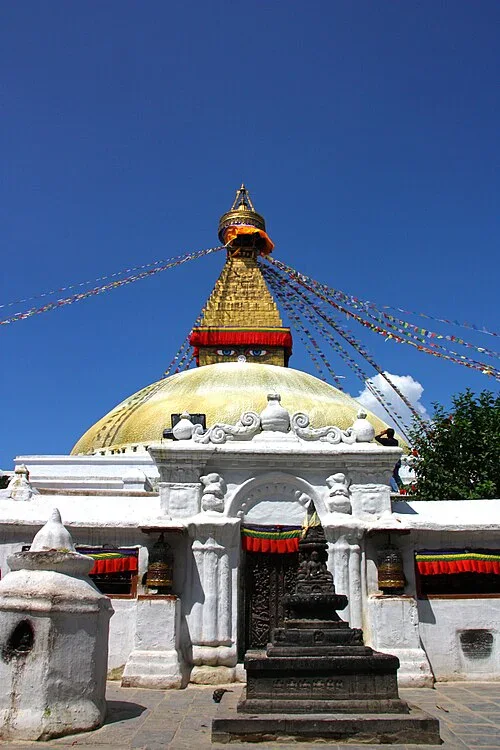 Northern Entrance Gate and Circular Plaza
The Great Stupa of Boudhanath
Welcome to Boudhanath, in the northeast of the Kathmandu Valley. A stupa is a Buddhist monument built as a solid dome of masonry, never entered, only honoured. Boudhanath is the largest spherical stupa in Nepal, and one of the largest in the world, rising about thirty-six metres. In Buddhist belief it embodies the enlightened mind of all the Buddhas. Its core purpose is a reliquary, a colossal vessel for consecrated sacred substances, raised so that all beings can gather merit in its presence. From the gateway, the whole anatomy is visible at once. A whitewashed dome sits on a stepped platform, a gilded square tower rises above it, and a tapering golden spire crowns the top. Pilgrims have come here from across the Himalayas for centuries, and the stupa is now a UNESCO World Heritage Site.
neiljs · CC BY 2.0
02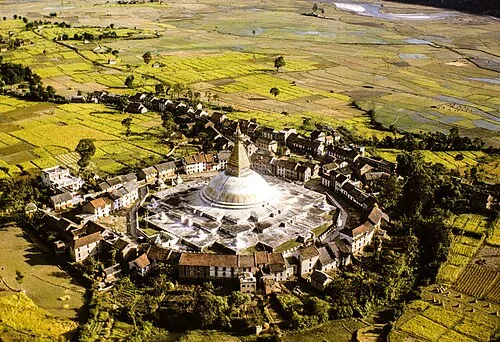 Northern Entrance Gate and Circular Plaza
Boudhanath Stupa from the Air, 1963
In 1963, the stupa rose out of open country, ringed by a single market settlement. Rice paddies stretched to the horizon on every side. That landscape explains why the monument stands here at all. Boudhanath sits on the ancient trade route from Tibet to India. Caravans came over the mountains and entered the Kathmandu Valley at the village of Sankhu, in its northeast corner. The road ran on past a smaller stupa at Chabahil, the Charumati Stupa, still known today as Little Boudhanath. From there it turned south, over the Bagmati River toward the old Malla kingdom at Patan. Tibetan merchants walking this road have rested and offered prayers at Boudha for many centuries. For them, the stupa was a place of merit on a long, hard mountain road.
Photo: Acme66 · CC BY-SA 4.0
03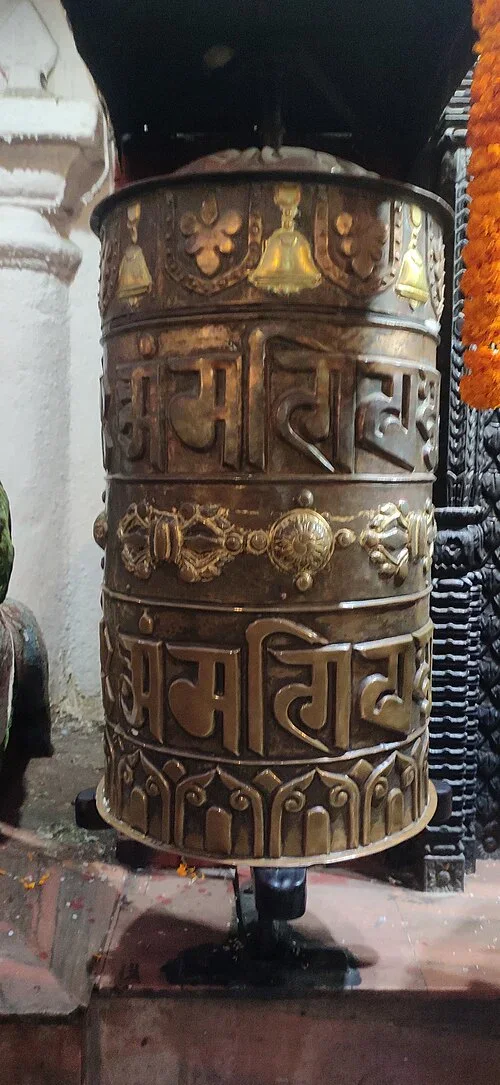 Outer Kora Ring and the Wall of Prayer Wheels
The Prayer Wheels
Set into the low walls around the stupa are bronze drums, each one a prayer wheel. They line the whole circuit of the monument. On every drum, the mantra Om Mani Padme Hum is engraved in Tibetan letters, curling band after band around the metal. Pilgrims circle the stupa clockwise, always, and set each wheel spinning as they pass. The practice is called kora, the ritual circuit. Turning a wheel is held to carry the same merit as reciting the mantra written on it. So a walker prays with every push of the hand, and the wheels never stop turning for long.
Listen in the appPhoto: Goutam1962 · CC BY-SA 4.0
04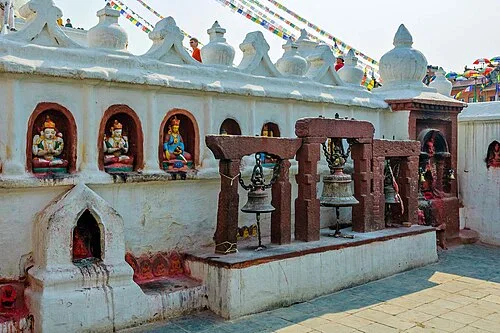 Outer Kora Ring and the Wall of Prayer Wheels
Bells and Buddha Niches
The earliest written traces of this stupa come from the chronicles of the Newars, the old inhabitants of the valley. They call it Khaasti Chaitya, and the name carries a legend. A Licchavi king, Vikramjit, built a water fountain in his palace courtyard, but no water came. Astrologers advised a sacrifice, and only a man of thirty-two perfections would do. Only the king himself and his two sons qualified. So the king told his son to sacrifice a sleeping man, without looking at his face. The son obeyed, then found he had killed his own father. Seeking atonement, he released a flying hen, and it landed on this spot, where the chaitya now stands. The name also remembers a drought. During construction, people survived by gathering droplets of dew. In Newari, khasu means dew and ti means droplets, so the place took the name Khasti. In this telling the father was King Dharmadeva and the son was Manadeva, a great Licchavi conqueror and patron of the arts, on the throne in the late fifth century. Other chronicles credit a later king, Shivadeva, who may have restored the chaitya. The accounts differ, and the tradition itself is old. Along the base, small Buddhas sit in niches beside old metal bells, work in the Newar manner.
Listen in the appPhoto: Everhard van Eimeren · CC BY-SA 4.0
05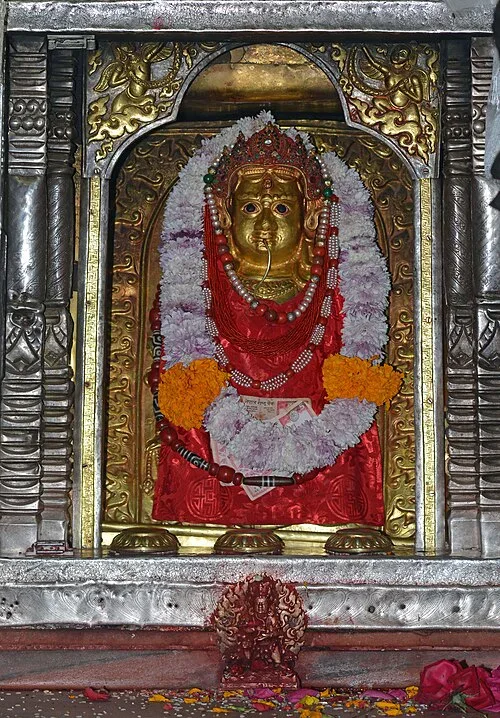 The Shrine of Ajima
The Shrine of Hariti (Ajima)
At the main northern entrance stands a shrine to the protectress Mammo Pukkasi, known to Newar Buddhists as the fierce Ajima. Her golden face is garlanded with flowers, and behind her shrine hangs the stupa's founding story. A Tibetan teaching tells of Samvari, a poultry farmer of the Kathmandu Valley. She amassed great wealth and made a vow, to build a great stupa whose essence would be the relics of the Buddhas, a place where all beings could gather merit. She asked the local king for land, and he was so taken with her purpose that he answered, 'Jarung!' — let it be done. She began at once, her four sons and a servant loading the bricks, an elephant and a donkey carrying them. But the local Newar people grew uneasy about the size of the stupa rising on the plain, and pressed the king to stop it. He refused. 'Jarung,' he said, had slipped from his tongue — kashor. So the stupa is called Jarung Kashor to this day. The Newars keep a bond of their own here. They hold that Ajima, a protecting female energy of the nation, was worshipped on this spot before the chaitya was ever built. And on the rear of her shrine, a painting shows Samvari herself, tending her ducks.
Listen in the appChristopher J. Fynn · CC BY-SA 4.0
06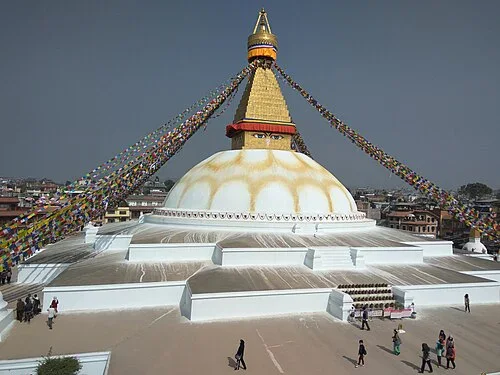 Stairway to the Stepped Mandala Terraces
The Mandala Terraces
From the stairway, the stupa's architecture reads plainly. A massive whitewashed dome rises from a stepped plinth of three tiers, a mandala, the cosmic diagram of Buddhist practice, built at monumental scale. The stupa's present size is largely the result of one man's restoration. In the fifteenth or sixteenth century the Tibetan yogi Shakya Zangpo followed a rediscovered sacred text to Nepal in search of the stupa, and found only an abandoned, overgrown mound. He undertook a restoration that is likely to have given the stupa the size it keeps today. The account says that during the work he found the remains of the Nepali king Amsuverma, the possible father of a Tibetan emperor's Nepali queen. Shakya Zangpo is believed to have lived at Chabahil while the work went on, a few kilometres away. There, the belief goes, the leftover earth and stones from Boudhanath raised a smaller stupa of their own. The place is still called, in Tibetan, leftover earth, leftover stones.
Listen in the appPhoto: Gaurav Dhwaj Khadka · CC BY-SA 4.0
07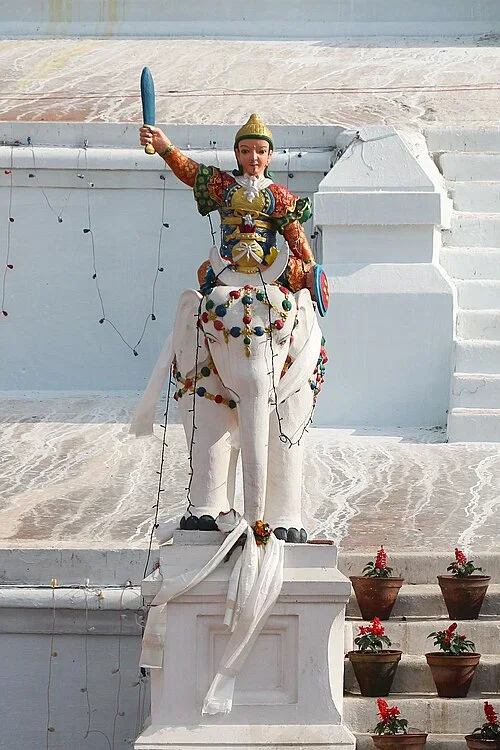 Stairway to the Stepped Mandala Terraces
Statue at the Terraces
A painted guardian rides a white elephant at the foot of the stairway, sword raised, strings of coloured beads across the beast's back. Figures like this mark the threshold where the street gives way to sacred ground. Climbing the terraces is itself part of the ritual approach, a slow rise toward the dome. In the traditional reading of any stupa, its stacked parts stand for the elements. The base is earth, the dome is water, and the levels rise through fire, air and space to the tip of the spire. The climb lets each layer be seen in its place.
Listen in the appBernard Gagnon · CC BY-SA 4.0
08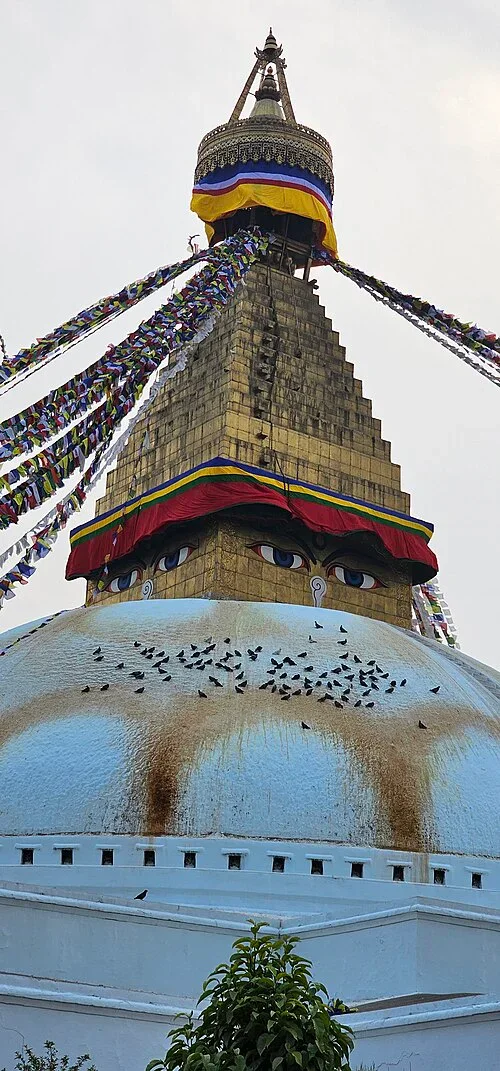 Upper Terrace Walkway Around the Whitewashed Dome
The Whitewashed Dome
The vast hemisphere of whitewash is more than a shape. Within it lies the garbha, the inner chamber or womb of the stupa, filled with consecrated substances when the monument was consecrated. Among them are bone relics held to be those of two Buddhas, Kassapa Buddha, who preceded the historical Buddha, and Shakyamuni himself. The inventory reaches far beyond bone. It includes dharma relics, cloth relics, and representations of the Buddha's body, speech and mind. This is why the stupa was built at such scale, and why it is honoured as a reliquary rather than a monument. Every path around the dome, from any side, is a path around the Buddha's presence.
Listen in the appPhoto: Nabin K. Sapkota · CC BY-SA 4.0
09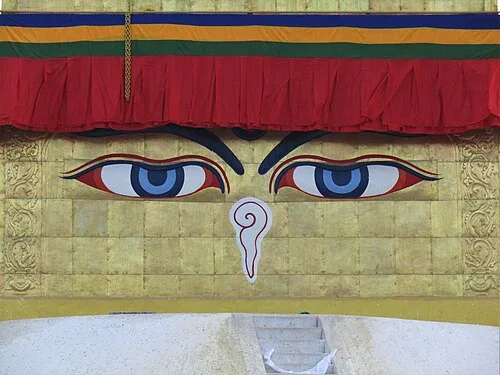 The Harmika and Thirteen-Tier Spire
The Eyes of Boudhanath
Above the dome rises the gilded square tower called the harmika, and on each of its four faces a pair of enormous eyes looks out. They are the Buddha's eyes, painted in red, blue and white, watching in every direction at once. In Buddhist reading, they are the wisdom and compassion of the enlightened mind, gazing over the Kathmandu Valley without ceasing. Between them curls a question-mark shape that is also the Nepali numeral for one. Devotees read it two ways at once: all life is one, and there is a single path to enlightenment. The shape is not a nose at all, but the number beneath the gaze. However a pilgrim walks the upper terrace, one pair of eyes faces outward to meet them.
Listen in the appPrakat Shrestha · CC BY-SA 4.0
10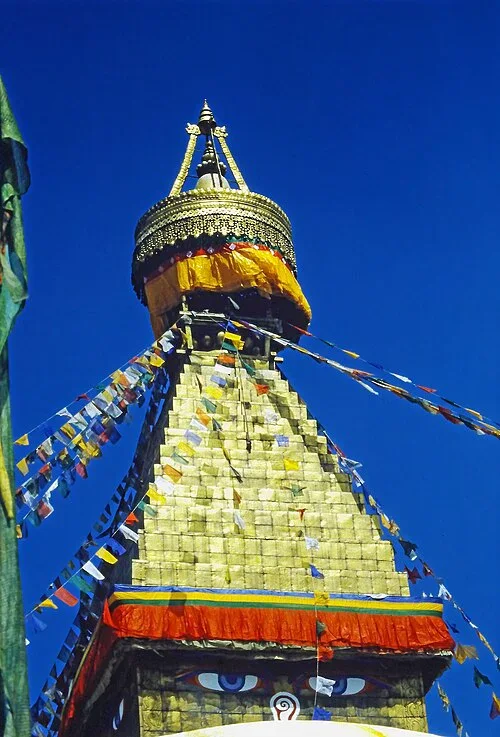 The Harmika and Thirteen-Tier Spire
The Thirteen-Tier Spire
Rising above the harmika, the golden spire tapers through thirteen diminishing tiers. In Buddhist symbolism, the thirteen stages stand for the steps of spiritual progress toward complete enlightenment. The whole spire is mounted on a single wooden pole at the stupa's centre, the life-tree, laden with consecrated relics. In April 2015, an earthquake severely cracked that spire. Everything above the dome had to be examined, and the sacred relics inside either saved or replaced. The community took the work on itself. The repairs were funded entirely by private donations from Buddhist groups and volunteers. More than thirty kilograms of gold went into the new gilding of the spire and harmika. The stupa reopened in November 2016, the first earthquake-damaged World Heritage Site in the Kathmandu valley to be rebuilt.
Listen in the appJan Kranendonk (https://www.jankranendonk.nl) · CC BY-SA 4.0
- 11
The Dharma Wheel and Deer
The golden wheel between two deer, and the legend that this stupa gave birth to Tibetan Buddhism.
- 12
Ka-Nying Shedrub Ling Monastery
How refugees after 1959 built more than fifty monasteries around the stupa and made Boudha an important centre of Tibetan Buddhism in Nepal.
- 13
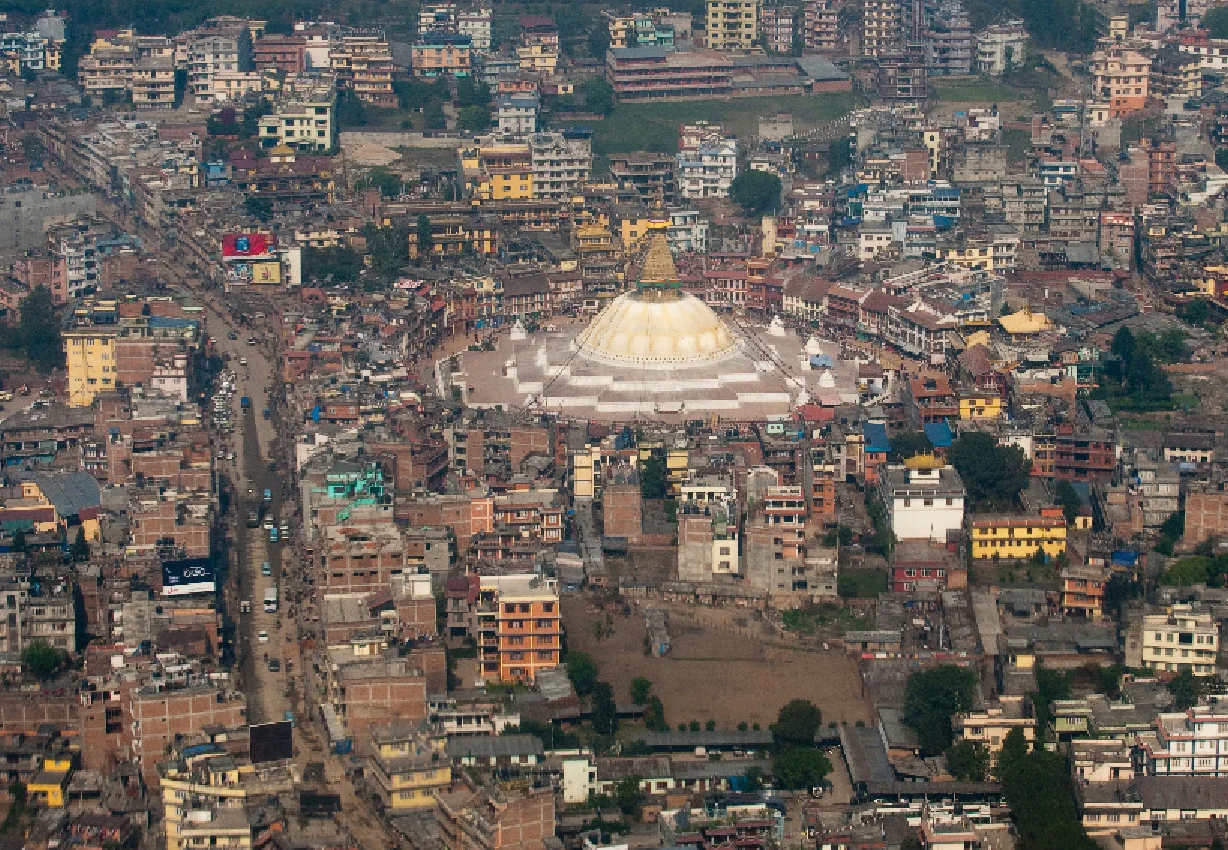
Boudhanath from Above
The whole mandala from above, and the stewards who keep the circle turning, from the Chiniya Lamas to the development committee.
Boudha Stupa
Frequently asked questions
How much does the guide cost?
Free app download. Listed guide price: $0.99. Guide price shown in the app. Audio guide only. Venue admission is separate.
Can I listen without internet?
Yes. Download the guide’s audio, images, and maps in the app before your visit. Your downloaded content is then available offline.
Can I listen in my language?
This audio guide is available in 15 languages, including English.
Do I need to follow a schedule?
No. This is a self-guided experience. Choose your stops, pause whenever you like, and return to a story at your own pace.
At your own pace
Explore Boudha Stupa.
Download Stanza, then search for “Boudha Stupa”.
Free app download · Guide price shown in the app
Keep exploring
Audio guides — Nepal
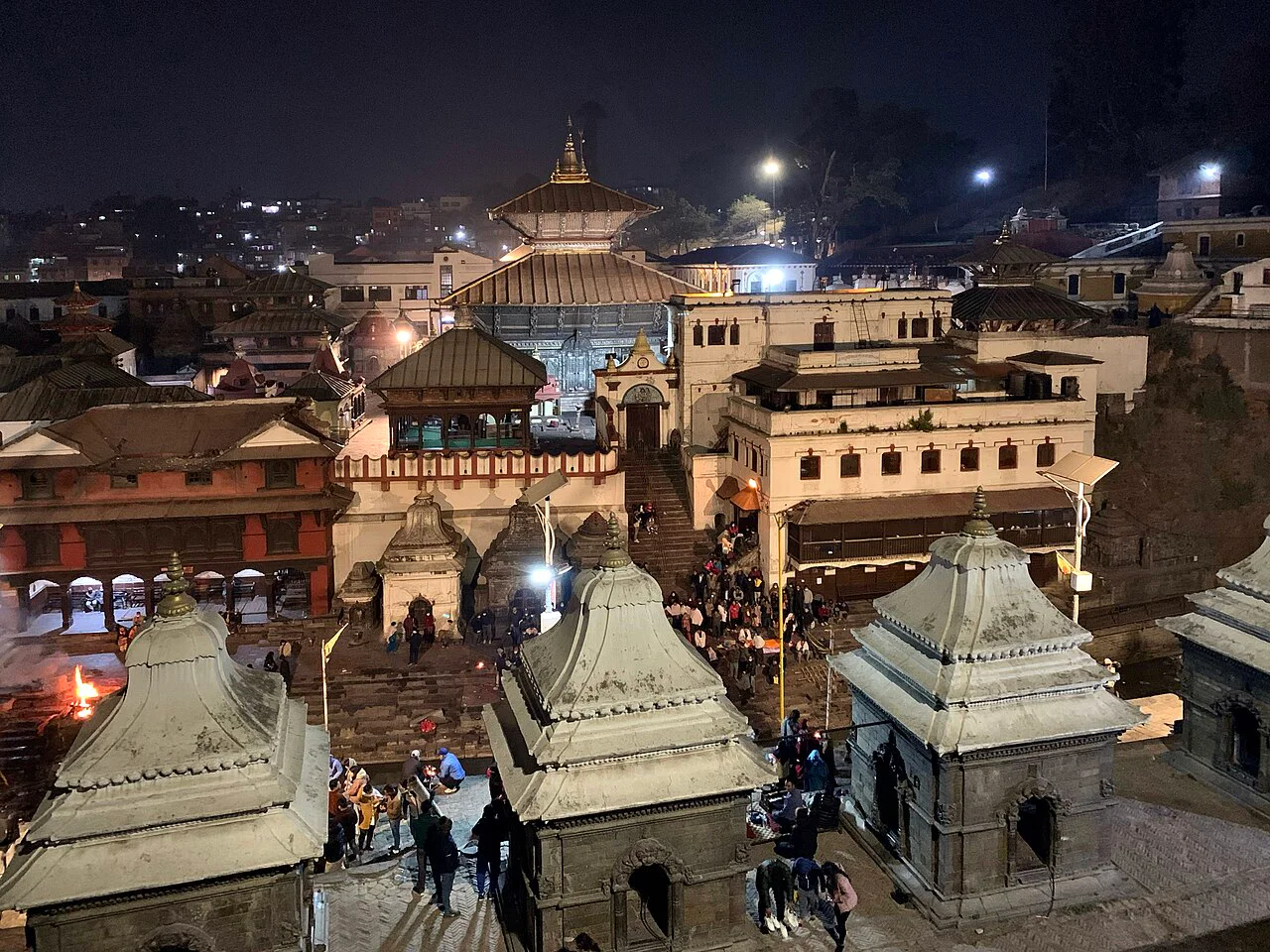
Kathmandu · 2 km
Pashupatinath Temple
Content & sources
Photo: Chainwit. · CC BY-SA 4.0
Kathmandu Metropolitan City · 7 km
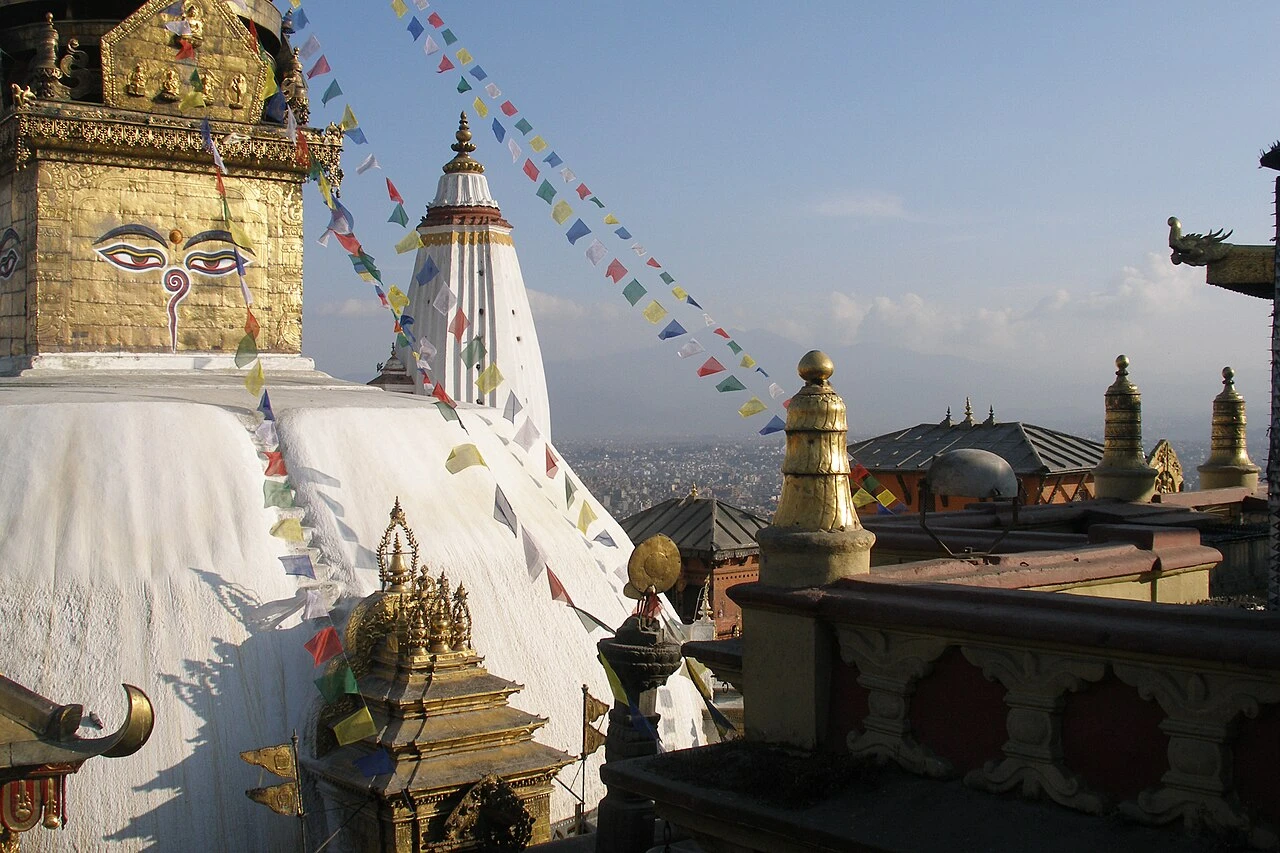
Swayambhunath
Content & sources
Vyacheslav Argenberg · CC BY 4.0
Lumbini
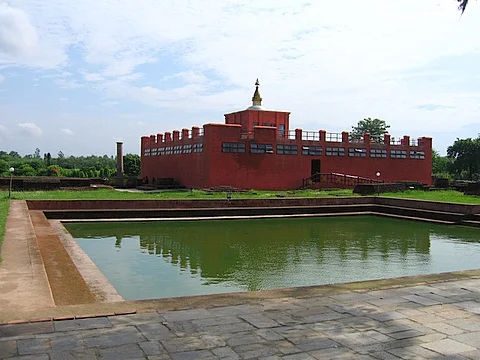
Maya Devi Temple, Lumbini
Content & sources
Wes Olson · CC BY-SA 2.5
Singtam
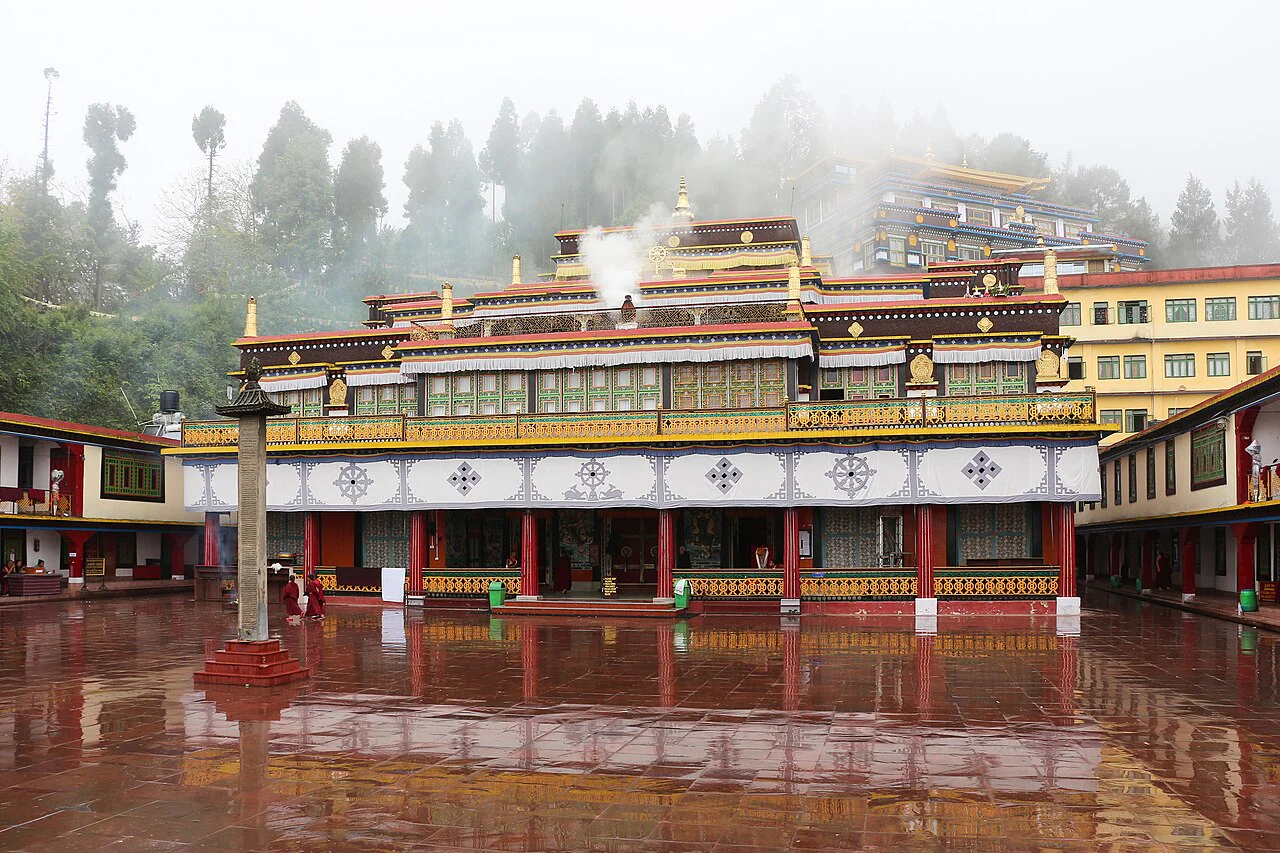
Rumtek Monastery
Content & sources
Bernard Gagnon · CC BY-SA 4.0