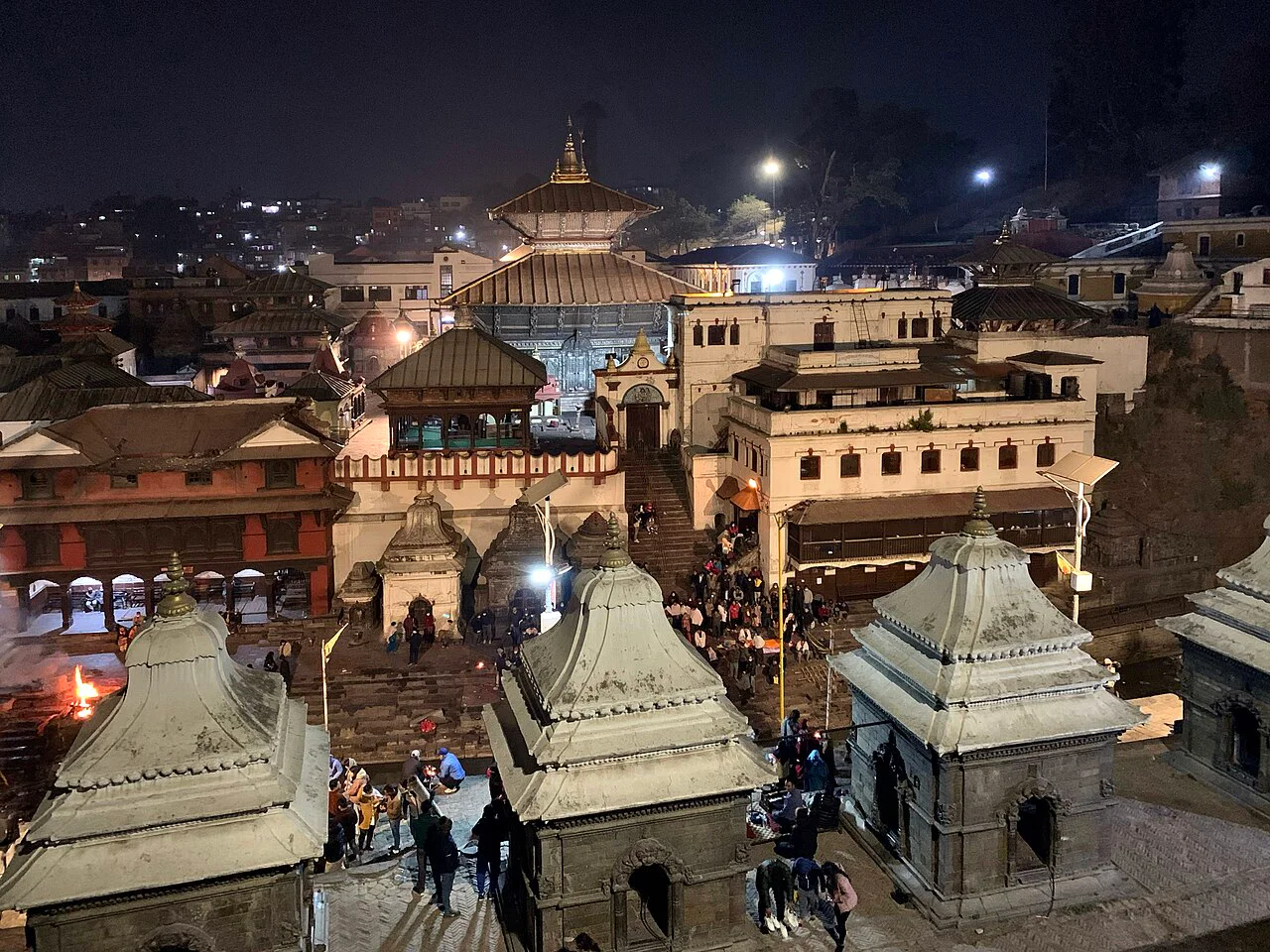
Stanza · Audio guide
Pashupatinath Temple Audio Guide
A place to remember. A story to take with you.
Pashupatinath Temple is a Hindu temple in Kathmandu dedicated to Pashupati, a manifestation of Shiva. It is one of the oldest and most significant religious complexes in South Asia and a UNESCO World Heritage…
Download Stanza, then search for “Pashupatinath Temple”.
About the tour
One guide. Your kind of visit.
Pashupatinath Temple is a Hindu temple in Kathmandu dedicated to Pashupati, a manifestation of Shiva. It is one of the oldest and most significant religious complexes in South Asia and a UNESCO World Heritage Site.
Ready when you are.
- 01Get the free Stanza app.
iOS & Android
- 02Find your guide.
“Pashupatinath Temple”
- 03Download before you go.
Works offline
Audio guide / 16 narrated stops
Inside the guide
Get to know a few of the stories before you go. Open a stop to read more.
01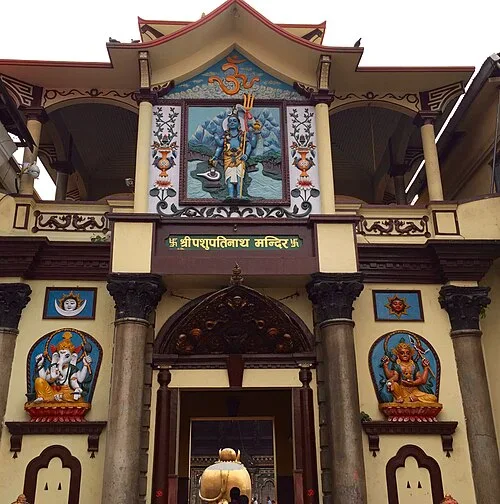 Western Entrance Gate & Approach Plaza
Western Entrance to the Pashupatinath Precinct
Welcome to Pashupatinath, one of the holiest sanctuaries of Shiva in all of South Asia. The name means lord of all beings, and it belongs to a form of Shiva worshipped here on the banks of the Bagmati River in Kathmandu. The precinct is vast, covering about two hundred and forty-six hectares, filled with hundreds of shrines, ashrams and carved images raised over the centuries. Since 1979 it has been part of a UNESCO World Heritage Site covering the monuments of the Kathmandu Valley. This is no preserved monument behind a rope. Worship continues here every day, on both banks of the river, much as it has for generations. The gateway ahead, with its painted panels of the gods, marks the way into that living world.
Photo: Ms Sarah Welch · CC BY-SA 4.0
02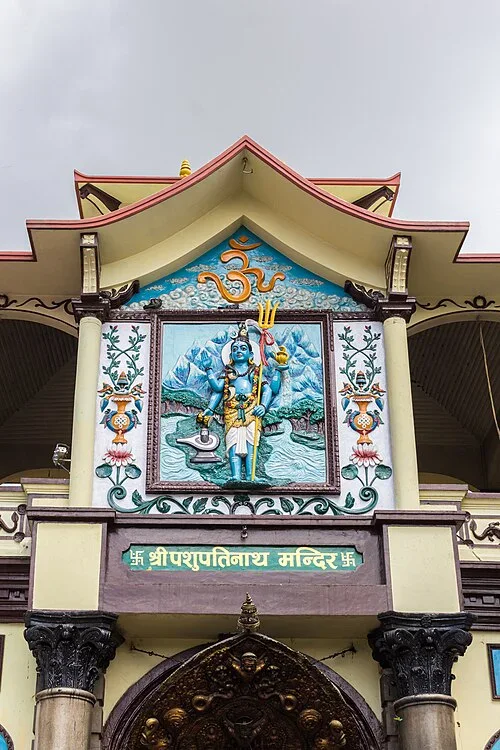 Western Entrance Gate & Approach Plaza
Western Gate Gajur and Shiva Panel
This is the Western Gate, topped by its gajur, the pinnacle that crowns a Newari roof. High on the gateway sits a painted panel of Shiva himself, blue-skinned, holding his trident against a backdrop of mountains. Above him glows the Om, the sacred syllable, set against swirling clouds. Flanking panels carry other deities, announcing before anyone steps through that this precinct belongs to Shiva. The gate also explains the shape of a visit here. Non-Hindu visitors may not enter the inner courtyard around the main temple. The sanctuary itself is viewed from the eastern bank of the river instead. So the precinct is experienced from its edges, and those edges have their own rewards, as this walk will show.
Photo: Bijay Chaurasia · CC BY-SA 4.0
03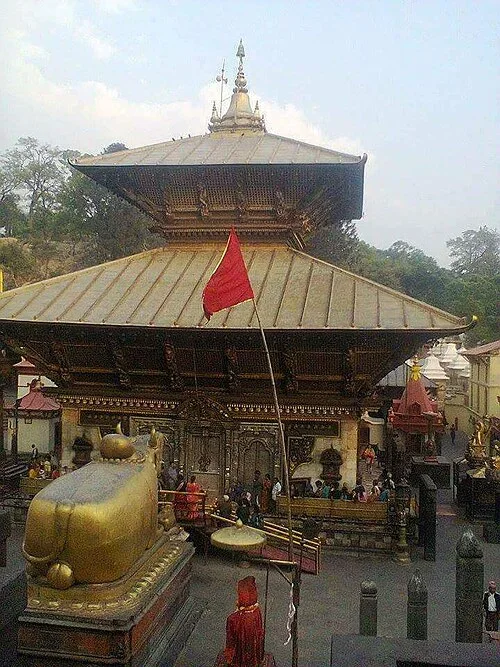 Outer Courtyard & Giant Bronze Nandi
The Main Pagoda: Golden Roofs and Silver Doors
The main temple rises in the classic Newari pagoda style, the building tradition of the Kathmandu Valley. Two great levels of roof sweep outward, copper sheathed in gold, catching the light long before the rest of the complex comes into view. All four of its main doors are covered in silver sheets. From the square base to the golden pinnacle, the temple measures twenty-three metres and seven centimetres. Inside there are two sacred spaces. The outer sanctum is an open, corridor-like space where worshippers circle. The inner sanctum, the garbhagriha, holds the idol itself, and only a handful of priests ever enter it.
Listen in the appPhoto: Samirkharel786 · CC BY-SA 4.0
04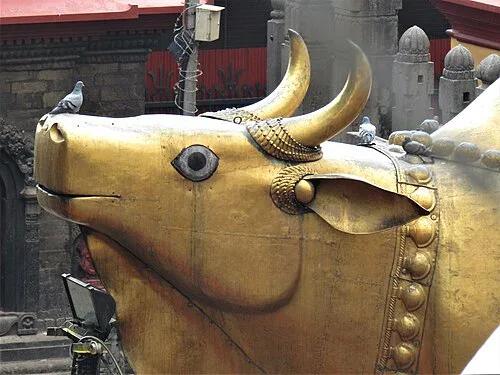 Outer Courtyard & Giant Bronze Nandi
The Great Bronze Nandi
Kneeling before the sanctuary is Nandi, the bull, Shiva's divine mount, cast in polished bronze. Devotees traditionally approach the god through his vehicle, speaking their prayers to Nandi, who carries them to his master's ear. The bull also carries the temple's origin legend. The Shiva Purana tells that after the war of the Mahabharata, the Pandava brothers sought Shiva to forgive them. Shiva hid himself underground in the form of a bull. When he finally reappeared, his body surfaced at holy places across the Himalayas. His head appeared here at Pashupatinath, his hump at Kedarnath, his face at Rudranath, his arms at Tungnath and his navel at Madhyamaheshwar. That is the legend as it is told, linking this sanctuary into a chain of shrines across the mountains.
Listen in the appPrakat Shrestha · CC BY-SA 4.0
05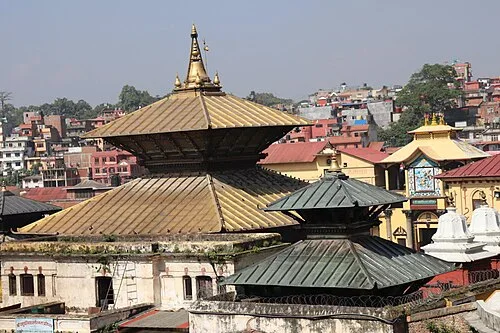 The Main Pagoda Sanctuary & Golden Roof
A Roofline Built Over Thirteen Centuries
The temple's existence is recorded as early as the year 400, under the Licchavi dynasty that ruled the Kathmandu Valley. Old chronicles credit a Licchavi king named Prachanda Deva with building the first temple here. Another chronicle says a later king, Supuspa Deva, raised a five-storey temple on the same spot. A medieval king called Shivadeva reconstructed it in the early twelfth century, and Ananta Malla added a roof to it in his turn. Termites and earthquakes wore the buildings down again and again. The form standing now took shape in a renovation of 1692. What reads as one temple is really the work of many reigns, each adding to a sacred core that was never abandoned.
Listen in the appPhoto: Nabin K. Sapkota · CC BY-SA 4.0
06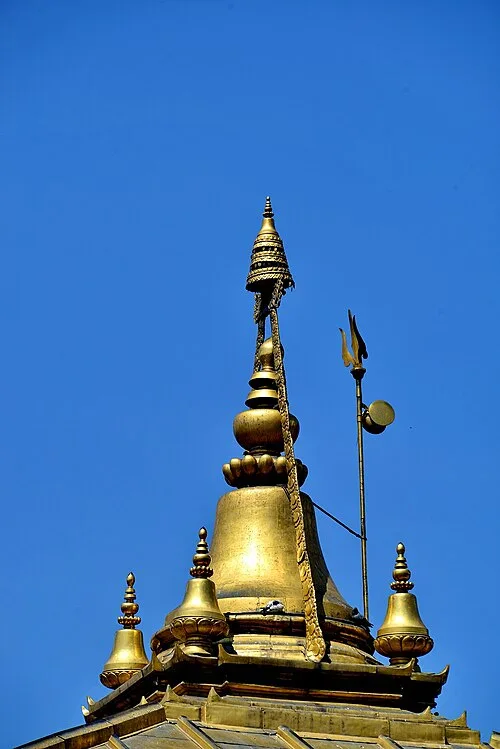 The Main Pagoda Sanctuary & Golden Roof
The Golden Gajur Pinnacle
Crowning the whole structure is the gajur, the gilded pinnacle that tops every Newari pagoda. Beside it rises a golden trident, Shiva's weapon, pointed at the sky. In April 2015 the Gorkha earthquake struck Nepal with a magnitude of about seven point eight, and one of the outer shrines in this complex was damaged. The main pagoda, by wide account, came through essentially without structural harm. Devotees read that survival as a miracle. Engineers might point instead to the traditional craft of the Newari builders, whose timber and brick structures have absorbed shocks for centuries. Both explanations are still spoken here, often in the same breath.
Listen in the appRajesh Dhungana · CC BY-SA 4.0
07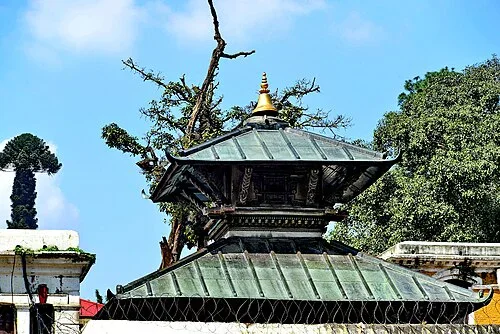 Vasukinath Temple Precinct
Vasukinath Shrine
Just east of the main pagoda stands a smaller shrine, its dark tiered roof set against the trees. This is Vasukinath, dedicated to Vasuki, the king of the serpents. By tradition, Vasuki is the guardian of the sanctuary, the sentinel who protects the central shrine of Pashupatinath. The shrine's roof and its golden finial catch the afternoon light while the larger temple draws the crowds, and Vasuki keeps his watch all the same.
Listen in the appRajesh Dhungana · CC BY-SA 4.0
08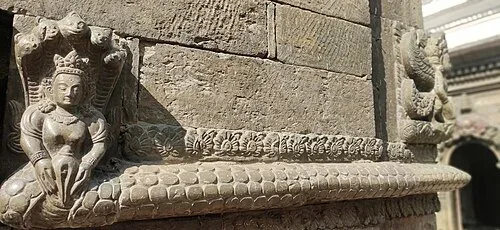 Vasukinath Temple Precinct
Serpent Carving and the Temple's Guardians
Worked into the masonry here is a crowned figure sheltered beneath the spreading hoods of a serpent, a naga carved in weathered stone. The guardians of this temple are not only made of stone. For centuries a Newar clan called the Rajbhandari has served as the temple's treasurers, caretakers and assistant priests, a hereditary office numbering one hundred and eight in all. Their main task is to help the Bhatta priests, who perform the daily rituals and are among the few allowed to touch the deity, and to maintain the inner sanctum. They serve in teams of three, handing over the duty each full moon. The temple's traditions faced a modern test in 2009, when Nepal's Maoist-led government appointed new priests while bypassing the temple's long-standing requirements. The Rajbhandari contested the appointment in court, and the Supreme Court overruled it. The government ignored the ruling, and the dispute spilled over into protests at the temple.
Listen in the appPhoto: Goutam1962 · CC BY-SA 4.0
09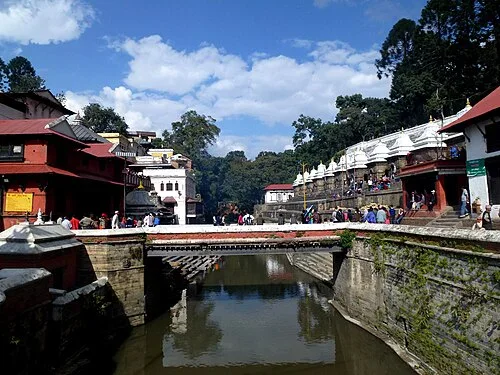 Bagmati River Footbridge
The footbridge here ties the two halves of Pashupatinath together. The Bagmati is the spine of the entire precinct, the river whose water makes both banks holy. On the western side stand the main temple and its crowded courtyard. On the eastern side, shrines and terraces climb the hillside among the trees.
Listen in the appHiroki Ogawa · CC BY 3.0
10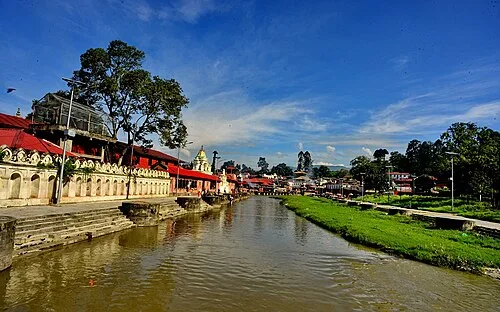 Bagmati River Footbridge
Eastern Riverbank
The banks that hold quiet riverside devotion also host the biggest days of the year. Twice the calendar brings extraordinary crowds to this water. Maha Shivaratri, the great night of Shiva, draws pilgrims from far beyond Nepal to keep vigil here. And Teej is among the most celebrated festivals at Pashupatinath, when women in red fill the precinct with song and prayer. On those days every ghat, gate and terrace is packed with worshippers. Through the rest of the year, the rhythm is gentler. People come down to the river at dawn and dusk, to bathe, to offer flowers, to sit with their prayers. The riverbank never quite empties.
Listen in the appRajesh Dhungana · CC BY-SA 4.0
- 11
Riverside Cremation Platforms
The riverside ghats, where funeral pyres burn in the open and Buddhists revere a great charnel ground.
- 12
The Garlanded Birupakshya Figure
A weathered stone figure by the ghats, kept bright with marigolds, vermilion and milk.
- 13
The Pandra Shivalaya: Fifteen Shrines on the Terrace
Fifteen identical domed shrines in a row on the eastern hillside, and the classic view back to the pagoda.
- 14
A Shiva Linga and the Idol in the Inner Sanctum
What a Shiva linga is, and the four-faced black stone idol at the hidden heart of the temple.
- 15
Gorakhnath Temple at Mrigasthali
The deer legend of the Shleshmanthak forest, and the Nath yogis who opened hatha yoga to everyone.
- 16
The Ascetics' Trishuls
The iron tridents left by Nath ascetics, and what centuries of coming pilgrims have built here.
Pashupatinath Temple
Frequently asked questions
How much does the guide cost?
Free app download. Listed guide price: $1.99. Guide price shown in the app. Audio guide only. Venue admission is separate.
Can I listen without internet?
Yes. Download the guide’s audio, images, and maps in the app before your visit. Your downloaded content is then available offline.
Can I listen in my language?
This audio guide is available in 15 languages, including English.
Do I need to follow a schedule?
No. This is a self-guided experience. Choose your stops, pause whenever you like, and return to a story at your own pace.
At your own pace
Explore Pashupatinath Temple.
Download Stanza, then search for “Pashupatinath Temple”.
Free app download · Guide price shown in the app
Keep exploring
Audio guides — Nepal
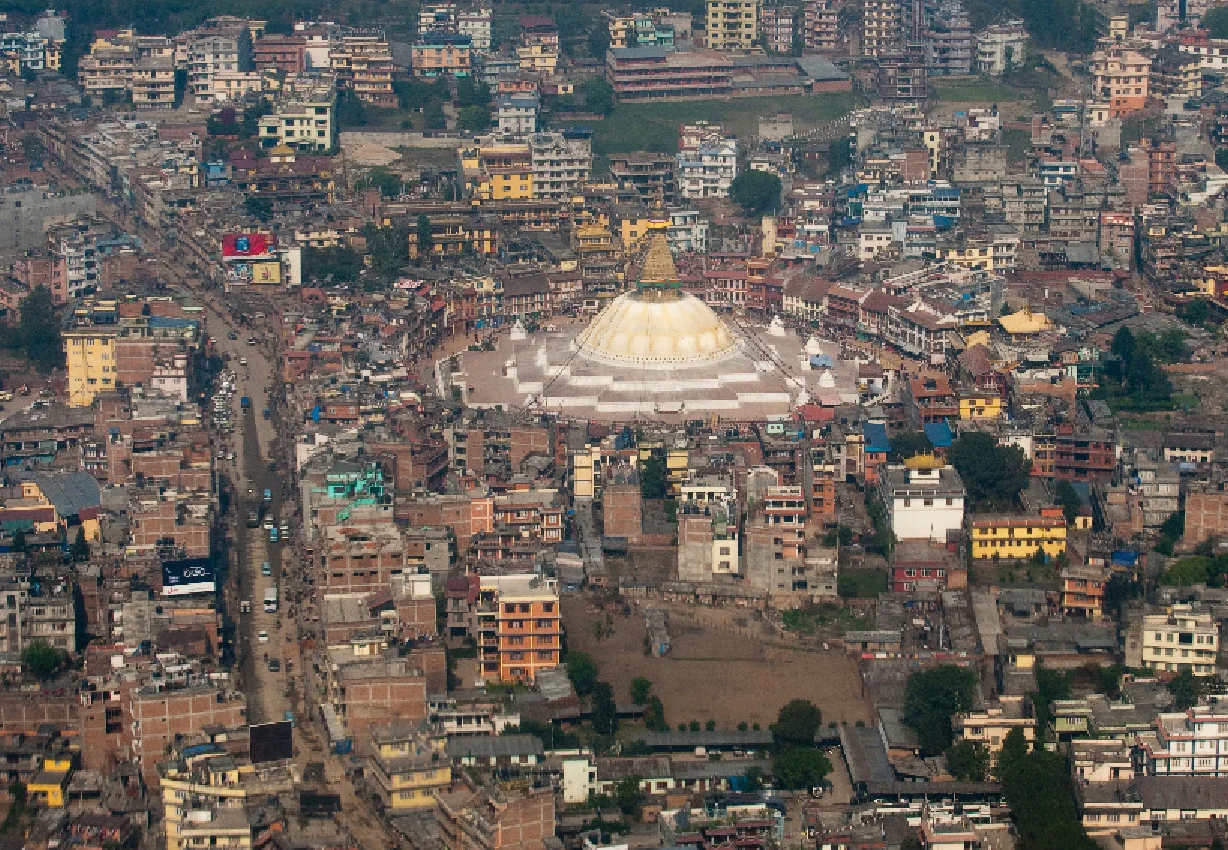
Kathmandu · 2 km
Boudha Stupa
Content & sources
Etter Studio · CC BY 2.0
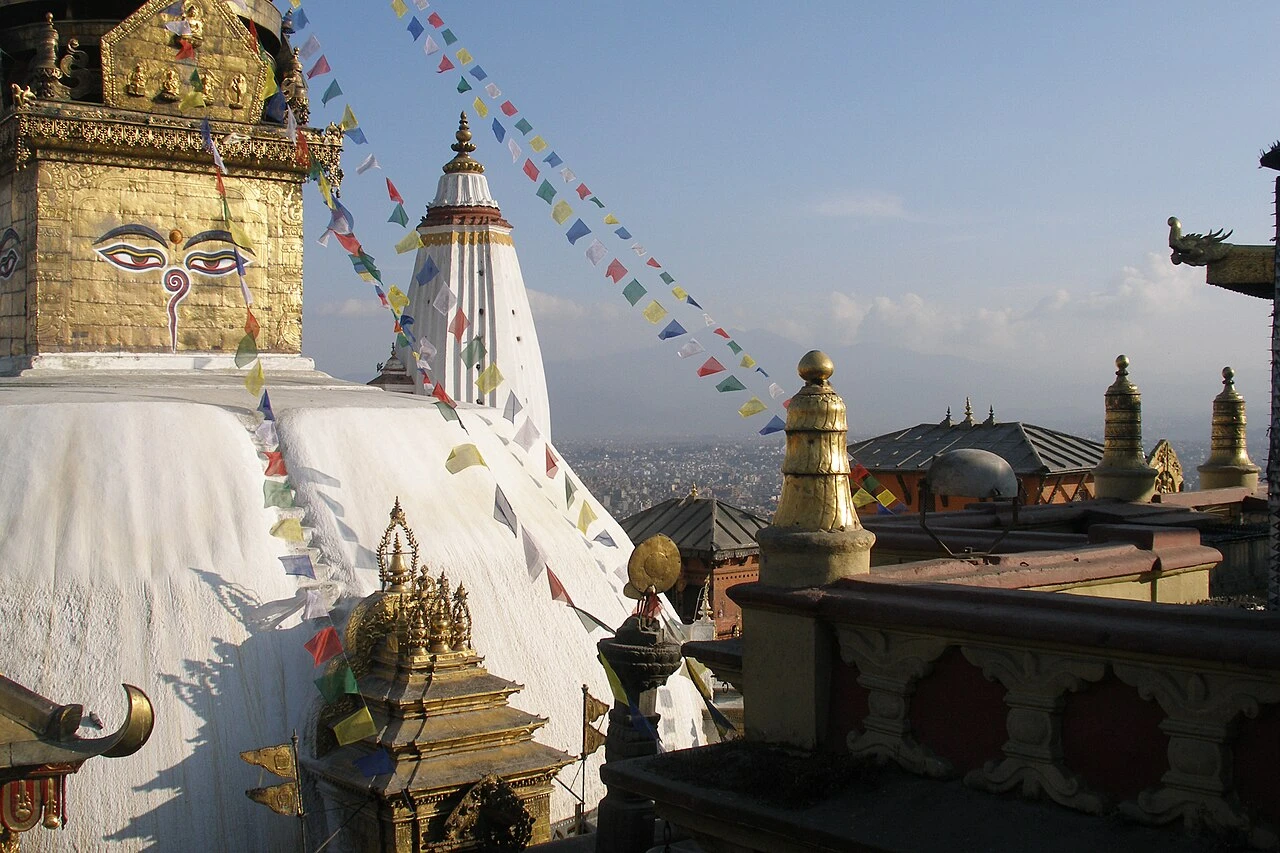
Kathmandu Metropolitan City · 6 km
Swayambhunath
Content & sources
Vyacheslav Argenberg · CC BY 4.0
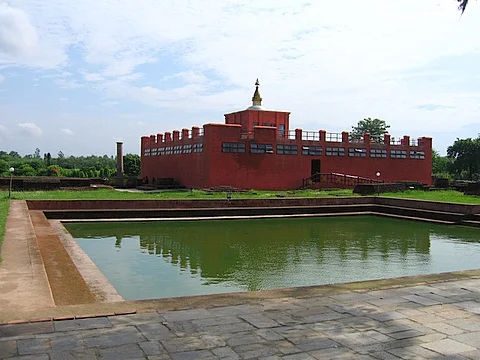
Lumbini
Maya Devi Temple, Lumbini
Content & sources
Wes Olson · CC BY-SA 2.5