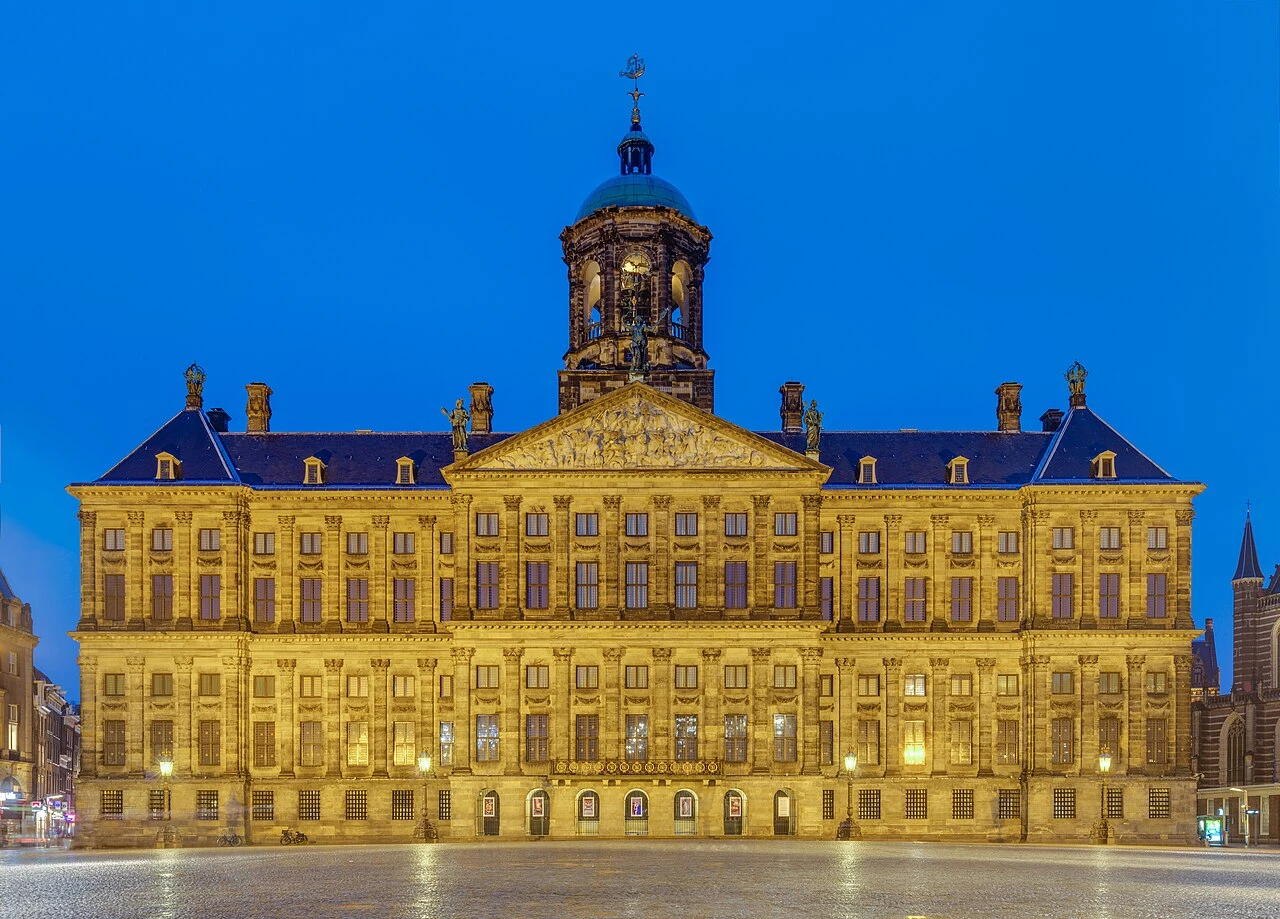
Stanza · Audio guide
Paleis op de Dam Audio Guide
A place to remember. A story to take with you.
The Royal Palace of Amsterdam is a grand 17th-century building on Dam Square, originally constructed as the city hall. It now serves as a royal palace for official functions and a public museum.
Download Stanza, then search for “Paleis op de Dam”.
About the tour
One guide. Your kind of visit.
The Royal Palace of Amsterdam is a grand 17th-century building on Dam Square, originally constructed as the city hall. It now serves as a royal palace for official functions and a public museum.
Ready when you are.
- 01Get the free Stanza app.
iOS & Android
- 02Find your guide.
“Paleis op de Dam”
- 03Download before you go.
Works offline
Audio guide / 13 narrated stops
Inside the guide
Get to know a few of the stories before you go. Open a stop to read more.
01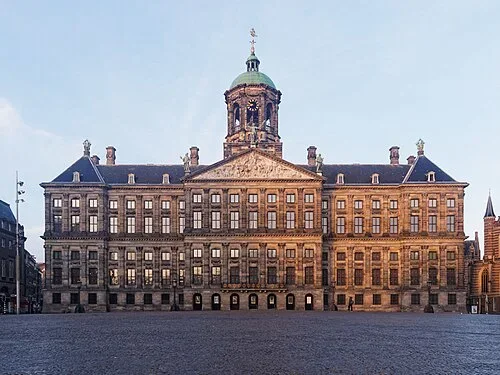 Dam Square Facade and Classical Cupola
The Facade on Dam Square
Welcome to the Royal Palace on Dam Square, a building that never set out to be a palace at all. In 1648 Amsterdam commissioned a new town hall, and the architect Jacob van Campen designed it in the Dutch Classical style. He took his inspiration from the administrative palaces of ancient Rome. The burgomasters of the city saw themselves as the consuls of a new Rome, and for them a new Capitol rose here. The first stone was laid on 28 October 1648 with a silver trowel, handled by sons and a nephew of the four sitting burgomasters. That trowel survives, on show in the Rijksmuseum. One oddity greets the eye straight away: there is no grand entrance. Most royal palaces have one, but this was designed as a city hall, a working seat of government. Today it is one of three palaces in the Netherlands placed at the monarch's disposal by Act of Parliament.
Photo: C messier · CC BY-SA 4.0
02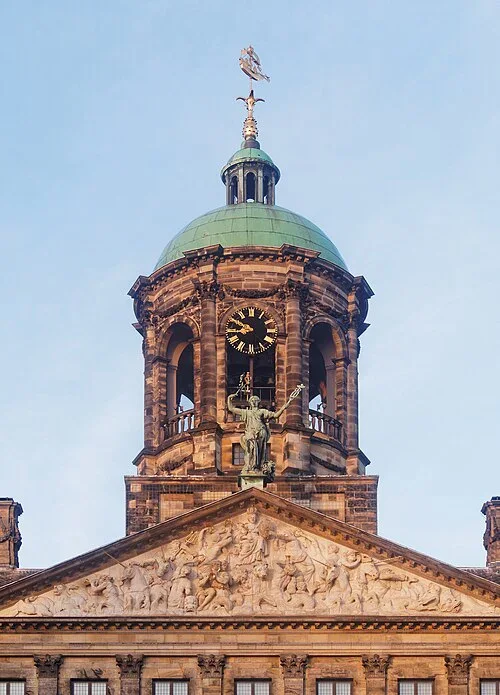 Dam Square Facade and Classical Cupola
Cupola and Ship Weather Vane
The dome carries the building's skyline. From the ground to the top of the cupola measures ninety metres, so the tower rises over every roof around the square. The clock face sits in the lantern, and below it stands a bronze figure with a staff, holding watch above the pediment. The stone itself tells a story of time. The whole building is clad in Bentheimer sandstone, which was originally a very light colour with a yellowish hue. Centuries of weather have darkened it considerably, so the pale classical facade Amsterdammers first saw has become the warm brown seen today. The classical reliefs across the pediment follow the same Roman model. At the rear of the roof there stands a six-metre-tall statue of Atlas, carrying the globe on his shoulders.
Photo: C messier · CC BY-SA 4.0
03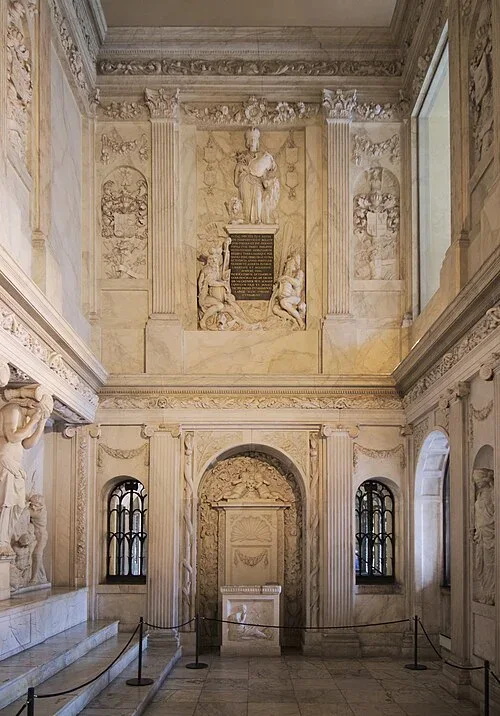 The Vierschaar (Tribunal of Justice)
The Vierschaar
Marble was chosen for the room where Amsterdam pronounced its harshest judgments. This is the Vierschaar, the tribunal of the town hall. Death sentences, already decided elsewhere in the building, were pronounced here in public, following an age-old Germanic rite. The room also shows how seriously the magistrates took their safety. Every ground-floor window of the building sits behind heavy iron bars. In the windows of this very room, the openings are still clearly visible through which muskets could be stuck out, to repel anyone storming the entrance. Access to the council floor above was just as guarded. Before the palace conversion, the great halls upstairs could be reached only by two narrow stairs hidden behind the Vierschaar. At the top of those stairs waited bronze fences, built to be defended.
Listen in the appPhoto: C messier · CC BY-SA 4.0
04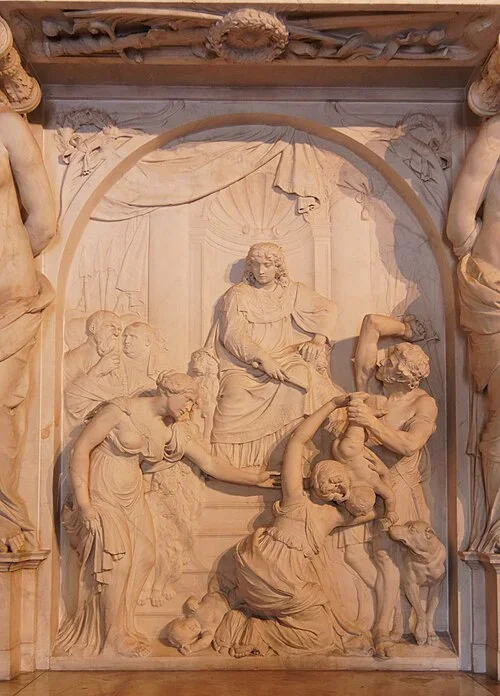 The Vierschaar (Tribunal of Justice)
The Judgment Reliefs of the Vierschaar
Solomon sits enthroned at the centre of this marble wall, judging the most famous dispute in the Bible. Two women both claim the same child, and a soldier raises his sword to divide it. The true mother reaches out to give the baby away, and the king points to her, his verdict rendered in stone. This relief is one of three life-size judgments lining the Vierschaar. Beside it stand the Roman consul Lucius Junius Brutus and the Greek lawgiver Zaleucus. Together they show what a verdict should be: impartial, merciful and wise. The magistrates of Amsterdam staged their own judgments against these ancient models. The sculpture throughout the building is attributed to Artus Quellinus, working with his collaborator Rombout Verhulst.
Listen in the appPhoto: C messier · CC BY-SA 4.0
05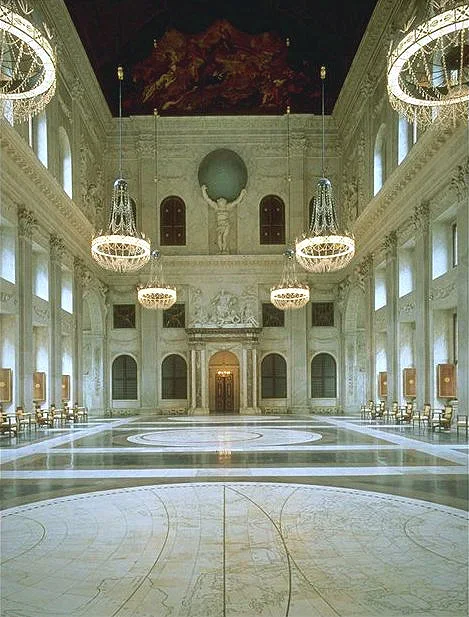 The Burgerzaal (Citizens' Hall)
The Burgerzaal
This is the Burgerzaal, the citizens' hall of the new town hall. On the morning of 29 July 1655, Amsterdam threw a party for itself. Services were held in the Old Church and the New Church from half past seven. The guests then made their own way to the Prinsenhof, and from there a solemn procession walked to the new town hall. Burgomaster Cornelis de Graeff gave the opening speech. In the afternoon came a feast at the city's expense, and the civic militia turned out in force. Six companies of the yellow regiment drew up in battle order and fired three salvos. By seven in the evening it was all over. The poet Joost van den Vondel devoted 1,378 lines of verse to the inauguration. All this splendour, and the building was still not finished.
Listen in the appbureau Monumenten & Archeologie (bMA) · Attribution
06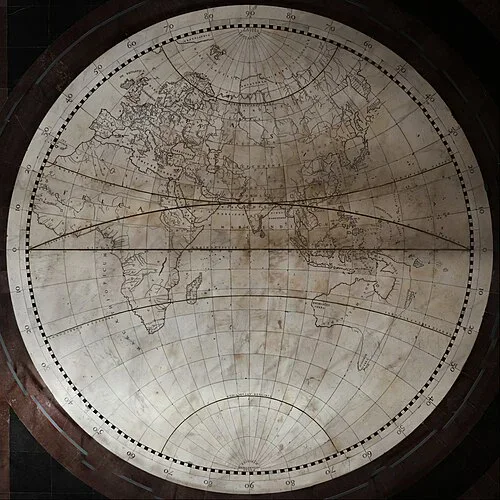 The Burgerzaal (Citizens' Hall)
The Marble World Underfoot
Underfoot, the floor becomes a map of the world. Three great circles are inlaid in the marble of the citizens' hall: one shows the eastern hemisphere, one the western, and one is a chart of the stars. Here at your feet is the eastern circle, with its continents, its graticule and its ring of degree marks. For the burgers of Amsterdam, the whole world lay at their feet, and the heavens too. That was the point. The hall was designed to show that Amsterdam stood at the centre of the universe, a claim made not in words but in stone. A city living from global maritime trade put the map of that world into the very floor its citizens walked across.
Listen in the appJacob Martenesz · Public domain
07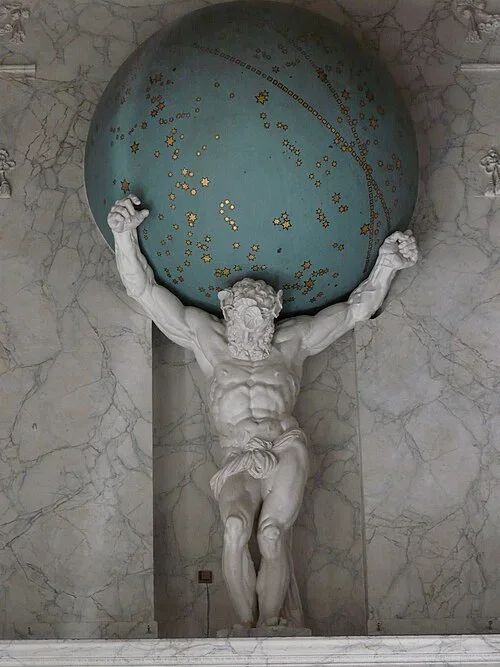 The Burgerzaal (Citizens' Hall)
Atlas in the Burgerzaal
A bearded giant holds up the sky inside the citizens' hall. This is Atlas of Greek myth, standing prominently in the Burgerzaal with the celestial sphere balanced across his shoulders. The sphere is painted a deep blue-green and scattered with golden stars, and his carved body strains under the weight. A figure from ancient myth is pressed into service for a civic message, matching the giant Atlas on the roof outside. Across the hall, above the entrance to the aldermen's chamber, Justice appears with her hourglass and instruments of torture. She tramples Avarice, shown as King Midas with donkey's ears, and Envy, shown as Medusa with snakes for hair. Even the doorways of this hall preach.
Listen in the appPhoto: G.Lanting · CC BY-SA 3.0
08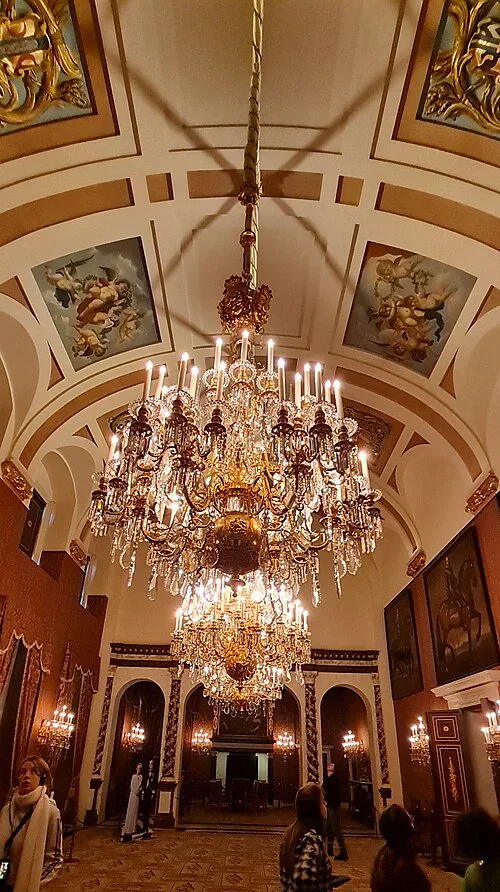 The Council Chamber and Civic Courtrooms
The Council Chamber
Government happened in rooms like this one. From here the burgomasters and regents ran the city, and a Dutch town hall of this era gathered council, justice and administration under a single roof. The building made each room's work plain. Reliefs above the doors named the function inside: one chamber where bankruptcies were declared, an insurance chamber where disputes over policies were settled, a secretary's office where legal documents were drawn up and archived. Today the room reads differently. Vaulted ceilings painted with cherubs, gilded compartments and a great crystal chandelier belong to its later royal life, layered over the working rooms of the old magistrates.
Listen in the appPhoto: Derbrauni · CC BY 4.0
09 The Council Chamber and Civic Courtrooms
Moses with the Ten Commandments
Moses comes down the mountain with the tablets of the law in his arms, angels above him and the people below stretching out their hands. Ferdinand Bol painted this scene in 1662 for the town hall. Moses was the archetypal lawgiver, and the painting speaks directly to the magistrates who met beneath it: their judgments, like his, answered to a higher law. The whole building carried this moral language, with history and scripture paintings delivering lessons to the men in office. The town hall itself was completed in 1665, but the decorating went on for years afterwards. Painters supplied chimney pieces for its rooms, among them Bol, Jan Lievens and the Flemish master Jacob Jordaens. Beneath this canvas, a marble frieze shows the worship of the Golden Calf, the law received above and broken below.
Listen in the appFerdinand Bol · Public domain
10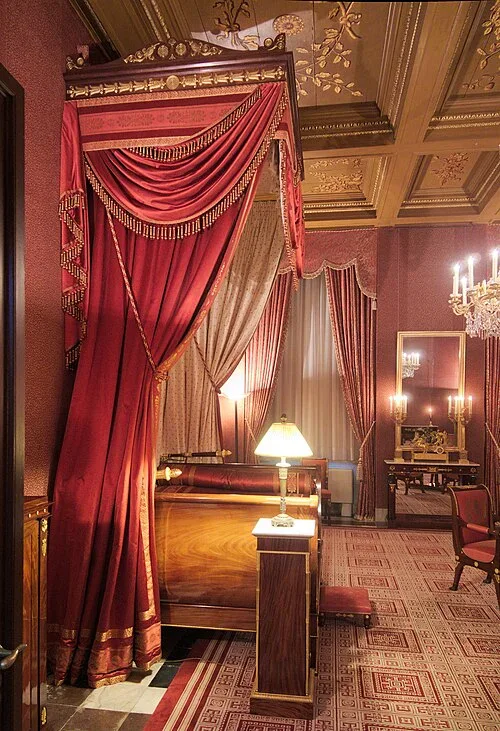 Royal Apartments and Empire Furniture
King Louis Bonaparte's Bedroom
In 1806 a brother of Napoleon became King of Holland. Louis Bonaparte took the title King Louis the First, and in 1808 he moved to Amsterdam, where the town hall was offered to him as his royal palace. The conversion cut straight into the old building. The galleries were divided into rooms with wooden walls, and sculptures that displeased the king were hidden behind cloths. A balcony was added to the front facade, and that balcony gained a life of its own. In 1980, Queen Juliana stood there to proclaim her daughter Beatrix the new queen. In 2013, Beatrix stood on the same balcony to abdicate and present her son, Willem-Alexander, as the new king. A bed alcove hung with crimson silk drapery, like the one in this chamber, shows how thoroughly the municipal rooms became royal ones.
Listen in the appPhoto: C messier · CC BY-SA 4.0
- 11
Empire Furniture of King Louis
The Empire chairs and furnishings King Louis left behind, said to form the largest such collection outside France.
- 12
The Conspiracy of the Batavians under Claudius Civilis
How Rembrandt painted a masterpiece for this wall, lost the commission, and a replacement was made in four days.
- 13
The Marble Galleries
A fire, thirteen thousand wooden piles and eight and a half million guilders: what the building cost, and what holds it up.
Paleis op de Dam
Frequently asked questions
How much does the guide cost?
Free app download. Listed guide price: $0.99. Guide price shown in the app. Audio guide only. Venue admission is separate.
Can I listen without internet?
Yes. Download the guide’s audio, images, and maps in the app before your visit. Your downloaded content is then available offline.
Can I listen in my language?
This audio guide is available in 15 languages, including English.
Do I need to follow a schedule?
No. This is a self-guided experience. Choose your stops, pause whenever you like, and return to a story at your own pace.
At your own pace
Explore Paleis op de Dam.
Download Stanza, then search for “Paleis op de Dam”.
Free app download · Guide price shown in the app
Keep exploring
Nearby audio guides
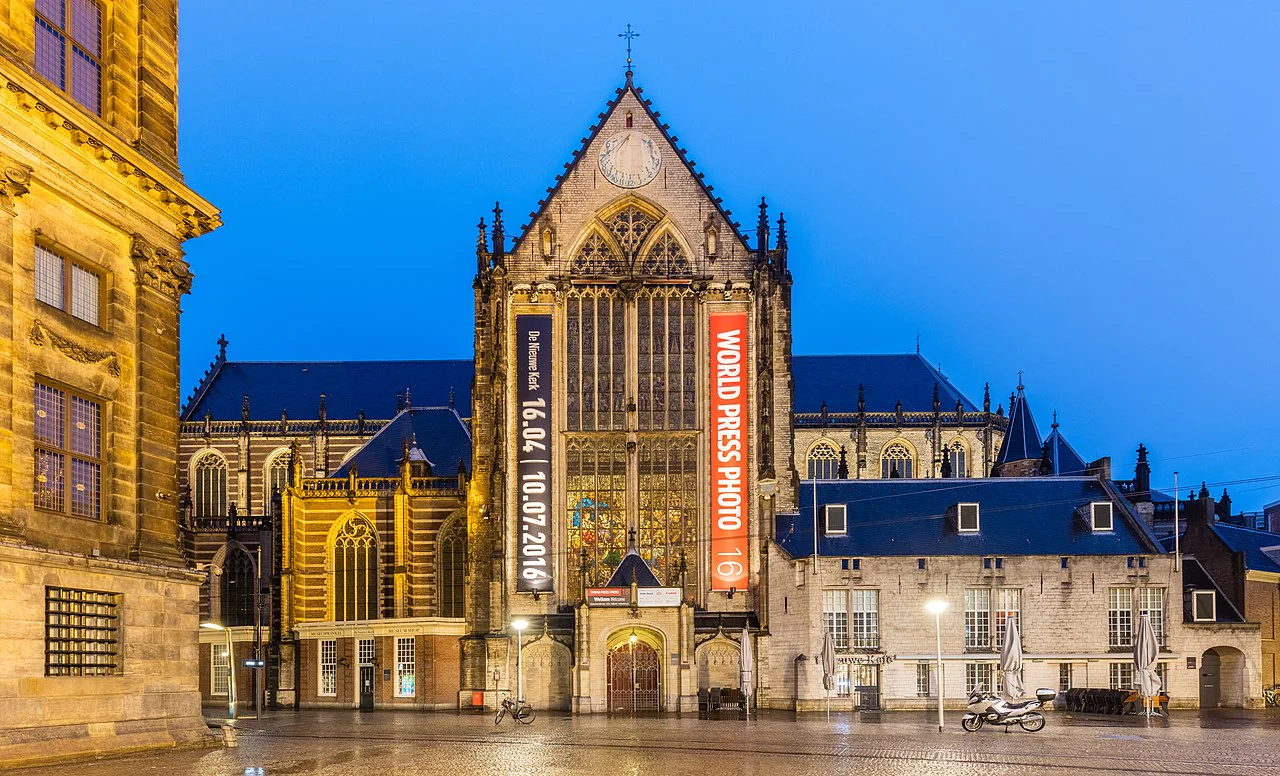
Amsterdam · 1 km
Nieuwe Kerk
Content & sources
Diego Delso · CC BY-SA 4.0
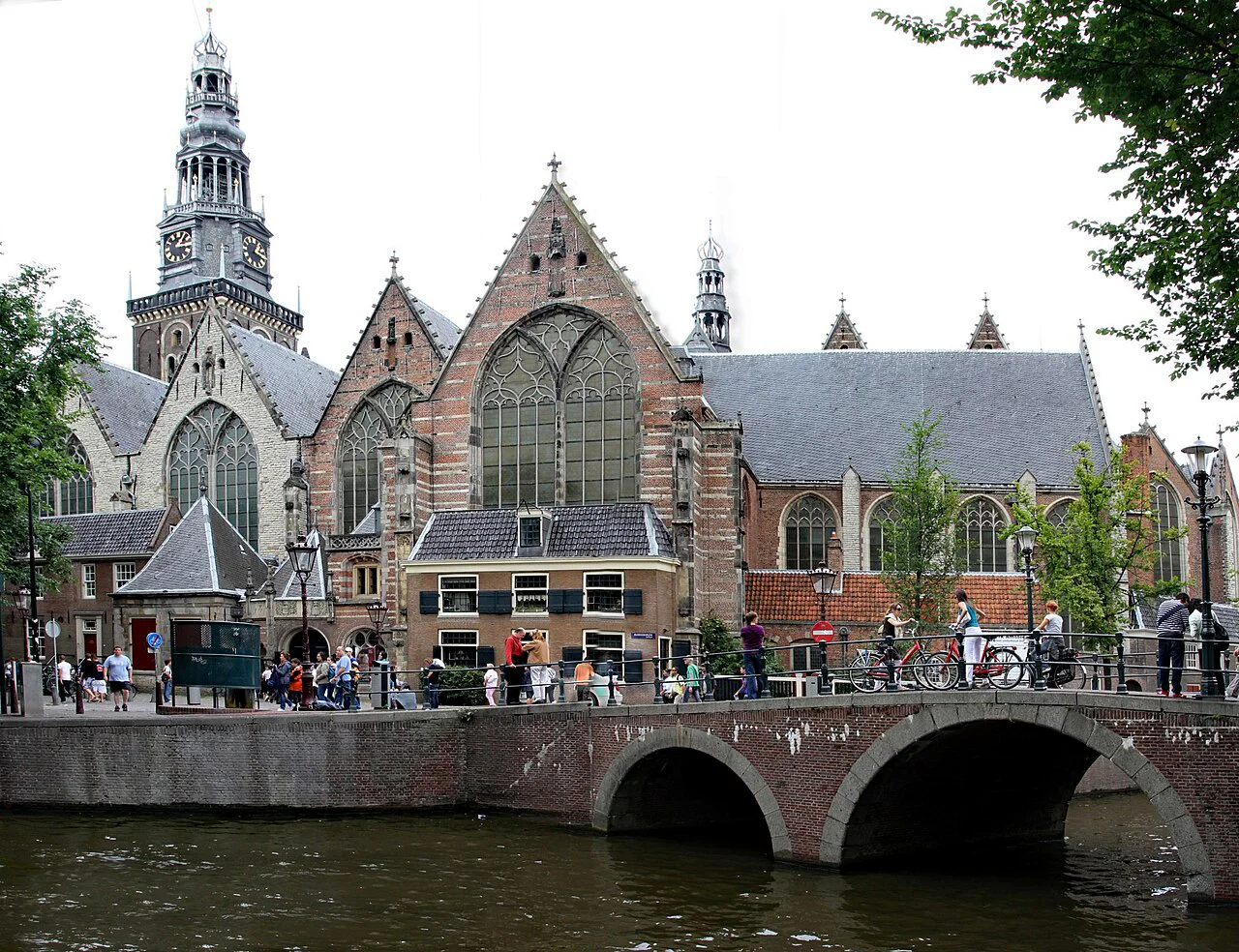
Amsterdam · 1 km
Oude Kerk
Content & sources
Gerd Eichmann · CC BY-SA 4.0
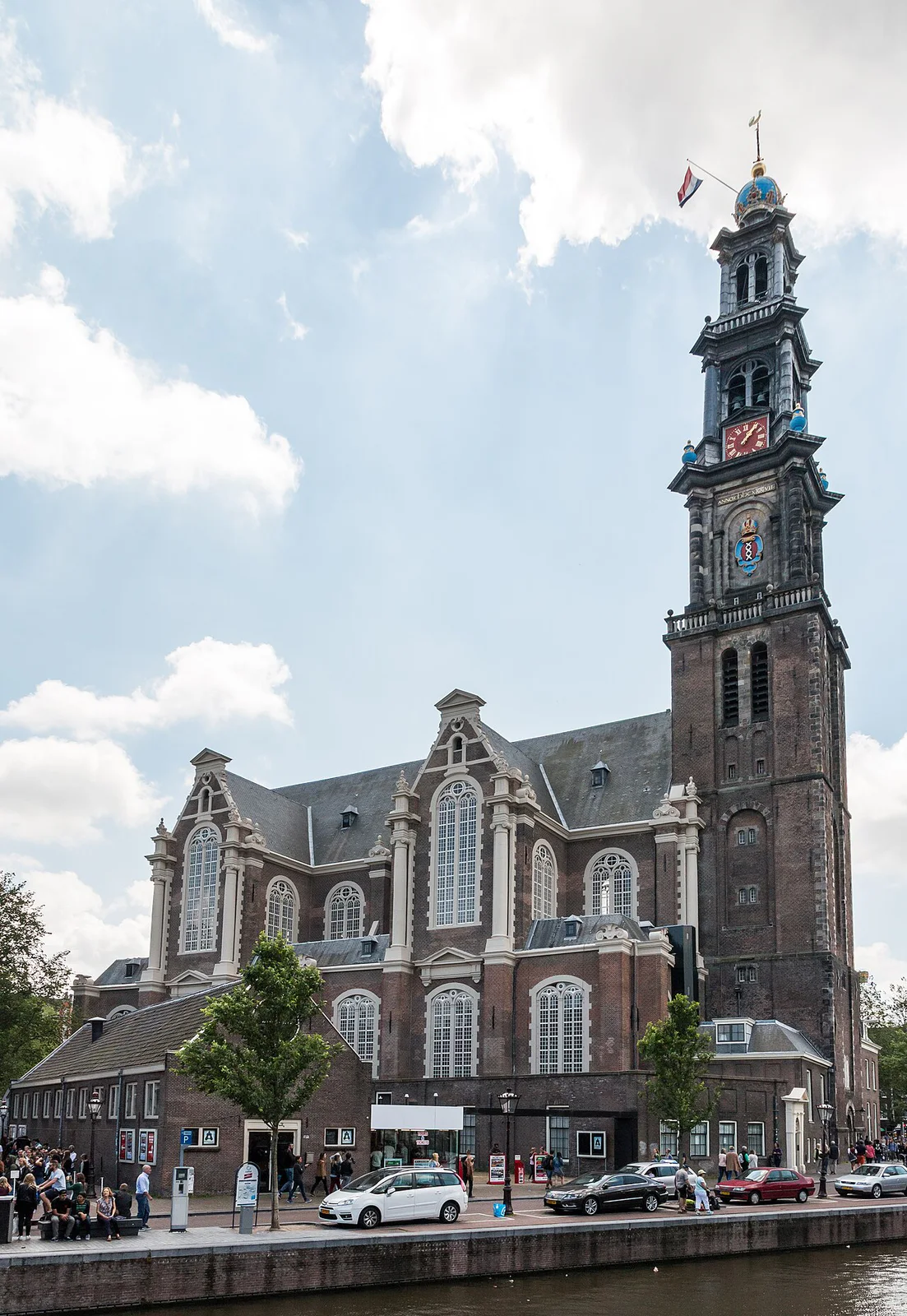
Amsterdam · 1 km
Westerkerk
Content & sources
Dietmar Rabich · CC BY-SA 4.0
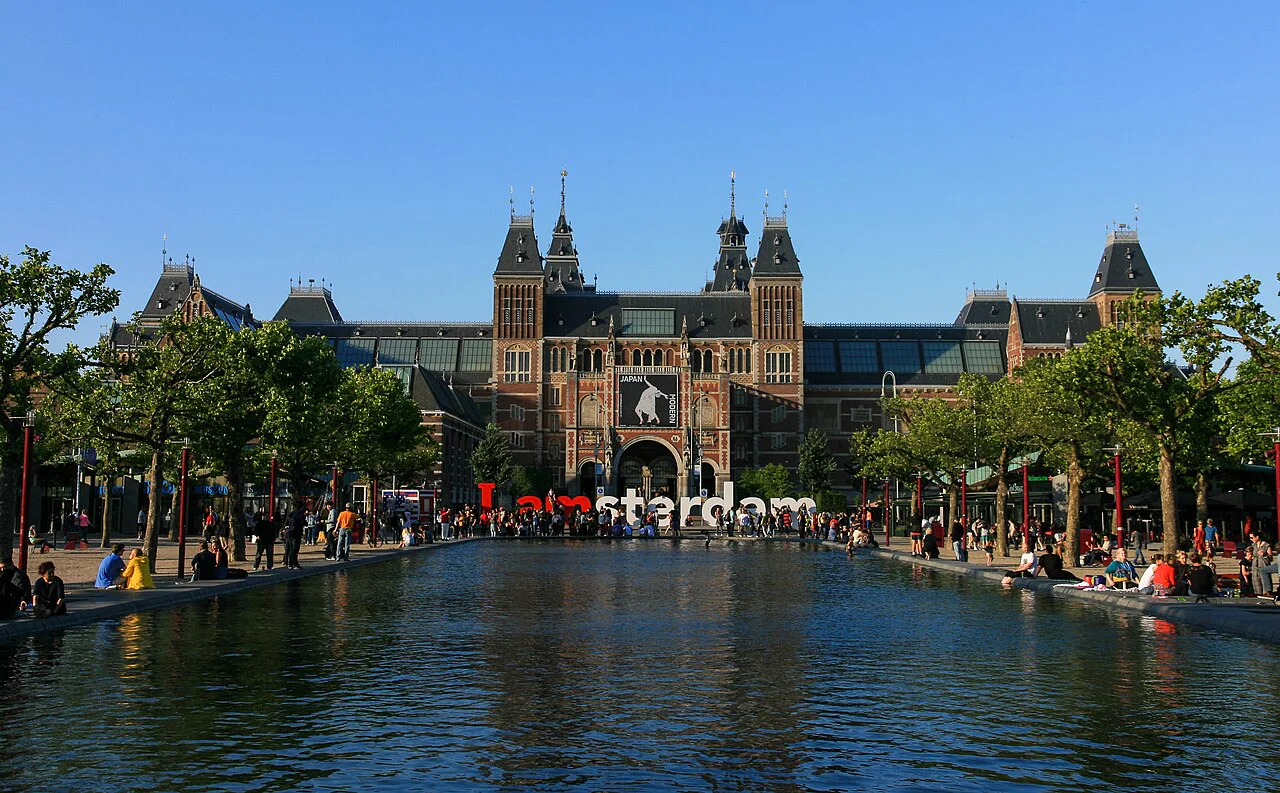
Amsterdam · 2 km
Rijksmuseum
Content & sources
Marco Almbauer · CC BY-SA 3.0