Stanza · Audio guide
Badshahi Mosque Audio Guide
A place to remember. A story to take with you.
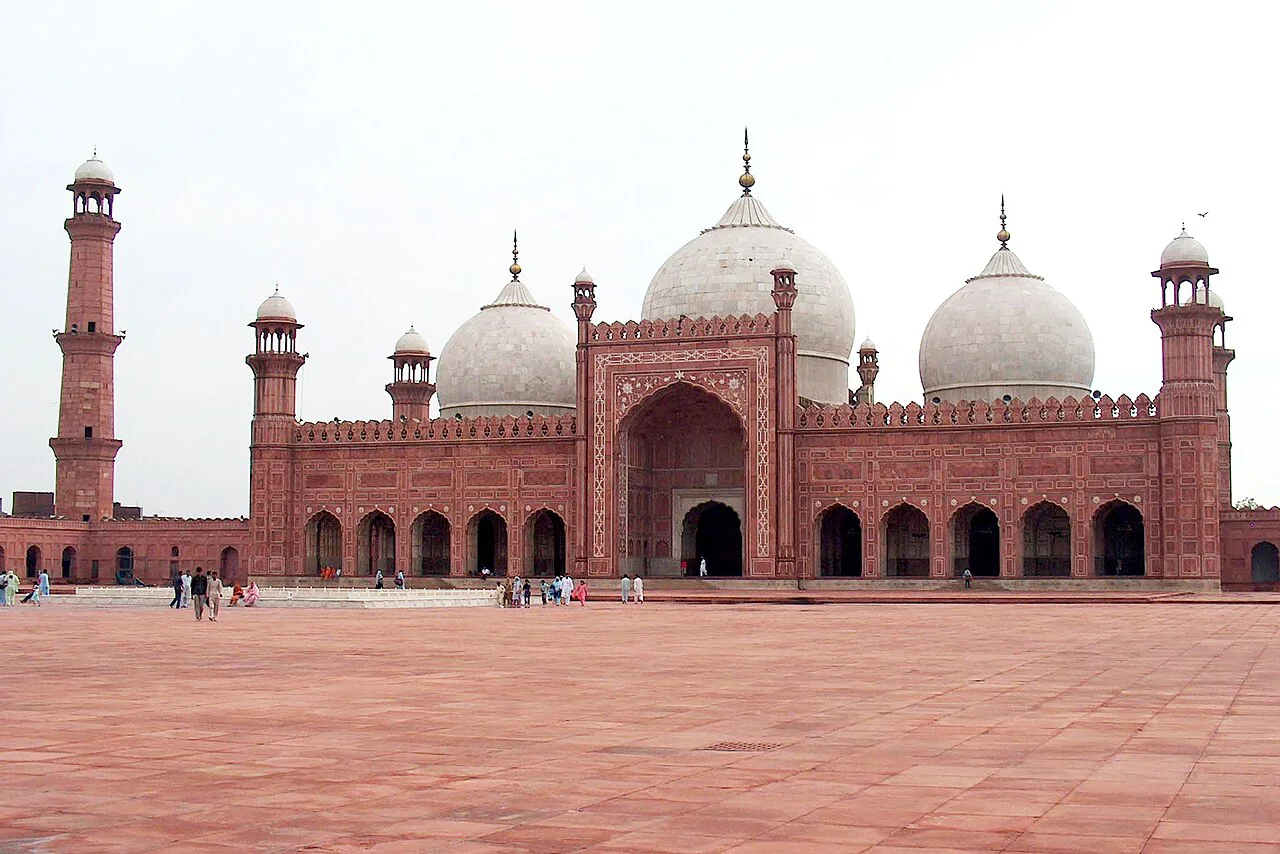
The Badshahi Mosque is a Mughal-era imperial mosque located in Lahore, Pakistan. It was constructed between 1671 and 1673 by the Mughal emperor Aurangzeb and is considered an iconic landmark of the country.
Download Stanza, then search for “Badshahi Mosque”.
About the tour
One guide. Your kind of visit.
The Badshahi Mosque is a Mughal-era imperial mosque located in Lahore, Pakistan. It was constructed between 1671 and 1673 by the Mughal emperor Aurangzeb and is considered an iconic landmark of the country.
Ready when you are.
- 01Get the free Stanza app.
iOS & Android
- 02Find your guide.
“Badshahi Mosque”
- 03Download before you go.
Works offline
Audio guide / 13 narrated stops
Inside the guide
Get to know a few of the stories before you go. Open a stop to read more.
01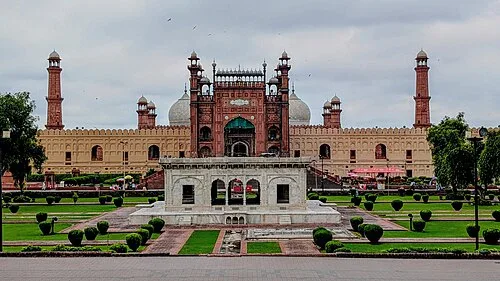 Hazuri Bagh and the Approach
 to the Badshahi Mosque
Welcome to the Badshahi Mosque, the imperial mosque of the Mughals in Lahore. The sixth Mughal emperor, Aurangzeb, commissioned it in 1671. Unlike the emperors before him, he was no great patron of art and architecture. His reign went instead to military conquests that enlarged the Mughal realm. This mosque was built to commemorate those campaigns in southern India, above all against the Maratha ruler Shivaji. Aurangzeb placed it with care. The entrance lies on the western side of the Hazuri Bagh, a walled garden, and faces the Alamgiri Gate of the Lahore Fort on its eastern side. He raised that gate at the same time as the mosque, so the two buildings answer each other across the garden. In the middle of the garden stands a marble pavilion, the Hazuri Bagh Baradari, built in 1818. Ranjit Singh, the Sikh maharaja who later ruled Lahore, used it as his official royal court of audience. The visit runs from this garden through the great gateway, into the courtyard and the prayer hall, and up to the minarets.
Photo: Muhammad Umair Mirza · CC BY-SA 4.0
02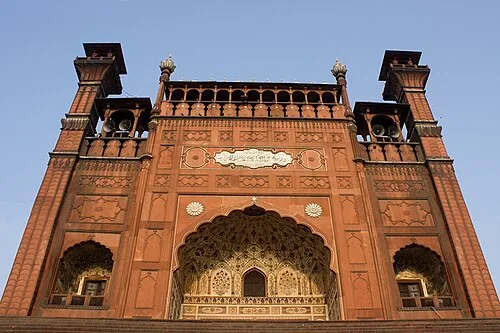 The Monumental Entrance Gateway
The Grand Entrance Gateway
Twenty-two stone steps climb from the Hazuri Bagh to the mosque's great gateway. The whole complex sits on a raised plinth, and this flight is the way up. The gateway is a two-storey edifice of red sandstone, its facades covered in framed and carved panelling. Above the vaulted entrance, the mosque's full name is written in inlaid marble. It reads Masjid Abul Zafar Muhy-ud-Din Mohammad Alamgir Badshah Ghazi, a string of Aurangzeb's imperial titles set out where everyone entering could read them. Within it are several chambers, closed to the public.
Mustafa · CC BY-SA 3.0
03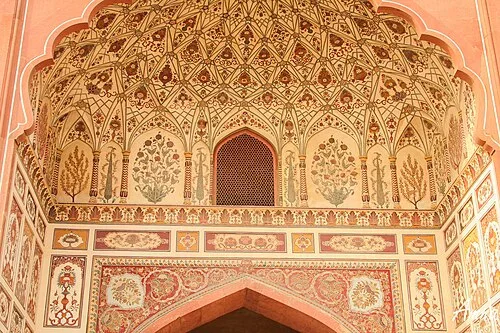 The Monumental Entrance Gateway
Muqarnas Vault and Painted Decoration
The gateway carries one of the mosque's signature ornaments, the muqarna, tiers of honeycomb niches that came to Mughal architecture from the Middle East. The nearby Wazir Khan Mosque was the first to introduce it, and this building took up the idea. Yet the decoration here also marks a deliberate break with that same mosque. Earlier Lahore mosques were covered in kashi-kari, intricate tile work in the Kashan style of Persia, and Lahore had long looked towards Persia as the gateway to the west. Aurangzeb chose differently. He followed the plan of his father Shah Jahan's Jama Masjid in Delhi, red sandstone dressed with white marble inlay, though he built far larger.
Listen in the appPhoto: Amnagondal · CC BY-SA 4.0
04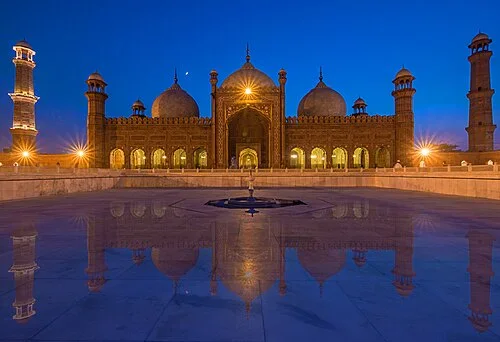 The Expansive Courtyard and Central Ablution Pool
The Vast Courtyard and Ablution Pool
Through the gateway, the courtyard opens wide. Sandstone paving spreads over some twenty-five thousand square metres, enclosed by single-aisled arcades. When the mosque serves as an Idgah, an open-air prayer ground for the festivals, it holds about one hundred thousand worshippers. The building rose quickly to match. Construction took only about two years, and the mosque opened for worship in 1673. Aurangzeb entrusted the work to his foster brother, Muzaffar Hussein, known by his title Fidai Khan Koka, who was also governor of Lahore. The courtyard has held other kinds of crowds since. In April 1919, after the Amritsar Massacre, an estimated twenty-five to thirty-five thousand people gathered in protest, Muslims, Hindus and Sikhs together. A speech by Gandhi was read to them by Khalifa Shuja-ud-Din, who later became Speaker of the Provincial Assembly of the Punjab.
Listen in the appMuhammad Ashar · CC BY-SA 4.0
05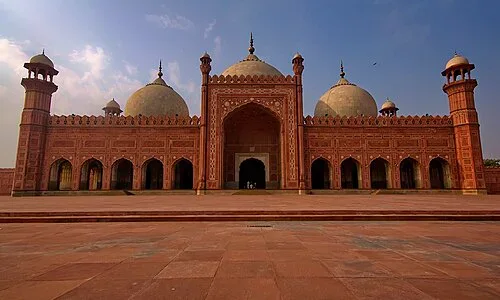 The Expansive Courtyard and Central Ablution Pool
The Courtyard as Imperial Stable
A mosque of this size made a prize of a different kind. On 7 July 1799 the Sikh army of Ranjit Singh took Lahore, and the maharaja turned the courtyard to his own uses. His army's horses were stabled on paving laid for prayer. The eighty hujras, small study rooms built into the surrounding walls, became quarters for his soldiers and magazines for military stores. A house of congregational worship served as a barracks. Ranjit Singh left his mark outside the walls too. The marble for his baradari in the garden may have come from other monuments in Lahore. After his death, his son and successor Kharak Singh began a tomb in his memory beside the mosque.
Listen in the appPhoto: Alichaudharyphotography · CC BY-SA 3.0
06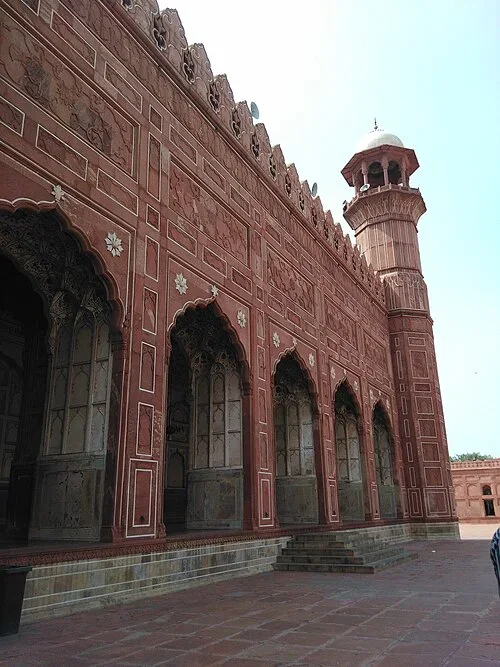 Perimeter Arcades and Historical Garrison Dalans
Arcades and the Dalan Galleries
The arcades lining the courtyard are not the mosque's original fabric. The eighty hujras built into the walls are gone. In 1849 the British seized Lahore from the Sikh Empire, and the mosque and the adjoining fort went on serving as a military garrison. After the Indian Rebellion of 1857, the British demolished the eighty cells so that they could no longer be used for activity against British rule. Open arcades rose in their place, the dalans that line the courtyard now. Muslim resentment at the mosque's military use had been building. In 1852 the British set up the Badshahi Mosque Authority to oversee restoration and re-establish worship. In 1856 John Lawrence, then Chief Commissioner of the Punjab, officially handed the building back to the Muslim community. Piecemeal repairs followed. The great campaign began in 1939, when Sikandar Hayat Khan, Premier of the Punjab, started raising funds, with the architect Nawab Alam Yar Jung Bahadur supervising. For that work Khan was buried in the Hazuri Bagh, beside the mosque. The poet Muhammad Iqbal, revered in Pakistan as the founder of the Pakistan Movement, lies near the entrance too.
Listen in the appPhoto: Sahar Bhutta · CC BY-SA 4.0
07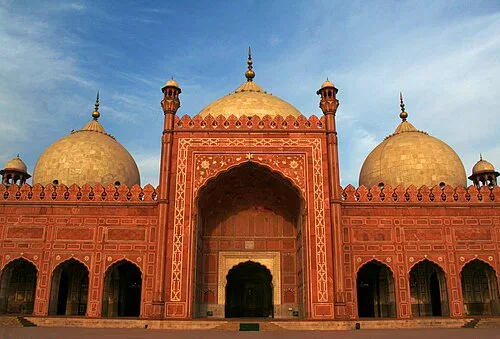 Main Prayer Hall Facade and Arched Peshtaq
The Prayer Hall Facade
The prayer hall's facade is the architectural heart of the complex. Red sandstone carries the whole edifice, dressed with white marble inlay. Its composition is strictly hierarchical. A towering central arch, the peshtaq, rises at the middle of the front. Five smaller arched niches flank it on either side. Each is about a third the size of the central arch. Everything answers across the centre line, the niches and the panels and the inlay alike. Behind this ordered front sits the prayer chamber, the imperial congregational core of the whole complex.
Listen in the appPhoto: Mohsinkhawar · CC BY-SA 4.0
08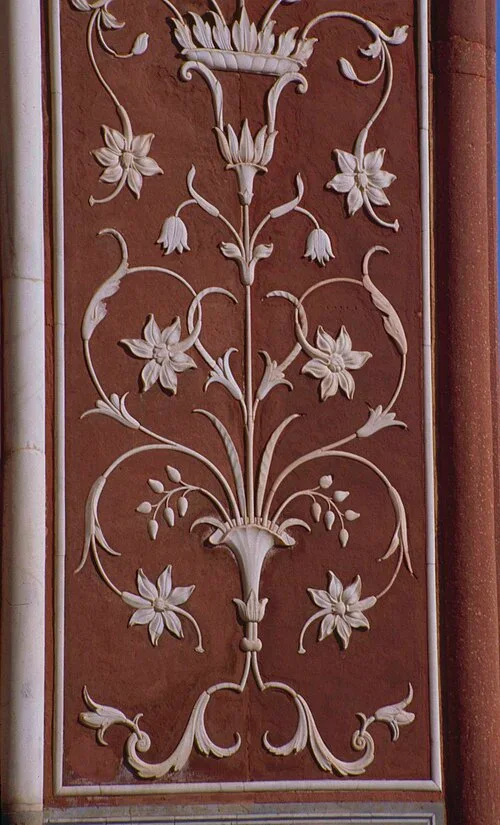 Main Prayer Hall Facade and Arched Peshtaq
Floral Marble Inlay
The facade's symmetry holds together a world of fine detail. White marble, carved with the floral design common to Mughal art, is set into the red sandstone across the building, inside and out. Judges of Mughal architecture have called these carvings uniquely fine, works unsurpassed in the tradition. Keeping them has taken care of its own. In 2000 the marble inlay in the main prayer hall was repaired. From 2008 the courtyard's red sandstone tiles were replaced, using stone imported from the original Mughal source near Jaipur, in Rajasthan. The repairs reach back to the same quarries the builders used.
Listen in the appPhoto: Ziegler175 · CC BY-SA 3.0
09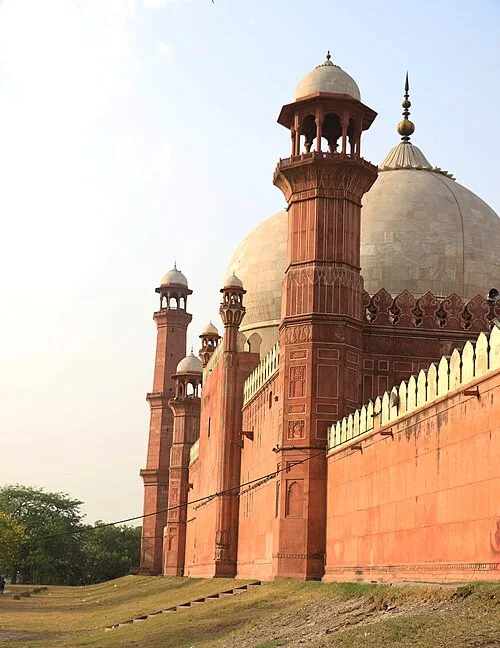 The Triple White Marble Domes
The Triple Marble Domes
Above the prayer chamber rise three domes of polished white marble. The largest stands at the centre, flanked by two smaller ones, and their pale shells contrast sharply with the red sandstone below. From a distance the group crowns the whole sanctuary, the point every view of the mosque returns to. The main building carries four smaller minarets as well, one at each corner of the building. Counting the great corner towers of the complex, the mosque has eight minarets in all.
Listen in the appPhoto: ZaheerzE · CC BY-SA 4.0
10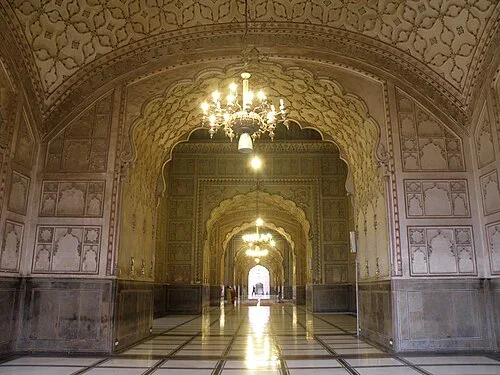 Interior Sanctuary and Mihrab
Inside the Main Prayer Hall
The prayer hall remains what it was built to be, a space for congregational worship. Overhead hang chandeliers, and the walls carry stucco tracery and floral fresco. About ten thousand worshippers fit inside the hall itself. The chambers on either side of the main chamber held rooms used for religious instruction, so the mosque taught as well as prayed. One modern gathering stands out. On 22 February 1974, Lahore hosted the Second Islamic Summit. Thirty-nine heads of Muslim states offered their Friday prayers in the mosque. Among them were Zulfiqar Ali Bhutto of Pakistan, King Faisal of Saudi Arabia, and Yasser Arafat.
Listen in the appPhoto: Ahsankhurshed1 · CC BY-SA 3.0
- 11
The Mihrab
The carved marble niche that turns every row of worshippers towards Mecca.
- 12
The Sacred Relics Gallery
Twenty-seven sacred relics, from Timur's Damascus to Delhi, through Afghan and Sikh hands, to a gallery at this mosque since 1885.
- 13
The Corner Minarets
The sixty-metre corner towers that once carried light guns in the 1841 siege, and the mosque's place among the great mosques of the world.
Badshahi Mosque
Frequently asked questions
How much does the guide cost?
Free app download. Listed guide price: $0.99. Guide price shown in the app. Audio guide only. Venue admission is separate.
Can I listen without internet?
Yes. Download the guide’s audio, images, and maps in the app before your visit. Your downloaded content is then available offline.
Can I listen in my language?
This audio guide is available in 15 languages, including English.
Do I need to follow a schedule?
No. This is a self-guided experience. Choose your stops, pause whenever you like, and return to a story at your own pace.
At your own pace
Explore Badshahi Mosque.
Download Stanza, then search for “Badshahi Mosque”.
Free app download · Guide price shown in the app
Keep exploring
Audio guides — Pakistan
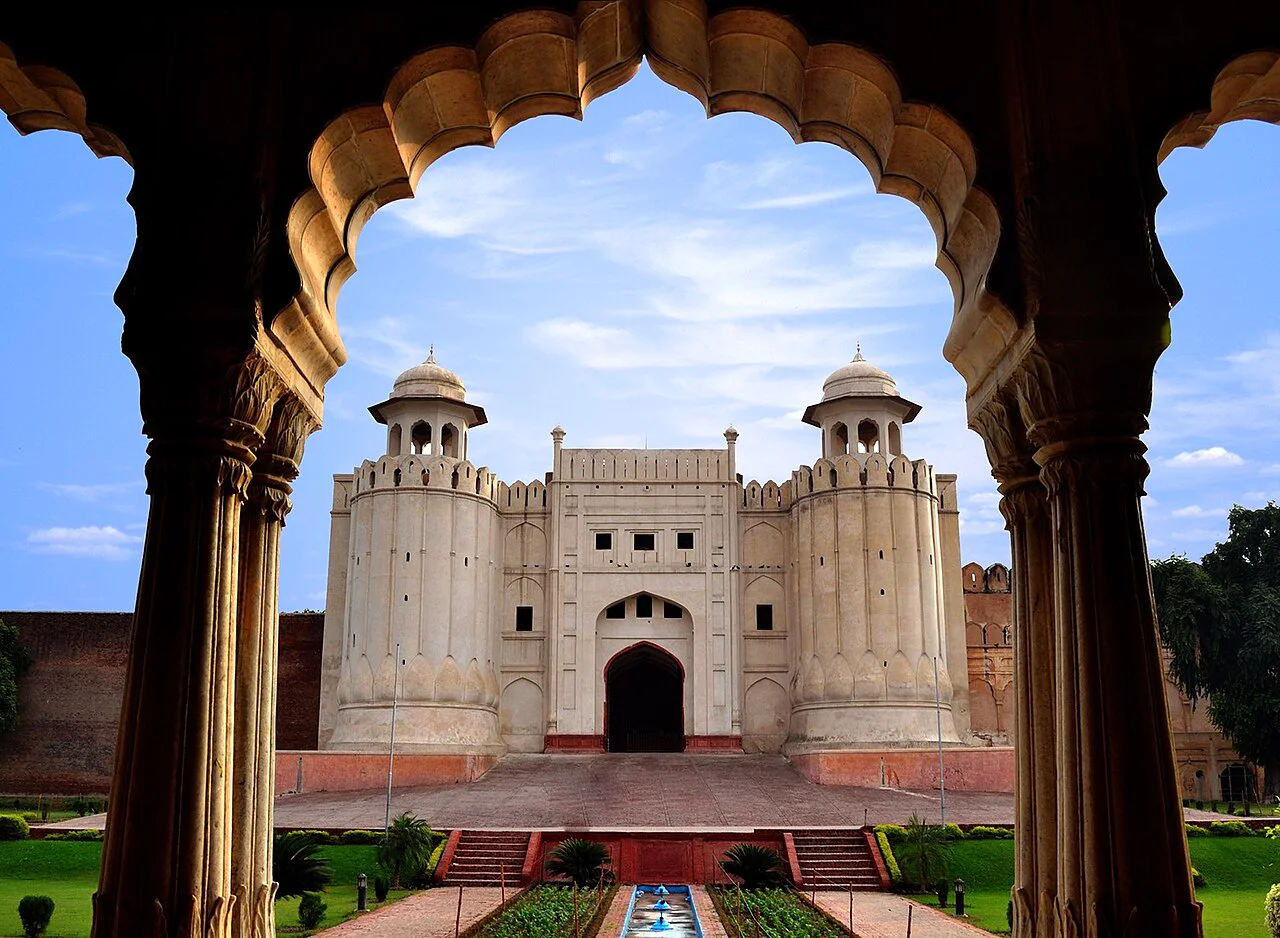
Lahore · 1 km
Lahore Fort
Content & sources
Rohaan Bhatti · CC BY-SA 3.0
Lahore · 7 km
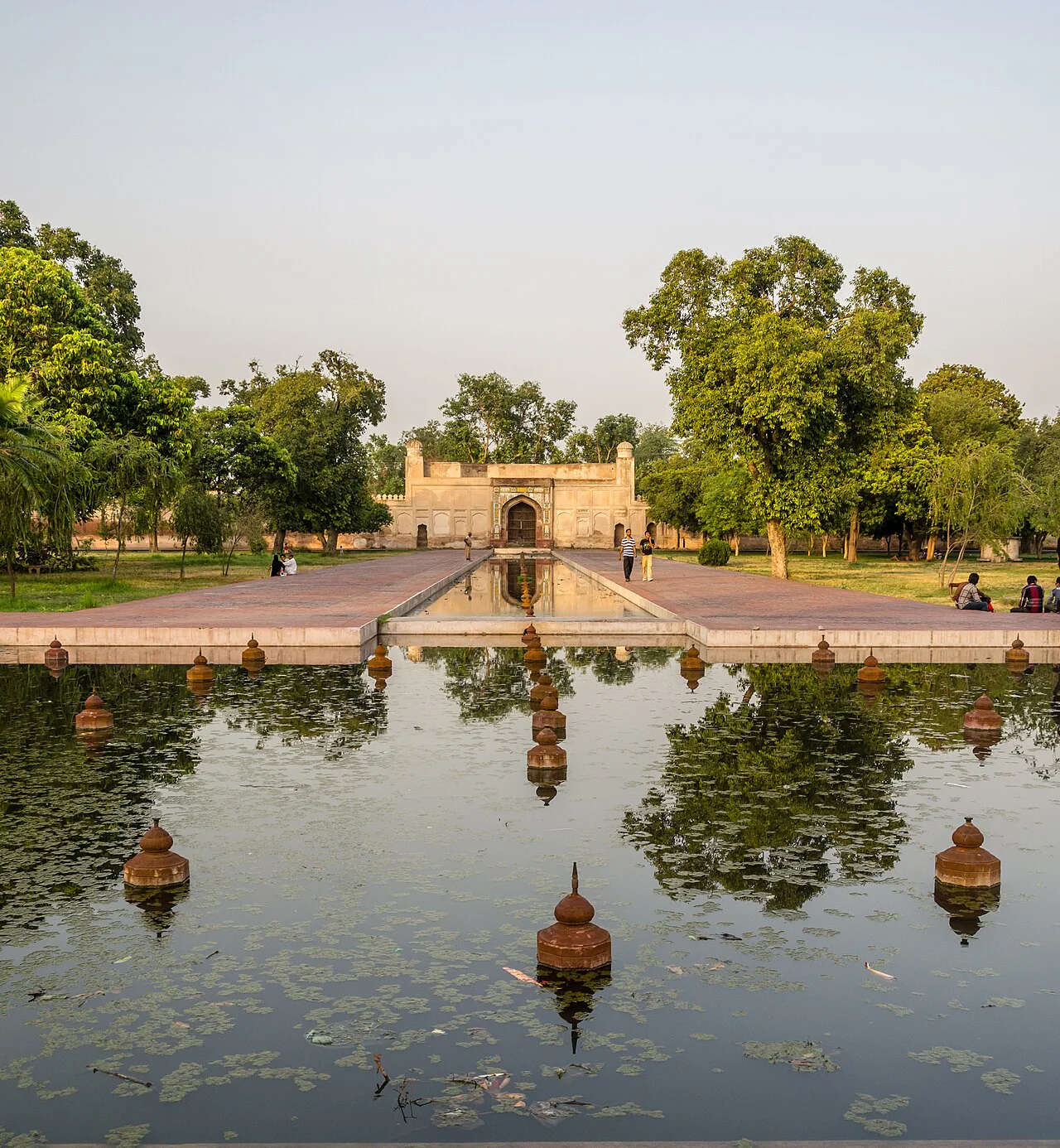
Shalamar Gardens, Lahore
Content & sources
Muhammad Ashar · CC BY-SA 3.0
Amritsar · 54 km
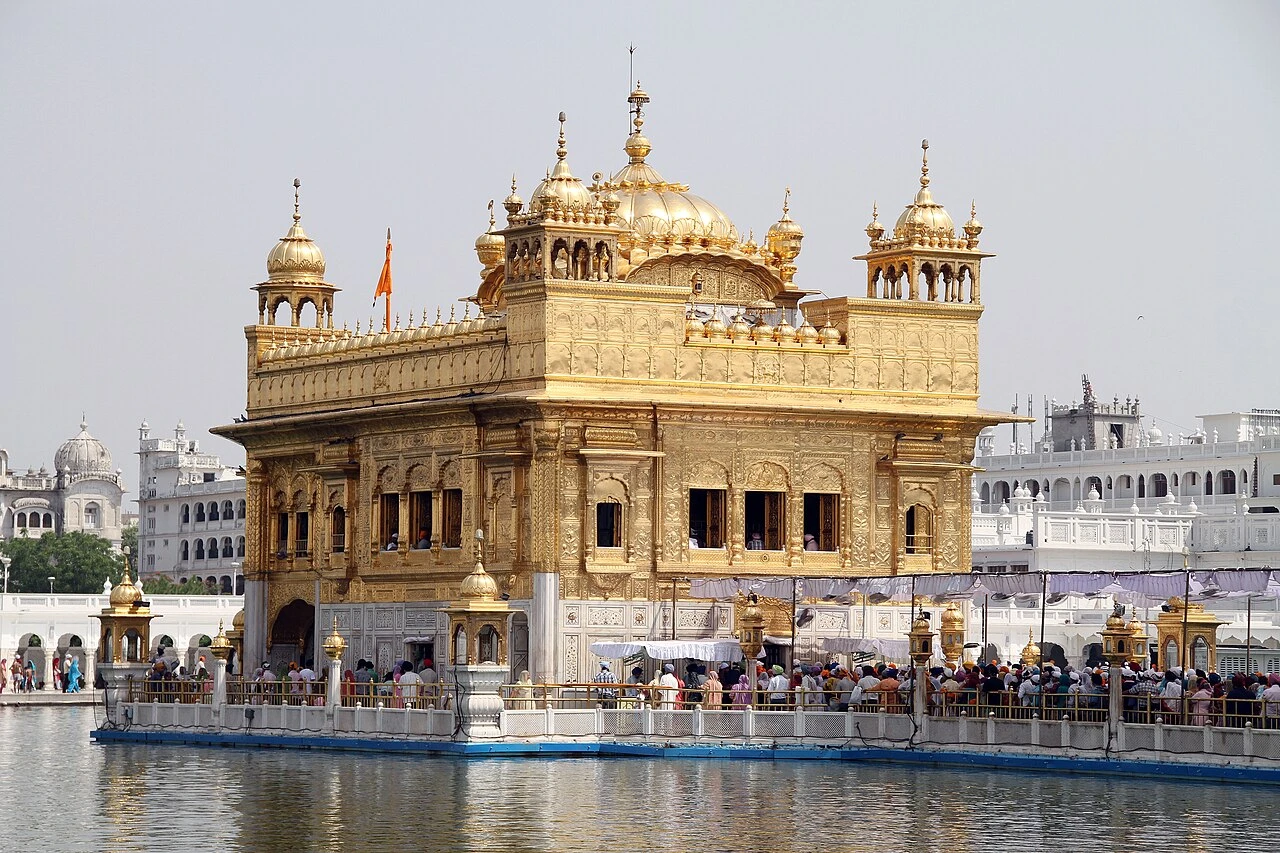
Harmandir Sahib
Dina Tehsil
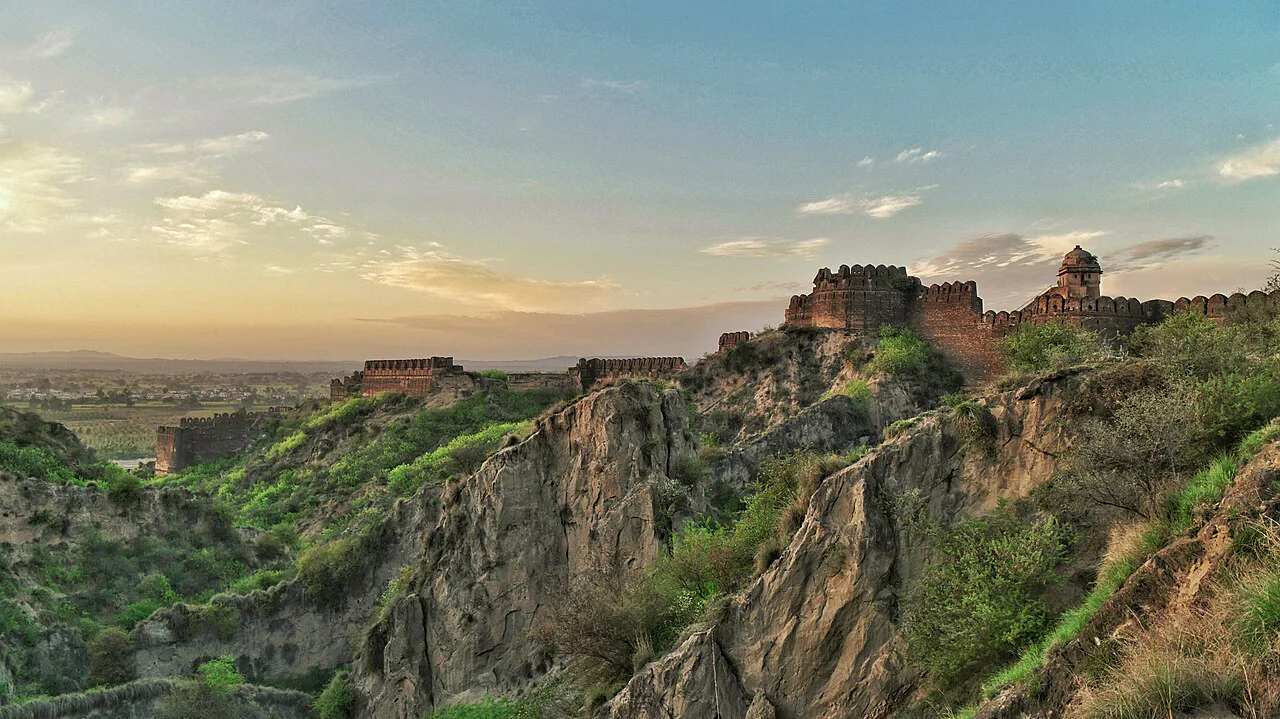
Rohtas Fort
Content & sources
Hussain Khalid · CC BY-SA 4.0