Stanza · Audio guide
Shalamar Gardens, Lahore Audio Guide
A place to remember. A story to take with you.
The Shalamar Gardens are a Mughal garden complex located in Lahore, Pakistan. Dating from the 17th-century Mughal Empire, they are one of the country's most popular tourist destinations.
Download Stanza, then search for “Shalamar Gardens, Lahore”.
About the tour
One guide. Your kind of visit.
The Shalamar Gardens are a Mughal garden complex located in Lahore, Pakistan. Dating from the 17th-century Mughal Empire, they are one of the country's most popular tourist destinations.
Ready when you are.
- 01Get the free Stanza app.
iOS & Android
- 02Find your guide.
“Shalamar Gardens, Lahore”
- 03Download before you go.
Works offline
Audio guide / 12 narrated stops
Inside the guide
Get to know a few of the stories before you go. Open a stop to read more.
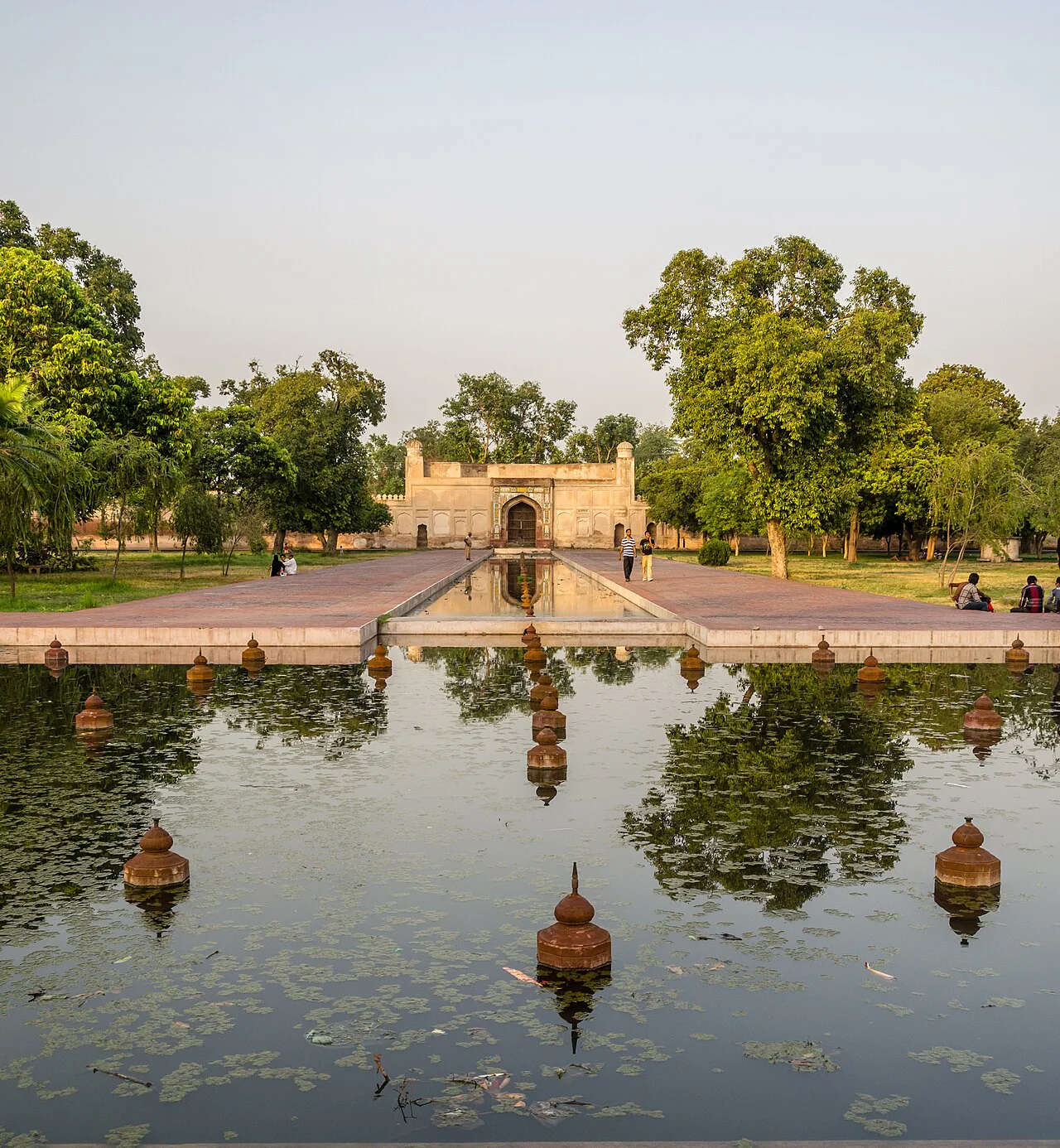
01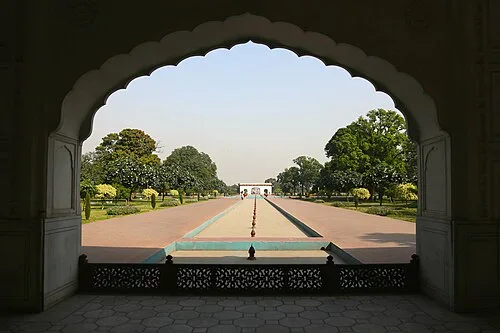 The Grand Entrance and the Arain Legacy
Main Entrance on the Grand Trunk Road
Welcome to the Shalamar Gardens of Lahore, a walled paradise built by the Mughal emperor Shah Jahan. Work began on the sixth of June, 1641, and the whole garden was finished in 1642. The court records give the exact span: seventeen months and fourteen days. Through this great arch, a long water channel runs straight toward the raised terraces at the far end, and that line of water is the garden's spine. Shah Jahan built the place chiefly to entertain guests, though a large portion was open to ordinary people as well. The design is a Charbagh, a four-part paradise garden, and it drew on the gardens his father Jahangir had made in Kashmir. In 1981 UNESCO inscribed the gardens as a World Heritage Site, judging them Mughal garden design at the very height of its development. The tour follows the water downhill, terrace by terrace, from the emperor's private rooms to the public lawn.
Aun Muhammad · CC BY-SA 4.0
02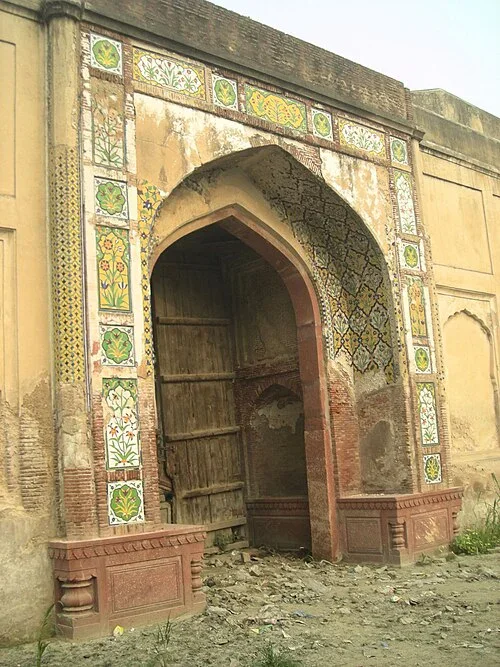 The Grand Entrance and the Arain Legacy
Gateway Tilework and the Arain Family's Gift
The floral tiles on this gateway have faded, but the story behind the land is still intact. The site was once known as Ishaq Pura, and it belonged to the Arain Mian family of Baghbanpura, the gardeners and landholders of this quarter. Their head at the time, Mian Muhammad Yusuf, ceded the site to Shah Jahan so the emperor could build his garden here. In return, the emperor granted the family governance of the Shalamar Gardens. That arrangement held for more than three centuries, an unusually long custodianship for a royal property, until the state took the garden over in 1962. The high brick wall around the garden, decorated with intricate fretwork, is part of the same idea. A Charbagh is meant to be a paradise, and a paradise has to be enclosed, cut off from the dust and noise outside. Behind these weathered tiles and heavy wooden doors, the wall seals in a private world of water and shade.
Photo: Ibnazhar · CC BY-SA 4.0
03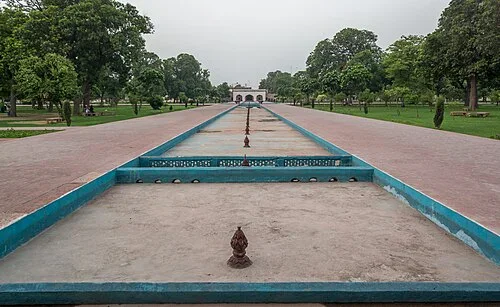 The Upper Terrace: Farah Baksh
Upper Terrace: Farah Baksh, Bestower of Pleasure
The garden steps down in three great terraces, each one four to five metres above the last. The uppermost level is the Bagh-e-Farah Baksh, the Bestower of Pleasure, and it was reserved for the emperor's harem. The middle terrace was the Emperor's own garden. The lowest terrace, where the main entrance stood, was open to noblemen and occasionally to the public at large. So the whole design is a social ladder in stone and water, from the most private court at the top to the most open ground below. The historian Muhammad Saleh Kamboh, who served Shah Jahan, wrote that the gardens of Kashmir inspired this design. But Kashmir's gardens could rely on naturally sloping hillsides to move their water. Lahore sits on a flat plain, so everything here, the terraces and the cascades alike, had to be engineered from scratch.
Listen in the appMuhammad Ashar · CC BY-SA 3.0
04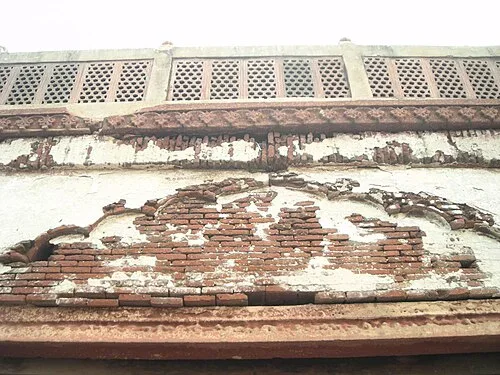 The Upper Terrace: Farah Baksh
Scarred Brickwork: The Sikh-Era Pillage
The stripped plaster and exposed brick here tell of a hard chapter in the garden's life. During the era of the Sikh Empire, much of the garden's marble was taken away. It went to decorate the Golden Temple and the Ram Bagh Palace in nearby Amritsar, reused rather than simply destroyed. The garden's costly agate gate was stripped out and sold by Lehna Singh Majithia, a court noble. In 1806, Maharaja Ranjit Singh ordered the Shalamar Gardens to be repaired. Even so, the garden never recovered its full richness. What survives today is a mix: marble where it endured, bare brick where it did not. The patchwork you see in the old walls is the record of that time.
Listen in the appPhoto: Ibnazhar · CC BY-SA 4.0
05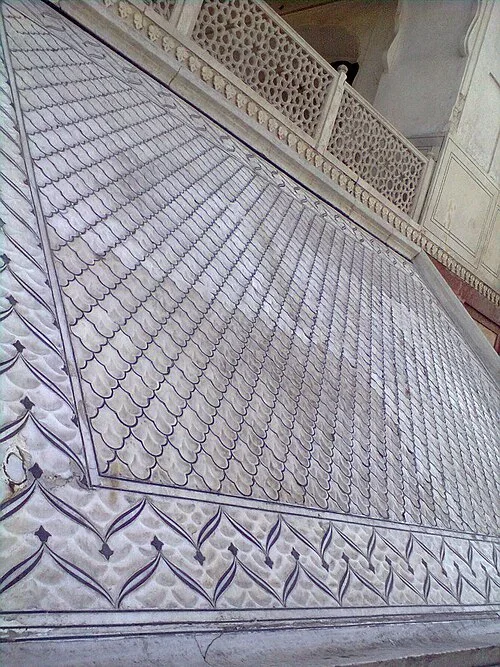 The Great Marble Cascade and Royal Throne
The Great Marble Cascade (Chador)
Water in this garden was never allowed to simply fall. It ran over carved marble paths called chadors, a word meaning curtains, and the carving turned each stream into a textured white sheet. This great marble cascade, patterned with rows of scallops, is the finest of them. The Gardens hold five water cascades in all, including this one and the one at the Sawan Bhadoon pavilion. The scalloped carving had a practical purpose as well as a beautiful one. It broke the falling water into fine ribbons, which cooled the air around it. On a hot Lahore afternoon, the sound and the spray together made the descent from one terrace to the next the most pleasant walk in the garden. It was the artistic centrepiece of the entire water system.
Listen in the appArshia Sohail · CC BY-SA 3.0
06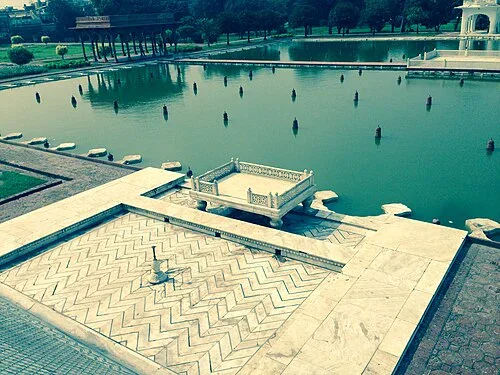 The Great Marble Cascade and Royal Throne
The King's Seat above the Pool
A seating pavilion set over a large pool, called a hauz, was a favourite Mughal arrangement. The emperor and his guests could sit here surrounded by water on every side, with fountains playing around them. This raised marble platform in the pool carried that idea to its height, placing the sitter at the centre of the spectacle rather than at its edge. A local legend attaches to the spot. Princess Zeb-un-Nissa, the poet daughter of Aurangzeb, is said to have sat by the great cascade composing Persian verses to the rhythm of the falling water. The story has been passed down rather than proven. What is certain is the practice itself: the Mughals repeatedly built their seats over water, so that pleasure and flowing water were never far apart.
Listen in the appPhoto: C++and html · CC BY-SA 3.0
07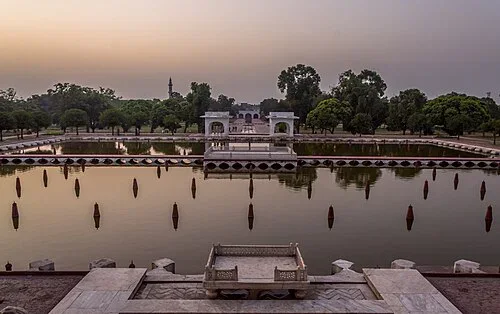 The Middle Terrace: Faiz Baksh and the Great Pool
Middle Terrace: Faiz Baksh, the Emperor's Garden
This middle level is the Faiz Baksh terrace, the Bestower of Goodness, and it was the Emperor's personal garden. It held the most elaborate waterworks of any Mughal garden anywhere. The geometry follows the Charbagh pattern: each square terrace is divided into four equal quarters by long fountains running through its centre. Alongside the fountains run the khayaban, brick walkways built deliberately elevated, so that strolling on them gave a view over the planting instead of through it. The second terrace itself is a narrow rectangle set between the two square levels above and below. At dusk, when the water goes still and the pavilions catch the last light, the terrace reads as one composed scene. That composure was the point: a paradise, arranged down to the last channel.
Listen in the appMuhammad Ashar · CC BY-SA 3.0
08 The Middle Terrace: Faiz Baksh and the Great Pool
One Spout Among Hundreds: The Gravity-Fed System
This lotus-shaped spout is one of hundreds. The Gardens hold just over four hundred fountains in total, though accounts differ on the exact figure, with one count giving 414. They are spread across the terraces: 105 on the upper level, 152 on the middle one. The lower terrace carries 153, the largest share of all. Every one of them ran on gravity alone, with no pumps of any kind. The water came by the Shah Nahar, a canal about a hundred and sixty kilometres long, built on the orders of Ali Mardan Khan, the noble responsible for most of the garden's construction. The site itself was chosen for its stable water supply. All this effort answered Lahore's summer heat, which can climb past forty-nine degrees. The fountains, the pools and the dense foliage together kept the enclosed garden noticeably cooler than the city around it.
Listen in the appMuhammad Bin Naveed · CC BY-SA 3.0
09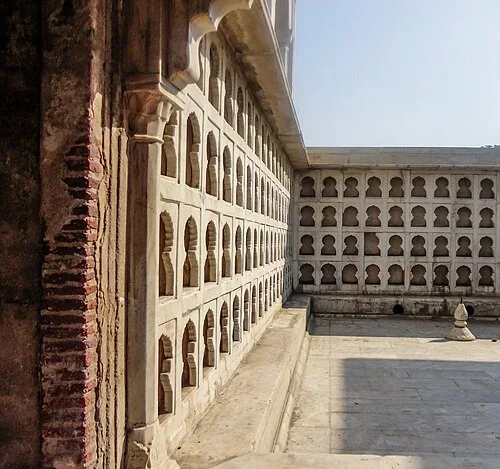 Sawan Bhadoon and the Magical Illumination
Chini Khanas: The Walls That Made Monsoon
These grids of arched niches are the chini khanas, the porcelain chambers, and they were built for a season that the architects wanted on demand. They line the walls of the Sawan Bhadoon pavilions, named for Punjab's two rainy months, Sawan and Bhadoon. In their day, water channels ran along these walls and over the pavilion, so that visitors stood inside falling water on every side. It was architecture designed to simulate the monsoon itself, the coolness and the sound of rain without the waiting. The niches held lamps and displays as well, tier upon tier of them. Built into a garden in a flat, hot plain, the pavilion gave the court a private rainy season whenever the emperor wished for one.
Listen in the appPhoto: AnoshNadeemButt · CC BY-SA 4.0
10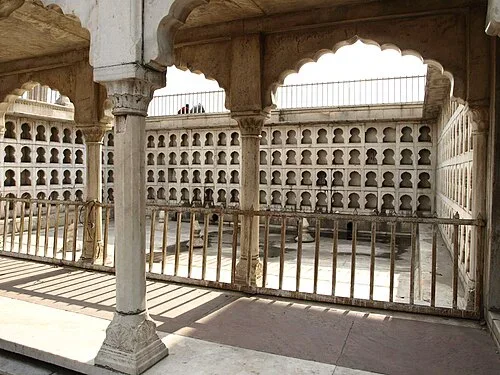 Sawan Bhadoon and the Magical Illumination
Lamplight Behind the Water: A Night Illusion
The tiers of little niches in this colonnaded enclosure were made for oil lamps, and their placement was the whole trick. Lamps set behind falling water, with the stream rushing between flame and eye, scatter the light into sudden flickers. The effect was meant to look like lightning flashing through a rainstorm, a night spectacle for the emperor and his guests. It belongs with the garden's wider play of water and light, the same instinct that shaped the monsoon pavilions with their walls of niches. By day the water was the show; by night, the lamps turned it into weather. Where exactly each effect was staged is hard to pin down now, but the lamp enclosures themselves remain, tier after tier, cut to hold the flame just where the water falls.
Listen in the appMuhammad Bin Naveed · CC BY-SA 3.0
- 11
Moorcroft Pavilion and the Baradari Tradition
A white summer pavilion, and the maharaja who renamed the garden and failed.
- 12
Corner Tower and the Garden's Meaning
The domed tower on the wall, and the size of the paradise it guarded.
Shalamar Gardens, Lahore
Frequently asked questions
How much does the guide cost?
Free app download. Listed guide price: $0.99. Guide price shown in the app. Audio guide only. Venue admission is separate.
Can I listen without internet?
Yes. Download the guide’s audio, images, and maps in the app before your visit. Your downloaded content is then available offline.
Can I listen in my language?
This audio guide is available in 15 languages, including English.
Do I need to follow a schedule?
No. This is a self-guided experience. Choose your stops, pause whenever you like, and return to a story at your own pace.
At your own pace
Explore Shalamar Gardens, Lahore.
Download Stanza, then search for “Shalamar Gardens, Lahore”.
Free app download · Guide price shown in the app
Keep exploring
Audio guides — Pakistan
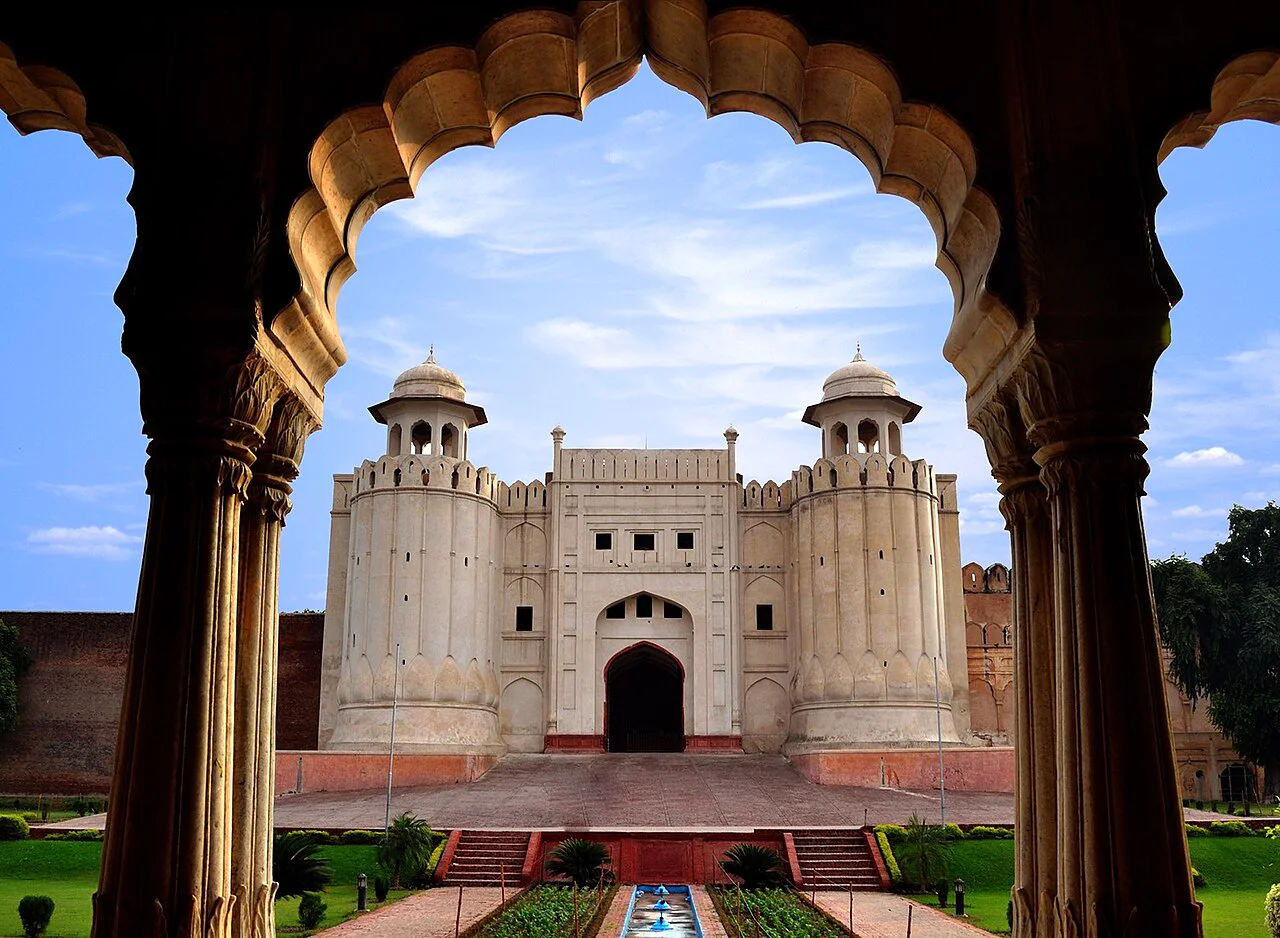
Lahore · 7 km
Lahore Fort
Content & sources
Rohaan Bhatti · CC BY-SA 3.0
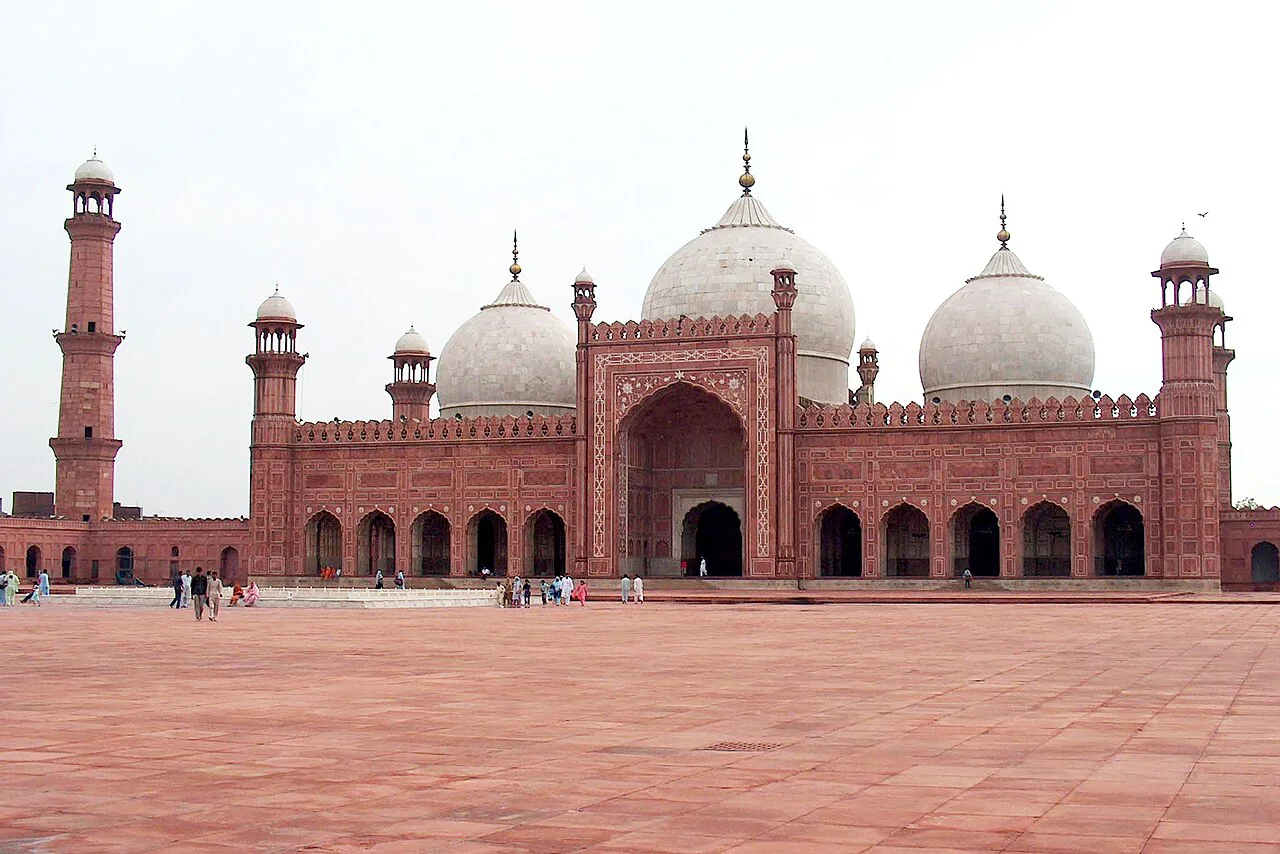
Lahore · 7 km
Badshahi Mosque
Content & sources
Ali Imran · CC BY-SA 2.5

Amritsar · 47 km
Harmandir Sahib
Dina Tehsil
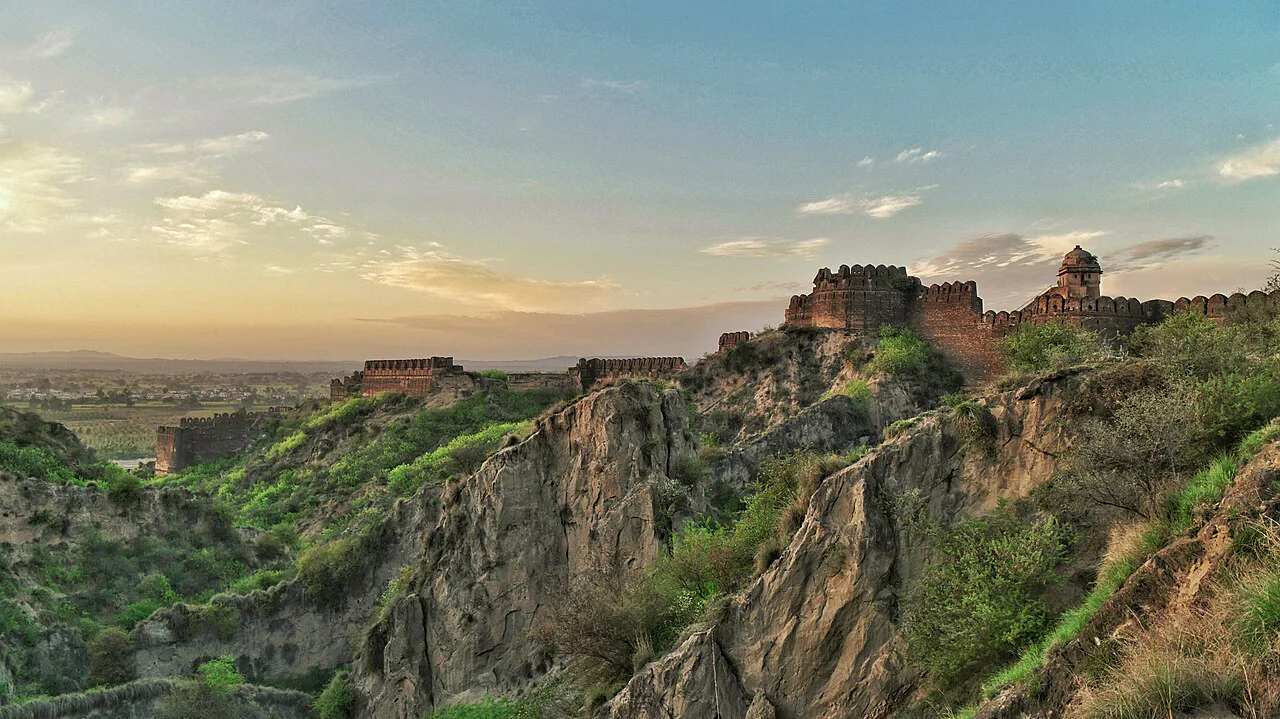
Rohtas Fort
Content & sources
Hussain Khalid · CC BY-SA 4.0