Stanza · Audio guide
Nazca lines Audio Guide
A place to remember. A story to take with you.
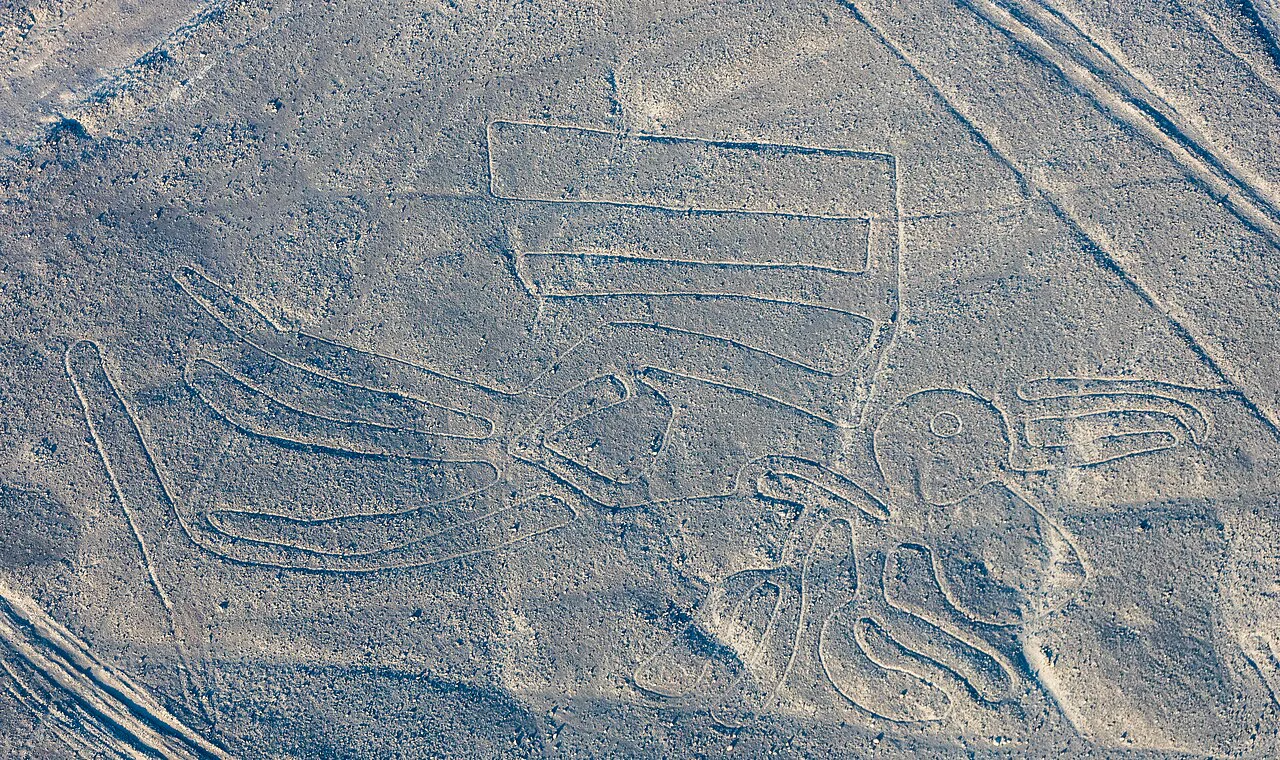
The Nazca lines are a group of geoglyphs made in the soil of the Nazca Desert in southern Peru. They were created between 500 BC and 500 AD by people making depressions or shallow incisions in the desert floor.
Download Stanza, then search for “Nazca lines”.
About the tour
One guide. Your kind of visit.
The Nazca lines are a group of geoglyphs made in the soil of the Nazca Desert in southern Peru. They were created between 500 BC and 500 AD by people making depressions or shallow incisions in the desert floor.
Ready when you are.
- 01Get the free Stanza app.
iOS & Android
- 02Find your guide.
“Nazca lines”
- 03Download before you go.
Works offline
Audio guide / 9 narrated stops
Inside the guide
Get to know a few of the stories before you go. Open a stop to read more.
01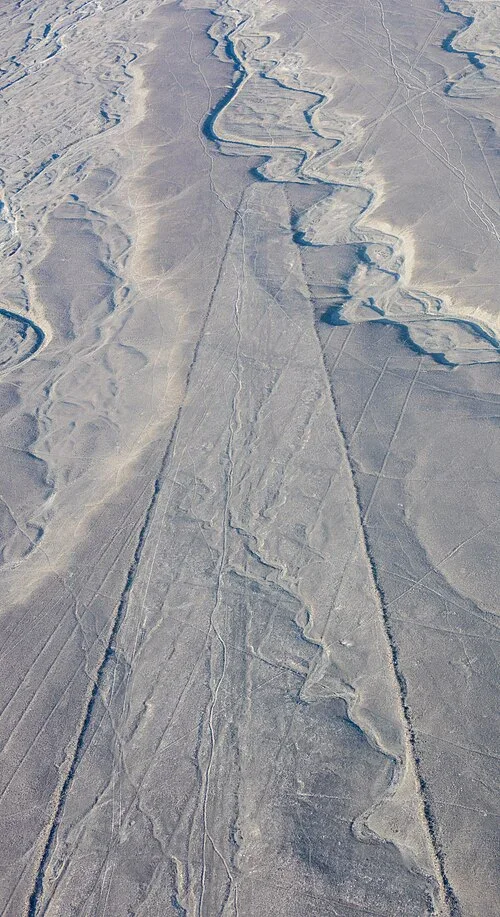 Takeoff over the Pampa: The Desert Canvas
The Desert Canvas: Straight Lines and Dry Riverbeds
Welcome to the Nazca lines, where an entire desert became a drawn canvas. The pampa covers roughly four hundred and fifty square kilometers, and its lines together run well over a thousand kilometers. Nothing here was painted. Workers lifted the reddish-brown pebbles that blanket the desert and set them aside, exposing a pale yellow-grey soil underneath. The contrast between the two layers makes the lines, and most of the trenches are only as deep as a hand's width. The straight strokes run for kilometers, and here they cross an ancient riverbed, dry for ages. Two cultures made all of it. The Paracas phase began around four hundred years before Christ, and the Nazca culture kept drawing until about five hundred years after. What preserved the work is the desert itself. Rain almost never falls and the wind hardly blows. The exposed subsoil is rich in lime, and moisture from morning mist hardens it into a crust that shields the trenches from erosion. The pebbles were moved with simple tools, probably stakes and cords, and the drawings have outlasted the civilization that made them.
Diego Delso · CC BY-SA 4.0
02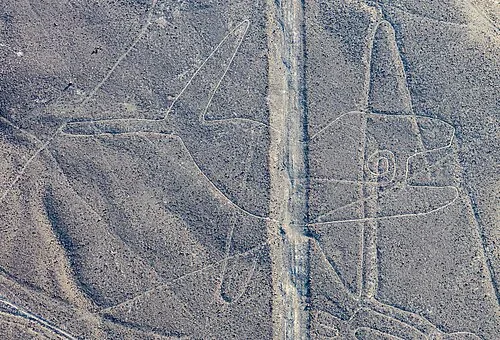 The Whale and Ceremonial Trapezoids
The Whale and the Question of Purpose
A long-headed creature stretches across the pampa, usually called the whale, the first great animal on the circuit. A straight track of later date runs right through it. The whale opens the central puzzle of this place: the makers drew creatures they could never see whole, on a scale best seen from far above. A leading explanation among archaeologists comes from Johan Reinhard, who published his case in 1985. In this desert rain rarely falls, so water governed Nazca religion and daily survival. Mountains, springs and rivers were worshipped as its givers. Reinhard read the lines as sacred paths leading to places where those deities could be honored, and the figures as invocations, animals and objects meant to call water down for the crops. Research near the temples of Cahuachi points the same way. Groups of geoglyphs there appear tied to the farming calendar, and to ceremonies that gathered pilgrims from communities sharing ancestors and beliefs. What the whale meant to any individual who drew it, though, nobody can honestly say.
Diego Delso · CC BY-SA 4.0
03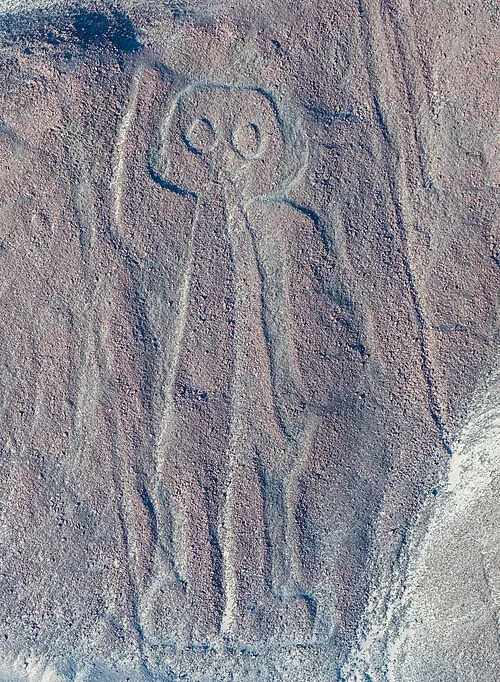 The Hillside Geoglyph: The Astronaut
The Astronaut on the Hillside
On a sloping hillside, a figure with large round eyes and one hand raised looks out across the desert. It runs about thirty-two meters, and unlike the flat pampa drawings it was cut into the slope itself. These relief-type figures could be recognized from the walking trails below, which may be why so many of them show humans and human scenes. This one earned the nickname astronaut. In 1968 the Swiss writer Erich von Däniken published a bestseller called Chariots of the Gods, claiming the lines were landing strips for visitors from other worlds. Scientists dismissed the idea as absurd, and pointed out that the drawings needed nothing beyond tools the Nazca already had. An American investigator of mysteries, Joe Nickell, settled the question in practice. Using only the tools and technology available to the Nazca, he and a small team reproduced even the largest figures within days, with no aerial help. Scientific American called his work remarkable in its exactness. The astronaut legend still draws believers to the desert, but the figures turn out to be thoroughly human work.
Listen in the appDiego Delso · CC BY-SA 4.0
04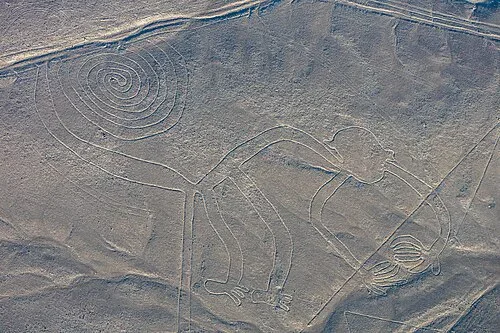 Desert Fauna: The Monkey and The Dog
The Monkey and the Single Line
The monkey's tail coils into a near-perfect spiral, the most playful stroke on the whole pampa. The figure spans about ninety-three meters. Look at how it is drawn: the outline, the limbs and that great coil are all one continuous line, an unbroken stroke from start to finish. Many of the animal figures work this way, which is part of what makes them so astonishing. As for the spiral itself, interpretations divide. Some researchers connect it to water rituals, fitting the desert's obsession with rain. Others see the heavens in it, reading the monkey as a constellation. Both readings remain speculation.
Listen in the appDiego Delso · CC BY-SA 4.0
05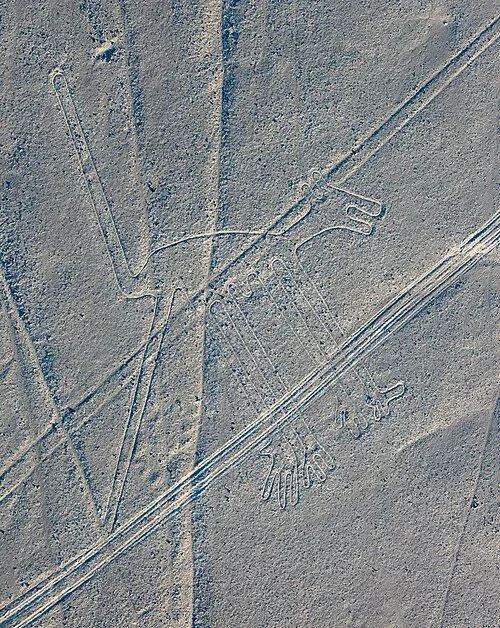 Desert Fauna: The Monkey and The Dog
The Dog: A Brief Encounter
A dog strides across the pampa, drawn with the same confident strokes as its neighbors. It belongs to a crowded bestiary: more than seventy animal designs cover the desert, among them a hummingbird, a condor, a spider, a monkey, a lizard and a cat. Contrary to popular belief, the lines were never visible only from the air. In 1927 the Peruvian archaeologist Toribio Mejía Xesspe spotted them while hiking through the surrounding foothills. He spoke about them publicly at a conference in Lima twelve years later.
Listen in the appDiego Delso · CC BY-SA 4.0
06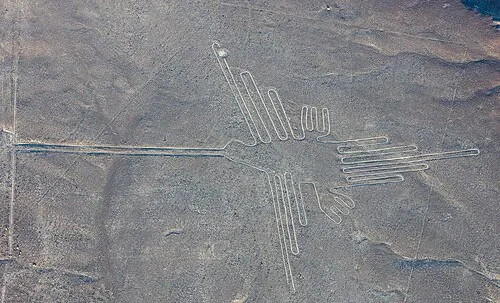 Sacred Avian Geoglyphs: The Hummingbird and The Condor
The Hummingbird
The hummingbird is the emblem of the whole desert, the figure people most often carry home in their memory. It stretches about ninety-three meters, drawn in perfectly proportioned curves with a long beak and layered wing feathers. Birds are the animals the Nazca depicted most often, and the figures in general are ascribed religious significance, so this one may well have carried religious meaning too. Its story also carries a modern warning. In December 2014, while the United Nations climate conference met in Lima, Greenpeace activists laid large banners beside the hummingbird. Their message read 'Time for Change! The future is renewable, Greenpeace.' The letters went up inside the restricted zone around the figure, leaving footprints and a visible line traced around its edge. The Ministry of Culture filed a complaint with prosecutors the next day. Greenpeace apologized, and one activist was later convicted and fined for the damage. The pale crust that makes the lines visible also keeps every mark pressed into it.
Listen in the appDiego Delso · CC BY-SA 4.0
07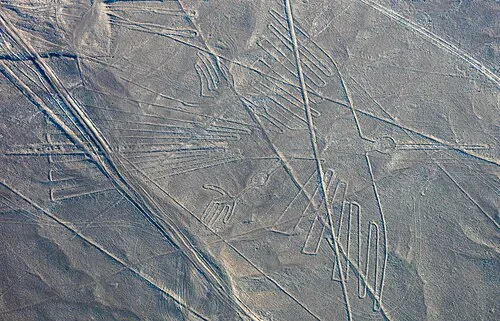 Sacred Avian Geoglyphs: The Hummingbird and The Condor
The Condor and the Astronomers
In 1940 an American historian named Paul Kosok came to Peru to study ancient irrigation systems. He flew over the desert, and realized that one of the lines took the shape of a bird. Then came the chance observation that changed everything: lines converging on the horizon at the winter solstice of the Southern Hemisphere. Kosok began hunting for the purpose of the lines, joined by the archaeologist Richard Schaedel and a German mathematician from Lima, Maria Reiche. Together they proposed that the figures marked where the sun and other celestial bodies rose on significant dates, a kind of observatory built on the ground. They called it the largest astronomical calendar in the world. The bird in this crowded stretch of desert is the condor, one of the great figures of the pampa at a hundred and thirty-four meters, half-buried in a web of overlapping lines and trapezoids. The calendar theory remains only one reading among several, and later scholars found the astronomical evidence too thin to settle anything.
Listen in the appDiego Delso · CC BY-SA 4.0
08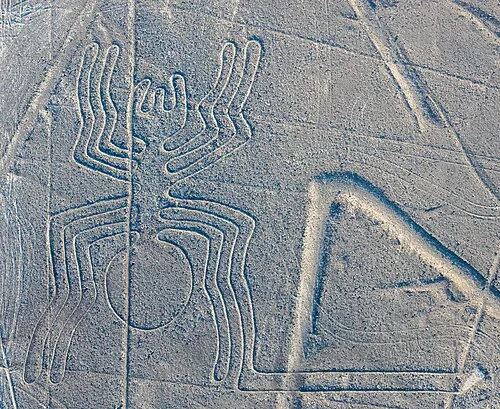 The Geometrical Masterpiece: The Spider
The Spider and the Lady of the Lines
A spider hangs from the pampa, its legs drawn in fine, curling detail beside a straight line and a trapezoid edge. It measures about forty-seven meters. The person most tied to this desert is Maria Reiche, the German mathematician who joined Kosok's work and gave the lines the rest of her life. For more than fifty years she measured, mapped and defended the figures, famously sweeping dust from them with her own hands. Peruvians came to call her the Lady of the Lines. She believed the figures represented constellations, and her protégé took the idea further. Phyllis Pitluga, an astronomer at the Adler Planetarium in Chicago, proposed that the spider is a diagram of Orion, with three of the lines leading to it tracking the shifting positions of the stars of Orion's Belt. The archaeoastronomer Anthony Aveni was not persuaded. She never explained how she chose those lines, he noted, and she paid no attention to the figure's twelve others. By 1990 Aveni and Gerald Hawkins had already concluded that the evidence for an astronomical purpose was insufficient. The spider's meaning, like so much here, stays open.
Listen in the appDiego Delso · CC BY-SA 4.0
09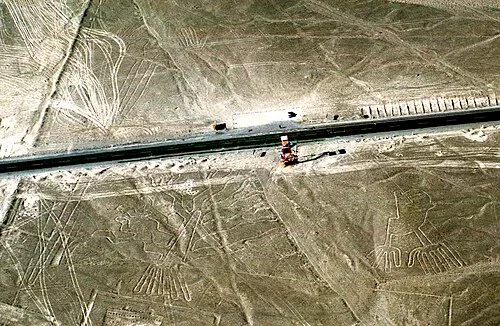 The Highway Vista: The Tree, Hands, and Observation Tower
The Highway Vista: Fragile Lines in the Modern World
The Southern Pan-American Highway runs dead straight across the pampa, straight through the middle of the drawings. When the road was built in 1938, its construction cut the lizard's tail in two, and its two halves lie on either side of the asphalt. Drawings that had survived more than a thousand years of desert weather came apart under machinery in a single construction season. In 1994 UNESCO listed the lines and geoglyphs of Nazca as a World Heritage Site, and the area now enjoys formal protection. Visitors can also meet a few figures without setting foot on the fragile ground, from observation towers built along the highway. After floods and mudslides hit the region in 2007, the site's resident archaeologist, Mario Olaechea Aquije, surveyed the desert and found the lines unharmed. The highway itself suffered, and he said the damage to the roads should serve as a reminder of just how fragile these figures are. The Nazca drew this immense landscape with their hands, and it survives only as long as people let it.
Listen in the appDennis G. Jarvis · CC BY-SA 2.0
Nazca lines
Frequently asked questions
How much does the guide cost?
Free app download. Listed guide price: $0.99. Guide price shown in the app. Audio guide only. Venue admission is separate.
Can I listen without internet?
Yes. Download the guide’s audio, images, and maps in the app before your visit. Your downloaded content is then available offline.
Can I listen in my language?
This audio guide is available in 15 languages, including English.
Do I need to follow a schedule?
No. This is a self-guided experience. Choose your stops, pause whenever you like, and return to a story at your own pace.
At your own pace
Explore Nazca lines.
Download Stanza, then search for “Nazca lines”.
Free app download · Guide price shown in the app
Keep exploring
Audio guides — Peru
Machupicchu
Machu Picchu
Content & sources
Photo: Draceane · CC BY-SA 4.0
Lima
Pachacamac
Content & sources
Ingo Mehling · CC BY-SA 3.0
Huarocondo
Moray
Content & sources
Photo: Draceane · CC BY-SA 4.0
Lima
Metropolitan Cathedral of Lima
Content & sources
Photo: Wasiwatana · CC BY-SA 4.0
Isla de Pascua
Anakena
Content & sources
Rivi · CC BY-SA 3.0